Works › The Mariale: Questions on “Missus est”
Volume 37 · p. 272
Question 184. How does she comprehend in herself the blessings given to the sons of Israel by Moses? And first, concerning the blessing of Reuben.
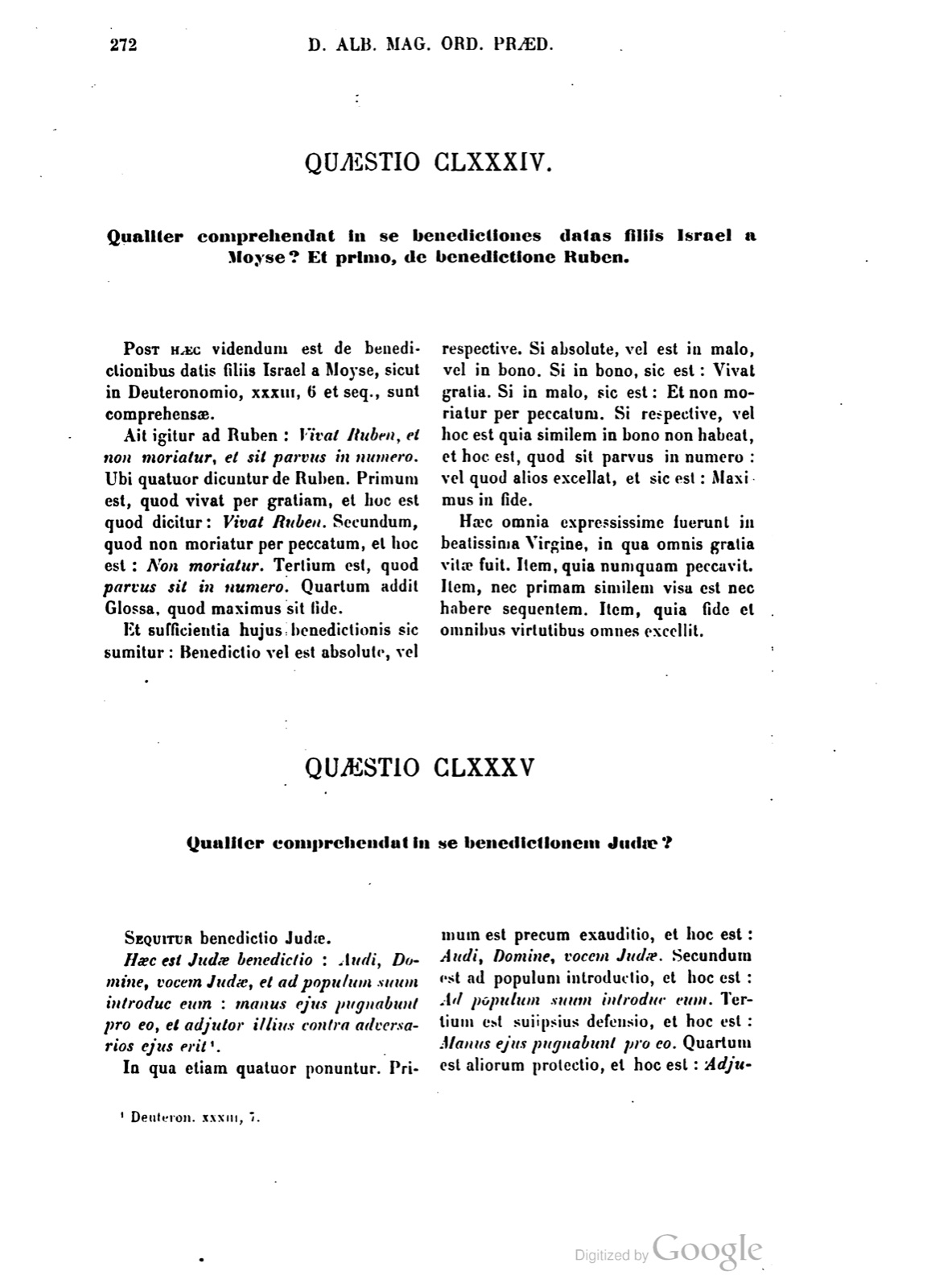
QUAESTIO CLXXXIV. Qualiter comprehendat in se benedictiones datas filiis Israel a Moyse? Et primo, de benedictione Ruben.
Post haec videndum est de benedictionibus datis filiis Israel a Moyse, sicut in Deuteronomio, XXXIII, 6 et seq., sunt comprehensae.
Ait igitur ad Ruben: Vivat Ruben, et non moriatur, et sit parvus in numero. Ubi quatuor dicuntur de Ruben. Primum est, quod vivat per gratiam, et hoc est quod dicitur: Vivat Ruben. Secundum, quod non moriatur per peccatum, et hoc est: Non moriatur. Tertium est, quod parvus sit in numero. Quartum addit Glossa, quod maximus sit fide.
Et sufficientia hujus benedictionis sic sumitur: Benedictio vel est absolute, vel respective. Si absolute, vel est in malo, vel in bono. Si in bono, sic est: Vivat gratia. Si in malo, sic est: Et non moriatur per peccatum. Si respective, vel hoc est quia similem in bono non habeat, et hoc est, quod sit parvus in numero: vel quod alios excellat, et sic est: Maximus in fide.
Haec omnia expressissime fuerunt in beatissima Virgine, in qua omnis gratia vitae fuit. Item, quia numquam peccavit. Item, nec primam similem visa est nec habere sequentem. Item, quia fide et omnibus virtutibus omnes excellit.
QUESTION 184. How does she comprehend in herself the blessings given to the sons of Israel by Moses? And first, concerning the blessing of Reuben.
After these things, one must see concerning the blessings given to the sons of Israel by Moses, as they are comprehended in Deuteronomy 33:6 and following.
Therefore he says to Reuben: Let Reuben live and not die, and let him be small in number. Here four things are said about Reuben. The first is that he should live through grace, and this is what is said: Let Reuben live. The second, that he should not die through sin, and this is: And not die. The third is that he should be small in number. The Gloss adds a fourth, that he should be greatest in faith.
And the sufficiency of this blessing is taken thus: a blessing is either absolute or respective. If absolute, it is either in evil or in good. If in good, thus it is: Let grace live. If in evil, thus it is: And let him not die through sin. If respective, either this is because he has no one similar in good, and this is that he be small in number; or because he surpasses others, and thus it is: Greatest in faith.
All these things were most expressly in the most blessed Virgin, in whom was every grace of life. Likewise, because she never sinned. Likewise, she did not seem to have a first one like herself nor one following. Likewise, because she surpasses all in faith and in all virtues.
If a page does not appear, its photograph has not been uploaded yet.