Works › The Mariale: Questions on “Missus est”
Volume 37 · pp. 268–269
Question 182. How does she comprehend in herself the fourth blessing of Balaam?
A marker with ≈ is an approximate page boundary, placed by measure of the text; the page photographs remain the authority. In the paired views, clicking a page marker brings that page into view.
QUAESTIO CLXXXII. Qualiter comprehendat in se quartam benedictionem Balaam?
Quarta benedictio Balaam, quae non tantum benedictio sed aliarum benedictionum est causa, est haec, Numer. XXIV, 17 et seq.: Orietur stella ex Jacob, et consurget virga de Israel: et percutiet duces Moab, vastabitque omnes filios Seth. Et erit Idumaea possessio ejus: hereditas Seir cedet inimicis suis: Israel vero fortiter aget. De Jacob erit qui dominetur, et perdat reliquias civitatis.
Haec benedictio dividitur in septem partes. Prima est benedictissimae Virginis generatio. Secunda est Filii Dei ex ipsa incarnatio. Tertia, destructio vitiorum. Quarta, hominum liberatio. Quinta, bonorum confirmatio. Sexta, bonorum dominatio. Septima, malorum damnatio. Prima intelligitur per hoc quod dicitur: Orietur stella ex Jacob. Secunda per hoc quod dicit: Et consurget virga de Israel. Tertia per id, Et percutiet duces Moab. Quarta per id, Et erit Idumaea possessio ejus. Quinta per id, Israel vero fortiter aget. Sexta per id, De Jacob erit qui dominetur. Septima per id, Et perdat reliquias civitatis.
QUESTION 182. How does she comprehend in herself the fourth blessing of Balaam?
The fourth blessing of Balaam, which is not only a blessing but also the cause of the other blessings, is this, Numbers 24:17 and following: A star will rise from Jacob, and a rod will spring up from Israel; and he will strike the leaders of Moab and lay waste all the sons of Seth. And Idumea will be his possession; the inheritance of Seir will yield to his enemies; but Israel will act strongly. From Jacob there will be one who rules and destroys the remnants of the city.
This blessing is divided into seven parts. The first is the generation of the most blessed Virgin. The second is the incarnation of the Son of God from her. The third, the destruction of vices. The fourth, the liberation of human beings. The fifth, the confirmation of the good. The sixth, the dominion of the good. The seventh, the damnation of the evil. The first is understood through what is said: A star will rise from Jacob. The second through what he says: And a rod will spring up from Israel. The third through this: And he will strike the leaders of Moab. The fourth through this: And Idumea will be his possession. The fifth through this: But Israel will act strongly. The sixth through this: From Jacob there will be one who rules. The seventh through this: And destroys the remnants of the city.
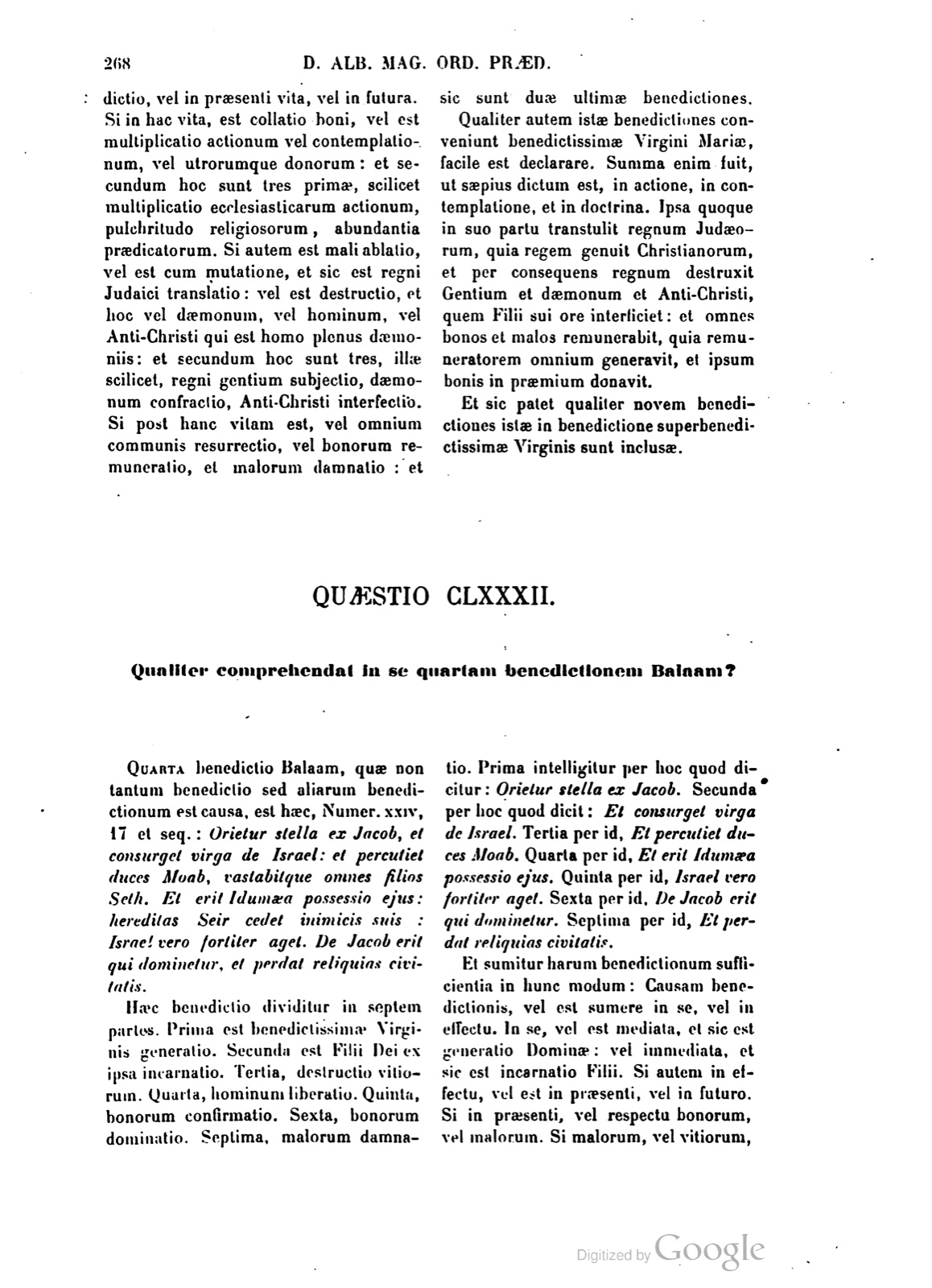
Et sumitur harum benedictionum sufficientia in hunc modum: Causam benedictionis, vel est sumere in se, vel in effectu. In se, vel est mediata, et sic est generatio Dominae: vel immediata, et sic est incarnatio Filii. Si autem in effectu, vel est in praesenti, vel in futuro. Si in praesenti, vel respectu bonorum, vel malorum. Si malorum, vel vitiorum, et sic est tertia: vel hominum, et sic est quarta. Si respectu bonorum, sic est quinta. Item, si est in futuro, vel est respectu bonorum, et sic est dominatio: vel malorum, et sic damnatio.
Patet igitur qualiter hae partes procedunt et dependent a benedictione beatissimae Virginis, quae in hac prima est radix omnium et causa consequentium: quidquid enim est causa causae, est causa omnium sequentium causatorum: unde cum beatissima Virgo mediante illa benedictione qua abundat in mulieribus, sit causa corporalis generationis de ipsa, et illa sit causa consequentium, patet quod in ipsa et sua benedictione istae benedictiones causaliter sunt inclusae.
And the sufficiency of these blessings is taken in this way. The cause of blessing is to be taken either in itself or in its effect. In itself, either it is mediate, and thus it is the generation of the Lady; or immediate, and thus it is the incarnation of the Son. But if in effect, it is either in the present or in the future. If in the present, either with respect to the good or to the evil. If to the evil, either to vices, and thus it is the third; or to human beings, and thus it is the fourth. If with respect to the good, thus it is the fifth. Likewise, if it is in the future, either it is with respect to the good, and thus it is dominion; or to the evil, and thus damnation.
Therefore it is clear how these parts proceed and depend on the blessing of the most blessed Virgin, which in this first blessing is the root of all and the cause of the things that follow. For whatever is the cause of a cause is the cause of all caused things that follow; whence, since the most blessed Virgin, by means of that blessing by which she abounds among women, is the cause of the bodily generation from herself, and that is the cause of the things that follow, it is clear that in her and in her blessing these blessings are causally included.
If a page does not appear, its photograph has not been uploaded yet.