Works › The Mariale: Questions on “Missus est”
Volume 37 · pp. 228–230
Question 158. Whether she had the properties of Dominations?
A marker with ≈ is an approximate page boundary, placed by measure of the text; the page photographs remain the authority. In the paired views, clicking a page marker brings that page into view.
QUAESTIO CLVIII. Utrum habuerit proprietates Dominationum?
Tertius in secunda hierarchia est ordo Dominationum, quarum proprietates ponit beatus Dionysius in libro de Caelesti hierarchia in haec verba: « Sanctarum Dominationum manifestativam nominationem aestimo declarare absolutam quamdam et ab omni pedestri minoratione liberam anagogen, nullaque tyrannicarum dissimilitudinum ullo modo eam universaliter inclinatam, liberaliter severam dominationem, omni minutivae servituti superpositam, superiorem subjectione omni, et remotam ab universali dissimilitudine, et dominationis incessanter appetentem, et ad illius ipsius naturaliter subsistentis virtutis similitudinem, quantum possibile, et seipsam et quae post eam sunt, optime et speciose conformantem, ad nulla vane videntium, sed ad proprie ὄν universale conversam, et dominicae semper deiformitatis in participatione, secundum quod possibile est ipsi, factam 1. » Ex hac auctoritate primo possunt extrahi decem proprietates Dominationum. Prima est a servitute libertas. Secunda est ab hoste invincibilitas. Tertia, liberalis severitas. Quarta est minutivi servitii superioritas. Quinta, nullius subjectionis egestas. Sexta, dissimilitudinis immunitas. Septima, dominandi ordinata voluntas. Octava, sui et suorum ad Deum conformitas. Nona, nulla in dominando vanitas. Decima, divinae dominationis particeps conformitas.
Et excluduntur in his proprietatibus decem impedimenta dominationum terrenarum. Primum est servitium superioris. Secundum, impetus hostium. Tertium, dominium. Quartum, gratuitas servitiorum. Quintum, provisio subditorum. Sextum, sollicitudo necessariorum extrinsecorum. Septimum, ambitio honoris.
QUESTION 158. Whether she had the properties of Dominations?
The third order in the second hierarchy is the order of Dominations, whose properties blessed Dionysius sets down in the book On the Celestial Hierarchy in these words: “I judge that the manifestative naming of the holy Dominations declares a certain absolute anagogy free from every earthly diminution, and in no way universally inclined by any tyrannical dissimilarities, a liberally severe domination set above every diminishing servitude, higher than every subjection, and removed from universal dissimilarity, and unceasingly desiring domination, and conforming both itself and the things after it, as far as possible, optimally and beautifully to the likeness of that very virtue naturally subsisting, turned to none of the things vainly seen, but to the universal properly being, and always made in participation of the Lordly God-formedness, according as is possible for it 1.” From this authority first ten properties of Dominations can be extracted. The first is freedom from servitude. The second is invincibility by the enemy. The third, liberal severity. The fourth is superiority over diminishing service. The fifth, need of no subjection. The sixth, immunity from dissimilarity. The seventh, ordered will of dominating. The eighth, conformity of oneself and one’s own to God. The ninth, no vanity in dominating. The tenth, participant conformity to divine domination.
And in these properties ten impediments of earthly dominations are excluded. The first is service to a superior. The second, attack of enemies. The third, dominion. The fourth, gratuitousness of services. The fifth, provision for subjects. The sixth, solicitude for external necessities. The seventh, ambition for honor.
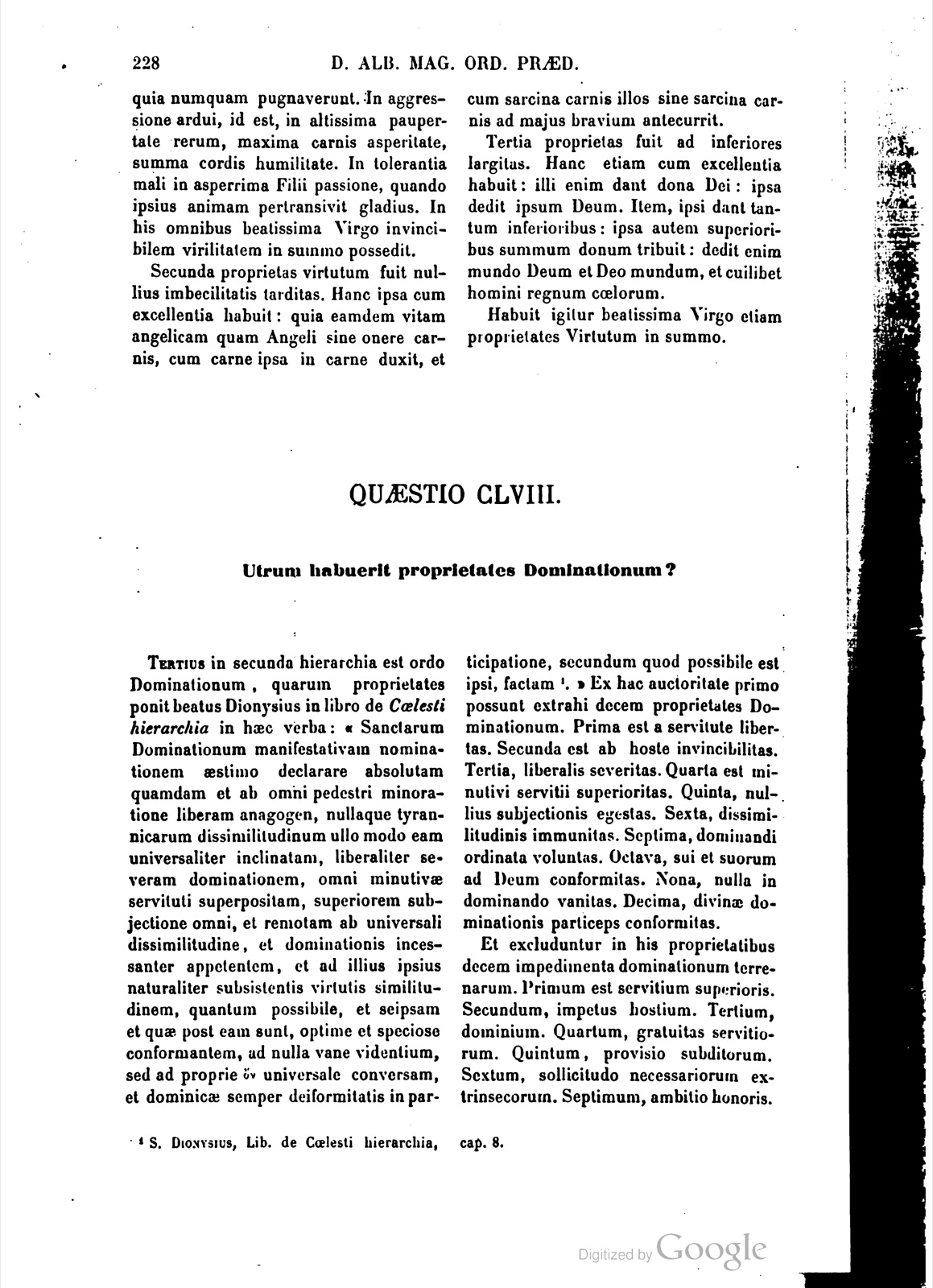
Octavum, contrarietas divitiarum et dominiorum. Nonum est excaecatio vanitatum. Decimum est elongatio imitationis divinarum actionum.
Quod autem hae proprietates in summo fuerunt in beatissima Virgine, sic est manifestum:
Quod libertatem a servitute habuit in summo, patet per ea quae dicta sunt supra de ipsius nobilitate.
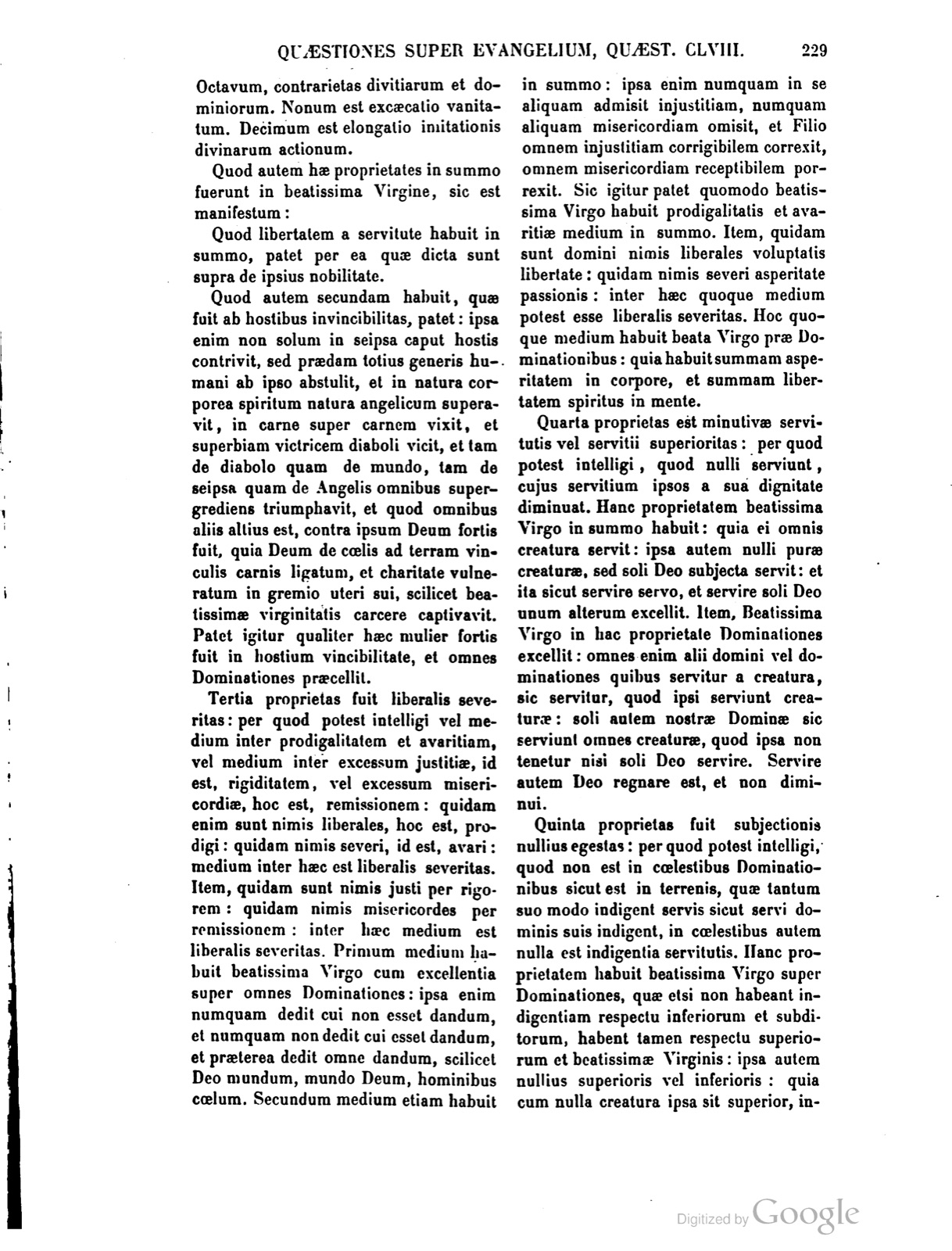
Quod autem secundam habuit, quae fuit ab hostibus invincibilitas, patet: ipsa enim non solum in seipsa caput hostis contrivit, sed praedam totius generis humani ab ipso abstulit, et in natura corporea spiritum natura angelicum superavit, in carne super carnem vixit, et superbiam victricem diaboli vicit, et tam de diabolo quam de mundo, tam de seipsa quam de Angelis omnibus supergrediens triumphavit, et quod omnibus aliis altius est, contra ipsum Deum fortis fuit, quia Deum de caelis ad terram vinculis carnis ligatum, et charitate vulneratum in gremio uteri sui, scilicet beatissimae virginitatis carcere captivavit. Patet igitur qualiter haec mulier fortis fuit in hostium vincibilitate, et omnes Dominationes praecellit.
Tertia proprietas fuit liberalis severitas: per quod potest intelligi vel medium inter prodigalitatem et avaritiam, vel medium inter excessum justitiae, id est, rigiditatem, vel excessum misericordiae, hoc est, remissionem: quidam enim sunt nimis liberales, hoc est, prodigi: quidam nimis severi, id est, avari: medium inter haec est liberalis severitas. Item, quidam sunt nimis justi per rigorem: quidam nimis misericordes per remissionem: inter haec medium est liberalis severitas. Primum medium habuit beatissima Virgo cum excellentia super omnes Dominationes: ipsa enim numquam dedit cui non esset dandum, et numquam non dedit cui esset dandum, et praeterea dedit omne dandum, scilicet Deo mundum, mundo Deum, hominibus caelum. Secundum medium etiam habuit in summo: ipsa enim numquam in se aliquam admisit injustitiam, numquam aliquam misericordiam omisit, et Filio omnem injustitiam corrigibilem correxit, omnem misericordiam receptibilem porrexit. Sic igitur patet quomodo beatissima Virgo habuit prodigalitatis et avaritiae medium in summo. Item, quidam sunt domini nimis liberales voluptatis libertate: quidam nimis severi asperitate passionis: inter haec quoque medium potest esse liberalis severitas. Hoc quoque medium habuit beata Virgo prae Dominationibus: quia habuit summam asperitatem in corpore, et summam libertatem spiritus in mente.
Quarta proprietas est minutivae servitutis vel servitii superioritas: per quod potest intelligi, quod nulli serviunt, cujus servitium ipsos a sua dignitate diminuat. Hanc proprietatem beatissima Virgo in summo habuit: quia ei omnis creatura servit: ipsa autem nulli purae creaturae, sed soli Deo subjecta servit: et ita sicut servire servo, et servire soli Deo unum alterum excellit. Item, Beatissima Virgo in hac proprietate Dominationes excellit: omnes enim alii domini vel dominationes quibus servitur a creatura, sic servitur, quod ipsi serviunt creaturae: soli autem nostrae Dominae sic serviunt omnes creaturae, quod ipsa non tenetur nisi soli Deo servire. Servire autem Deo regnare est, et non diminui.
Quinta proprietas fuit subjectionis nullius egestas: per quod potest intelligi, quod non est in caelestibus Dominationibus sicut est in terrenis, quae tantum suo modo indigent servis sicut servi dominis suis indigent, in caelestibus autem nulla est indigentia servitutis. Hanc proprietatem habuit beatissima Virgo super Dominationes, quae etsi non habeant indigentiam respectu inferiorum et subditorum, habent tamen respectu superiorum et beatissimae Virginis: ipsa autem nullius superioris vel inferioris: quia cum nulla creatura ipsa sit superior, indigentiam non habet creaturae, sed solius creatricis personae.
The eighth is contrariety of riches and dominions. The ninth is the blinding of vanities. The tenth is distance from imitation of divine actions.
But that these properties were in the most blessed Virgin in the highest degree is manifest thus.
That she had freedom from servitude in the highest degree is clear from the things said above concerning her nobility.
But that she had the second, which was invincibility by enemies, is clear: for she not only crushed the head of the enemy in herself, but took away from him the prey of the whole human race, and in bodily nature overcame a spirit angelic by nature, lived in flesh above flesh, conquered the conquering pride of the devil, and triumphantly surpassed both the devil and the world, both herself and all Angels; and what is higher than all others, she was strong against God himself, because she captured God from the heavens to earth, bound by the bonds of flesh and wounded by charity, in the lap of her womb, that is, in the prison of most blessed virginity. Therefore it is clear how this strong woman was strong in the conquerability of enemies and excels all the Dominations.
The third property was liberal severity. By this can be understood either the mean between prodigality and avarice, or the mean between excess of justice, that is, rigidity, and excess of mercy, that is, remission. For some are too liberal, that is, prodigal; some too severe, that is, avaricious; between these is liberal severity. Likewise, some are too just through rigor; some too merciful through remission; between these is liberal severity. The most blessed Virgin had the first mean with excellence above all Dominations, for she never gave to one to whom it was not to be given, and never did not give to one to whom it was to be given, and besides she gave everything to be given, namely the world to God, God to the world, heaven to human beings. She also had the second mean in the highest degree: for she never admitted any injustice in herself, never omitted any mercy, and for the Son corrected every correctible injustice and extended every receivable mercy. Thus therefore it is clear how the most blessed Virgin had the mean of prodigality and avarice in the highest degree. Likewise, some lords are too liberal by liberty of pleasure; some too severe by harshness of suffering; between these too there can be liberal severity. The blessed Virgin also had this mean before the Dominations, because she had the highest harshness in body and the highest liberty of spirit in mind.
The fourth property is superiority over diminishing servitude or service. By this it can be understood that they serve no one whose service diminishes them from their dignity. The most blessed Virgin had this property in the highest degree, because every creature serves her, but she herself serves no pure creature, but serves God alone as subject to him; and thus serving a servant and serving God alone, one excels the other. Likewise, the most blessed Virgin excels the Dominations in this property: for all other lords or dominations who are served by a creature are served in such a way that they themselves serve a creature; but all creatures serve our Lady alone in such a way that she is bound to serve none except God alone. But to serve God is to reign, and not to be diminished.
The fifth property was need of no subjection. By this it can be understood that it is not in the heavenly Dominations as it is in earthly ones, which in their own way need servants as much as servants need their lords, but in heavenly things there is no need of servitude. The most blessed Virgin had this property above the Dominations, which, even if they do not have need with respect to inferiors and subjects, nevertheless have it with respect to superiors and the most blessed Virgin. But she has need of no superior or inferior, because since no creature is superior to her, she has need not of a creature, but only of the creating person.
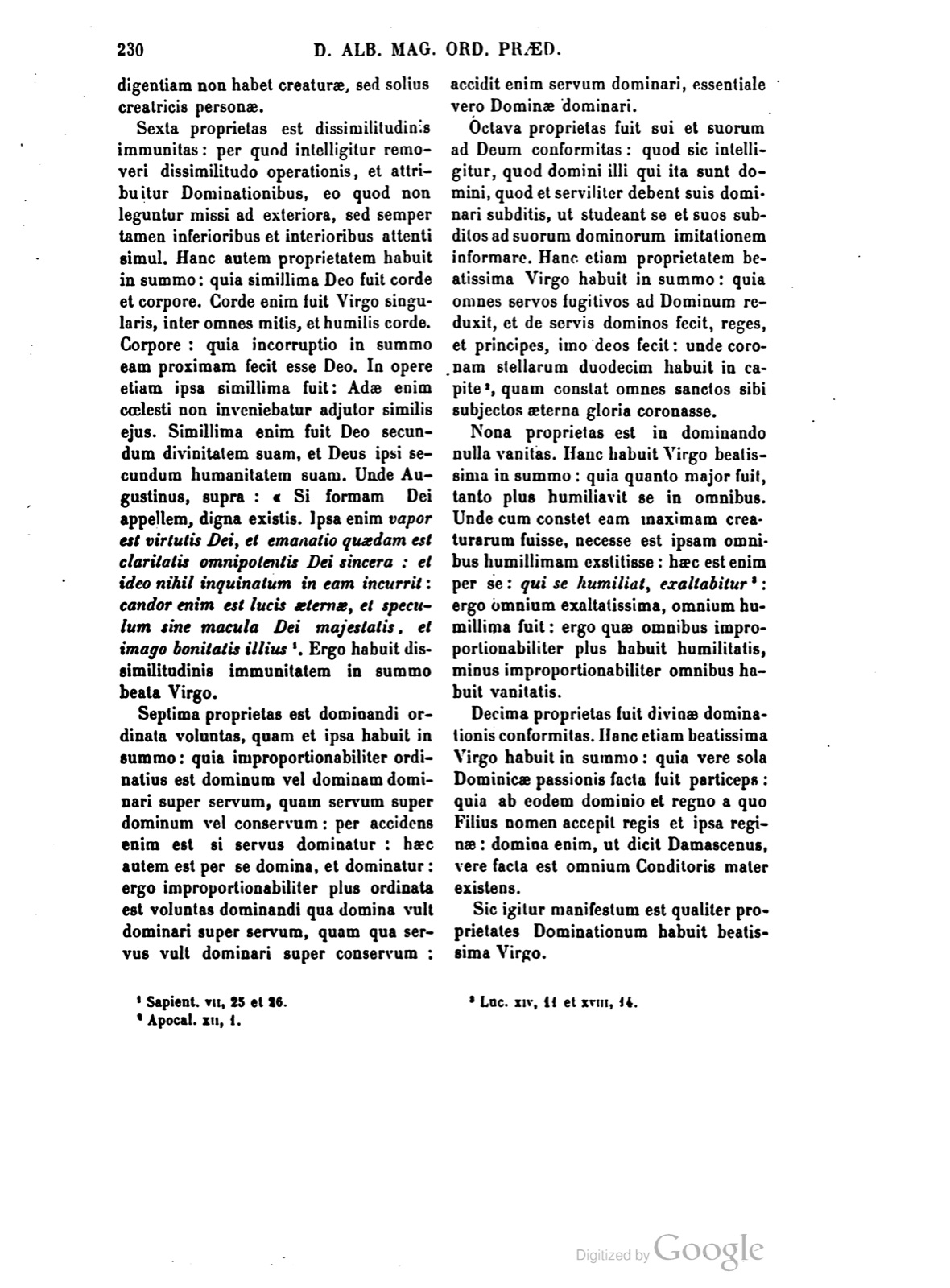
Sexta proprietas est dissimilitudinis immunitas: per quod intelligitur removeri dissimilitudo operationis, et attribuitur Dominationibus, eo quod non leguntur missi ad exteriora, sed semper tamen inferioribus et interioribus attenti simul. Hanc autem proprietatem habuit in summo: quia simillima Deo fuit corde et corpore. Corde enim fuit Virgo singularis, inter omnes mitis, et humilis corde. Corpore: quia incorruptio in summo eam proximam fecit esse Deo. In opere etiam ipsa simillima fuit: Adae enim caelesti non inveniebatur adjutor similis ejus. Simillima enim fuit Deo secundum divinitatem suam, et Deus ipsi secundum humanitatem suam. Unde Augustinus, supra: « Si formam Dei appellem, digna existis. Ipsa enim vapor est virtutis Dei, et emanatio quaedam est claritatis omnipotentis Dei sincera: et ideo nihil inquinatum in eam incurrit: candor enim est lucis aeternae, et speculum sine macula Dei majestatis, et imago bonitatis illius 2. Ergo habuit dissimilitudinis immunitatem in summo beata Virgo.
Septima proprietas est dominandi ordinata voluntas, quam et ipsa habuit in summo: quia improportionabiliter ordinatius est dominum vel dominam dominari super servum, quam servum super dominum vel conservum: per accidens enim est si servus dominatur: haec autem est per se domina, et dominatur: ergo improportionabiliter plus ordinata est voluntas dominandi qua domina vult dominari super servum, quam qua servus vult dominari super conservum: accidit enim servum dominari, essentiale vero Dominae dominari.
Octava proprietas fuit sui et suorum ad Deum conformitas: quod sic intelligitur, quod domini illi qui ita sunt domini, quod et serviliter debent suis dominari subditis, ut studeant se et suos subditos ad suorum dominorum imitationem informare. Hanc etiam proprietatem beatissima Virgo habuit in summo: quia omnes servos fugitivos ad Dominum reduxit, et de servis dominos fecit, reges, et principes, imo deos fecit: unde coronam stellarum duodecim habuit in capite 3, quam constat omnes sanctos sibi subjectos aeterna gloria coronasse.
Nona proprietas est in dominando nulla vanitas. Hanc habuit Virgo beatissima in summo: quia quanto major fuit, tanto plus humiliavit se in omnibus. Unde cum constet eam maximam creaturarum fuisse, necesse est ipsam omnibus humillimam exstitisse: haec est enim per se: qui se humiliat, exaltabitur 4: ergo omnium exaltatissima, omnium humillima fuit: ergo quae omnibus improportionabiliter plus habuit humilitatis, minus improportionabiliter omnibus habuit vanitatis.
Decima proprietas fuit divinae dominationis conformitas. Hanc etiam beatissima Virgo habuit in summo: quia vere sola Dominicae passionis facta fuit particeps: quia ab eodem dominio et regno a quo Filius nomen accepit regis et ipsa reginae: domina enim, ut dicit Damascenus, vere facta est omnium Conditoris mater existens.
Sic igitur manifestum est qualiter proprietates Dominationum habuit beatissima Virgo.
The sixth property is immunity from dissimilarity. By this is understood the removal of dissimilarity of operation, and it is attributed to the Dominations because they are not read to be sent to exterior things, but nevertheless are always attentive at once to inferior and interior things. But she had this property in the highest degree, because she was most like God in heart and body. In heart she was a singular Virgin, meek among all, and humble of heart. In body, because incorruption in the highest degree made her to be nearest to God. In work also she was most like him: for no helper like him was found for the heavenly Adam. For she was most like God according to his divinity, and God most like her according to his humanity. Whence Augustine above says: “If I call you the form of God, you are worthy. For she is the vapor of the power of God, and a certain sincere emanation of the brightness of almighty God; and therefore nothing defiled enters into her. For she is the brightness of eternal light, and the spotless mirror of God’s majesty, and the image of his goodness 2.” Therefore the blessed Virgin had immunity from dissimilarity in the highest degree.
The seventh property is an ordered will of dominating, which she too had in the highest degree, because it is disproportionately more ordered for a lord or lady to rule over a servant than for a servant to rule over a lord or fellow-servant. For it is accidental if a servant rules, but she is lady through herself and rules; therefore the will of dominating by which a lady wishes to rule over a servant is disproportionately more ordered than that by which a servant wishes to rule over a fellow-servant. For it happens accidentally that a servant rules, but it is essential to the Lady to rule.
The eighth property was conformity of herself and her own to God. This is understood thus: those lords who are lords in such a way that they also ought to rule their subjects in a servile way, so that they may strive to form themselves and their subjects to the imitation of their lords. The most blessed Virgin also had this property in the highest degree, because she led all fugitive servants back to the Lord, and from servants made lords, kings, and princes, indeed gods. Whence she had a crown of twelve stars on her head 3, with which it is clear that all the saints subject to her crowned her with eternal glory.
The ninth property is no vanity in dominating. The most blessed Virgin had this in the highest degree, because the greater she was, the more she humbled herself in all things. Whence since it is clear that she was the greatest of creatures, it is necessary that she existed as the humblest of all. For this holds through itself: he who humbles himself shall be exalted 4. Therefore she who was most exalted of all was most humble of all. Therefore she who had disproportionately more humility than all had disproportionately less vanity than all.
The tenth property was conformity to divine domination. The most blessed Virgin also had this in the highest degree, because she alone truly was made a sharer in the Lord’s passion, because from the same dominion and kingdom from which the Son received the name of king she received that of queen; for the Lady, as Damascene says, was truly made the mother of the Creator of all.
Thus therefore it is manifest how the most blessed Virgin had the properties of the Dominations.
If a page does not appear, its photograph has not been uploaded yet.