Works › The Mariale: Questions on “Missus est”
Volume 37 · pp. 203–204
Question 144. Whether she could be called mother of mothers, as Virgin of virgins?
A marker with ≈ is an approximate page boundary, placed by measure of the text; the page photographs remain the authority. In the paired views, clicking a page marker brings that page into view.
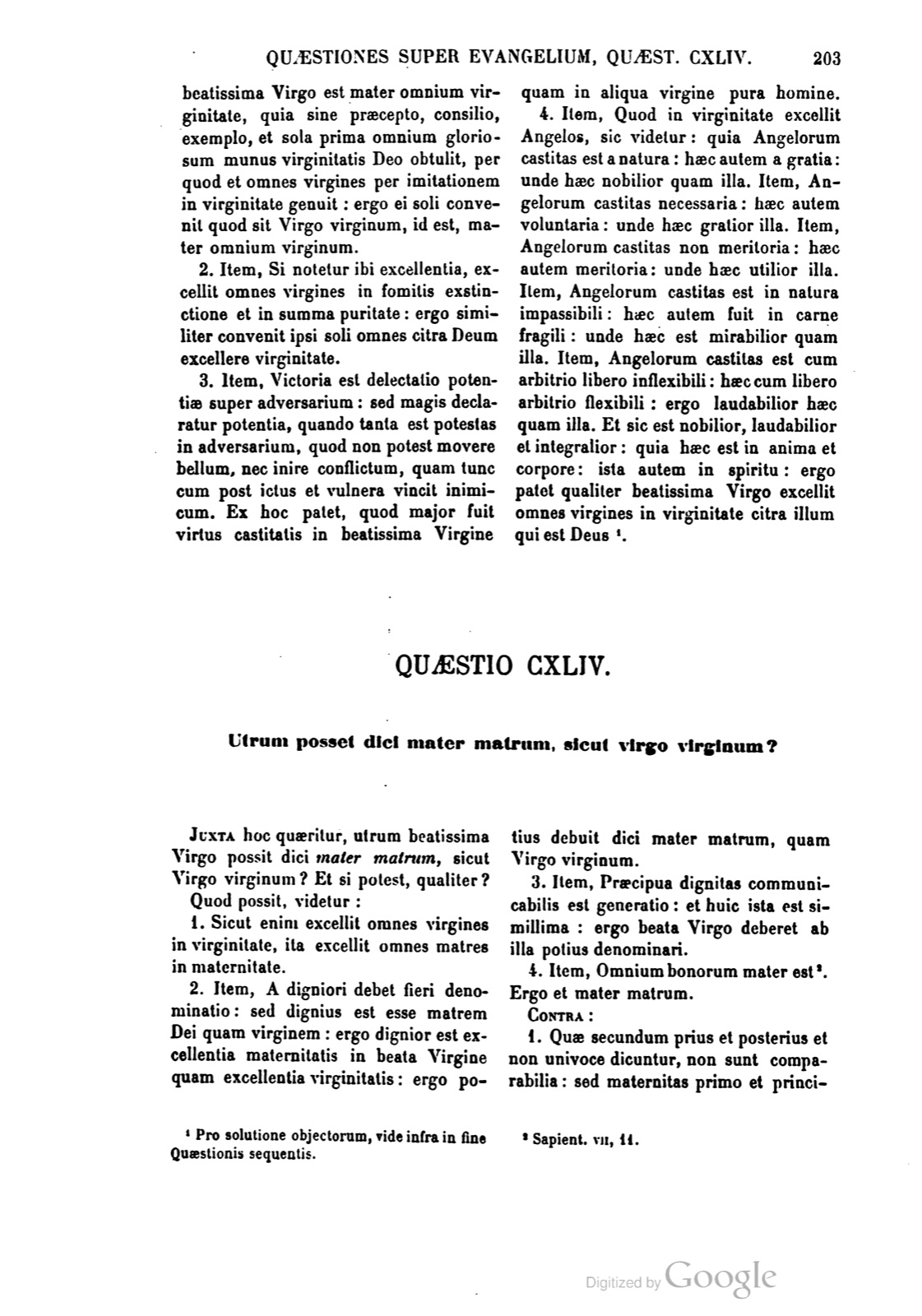
QUAESTIO CXLIV. Utrum posset dici mater matrum, sicut virgo virginum?
Juxta hoc quaeritur, utrum beatissima Virgo possit dici mater matrum, sicut Virgo virginum? Et si potest, qualiter?
Quod possit, videtur:
1. Sicut enim excellit omnes virgines in virginitate, ita excellit omnes matres in maternitate.
2. Item, A digniori debet fieri denominatio: sed dignius est esse matrem Dei quam virginem: ergo dignior est excellentia maternitatis in beata Virgine quam excellentia virginitatis: ergo potius debuit dici mater matrum, quam Virgo virginum.
3. Item, Praecipua dignitas communicabilis est generatio: et huic ista est simillima: ergo beata Virgo deberet ab illa potius denominari.
4. Item, Omnium bonorum mater est 1. Ergo et mater matrum.
Contra:
1. Quae secundum prius et posterius et non univoce dicuntur, non sunt comparabilia: sed maternitas primo et principaliter dicitur de beatissima Virgine, de aliis per posterius: ergo aliae non sunt ei comparabiles in maternitate: sed res superlativi gradus comparantur rebus positivi gradus per genitivum: ergo nec proprie nec vere dicitur mater matrum.
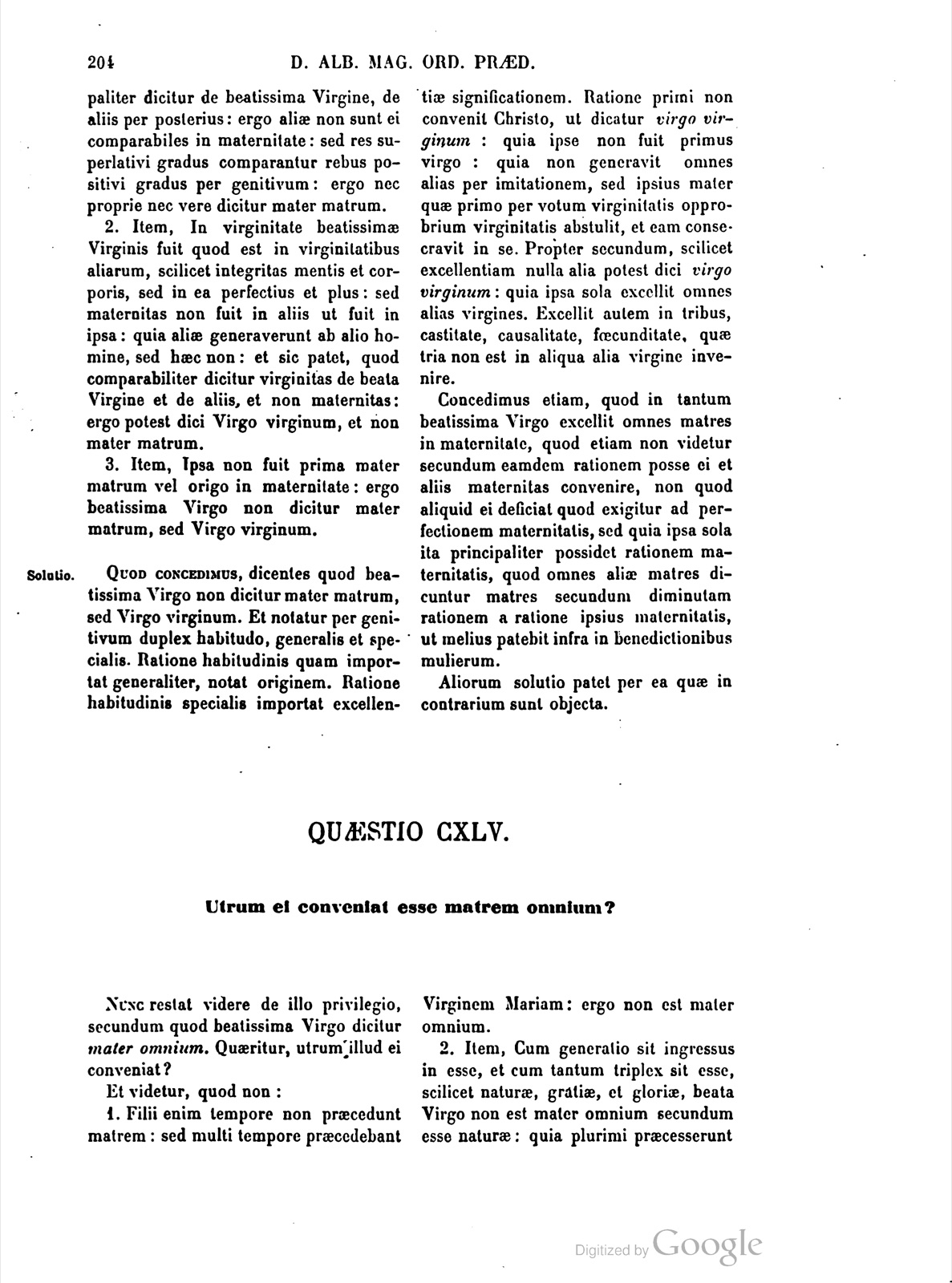
2. Item, In virginitate beatissimae Virginis fuit quod est in virginitatibus aliarum, scilicet integritas mentis et corporis, sed in ea perfectius et plus: sed maternitas non fuit in aliis ut fuit in ipsa: quia aliae generaverunt ab alio homine, sed haec non: et sic patet, quod comparabiliter dicitur virginitas de beata Virgine et de aliis, et non maternitas: ergo potest dici Virgo virginum, et non mater matrum.
QUESTION 144. Whether she could be called mother of mothers, as Virgin of virgins?
Next to this it is asked whether the most blessed Virgin can be called mother of mothers, as Virgin of virgins; and if she can, in what way.
That she can seems so:
1. For as she excels all virgins in virginity, so she excels all mothers in maternity.
2. Likewise, denomination ought to be made from the more worthy thing. But it is more worthy to be Mother of God than to be a virgin. Therefore the excellence of maternity in the blessed Virgin is more worthy than the excellence of virginity. Therefore she ought rather to be called mother of mothers than Virgin of virgins.
3. Likewise, the chief communicable dignity is generation; and this is most similar to it. Therefore the blessed Virgin ought rather to be named from that.
4. Likewise, she is mother of all good things 1. Therefore also mother of mothers.
To the contrary:
1. Things which are said according to prior and posterior and not univocally are not comparable. But maternity is said first and principally of the most blessed Virgin, and of others posteriorly. Therefore others are not comparable to her in maternity. But things of the superlative degree are compared with things of the positive degree through the genitive. Therefore she is called mother of mothers neither properly nor truly.
2. Likewise, in the virginity of the most blessed Virgin there was what is in the virginities of others, namely integrity of mind and body, but in her more perfectly and more fully. But maternity was not in others as it was in her, because others generated from another human being, but she did not. And thus it is clear that virginity is said comparably of the blessed Virgin and of others, but maternity is not. Therefore she can be called Virgin of virgins, and not mother of mothers.
3. Item, Ipsa non fuit prima mater matrum vel origo in maternitate: ergo beatissima Virgo non dicitur mater matrum, sed Virgo virginum.
Solutio. Quod concedimus, dicentes quod beatissima Virgo non dicitur mater matrum, sed Virgo virginum. Et notatur per genitivum duplex habitudo, generalis et specialis. Ratione habitudinis quam importat generaliter, notat originem. Ratione habitudinis specialis importat excellentiae significationem. Ratione primi non convenit Christo, ut dicatur virgo virginum: quia ipse non fuit primus virgo: quia non generavit omnes alias per imitationem, sed ipsius mater quae primo per votum virginitatis opprobrium virginitatis abstulit, et eam consecravit in se. Propter secundum, scilicet excellentiam nulla alia potest dici virgo virginum: quia ipsa sola excellit omnes alias virgines. Excellit autem in tribus, castitate, causalitate, foecunditate, quae tria non est in aliqua alia virgine invenire.
Concedimus etiam, quod in tantum beatissima Virgo excellit omnes matres in maternitate, quod etiam non videtur secundum eamdem rationem posse ei et aliis maternitas convenire, non quod aliquid ei deficiat quod exigitur ad perfectionem maternitatis, sed quia ipsa sola ita principaliter possidet rationem maternitatis, quod omnes aliae matres dicuntur matres secundum diminutam rationem a ratione ipsius maternitatis, ut melius patebit infra in benedictionibus mulierum.
Aliorum solutio patet per ea quae in contrarium sunt objecta.
3. Likewise, she herself was not the first mother of mothers or origin in maternity. Therefore the most blessed Virgin is not called mother of mothers, but Virgin of virgins.
Solution. This we concede, saying that the most blessed Virgin is not called mother of mothers, but Virgin of virgins. And through the genitive a twofold relation is noted, general and special. By reason of the relation which it generally imports, it notes origin. By reason of the special relation, it imports the signification of excellence. By reason of the first it does not belong to Christ that he be called virgin of virgins, because he was not the first virgin, because he did not generate all the others through imitation; but his mother did, who first through the vow of virginity removed the disgrace of virginity and consecrated it in herself. Because of the second, namely excellence, no other can be called virgin of virgins, because she alone excels all other virgins. But she excels in three things: chastity, causality, and fecundity, which three are not found in any other virgin.
We also concede that the most blessed Virgin excels all mothers in maternity to such an extent that maternity does not even seem able to belong to her and to others according to the same account; not because anything is lacking to her which is required for the perfection of maternity, but because she alone so principally possesses the account of maternity that all other mothers are called mothers according to an account diminished from the account of her maternity, as will be clearer below in the blessings of women.
The solution of the other objections is clear through those things which were objected to the contrary.
Notes
- Wisdom 7:11. (Sapient. VII, 11.) ↩
If a page does not appear, its photograph has not been uploaded yet.