Works › The Mariale: Questions on “Missus est”
Volume 37 · pp. 199–200
Question 141. Whether it would be more for a human being to be father of God than mother?
A marker with ≈ is an approximate page boundary, placed by measure of the text; the page photographs remain the authority. In the paired views, clicking a page marker brings that page into view.
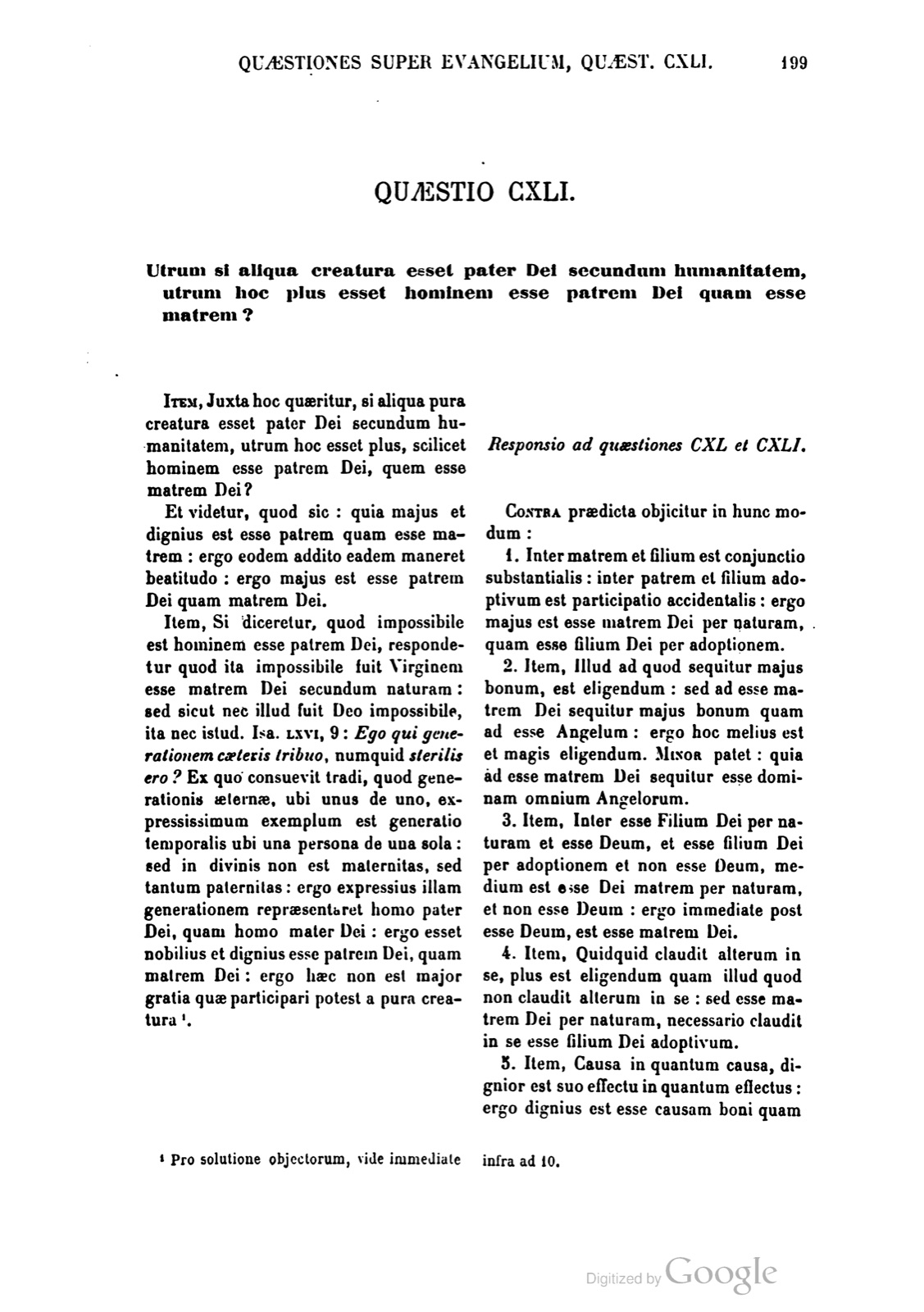
QUAESTIO CXLI. Utrum si aliqua creatura esset pater Dei secundum humanitatem, utrum hoc plus esset hominem esse patrem Dei quam esse matrem?
Item, Juxta hoc quaeritur, si aliqua pura creatura esset pater Dei secundum humanitatem, utrum hoc esset plus, scilicet hominem esse patrem Dei, quem esse matrem Dei?
Et videtur, quod sic: quia majus et dignius est esse patrem quam esse matrem: ergo eodem addito eadem maneret beatitudo: ergo majus est esse patrem Dei quam matrem Dei.
Item, Si diceretur, quod impossibile est hominem esse patrem Dei, respondetur quod ita impossibile fuit Virginem esse matrem Dei secundum naturam: sed sicut nec illud fuit Deo impossibile, ita nec istud. Isa. LXVI, 9: Ego qui generationem caeteris tribuo, numquid sterilis ero? Ex quo consuevit tradi, quod generationis aeternae, ubi unus de uno, expressissimum exemplum est generatio temporalis ubi una persona de una sola: sed in divinis non est maternitas, sed tantum paternitas: ergo expressius illam generationem repraesentaret homo pater Dei, quam homo mater Dei: ergo esset nobilius et dignius esse patrem Dei, quam matrem Dei: ergo haec non est major gratia quae participari potest a pura creatura 1.
Responsio ad quaestiones CXL et CXLI.
Contra praedicta objicitur in hunc modum:
1. Inter matrem et filium est conjunctio substantialis: inter patrem et filium adoptivum est participatio accidentalis: ergo majus est esse matrem Dei per naturam, quam esse filium Dei per adoptionem.
2. Item, Illud ad quod sequitur majus bonum, est eligendum: sed ad esse matrem Dei sequitur majus bonum quam ad esse Angelum: ergo hoc melius est et magis eligendum. Minor patet: quia ad esse matrem Dei sequitur esse dominam omnium Angelorum.
3. Item, Inter esse Filium Dei per naturam et esse Deum, et esse filium Dei per adoptionem et non esse Deum, medium est esse Dei matrem per naturam, et non esse Deum: ergo immediate post esse Deum, est esse matrem Dei.
4. Item, Quidquid claudit alterum in se, plus est eligendum quam illud quod non claudit alterum in se: sed esse matrem Dei per naturam, necessario claudit in se esse filium Dei adoptivum.
QUESTION 141. If some creature were father of God according to humanity, whether this would be more, namely for a human being to be father of God, than to be mother?
Likewise, next to this it is asked: if some pure creature were father of God according to humanity, whether this would be more, namely for a human being to be father of God, than to be Mother of God.
And it seems that it would, because it is greater and more worthy to be father than to be mother. Therefore, with the same thing added, the same beatitude would remain; therefore it is greater to be father of God than mother of God.
Likewise, if it were said that it is impossible for a human being to be father of God, the answer is that it was just as impossible for the Virgin to be Mother of God according to nature. But just as that was not impossible to God, so neither is this. Isaiah 66:9: I who grant generation to the rest, shall I be barren? From this it has customarily been handed down that of eternal generation, where one is from one, the most express example is temporal generation where one person is from one alone. But in divine things there is no maternity, but only paternity. Therefore a human father of God would represent that generation more expressly than a human mother of God. Therefore it would be nobler and more worthy to be father of God than Mother of God. Therefore this is not the greatest grace that can be participated by a pure creature 1.
Response to Questions 140 and 141.
Against the foregoing one objects in this way:
1. Between mother and son there is a substantial conjunction; between father and adoptive son there is an accidental participation. Therefore it is greater to be Mother of God by nature than to be son of God by adoption.
2. Likewise, that to which a greater good follows is to be chosen. But a greater good follows upon being Mother of God than upon being an Angel. Therefore this is better and more to be chosen. The minor is clear, because upon being Mother of God there follows being Lady of all the Angels.
3. Likewise, between being Son of God by nature and being God, and being son of God by adoption and not being God, the middle is to be Mother of God by nature and not to be God. Therefore immediately after being God is being Mother of God.
4. Likewise, whatever encloses another thing in itself is more to be chosen than that which does not enclose the other in itself. But being Mother of God by nature necessarily encloses in itself being adoptive son of God.
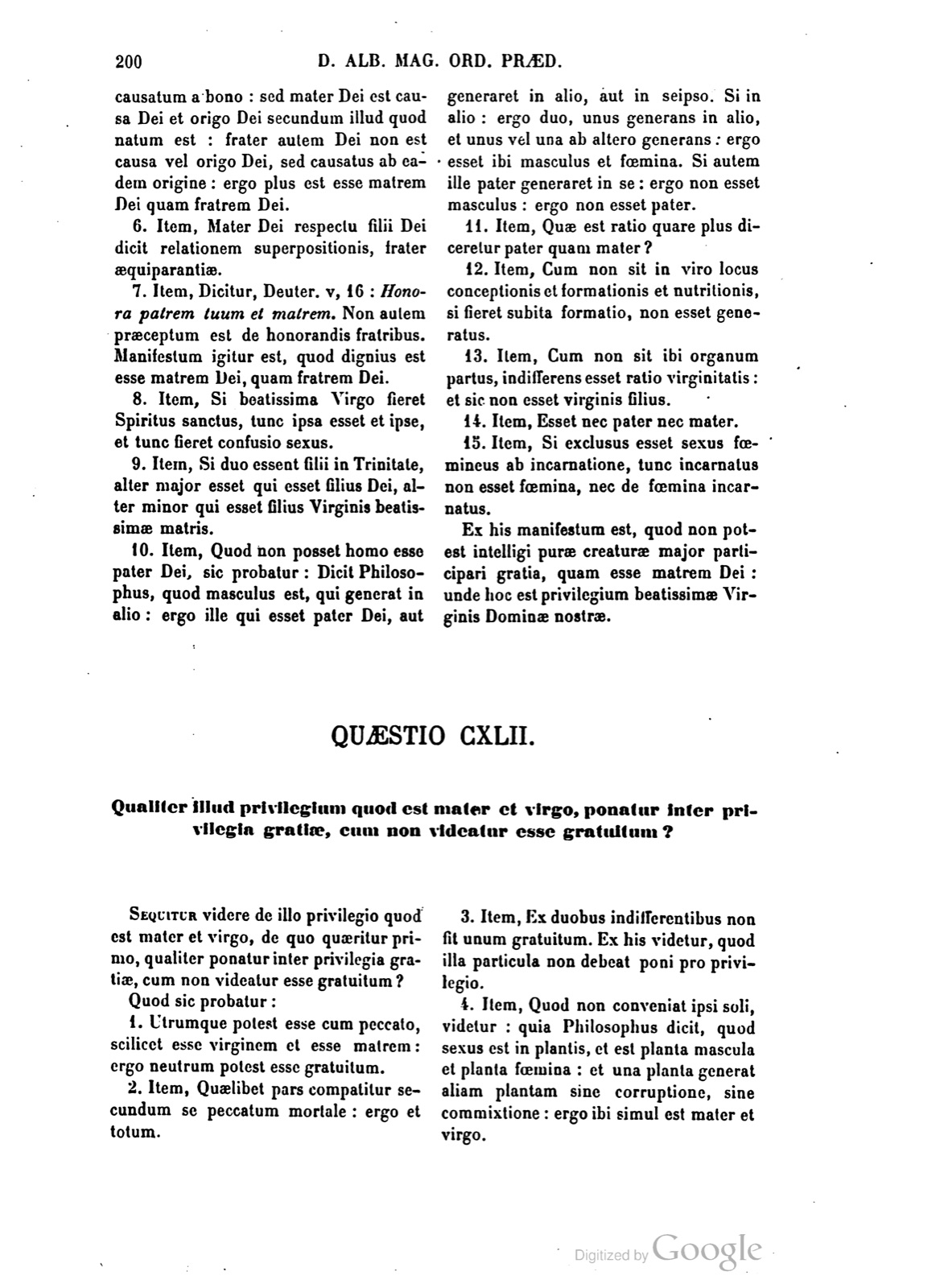
5. Item, Causa in quantum causa, dignior est suo effectu in quantum effectus: ergo dignius est esse causam boni quam causatum a bono: sed mater Dei est causa Dei et origo Dei secundum illud quod natum est: frater autem Dei non est causa vel origo Dei, sed causatus ab eadem origine: ergo plus est esse matrem Dei quam fratrem Dei.
6. Item, Mater Dei respectu filii Dei dicit relationem superpositionis, frater aequiparantiae.
7. Item, Dicitur, Deuter. V, 16: Honora patrem tuum et matrem. Non autem praeceptum est de honorandis fratribus. Manifestum igitur est, quod dignius est esse matrem Dei, quam fratrem Dei.
8. Item, Si beatissima Virgo fieret Spiritus sanctus, tunc ipsa esset et ipse, et tunc fieret confusio sexus.
9. Item, Si duo essent filii in Trinitate, alter major esset qui esset filius Dei, alter minor qui esset filius Virginis beatissimae matris.
10. Item, Quod non posset homo esse pater Dei, sic probatur: Dicit Philosophus, quod masculus est, qui generat in alio: ergo ille qui esset pater Dei, aut generaret in alio, aut in seipso. Si in alio: ergo duo, unus generans in alio, et unus vel una ab altero generans: ergo esset ibi masculus et foemina. Si autem ille pater generaret in se: ergo non esset masculus: ergo non esset pater.
11. Item, Quae est ratio quare plus diceretur pater quam mater?
12. Item, Cum non sit in viro locus conceptionis et formationis et nutritionis, si fieret subita formatio, non esset generatus.
13. Item, Cum non sit ibi organum partus, indifferens esset ratio virginitatis: et sic non esset virginis filius.
14. Item, Esset nec pater nec mater.
15. Item, Si exclusus esset sexus foemineus ab incarnatione, tunc incarnatus non esset foemina, nec de foemina incarnatus.
Ex his manifestum est, quod non potest intelligi purae creaturae major participari gratia, quam esse matrem Dei: unde hoc est privilegium beatissimae Virginis Dominae nostrae.
5. Likewise, cause insofar as cause is more worthy than its effect insofar as effect. Therefore it is more worthy to be cause of good than caused by good. But the Mother of God is cause of God and origin of God according to that which was born. But the brother of God is not cause or origin of God, but caused by the same origin. Therefore it is more to be Mother of God than brother of God.
6. Likewise, Mother of God with respect to the Son of God expresses a relation of superposition; brother expresses a relation of equal standing.
7. Likewise, it is said in Deuteronomy 5:16: Honor your father and your mother. But there is no precept about honoring brothers. Therefore it is manifest that it is more worthy to be Mother of God than brother of God.
8. Likewise, if the most blessed Virgin became the Holy Spirit, then she would be both she and he, and then there would be confusion of sex.
9. Likewise, if there were two sons in the Trinity, one would be greater who was Son of God, and the other lesser who was son of the Virgin, the most blessed mother.
10. Likewise, that a human being could not be father of God is proved thus: the Philosopher says that the male is the one who generates in another. Therefore he who would be father of God would generate either in another or in himself. If in another, then there would be two: one generating in another, and one, whether male or female, generating from another. Therefore there would be male and female there. But if that father generated in himself, then he would not be male; therefore he would not be father.
11. Likewise, what is the reason why he would be called father more than mother?
12. Likewise, since in man there is no place of conception and formation and nourishment, if sudden formation took place, he would not be generated.
13. Likewise, since there is no organ of birth there, the account of virginity would be indifferent, and thus he would not be the son of a virgin.
14. Likewise, he would be neither father nor mother.
15. Likewise, if the female sex were excluded from the incarnation, then the incarnate one would not be female, nor incarnate from a woman.
From these things it is manifest that no greater grace can be understood to be participated by a pure creature than to be Mother of God; hence this is a privilege of the most blessed Virgin, our Lady.
Notes
- For the solution of the objections, see immediately below at 10. (Pro solutione objectorum, vide immediate infra ad 10.) ↩
If a page does not appear, its photograph has not been uploaded yet.