Volume 37 · pp. 540–542
Chapter XVI. The providence of God, how it extends itself to all things?
A marker with ≈ is an approximate page boundary, placed by measure of the text; the page photographs remain the authority. In the paired views, clicking a page marker brings that page into view.
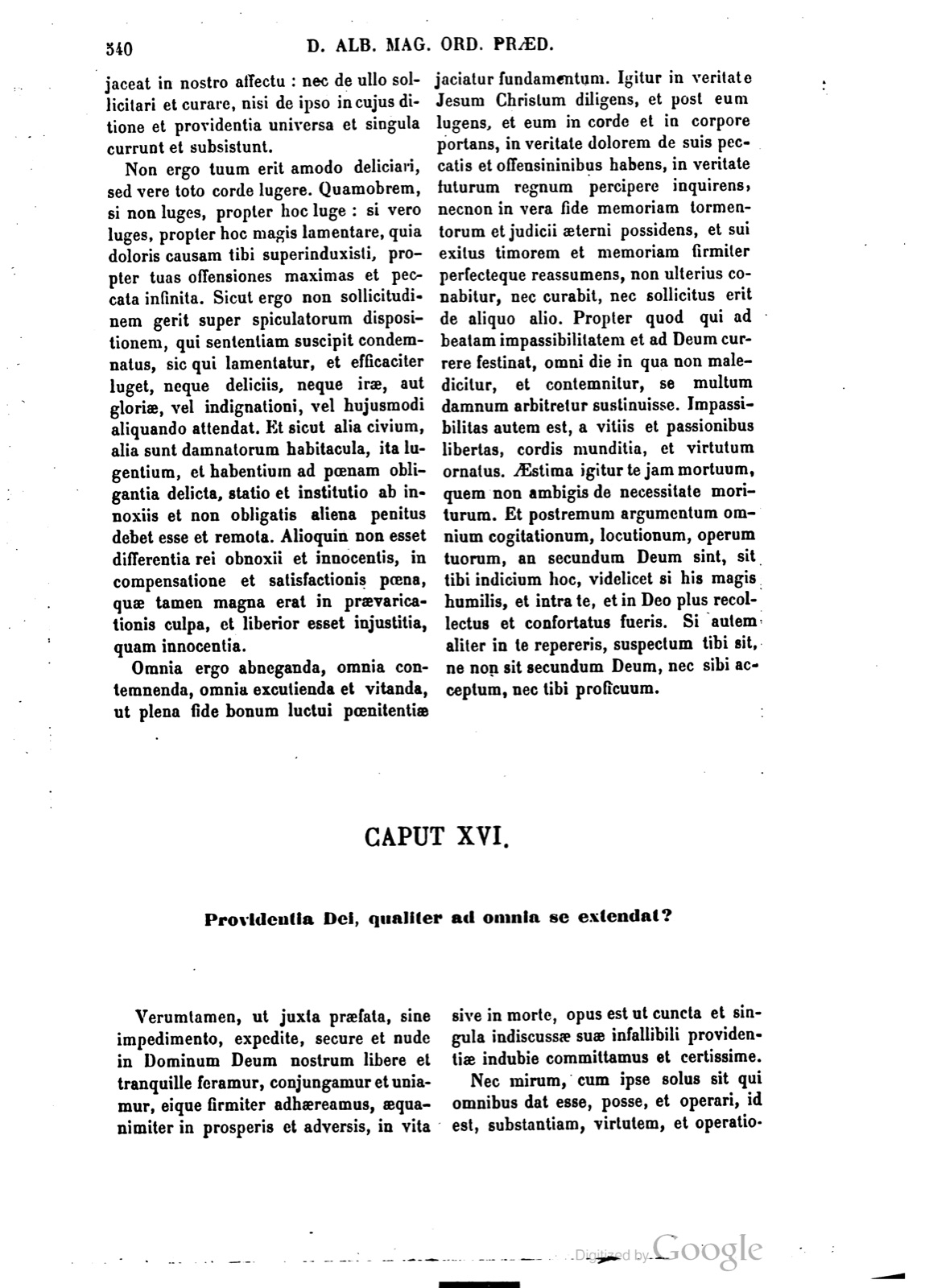
Caput XVI. Providentia Dei, qualiter ad omnia se extendat?
Verumtamen, ut juxta praefata, sine impedimento, expedite, secure et nude in Dominum Deum nostrum libere et tranquille feramur, conjungamur et uniamur, eique firmiter adhaereamus, aequanimiter in prosperis et adversis, in vita sive in morte, opus est ut cuncta et singula indiscussae suae infallibili providentiae indubie committamus et certissime.
Nec mirum, cum ipse solus sit qui omnibus dat esse, posse, et operari, id est, substantiam, virtutem, et operationem, speciem, modum, et ordinem in numero, pondere, et mensura. Praesertim cum sicut opus artis praesupponit opus naturae, ita opus naturae praesupponit opus Dei creantis, conservantis, ordinantis, et administrantis: eo quod ipsius solius sit infinita potentia, sapientia, bonitas, et essentialis misericordia, justitia, et veritas, charitasque, immutabilis aeternitas et immensitas.
Nulla ergo res potest propria virtute subsistere, nec agere, nisi agat in virtute ipsius Dei, scilicet primi moventis, primi principii, qui est causa omnis actionis, et operatur in omni agente. Quippe quantum ad rationem ordinis pertinet, Deus immediate omnibus providet, et usque ad ultima singularia. Nihil igitur a maximo usque ad minimum sempiternam Dei providentiam effugit, nec declinat etiam, sive in voluntariis, sive in casualibus, sive in fortuitis nec de se intentis. Sed nec aliquid Deus facere potest, quin sub ordinem suae providentiae cadat, sicut non potest facere aliquid, quod ejus operationi non subdatur.
Extendit igitur se providentia divina ad omnia et singula, etiam usque ad hominum cogitata. Qua de re Scriptura, juxta illud primae Petri, V, 7: Omnem sollicitudinem vestram projicientes in eum, quoniam ipsi cura est de vobis. Et rursum Propheta: Jacta super Dominum curam tuam, et ipse te enutriet 1. Et, Ecclesiastici, II, 11 et 12: Respicite, filii, nationes hominum, et scitote quia nullus speravit in Domino et confusus est. Qui enim permansit in mandatis ejus, et derelictus est? Et Dominus ait: Nolite solliciti esse, dicentes: Quid manducabimus 2? Quidquid ergo, et quantumcumque magnum a Deo sperare possumus, erimus sine dubio accepturi, secundum illud Deuteronomii, XI, 24: Omnis locus quem calcaverit pes vester, vester erit. Quia quantumcumque desiderare quis potuerit, tantum est accepturus: et quatenus fiduciae pedem porrexerit, eatenus possidebit. Unde Bernardus: « Auctor omnium Deus tantae abundat visceribus pietatis, ut ad quantumcumque gratiam fiduciae sinum extendere poterimus, tantum erimus sine dubio accepturi. » Unde, Marci, XI, 24: Omnia quaecumque orantes petitis, credite quia accipietis, et evenient vobis.
Chapter XVI. The providence of God, how it extends itself to all things?
Nevertheless, so that, according to the things said before, without impediment, readily, securely, and nakedly, we may be freely and tranquilly carried into our Lord God, joined and united, and firmly adhere to him, with equanimity in prosperous and adverse things, in life or in death, it is necessary that we indubitably and most certainly commit all things, each and all, to his undiscussed and infallible providence.
Nor is it marvelous, since he alone is the one who gives to all things being, power, and operation, that is, substance, virtue, and operation, species, mode, and order in number, weight, and measure. Especially since, as the work of art presupposes the work of nature, so the work of nature presupposes the work of God creating, conserving, ordering, and administering, because infinite power, wisdom, goodness, and essential mercy, justice and truth, and charity, unchangeable eternity and immensity, belong to him alone.
Therefore no thing can subsist by its own power, nor act, unless it acts in the power of God himself, namely of the first mover, the first principle, who is the cause of every action and works in every agent. Indeed, as far as the notion of order is concerned, God immediately provides for all things, even down to the last singular things. Therefore nothing from the greatest down to the least escapes the everlasting providence of God, nor even declines from it, whether in voluntary things, or in casual things, or in fortuitous things and things not intended of themselves. But neither can God do anything that does not fall under the order of his providence, just as he cannot do anything that is not subject to his operation.
Therefore divine providence extends itself to all things and each thing, even to the thoughts of men. For this reason Scripture, according to that saying of 1 Peter 5:7: Casting all your care upon him, because he has care for you. And again the Prophet: Cast your care upon the Lord, and he will nourish you 1. And Ecclesiasticus 2:11 and 12: Look, sons, at the nations of men, and know that no one has hoped in the Lord and been confounded. For who has remained in his commandments and been abandoned? And the Lord says: Do not be solicitous, saying: What shall we eat 2? Therefore whatever, and however great a thing, we can hope from God, we shall without doubt receive, according to that saying of Deuteronomy 11:24: Every place that your foot shall tread upon will be yours. For however much anyone could desire, so much he will receive; and as far as he has extended the foot of trust, so far he will possess. Hence Bernard says: « God, the author of all things, abounds with such bowels of piety that, to whatever extent we shall be able to extend the bosom of trust toward grace, so much we shall without doubt receive. » Hence, Mark 11:24: All things whatsoever you ask when praying, believe that you will receive, and they will come to you.
Porro, quanto haec fiducia in Deum fortior est et instantior, et quanto in Deo cum humilitate et reverentia se violentius erigit, tanto securius, et abundantius, et citius, quod sperabat, impetrabit ac obtinebit.
At vero, si inter haec propter multitudinem et magnitudinem peccatorum fiducia in Deum se erigere tependo retardat, animadvertat qui hujusmodi est, quod omnia possibilia sunt apud Deum: et quod vult, necesse est quod fiat, et quod non vult, impossibile est ut fiat: et quod tam facile est ei tam innumerabilia peccata, quantumcumque enormia, remittere et delere, sicut unum peccatum. Et sicut peccator non potest, quantum in se est, ab innumerabilibus peccatis surgere, et se ab eis excutere et absolvere, sic nec ab uno peccato. Non enim possumus non solum facere, sed nec cogitare bonum a nobis, quasi ex nobis, sed hoc ex Deo est 3.
Attamen utique multo periculosius est, pluribus irretitum esse peccatis, caeteris paribus, quam uno solo: quia nullum malum impunitum, et cuique peccato mortali debetur infinita poena, et hoc de rigore justitiae, eo quod quodlibet tale peccatum sit contra Deum, qui est actu infinitae reverentiae, dignitatis, et honorificentiae.
Moreover, the stronger and more urgent this trust in God is, and the more violently it raises itself in God with humility and reverence, the more securely, abundantly, and quickly it will ask and obtain what it hoped.
But if, among these things, because of the multitude and magnitude of sins, trust in God delays in tepidity to raise itself, let the person of this kind notice that all things are possible with God; and that what he wills must necessarily happen, and that what he does not will is impossible to happen; and that it is as easy for him to remit and destroy so many innumerable sins, however enormous, as one sin. And just as a sinner cannot, as far as lies in himself, rise from innumerable sins and shake and absolve himself from them, so neither can he rise from one sin. For not only can we not do good from ourselves, but we cannot even think good from ourselves, as if from ourselves; rather this is from God 3.
Yet certainly it is much more dangerous, other things being equal, to be ensnared by many sins than by one alone, because no evil is unpunished, and to each mortal sin an infinite punishment is owed, and this according to the rigor of justice, because any such sin is against God, who is of actually infinite reverence, dignity, and honorableness.
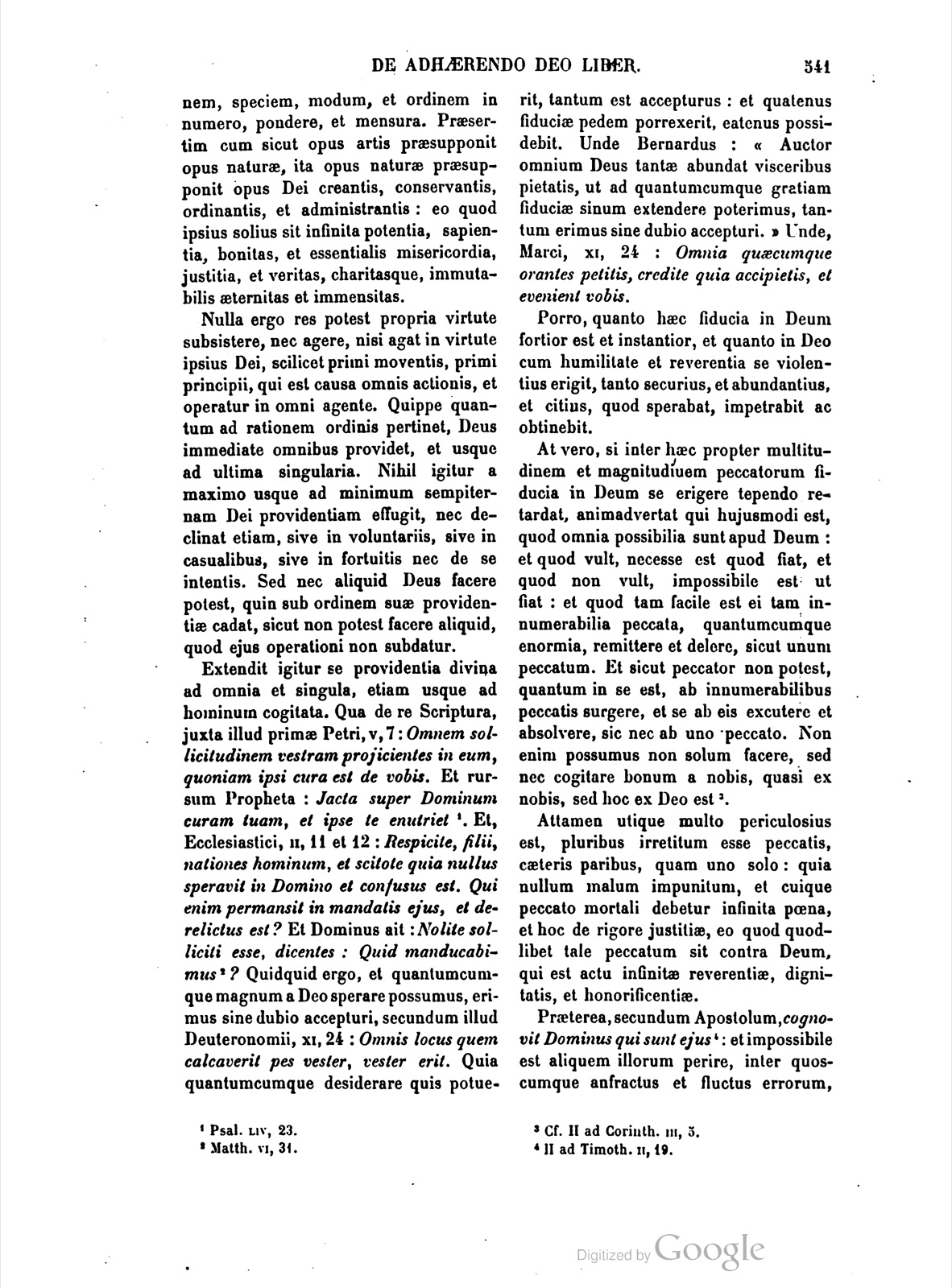
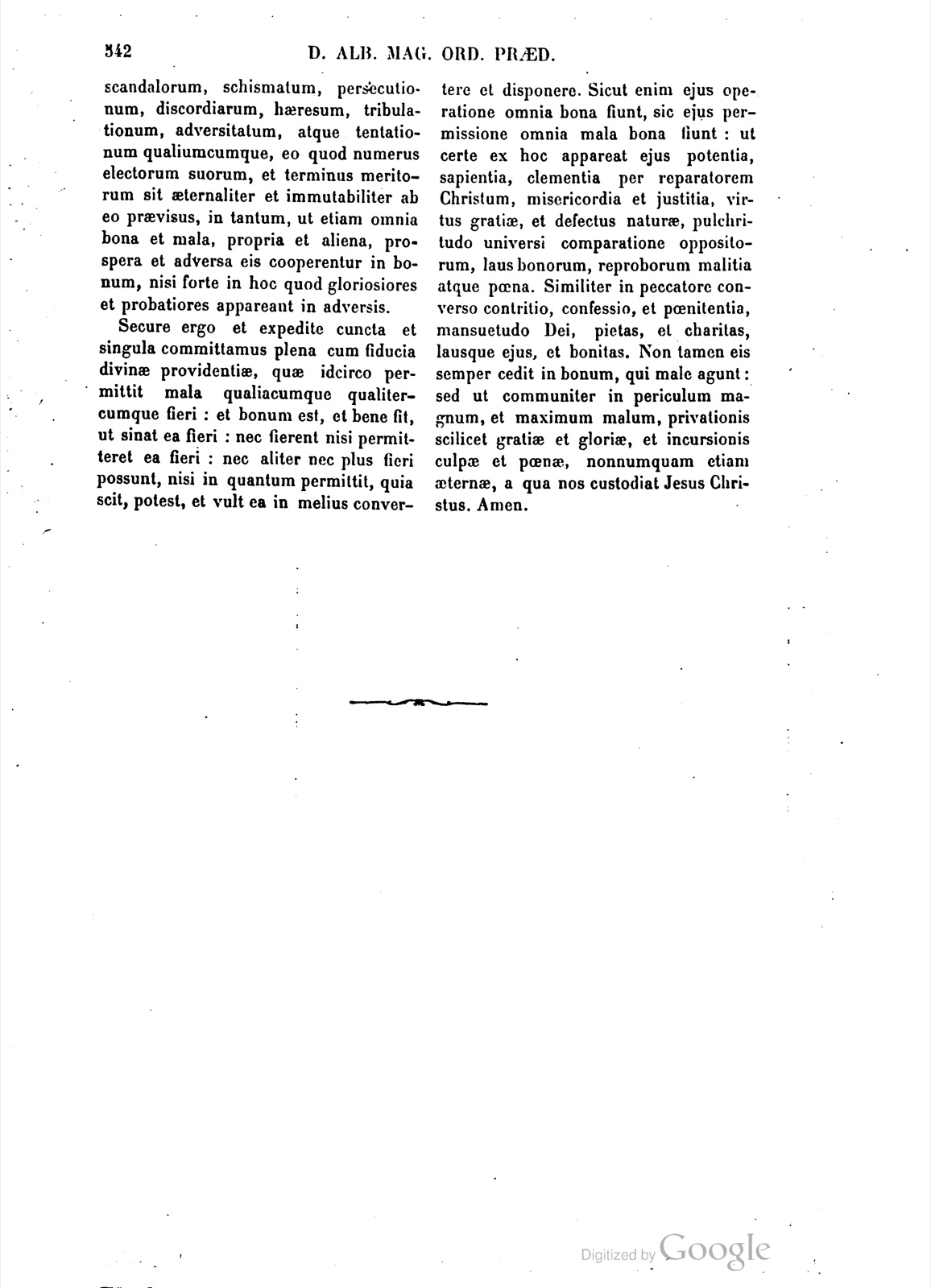
Praeterea, secundum Apostolum, cognovit Dominus qui sunt ejus 4: et impossibile est aliquem illorum perire, inter quoscumque anfractus et fluctus errorum, scandalorum, schismatum, persecutionum, discordiarum, haeresum, tribulationum, adversitatum, atque tentationum qualiumcumque, eo quod numerus electorum suorum, et terminus meritorum sit aeternaliter et immutabiliter ab eo praevisus, in tantum, ut etiam omnia bona et mala, propria et aliena, prospera et adversa eis cooperentur in bonum, nisi forte in hoc quod gloriosiores et probatiores appareant in adversis.
Secure ergo et expedite cuncta et singula committamus plena cum fiducia divinae providentiae, quae idcirco permittit mala qualiacumque qualitercumque fieri: et bonum est, et bene fit, ut sinat ea fieri: nec fierent nisi permitteret ea fieri: nec aliter nec plus fieri possunt, nisi in quantum permittit, quia scit, potest, et vult ea in melius convertere et disponere. Sicut enim ejus operatione omnia bona fiunt, sic ejus permissione omnia mala bona fiunt: ut certe ex hoc appareat ejus potentia, sapientia, clementia per reparatorem Christum, misericordia et justitia, virtus gratiae, et defectus naturae, pulchritudo universi comparatione oppositorum, laus bonorum, reproborum malitia atque poena. Similiter in peccatore converso contritio, confessio, et poenitentia, mansuetudo Dei, pietas, et charitas, lausque ejus, et bonitas. Non tamen eis semper cedit in bonum, qui male agunt: sed ut communiter in periculum magnum, et maximum malum, privationis scilicet gratiae et gloriae, et incursionis culpae et poenae, nonnumquam etiam aeternae, a qua nos custodiat Jesus Christus. Amen.
Furthermore, according to the Apostle, the Lord knows those who are his 4; and it is impossible that any of them perish amid whatever windings and waves of errors, scandals, schisms, persecutions, discords, heresies, tribulations, adversities, and temptations of whatever kind, because the number of his elect and the limit of their merits has been foreseen by him eternally and immutably, so much so that even all good and evil things, their own and others', prosperous and adverse, work together for their good, unless perhaps in this, that they may appear more glorious and more tested in adversities.
Therefore securely and readily let us commit all things, each and all, with full trust to divine providence, which for this reason permits evils of whatever kind to happen in whatever way: and it is good, and is done well, that he allows them to happen; nor would they happen unless he permitted them to happen; nor can they happen otherwise or more than insofar as he permits, because he knows, can, and wills to convert and dispose them for the better. For just as by his operation all good things are made, so by his permission all evil things become good, so that certainly from this his power, wisdom, clemency through Christ the restorer, mercy and justice, the virtue of grace, and the defect of nature, the beauty of the universe by comparison of opposites, the praise of the good, and the malice and punishment of the reprobate may appear. Similarly in the converted sinner there appear contrition, confession, and penitence, the gentleness of God, piety and charity, and his praise and goodness. Nevertheless, for those who act badly it does not always fall out for good, but commonly into great danger and the greatest evil, namely the privation of grace and glory, and the incurring of guilt and punishment, sometimes even eternal punishment, from which may Jesus Christ guard us. Amen.
If a page does not appear, its photograph has not been uploaded yet.