Volume 37 · pp. 535–536
Chapter XII. On the love of God, how efficacious it is.
A marker with ≈ is an approximate page boundary, placed by measure of the text; the page photographs remain the authority. In the paired views, clicking a page marker brings that page into view.
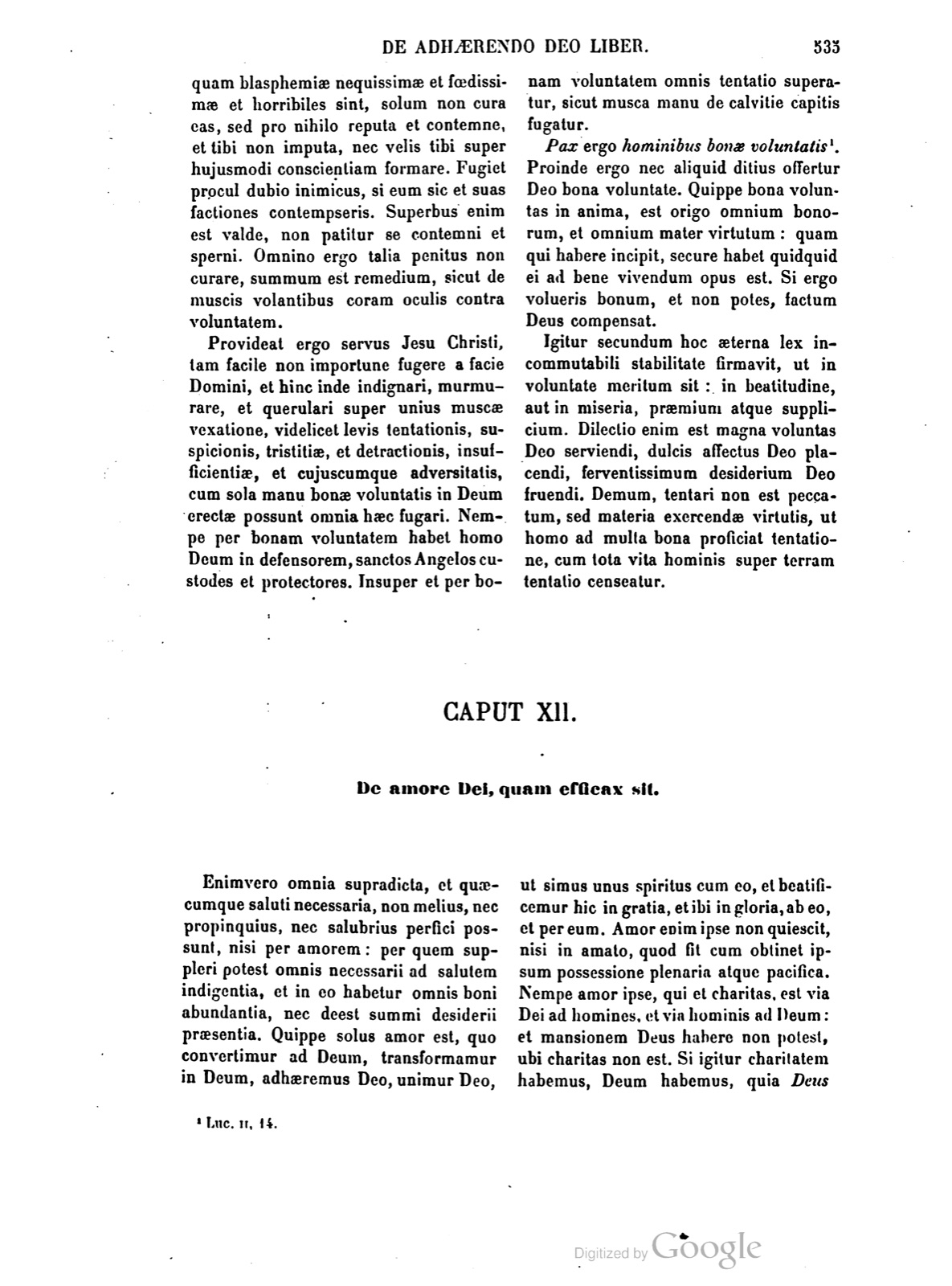
Caput XII. De amore Dei, quam efficax sit.
Enimvero omnia supradicta, et quaecumque saluti necessaria, non melius, nec propinquius, nec salubrius perfici possunt, nisi per amorem: per quem suppleri potest omnis necessarii ad salutem indigentia, et in eo habetur omnis boni abundantia, nec deest summi desiderii praesentia. Quippe solus amor est, quo convertimur ad Deum, transformamur in Deum, adhaeremus Deo, unimur Deo, ut simus unus spiritus cum eo, et beatificemur hic in gratia, et ibi in gloria, ab eo, et per eum. Amor enim ipse non quiescit, nisi in amato, quod fit cum obtinet ipsum possessione plenaria atque pacifica. Nempe amor ipse, qui et charitas, est via Dei ad homines, et via hominis ad Deum: et mansionem Deus habere non potest, ubi charitas non est. Si igitur charitatem habemus, Deum habemus, quia Deus charitas est 1.
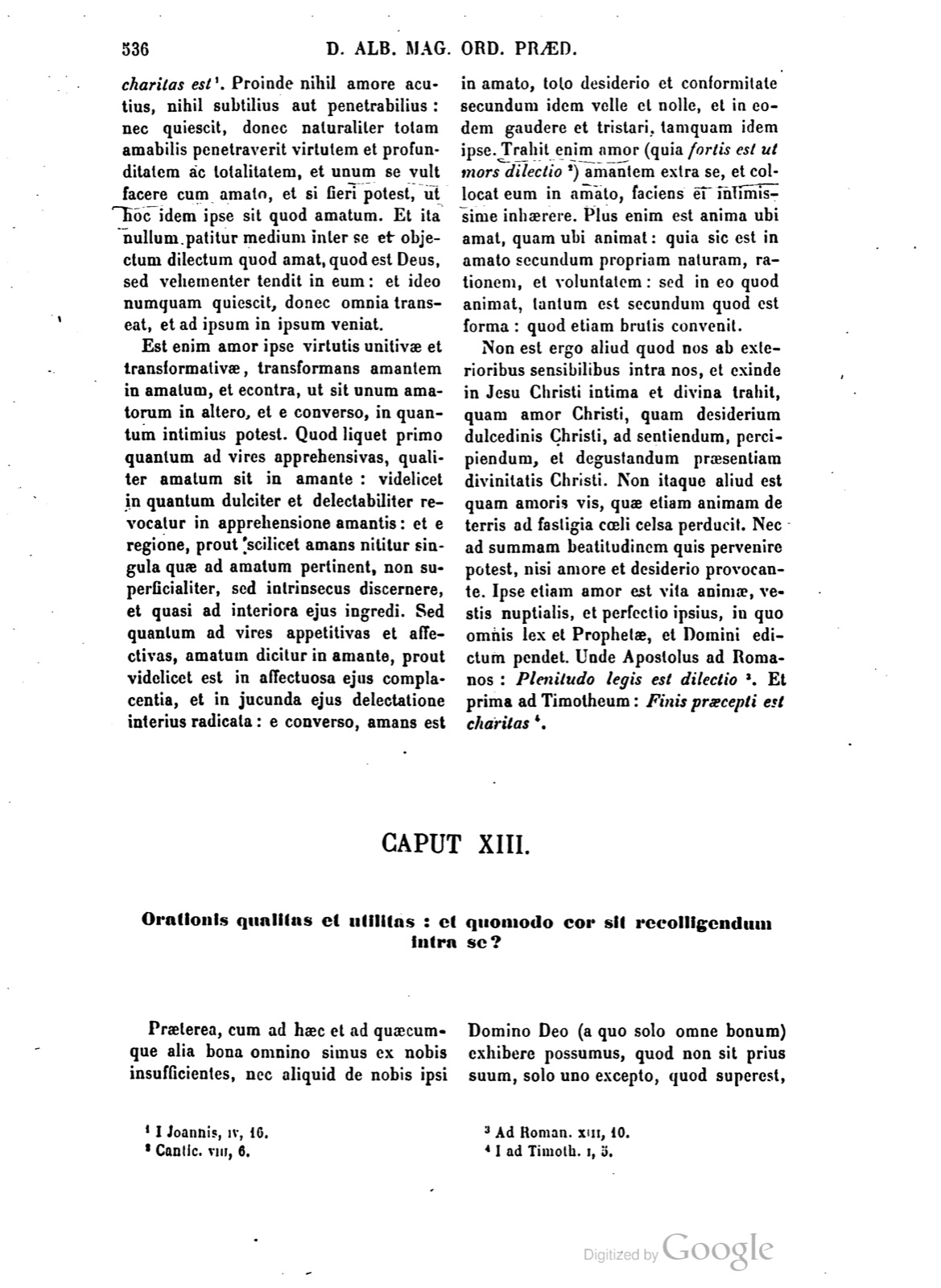
Proinde nihil amore acutius, nihil subtilius aut penetrabilius: nec quiescit, donec naturaliter totam amabilis penetraverit virtutem et profunditatem ac totalitatem, et unum se vult facere cum amato, et si fieri potest, ut hoc idem ipse sit quod amatum. Et ita nullum patitur medium inter se et objectum dilectum quod amat, quod est Deus, sed vehementer tendit in eum: et ideo numquam quiescit, donec omnia transeat, et ad ipsum in ipsum veniat.
Est enim amor ipse virtutis unitivae et transformativae, transformans amantem in amatum, et econtra, ut sit unum amatorum in altero, et e converso, in quantum intimius potest. Quod liquet primo quantum ad vires apprehensivas, qualiter amatum sit in amante: videlicet in quantum dulciter et delectabiliter revocatur in apprehensione amantis: et e regione, prout scilicet amans nititur singula quae ad amatum pertinent, non superficialiter, sed intrinsecus discernere, et quasi ad interiora ejus ingredi. Sed quantum ad vires appetitivas et affectivas, amatum dicitur in amante, prout videlicet est in affectuosa ejus complacentia, et in jucunda ejus delectatione interius radicata: e converso, amans est in amato, toto desiderio et conformitate secundum idem velle et nolle, et in eodem gaudere et tristari, tamquam idem ipse. Trahit enim amor (quia fortis est ut mors dilectio 2) amantem extra se, et collocat eum in amato, faciens ei intimissime inhaerere. Plus enim est anima ubi amat, quam ubi animat: quia sic est in amato secundum propriam naturam, rationem, et voluntatem: sed in eo quod animat, tantum est secundum quod est forma: quod etiam brutis convenit.
Chapter XII. On the love of God, how efficacious it is.
Indeed, all the things said above, and whatever things are necessary for salvation, cannot be accomplished better, more nearly, or more wholesomely except through love. Through love every lack of what is necessary for salvation can be supplied, and in it there is the abundance of every good, nor is the presence of the highest desire lacking. For love alone is that by which we are converted to God, are transformed into God, adhere to God, are united to God, so that we may be one spirit with him, and may be beatified here in grace and there in glory, by him and through him. For love itself does not rest except in the beloved, which happens when it obtains him with full and peaceful possession. Indeed love itself, which is also charity, is the way of God to men and the way of man to God; and God cannot have a dwelling where charity is not. Therefore if we have charity, we have God, because God is charity 1.
Therefore nothing is sharper than love, nothing subtler or more penetrating; nor does it rest until it has naturally penetrated the whole power, depth, and totality of the lovable one, and it wills to make itself one with the beloved, and, if it can be done, so that it itself may be this same thing which the beloved is. And thus it suffers no middle thing between itself and the beloved object which it loves, which is God, but tends vehemently into him. And therefore it never rests until it passes beyond all things and comes to him, into him.
For love itself belongs to unitive and transformative power, transforming the lover into the beloved, and conversely, so that one of the lovers is in the other, and conversely, as inwardly as it can be. This is clear first with respect to the apprehensive powers, how the beloved is in the lover: namely insofar as he is recalled sweetly and delightfully in the apprehension of the lover; and on the opposite side, insofar as the lover strives to discern each thing that pertains to the beloved, not superficially, but inwardly, and as it were to enter his inner parts. But with respect to the appetitive and affective powers, the beloved is said to be in the lover insofar as he is in the lover's affectionate complacency and in his pleasant delight rooted inwardly. Conversely, the lover is in the beloved by his whole desire and conformity according to the same willing and not willing, and by rejoicing and being saddened in the same thing, as the same one himself. For love draws the lover outside himself, because love is strong as death 2, and places him in the beloved, making him adhere to him most inwardly. For the soul is more where it loves than where it animates, because thus it is in the beloved according to its proper nature, reason, and will; but in that which it animates, it is only according as it is form, which also belongs to brute animals.
Non est ergo aliud quod nos ab exterioribus sensibilibus intra nos, et exinde in Jesu Christi intima et divina trahit, quam amor Christi, quam desiderium dulcedinis Christi, ad sentiendum, percipiendum, et degustandum praesentiam divinitatis Christi. Non itaque aliud est quam amoris vis, quae etiam animam de terris ad fastigia coeli celsa perducit. Nec ad summam beatitudinem quis pervenire potest, nisi amore et desiderio provocante. Ipse etiam amor est vita animae, vestis nuptialis, et perfectio ipsius, in quo omnis lex et Prophetae, et Domini edictum pendet. Unde Apostolus ad Romanos: Plenitudo legis est dilectio 3. Et prima ad Timotheum: Finis praecepti est charitas 4.
Therefore there is nothing else that draws us from exterior sensible things within ourselves, and from there into the inward and divine things of Jesus Christ, than the love of Christ, than the desire for the sweetness of Christ, for sensing, perceiving, and tasting the presence of the divinity of Christ. And so it is nothing other than the force of love that also leads the soul from earth to the high summits of heaven. Nor can anyone arrive at highest beatitude unless love and desire provoke him. Love itself also is the life of the soul, the wedding garment, and its perfection, in which the whole law and the Prophets and the command of the Lord hang. Hence the Apostle to the Romans: The fullness of the law is love 3. And in the first to Timothy: The end of the command is charity 4.
If a page does not appear, its photograph has not been uploaded yet.