Volume 37 · pp. 421–425
The Gospel according to Matthew, page 421
EVANGELIUM SECUNDUM MATTHAEUM.
Liber generationis Jesu Christi, filii David, filii Abraham 1.
1. Domina Evangelistarum in Evangelio B. Matthaei, I, 18: Cum esset desponsata, etc. Magna fuit humilitas, quod Domina voluit desponsari servo, Imperatrix fabro. Unde Bernardus: "Quae est haec virgo tam venerabilis, ut salutetur ab Angelo, tam humilis ut desponsata sit fabro, etc. Audis, o peccator, virginem, audis humilem: si non potes virginitatem humilis, imitare humilitatem Virginis. Potes enim sine virginitate salvari, sine humilitate vero non potes, etc. Maria enim placuit ex virginitate, tamen ex humilitate concepit 2."
Fuit autem desponsatio Virginis utilis propter multa. Primo, ut matrimonium bonum esse ostenderetur. Secundo, ut Maria nullo bono privaretur. Tertio, ut hostis falleretur. Quarto, ut testis castitatis haberetur. Quinto, ut origo Dominae describeretur, nam Scriptura non consuevit foeminas genealogizare. Sexto, ut ab infamia servaretur. Septimo, ut poena caveretur. Octavo, ut a Christo persecutio tolleretur. Nono, ut filius procuraretur. Decimo, ut Domino serviretur. Undecimo, ut humilitas virginitati conjungeretur. Duodecimo, ut occasio incuriae famae virginibus tollatur. Decimo tertio, ut Filii charitas et humilitas ostendatur, qui voluit potius dici filius fabri, quam matrem infamari. Decimo quarto, ut matris dignitas humilitati sociaretur, ut quanto major esset, tanto magis se humiliaret, videlicet ut sit mater Dei et uxor fabri.
2. Item, Ipsa commendatur a sublimi dignitate, eo quod fit mater Jesu. Bernardus 3: Quod si et cujus mater attendas, etc., an non Deum et Dominum Angelorum Maria suum audacter appellat filium, dicens: Fili, quid fecisti nobis sic 4."
3. Item, Commendatur a fidelitate: reposuit enim Deus nostrae redemptionis thesaurum in ea, ut ibi, Inventa est in utero habens. Sed quid? Bernardus: "Angeli laetitiam, justi gratiam, peccatores veniam. Redde ergo, mater, quod debes, obsidem quo redimamur, thesaurum quo ditemur, fratrem quo uniamur, Deum per quem exaltemur: hoc enim in utero habes."
4. Commendatur item a puritate summa, ut ibi, De spiritu sancto. Unde, Anselmus: "Decens erat, ut ea puritate qua major sub Deo nequit intelligi, virgo
THE GOSPEL ACCORDING TO MATTHEW.
The book of the generation of Jesus Christ, the son of David, the son of Abraham 1.
1. The Lady of the Evangelists in the Gospel of blessed Matthew, 1:18: When she had been betrothed, and so forth. Great was the humility, that the Lady wished to be betrothed to a servant, the Empress to a craftsman. Whence Bernard: "Who is this virgin so venerable that she is greeted by an Angel, so humble that she is betrothed to a craftsman, and so forth? You hear, O sinner, a virgin; you hear one humble. If you cannot imitate the virginity of the humble one, imitate the humility of the Virgin. For you can be saved without virginity, but without humility you cannot, and so forth. For Mary pleased by virginity, yet conceived by humility 2."
But the betrothal of the Virgin was useful for many things. First, so that marriage might be shown to be good. Second, so that Mary might be deprived of no good. Third, so that the enemy might be deceived. Fourth, so that a witness of chastity might be had. Fifth, so that the origin of the Lady might be described, for Scripture is not accustomed to genealogize women. Sixth, so that she might be preserved from infamy. Seventh, so that punishment might be guarded against. Eighth, so that persecution might be removed from Christ. Ninth, so that a son might be provided. Tenth, so that the Lord might be served. Eleventh, so that humility might be joined to virginity. Twelfth, so that the occasion of carelessness about reputation might be taken away from virgins. Thirteenth, so that the charity and humility of the Son might be shown, who preferred to be called the son of a craftsman rather than have his mother defamed. Fourteenth, so that the dignity of the mother might be associated with humility, so that the greater she was, by so much the more she might humble herself, namely that she should be the mother of God and the wife of a craftsman.
2. Likewise, she herself is commended from sublime dignity, in that she becomes the mother of Jesus. Bernard 3: If you attend also to whose mother she is, and so forth, does not Mary boldly call God and the Lord of Angels her son, saying: Son, why have you done thus to us 4?"
3. Likewise, she is commended from faithfulness: for God stored the treasure of our redemption in her, as there: She was found having in the womb. But what? Bernard says: "The joy of Angels, the grace of the just, pardon for sinners. Therefore give back, O mother, what you owe: the hostage by whom we may be redeemed, the treasure by which we may be enriched, the brother by whom we may be united, God through whom we may be exalted; for this you have in the womb."
4. Likewise she is commended from highest purity, as there: Of the Holy Spirit. Whence Anselm: "It was fitting that with that purity, than which no greater can be understood under God, the virgin
illa niteret, cui Deus Pater unicum Filium suum, quem de corde suo aequalem sibi genitum, tamquam seipsum diligebat, ita dare disponebat, ut naturaliter esset unus idemque communis Dei Patris et Virginis Filius, et quam ipse Filius substantialiter sibi matrem eligebat, et de qua Spiritus sanctus volebat, et operaturus erat, ut conciperetur et nasceretur ille, de quo procedebat 5."
5. Item, Commendatur a nativitatis Dei utilitate, ut ibi, v. 20: Joseph, fili David, etc. Sequitur, v. 21 et seq.: Pariet autem filium, etc. Sed quem? Angelorum restauratorem, hominum redemptorem, corporalium innovatorem. Et vocabitur nomen ejus, ut dicit Isaias, Emmanuel 6; quod est interpretatum nobiscum Deus. Nobiscum fraternitate, quia frater et caro nostra est 7. Nobiscum conversatione, Joan. XVII, 12: Pater, ... quos dedisti mihi, custodivi, etc. Nobiscum provisione. I Petri, V, 7: Omnem sollicitudinem vestram projicientes in eum. Nobiscum in aeterna habitatione, Matth. XXVIII, 20: Ecce ego vobiscum sum omnibus diebus, usque ad consummationem saeculi.
6. Item, Ipsa est stella in Oriente. Matth. II, 2: Vidimus stellam ejus in Oriente. Haec stella primo apparet peccatori ad Deum redeunti: unde sequitur: Et venimus adorare eum, id est, Filium Dei et Dominam, matrem ejus.
7. Item, Ipsa turbat Herodem, id est, diabolum, ut ibi, v. 3: Audiens autem Herodes rex, turbatus est, etc. et infra, v. 7: Herodes diligenter didicit ab eis tempus stellae, id est, Mariae, quae apparuit per naturam, in mundum nascendo, et per gratiam in mente apparendo: Herodes igitur, id est, diabolus vehementius expavescit.
8. Item, Ipsa praestat se sequentibus ducatum, ut ibi, v. 9: Et ecce stella quam viderant in Oriente, antecedebat eos, ut reconciliatrix reorum, et hospitum invitatrix.
9. Item, Ipsa peregrinos suos laetificat, ut ibi, v. 10: Videntes autem stellam, id est, Mariam, gavisi sunt gaudio magno valde.
10. Item, Ipsa Maria in duobus assumi debet ad diabolum fugandum et in patriam redeundum. De primo, ibidem, v. 13: Angelus Domini apparuit in somnis Joseph, id est, peccatori in peccatis dormienti, dicens: Surge, scilicet celeriter, et accipe puerum et matrem ejus, scilicet Patri in oblationem puerum, matrem in reconciliationem, ut pro te loquatur. De secundo, Angelus dixit Joseph, Matth. II, 20: Surge laetanter, et accipe puerum et matrem ejus, et vade in terram Israel, id est, in caelestem patriam: defuncti sunt enim qui quaerebant animam pueri, imo et animam tuam, scilicet daemones, vos tentantes, cogitationes impugnantes, mundum decipientes, qui quaerunt gratiam Christi in te exstinguere, et te ad infernum rapere.
11. Item, Ipsa est mons illuminationis omnium beatitudinum. Matth. V, 1 et seq.: Videns Jesus turbas, ascendit in montem, id est, Mariam in incarnatione. Prima autem illuminatio beatitudinis est illuminatio paupertatis: unde, v. 3: Beati pauperes spiritu, etc. Beati pauperes. Glossa: quos non necessitas, sed fides et devotio pauperes facit, ut contemptis omnibus, Deo vivant. Talis autem contemptus omnium rerum, in beata Virgine in summo fuit. Quidam enim dant superflua naturae, sed non personae. Augustinus: "Utere superfluis, da pauperibus necessaria:
should shine, to whom God the Father was arranging to give his only Son, whom, begotten from his heart as equal to himself, he loved as himself, in such a way that naturally one and the same Son would be common to God the Father and the Virgin; and she whom the Son himself was substantially choosing as mother for himself, and from whom the Holy Spirit was willing and was going to work that he should be conceived and born, he from whom he proceeded 5."
5. Likewise, she is commended from the usefulness of the nativity of God, as there, verse 20: Joseph, son of David, and so forth. There follows, verse 21 and following: But she will bear a son, and so forth. But whom? The restorer of Angels, the redeemer of human beings, the renewer of bodily things. And his name will be called, as Isaiah says, Emmanuel 6, which is interpreted God-with-us. With us by brotherhood, because he is our brother and flesh 7. With us by companionship, John 17:12: Father, ... those whom you gave me, I have guarded, and so forth. With us by provision, 1 Peter 5:7: Casting all your care upon him. With us in eternal dwelling, Matthew 28:20: Behold, I am with you all days, even to the consummation of the age.
6. Likewise, she herself is the star in the East. Matthew 2:2: We have seen his star in the East. This star first appears to the sinner returning to God; whence there follows: And we have come to adore him, that is, the Son of God and the Lady, his mother.
7. Likewise, she herself troubles Herod, that is, the devil, as there, verse 3: But Herod the king, hearing, was troubled, and so forth; and below, verse 7: Herod diligently learned from them the time of the star, that is, of Mary, who appeared through nature, by being born into the world, and through grace, by appearing in the mind; therefore Herod, that is, the devil, is more vehemently terrified.
8. Likewise, she herself furnishes leadership to those following her, as there, verse 9: And behold, the star which they had seen in the East went before them, as the reconciler of the guilty and inviter of guests.
9. Likewise, she herself gladdens her pilgrims, as there, verse 10: But seeing the star, that is, Mary, they rejoiced with exceedingly great joy.
10. Likewise, Mary herself ought to be taken up in two things: for driving away the devil and for returning into the homeland. Concerning the first, in the same place, verse 13: The Angel of the Lord appeared in dreams to Joseph, that is, to the sinner sleeping in sins, saying: Arise, namely quickly, and take the child and his mother, namely the child for offering to the Father, the mother for reconciliation, so that she may speak for you. Concerning the second, the Angel said to Joseph, Matthew 2:20: Arise joyfully, and take the child and his mother, and go into the land of Israel, that is, into the heavenly homeland; for those who sought the soul of the child have died, indeed also those who sought your soul, namely demons, tempting you, thoughts attacking you, the world deceiving you, who seek to extinguish the grace of Christ in you and to drag you to hell.
11. Likewise, she herself is the mountain of the illumination of all the beatitudes. Matthew 5:1 and following: Jesus, seeing the crowds, ascended the mountain, that is, Mary in the incarnation. But the first illumination of beatitude is the illumination of poverty; whence, verse 3: Blessed are the poor in spirit, and so forth. Blessed are the poor. Gloss: those whom not necessity but faith and devotion makes poor, so that, with all things despised, they may live to God. But such contempt of all things was in the blessed Virgin in the highest degree. For some give the superfluous things of nature, but not of the person. Augustine: "Use superfluous things; give necessary things to the poor:
utere pretiosis, da pauperibus vilia: et iste est primus gradus paupertatis 8." Secundus gradus est, dare superflua naturae, et personae. Luc. XI, 41: Quod superest, date eleemosynam. Glossa: Non solum exteriora, sed valde necessaria cum proximis dividamus. Tertius gradus est, non tantum dare superflua, sed etiam necessaria. Unde, Luc. III, 11: Qui habet duas tunicas, det non habenti. Quartus gradus est, omnia necessaria et superflua simul dare, sed adhuc semetipsum retinere: sicut quidam Philosophorum fecerunt, licet non propter Deum. Quintus gradus est, omnia dare, et semetipsum relinquere: propterea manibus laborare, ut habeat unde necessitatem tribuat patienti. Hunc gradum habuit Apostolus. Sextus gradus est, omnia dare, et semetipsum superaddere. Unde in Evangelio Matthaei, XIX, 21: Si vis perfectus esse, vade, vende, etc. Septimus gradus est, omnia dare, et semetipsum, et spiritu et corpore laborare, ut pascat proximum pane spirituali. Et iste excellentior est sexto: quia dicit Gregorius: "Plus est verbi pabulo victuram in perpetuum mentem reficere, quam ventrem moriturae carnis terreno pane satiare 9." Octavus gradus est, omnia, et seipsum relinquere, et de substantia sui corporis accipere partem ad refectionem animarum proximorum. Sicut beatissima Virgo de purissimis carnibus et sanguine, nobis panem vitae confecit, quem qui manducabit, mortem non gustabit in aeternum 10. Nonus gradus est, omnia dare, animam, et corpus proprium, etiam deitatem his unitam, proximo dare in cibum animae sub specie aliena. Hic est gradus summae paupertatis in via. Decimus est, seipsum dare, secundum totum corpus et animam, et deitatem sub specie propria in cibum corporis et animae simul in beatitudine aeterna, de qua dicitur, Luc. XIV, 15: Beatus qui manducabit panem in regno Dei. Hic patet, quod beata Maria paupertatem spiritus habeat excellentius omni homine, praeter Christum: quia cum ipsa praecellat omnes dignitate, et aequalem aliis habuerit paupertatem, excellit omnes improportionaliter paupertate.
Secunda illuminatio est mititas, ibi, Matth. V, 4: Beati mites, quoniam ipsi possidebunt terram. Istam mititatem et mansuetudinem, praeter Christum excellentissime habuit. Glossa: Mitis est, qui malis moribus dominatur, quod ipsa perfectissime fecit. Ejus enim dominium de malis moribus fuit sine pugna, omnium aliorum cum pugna. Item, Glossa: Mansuetus non irritat, nec irritatur. Cogitat enim nulli nocere, et omnibus in summo prodesse. Hoc ipsa perfectissime implevit. Unde eam collaudans Ecclesia in hymno: "Ave, maris stella", dicit de ea: "Virgo singularis, inter omnes mitis, nos, etc."
Tertia illuminatio est luctus. Ibidem, v. 5: Beati qui lugent, quoniam ipsi consolabuntur. Qui luctus post Christum excellentissime fuit in beata Virgine. Item, servitia quanto minus debita, tanto magis grata: sed luctus beatae Mariae Virginis nullo modo fuit debitus debito necessitatis, sed tantummodo debito charitatis: ergo sicut luctus ejus aliis fuit improportionabilis, ita et consolatio ejus aliis etiam fuit improportionabilis.
Quarta illuminatio est esuries et sitis justitiae, ibi, v. 6: Beati qui esuriunt et sitiunt justitiam, etc. Quae in ea similiter fuit excellentissime.
Quinta est illuminatio misericordiae, ibi, v. 8: Beati misericordes, quoniam ipsi misericordiam consequentur. Cum autem misericordia sit dare, et dimittere, et beata Virgo plus omnibus dedit, et super omnes plus dimisit: ergo super omnes beatitudinem misericordiae accepit. Ambrosius: "Misericordia est, nullum
use precious things; give cheap things to the poor; and this is the first degree of poverty 8." The second degree is to give the superfluous things of nature and of the person. Luke 11:41: What remains, give as alms. Gloss: Let us divide with our neighbors not only outward things, but very necessary things. The third degree is not only to give superfluous things, but also necessary things. Whence Luke 3:11: He who has two tunics, let him give to one who does not have. The fourth degree is to give all necessary and superfluous things together, but still to retain oneself: as certain Philosophers did, although not for God. The fifth degree is to give all things and to leave oneself: on that account to labor with the hands, so that one may have from which to give necessity to the one suffering need. The Apostle had this degree. The sixth degree is to give all things and to add oneself besides. Whence in the Gospel of Matthew 19:21: If you wish to be perfect, go, sell, and so forth. The seventh degree is to give all things, and oneself, and to labor in spirit and body, so as to feed one's neighbor with spiritual bread. And this is more excellent than the sixth, because Gregory says: "It is more to refresh with the food of the word the mind that will live forever than to satisfy with earthly bread the belly of flesh that will die 9." The eighth degree is to leave all things and oneself, and from the substance of one's own body to receive a part for the refreshment of the souls of neighbors. So the most blessed Virgin from her most pure flesh and blood made for us the bread of life, which whoever shall eat will not taste death forever 10. The ninth degree is to give all things, one's own soul and body, even the deity united to these, to one's neighbor as food of the soul under another species. This is the degree of highest poverty on the way. The tenth is to give oneself according to the whole body and soul, and deity under its own species, as food of body and soul together in eternal beatitude, concerning which Luke 14:15 says: Blessed is he who shall eat bread in the kingdom of God. Here it is clear that blessed Mary has poverty of spirit more excellently than every human being, except Christ; because, since she surpasses all in dignity and had poverty equal to others, she surpasses all disproportionately in poverty.
The second illumination is meekness, there, Matthew 5:4: Blessed are the meek, for they shall possess the land. She had this meekness and mildness, excepting Christ, most excellently. Gloss: The meek person is one who rules over bad manners; this she did most perfectly. For her rule over bad manners was without battle; the rule of all others is with battle. Likewise, Gloss: The mild person does not provoke, nor is provoked. For he thinks to harm no one and to profit all in the highest degree. She fulfilled this most perfectly. Whence the Church, praising her in the hymn "Hail, star of the sea," says concerning her: "Singular Virgin, meek among all, us, and so forth."
The third illumination is mourning. In the same place, verse 5: Blessed are they who mourn, for they shall be consoled. This mourning, after Christ, was most excellently in the blessed Virgin. Likewise, the less services are owed, the more pleasing they are; but the mourning of the blessed Virgin Mary was in no way owed by a debt of necessity, but only by a debt of charity. Therefore, just as her mourning was disproportionate to others, so also her consolation was disproportionate to others.
The fourth illumination is hunger and thirst for justice, there, verse 6: Blessed are they who hunger and thirst for justice, and so forth. This likewise was in her most excellently.
The fifth is the illumination of mercy, there, verse 8: Blessed are the merciful, for they shall obtain mercy. But since mercy is to give and to forgive, and the blessed Virgin gave more than all and forgave more over all, therefore above all she received the beatitude of mercy. Ambrose says: "Mercy is to leave no one
in miseria relinquere, et nullum miserum facere:" quod in summo est in beata Virgine: ergo in summo habet beatitudinem misericordiae.
Sexta est illuminatio munditiae, ibi, v. 8: Beati mundo corde, quoniam ipsi Deum videbunt. Sed hi (ut dicit Glossa) mundi corde sunt, quos non arguit conscientia peccatorum: sed hoc in beata Virgine fuit in summo: ergo habuit munditiam cordis in summo.
Septima est illuminatio pacis, ut ibi, v. 9: Beati pacifici, quoniam filii Dei vocabuntur. Glossa: Dum lex carnis repugnat legi mentis, non modo altero, sed nec hoc modo possumus esse pacifici. Ergo super omnes pacificata existebat, in qua caro adversus spiritum non rebellavit. Et sic ipsa beatitudinem summae pacis possidebat et possidet.
Octava illuminatio est martyrii vel persecutionis, ut ibi, v. 10: Beati qui persecutionem patiuntur propter justitiam. Hic agitur de persecutione illa, quae est martyrium, cui debetur laureola. Unde Bernardus: "Longe eam plusquam martyrem non immerito praedicamus, in qua nimirum corporeae sensum passionis excesserit compassionis affectus 11." Item, Bernardus super illud, In plenitudine Sanctorum detentio mea 13: "Merito in plenitudine sanctorum ejus erat detentio, cui non deerat fides Patriarcharum, nec Prophetarum spiritus, nec Apostolorum zelus, nec constantia Martyrum, nec sobrietas Confessorum, nec castitas Virginum, nec conjugatorum foecunditas, nec Angelorum puritas 12." Isti sunt octo radii illuminationis, quibus mens Virginis Mariae prae omnibus incomparabiliter est illuminata.
12. Item, Ipsa est civitas in excelsum et in refugium nobis posita. Matth. V, 14: Non potest civitas abscondi, id est, Maria celari, supra montem posita, scilicet virtutum, et gratiarum.
13. Item, Ipsa est lucerna omnibus lucens. Matth. V, 15: Neque accendunt, scilicet Pater, et Filius, et Spiritus sanctus, lucernam, id est, Mariam, quae accensa fuit in die incarnationis: et ponunt eam sub modio, sicut faciunt, ipsam inhonorantes, sed super candelabrum, id est, Ecclesiam, ut luceat, indifferenter, omnibus qui in domo sunt, id est, in Ecclesia, vel in mundo.
14. Item, Ipsa est altare nostrarum oblationum. Matth. V, 23 et 24: Si offers munus tuum ad altare, id est, ad Mariam, vade prius reconciliari fratri tuo, id est, Jesu Christo.
15. Item, Ipsa est datrix et mutuatrix nostra. Matth. V, 42: Qui petit a te, o Maria, instanter, da ei. Glossa: quae honeste et juste dari possunt: et volenti mutuare a te, quae ditissima es, ne avertaris.
16. Item, Ipsa est sol omnimicans. Matth. V, 45: Pater, qui solem suum, id est, Virginem Mariam, oriri facit, per nativitatem in mundo, per gratiam in mente, super bonos, ut confirmentur, consolentur, et illuminentur: et malos, ut convertantur, et salventur. Et pluit super justos et injustos, sed aliter et aliter.
17. Item, Ipsa est arbor bona, quae optimum fructum facit. Matth. VII, 18: Non potest arbor bona, id est, bona in natura,
in misery, and to make no one wretched"; this is in the blessed Virgin in the highest degree. Therefore she has the beatitude of mercy in the highest degree.
The sixth is the illumination of cleanness, there, verse 8: Blessed are the clean of heart, for they shall see God. But these, as the Gloss says, are clean of heart whom the conscience of sins does not accuse; but this was in the blessed Virgin in the highest degree. Therefore she had cleanness of heart in the highest degree.
The seventh is the illumination of peace, as there, verse 9: Blessed are the peacemakers, for they shall be called sons of God. Gloss: While the law of the flesh fights against the law of the mind, not only in one way, but not even in this way, can we be peacemakers. Therefore she existed as more pacified than all, in whom the flesh did not rebel against the spirit. And thus she possessed and possesses the beatitude of highest peace.
The eighth illumination is of martyrdom or persecution, as there, verse 10: Blessed are those who suffer persecution for justice. Here that persecution is treated which is martyrdom, to which a little crown is owed. Whence Bernard: "Not undeservedly do we proclaim her far more than a martyr, in whom, undoubtedly, the affection of compassion exceeded the sense of bodily passion 11." Likewise, Bernard on that saying, In the fullness of the Saints is my detention 13: "Deservedly her detention was in the fullness of saints, to whom the faith of the Patriarchs was not lacking, nor the spirit of the Prophets, nor the zeal of the Apostles, nor the constancy of Martyrs, nor the sobriety of Confessors, nor the chastity of Virgins, nor the fruitfulness of the married, nor the purity of Angels 12." These are the eight rays of illumination by which the mind of the Virgin Mary was incomparably illuminated before all.
12. Likewise, she herself is the city set for us on high and for refuge. Matthew 5:14: A city cannot be hidden, that is, Mary cannot be concealed, set upon a mountain, namely of virtues and graces.
13. Likewise, she herself is the lamp shining for all. Matthew 5:15: Nor do they light, namely the Father, and the Son, and the Holy Spirit, a lamp, that is, Mary, who was lit on the day of the incarnation, and place it under a bushel, as those who dishonor her do, but upon a lampstand, that is, the Church, so that it may shine, without distinction, for all who are in the house, that is, in the Church or in the world.
14. Likewise, she herself is the altar of our offerings. Matthew 5:23 and 24: If you offer your gift at the altar, that is, at Mary, go first to be reconciled with your brother, that is, Jesus Christ.
15. Likewise, she herself is our giver and lender. Matthew 5:42: Whoever asks from you, O Mary, insistently, give to him. Gloss: those things which can be given honorably and justly; and from one willing to borrow from you, you who are most rich, do not turn away.
16. Likewise, she herself is the sun shining everywhere. Matthew 5:45: The Father, who makes his sun, that is, the Virgin Mary, rise, by nativity in the world and by grace in the mind, upon the good, so that they may be strengthened, consoled, and illuminated; and upon the evil, so that they may be converted and saved. And he rains upon the just and the unjust, but in one way and another way.
17. Likewise, she herself is the good tree, which makes the best fruit. Matthew 7:18: A good tree cannot, that is, one good in nature,
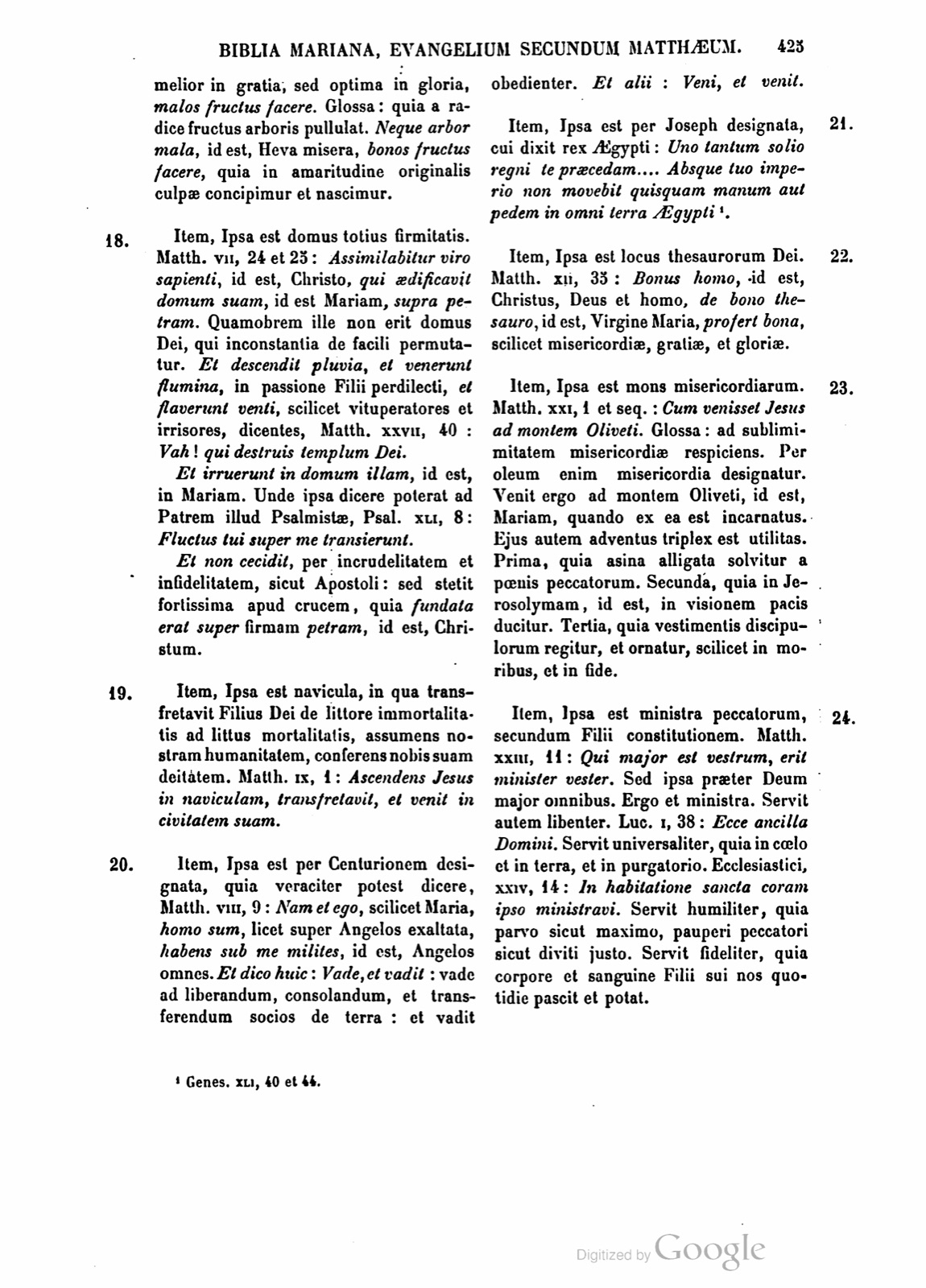
melior in gratia, sed optima in gloria, malos fructus facere. Glossa: quia a radice fructus arboris pullulat. Neque arbor mala, id est, Heva misera, bonos fructus facere, quia in amaritudine originalis culpae concipimur et nascimur.
18. Item, Ipsa est domus totius firmitatis. Matth. VII, 24 et 25: Assimilabitur viro sapienti, id est, Christo, qui aedificavit domum suam, id est Mariam, supra petram. Quamobrem ille non erit domus Dei, qui inconstantia de facili permutatur. Et descendit pluvia, et venerunt flumina, in passione Filii perdilecti, et flaverunt venti, scilicet vituperatores et irrisores, dicentes, Matth. XXVII, 40: Vah! qui destruis templum Dei. Et irruerunt in domum illam, id est, in Mariam. Unde ipsa dicere poterat ad Patrem illud Psalmistae, Psal. XLI, 8: Fluctus tui super me transierunt. Et non cecidit, per incrudelitatem et infidelitatem, sicut Apostoli: sed stetit fortissima apud crucem, quia fundata erat super firmam petram, id est, Christum.
19. Item, Ipsa est navicula, in qua transfretavit Filius Dei de littore immortalitatis ad littus mortalitatis, assumens nostram humanitatem, conferens nobis suam deitatem. Matth. IX, 1: Ascendens Jesus in naviculam, transfretavit, et venit in civitatem suam.
20. Item, Ipsa est per Centurionem designata, quia veraciter potest dicere, Matth. VIII, 9: Nam et ego, scilicet Maria, homo sum, licet super Angelos exaltata, habens sub me milites, id est, Angelos omnes. Et dico huic: Vade, et vadit: vade ad liberandum, consolandum, et transferendum socios de terra: et vadit obedienter. Et alii: Veni, et venit.
21. Item, Ipsa est per Joseph designata, cui dixit rex Aegypti: Uno tantum solio regni te praecedam.... Absque tuo imperio non movebit quisquam manum aut pedem in omni terra Aegypti 14.
22. Item, Ipsa est locus thesaurorum Dei. Matth. XII, 35: Bonus homo, id est, Christus, Deus et homo, de bono thesauro, id est, Virgine Maria, profert bona, scilicet misericordiae, gratiae, et gloriae.
23. Item, Ipsa est mons misericordiarum. Matth. XXI, 1 et seq.: Cum venisset Jesus ad montem Oliveti. Glossa: ad sublimitatem misericordiae respiciens. Per oleum enim misericordia designatur. Venit ergo ad montem Oliveti, id est, Mariam, quando ex ea est incarnatus. Ejus autem adventus triplex est utilitas. Prima, quia asina alligata solvitur a poenis peccatorum. Secunda, quia in Jerosolymam, id est, in visionem pacis ducitur. Tertia, quia vestimentis discipulorum regitur, et ornatur, scilicet in moribus, et in fide.
24. Item, Ipsa est ministra peccatorum, secundum Filii constitutionem. Matth. XXIII, 11: Qui major est vestrum, erit minister vester. Sed ipsa praeter Deum major omnibus. Ergo et ministra. Servit autem libenter. Luc. I, 38: Ecce ancilla Domini. Servit universaliter, quia in caelo et in terra, et in purgatorio. Ecclesiastici, XXIV, 14: In habitatione sancta coram ipso ministravi. Servit humiliter, quia parvo sicut maximo, pauperi peccatori sicut diviti justo. Servit fideliter, quia corpore et sanguine Filii sui nos quotidie pascit et potat.
better in grace, but best in glory, make evil fruits. Gloss: because the fruit of the tree sprouts from the root. Nor can a bad tree, that is, wretched Eve, make good fruits, because we are conceived and born in the bitterness of original fault.
18. Likewise, she herself is the house of all firmness. Matthew 7:24 and 25: He shall be likened to a wise man, that is, to Christ, who built his house, that is, Mary, upon rock. Therefore that person will not be the house of God who is easily changed by inconstancy. And the rain descended, and the floods came, in the passion of the most beloved Son, and the winds blew, namely the revilers and mockers, saying, Matthew 27:40: Vah! you who destroy the temple of God. And they rushed against that house, that is, against Mary. Whence she herself could say to the Father that saying of the Psalmist, Psalm 41:8: Your waves have passed over me. And she did not fall through cruelty and unbelief, as did the Apostles; but she stood most strong beside the cross, because she had been founded upon firm rock, that is, Christ.
19. Likewise, she herself is the little boat in which the Son of God crossed over from the shore of immortality to the shore of mortality, taking on our humanity and conferring his deity upon us. Matthew 9:1: Jesus, going up into the little boat, crossed over and came into his own city.
20. Likewise, she herself is designated by the Centurion, because she can truly say, Matthew 8:9: For I also, namely Mary, am a human being, although exalted above the Angels, having soldiers under me, that is, all the Angels. And I say to this one: Go, and he goes; go to liberate, console, and transfer companions from earth, and he goes obediently. And to another: Come, and he comes.
21. Likewise, she herself is designated by Joseph, to whom the king of Egypt said: Only by the throne of the kingdom will I precede you.... Without your command no one shall move hand or foot in all the land of Egypt 14.
22. Likewise, she herself is the place of the treasures of God. Matthew 12:35: The good man, that is, Christ, God and man, from the good treasure, that is, from the Virgin Mary, brings forth good things, namely things of mercy, grace, and glory.
23. Likewise, she herself is the mountain of mercies. Matthew 21:1 and following: When Jesus had come to the Mount of Olives. Gloss: looking to the height of mercy. For mercy is designated by oil. Therefore he came to the Mount of Olives, that is, to Mary, when he was incarnate from her. But his coming has a threefold usefulness. First, because the bound she-ass is loosed from the punishments of sins. Second, because she is led into Jerusalem, that is, into the vision of peace. Third, because she is ruled and adorned with the garments of the disciples, namely in morals and in faith.
24. Likewise, she herself is the servant of sinners, according to the constitution of the Son. Matthew 23:11: He who is greater among you shall be your servant. But she, apart from God, is greater than all. Therefore she is also servant. But she serves willingly. Luke 1:38: Behold the handmaid of the Lord. She serves universally, because in heaven and on earth and in purgatory. Ecclesiasticus 24:14: In the holy dwelling I ministered before him. She serves humbly, because to the small as to the greatest, to the poor sinner as to the rich just person. She serves faithfully, because she daily feeds and gives drink to us with the body and blood of her Son.
Notes
- Matthew 1:1. (Matth. I, 1.) ↩
- Saint Bernard, Homily I On Missus est. (S. Bernardus, Homil. I super Missus est.) ↩
- The same, in the same place. (Idem, ibidem.) ↩
- Luke 2:48. (Luc. II, 48.) ↩
- Saint Anselm, Book On the Virginal Conception, chapter 18. (S. Anselmus, Lib. de Conceptu virginali, cap. 18.) ↩
- Isaiah 7:14. (Isa. VII, 14.) ↩
- Genesis 37:27. (Genes. XXXVII, 27.) ↩
- Saint Augustine, Sermon 5 On the words of the Lord in the Gospel according to Matthew. (S. Augustinus, Serm. 5 de verbis Domini in Evangelium secundum Matthaeum.) ↩
- (Saint Gregory the Great,) Homily 6 on the Gospel. ((S. Gregorius M.,) Homilia 6 in Evang.) ↩
- John 8:51 and 52. (Joan. VIII, 51 et 52.) ↩
- Saint Bernard, Sermon on the Blessed Virgin on those words of Apocalypse 12:1: A great sign appeared, and so forth. (S. Bernardus, Serm. de B. Virgine super illa verba Apocalypsis, XII, 1: Signum magnum apparuit, etc.) ↩
- Although this authority is usually cited from Saint Bernard, nevertheless we do not find it in Saint Bernard, but in Idiota, in the book of Contemplations on the Blessed Virgin, chapter 2, in these words: "Purity of Angels was not lacking to you, nor faith of Patriarchs, nor knowledge of Prophets, nor zeal of Apostles, nor patience of Martyrs, nor sobriety of Confessors, nor innocence or humility of Virgins; in sum, you are empty of no kind of virtues." It exists in volume X of the Cologne edition of the Library of the old Fathers. (Note of the Lyon editor.) (Licet haec auctoritas ex S. Bernardo citari soleat, eam tamen in S. Bernardo non reperimus, sed in Idiota, in libro Contemplationum de B. Virgine, cap. 2, in haec verba: "Non defuit tibi puritas Angelorum, non fides Patriarcharum, non scientia Prophetarum, non zelus Apostolorum, non patientia Martyrum, non sobrietas Confessorum, non innocentia aut humilitas Virginum: in summa nullo genere vacas virtutum." Exstat tom. X Bibliotheca veterum Patrum editionis Coloniensis (Nota edit. Lugd.).) ↩
- Ecclesiasticus 24:16. (Eccli. XXIV, 16.) ↩
- Genesis 41:40 and 44. (Genes. XLI, 40 et 44.) ↩
If a page does not appear, its photograph has not been uploaded yet.