Volume 37 · p. 379
Book of Ruth, page 379
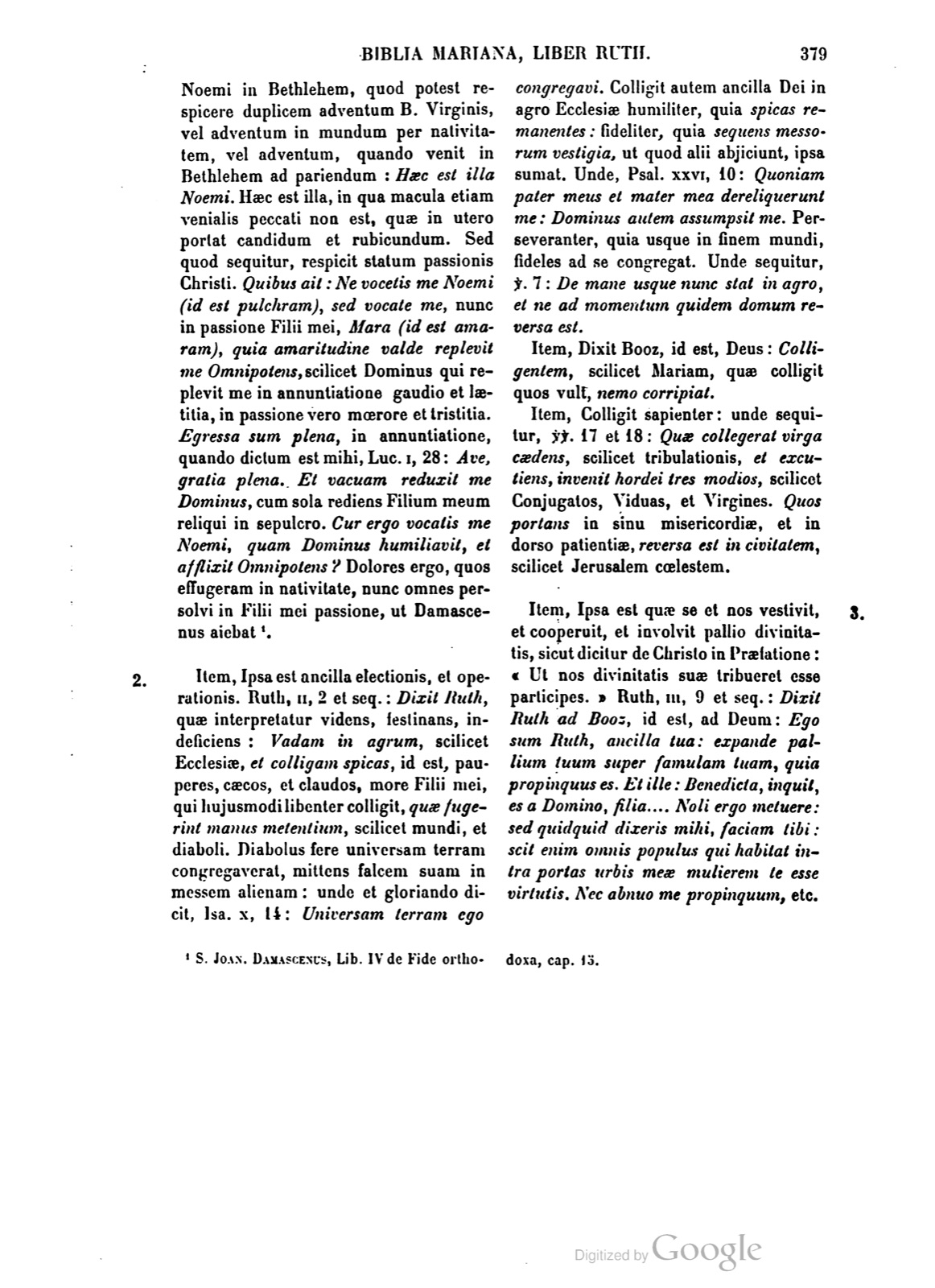
Noemi in Bethlehem, quod potest respicere duplicem adventum B. Virginis, vel adventum in mundum per nativitatem, vel adventum, quando venit in Bethlehem ad pariendum: Haec est illa Noemi. Haec est illa, in qua macula etiam venialis peccati non est, quae in utero portat candidum et rubicundum. Sed quod sequitur, respicit statum passionis Christi. Quibus ait: Ne vocetis me Noemi (id est pulchram), sed vocate me, nunc in passione Filii mei, Mara (id est amaram), quia amaritudine valde replevit me Omnipotens, scilicet Dominus qui replevit me in annuntiatione gaudio et laetitia, in passione vero moerore et tristitia. Egressa sum plena, in annuntiatione, quando dictum est mihi, Luc. I, 28: Ave, gratia plena. Et vacuam reduxit me Dominus, cum sola rediens Filium meum reliqui in sepulcro. Cur ergo vocatis me Noemi, quam Dominus humiliavit, et afflixit Omnipotens? Dolores ergo, quos effugeram in nativitate, nunc omnes persolvi in Filii mei passione, ut Damascenus aiebat 1.
2. Item, Ipsa est ancilla electionis, et operationis. Ruth, II, 2 et seq.: Dixit Ruth, quae interpretatur videns, festinans, indeficiens: Vadam in agrum, scilicet Ecclesiae, et colligam spicas, id est, pauperes, caecos, et claudos, more Filii mei, qui hujusmodi libenter colligit, quae fugerint manus metentium, scilicet mundi, et diaboli. Diabolus fere universam terram congregaverat, mittens falcem suam in messem alienam: unde et gloriando dicit, Isa. X, 14: Universam terram ego congregavi. Colligit autem ancilla Dei in agro Ecclesiae humiliter, quia spicas remanentes: fideliter, quia sequens messorum vestigia, ut quod alii abjiciunt, ipsa sumat. Unde, Psal. XXVI, 10: Quoniam pater meus et mater mea dereliquerunt me: Dominus autem assumpsit me. Perseveranter, quia usque in finem mundi, fideles ad se congregat. Unde sequitur, v. 7: De mane usque nunc stat in agro, et ne ad momentum quidem domum reversa est. Item, Dixit Booz, id est, Deus: Colligentem, scilicet Mariam, quae colligit quos vult, nemo corripiat. Item, Colligit sapienter: unde sequitur, vv. 17 et 18: Quae collegerat virga caedens, scilicet tribulationis, et excutiens, invenit hordei tres modios, scilicet Conjugatos, Viduas, et Virgines. Quos portans in sinu misericordiae, et in dorso patientiae, reversa est in civitatem, scilicet Jerusalem caelestem.
3. Item, Ipsa est quae se et nos vestivit, et cooperuit, et involvit pallio divinitatis, sicut dicitur de Christo in Praefatione: "Ut nos divinitatis suae tribueret esse participes." Ruth, III, 9 et seq.: Dixit Ruth ad Booz, id est, ad Deum: Ego sum Ruth, ancilla tua: expande pallium tuum super famulam tuam, quia propinquus es. Et ille: Benedicta, inquit, es a Domino, filia.... Noli ergo metuere: sed quidquid dixeris mihi, faciam tibi: scit enim omnis populus qui habitat intra portas urbis meae mulierem te esse virtutis. Nec abnuo me propinquum, etc.
of Naomi into Bethlehem, which can look to the double coming of the Blessed Virgin, either her coming into the world through the nativity, or the coming when she came into Bethlehem to give birth: This is that Naomi. This is she in whom there is not even the stain of venial sin, who carries in her womb the white and ruddy one. But what follows looks to the state of Christ's passion. She said to them: Do not call me Naomi, that is, beautiful, but call me now, in the passion of my Son, Mara, that is, bitter, because the Almighty has filled me very much with bitterness, namely the Lord who filled me in the annunciation with joy and gladness, but in the passion with grief and sadness. I went out full, in the annunciation, when it was said to me, Luke I, 28: Hail, full of grace. And the Lord has brought me back empty, since returning alone I left my Son in the tomb. Why therefore do you call me Naomi, whom the Lord has humbled, and the Almighty has afflicted? Therefore the pains that I had escaped in the nativity I now paid in full in the passion of my Son, as Damascene was saying 1.
2. Likewise, she is the handmaid of election and operation. Ruth II, 2 and following: Ruth, which is interpreted seeing, hastening, unfailing, said: I shall go into the field, namely of the Church, and gather ears, that is, the poor, the blind, and the lame, in the manner of my Son, who gladly gathers such persons, which have fled from the hands of the reapers, namely of the world and the devil. The devil had gathered almost the whole earth, sending his sickle into another's harvest; hence also boasting he says, Isaiah X, 14: I have gathered the whole earth. But the handmaid of God gathers in the field of the Church humbly, because the ears remain; faithfully, because she follows the tracks of the reapers, so that what others cast aside she may take. Hence, Psalm XXVI, 10: For my father and my mother have abandoned me, but the Lord has taken me up. Perseveringly, because until the end of the world she gathers the faithful to herself. Hence it follows, verse 7: From morning until now she stands in the field, and not even for a moment has she returned home. Likewise, Boaz, that is, God, said: Let no one rebuke her as she gathers, namely Mary, who gathers whom she wishes. Likewise, she gathers wisely; hence it follows, verses 17 and 18: Beating with a rod, namely of tribulation, and shaking out what she had gathered, she found three measures of barley, namely Married Persons, Widows, and Virgins. Carrying them in the bosom of mercy and on the back of patience, she returned into the city, namely the heavenly Jerusalem.
3. Likewise, she is the one who clothed herself and us, and covered and wrapped us with the cloak of divinity, as is said of Christ in the Preface: "That he might grant us to be sharers of his divinity." Ruth III, 9 and following: Ruth said to Boaz, that is, to God: I am Ruth, your handmaid; spread your cloak over your servant, because you are near kin. And he said: Blessed are you by the Lord, daughter.... Therefore do not fear; but whatever you shall say to me, I will do for you; for all the people who dwell within the gates of my city know that you are a woman of virtue. Nor do I deny that I am near kin, etc.
Notes
- St. John Damascene, Book IV On the Orthodox Faith, chapter 13. (S. Joan. Damascenus, Lib. IV de Fide orthodoxa, cap. 13.) ↩
If a page does not appear, its photograph has not been uploaded yet.