Volume 37 · pp. 365–369
Marian Bible. The Book of Genesis Begins.
D. ALBERTI MAGNI, RATISBONENSIS EPISCOPI, ORDINIS PRAEDICATORUM, BIBLIA MARIANA. INCIPIT LIB. GENESIS.
In principio creavit Deus caelum, et terram 1.
1. Coelum, scilicet empyreum, per quod intelligitur Domina mundi, Virgo Maria. Est enim similis caelo multis de causis, quarum una ponitur in historia. Empyreum etenim quam cito factum est, statim dispositum est, ordinatum est, quod non alii caeli. Sic ipsa in gratia, et sanctificatione. (Require in titulo de caelo.) Coelum enim a luendo dicitur, id est, purgando tenebras haereticorum, et peccatorum.
2. Ipsa etiam dicitur lux. Genes. I, 2: Tenebrae erant super faciem abyssi 2. Glossa: "Tenebrae ignorantiae et caecitatis, super faciem cordis humani." Dixitque Deus: Fiat lux 3, id est, Maria generetur, et nascatur. Glossa: "Ab aeterna luce primo fiat temporalis lux, ut per eam caetera videantur." Lux enim a luendo dicitur, id est, purgando tenebras haereticorum, et peccatorum. Et facta est lux. Et vidit Deus lucem quod esset bona 4. Lux enim multa bona facit. (Require in titulo de luce, et adapta.) Appellavitque lucem Diem 5, id est Mariam, hoc nomen ei est in aeternum. Ipsa enim optime dies dicitur, et Heva nox. Glossa: "Deus a luce opera sua inchoavit."
3. Ipsa etiam est terra fructificans 6, id est, Christum in nativitate. Glossa: "Pabulum Verbi opera misericordiae." Et lignum pomiferum faciens fructum 7, etc.: ipse enim Jesus fuit herba viridis
THE MARIAN BIBLE OF D. ALBERT THE GREAT, BISHOP OF RATISBON, OF THE ORDER OF PREACHERS. THE BOOK OF GENESIS BEGINS.
In the beginning God created heaven and earth 1.
1. Heaven, namely the empyrean, through which the Lady of the world, the Virgin Mary, is understood. For she is like heaven for many reasons, one of which is set down in the history. For the empyrean, as soon as it was made, was immediately disposed and ordered, which was not so for the other heavens. So she was in grace and sanctification. (Look in the title concerning heaven.) For heaven is said from washing away, that is, from purging the darknesses of heretics and sinners.
2. She is also called light. Genesis I, 2: Darknesses were upon the face of the abyss 2. The Gloss: "The darknesses of ignorance and blindness, upon the face of the human heart." And God said: Let light be made 3, that is, let Mary be generated and be born. The Gloss: "From the eternal light let temporal light first be made, so that through it the other things may be seen." For light is said from washing away, that is, from purging the darknesses of heretics and sinners. And light was made. And God saw the light, that it was good 4. For light does many good things. (Look in the title concerning light, and adapt it.) And he called the light Day 5, that is Mary; this name is hers forever. For she is most fittingly called day, and Eve night. The Gloss: "God began his works from light."
3. She is also the fruit-bearing earth 6, that is, bearing Christ in the nativity. The Gloss: "The food of the Word is works of mercy." And the fruit-tree making fruit 7, etc.; for Jesus himself was the green plant
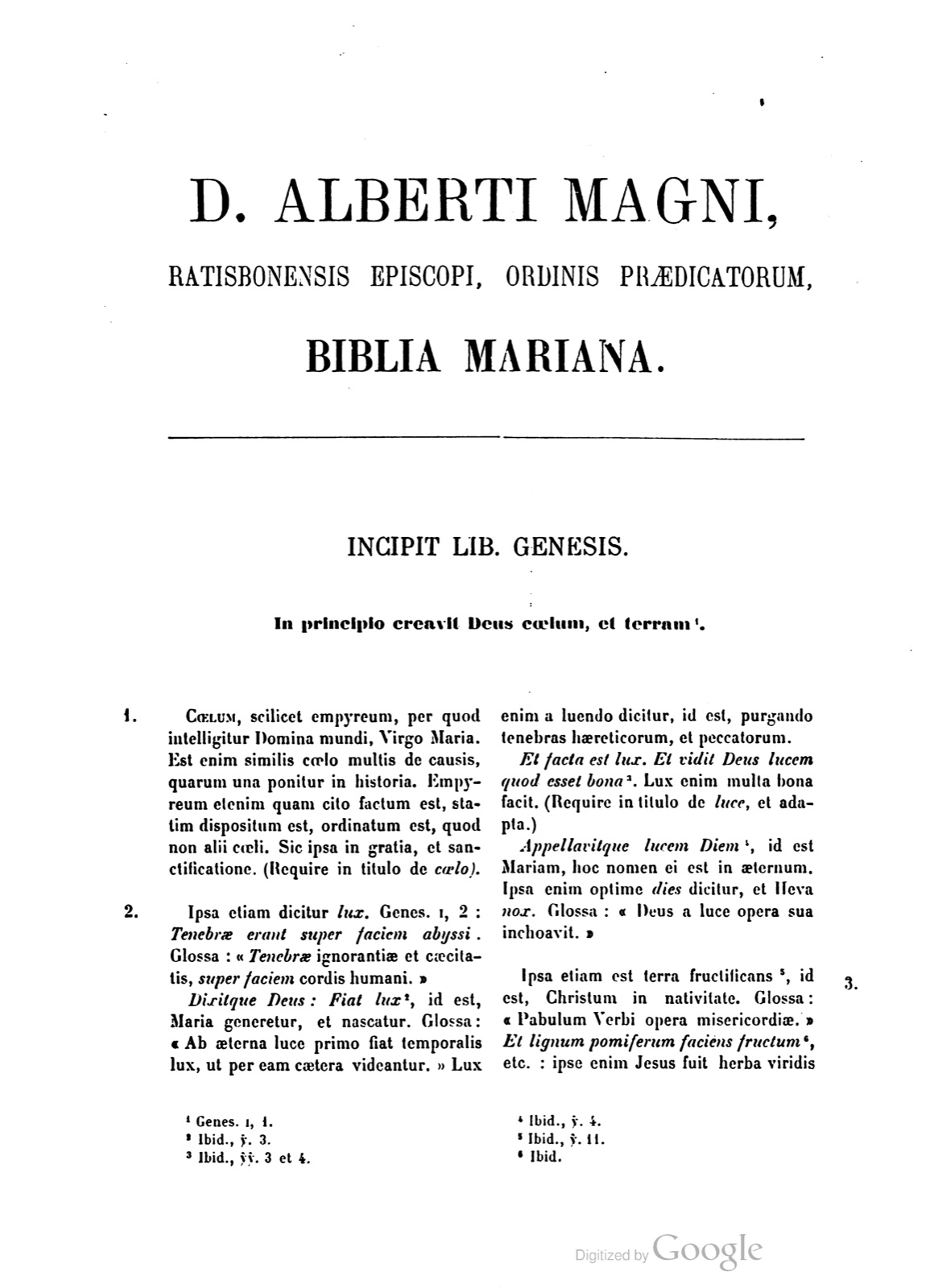
in nativitate, lignum vero faciens fructum in passione.
4. Ipsa est etiam dies completionis operum Domini. Genes. II, 2: Complevitque Deus die septimo opus suum quod fecerat. Glossa: "Quia ipsam benedixit et sanctificavit." Opus enim suum est benedictio, et sanctificatio. Et requievit die septimo ab universo opere quod patrarat. Glossa: "Quia creaturis rationalibus in se requiem dedit."
5. Ipsa est fons irrigationis peccatorum per peccatum aridorum. Genes. II, 6: Fons, id est Maria, ascendebat, in nativitate quando nata fuit, vel in assumptione, e terra miseriae et tenebrarum, irrigans gratia, venia, gloria, universam superficiem terrae.
6. Ipsa est etiam paradisus plantationis. Genes. II, 8: Plantaverat Dominus Deus paradisum voluptatis, id est, Mariam, a principio: in quo posuit hominem, id est, Christum, quem formaverat, in quantum est homo, in incarnatione. Glossa: "Paradisus est hortus deliciarum, qui factus est remotis aquis a superficie terrae, et est altus locus, quia aquae diluvii illuc non pervenerunt." Nota de sanctificatione ejus.
7. Ipsa est fluvius jucunditatis. Genes. II, 10 et seq.: Fluvius, id est, affluentia aeternae jucunditatis, egrediebatur, scilicet in nativitate, de loco voluptatis. Glossa: "A paterno fonte:" ad irrigandum paradisum. Glossa: id est, Ecclesiam. Nomen uni Phison. Glossa: id est, oris mutatio: quia mutavit nobis os severitatis, in os benignitatis 8. Nomen fluvii secundi Gehon. Glossa: id est, hiatus terrae, quia in se ampliavit et dilatavit per desiderium Sanctorum. Hiatio est ad percipiendam pro nobis abundantiam gratiarum, insuper et nos hiare facit, et Filium suum ad nos. Nomen fluminis tertii Tygris. Glossa: id est, velocitas in auxilii subventione, in consolationis exhibitione, pro peccatoribus ad Deum interpellatione. Fluvius quartus, ipse est Euphrates. Glossa: id est, frugifera in omni gratiarum repletione, et quantum ad nos largissima communicatione.
8. Ipsa est etiam adjutrix nostrae redemptionis. Genes. II, 20: Adae vero non inveniebatur adjutor similis ejus 9: quia omnes declinaverunt, simul inutiles facti sunt. Dixit ergo Dominus Deus: Non est bonum esse hominem solum, id est Christum. Faciamus ei creando, et in mundum producendo, adjutorium simile sibi, id est, Mariam.
9. Ipsa etiam est contus contritionis diaboli. Genes. III, 15: Inimicitias ponam magnas, et implacabiles, inter te et mulierem: ipsa conteret caput tuum. Glossa: quod est mors.
10. Ipsa est etiam mater vitae. Genes. III, 20: Vocavit Adam nomen uxoris suae, Heva, eo quod mater esset cunctarum gentium, id est, cunctorum bene operantium, quibus contraria sunt peccata, quae dicuntur mortalia.
11. Ipsa etiam est arca salvationis. Genes. VI, 13 et seq.: Dixit Dominus ad Noe: Finis universae carnis venit coram me. Glossa: id est, omnium mortalium, praeter eos, qui salvandi erant in arca. Fac tibi arcam, id est, Mariam, quod respicit ejus nativitatem, de lignis levigatis, id est, quadratis, et bituminatis, et politis, ne quid inhaereat (haec nota de sanctificatione ejus), et fortibus, et insolubilibus, ut nec vi ventorum, nec inundatione solvatur. Talis est Domina nostra. Mansiunculas in arca facies. Glossa: Diversos ordines vitae: ipsa enim habet
in the nativity, but a tree making fruit in the passion.
4. She is also the day of the completion of the Lord's works. Genesis II, 2: And God completed on the seventh day his work that he had made. The Gloss: "Because he blessed and sanctified it." For his work is blessing and sanctification. And he rested on the seventh day from all the work that he had performed. The Gloss: "Because he gave rational creatures rest in himself."
5. She is the fountain of irrigation for sinners made dry through sin. Genesis II, 6: A fountain, that is Mary, was ascending, in the nativity when she was born, or in the assumption, from the earth of misery and darknesses, watering with grace, pardon, and glory the whole surface of the earth.
6. She is also the paradise of planting. Genesis II, 8: The Lord God had planted a paradise of pleasure, that is, Mary, from the beginning; in it he placed the man, that is, Christ, whom he had formed, insofar as he is man, in the incarnation. The Gloss: "Paradise is a garden of delights, which was made when the waters were removed from the surface of the earth, and it is a high place, because the waters of the flood did not reach there." Note this concerning her sanctification.
7. She is the river of delight. Genesis II, 10 and following: A river, that is, the abundance of eternal delight, went forth, namely in the nativity, from the place of pleasure. The Gloss: "From the paternal fountain:" to water paradise. The Gloss: that is, the Church. The name of one is Phison. The Gloss: that is, change of mouth, because she changed for us the mouth of severity into the mouth of kindness 8. The name of the second river is Gehon. The Gloss: that is, the gaping of the earth, because she enlarged and widened herself through the desire of the Saints. Her gaping is for receiving for us an abundance of graces; moreover she also makes us gape, and makes her Son toward us. The name of the third river is Tigris. The Gloss: that is, swiftness in supplying help, in exhibiting consolation, and in interceding to God for sinners. The fourth river is Euphrates itself. The Gloss: that is, fruit-bearing in every fullness of graces, and, with respect to us, most generous in communication.
8. She is also the helper of our redemption. Genesis II, 20: But for Adam there was not found a helper like him 9, because all have turned aside; together they have become useless. Therefore the Lord God said: It is not good for the man to be alone, that is, Christ. Let us make for him, by creating and bringing into the world, a help like himself, that is, Mary.
9. She is also the staff of the crushing of the devil. Genesis III, 15: I will put great and implacable enmities between you and the woman: she will crush your head. The Gloss: which is death.
10. She is also the mother of life. Genesis III, 20: Adam called the name of his wife Eve, because she was the mother of all nations, that is, of all who work well, to whom sins are contrary, which are called mortal.
11. She is also the ark of salvation. Genesis VI, 13 and following: The Lord said to Noah: The end of all flesh has come before me. The Gloss: that is, of all mortals, except those who were to be saved in the ark. Make yourself an ark, that is, Mary, which looks to her nativity, from smoothed woods, that is, squared, pitch-covered, and polished woods, so that nothing may cling to it (note this concerning her sanctification), and strong and indissoluble, so that it may be dissolved neither by the force of winds nor by inundation. Such is Our Lady. You shall make little dwellings in the ark. The Gloss: The diverse orders of life; for she has
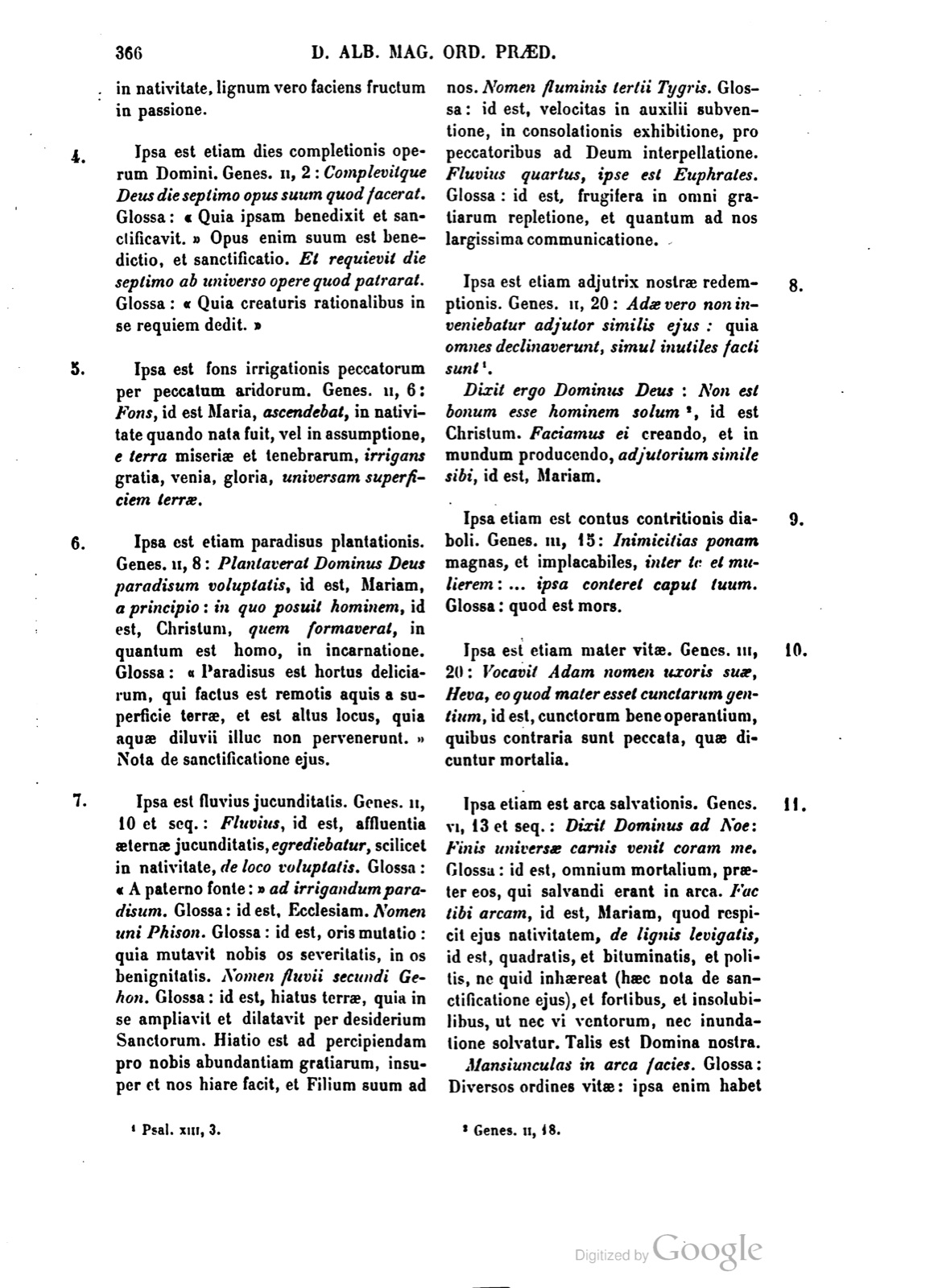
ordines Conjugatorum, Viduarum, Virginum. Et bitumine, id est, dilectionis ardore, linies intrinsecus et extrinsecus. Glossa: ne dissolvatur intus, vel foris. Fenestram in arca facies. Glossa: ad emittendum corvum, vel columbam. Haec fenestra dicitur diluculum meridianum, dicitur et crystallina. Et in cubito consummabis summitatem ejus. Glossa: Cubitus unus, charitas est. Bina de omnibus ingredientur tecum, ut possint vivere. Glossa: ne diluvio pereant.
12. Ipsa etiam post Deum est principium omnis gratiae in nobis. Genes. VII, 11: Anno sexcentesimo vitae Noe, id est, Christi, qui intravit in arcam, id est, in uterum Virginis Mariae, quod factum est in incarnatione, rupti sunt omnes fontes, id est, gratiarum, abyssi magnae, quando gratiarum diluvium Mariae inundavit, et diabolus est submersus, et peccata deleta.
13. Ipsa etiam per adventum suum in mundum, quando nata est, ramum olivae, id est, pacis inter nos et Deum attulit. Genes. VIII, 11 10: Columba, id est, Maria, quae columbae comparatur, venit ad eum, scilicet ad Noe, ad vesperam, scilicet in fine mundi, portans ramum olivae, id est, pacis inter nos. Glossa: "Refectionis et luminis." Virentibus foliis in ore suo, quando dixit: Ecce ancilla 11. Intellexit ergo Noe quod cessassent aquae indignationis et furoris Dei, super terram.
14. Ipsa etiam altare propitiationis est, et placationis Dei. Genes. VIII, 20 et 21 12: Edificavit Noe altare Domino, id est, Mariam: et tollens de cunctis pecoribus et volucribus mundis, obtulit holocausta super altare. Odoratusque est Dominus odorem suavitatis, et ait: Nequaquam ultra maledicam terrae propter homines... Non igitur ultra percutiam. Glossa: temporali judicio, omnem animam viventem, sicut feci: sed Maria precante parcam omni veniam quaerenti.
15. Ipsa est etiam signum securitatis formidoloso peccatori. Genes. IX, 12 et 13: Hoc signum foederis, quod do inter me et vos: ... arcum meum. Glossa: qui habuit duos colores, caeruleum extrinsecus, et igneum intrinsecus, ponam in nubibus. Hoc pono mihi signum securitatis in nubibus coeli, ne homines formidolosi timeant altero deleri diluvio pluviarum. Arcus non est, nisi ex radiis solis, et humida nube. Cumque obduxero nubibus caelum, apparebit arcus meus, id est, Maria, in nubibus: et recordabor foederis mei vobiscum: ... et non erunt ultra aquae diluvii ad delendam universam carnem 13, id est, peccatores.
16. Ipsa etiam est humilitatis nostrae exaltatrix, quia soror et neptis nostra est. Genes. XII, 11 et seq.: Cumque prope esset ut ingrederetur Abram Aegyptum, dixit Sarai uxori suae: Novi quod pulchra sis mulier, ... et Aegyptii interficient me, et te reservabunt. Dic ergo, obsecro te, quod soror mea sis, ut bene sit mihi propter te, et vivat anima mea ob gratiam tui. Et in fine capitis XX, 13: Hanc misericordiam facias mecum: in omni loco, ad quem ingrediemur, dices quod frater tuus sim.
17. Ipsa etiam vocatur mater gaudii, et exsultationis. Genes. XXI, 1 et seq.: Visitavit Dominus Saram, id est, Mariam. Glossa: quod interpretatur princeps. Et implevit quae locutus est. Glossa: per Prophetas. Concepit et peperit filium in senectute sua. Glossa: id est, novissimis temporibus, Christum.
the orders of Married Persons, Widows, and Virgins. And with pitch, that is, with the ardor of love, you shall smear it within and without. The Gloss: lest it be dissolved inside or outside. You shall make a window in the ark. The Gloss: for sending out the raven or the dove. This window is called the noonday dawn, and it is also called crystalline. And in one cubit you shall complete its summit. The Gloss: One cubit is charity. Pairs from all things shall enter with you, that they may be able to live. The Gloss: lest they perish in the flood.
12. She also, after God, is the beginning of every grace in us. Genesis VII, 11: In the six-hundredth year of the life of Noah, that is, of Christ, who entered the ark, that is, the womb of the Virgin Mary, which was done in the incarnation, all the fountains, that is, of graces, of the great abyss were broken open, when the flood of graces inundated Mary, and the devil was submerged, and sins were destroyed.
13. She also, through her coming into the world, when she was born, brought the branch of olive, that is, of peace between us and God. Genesis VIII, 11 10: The dove, that is, Mary, who is compared to a dove, came to him, namely to Noah, toward evening, namely at the end of the world, carrying the branch of olive, that is, of peace between us. The Gloss: "Of refreshment and of light." With green leaves in her mouth, when she said: Behold the handmaid 11. Therefore Noah understood that the waters of God's indignation and fury over the earth had ceased.
14. She is also the altar of propitiation and of God's appeasement. Genesis VIII, 20 and 21 12: Noah built an altar to the Lord, that is, Mary; and taking from all clean cattle and birds, he offered holocausts upon the altar. And the Lord smelled the odor of sweetness, and said: Never again will I curse the earth because of men... Therefore I will not again strike. The Gloss: by a temporal judgment, every living soul, as I did; but with Mary praying, I will spare everyone seeking pardon.
15. She is also the sign of security for the fearful sinner. Genesis IX, 12 and 13: This is the sign of the covenant that I give between me and you: ... my bow. The Gloss: which had two colors, blue outwardly and fiery inwardly, I shall put in the clouds. I set this for myself as a sign of security in the clouds of heaven, lest fearful men be afraid that they will be destroyed by another flood of rains. The bow exists only from the rays of the sun and a moist cloud. And when I shall cover the heaven with clouds, my bow, that is, Mary, will appear in the clouds, and I will remember my covenant with you; ... and the waters of the flood will no longer be for destroying all flesh 13, that is, sinners.
16. She also is the exalter of our humility, because she is our sister and kinswoman. Genesis XII, 11 and following: And when Abram was near to entering Egypt, he said to Sarai his wife: I know that you are a beautiful woman, ... and the Egyptians will kill me and keep you. Say therefore, I beg you, that you are my sister, so that it may be well with me because of you, and my soul may live by your grace. And at the end of chapter XX, 13: Do this mercy with me: in every place to which we shall enter, you will say that I am your brother.
17. She is also called the mother of joy and exultation. Genesis XXI, 1 and following: The Lord visited Sarah, that is, Mary. The Gloss: which is interpreted princess. And he fulfilled what he had spoken. The Gloss: through the Prophets. She conceived and bore a son in her old age. The Gloss: that is, in the last times, Christ.
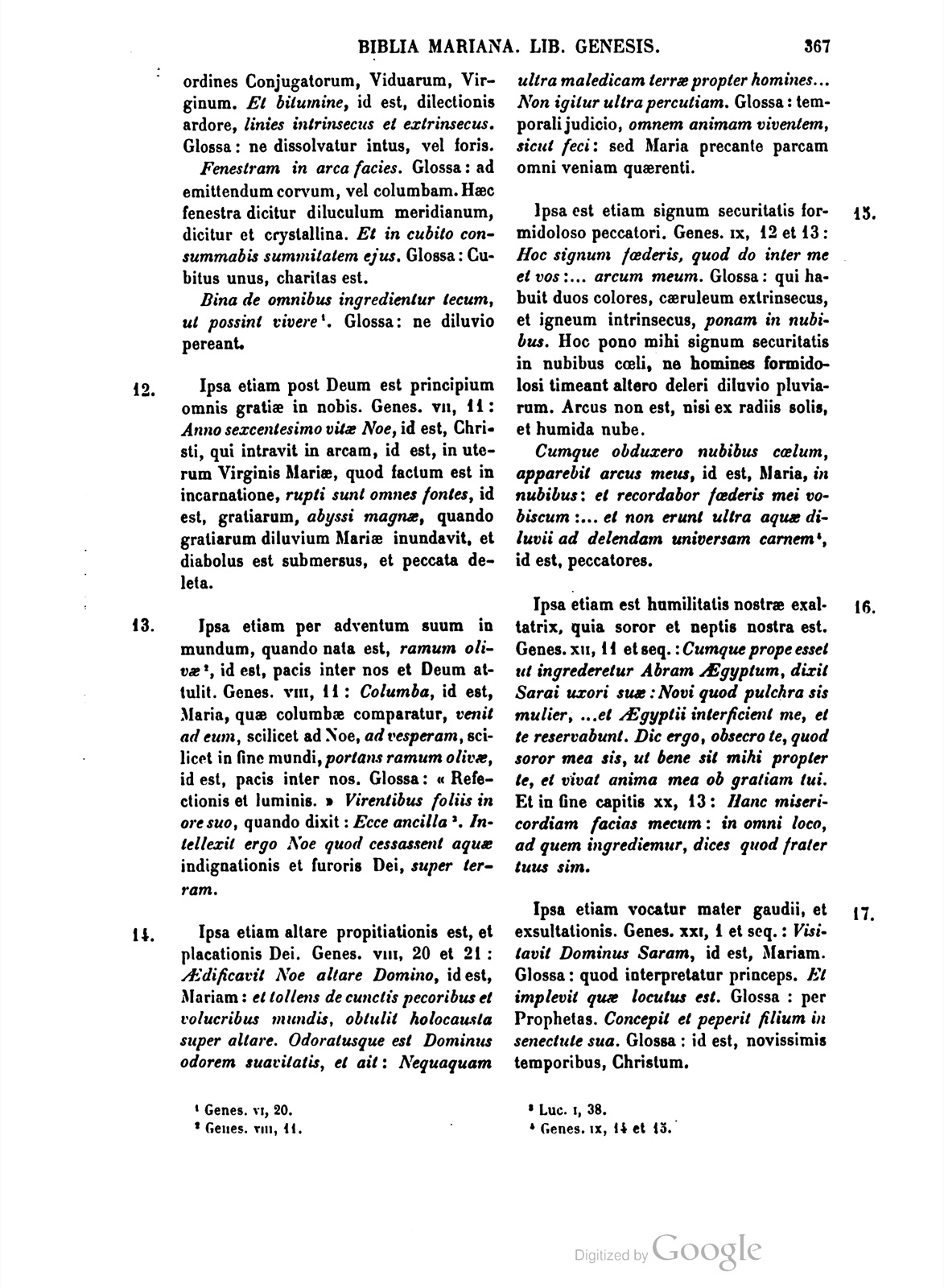
Vocavitque Abraham nomen filii sui, quem genuit ei Sara, Isaac, id est, gaudium, quia in nativitate Christi gavisi sunt pastores, et Angeli 14. Dixitque Sara, id est, Maria: Risum fecit mihi Deus, sed Heva planctum: quicumque audierit peccator, justus, Angelus, corridebit mihi, id est, congaudebit, quia peperi Angelo laetitiam, justo gratiam, peccatori veniam. Rursumque ait: Quis auditurum crederet Abraham quod Sara, id est, paupercula Maria, lactaret filium, quem peperit ei jam seni? lactem eum, qui lactat omnia: portem eum, qui portat omnia. Glossa: "Haec est commendatio gratiae."
18. Ipsa etiam est princeps omnium creaturarum, quantum ad defensionem, cohortationem, et commissionem. Genes. XVII, 15: Dixit quoque Deus ad Abraham: Sarai uxorem tuam non vocabis Sarai, id est, princeps mea, et quasi unius gentis, sed Saram, id est princeps absolute, quasi omnium princeps. Dicet enim huic: Vade, et vadit: et alii: Veni, et venit 15. De hoc principatu, dicit Pharao ad Joseph, Genes. XLI, 40: Uno tantum regni solio te praecedam. Et infra, v. 44: Absque tuo imperio non movebit quisquam manum aut pedem, etc.
19. Ipsa etiam est fontis vitae hausorium, animarum sitibundarum refocillatrix. Genes. XXIV, 15 et seq.: Rebecca, quae interpretatur patientia, id est, Maria, egrediebatur, scilicet in nativitate, quando nata est, habens hydriam in scapula sua. Glossa: "Verbum Dei humiliter susceptura:" puella decora nimis, virgoque pulcherrima, et incognita viro: descenderat autem ad fontem. Glossa: Vitae, ad quem se inclinaverat hauriendum, et impleverat hydriam, scilicet cordis, gratia, venia, gloria. Occurritque ei servus, et ait: Pauxillum aquae mihi ad bibendum. Glossa: de salute animae, praebe de hydria tua: quia de mundi hydria, hausi vanitatem, de hydria diaboli iniquitatem. Quae respondit: Bibe, domine mi: celeriterque deposuit hydriam super ulnam suam, et dedit ei potum. Cumque ille bibisset, adjecit: Quin et camelis tuis hauriam aquam gratiae, veniae, laetitiae, donec cuncti bibant. Cantic. V, 1: Bibite, et inebriamini, carissimi, etc. Haustum igitur omnibus camelis dedit, unde et largissima est.
20. Ipsa est etiam vagantium animarum hospitatrix. Genes. XXIV, 23 et seq.: Dixit Eliezer ad Rebeccam: Cujus es filia? indica mihi: est in domo patris tui locus ad manendum? Quae respondit: Filia sum Bathuelis... Palearum quoque et faeni plurimum est apud nos, et locus spatiosus ad manendum. Glossa: "Per latitudinem charitatis." Et ait Laban frater Rebeccae: Ingredere, benedicte Domini: cur foris stas? praeparavi domum, et locum camelis 16. Et introduxit eum in hospitium. Rebecca etiam Maria, frater Rebeccae, Christus, qui nos in regnum introduxit.
21. Ipsa etiam est sponsa, et mater propitiationis, quam praeparavit ab aeterno, Filio in matrem, reo in reconciliationem, justo in praemium. Genes. XXIV, 42 et seq.: Dixit Eliezer: Veni hodie ad fontem aquae, et dixi: Virgo quae audierit a me: Da mihi pauxillum aquae ad bibendum ex hydria tua, et dixerit mihi: Et tu bibe, et camelis tuis hauriam, ipsa est mulier quam praeparavit Dominus filio domini mei. Unde ipsa dicere potest: Ab aeterno ordinata sum 17.
22. Ipsa etiam est soror nostrae professionis, defensionis, fidelitatis, et exaltationis.
And Abraham called the name of his son, whom Sarah bore to him, Isaac, that is, joy, because at the nativity of Christ the shepherds and Angels rejoiced 14. And Sarah, that is, Mary, said: God has made laughter for me, but Eve lamentation; whoever hears, whether sinner, just person, or Angel, will laugh with me, that is, will rejoice together with me, because I have borne gladness for the Angel, grace for the just person, pardon for the sinner. And again she said: Who would believe that Abraham would hear that Sarah, that is, poor little Mary, would nurse the son whom she bore to him now old? that I should nurse him who nurses all things; that I should carry him who carries all things. The Gloss: "This is a commendation of grace."
18. She is also the prince of all creatures, with respect to defense, exhortation, and command. Genesis XVII, 15: God also said to Abraham: You shall not call Sarai your wife Sarai, that is, my princess and as it were of one nation, but Sarah, that is prince absolutely, as it were prince of all. For she will say to this one, Go, and he goes; and to another, Come, and he comes 15. Concerning this principality Pharaoh says to Joseph, Genesis XLI, 40: Only by the throne of the kingdom will I precede you. And below, verse 44: Without your command no one shall move hand or foot, etc.
19. She is also the vessel for drawing from the fountain of life, the refresher of thirsty souls. Genesis XXIV, 15 and following: Rebecca, which is interpreted patience, that is, Mary, was going out, namely in the nativity, when she was born, having a water-jar on her shoulder. The Gloss: "About to receive humbly the Word of God:" a maiden exceedingly fair, a most beautiful virgin, and unknown to man; but she had gone down to the fountain. The Gloss: of Life, to which she had inclined herself to draw, and she had filled the water-jar, namely of the heart, with grace, pardon, and glory. And the servant met her and said: Give me a little water to drink. The Gloss: concerning the salvation of the soul, supply from your jar, because from the jar of the world I have drawn vanity, and from the jar of the devil iniquity. She answered: Drink, my lord; and quickly she lowered the jar upon her arm and gave him drink. And when he had drunk, she added: Indeed, I will draw also for your camels the water of grace, pardon, and gladness, until all drink. Song of Songs V, 1: Drink, and be inebriated, dearest ones, etc. Therefore she gave a draught to all the camels; whence she is also most generous.
20. She is also the hostess of wandering souls. Genesis XXIV, 23 and following: Eliezer said to Rebecca: Whose daughter are you? Tell me: is there a place in your father's house for lodging? She answered: I am the daughter of Bathuel... There is also very much straw and hay with us, and a spacious place for lodging. The Gloss: "Through the breadth of charity." And Laban, Rebecca's brother, said: Enter, blessed of the Lord; why do you stand outside? I have prepared the house and a place for the camels 16. And he brought him into the lodging. Rebecca also is Mary; the brother of Rebecca is Christ, who has brought us into the kingdom.
21. She is also the spouse and mother of propitiation, whom he prepared from eternity, as mother for the Son, as reconciliation for the guilty, as reward for the just. Genesis XXIV, 42 and following: Eliezer said: I came today to the fountain of water, and I said: The virgin who shall hear from me, Give me a little water to drink from your jar, and shall say to me, Both you drink and I will draw for your camels, she is the woman whom the Lord has prepared for the son of my lord. Hence she herself can say: From eternity I was ordained 17.
22. She is also the sister of our profession, defense, fidelity, and exaltation.
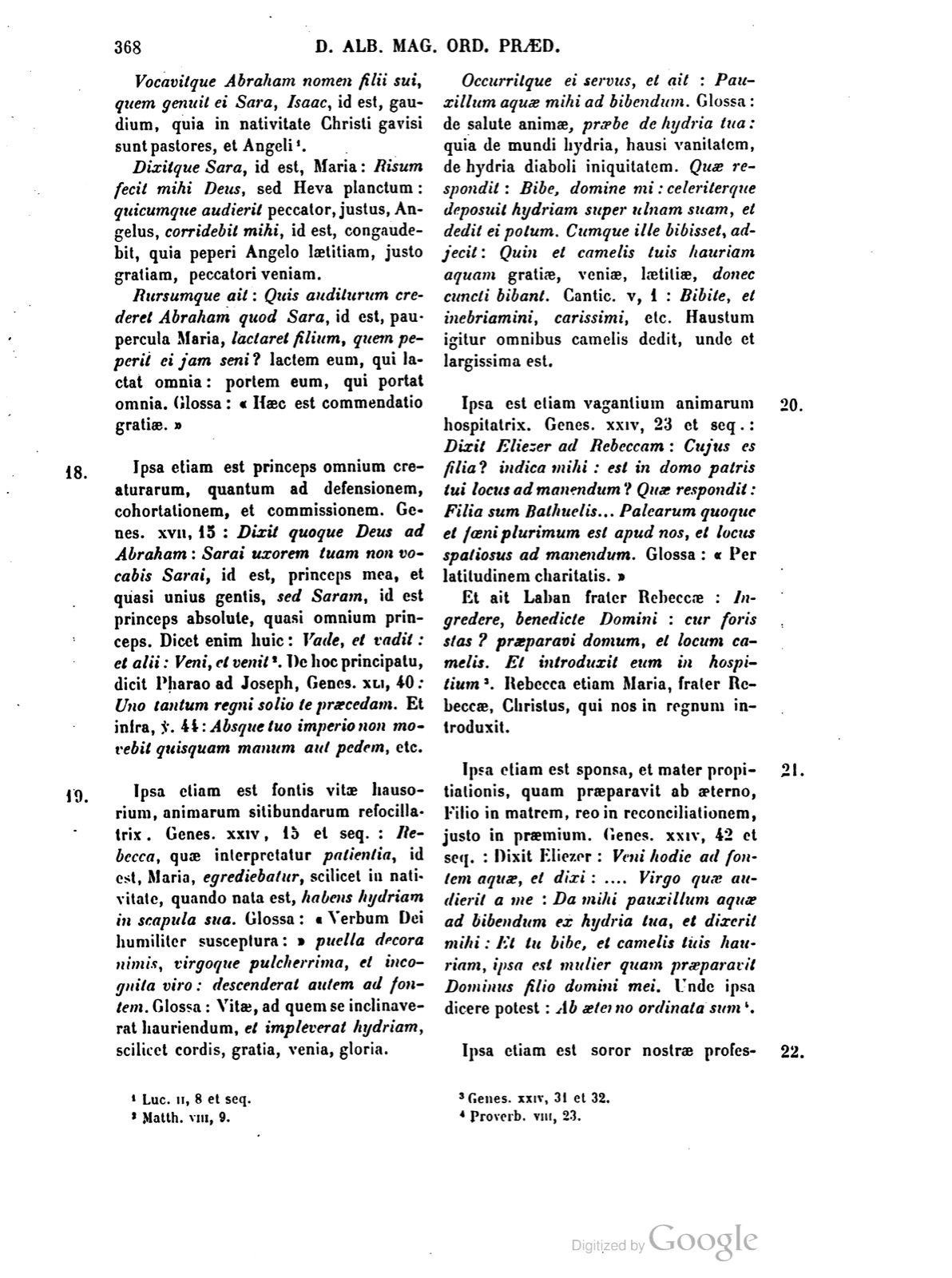
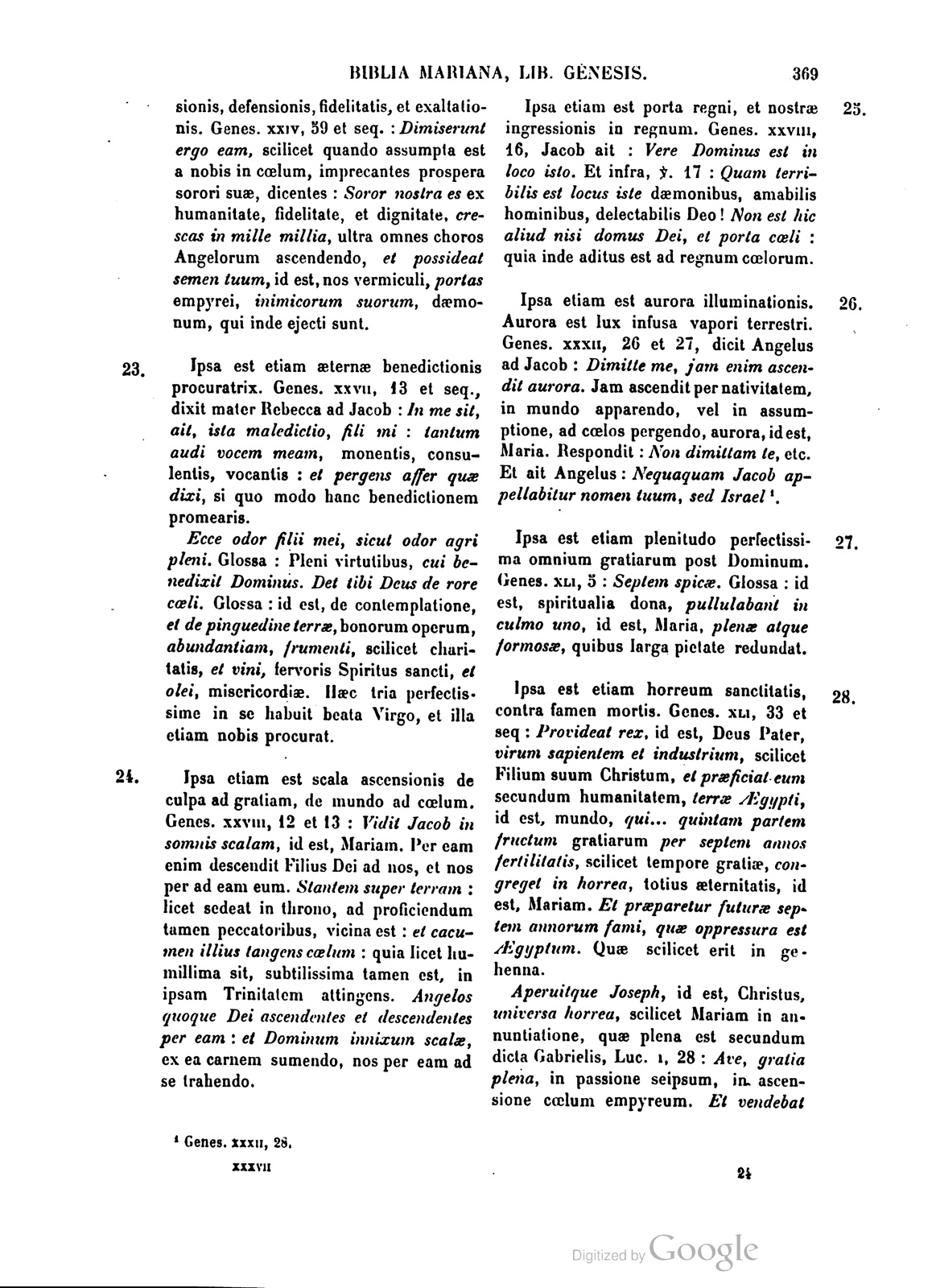
Genes. XXIV, 59 et seq.: Dimiserunt ergo eam, scilicet quando assumpta est a nobis in caelum, imprecantes prospera sorori suae, dicentes: Soror nostra es ex humanitate, fidelitate, et dignitate, crescas in mille millia, ultra omnes choros Angelorum ascendendo, et possideat semen tuum, id est, nos vermiculi, portas empyrei, inimicorum suorum, daemonum, qui inde ejecti sunt.
23. Ipsa est etiam aeternae benedictionis procuratrix. Genes. XXVII, 13 et seq., dixit mater Rebecca ad Jacob: In me sit, ait, ista maledictio, fili mi: tantum audi vocem meam, monentis, consulentis, vocantis: et pergens affer quae dixi, si quo modo hanc benedictionem promearis. Ecce odor filii mei, sicut odor agri pleni. Glossa: Pleni virtutibus, cui benedixit Dominus. Det tibi Deus de rore caeli. Glossa: id est, de contemplatione, et de pinguedine terrae, bonorum operum, abundantiam, frumenti, scilicet charitatis, et vini, fervoris Spiritus sancti, et olei, misericordiae. Haec tria perfectissime in se habuit beata Virgo, et illa etiam nobis procurat.
24. Ipsa etiam est scala ascensionis de culpa ad gratiam, de mundo ad caelum. Genes. XXVIII, 12 et 13: Vidit Jacob in somnis scalam, id est, Mariam. Per eam enim descendit Filius Dei ad nos, et nos per ad eam eum. Stantem super terram: licet sedeat in throno, ad proficiendum tamen peccatoribus, vicina est: et cacumen illius tangens caelum: quia licet humillima sit, subtilissima tamen est, in ipsam Trinitatem attingens. Angelos quoque Dei ascendentes et descendentes per eam: et Dominum innixum scalae, ex ea carnem sumendo, nos per eam ad se trahendo.
25. Ipsa etiam est porta regni, et nostrae ingressionis in regnum. Genes. XXVIII, 16, Jacob ait: Vere Dominus est in loco isto. Et infra, v. 17: Quam terribilis est locus iste daemonibus, amabilis hominibus, delectabilis Deo! Non est hic aliud nisi domus Dei, et porta caeli: quia inde aditus est ad regnum caelorum.
26. Ipsa etiam est aurora illuminationis. Aurora est lux infusa vapori terrestri. Genes. XXXII, 26 et 27, dicit Angelus ad Jacob: Dimitte me, jam enim ascendit aurora. Jam ascendit per nativitatem, in mundo apparendo, vel in assumptione, ad caelos pergendo, aurora, id est, Maria. Respondit: Non dimittam te, etc. Et ait Angelus: Nequaquam Jacob appellabitur nomen tuum, sed Israel 18.
27. Ipsa est etiam plenitudo perfectissima omnium gratiarum post Dominum. Genes. XLI, 5: Septem spicae. Glossa: id est, spiritualia dona, pullulabant in culmo uno, id est, Maria, plenae atque formosae, quibus larga pietate redundat.
28. Ipsa est etiam horreum sanctitatis, contra famen mortis. Genes. XLI, 33 et seq.: Provideat rex, id est, Deus Pater, virum sapientem et industrium, scilicet Filium suum Christum, et praeficiat eum secundum humanitatem, terrae Aegypti, id est, mundo, qui... quintam partem fructum gratiarum per septem annos fertilitatis, scilicet tempore gratiae, congreget in horrea, totius aeternitatis, id est, Mariam. Et praeparetur futurae septem annorum fami, quae oppressura est Aegyptum. Quae scilicet erit in gehenna. Aperuitque Joseph, id est, Christus, universa horrea, scilicet Mariam in annuntiatione, quae plena est secundum dicta Gabrielis, Luc. I, 28: Ave, gratia plena, in passione seipsum, in ascensione caelum empyreum. Et vendebat
Genesis XXIV, 59 and following: Therefore they sent her away, namely when she was assumed from us into heaven, praying prosperity for their sister, saying: You are our sister by humanity, fidelity, and dignity; may you grow into thousands of thousands by ascending beyond all the choirs of Angels, and may your seed, that is, we little worms, possess the gates of the empyrean, of their enemies, the demons, who were cast out from there.
23. She is also the procurer of eternal blessing. Genesis XXVII, 13 and following: Mother Rebecca said to Jacob: Upon me, she said, let that curse be, my son; only hear my voice, as it warns, counsels, and calls; and going, bring what I have said, if in some way you may earn this blessing. Behold the odor of my son, like the odor of a full field. The Gloss: Full of virtues, which the Lord has blessed. May God give you from the dew of heaven. The Gloss: that is, from contemplation, and from the richness of the earth, the abundance of good works, of grain, namely charity, and of wine, the fervor of the Holy Spirit, and of oil, mercy. The blessed Virgin had these three things most perfectly in herself, and she also procures them for us.
24. She is also the ladder of ascent from guilt to grace, from the world to heaven. Genesis XXVIII, 12 and 13: Jacob saw in dreams a ladder, that is, Mary. For through her the Son of God descended to us, and we through her to him. Standing upon the earth: although she sits on the throne, nevertheless, for sinners to profit, she is near; and its top touching heaven: because although she is most humble, nevertheless she is most subtle, reaching into the Trinity itself. Also the Angels of God ascending and descending through her; and the Lord leaning upon the ladder, by taking flesh from her, and by drawing us through her to himself.
25. She is also the gate of the kingdom and of our entrance into the kingdom. Genesis XXVIII, 16: Jacob said: Truly the Lord is in this place. And below, verse 17: How terrible this place is to demons, lovely to men, delightful to God! This is nothing else but the house of God and the gate of heaven, because from there is access to the kingdom of the heavens.
26. She is also the dawn of illumination. Dawn is light poured into earthly vapor. Genesis XXXII, 26 and 27: the Angel says to Jacob: Let me go, for dawn has now ascended. Now dawn has ascended through the nativity, by appearing in the world, or in the assumption, by going to the heavens; that is, Mary. He answered: I will not let you go, etc. And the Angel said: Your name shall no longer be called Jacob, but Israel 18.
27. She is also the most perfect fullness of all graces after the Lord. Genesis XLI, 5: Seven ears of grain. The Gloss: that is, spiritual gifts, were sprouting on one stalk, that is, Mary, full and beautiful, with which she overflows by generous piety.
28. She is also the granary of holiness against the famine of death. Genesis XLI, 33 and following: Let the king, that is, God the Father, provide a wise and industrious man, namely his Son Christ, and set him according to his humanity over the land of Egypt, that is, the world, who... may gather the fifth part, the fruit of graces, through the seven years of fertility, namely in the time of grace, into the granaries of all eternity, that is, Mary. And let it be prepared for the future famine of seven years, which will oppress Egypt, which indeed will be in Gehenna. And Joseph, that is, Christ, opened all the granaries, namely Mary in the annunciation, who is full according to the words of Gabriel, Luke I, 28: Hail, full of grace; in the passion, himself; in the ascension, the empyrean heaven. And he was selling
Notes
- Genesis I, 1. (Genes. I, 1.) ↩
- Ibid., verse 3. (Ibid., v. 3.) ↩
- Ibid., verses 3 and 4. (Ibid., vv. 3 et 4.) ↩
- Ibid., verse 4. (Ibid., v. 4.) ↩
- Ibid., verse 11. (Ibid., v. 11.) ↩
- Ibid. ↩
- Ibid. ↩
- Psalm XI, 3. (Psal. XI, 3.) ↩
- Genesis II, 18. (Genes. II, 18.) ↩
- Genesis VIII, 11. (Genes. VIII, 11.) ↩
- Luke I, 38. (Luc. I, 38.) ↩
- Genesis VIII, 20. (Genes. VIII, 20.) ↩
- Genesis IX, 14 and 15. (Genes. IX, 14 et 15.) ↩
- Luke II, 8 and following. (Luc. II, 8 et seq.) ↩
- Matthew VIII, 9. (Matth. VIII, 9.) ↩
- Genesis XXIV, 31 and 32. (Genes. XXIV, 31 et 32.) ↩
- Proverbs VIII, 23. (Proverb. VIII, 23.) ↩
- Genesis XXXII, 28. (Genes. XXXII, 28.) ↩
If a page does not appear, its photograph has not been uploaded yet.