Works › Sermons for the Seasons of the Year
Volume 13 · pp. 265–266
Sermon LXVIII, Conclusion
A marker with ≈ is an approximate page boundary, placed by measure of the text; the page photographs remain the authority. In the paired views, clicking a page marker brings that page into view.
Septimus leprosus est septimi praecepti contemptor, quod dicit: Non furtum facies 1. Hoc mandato et furtum, et rapina, et dolus, et calumnia, et omnis generis usura prohibetur.
Octavus leprosus est, qui loquitur contra proximum falsum testimonium. Dicit enim octavum praeceptum: Non loqueris contra proximum tuum falsum testimonium 2. Hoc praeceptum violant, qui verbis suis vel vitae, vel famae, vel etiam rebus proximi nocent.
Nonus leprosus est noni praecepti transgressor, quod sic ait: Non desiderabis uxorem proximi tui 3. Hinc etiam luxuria mentalis prohibetur, ne videlicet aliquis credat quod non sit peccatum deliciari cum luxuriosis cogitationibus in corde.
Decimus leprosus est, qui violat decimum praeceptum, quod ait: Non concupisces domum proximi tui, nec omnia quae illius sunt 4. Hoc mandatum non observat, qui per avaritiam intus exaestuans quamcumque rem proximi contra justitiam concupiscit.
III.
De tertio nota, quod ad hoc, ut hujusmodi leprosi curentur, quinque specialiter requiruntur.
1. Primum est, ut Jesu castellum ingredienti occurrant. Ille Jesu occurrit, qui hoc firmiter credit, quod Jesus ad judicium in mundum veniet, et quod in carne sua resurget, et coram Deo judice stabit, vel vitae aeternae, vel mortis perpetuae sententiam auditurus.
2. Secundum, ut viso Jesu stent a longe. Ille a longe stat, qui se humiliat, et Christum judicem sperando formidat. In hoc enim notatur spes, quod steterunt. Timor autem in hoc innuitur, quod steterunt a longe, tamquam non audentes propius accedere.
3. Tertium est, quod vocem suam ad Deum levent dicentes: Jesu praeceptor, miserere nostri. Ille ad Deum vocem levat, qui per poenitentiam, et justitiam ad Deum clamat. Misericordia quippe et justitia sunt alae orationis, quibus levatur ad Deum. Misericordia sua pauperibus tribuit. Justitia vero unicuique ablata restituit.
4. Quartum est, quod Sacerdotibus se ostendant. Unde dixit eis: Ite, ostendite vos Sacerdotibus 5.
Et nota, quod ad confessionem praecipue quatuor exiguntur, quae hic innuuntur.
Primum est, ut sit humilis, unde non dixit, "equitate," sed ite.
Secundum est, quod sit nuda et sui accusatoria: unde ait: Ostendite vos, et non alios.
The seventh leper is the despiser of the seventh precept, which says: You shall not steal 1. By this command theft, robbery, fraud, calumny, and usury of every kind are prohibited.
The eighth leper is he who speaks false testimony against his neighbor. For the eighth precept says: You shall not speak false testimony against your neighbor 2. Those violate this precept who harm their neighbor by their words, either in life or reputation or even in things.
The ninth leper is the transgressor of the ninth precept, which says thus: You shall not desire the wife of your neighbor 3. Hence mental lust also is prohibited, lest namely someone believe that it is not a sin to delight with lustful thoughts in the heart.
The tenth leper is he who violates the tenth precept, which says: You shall not covet the house of your neighbor, nor all things that are his 4. He does not observe this command who, inwardly burning through avarice, covets any thing of his neighbor against justice.
III.
Concerning the third, note that for lepers of this sort to be cured, five things are specially required.
1. The first is that they meet Jesus as he enters the castle. He meets Jesus who firmly believes this, that Jesus will come into the world for judgment, and that he will rise again in his flesh, and stand before God as judge, about to hear the sentence either of eternal life or of perpetual death.
2. The second is that, having seen Jesus, they stand far off. He stands far off who humbles himself and, by hoping, fears Christ as judge. For hope is noted in this, that they stood. But fear is intimated in this, that they stood far off, as if not daring to come nearer.
3. The third is that they lift their voice to God, saying: Jesus, master, have mercy on us. He lifts his voice to God who cries to God through repentance and justice. For mercy and justice are the wings of prayer by which it is lifted to God. Mercy gives its own things to the poor. But justice restores to each person things taken away.
4. The fourth is that they show themselves to the Priests. Hence he said to them: Go, show yourselves to the Priests 5.
And note that for confession especially four things are required, which are intimated here.
The first is that it be humble; hence he did not say, "go on horseback," but go.
The second is that it be naked and accusatory of itself; hence he says: Show yourselves, and not others.
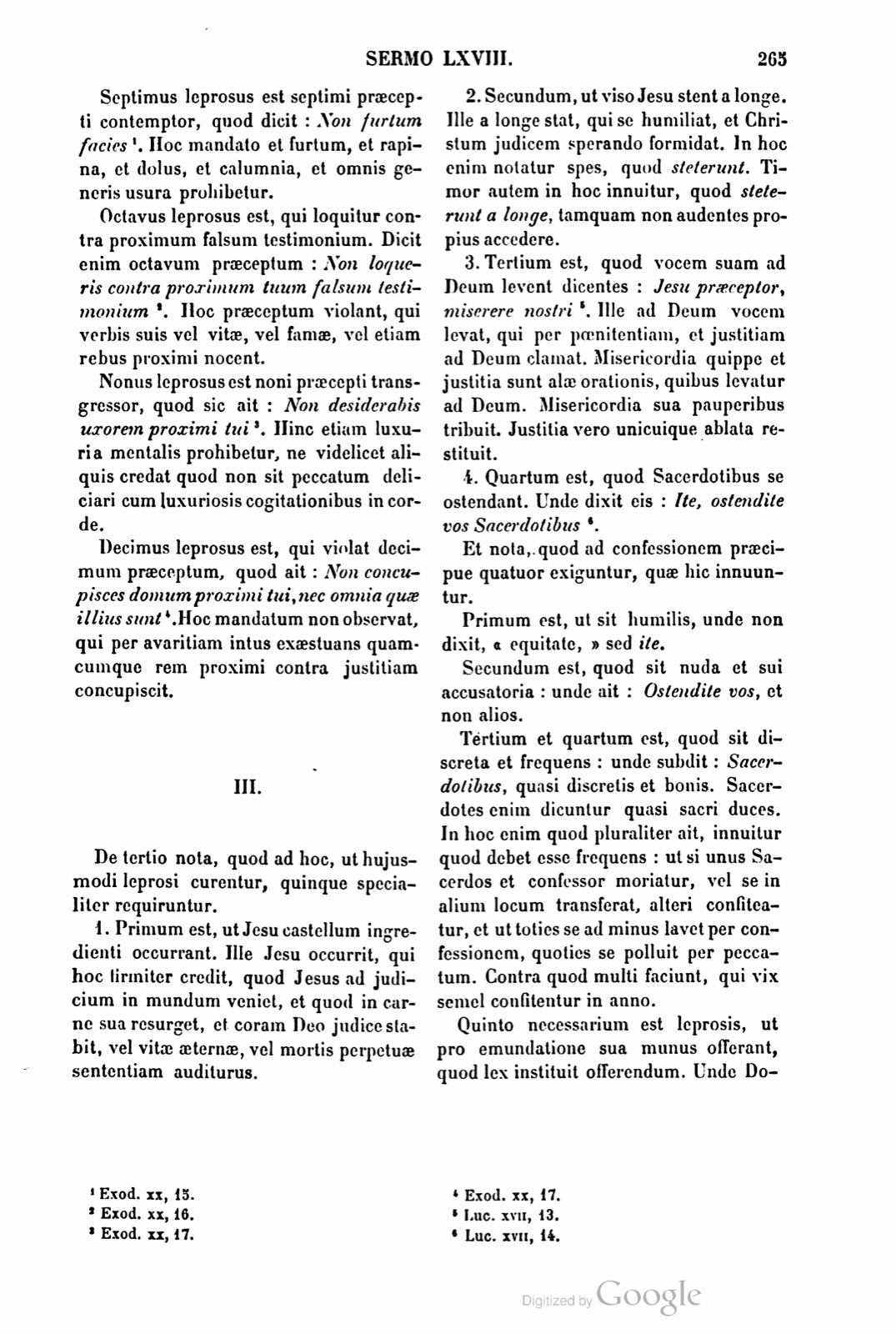
Tertium et quartum est, quod sit discreta et frequens: unde subdit: Sacerdotibus, quasi discretis et bonis. Sacerdotes enim dicuntur quasi sacri duces. In hoc enim quod pluraliter ait, innuitur quod debet esse frequens: ut si unus Sacerdos et confessor moriatur, vel se in alium locum transferat, alteri confiteatur, et ut toties se ad minus lavet per confessionem, quoties se polluit per peccatum. Contra quod multi faciunt, qui vix semel confitentur in anno.
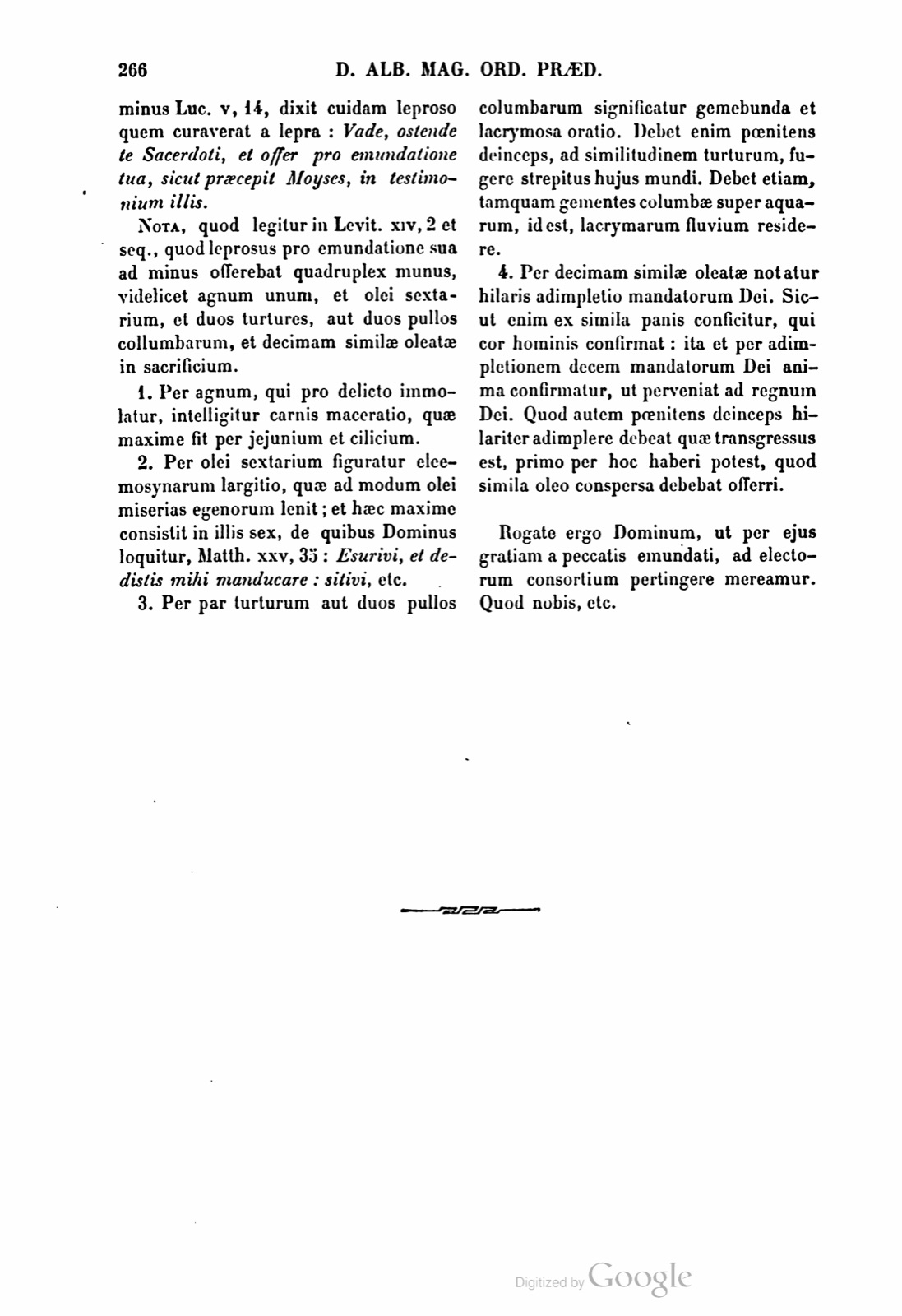
Quinto necessarium est leprosis, ut pro emundatione sua munus offerant, quod lex instituit offerendum. Unde Dominus Luc. V, 14, dixit cuidam leproso quem curaverat a lepra: Vade, ostende te Sacerdoti, et offer pro emundatione tua, sicut praecepit Moyses, in testimonium illis.
NOTA, quod legitur in Levit. XIV, 2 et seq., quod leprosus pro emundatione sua ad minus offerebat quadruplex munus, videlicet agnum unum, et olei sextarium, et duos turtures, aut duos pullos columbarum, et decimam similae oleatae in sacrificium.
1. Per agnum, qui pro delicto immolatur, intelligitur carnis maceratio, quae maxime fit per jejunium et cilicium.
2. Per olei sextarium figuratur eleemosynarum largitio, quae ad modum olei miserias egenorum lenit; et haec maxime consistit in illis sex, de quibus Dominus loquitur, Matth. XXV, 35: Esurivi, et dedistis mihi manducare: sitivi, etc.
3. Per par turturum aut duos pullos columbarum significatur gemebunda et lacrymosa oratio. Debet enim poenitens deinceps, ad similitudinem turturum, fugere strepitus hujus mundi. Debet etiam, tamquam gementes columbae super aquarum, id est, lacrymarum fluvium residere.
4. Per decimam similae oleatae notatur hilaris adimpletio mandatorum Dei. Sicut enim ex simila panis conficitur, qui cor hominis confirmat: ita et per adimpletionem decem mandatorum Dei anima confirmatur, ut perveniat ad regnum Dei. Quod autem poenitens deinceps hilariter adimplere debeat quae transgressus est, primo per hoc haberi potest, quod simila oleo conspersa debebat offerri.
Rogate ergo Dominum, ut per ejus gratiam a peccatis emundati, ad electorum consortium pertingere mereamur. Quod nobis, etc.
The third and fourth are that it be discreet and frequent; hence he adds: To the Priests, as to discreet and good men. For priests are called as it were sacred leaders. For in this, that he speaks in the plural, it is intimated that it ought to be frequent: so that if one Priest and confessor dies, or transfers himself to another place, one may confess to another, and that at least so often he wash himself through confession as he pollutes himself through sin. Against this many act, who scarcely confess once in the year.
Fifth, it is necessary for lepers to offer for their cleansing the gift which the law established to be offered. Hence the Lord, Luke V, 14, said to a certain leper whom he had cured from leprosy: Go, show yourself to the Priest, and offer for your cleansing as Moses commanded, for a testimony to them.
NOTE that it is read in Leviticus XIV, 2 and following, that the leper for his cleansing offered at least a fourfold gift, namely one lamb, and a sixth-part measure of oil, and two turtledoves or two young doves, and a tenth of fine flour mixed with oil for sacrifice.
1. By the lamb, which is immolated for sin, is understood the maceration of the flesh, which especially happens through fasting and a hair-shirt.
2. By the sixth-part measure of oil is figured the bestowal of alms, which, after the manner of oil, soothes the miseries of the needy; and this consists especially in those six things concerning which the Lord speaks, Matthew XXV, 35: I was hungry, and you gave me to eat; I was thirsty, etc.
3. By the pair of turtledoves or two young doves is signified groaning and tearful prayer. For the penitent ought henceforth, after the likeness of turtledoves, to flee the noises of this world. He ought also, like groaning doves, to sit upon a river of waters, that is, of tears.
4. By the tenth of fine flour mixed with oil is noted the cheerful fulfillment of the commandments of God. For just as from fine flour bread is made, which strengthens the heart of a human being, so also through the fulfillment of the ten commandments of God the soul is strengthened, so that it may come to the kingdom of God. But that the penitent ought henceforth cheerfully to fulfill the things which he has transgressed can first be had from this, that the fine flour sprinkled with oil had to be offered.
Therefore ask the Lord that, cleansed from sins through his grace, we may deserve to reach the company of the elect. May he grant this to us, etc.
If a page does not appear, its photograph has not been uploaded yet.