Works › Sermons for the Seasons of the Year
Volume 13 · pp. 203–204
Sermon LI. Again on the Same, opening
A marker with ≈ is an approximate page boundary, placed by measure of the text; the page photographs remain the authority. In the paired views, clicking a page marker brings that page into view.
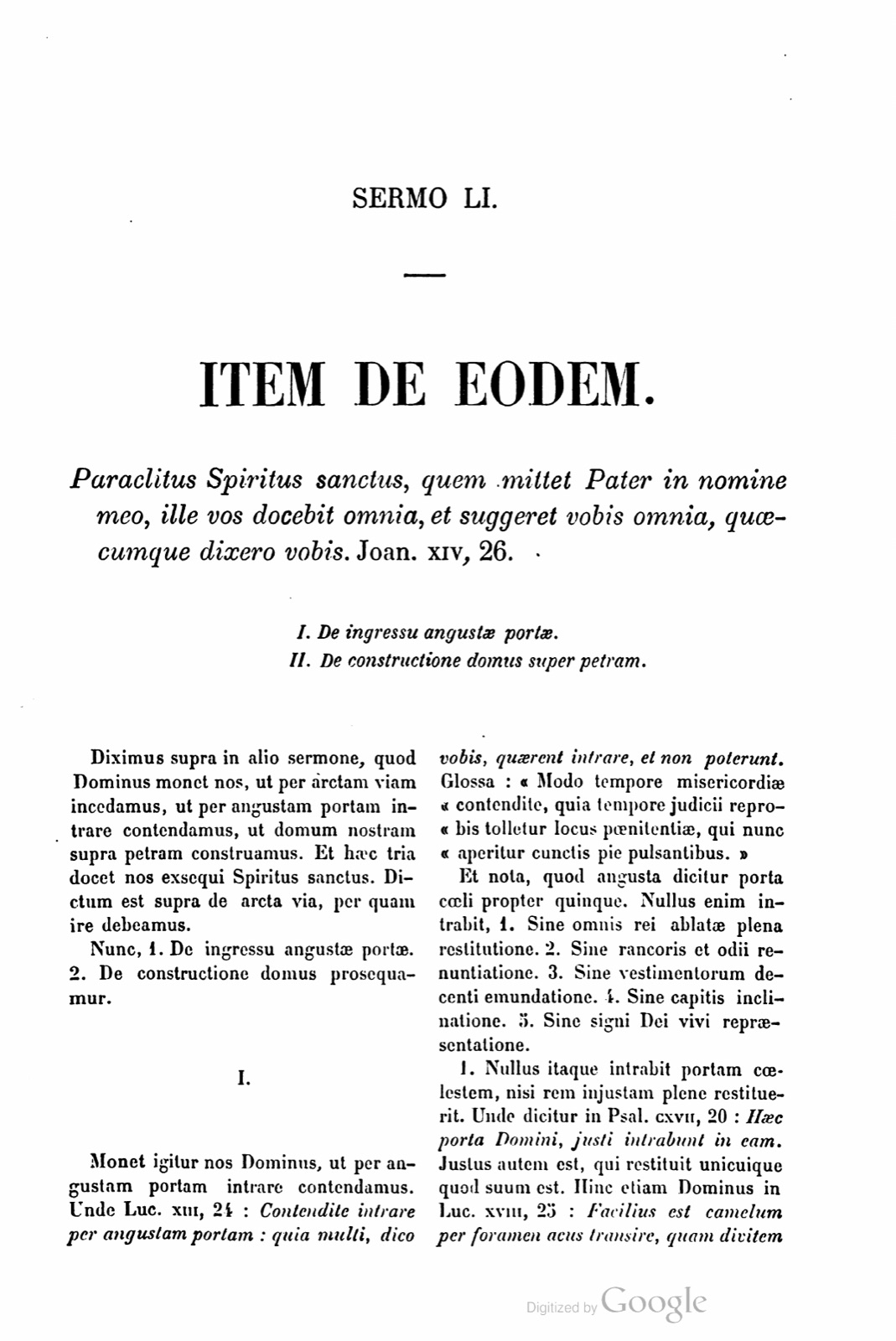
SERMO LI. ITEM DE EODEM.
Paraclitus Spiritus sanctus, quem mittet Pater in nomine meo, ille vos docebit omnia, et suggeret vobis omnia, quæcumque dixero vobis. Joan. xiv, 26.
I. De ingressu angustæ portæ. II. De constructione domus super petram.
Diximus supra in alio sermone, quod Dominus monet nos, ut per arctam viam incedamus, ut per angustam portam intrare contendamus, ut domum nostram supra petram construamus. Et hæc tria docet nos exsequi Spiritus sanctus. Dictum est supra de arcta via, per quam ire debeamus.
Nunc, 1. De ingressu angustæ portæ. 2. De constructione domus prosequamur.
I. Monet igitur nos Dominus, ut per angustam portam intrare contendamus. Unde Luc. xiii, 24: Contendite intrare per angustam portam: quia multi, dico vobis, quærent intrare, et non poterunt. Glossa: «Modo tempore misericordiæ contendite, quia tempore judicii reprobis tolletur locus pœnitentiæ, qui nunc aperitur cunctis pie pulsantibus.»
Et nota, quod angusta dicitur porta cæli propter quinque. Nullus enim intrabit, 1. Sine omnis rei ablatæ plena restitutione. 2. Sine rancoris et odii renuntiatione. 3. Sine vestimentorum decenti emundatione. 4. Sine capitis inclinatione. 5. Sine signi Dei vivi repræsentatione.
1. Nullus itaque intrabit portam cœlestem, nisi rem injustam plene restituerit. Unde dicitur in Psal. cxvii, 20: Hæc porta Domini, justi intrabunt in eam. Justus autem est, qui restituit unicuique quod suum est. Hinc etiam Dominus in Luc. xviii, 25: Facilius est camelum per foramen acus transire, quam divitem intrare in regnum Dei. Hæc verba intellige de tali divite, qui dives factus est per res injuste conquisitas: vel etiam de illo qui res bene acquisitas nimis avare detinet, nec pauperibus miseretur. Item, Augustinus ad Macedonium: «Si res aliena cum reddi possit, non redditur, non agitur pœnitentia, sed fingitur. Si autem veraciter agitur, non remittetur peccatum, quin restituatur ablatum.»
2. Item, nullus intrabit, nisi rancori et odio renuntiaverit. Unde I Joan. iii, 14 et 15: Nos scimus quoniam translati sumus de morte ad vitam, quoniam diligimus fratres. Qui non diligit, manet in morte: Omnis, qui odit fratrem suum, homicida est. Et scitis quoniam omnis homicida non habet vitam æternam in semetipso manentem. Igitur qui odit et invidet proximo suo non potest intrare illuc, ubi regnat vita æterna, et ubi charitas possidet principatum. Unde Boetius in secundo libro de Consolatione: «O felix hominum genus, si vestros animos amor, quo cœlum regitur, regat.»
SERMON LI. AGAIN ON THE SAME.
The Paraclete, the Holy Spirit, whom the Father will send in my name, he will teach you all things and will suggest to you all things whatsoever I have said to you. John 14:26.
I. On entering through the narrow gate. II. On building the house upon the rock.
We said above in another sermon that the Lord admonishes us to walk by the narrow way, to strive to enter through the narrow gate, and to build our house upon the rock. And the Holy Spirit teaches us to carry out these three things. It was said above concerning the narrow way by which we ought to go.
Now let us pursue: 1. the entering through the narrow gate; 2. the building of the house.
I. Therefore the Lord admonishes us to strive to enter through the narrow gate. Hence Luke 13:24 says: Strive to enter through the narrow gate, because many, I say to you, will seek to enter and will not be able. The Gloss says: Strive now in the time of mercy, because in the time of judgment the place of penance, which is now opened to all who piously knock, will be taken away from the reprobate.
And note that the gate of heaven is called narrow because of five things. For no one will enter: 1. Without full restitution of every thing taken away. 2. Without renunciation of rancor and hatred. 3. Without decent cleansing of garments. 4. Without lowering of the head. 5. Without representation of the sign of the living God.
1. Therefore no one will enter the heavenly gate unless he has fully restored the unjust thing. Hence it is said in Psalm 117:20: This is the gate of the Lord; the just will enter through it. But the just person is one who restores to each person what is his. Hence also the Lord says in Luke 18:25: It is easier for a camel to pass through the eye of a needle than for a rich person to enter into the kingdom of God. Understand these words concerning such a rich person who has been made rich through things unjustly acquired, or also concerning the one who holds things well acquired too avariciously and does not have mercy on the poor. Likewise Augustine to Macedonius says: If another's property, when it can be restored, is not restored, penance is not being done but feigned. But if penance is truly done, the sin will not be remitted unless what was taken away is restored.
2. Likewise, no one will enter unless he has renounced rancor and hatred. Hence 1 John 3:14 and 15 says: We know that we have been transferred from death to life because we love the brothers. The one who does not love remains in death; everyone who hates his brother is a murderer. And you know that every murderer does not have eternal life remaining in himself. Therefore one who hates and envies his neighbor cannot enter there where eternal life reigns and where charity possesses the principate. Hence Boethius in the second book of the Consolation says: O happy human race, if the love by which heaven is ruled were to rule your souls.
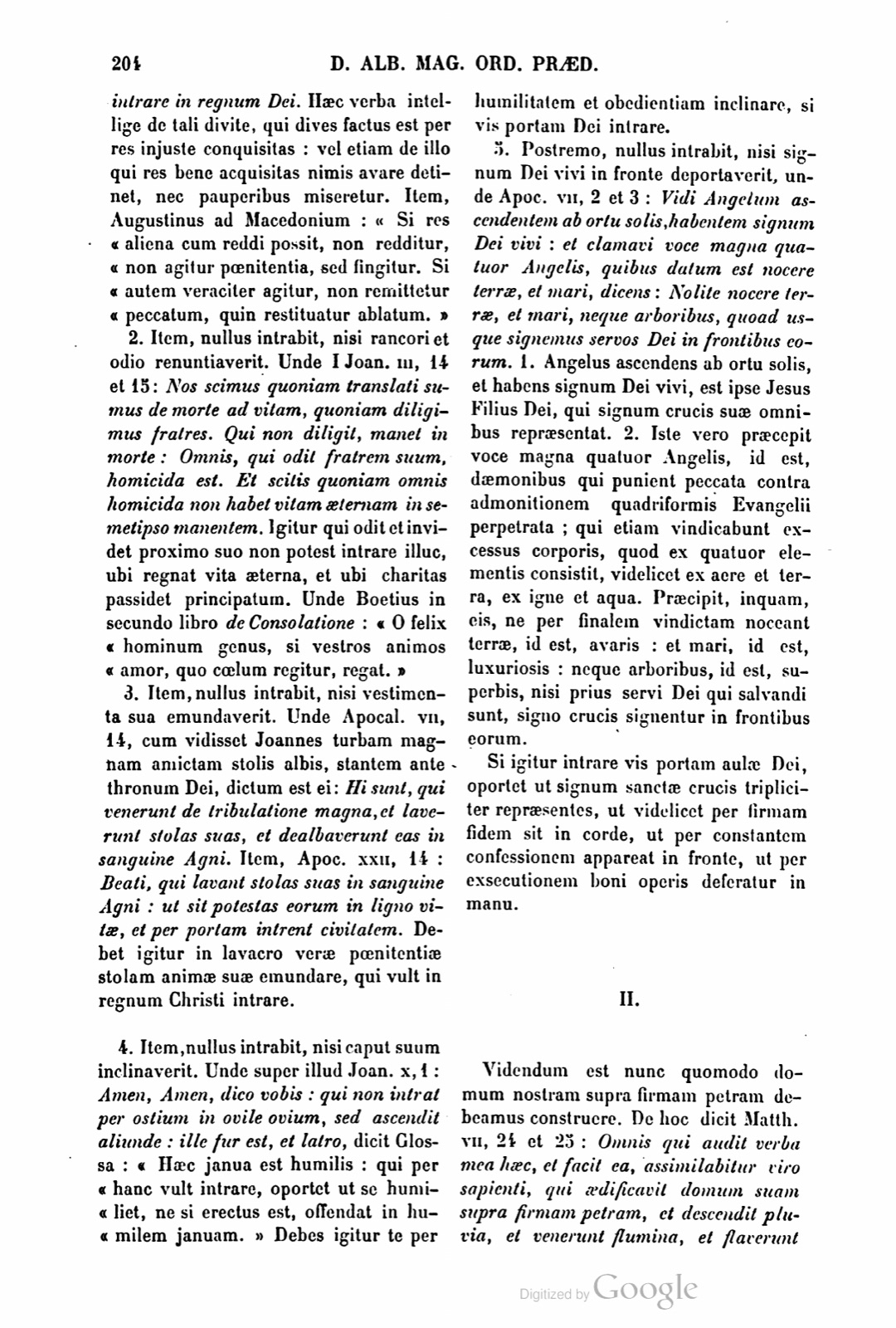
3. Item, nullus intrabit, nisi vestimenta sua emundaverit. Unde Apocal. vii, 14, cum vidisset Joannes turbam magnam amictam stolis albis, stantem ante thronum Dei, dictum est ei: Hi sunt, qui venerunt de tribulatione magna, et laverunt stolas suas, et dealbaverunt eas in sanguine Agni. Item, Apoc. xxii, 14: Beati, qui lavant stolas suas in sanguine Agni: ut sit potestas eorum in ligno vitæ, et per portam intrent civitatem. Debet igitur in lavacro veræ pœnitentiæ stolam animæ suæ emundare, qui vult in regnum Christi intrare.
4. Item, nullus intrabit, nisi caput suum inclinaverit. Unde super illud Joan. x, 1: Amen, Amen, dico vobis: qui non intrat per ostium in ovile ovium, sed ascendit aliunde: ille fur est, et latro, dicit Glossa: «Hæc janua est humilis: qui per hanc vult intrare, oportet ut se humiliet, ne si erectus est, offendat in humilem januam.» Debes igitur te per humilitatem et obedientiam inclinare, si vis portam Dei intrare.
5. Postremo, nullus intrabit, nisi signum Dei vivi in fronte deportaverit, unde Apoc. vii, 2 et 3: Vidi Angelum ascendentem ab ortu solis, habentem signum Dei vivi: et clamavi voce magna quatuor Angelis, quibus datum est nocere terræ, et mari, dicens: Nolite nocere terræ, et mari, neque arboribus, quoad usque signemus servos Dei in frontibus eorum. 1. Angelus ascendens ab ortu solis, et habens signum Dei vivi, est ipse Jesus Filius Dei, qui signum crucis suæ omnibus repræsentat. 2. Iste vero præcepit voce magna quatuor Angelis, id est, dæmonibus qui punient peccata contra admonitionem quadriformis Evangelii perpetrata; qui etiam vindicabunt excessus corporis, quod ex quatuor elementis consistit, videlicet ex aere et terra, ex igne et aqua. Præcipit, inquam, eis, ne per finalem vindictam noceant terræ, id est, avaris: et mari, id est, luxuriosis: neque arboribus, id est, superbis, nisi prius servi Dei qui salvandi sunt, signo crucis signentur in frontibus eorum.
Si igitur intrare vis portam aulæ Dei, oportet ut signum sanctæ crucis tripliciter repræsentes, ut videlicet per firmam fidem sit in corde, ut per constantem confessionem appareat in fronte, ut per exsecutionem boni operis deferatur in manu.
II. Videndum est nunc quomodo domum nostram supra firmam petram debeamus construere. De hoc dicit Matth. vii, 24 et 25: Omnis qui audit verba mea hæc, et facit ea, assimilabitur viro sapienti, qui ædificavit domum suam supra firmam petram, et descendit pluvia, et venerunt flumina, et flaverunt
3. Likewise, no one will enter unless he has cleansed his garments. Hence in Apocalypse 7:14, when John had seen a great crowd clothed in white robes, standing before the throne of God, it was said to him: These are the ones who came from great tribulation and washed their robes and made them white in the blood of the Lamb. Likewise Apocalypse 22:14: Blessed are those who wash their robes in the blood of the Lamb, so that their power may be in the tree of life and they may enter the city through the gate. Therefore the one who wishes to enter into the kingdom of Christ ought to cleanse the robe of his soul in the washing of true penance.
4. Likewise, no one will enter unless he has lowered his head. Hence on that saying of John 10:1, Amen, amen, I say to you: the one who does not enter through the door into the sheepfold, but climbs up another way, is a thief and robber, the Gloss says: This doorway is humble; the one who wishes to enter through it must humble himself, lest if he is upright he strike against the humble doorway. Therefore you ought to lower yourself through humility and obedience if you wish to enter the gate of God.
5. Lastly, no one will enter unless he has carried the sign of the living God on his forehead; hence Apocalypse 7:2 and 3 says: I saw an Angel ascending from the rising of the sun, having the sign of the living God; and I cried with a great voice to the four Angels to whom it was given to harm the earth and the sea, saying: Do not harm the earth and the sea or the trees until we sign the servants of God on their foreheads. 1. The Angel ascending from the rising of the sun and having the sign of the living God is Jesus himself, the Son of God, who represents to all the sign of his cross. 2. But he commanded with a great voice the four Angels, that is, the demons who will punish sins perpetrated against the admonition of the fourfold Gospel, and who will also avenge the excesses of the body, which consists of the four elements, namely air and earth, fire and water. He commands them, I say, not to harm by final vengeance the earth, that is, the avaricious; and the sea, that is, the luxurious; nor the trees, that is, the proud, until first the servants of God who are to be saved are signed with the sign of the cross on their foreheads.
Therefore if you wish to enter the gate of the court of God, you must represent the sign of the holy cross in three ways: namely, that through firm faith it may be in the heart, that through constant confession it may appear on the forehead, and that through execution of good work it may be carried in the hand.
II. Now it must be seen how we ought to build our house upon the firm rock. Concerning this Matthew 7:24 and 25 says: Everyone who hears these words of mine and does them will be likened to a wise man who built his house upon the firm rock; and the rain descended, and the floods came, and the winds blew
If a page does not appear, its photograph has not been uploaded yet.