Works › Sermons for the Seasons of the Year
Volume 13 · pp. 199–202
Sermon L. On the Day of Pentecost
A marker with ≈ is an approximate page boundary, placed by measure of the text; the page photographs remain the authority. In the paired views, clicking a page marker brings that page into view.
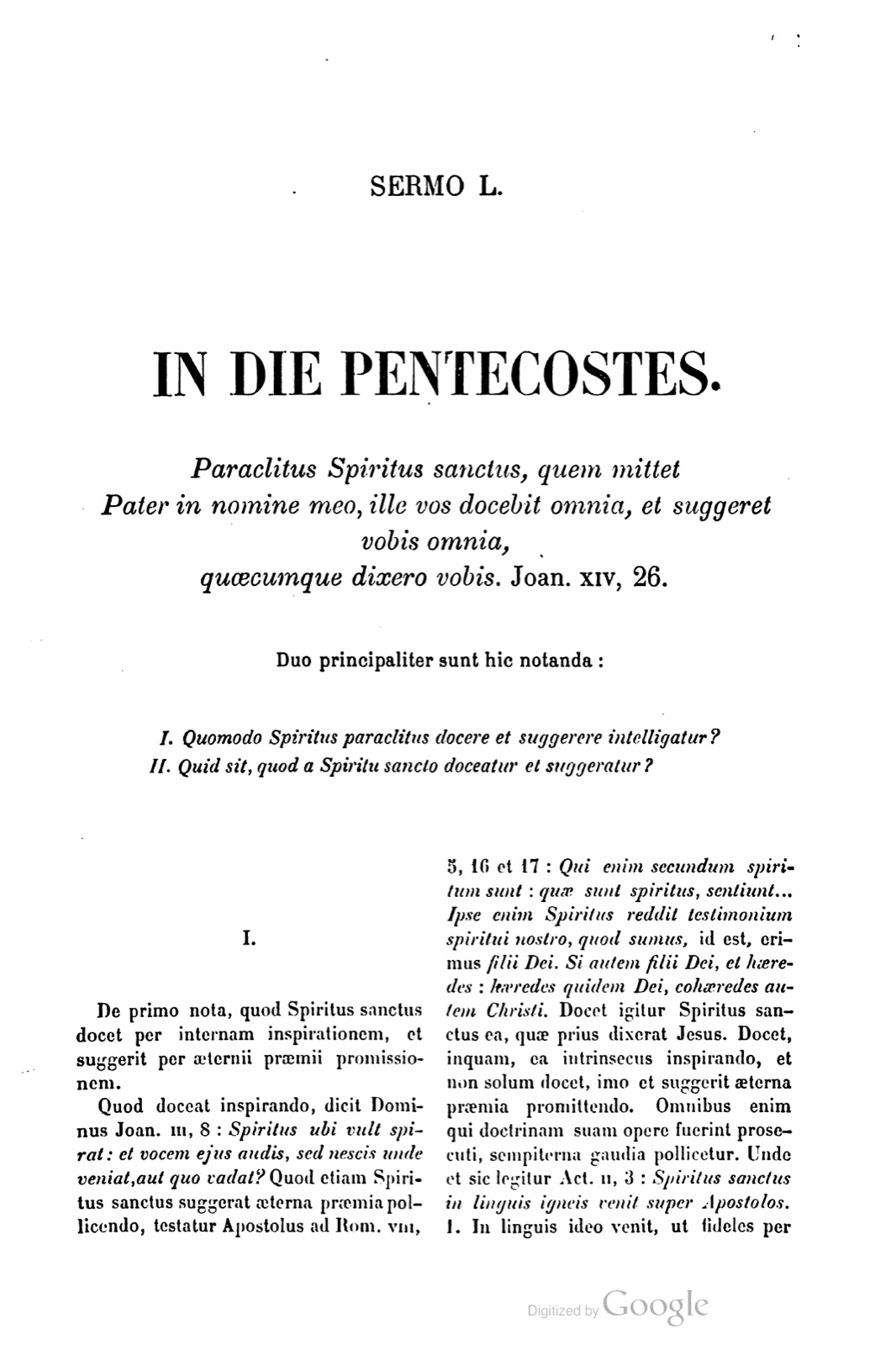
SERMO L. IN DIE PENTECOSTES.
Paraclitus Spiritus sanctus, quem mittet Pater in nomine meo, ille vos docebit omnia, et suggeret vobis omnia, quæcumque dixero vobis. Joan. xiv, 26.
Duo principaliter sunt hic notanda: I. Quomodo Spiritus paraclitus docere et suggerere intelligatur? II. Quid sit, quod a Spiritu sancto doceatur et suggeratur?
I. De primo nota, quod Spiritus sanctus docet per internam inspirationem, et suggerit per æterni præmii promissionem. Quod doceat inspirando, dicit Dominus Joan. iii, 8: Spiritus ubi vult spirat: et vocem ejus audis, sed nescis unde veniat, aut quo vadat? Quod etiam Spiritus sanctus suggerat æterna præmia pollicendo, testatur Apostolus ad Rom. viii, 5, 16 et 17: Qui enim secundum spiritum sunt: quæ sunt spiritus, sentiunt... Ipse enim Spiritus reddit testimonium spiritui nostro, quod sumus, id est, erimus filii Dei. Si autem filii Dei, et hæredes: hæredes quidem Dei, cohæredes autem Christi. Docet igitur Spiritus sanctus ea, quæ prius dixerat Jesus. Docet, inquam, ea intrinsecus inspirando, et non solum docet, imo et suggerit æterna præmia promittendo. Omnibus enim qui doctrinam suam opere fuerint prosecuti, sempiterna gaudia pollicetur. Unde et sic legitur Act. ii, 3: Spiritus sanctus in linguis igneis venit super Apostolos. 1. In linguis ideo venit, ut fideles per eum doceantur. Ipse quippe est magistrorum optimus. 2. In igne propter hoc venit, ut per eum docti ad spem supernorum moneantur. «Ignis etenim, ut dicit Dionysius, est sursum ferens, acute means, et excelsus.»
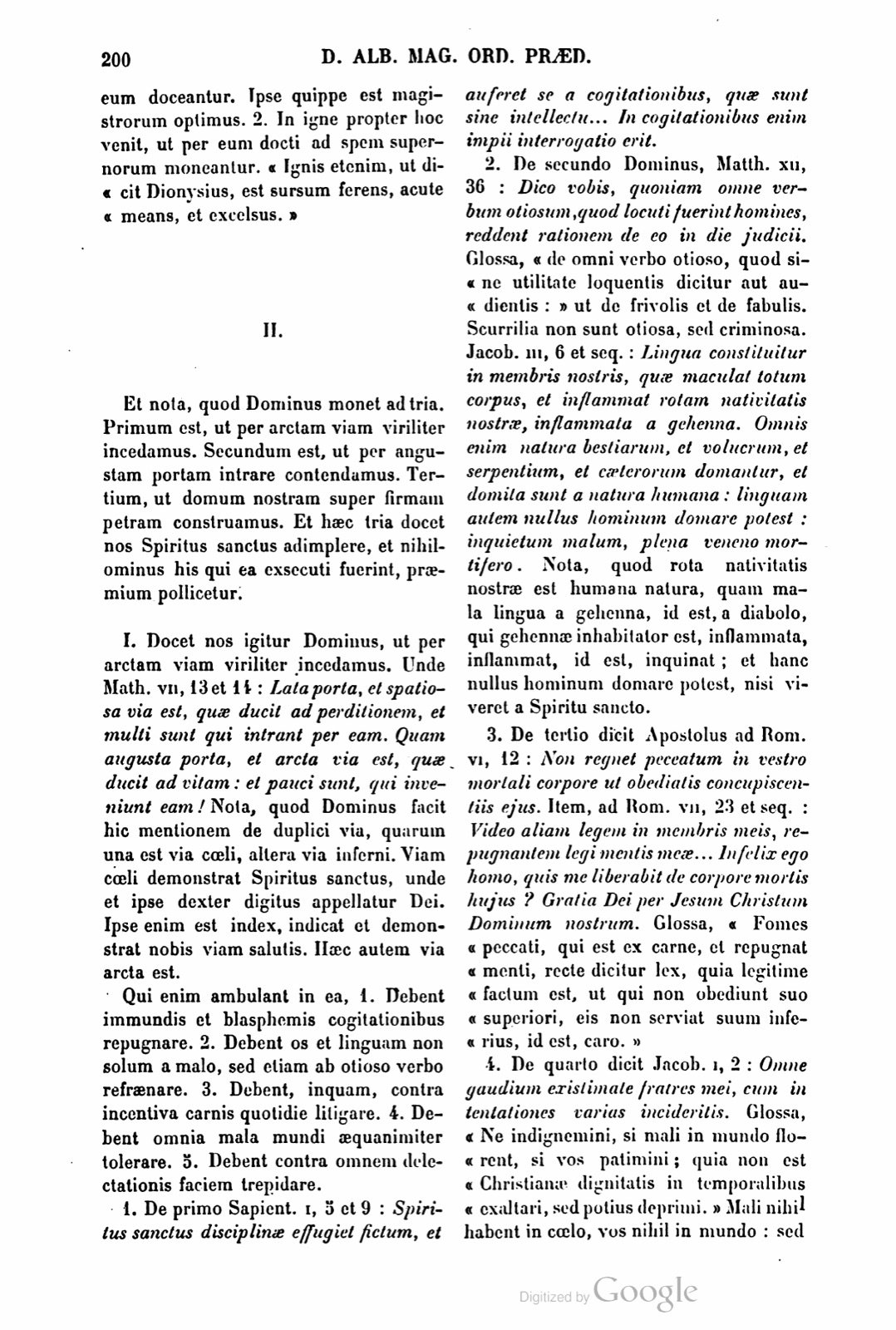
II. Et nota, quod Dominus monet ad tria. Primum est, ut per arctam viam viriliter incedamus. Secundum est, ut per angustam portam intrare contendamus. Tertium, ut domum nostram super firmam petram construamus. Et hæc tria docet nos Spiritus sanctus adimplere, et nihilominus his qui ea exsecuti fuerint, præmium pollicetur.
I. Docet nos igitur Dominus, ut per arctam viam viriliter incedamus. Unde Matth. vii, 13 et 14: Lata porta, et spatiosa via est, quæ ducit ad perditionem, et multi sunt qui intrant per eam. Quam angusta porta, et arcta via est, quæ ducit ad vitam: et pauci sunt, qui inveniunt eam! Nota, quod Dominus facit hic mentionem de duplici via, quarum una est via cæli, altera via inferni. Viam cæli demonstrat Spiritus sanctus, unde et ipse dexter digitus appellatur Dei. Ipse enim est index, indicat et demonstrat nobis viam salutis. Hæc autem via arcta est.
SERMON L. ON THE DAY OF PENTECOST.
The Paraclete, the Holy Spirit, whom the Father will send in my name, he will teach you all things and will suggest to you all things whatsoever I have said to you. John 14:26.
Two things are principally to be noted here: I. In what manner is the Paraclete Spirit understood to teach and suggest? II. What is it that is taught and suggested by the Holy Spirit?
I. On the first, note that the Holy Spirit teaches through inward inspiration and suggests through the promise of eternal reward. That he teaches by inspiring, the Lord says in John 3:8: The Spirit breathes where he wills, and you hear his voice, but you do not know whence he comes or whither he goes. That the Holy Spirit also suggests by promising eternal rewards, the Apostle testifies in Romans 8:5, 16 and 17: For those who are according to the spirit perceive the things that are of the spirit... The Spirit himself bears testimony to our spirit that we are, that is, will be, sons of God. But if sons of God, then heirs: heirs indeed of God, but coheirs of Christ. Therefore the Holy Spirit teaches the things that Jesus had said before. He teaches, I say, by inwardly inspiring them, and not only teaches, indeed also suggests by promising eternal rewards. For to all who will have pursued his doctrine by work he promises everlasting joys. Hence it is also read thus in Acts 2:3: The Holy Spirit came upon the Apostles in fiery tongues. 1. He came in tongues for this reason, that the faithful may be taught through him. For he is the best of teachers. 2. He came in fire for this reason, that those taught through him may be admonished toward hope of heavenly things. For fire, as Dionysius says, is carrying upward, sharply moving, and lofty.
II. And note that the Lord admonishes toward three things. The first is that we walk manfully by the narrow way. The second is that we strive to enter through the narrow gate. The third is that we build our house upon the firm rock. And the Holy Spirit teaches us to fulfill these three things, and nevertheless promises a reward to those who will have carried them out.
I. Therefore the Lord teaches us to walk manfully by the narrow way. Hence Matthew 7:13 and 14 says: Wide is the gate and spacious is the way that leads to destruction, and many are those who enter through it. How narrow is the gate and strait the way that leads to life, and few are those who find it! Note that the Lord here makes mention of a twofold way, of which one is the way of heaven, the other the way of hell. The Holy Spirit shows the way of heaven; hence he himself is called the right finger of God. For he is the pointer; he points out and shows to us the way of salvation. This way, however, is narrow.
Qui enim ambulant in ea, 1. Debent immundis et blasphemis cogitationibus repugnare. 2. Debent os et linguam non solum a malo, sed etiam ab otioso verbo refrænare. 3. Debent, inquam, contra incentiva carnis quotidie litigare. 4. Debent omnia mala mundi æquanimiter tolerare. 5. Debent contra omnem delectationis faciem trepidare.
1. De primo Sapient. i, 3 et 9: Spiritus sanctus disciplinæ effugiet fictum, et auferet se a cogitationibus, quæ sunt sine intellectu... In cogitationibus enim impii interrogatio erit.
2. De secundo Dominus, Matth. xii, 36: Dico vobis, quoniam omne verbum otiosum, quod locuti fuerint homines, reddent rationem de eo in die judicii. Glossa, «de omni verbo otioso, quod sine utilitate loquentis dicitur aut audientis:» ut de frivolis et de fabulis. Scurrilia non sunt otiosa, sed criminosa. Jacob. iii, 6 et seq.: Lingua constituitur in membris nostris, quæ maculat totum corpus, et inflammat rotam nativitatis nostræ, inflammata a gehenna. Omnis enim natura bestiarum, et volucrum, et serpentium, et cæterorum domantur, et domita sunt a natura humana: linguam autem nullus hominum domare potest: inquietum malum, plena veneno mortifero. Nota, quod rota nativitatis nostræ est humana natura, quam mala lingua a gehenna, id est, a diabolo, qui gehennæ inhabitator est, inflammata, inflammat, id est, inquinat; et hanc nullus hominum domare potest, nisi viveret a Spiritu sancto.
3. De tertio dicit Apostolus ad Rom. vi, 12: Non regnet peccatum in vestro mortali corpore ut obediatis concupiscentiis ejus. Item, ad Rom. vii, 23 et seq.: Video aliam legem in membris meis, repugnantem legi mentis meæ... Infelix ego homo, quis me liberabit de corpore mortis hujus? Gratia Dei per Jesum Christum Dominum nostrum. Glossa, «Fomes peccati, qui est ex carne, et repugnat menti, recte dicitur lex, quia legitime factum est, ut qui non obediunt suo superiori, eis non serviat suum inferius, id est, caro.»
For those who walk in it ought: 1. to fight against unclean and blasphemous thoughts; 2. to restrain mouth and tongue not only from evil but also from an idle word; 3. to struggle daily, I say, against the incentives of the flesh; 4. to tolerate all evils of the world with equanimity; 5. to tremble before every appearance of delight.
1. Concerning the first, Wisdom 1:3 and 9 says: The Holy Spirit of discipline will flee deceit, and will take himself away from thoughts that are without understanding... For in the thoughts of the impious there will be interrogation.
2. Concerning the second, the Lord says in Matthew 12:36: I say to you that every idle word that human beings have spoken, they will render an account for it on the day of judgment. The Gloss says, concerning every idle word, which is said without usefulness either to the speaker or to the hearer, as concerning frivolous things and fables. Scurrilous things are not idle but criminal. James 3:6 and following: The tongue is established among our members, which stains the whole body and inflames the wheel of our birth, itself inflamed by Gehenna. For every nature of beasts, birds, serpents, and the rest are tamed and have been tamed by human nature; but no human being can tame the tongue: an unquiet evil, full of deadly poison. Note that the wheel of our birth is human nature, which an evil tongue, inflamed by Gehenna, that is, by the devil, who is the inhabitant of Gehenna, inflames, that is, stains; and no human being can tame this unless he lives by the Holy Spirit.
3. Concerning the third, the Apostle says in Romans 6:12: Let sin not reign in your mortal body so that you obey its concupiscences. Likewise, in Romans 7:23 and following: I see another law in my members, fighting against the law of my mind... Unhappy human that I am, who will free me from the body of this death? The grace of God through Jesus Christ our Lord. The Gloss says: The tinder of sin, which is from the flesh and fights against the mind, is rightly called a law, because it has been lawfully done that for those who do not obey their superior, their inferior, that is, the flesh, should not serve them.
4. De quarto dicit Jacob. i, 2: Omne gaudium existimate fratres mei, cum in tentationes varias incideritis. Glossa, «Ne indignemini, si mali in mundo florent, si vos patimini; quia non est Christianæ dignitatis in temporalibus exaltari, sed potius deprimi.» Mali nihil habent in cælo, vos nihil in mundo: sed spe illius boni, ad quod tenditis, quidquid in via contingit, gaudere debetis.
5. De quinto dicitur arcta via cæli. Qui in ea ambulant, ad omnem delectationis faciem debent formidare. Timere etiam debent, ne vel in edendo, vel bibendo, vel dormiendo, vel opus conjugale exercendo, vel quodcumque opus aliud agendo, plus in eo quam debeant, delectentur. Unde Job, ix, 28: Verebar omnia opera mea, sciens quod non parceres delinquenti.
II. Et nota, quod licet via quæ ducit ad cælum sit arcta, est tamen directa. Unde Isa. xxxv, 8: Erit vobis directa via, ita ut stulti non erunt per eam. Vere directa est, quia est signata quadriformiter: Primo lapidum comportatione: Tulerunt lapides Judæi, ut jacerent in Jesum 1. Secundo per plectam: Et plectentes coronam de spinis, posuerunt super caput ejus 2. Tertio per fixuras clavorum: Foderunt enim manus et pedes Jesu 3. Quarto per crucem: in cruce quippe Dominus suspensus fuit.
III. Item nota, quod arcta via ducit hominem ad cælum. 1. Ubi erit innumerabilium amicorum dulcis societas. 2. Ubi divinæ erit voluptatis plena satietas. 3. Ubi erit summi boni vera proprietas. 4. Ubi erit incolumitatis ac vitæ felix æternitas.
1. De primo dicit Augustinus: «In illa perfecta charitate innumerabilium beatorum Angelorum et hominum, ubi nullus minus diligit alium quam seipsum: non aliter gaudebit quisque pro singulis aliis, quam pro seipso.»
4. Concerning the fourth, James 1:2 says: Count it all joy, my brothers, when you fall into various temptations. The Gloss says: Do not be indignant if the evil flourish in the world while you suffer, because it is not of Christian dignity to be exalted in temporal things, but rather to be pressed down. The evil have nothing in heaven; you have nothing in the world; but by hope of that good toward which you tend, whatever happens on the way, you ought to rejoice.
5. Concerning the fifth, it is called the narrow way of heaven. Those who walk in it ought to fear before every face of delight. They ought also to fear lest either in eating, or drinking, or sleeping, or exercising the conjugal work, or doing any other work whatsoever, they be delighted in it more than they ought. Hence Job 9:28 says: I feared all my works, knowing that you would not spare the delinquent.
II. And note that although the way that leads to heaven is narrow, nevertheless it is direct. Hence Isaiah 35:8 says: There will be for you a direct way, so that fools will not be on it. It is truly direct because it is marked in four ways: first, by the carrying together of stones: The Jews took up stones to throw at Jesus 1. Second, by the plait: And plaiting a crown of thorns, they placed it upon his head 2. Third, by the piercings of the nails: For they dug through the hands and feet of Jesus 3. Fourth, by the cross: for the Lord was hanging on the cross.
III. Likewise note that the narrow way leads the human being to heaven. 1. Where there will be sweet society of innumerable friends. 2. Where there will be full satiety of divine pleasure. 3. Where there will be true possession of the highest good. 4. Where there will be blessed eternity of safety and life.
1. Concerning the first, Augustine says: In that perfect charity of innumerable blessed Angels and human beings, where no one loves another less than himself, each will rejoice no otherwise for every other than for himself.
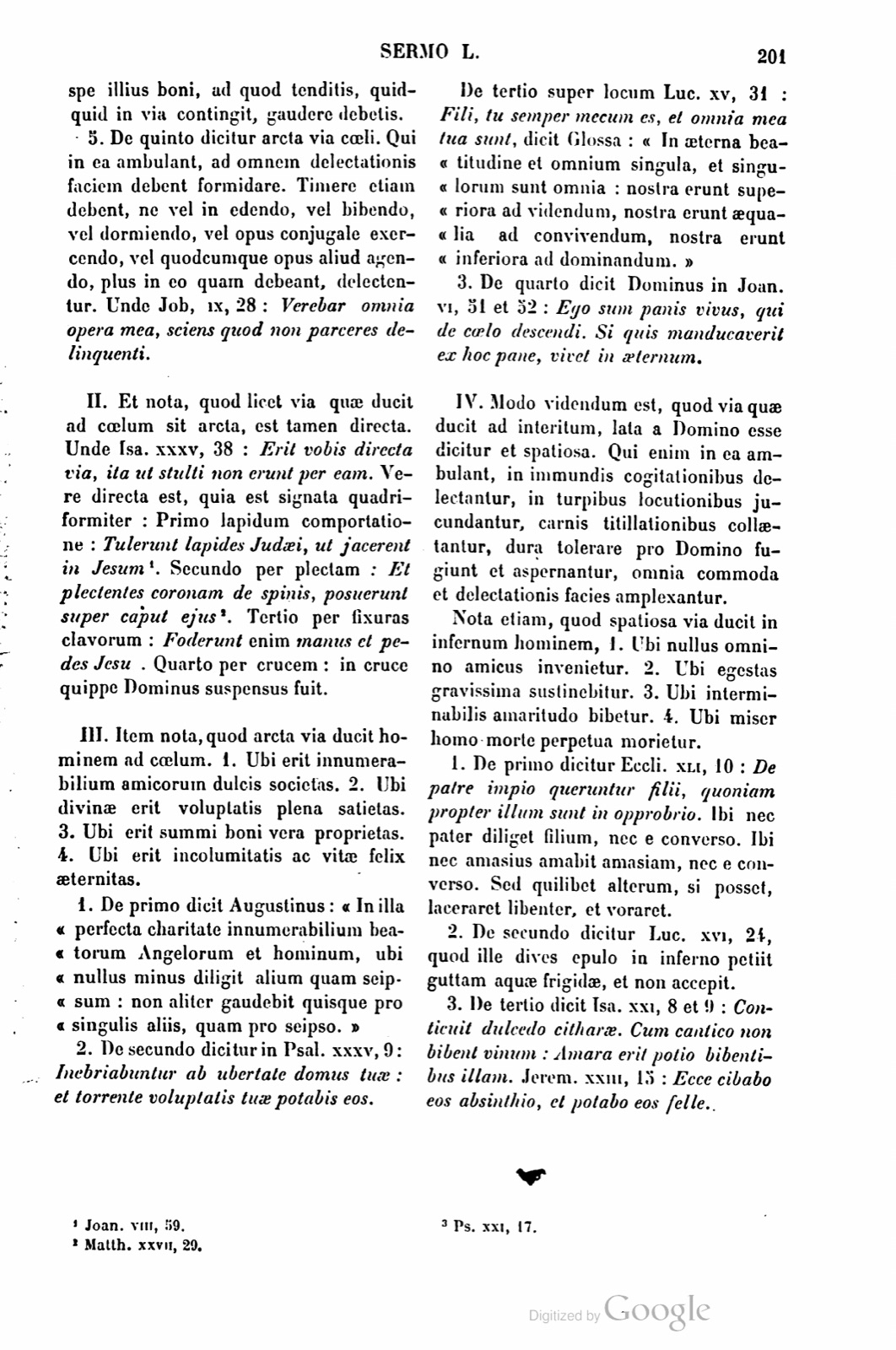
2. De secundo dicitur in Psal. xxxv, 9: Inebriabuntur ab ubertate domus tuæ: et torrente voluptatis tuæ potabis eos.
De tertio super locum Luc. xv, 31: Fili, tu semper mecum es, et omnia mea tua sunt, dicit Glossa: «In æterna beatitudine et omnium singula, et singulorum sunt omnia: nostra erunt superiora ad videndum, nostra erunt æqualia ad convivendum, nostra erunt inferiora ad dominandum.»
3. De quarto dicit Dominus in Joan. vi, 51 et 52: Ego sum panis vivus, qui de cœlo descendi. Si quis manducaverit ex hoc pane, vivet in æternum.
IV. Modo videndum est, quod via quæ ducit ad interitum, lata a Domino esse dicitur et spatiosa. Qui enim in ea ambulant, in immundis cogitationibus delectantur, in turpibus locutionibus jucundantur, carnis titillationibus collætantur, dura tolerare pro Domino fugiunt et aspernantur, omnia commoda et delectationis facies amplexantur.
Nota etiam, quod spatiosa via ducit in infernum hominem, 1. Ubi nullus omnino amicus invenietur. 2. Ubi egestas gravissima sustinebitur. 3. Ubi interminabilis amaritudo bibetur. 4. Ubi miser homo morte perpetua morietur.
1. De primo dicitur Eccli. xli, 10: De patre impio queruntur filii, quoniam propter illum sunt in opprobrio. Ibi nec pater diliget filium, nec e converso. Ibi nec amasius amabit amasiam, nec e converso. Sed quilibet alterum, si posset, laceraret libenter, et voraret.
2. De secundo dicitur Luc. xvi, 24, quod ille dives epulo in inferno petiit guttam aquæ frigidæ, et non accepit.
3. De tertio dicit Isa. xxiv, 8 et 9: Conticuit dulcedo citharæ. Cum cantico non bibent vinum: Amara erit potio bibentibus illam. Jerem. xxiii, 15: Ecce cibabo eos absinthio, et potabo eos felle.
4. De quarto dicit Augustinus: «Ibi non erunt ante mortem, vel post mortem, sed semper in morte.»
Rogate ergo Dominum, ut sic secundum doctrinam sancti Spiritus per arctam viam incedamus, ut Deum nostrum cum omni exsultatione in patria videamus. Amen.
2. Concerning the second, it is said in Psalm 35:9: They will be inebriated from the abundance of your house, and you will give them to drink from the torrent of your pleasure.
Concerning the third, on the place in Luke 15:31, Son, you are always with me, and all my things are yours, the Gloss says: In eternal blessedness both the several things of all and all things of the several are present: the things above us will be ours to see, the things equal to us will be ours to live with, the things below us will be ours to rule.
3. Concerning the fourth, the Lord says in John 6:51 and 52: I am the living bread who came down from heaven. If anyone eats from this bread, he will live forever.
IV. Now it must be seen that the way that leads to destruction is said by the Lord to be wide and spacious. For those who walk in it are delighted in unclean thoughts, rejoice in shameful speeches, rejoice together with the ticklings of the flesh, flee and reject hard things to be endured for the Lord, and embrace every comfort and appearance of delight.
Note also that the spacious way leads a human being into hell: 1. where no friend at all will be found; 2. where most grave need will be endured; 3. where endless bitterness will be drunk; 4. where the wretched human being will die by perpetual death.
1. Concerning the first, Ecclesiasticus 41:10 says: The children complain about an impious father, because on account of him they are in disgrace. There neither will a father love a son, nor conversely. There neither will a lover love his beloved, nor conversely. But each would gladly tear and devour the other, if he could.
2. Concerning the second, it is said in Luke 16:24 that that rich feaster in hell sought a drop of cold water and did not receive it.
3. Concerning the third, Isaiah 24:8 and 9 says: The sweetness of the harp was silent. They will not drink wine with song; the drink will be bitter to those drinking it. Jeremiah 23:15 says: Behold, I will feed them with wormwood and give them gall to drink.
4. Concerning the fourth, Augustine says: There they will not be before death or after death, but always in death.
Therefore pray to the Lord that according to the doctrine of the Holy Spirit we may walk by the narrow way in such a way that we may see our God with all exultation in the homeland. Amen.

If a page does not appear, its photograph has not been uploaded yet.