Works › Sermons for the Seasons of the Year
Volume 13 · pp. 155–156
Sermon XXXVI. On the Holy Day of Easter, Opening
A marker with ≈ is an approximate page boundary, placed by measure of the text; the page photographs remain the authority. In the paired views, clicking a page marker brings that page into view.
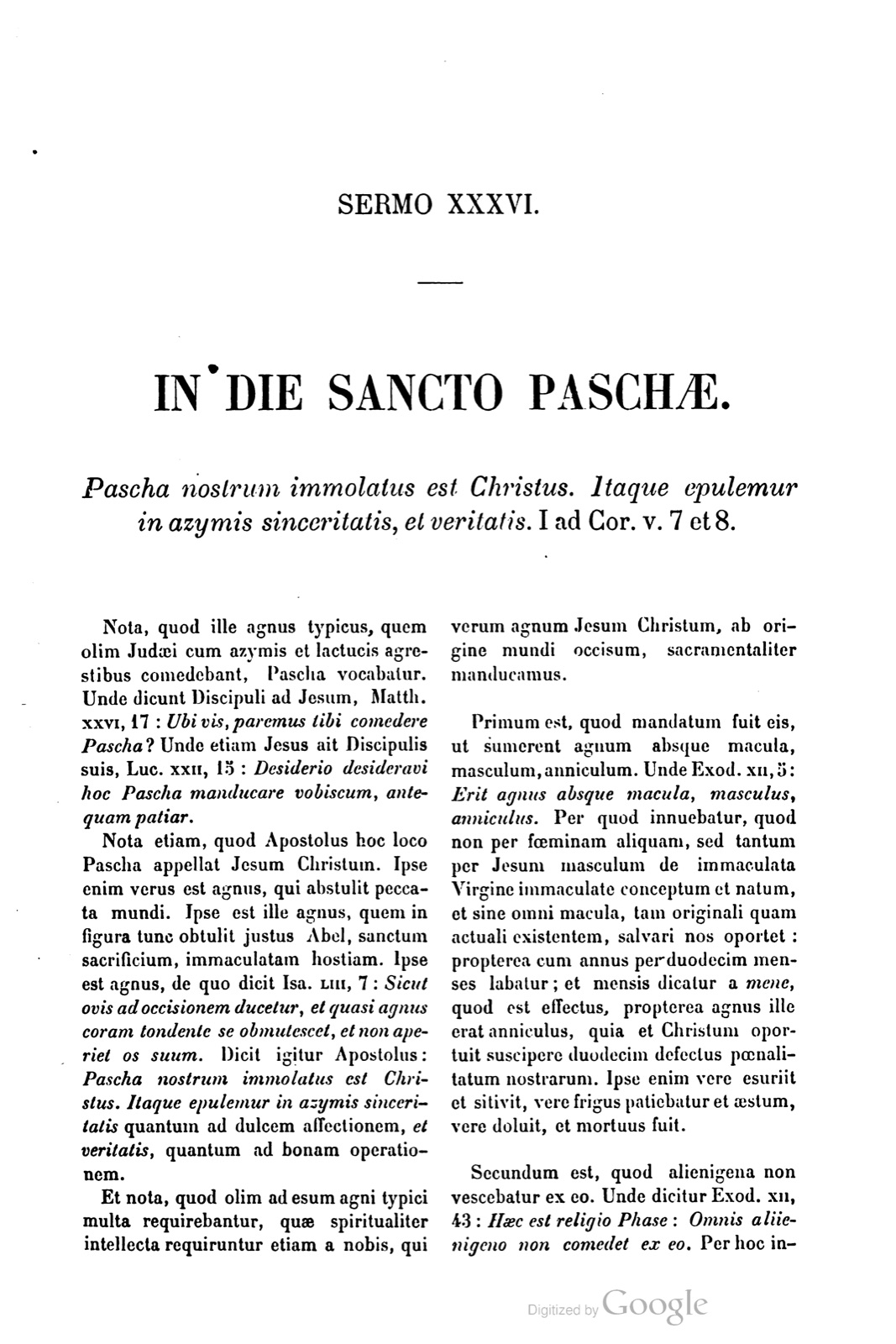
SERMO XXXVI.
IN DIE SANCTO PASCHAE.
Pascha nostrum immolatus est Christus. Itaque epulemur in azymis sinceritatis, et veritatis. I ad Cor. V. 7 et 8.
Nota, quod ille agnus typicus, quem olim Judaei cum azymis et lactucis agrestibus comedebant, Pascha vocabatur. Unde dicunt Discipuli ad Jesum, Matth. XXVI, 17: Ubi vis, paremus tibi comedere Pascha? Unde etiam Jesus ait Discipulis suis, Luc. XXII, 15: Desiderio desideravi hoc Pascha manducare vobiscum, antequam patiar.
Nota etiam, quod Apostolus hoc loco Pascha appellat Jesum Christum. Ipse enim verus est agnus, qui abstulit peccata mundi. Ipse est ille agnus, quem in figura tunc obtulit justus Abel, sanctum sacrificium, immaculatam hostiam. Ipse est agnus, de quo dicit Isa. LIII, 7: Sicut ovis ad occisionem ducetur, et quasi agnus coram tondente se obmutescet, et non aperiet os suum. Dicit igitur Apostolus: Pascha nostrum immolatus est Christus. Itaque epulemur in azymis sinceritatis quantum ad dulcem affectionem, et veritatis, quantum ad bonam operationem.
Et nota, quod olim ad esum agni typici multa requirebantur, quae spiritualiter intellecta requiruntur etiam a nobis, qui verum agnum Jesum Christum, ab origine mundi occisum, sacramentaliter manducamus.
Primum est, quod mandatum fuit eis, ut sumerent agnum absque macula, masculum, anniculum. Unde Exod. XII, 5: Erit agnus absque macula, masculus, anniculus. Per quod innuebatur, quod non per foeminam aliquam, sed tantum per Jesum masculum de immaculata Virgine immaculate conceptum et natum, et sine omni macula, tam originali quam actuali existentem, salvari nos oportet: propterea cum annus per duodecim menses labatur; et mensis dicatur a mene, quod est effectus, propterea agnus ille erat anniculus, quia et Christum oportuit suscipere duodecim defectus poenalitatum nostrarum. Ipse enim vere esuriit et sitivit, vere frigus patiebatur et aestum, vere doluit, et mortuus fuit.
Secundum est, quod alienigena non vescebatur ex eo. Unde dicitur Exod. XII, 43: Haec est religio Phase: Omnis alienigena non comedet ex eo. Per hoc innuitur, quod illi, qui per sententiam excommunicationis quasi ethnici et publicani sequestrati sunt ab Ecclesia et a fidelium consortio, non debent accedere ad communionem et participationem sacrosancti corporis Jesu Christi; et si accesserint, peccant mortaliter.
Tertium est, quod oportuit eos circumcisos esse, qui vescebantur ex eo. Unde Exod. XII, 48: Si quis circumcisus non fuerit, non vescetur ex eo. Per hoc innuitur, quod corpus Christi sumpturi circumcidere cor, linguam, et manum debent: cor ab odii et rancoris veneno, linguam a perjurio et turpiloquio, manum a malis operibus, et ab immundis attactibus.
Quartum, quod renes accingebant. Unde Exod. XII, 11: Renes vestros accingetis. Per hoc intelligitur, quod corpus Domini sumpturi renes suos, in quibus est seminarium luxuriae, debent accingere cingulo castitatis. Hunc autem cingulum conficere debemus ex fune, quo Dominus ligatus fuit ad columnam. Unde Job, XII, 18: Balteum regum dissolvit, et praecinxit fune renes eorum. Per balteum intelligitur jactantia corporalis fortitudinis, quem Dominus dissolvit, et fune spiritualis roboris, hoc est, castitatis praecingit renes electorum suorum.
SERMON XXXVI.
ON THE HOLY DAY OF EASTER.
Christ our Passover has been sacrificed. Therefore let us feast in the unleavened breads of sincerity and of truth. I Corinthians V, 7 and 8.
Note that that typical lamb, which formerly the Jews ate with unleavened breads and wild lettuces, was called Passover. Hence the Disciples say to Jesus, Matthew XXVI, 17: Where do you wish us to prepare for you to eat the Passover? Hence Jesus also says to his Disciples, Luke XXII, 15: With desire I have desired to eat this Passover with you before I suffer.
Note also that the Apostle in this place calls Jesus Christ the Passover. For he himself is the true lamb who took away the sins of the world. He himself is that lamb which once in figure righteous Abel offered, a holy sacrifice, an immaculate victim. He himself is the lamb of whom Isaiah LIII, 7 says: Like a sheep he will be led to slaughter, and like a lamb before the one shearing him he will become silent and will not open his mouth. Therefore the Apostle says: Christ our Passover has been sacrificed. Therefore let us feast in the unleavened breads of sincerity, as to sweet affection, and of truth, as to good operation.
And note that formerly many things were required for the eating of the typical lamb, which, understood spiritually, are also required from us, who sacramentally eat the true lamb Jesus Christ, slain from the origin of the world.
The first is that it was commanded to them that they should take a lamb without blemish, male, a year old. Hence Exodus XII, 5: The lamb will be without blemish, male, a year old. Through this it was suggested that we ought to be saved not through some female, but only through the male Jesus, immaculately conceived and born of the immaculate Virgin, and existing without any blemish, both original and actual; for this reason, since the year passes through twelve months, and month is said from mene, which is effect, for this reason that lamb was a year old, because Christ also had to take up the twelve defects of our penalties. For he truly hungered and thirsted, truly suffered cold and heat, truly grieved, and died.
The second is that a foreigner did not eat from it. Hence it is said in Exodus XII, 43: This is the rite of Passover: Every foreigner shall not eat from it. Through this it is suggested that those who through the sentence of excommunication have been separated from the Church and from the fellowship of the faithful like heathens and publicans ought not to approach the communion and participation of the most holy body of Jesus Christ; and if they have approached, they sin mortally.
The third is that it was necessary for those who ate from it to be circumcised. Hence Exodus XII, 48: If anyone has not been circumcised, he shall not eat from it. Through this it is suggested that those about to receive the body of Christ ought to circumcise heart, tongue, and hand: the heart from the poison of hatred and rancor, the tongue from perjury and foul speech, the hand from evil works and from unclean touches.
The fourth, that they girded their loins. Hence Exodus XII, 11: You shall gird your loins. Through this it is understood that those about to receive the body of the Lord ought to gird their loins, in which is the seedbed of lust, with the girdle of chastity. But we ought to make this girdle from the rope with which the Lord was bound to the column. Hence Job XII, 18: He loosens the belt of kings and girds their loins with a rope. By the belt is understood the boastfulness of bodily strength, which the Lord loosens, and with the rope of spiritual strength, that is, of chastity, he girds the loins of his elect.
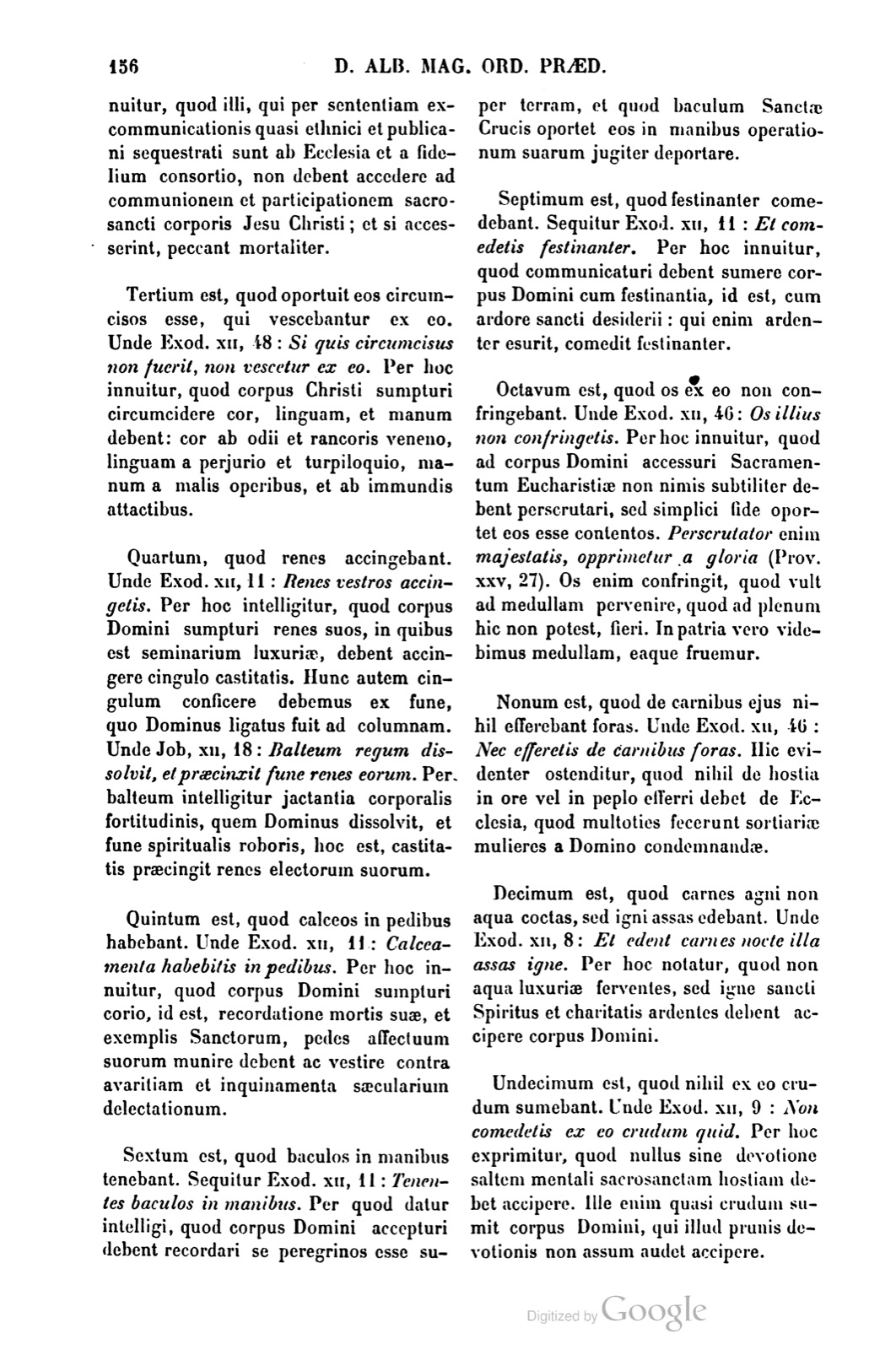
Quintum est, quod calceos in pedibus habebant. Unde Exod. XII, 11: Calceamenta habebitis in pedibus. Per hoc innuitur, quod corpus Domini sumpturi corio, id est, recordatione mortis suae, et exemplis Sanctorum, pedes affectuum suorum munire debent ac vestire contra avaritiam et inquinamenta saecularium delectationum.
Sextum est, quod baculos in manibus tenebant. Sequitur Exod. XII, 11: Tenentes baculos in manibus. Per quod datur intelligi, quod corpus Domini accepturi debent recordari se peregrinos esse super terram, et quod baculum Sanctae Crucis oportet eos in manibus operationum suarum jugiter deportare.
Septimum est, quod festinanter comedebant. Sequitur Exod. XII, 11: Et comedetis festinanter. Per hoc innuitur, quod communicaturi debent sumere corpus Domini cum festinantia, id est, cum ardore sancti desiderii: qui enim ardenter esurit, comedit festinanter.
Octavum est, quod os ex eo non confringebant. Unde Exod. XII, 46: Os illius non confringetis. Per hoc innuitur, quod ad corpus Domini accessuri Sacramentum Eucharistiae non nimis subtiliter debent perscrutari, sed simplici fide oportet eos esse contentos. Perscrutator enim majestatis, opprimetur a gloria (Prov. XXV, 27). Os enim confringit, quod vult ad medullam pervenire, quod ad plenum hic non potest, fieri. In patria vero videbimus medullam, eaque fruemur.
Nonum est, quod de carnibus ejus nihil efferebant foras. Unde Exod. XII, 46: Nec efferetis de carnibus foras. Hic evidenter ostenditur, quod nihil de hostia in ore vel in peplo efferri debet de Ecclesia, quod multoties fecerunt sortiariae mulieres a Domino condemnandae.
Decimum est, quod carnes agni non aqua coctas, sed igni assas edebant. Unde Exod. XII, 8: Et edent carnes nocte illa assas igne. Per hoc notatur, quod non aqua luxuriae ferventes, sed igne sancti Spiritus et charitatis ardentes debent accipere corpus Domini.
Undecimum est, quod nihil ex eo crudum sumebant. Unde Exod. XII, 9: Non comedetis ex eo crudum quid. Per hoc exprimitur, quod nullus sine devotione saltem mentali sacrosanctam hostiam debet accipere. Ille enim quasi crudum sumit corpus Domini, qui illud prunis devotionis non assum audet accipere.
The fifth is that they had shoes on their feet. Hence Exodus XII, 11: You will have footwear on your feet. Through this it is suggested that those about to receive the body of the Lord ought with leather, that is, with remembrance of his death, and with the examples of the Saints, to fortify and clothe the feet of their affections against avarice and the defilements of secular delights.
The sixth is that they held staffs in their hands. Exodus XII, 11 follows: Holding staffs in your hands. Through this it is given to be understood that those about to receive the body of the Lord ought to remember that they are pilgrims upon the earth, and that they must continually carry the staff of the Holy Cross in the hands of their operations.
The seventh is that they ate hastily. Exodus XII, 11 follows: And you shall eat hastily. Through this it is suggested that those about to communicate ought to receive the body of the Lord with haste, that is, with ardor of holy desire; for he who hungers ardently eats hastily.
The eighth is that they did not break a bone from it. Hence Exodus XII, 46: You shall not break its bone. Through this it is suggested that those about to approach the body of the Lord ought not to search too subtly into the Sacrament of the Eucharist, but they ought to be content with simple faith. For the searcher of majesty will be oppressed by glory (Proverbs XXV, 27). For he breaks the bone who wishes to reach the marrow, which cannot happen fully here. But in the homeland we shall see the marrow and enjoy it.
The ninth is that they did not carry anything from its flesh outside. Hence Exodus XII, 46: Nor shall you carry out of the flesh outside. Here it is evidently shown that nothing of the host ought to be carried out of the Church in the mouth or in a fold of cloth, which sorceress women, to be condemned by the Lord, have done many times.
The tenth is that they ate the flesh of the lamb not cooked in water but roasted by fire. Hence Exodus XII, 8: And they shall eat the flesh on that night roasted by fire. Through this it is noted that those burning not with the water of lust, but burning with the fire of the Holy Spirit and charity, ought to receive the body of the Lord.
The eleventh is that they took nothing raw from it. Hence Exodus XII, 9: You shall not eat anything raw from it. Through this it is expressed that no one without at least mental devotion ought to receive the most holy host. For he takes the body of the Lord as if raw who dares to receive it not roasted by the coals of devotion.
If a page does not appear, its photograph has not been uploaded yet.