Works › Sermons for the Seasons of the Year
Volume 13 · pp. 152–154
Sermon XXXV. At the Supper of the Lord
A marker with ≈ is an approximate page boundary, placed by measure of the text; the page photographs remain the authority. In the paired views, clicking a page marker brings that page into view.
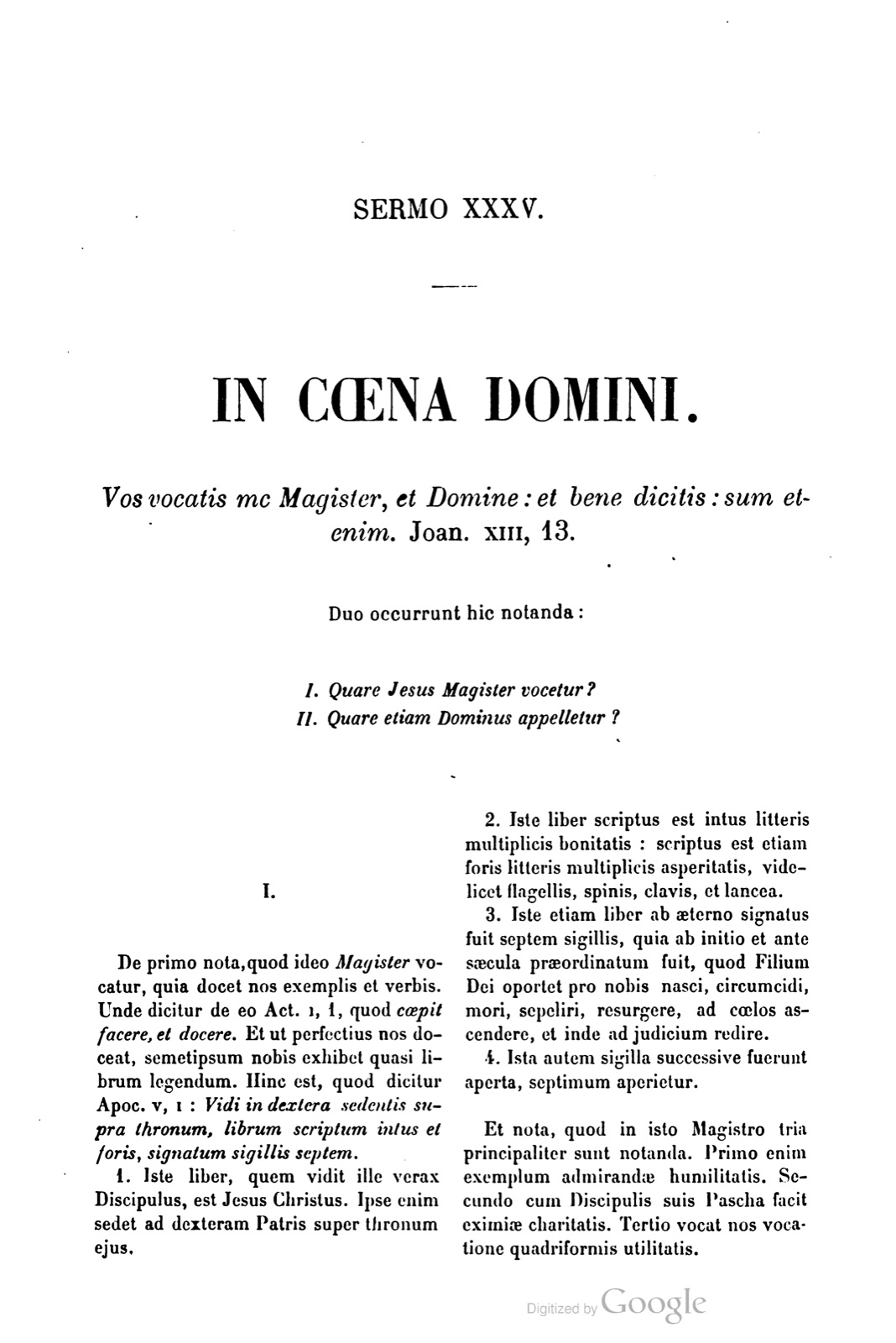
SERMO XXXV.
IN COENA DOMINI.
Vos vocatis me Magister, et Domine: et bene dicitis: sum etenim. Joan. XIII, 13.
Duo occurrunt hic notanda:
I. Quare Jesus Magister vocetur? II. Quare etiam Dominus appelletur?
I.
De primo nota, quod ideo Magister vocatur, quia docet nos exemplis et verbis. Unde dicitur de eo Act. I, 1, quod caepit facere, et docere. Et ut perfectius nos doceat, semetipsum nobis exhibet quasi librum legendum. Hinc est, quod dicitur Apoc. V, 1: Vidi in dextera sedentis supra thronum, librum scriptum intus et foris, signatum sigillis septem.
1. Iste liber, quem vidit ille verax Discipulus, est Jesus Christus. Ipse enim sedet ad dexteram Patris super thronum ejus.
2. Iste liber scriptus est intus litteris multiplicis bonitatis: scriptus est etiam foris litteris multiplicis asperitatis, videlicet flagellis, spinis, clavis, et lancea.
3. Iste etiam liber ab aeterno signatus fuit septem sigillis, quia ab initio et ante saecula praeordinatum fuit, quod Filium Dei oportet pro nobis nasci, circumcidi, mori, sepeliri, resurgere, ad caelos ascendere, et inde ad judicium redire.
4. Ista autem sigilla successive fuerunt aperta, septimum aperietur.
Et nota, quod in isto Magistro tria principaliter sunt notanda. Primo enim exemplum admirandae humilitatis. Secundo cum Discipulis suis Pascha facit eximiae charitatis. Tertio vocat nos vocatione quadriformis utilitatis.
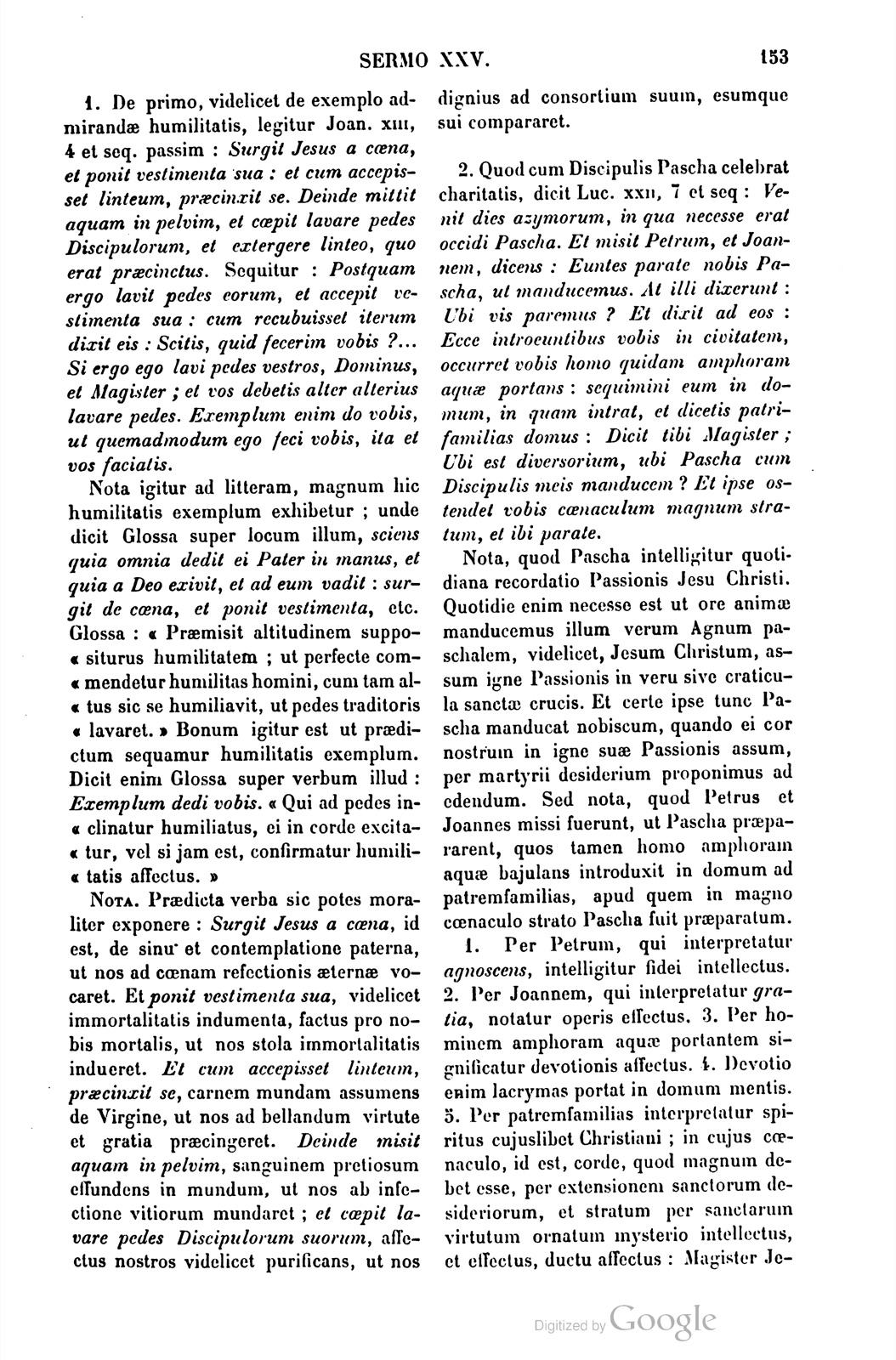
1. De primo, videlicet de exemplo admirandae humilitatis, legitur Joan. XIII, 4 et seq. passim: Surgit Jesus a coena, et ponit vestimenta sua: et cum accepisset linteum, praecinxit se. Deinde mittit aquam in pelvim, et caepit lavare pedes Discipulorum, et extergere linteo, quo erat praecinctus. Sequitur: Postquam ergo lavit pedes eorum, et accepit vestimenta sua: cum recubuisset iterum dixit eis: Scitis, quid fecerim vobis?... Si ergo ego lavi pedes vestros, Dominus, et Magister; et vos debetis alter alterius lavare pedes. Exemplum enim do vobis, ut quemadmodum ego feci vobis, ita et vos faciatis.
Nota igitur ad litteram, magnum hic humilitatis exemplum exhibetur; unde dicit Glossa super locum illum, sciens quia omnia dedit ei Pater in manus, et quia a Deo exivit, et ad eum vadit: surgit de coena, et ponit vestimenta, etc. Glossa: "Praemisit altitudinem suppositurus humilitatem; ut perfecte commendetur humilitas homini, cum tam altus sic se humiliavit, ut pedes traditoris lavaret." Bonum igitur est ut praedictum sequamur humilitatis exemplum. Dicit enim Glossa super verbum illud: Exemplum dedi vobis. "Qui ad pedes inclinatur humiliatus, ei in corde excitatur, vel si jam est, confirmatur humilitatis affectus."
NOTA. Praedicta verba sic potes moraliter exponere: Surgit Jesus a coena, id est, de sinu et contemplatione paterna, ut nos ad coenam refectionis aeternae vocaret. Et ponit vestimenta sua, videlicet immortalitatis indumenta, factus pro nobis mortalis, ut nos stola immortalitatis indueret. Et cum accepisset linteum, praecinxit se, carnem mundam assumens de Virgine, ut nos ad bellandum virtute et gratia praecingeret. Deinde misit aquam in pelvim, sanguinem pretiosum effundens in mundum, ut nos ab infectione vitiorum mundaret; et caepit lavare pedes Discipulorum suorum, affectus nostros videlicet purificans, ut nos dignius ad consortium suum, esumque sui compararet.
SERMON XXXV.
AT THE SUPPER OF THE LORD.
You call me Teacher and Lord, and you say well, for so I am. John XIII, 13.
Two things occur here to be noted:
I. Why Jesus is called Teacher. II. Why he is also called Lord.
I.
Concerning the first, note that he is called Teacher for this reason, because he teaches us by examples and words. Hence it is said of him in Acts I, 1, that he began to do and to teach. And so that he may teach us more perfectly, he offers himself to us like a book to be read. Hence it is said in Apocalypse V, 1: I saw in the right hand of the one sitting upon the throne a book written inside and outside, sealed with seven seals.
1. This book, which that truthful Disciple saw, is Jesus Christ. For he sits at the right hand of the Father upon his throne.
2. This book is written inside with letters of manifold goodness; it is also written outside with letters of manifold harshness, namely with scourges, thorns, nails, and lance.
3. This book also was sealed from eternity with seven seals, because from the beginning and before the ages it was preordained that the Son of God had to be born for us, circumcised, die, be buried, rise, ascend to the heavens, and thence return to judgment.
4. But these seals were opened successively; the seventh will be opened.
And note that in this Teacher three things are chiefly to be noted. First, indeed, the example of admirable humility. Second, with his Disciples he makes the Passover of exceptional charity. Third, he calls us with the calling of fourfold usefulness.
1. Concerning the first, namely concerning the example of admirable humility, it is read in John XIII, 4 and following, throughout: Jesus rises from supper and lays aside his garments; and when he had taken a linen cloth, he girded himself. Then he puts water into a basin and began to wash the feet of the Disciples and to wipe them with the linen cloth with which he was girded. It follows: Therefore after he washed their feet and took his garments, when he had lain down again he said to them: Do you know what I have done to you?... If therefore I, Lord and Teacher, have washed your feet, you also ought to wash one another's feet. For I give you an example, so that as I have done to you, so you also may do.
Therefore note according to the letter that a great example of humility is shown here; hence the Gloss says on that place, knowing that the Father gave all things into his hands, and that he went forth from God and goes to him: he rises from supper and lays aside his garments, etc. The Gloss: "He put forth the height first, about to set humility beneath it, so that humility might be commended perfectly to man, when one so high humbled himself in such a way that he washed the feet of the betrayer." Therefore it is good that we follow the aforesaid example of humility. For the Gloss says on that word, I have given you an example: "He who is bent down to the feet after being humbled, in his heart the affection of humility is stirred up, or, if it already is there, is confirmed."
NOTE. You can expound the aforesaid words morally thus: Jesus rises from supper, that is, from the bosom and contemplation of the Father, so that he might call us to the supper of eternal refreshment. And he lays aside his garments, namely the clothing of immortality, made mortal for us, so that he might clothe us with the robe of immortality. And when he had taken a linen cloth, he girded himself, taking clean flesh from the Virgin, so that he might gird us for fighting with virtue and grace. Then he sent water into the basin, pouring precious blood into the world, so that he might cleanse us from the infection of vices; and he began to wash the feet of his Disciples, namely purifying our affections, so that he might prepare us more worthily for his company and for the eating of himself.
2. Quod cum Discipulis Pascha celebrat charitatis, dicit Luc. XXII, 7 et seq: Venit dies azymorum, in qua necesse erat occidi Pascha. Et misit Petrum, et Joannem, dicens: Euntes parate nobis Pascha, ut manducemus. At illi dixerunt: Ubi vis paremus? Et dixit ad eos: Ecce introeuntibus vobis in civitatem, occurret vobis homo quidam amphoram aquae portans: sequimini eum in domum, in quam intrat, et dicetis patrifamilias domus: Dicit tibi Magister; Ubi est diversorium, ubi Pascha cum Discipulis meis manducem? Et ipse ostendet vobis coenaculum magnum stratum, et ibi parate.
Nota, quod Pascha intelligitur quotidiana recordatio Passionis Jesu Christi. Quotidie enim necesse est ut ore animae manducemus illum verum Agnum paschalem, videlicet, Jesum Christum, assum igne Passionis in veru sive craticula sanctae crucis. Et certe ipse tunc Pascha manducat nobiscum, quando ei cor nostrum in igne suae Passionis assum, per martyrii desiderium proponimus ad edendum. Sed nota, quod Petrus et Joannes missi fuerunt, ut Pascha praepararent, quos tamen homo amphoram aquae bajulans introduxit in domum ad patremfamilias, apud quem in magno coenaculo strato Pascha fuit praeparatum.
1. Per Petrum, qui interpretatur agnoscens, intelligitur fidei intellectus. 2. Per Joannem, qui interpretatur gratia, notatur operis effectus. 3. Per hominem amphoram aquae portantem significatur devotionis affectus. 4. Devotio enim lacrymas portat in domum mentis. 5. Per patremfamilias interpretatur spiritus cujuslibet Christiani; in cujus coenaculo, id est, corde, quod magnum debet esse, per extensionem sanctorum desideriorum, et stratum per sanctarum virtutum ornatum mysterio intellectus, et effectus, ductu affectus: Magister Jesus Pascha facit per suae Passionis quotidianam recordationem, per quam charitatem in nobis mirabiliter accendit et confirmat.
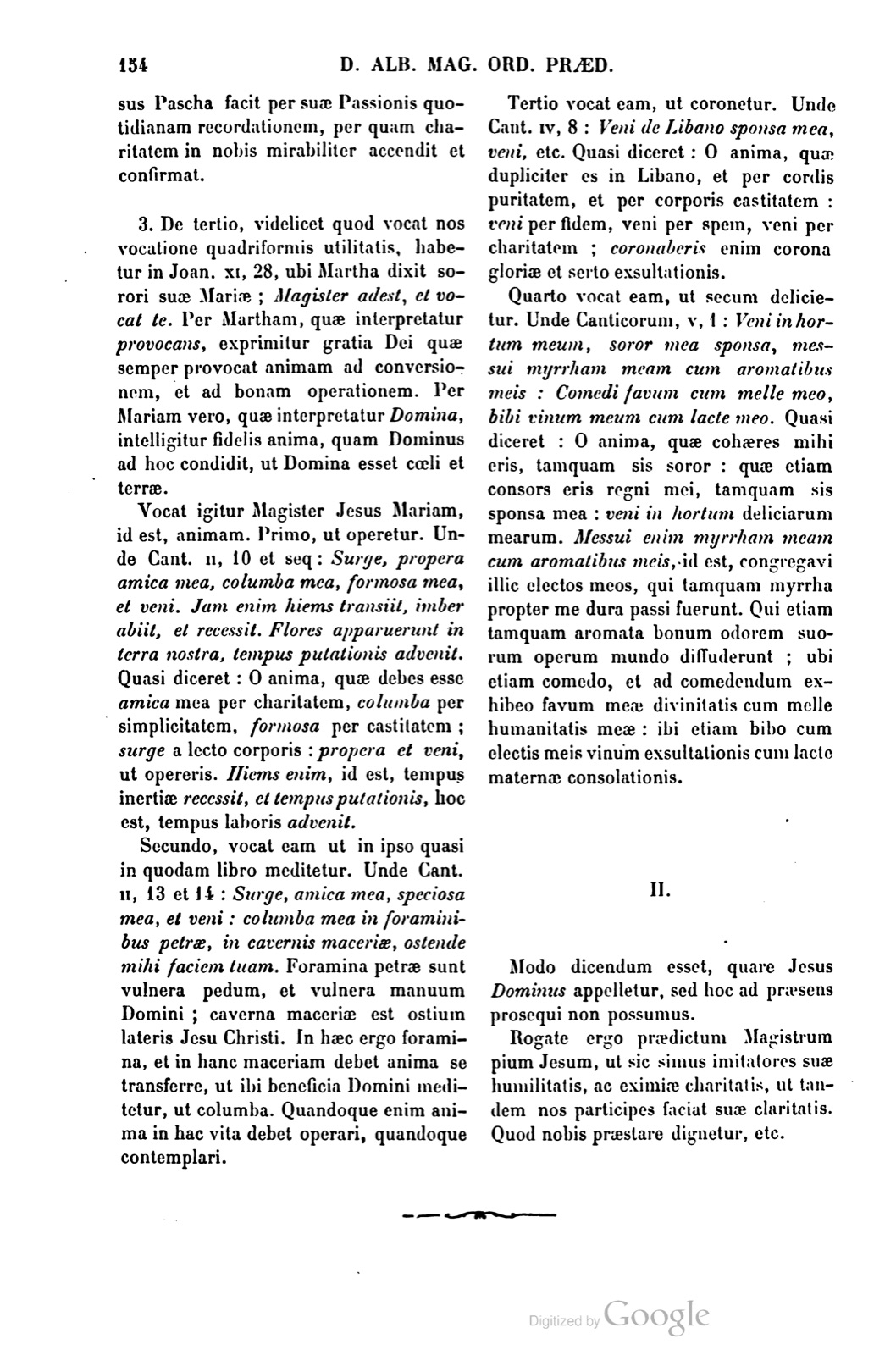
3. De tertio, videlicet quod vocat nos vocatione quadriformis utilitatis, habetur in Joan. XI, 28, ubi Martha dixit sorori suae Mariae; Magister adest, et vocat te. Per Martham, quae interpretatur provocans, exprimitur gratia Dei quae semper provocat animam ad conversionem, et ad bonam operationem. Per Mariam vero, quae interpretatur Domina, intelligitur fidelis anima, quam Dominus ad hoc condidit, ut Domina esset caeli et terrae.
2. That he celebrates the Passover of charity with the Disciples, Luke XXII, 7 and following says: The day of unleavened breads came, on which it was necessary that the Passover be killed. And he sent Peter and John, saying: Going, prepare the Passover for us, so that we may eat. But they said: Where do you wish us to prepare it? And he said to them: Behold, as you enter into the city, a certain man carrying a jar of water will meet you; follow him into the house into which he enters, and you shall say to the father of the family of the house: The Teacher says to you, Where is the lodging-place where I may eat the Passover with my Disciples? And he will show you a great furnished upper room, and there prepare it.
Note that Passover is understood as the daily remembrance of the Passion of Jesus Christ. For daily it is necessary that with the mouth of the soul we eat that true paschal Lamb, namely Jesus Christ, roasted by the fire of the Passion on the spit or grill of the holy cross. And certainly he then eats Passover with us when we set before him our heart, roasted in the fire of his Passion through desire for martyrdom, to be eaten. But note that Peter and John were sent to prepare the Passover; nevertheless a man carrying a jar of water led them into the house to the father of the family, with whom in a great furnished upper room the Passover was prepared.
1. By Peter, who is interpreted knowing, the understanding of faith is understood. 2. By John, who is interpreted grace, the effect of work is noted. 3. By the man carrying a jar of water the affection of devotion is signified. 4. For devotion carries tears into the house of the mind. 5. By the father of the family is interpreted the spirit of any Christian; in whose upper room, that is, heart, which ought to be great through the extension of holy desires, and furnished through the ornament of holy virtues, by the mystery of understanding and of effect, by the guidance of affection, the Teacher Jesus makes Passover through the daily remembrance of his Passion, through which he wonderfully kindles and confirms charity in us.
3. Concerning the third, namely that he calls us with the calling of fourfold usefulness, it is contained in John XI, 28, where Martha said to her sister Mary: The Teacher is here and calls you. By Martha, who is interpreted provoking, is expressed the grace of God which always provokes the soul to conversion and to good operation. But by Mary, who is interpreted Lady, is understood the faithful soul, which the Lord made for this, that it might be Lady of heaven and earth.
Vocat igitur Magister Jesus Mariam, id est, animam. Primo, ut operetur. Unde Cant. II, 10 et seq: Surge, propera amica mea, columba mea, formosa mea, et veni. Jam enim hiems transiit, imber abiit, et recessit. Flores apparuerunt in terra nostra, tempus putationis advenit. Quasi diceret: O anima, quae debes esse amica mea per charitatem, columba per simplicitatem, formosa per castitatem; surge a lecto corporis: propera et veni, ut opereris. Hiems enim, id est, tempus inertiae recessit, et tempus putationis, hoc est, tempus laboris advenit.
Secundo, vocat eam ut in ipso quasi in quodam libro meditetur. Unde Cant. II, 13 et 14: Surge, amica mea, speciosa mea, et veni: columba mea in foraminibus petrae, in cavernis maceriae, ostende mihi faciem tuam. Foramina petrae sunt vulnera pedum, et vulnera manuum Domini; caverna maceriae est ostium lateris Jesu Christi. In haec ergo foramina, et in hanc maceriam debet anima se transferre, ut ibi beneficia Domini meditetur, ut columba. Quandoque enim anima in hac vita debet operari, quandoque contemplari.
Tertio vocat eam, ut coronetur. Unde Cant. IV, 8: Veni de Libano sponsa mea, veni, etc. Quasi diceret: O anima, quae dupliciter es in Libano, et per cordis puritatem, et per corporis castitatem: veni per fidem, veni per spem, veni per charitatem; coronaberis enim corona gloriae et serto exsultationis.
Quarto vocat eam, ut secum delicietur. Unde Canticorum, V, 1: Veni in hortum meum, soror mea sponsa, messui myrrham meam cum aromatibus meis: Comedi favum cum melle meo, bibi vinum meum cum lacte meo. Quasi diceret: O anima, quae cohaeres mihi eris, tamquam sis soror: quae etiam consors eris regni mei, tamquam sis sponsa mea: veni in hortum deliciarum mearum. Messui enim myrrham meam cum aromatibus meis, id est, congregavi illic electos meos, qui tamquam myrrha propter me dura passi fuerunt. Qui etiam tamquam aromata bonum odorem suorum operum mundo diffuderunt; ubi etiam comedo, et ad comedendum exhibeo favum meae divinitatis cum melle humanitatis meae: ibi etiam bibo cum electis meis vinum exsultationis cum lacte maternae consolationis.
II.
Modo dicendum esset, quare Jesus Dominus appelletur, sed hoc ad praesens prosequi non possumus.
Rogate ergo praedictum Magistrum pium Jesum, ut sic simus imitatores suae humilitatis, ac eximiae charitatis, ut tandem nos participes faciat suae claritatis. Quod nobis praestare dignetur, etc.
Therefore the Teacher Jesus calls Mary, that is, the soul. First, that it may work. Hence Canticles II, 10 and following: Arise, hasten, my friend, my dove, my beautiful one, and come. For now winter has passed, the rain has gone away and withdrawn. Flowers have appeared on our earth; the time of pruning has come. As though he said: O soul, which ought to be my friend through charity, a dove through simplicity, beautiful through chastity; rise from the bed of the body; hasten and come, so that you may work. For winter, that is, the time of idleness, has withdrawn, and the time of pruning, that is, the time of labor, has come.
Second, he calls it so that it may meditate on him as in a certain book. Hence Canticles II, 13 and 14: Arise, my friend, my beautiful one, and come; my dove in the openings of the rock, in the hollows of the wall, show me your face. The openings of the rock are the wounds of the feet and the wounds of the hands of the Lord; the hollow of the wall is the opening of the side of Jesus Christ. Therefore into these openings and into this wall the soul ought to transfer itself, so that there it may meditate on the benefits of the Lord like a dove. For sometimes the soul in this life ought to work, sometimes to contemplate.
Third, he calls it so that it may be crowned. Hence Canticles IV, 8: Come from Lebanon, my bride, come, etc. As though he said: O soul, which are in Lebanon doubly, both through purity of heart and through chastity of body: come through faith, come through hope, come through charity; for you will be crowned with a crown of glory and a wreath of exultation.
Fourth, he calls it so that it may delight with him. Hence Canticles V, 1: I came into my garden, my sister bride; I harvested my myrrh with my aromatics; I ate my honeycomb with my honey; I drank my wine with my milk. As though he said: O soul, which will be co-heir with me, as if you were my sister, which also will be sharer of my kingdom, as if you were my bride: come into the garden of my delights. For I have harvested my myrrh with my aromatics, that is, I have gathered there my elect, who like myrrh suffered hard things for me. They also like aromatics spread through the world the good odor of their works; where I also eat, and offer to be eaten, the honeycomb of my divinity with the honey of my humanity; there I also drink with my elect the wine of exultation with the milk of maternal consolation.
II.
Now it would have to be said why Jesus is called Lord, but we cannot pursue this at present.
Therefore pray to the aforesaid Teacher, the loving Jesus, that we may so be imitators of his humility and exceptional charity that at last he may make us sharers of his brightness. May he deign to grant this to us, etc.
If a page does not appear, its photograph has not been uploaded yet.