Works › Sermons for the Seasons of the Year
Volume 13 · pp. 141–144
Sermon XXXII. On the Fourth Sunday of Lent
A marker with ≈ is an approximate page boundary, placed by measure of the text; the page photographs remain the authority. In the paired views, clicking a page marker brings that page into view.
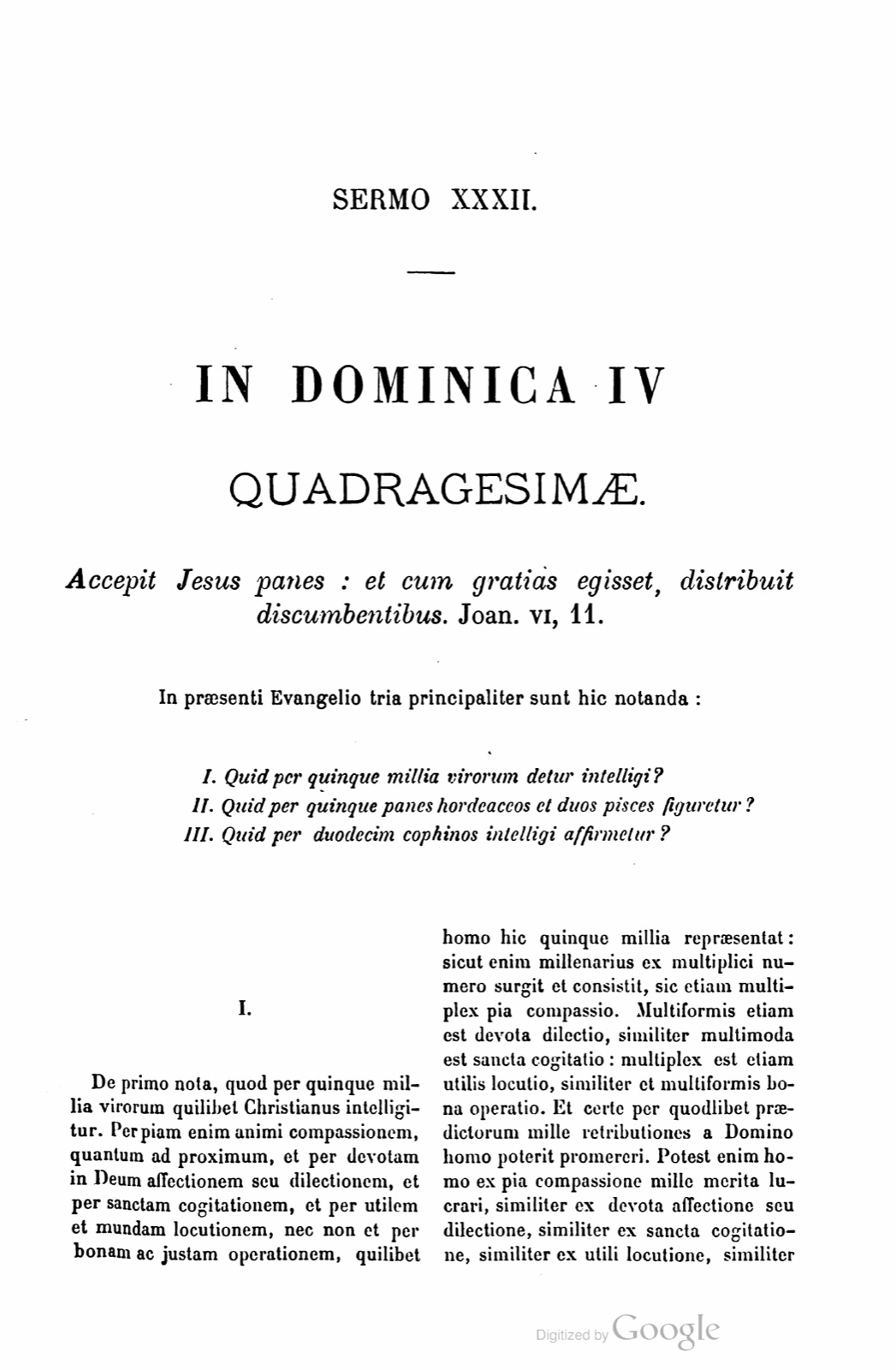
SERMO XXXII. IN DOMINICA IV QUADRAGESIMÆ.
Accepit Jesus panes: et cum gratias egisset, distribuit discumbentibus. Joan. vi, 11.
In præsenti Evangelio tria principaliter sunt hic notanda: I. Quid per quinque millia virorum detur intelligi? II. Quid per quinque panes hordeaceos et duos pisces figuretur? III. Quid per duodecim cophinos intelligi affirmetur?
I. De primo nota, quod per quinque millia virorum quilibet Christianus intelligitur. Per piam enim animi compassionem, quantum ad proximum, et per devotam in Deum affectionem seu dilectionem, et per sanctam cogitationem, et per utilem et mundam locutionem, nec non et per bonam ac justam operationem, quilibet homo hic quinque millia repræsentat: sicut enim millenarius ex multiplici numero surgit et consistit, sic etiam multiplex pia compassio. Multiformis etiam est devota dilectio, similiter multimoda est sancta cogitatio: multiplex est etiam utilis locutio, similiter et multiformis bona operatio. Et certe per quodlibet prædictorum mille retributiones a Domino homo poterit promereri. Potest enim homo ex pia compassione mille merita lucrari, similiter ex devota affectione seu dilectione, similiter ex sancta cogitatione, similiter ex utili locutione, similiter ex bona operatione. Et nota, quod hæc quinque millia dicuntur viri fuisse, non mulieres. Sicut enim viri sunt fortiores ad laborandum: ita quilibet in quinque prædictis se debet strenue exercere, ut per ea retributionem perpetuam mereatur.
II. De secundo nota, quod per illos quinque panes hordeaceos hæc quinque figurantur, videlicet, pœnitentialis satisfactio, sancta prædicatio, mortis recordatio, Sanctorum imitatio, et Dominici corporis et sanguinis participatio. Duo pisces sunt, spes divinæ pietatis, et dulcedo charitatis.
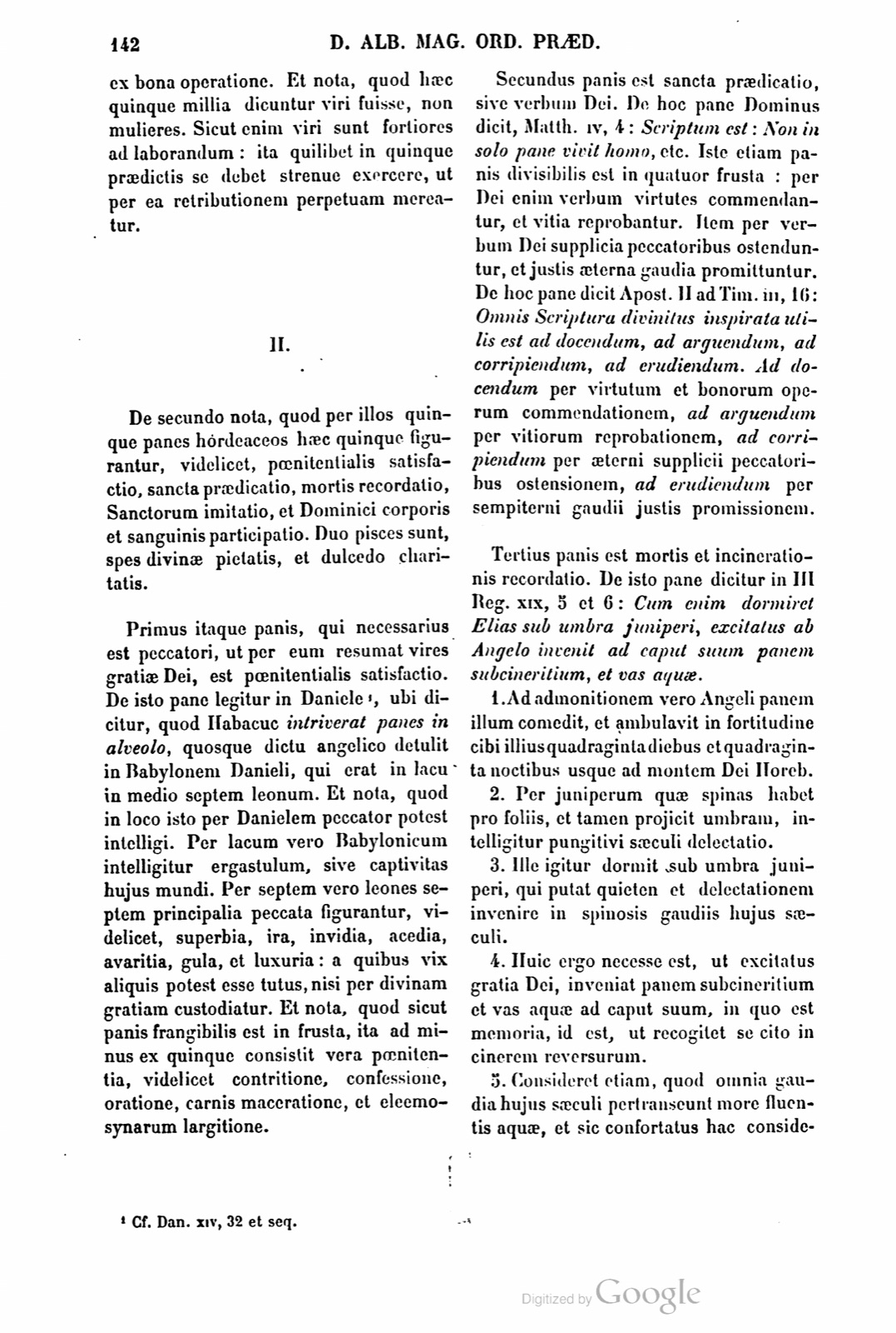
Primus itaque panis, qui necessarius est peccatori, ut per eum resumat vires gratiæ Dei, est pœnitentialis satisfactio. De isto pane legitur in Daniele, ubi dicitur, quod Habacuc intriverat panes in alveolo, quosque dictu angelico detulit in Babylonem Danieli, qui erat in lacu in medio septem leonum 1. Et nota, quod in loco isto per Danielem peccator potest intelligi. Per lacum vero Babylonicum intelligitur ergastulum, sive captivitas hujus mundi. Per septem vero leones septem principalia peccata figurantur, videlicet, superbia, ira, invidia, acedia, avaritia, gula, et luxuria: a quibus vix aliquis potest esse tutus, nisi per divinam gratiam custodiatur. Et nota, quod sicut panis frangibilis est in frusta, ita ad minus ex quinque consistit vera pænitentia, videlicet contritione, confessione, oratione, carnis maceratione, et eleemosynarum largitione.
SERMON XXXII. ON THE FOURTH SUNDAY OF LENT.
Jesus took the breads, and when he had given thanks, he distributed them to those reclining. John 6:11.
In the present Gospel three things are principally to be noted here: I. What is given to be understood by the five thousand men? II. What is figured by the five barley loaves and two fishes? III. What is affirmed to be understood by the twelve baskets?
I. On the first, note that by the five thousand men any Christian is understood. For through pious compassion of the soul, with respect to neighbor, and through devout affection or love toward God, and through holy thought, and through useful and clean speech, and also through good and just operation, any human being here represents five thousand. For just as the number one thousand rises and consists from a manifold number, so also pious compassion is manifold. Devout love too is multiform; likewise holy thought is manifold; useful speech also is manifold; likewise good operation is multiform. And certainly through any one of the aforesaid things a human being will be able to merit a thousand repayments from the Lord. For a human being can gain a thousand merits from pious compassion, likewise from devout affection or love, likewise from holy thought, likewise from useful speech, likewise from good operation. And note that these five thousand are said to have been men, not women. For just as men are stronger for laboring, so anyone ought to exercise himself strenuously in the aforesaid five, so that through them he may merit perpetual repayment.
II. On the second, note that by those five barley loaves these five things are figured, namely penitential satisfaction, holy preaching, remembrance of death, imitation of the Saints, and participation in the Lord's body and blood. The two fishes are hope of divine piety and the sweetness of charity.
Therefore the first bread, which is necessary for the sinner so that through it he may resume the powers of God's grace, is penitential satisfaction. Concerning this bread it is read in Daniel, where it is said that Habakkuk had broken up loaves in a bowl, and at the angel's command brought them into Babylon to Daniel, who was in the pit in the midst of seven lions 1. And note that in this place by Daniel the sinner can be understood. But by the Babylonian pit is understood the prison or captivity of this world. By the seven lions are figured the seven principal sins, namely pride, anger, envy, acedia, avarice, gluttony, and luxury, from which scarcely anyone can be safe unless he is guarded through divine grace. And note that, just as bread is breakable into pieces, so true penance consists at least of five things, namely contrition, confession, prayer, mortification of the flesh, and the giving of alms.
Secundus panis est sancta prædicatio, sive verbum Dei. De hoc pane Dominus dicit, Matth. iv, 4: Scriptum est: Non in solo pane vivit homo, etc. Iste etiam panis divisibilis est in quatuor frusta: per Dei enim verbum virtutes commendantur, et vitia reprobantur. Item per verbum Dei supplicia peccatoribus ostenduntur, et justis æterna gaudia promittuntur. De hoc pane dicit Apost. II ad Tim. iii, 16: Omnis Scriptura divinitus inspirata utilis est ad docendum, ad arguendum, ad corripiendum, ad erudiendum. Ad docendum per virtutum et bonorum operum commendationem, ad arguendum per vitiorum reprobationem, ad corripiendum per æterni supplicii peccatoribus ostensionem, ad erudiendum per sempiterni gaudii justis promissionem.
Tertius panis est mortis et incinerationis recordatio. De isto pane dicitur in III Reg. xix, 5 et 6: Cum enim dormiret Elias sub umbra juniperi, excitatus ab Angelo invenit ad caput suum panem subcineritium, et vas aquæ. 1. Ad admonitionem vero Angeli panem illum comedit, et ambulavit in fortitudine cibi illius quadraginta diebus et quadraginta noctibus usque ad montem Dei Horeb. 2. Per juniperum quæ spinas habet pro foliis, et tamen projicit umbram, intelligitur pungitivi sæculi delectatio. 3. Ille igitur dormit sub umbra juniperi, qui putat quietem et delectationem invenire in spinosis gaudiis hujus sæculi. 4. Huic ergo necesse est, ut excitatus gratia Dei, inveniat panem subcineritium et vas aquæ ad caput suum, in quo est memoria, id est, ut recogitet se cito in cinerem reversurum. 5. Consideret etiam, quod omnia gaudia hujus sæculi pertranseunt more fluentis aquæ, et sic confortatus hac consideratione pervenire poterit ad mensam Domini, ubi est vera requies. 6. Horeb enim interpretatur mensa. De hoc etiam pane dicit Psal. ci, 10: Cinerem tamquam panem manducabam, etc.
The second bread is holy preaching, or the word of God. Concerning this bread the Lord says in Matthew 4:4: It is written: Man does not live by bread alone, and so forth. This bread also is divisible into four pieces: for through the word of God the virtues are commended, and vices are reproved. Likewise through the word of God punishments are shown to sinners, and eternal joys are promised to the just. Concerning this bread the Apostle says in 2 Timothy 3:16: All Scripture inspired by God is useful for teaching, for arguing, for correcting, for instructing. For teaching, through the commendation of virtues and good works; for arguing, through the reproof of vices; for correcting, through the showing of eternal punishment to sinners; for instructing, through the promise of everlasting joy to the just.
The third bread is remembrance of death and incineration. Concerning this bread it is said in 3 Kings 19:5 and 6: For when Elijah was sleeping under the shade of the juniper, having been awakened by an Angel, he found at his head a hearth-cake and a vessel of water. 1. But at the admonition of the Angel he ate that bread and walked in the strength of that food forty days and forty nights as far as the mountain of God, Horeb. 2. By the juniper, which has thorns in place of leaves and nevertheless casts shade, is understood the delight of the stinging age. 3. Therefore he sleeps under the shade of the juniper who thinks that he finds quiet and delight in the thorny joys of this age. 4. Therefore it is necessary for him, awakened by the grace of God, to find the hearth-cake and vessel of water at his head, in which there is memory, that is, that he should consider again that he is soon to return into ashes. 5. Let him also consider that all the joys of this age pass by after the manner of flowing water; and thus, strengthened by this consideration, he will be able to arrive at the table of the Lord, where true rest is. 6. For Horeb is interpreted as table. Concerning this bread Psalm 101:10 also says: I ate ashes like bread, and so forth.
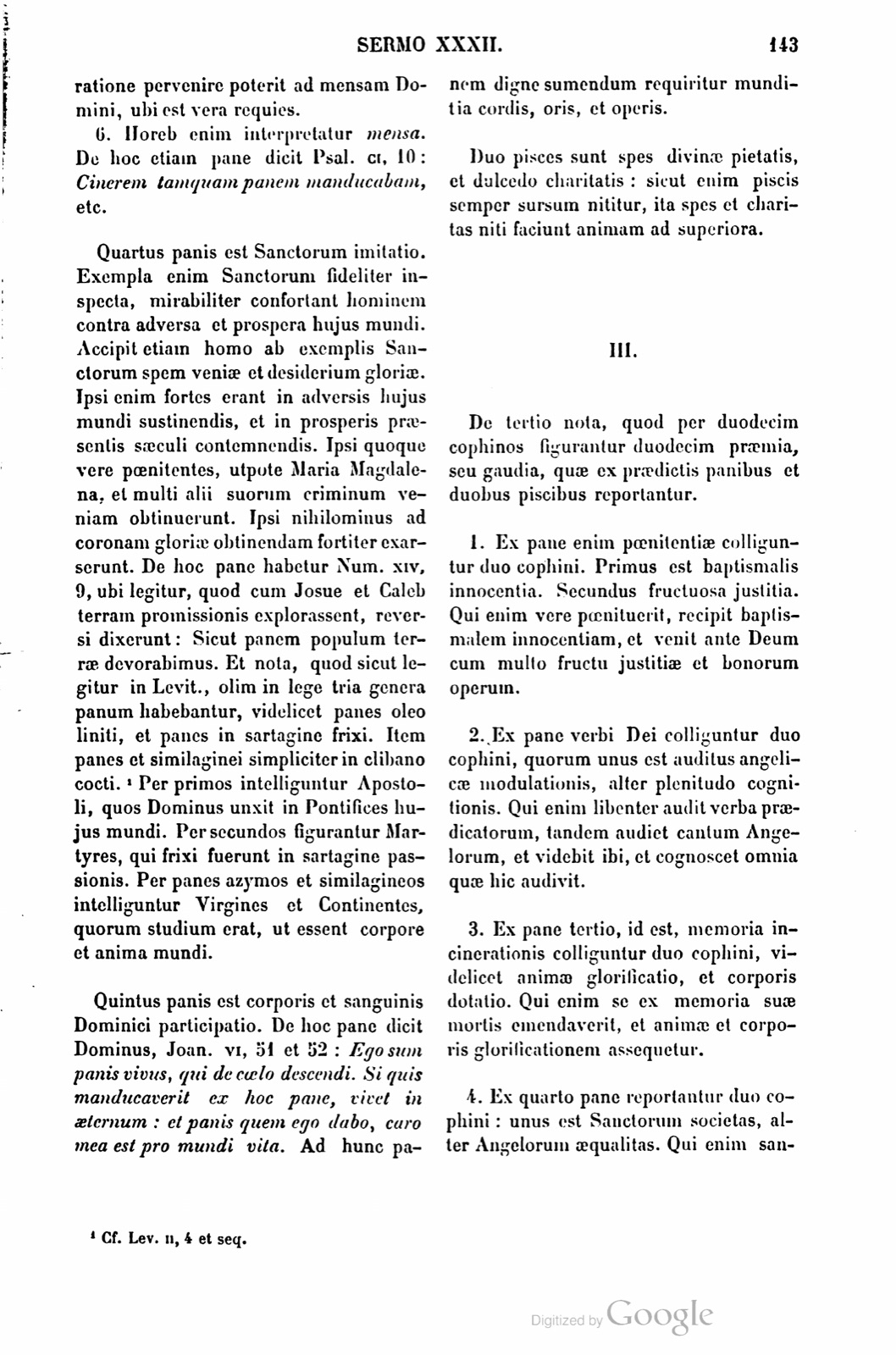
Quartus panis est Sanctorum imitatio. Exempla enim Sanctorum fideliter inspecta, mirabiliter confortant hominem contra adversa et prospera hujus mundi. Accipit etiam homo ab exemplis Sanctorum spem veniæ et desiderium gloriæ. Ipsi enim fortes erant in adversis hujus mundi sustinendis, et in prosperis præsentis sæculi contemnendis. Ipsi quoque vere pœnitentes, utpote Maria Magdalena, et multi alii suorum criminum veniam obtinuerunt. Ipsi nihilominus ad coronam gloriæ obtinendam fortiter exarserunt. De hoc pane habetur Num. xiv, 9, ubi legitur, quod cum Josue et Caleb terram promissionis explorassent, reversi dixerunt: Sicut panem populum terræ devorabimus. Et nota, quod sicut legitur in Levit., olim in lege tria genera panum habebantur, videlicet panes oleo liniti, et panes in sartagine frixi. Item panes et similaginei simpliciter in clibano cocti 2. Per primos intelliguntur Apostoli, quos Dominus unxit in Pontifices hujus mundi. Per secundos figurantur Martyres, qui frixi fuerunt in sartagine passionis. Per panes azymos et similagineos intelliguntur Virgines et Continentes, quorum studium erat, ut essent corpore et anima mundi.
Quintus panis est corporis et sanguinis Dominici participatio. De hoc pane dicit Dominus, Joan. vi, 51 et 52: Ego sum panis vivus, qui de cælo descendi. Si quis manducaverit ex hoc pane, vivet in æternum: et panis quem ego dabo, caro mea est pro mundi vita. Ad hunc panem digne sumendum requiritur munditia cordis, oris, et operis.
Duo pisces sunt spes divinæ pietatis, et dulcedo charitatis: sicut enim piscis semper sursum nititur, ita spes et charitas niti faciunt animam ad superiora.
The fourth bread is imitation of the Saints. For examples of the Saints faithfully inspected wondrously comfort a human being against the adversities and prosperities of this world. A human being also receives from the examples of the Saints hope of pardon and desire of glory. For they were strong in sustaining the adversities of this world and in contemning the prosperous things of the present age. They also, truly penitent persons, as Mary Magdalene and many others, obtained pardon for their crimes. They nevertheless burned strongly to obtain the crown of glory. Concerning this bread it is had in Numbers 14:9, where it is read that, when Joshua and Caleb had explored the land of promise, having returned they said: We shall devour the people of the land like bread. And note that, as is read in Leviticus, once in the Law there were three kinds of loaves, namely loaves smeared with oil, and loaves fried in a pan. Likewise loaves also of fine flour simply baked in an oven 2. By the first are understood the Apostles, whom the Lord anointed as Pontiffs of this world. By the second are figured the Martyrs, who were fried in the pan of suffering. By the unleavened and fine-flour loaves are understood Virgins and Continent persons, whose zeal was that they should be clean in body and soul.
The fifth bread is participation in the body and blood of the Lord. Concerning this bread the Lord says in John 6:51 and 52: I am the living bread, who came down from heaven. If anyone eats from this bread, he shall live forever; and the bread that I shall give is my flesh for the life of the world. For receiving this bread worthily there is required cleanness of heart, mouth, and work.
The two fishes are hope of divine piety and the sweetness of charity: for just as a fish always strives upward, so hope and charity make the soul strive toward higher things.
III. De tertio nota, quod per duodecim cophinos figurantur duodecim præmia, seu gaudia, quæ ex prædictis panibus et duobus piscibus reportantur.
1. Ex pane enim pænitentiæ colliguntur duo cophini. Primus est baptismalis innocentia. Secundus fructuosa justitia. Qui enim vere pænituerit, recipit baptismalem innocentiam, et venit ante Deum cum multo fructu justitiæ et bonorum operum.
2. Ex pane verbi Dei colliguntur duo cophini, quorum unus est auditus angelicæ modulationis, alter plenitudo cognitionis. Qui enim libenter audit verba prædicatorum, tandem audiet cantum Angelorum, et videbit ibi, et cognoscet omnia quæ hic audivit.
3. Ex pane tertio, id est, memoria incinerationis colliguntur duo cophini, videlicet animæ glorificatio, et corporis dotatio. Qui enim se ex memoria suæ mortis emendaverit, et animæ et corporis glorificationem assequetur.
4. Ex quarto pane reportantur duo cophini: unus est Sanctorum societas, alter Angelorum æqualitas. Qui enim sanctos fuerit imitatus, Sanctis in cœlo sociabitur, et Angelis æquabitur.
5. Ex pane Eucharistiæ colliguntur duo cophini: unus est jucundæ visionis, alter suavissimæ fruitionis. Qui enim digne nunc sumpserit corpus et sanguinem Jesu Christi, tunc eum facie ad faciem videbit jucundissime, et fruetur etiam eo suavissime.
1. Ex pisce spei colligitur unus cophinus, id est, corona gloriæ. Qui enim se per spem infatigabiliter extendit ad supercœlestia, apprehendet coronam gloriæ sempiternæ.
2. Ex pisce charitatis colligitur unus cophinus, id est, plena possessio supercœlestis curiæ. Qui enim veram habuerit charitatem, cum ipsa sit regina mundi, per ipsam omnium bonorum Domini plenus possessor constituetur.
Rogate ergo Filium Dei, ut sic panibus prædictis cibari mereamur in terris, ut cophinos plenos totius gaudii inveniamus in cælis. Quod nobis præstare dignetur, etc.
III. On the third, note that by the twelve baskets are figured twelve rewards or joys, which are carried away from the aforesaid loaves and the two fishes.
1. For from the bread of penance two baskets are gathered. The first is baptismal innocence. The second is fruitful justice. For one who has truly repented receives baptismal innocence and comes before God with much fruit of justice and of good works.
2. From the bread of the word of God two baskets are gathered, of which one is the hearing of angelic modulation, the other fullness of knowledge. For one who gladly hears the words of preachers will at last hear the song of Angels and will there see and know all the things that he heard here.
3. From the third bread, that is, memory of incineration, two baskets are gathered, namely glorification of the soul and endowment of the body. For one who has amended himself from memory of his death will obtain the glorification both of soul and of body.
4. From the fourth bread two baskets are carried away: one is the society of Saints, the other equality with Angels. For one who has imitated the saints will be associated with the Saints in heaven and will be made equal to Angels.
5. From the bread of the Eucharist two baskets are gathered: one is of joyful vision, the other of sweetest fruition. For one who now worthily receives the body and blood of Jesus Christ will then see him face to face most joyfully, and will also enjoy him most sweetly.
1. From the fish of hope one basket is gathered, that is, the crown of glory. For one who tirelessly stretches himself through hope toward the supercelestial things will lay hold of the crown of everlasting glory.
2. From the fish of charity one basket is gathered, that is, full possession of the supercelestial court. For one who has true charity, since it is the queen of the world, through it will be established as the full possessor of all the goods of the Lord.
Therefore pray to the Son of God, that we may deserve to be fed with the aforesaid breads on earth in such a way that we may find baskets full of all joy in heaven. May he deign to grant this to us, and so forth.

If a page does not appear, its photograph has not been uploaded yet.