Works › Sermons for the Seasons of the Year
Volume 13 · pp. 97–99
Sermon XIX continuation and conclusion
A marker with ≈ is an approximate page boundary, placed by measure of the text; the page photographs remain the authority. In the paired views, clicking a page marker brings that page into view.
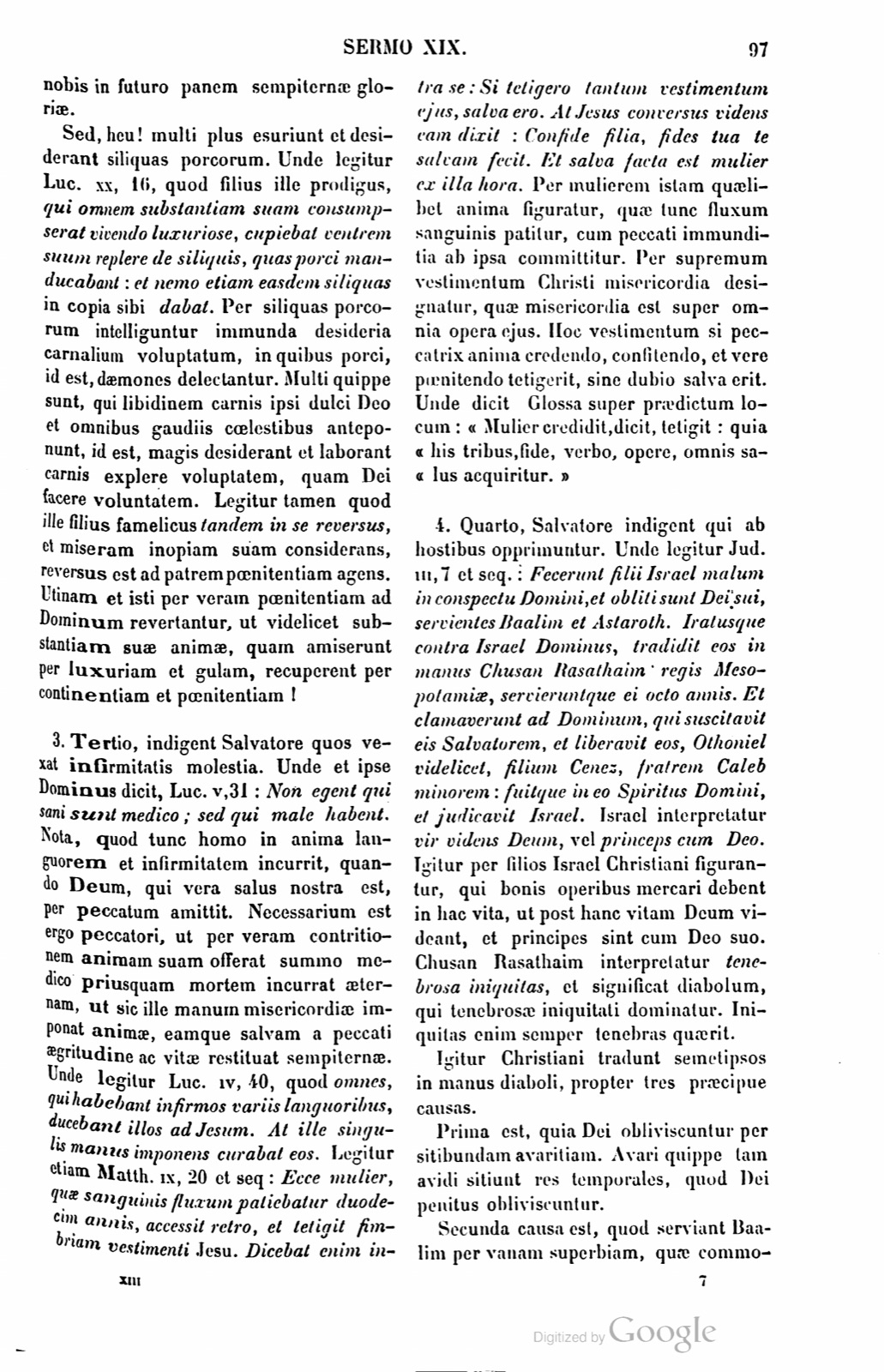
nobis in futuro panem sempiternae gloriae.
Sed, heu! multi plus esuriunt et desiderant siliquas porcorum. Unde legitur Luc. xv, 16, quod filius ille prodigus, qui omnem substantiam suam consumpserat vivendo luxuriose, cupiebat ventrem suum replere de siliquis, quas porci manducabant: et nemo etiam easdem siliquas in copia sibi dabat. Per siliquas porcorum intelliguntur immunda desideria carnalium voluptatum, in quibus porci, id est, daemones delectantur. Multi quippe sunt, qui libidinem carnis ipsi dulci Deo et omnibus gaudiis caelestibus anteponunt, id est, magis desiderant et laborant carnis explere voluptatem, quam Dei facere voluntatem. Legitur tamen quod ille filius famelicus tandem in se reversus, et miseram inopiam suam considerans, reversus est ad patrem paenitentiam agens. Utinam et isti per veram paenitentiam ad Dominum revertantur, ut videlicet substantiam suae animae, quam amiserunt per luxuriam et gulam, recuperent per continentiam et paenitentiam!
3. Tertio, indigent Salvatore quos vexat infirmitatis molestia. Unde et ipse Dominus dicit, Luc. v, 31: Non egent qui sani sunt medico; sed qui male habent. Nota, quod tunc homo in anima languorem et infirmitatem incurrit, quando Deum, qui vera salus nostra est, per peccatum amittit. Necessarium est ergo peccatori, ut per veram contritionem animam suam offerat summo medico priusquam mortem incurrat aeternam, ut sic ille manum misericordiae imponat animae, eamque salvam a peccati aegritudine ac vitae restituat sempiternae. Unde legitur Luc. iv, 40, quod omnes, qui habebant infirmos variis languoribus, ducebant illos ad Jesum. At ille singulis manus imponens curabat eos. Legitur etiam Matth. ix, 20 et seq.: Ecce mulier, quae sanguinis fluxum patiebatur duodecim annis, accessit retro, et tetigit fimbriam vestimenti Jesu. Dicebat enim intra se: Si tetigero tantum vestimentum ejus, salva ero. At Jesus conversus videns eam dixit: Confide filia, fides tua te salvam fecit. Et salva facta est mulier ex illa hora. Per mulierem istam quaelibet anima figuratur, quae tunc fluxum sanguinis patitur, cum peccati immunditia ab ipsa committitur. Per supremum vestimentum Christi misericordia designatur, quae misericordia est super omnia opera ejus. Hoc vestimentum si peccatrix anima credendo, confitendo, et vere paenitendo tetigerit, sine dubio salva erit. Unde dicit Glossa super praedictum locum: "Mulier credidit, dicit, tetigit: quia his tribus, fide, verbo, opere, omnis salus acquiritur."
4. Quarto, Salvatore indigent qui ab hostibus opprimuntur. Unde legitur Jud. iii, 7 et seq.: Fecerunt filii Israel malum in conspectu Domini, et obliti sunt Dei sui, servientes Baalim et Astaroth. Iratusque contra Israel Dominus, tradidit eos in manus Chusan Rasathaim regis Mesopotamiae, servieruntque ei octo annis. Et clamaverunt ad Dominum, qui suscitavit eis Salvatorem, et liberavit eos, Othoniel videlicet, filium Cenez, fratrem Caleb minorem: fuitque in eo Spiritus Domini, et judicavit Israel. Israel interpretatur vir videns Deum, vel princeps cum Deo. Igitur per filios Israel Christiani figurantur, qui bonis operibus mercari debent in hac vita, ut post hanc vitam Deum videant, et principes sint cum Deo suo. Chusan Rasathaim interpretatur tenebrosa iniquitas, et significat diabolum, qui tenebrosae iniquitati dominatur. Iniquitas enim semper tenebras quaerit.
to us in the future the bread of everlasting glory.
But alas, many hunger for and desire more the husks of swine. Hence it is read in Luke 15:16 that that prodigal son, who had consumed all his substance by living luxuriously, desired to fill his belly with the husks that the swine were eating, and no one gave him even those husks in abundance. By the husks of swine are understood the unclean desires of carnal pleasures, in which swine, that is, demons, delight. For there are many who place the lust of the flesh before sweet God himself and all heavenly joys, that is, who desire and labor more to fulfill the pleasure of the flesh than to do the will of God. Nevertheless it is read that that hungry son at last returned into himself, and considering his wretched poverty, returned to his father doing penance. Would that these too through true penance would return to the Lord, namely so that they may recover through continence and penance the substance of their soul that they lost through luxury and gluttony!
3. Thirdly, those need a Savior whom the trouble of infirmity vexes. Hence the Lord himself also says, Luke 5:31: Those who are healthy do not need a physician, but those who are ill. Note that then a human being incurs sickness and infirmity in the soul when through sin he loses God, who is our true salvation. Therefore it is necessary for the sinner that through true contrition he offer his soul to the highest physician before he incurs eternal death, so that thus he may place the hand of mercy upon the soul and restore it, saved from the sickness of sin, to everlasting life. Hence it is read in Luke 4:40 that all who had the sick with various diseases were bringing them to Jesus. But he, laying hands on each one, cured them. It is also read in Matthew 9:20 and following: Behold, a woman who had suffered a flow of blood for twelve years approached from behind and touched the hem of Jesus' garment. For she was saying within herself: If I touch only his garment, I shall be saved. But Jesus, turning and seeing her, said: Have confidence, daughter; your faith has made you saved. And the woman was made saved from that hour. By this woman any soul is figured, which then suffers a flow of blood when the uncleanness of sin is committed by it. By the uppermost garment of Christ mercy is designated, which mercy is above all his works. If the sinful soul touches this garment by believing, confessing, and truly repenting, without doubt it will be saved. Hence the Gloss says on the aforesaid place: "The woman believed, spoke, touched, because by these three, faith, word, work, all salvation is acquired."
4. Fourthly, those need a Savior who are oppressed by enemies. Hence it is read in Judges 3:7 and following: The children of Israel did evil in the sight of the Lord and forgot their God, serving Baalim and Astaroth. And the Lord, angry against Israel, delivered them into the hands of Chusan Rasathaim, king of Mesopotamia, and they served him eight years. And they cried to the Lord, who raised up a Savior for them and freed them, namely Othoniel, son of Cenez, younger brother of Caleb; and the Spirit of the Lord was in him, and he judged Israel. Israel is interpreted as a man seeing God, or a prince with God. Therefore by the children of Israel Christians are figured, who ought to trade with good works in this life, so that after this life they may see God and be princes with their God. Chusan Rasathaim is interpreted as dark iniquity, and signifies the devil, who rules over dark iniquity. For iniquity always seeks darkness.
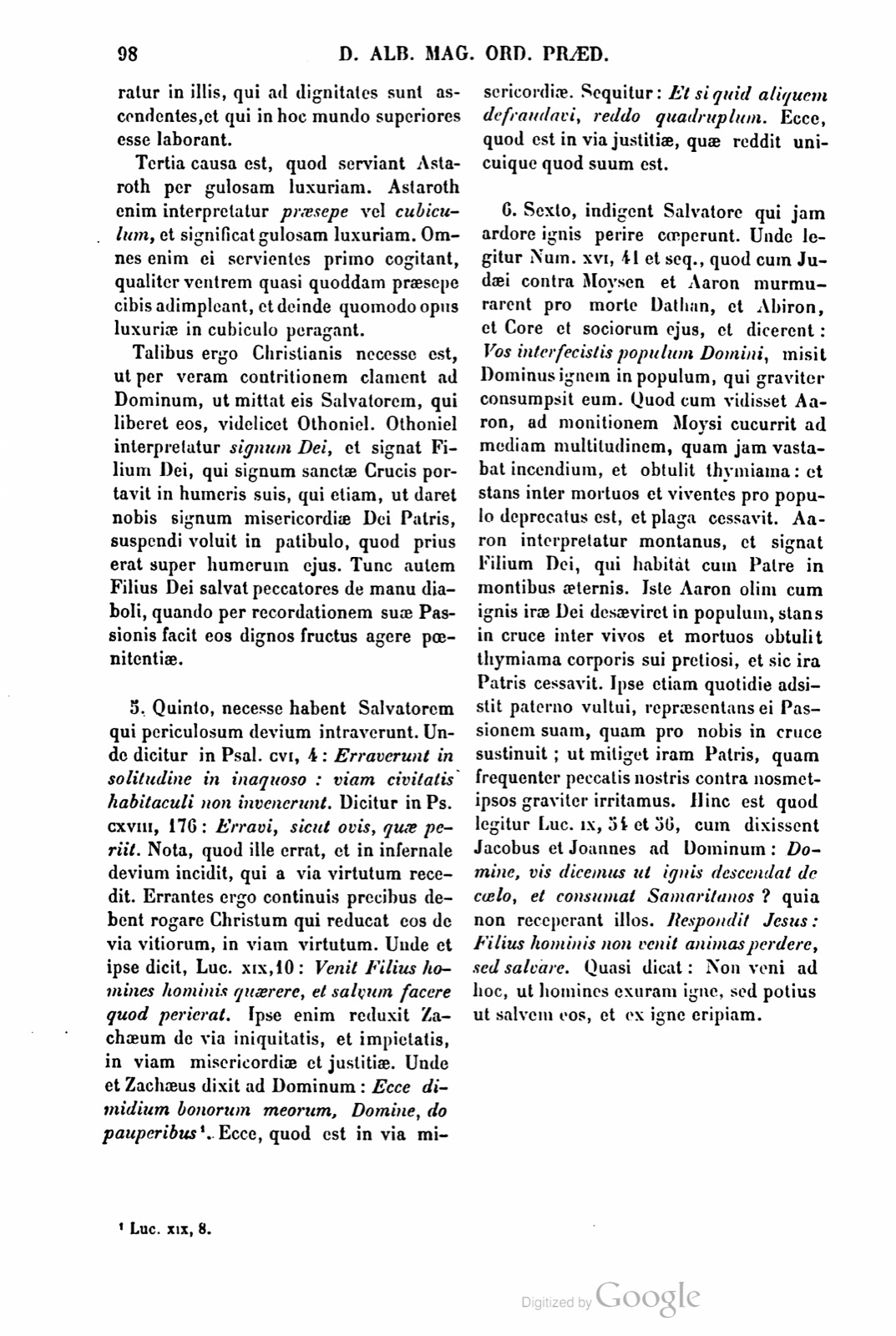
Igitur Christiani tradunt semetipsos in manus diaboli, propter tres praecipue causas.
Prima est, quia Dei obliviscuntur per sitibundam avaritiam. Avari quippe tam avidi sitiunt res temporales, quod Dei penitus obliviscuntur.
Secunda causa est, quod serviant Baalim per vanam superbiam, quae commoratur in illis, qui ad dignitates sunt ascendentes, et qui in hoc mundo superiores esse laborant.
Tertia causa est, quod serviant Astaroth per gulosam luxuriam. Astaroth enim interpretatur praesepe vel cubiculum, et significat gulosam luxuriam. Omnes enim ei servientes primo cogitant, qualiter ventrem quasi quoddam praesepe cibis adimpleant, et deinde quomodo opus luxuriae in cubiculo peragant.
Talibus ergo Christianis necesse est, ut per veram contritionem clament ad Dominum, ut mittat eis Salvatorem, qui liberet eos, videlicet Othoniel. Othoniel interpretatur signum Dei, et signat Filium Dei, qui signum sanctae Crucis portavit in humeris suis, qui etiam, ut daret nobis signum misericordiae Dei Patris, suspendi voluit in patibulo, quod prius erat super humerum ejus. Tunc autem Filius Dei salvat peccatores de manu diaboli, quando per recordationem suae Passionis facit eos dignos fructus agere paenitentiae.
5. Quinto, necesse habent Salvatorem qui periculosum devium intraverunt. Unde dicitur in Psal. cvi, 4: Erraverunt in solitudine in inaquoso: viam civitatis habitaculi non invenerunt. Dicitur in Ps. cxviii, 176: Erravi, sicut ovis, quae periit. Nota, quod ille errat, et in infernale devium incidit, qui a via virtutum recedit. Errantes ergo continuis precibus debent rogare Christum qui reducat eos de via vitiorum, in viam virtutum. Unde et ipse dicit, Luc. xix, 10: Venit Filius hominis quaerere, et salvum facere quod perierat. Ipse enim reduxit Zachaeum de via iniquitatis, et impietatis, in viam misericordiae et justitiae. Unde et Zachaeus dixit ad Dominum: Ecce dimidium bonorum meorum, Domine, do pauperibus 1. Ecce, quod est in via misericordiae. Sequitur: Et si quid aliquem defraudavi, reddo quadruplum. Ecce, quod est in via justitiae, quae reddit unicuique quod suum est.
6. Sexto, indigent Salvatore qui jam ardore ignis perire coeperunt. Unde legitur Num. xvi, 41 et seq., quod cum Judaei contra Moysen et Aaron murmurarent pro morte Dathan, et Abiron, et Core et sociorum ejus, et dicerent: Vos interfecistis populum Domini, misit Dominus ignem in populum, qui graviter consumpsit eum. Quod cum vidisset Aaron, ad monitionem Moysi cucurrit ad mediam multitudinem, quam jam vastabat incendium, et obtulit thymiama: et stans inter mortuos et viventes pro populo deprecatus est, et plaga cessavit. Aaron interpretatur montanus, et signat Filium Dei, qui habitat cum Patre in montibus aeternis. Iste Aaron olim cum ignis irae Dei desaeviret in populum, stans in cruce inter vivos et mortuos obtulit thymiama corporis sui pretiosi, et sic ira Patris cessavit. Ipse etiam quotidie assistit paterno vultui, repraesentans ei Passionem suam, quam pro nobis in cruce sustinuit; ut mitiget iram Patris, quam frequenter peccatis nostris contra nosmetipsos graviter irritamus. Hinc est quod legitur Luc. ix, 54 et 56, cum dixissent Jacobus et Joannes ad Dominum: Domine, vis dicemus ut ignis descendat de caelo, et consumat Samaritanos? quia non receperant illos. Respondit Jesus: Filius hominis non venit animas perdere, sed salvare. Quasi dicat: Non veni ad hoc, ut homines exuram igne, sed potius ut salvem eos, et ex igne eripiam.
Therefore Christians hand themselves over into the hands of the devil chiefly for three causes.
The first is because they forget God through thirsting avarice. For the avaricious so greedily thirst for temporal things that they completely forget God.
The second cause is that they serve Baalim through vain pride, which dwells in those who are ascending to dignities and who labor to be higher in this world.
The third cause is that they serve Astaroth through gluttonous luxury. For Astaroth is interpreted as manger or bedchamber and signifies gluttonous luxury. For all who serve it first think how they may fill the belly with foods as a certain manger, and then how they may carry out the work of luxury in the bedchamber.
Therefore it is necessary for such Christians that through true contrition they cry to the Lord that he send them a Savior who may free them, namely Othoniel. Othoniel is interpreted as sign of God and signifies the Son of God, who carried the sign of the holy Cross on his shoulders, who also, so that he might give us a sign of the mercy of God the Father, wished to be suspended on the gibbet that earlier had been upon his shoulder. Then the Son of God saves sinners from the hand of the devil when through the remembrance of his Passion he makes them produce worthy fruits of penance.
5. Fifthly, those have need of a Savior who have entered a dangerous byway. Hence it is said in Psalm 106:4: They wandered in solitude, in a waterless place; they did not find the way of a city of habitation. It is said in Psalm 118:176: I have wandered like a sheep that has perished. Note that he wanders and falls into an infernal byway who withdraws from the way of virtues. Therefore those wandering ought with continual prayers to ask Christ to lead them back from the way of vices into the way of virtues. Hence he himself also says, Luke 19:10: The Son of man came to seek and to make saved what had perished. For he led Zacchaeus back from the way of iniquity and impiety into the way of mercy and justice. Hence Zacchaeus also said to the Lord: Behold, Lord, I give half of my goods to the poor 1. Behold what is in the way of mercy. It follows: And if I have defrauded anyone of anything, I restore fourfold. Behold what is in the way of justice, which renders to each one what is his.
6. Sixthly, those need a Savior who already have begun to perish by the heat of fire. Hence it is read in Numbers 16:41 and following that when the Jews murmured against Moses and Aaron over the death of Dathan and Abiron and Core and his companions, and said: You have killed the people of the Lord, the Lord sent fire into the people, which grievously consumed them. When Aaron had seen this, at Moses' warning he ran to the midst of the multitude that the fire was already laying waste, and he offered incense; and standing between the dead and the living he prayed for the people, and the plague ceased. Aaron is interpreted as mountainous and signifies the Son of God, who dwells with the Father in the eternal mountains. That Aaron once, when the fire of God's wrath raged against the people, standing on the cross between the living and the dead, offered the incense of his precious body, and thus the Father's wrath ceased. He also daily stands before the Father's face, representing to him his Passion, which he sustained for us on the cross, so that he may mitigate the Father's wrath, which we very often grievously provoke against ourselves by our sins. Hence it is read in Luke 9:54 and 56, when James and John had said to the Lord: Lord, do you wish that we say that fire descend from heaven and consume the Samaritans? because they did not receive them. Jesus answered: The Son of man did not come to destroy souls, but to save them. As if he were saying: I did not come for this, to burn human beings with fire, but rather to save them and snatch them from fire.
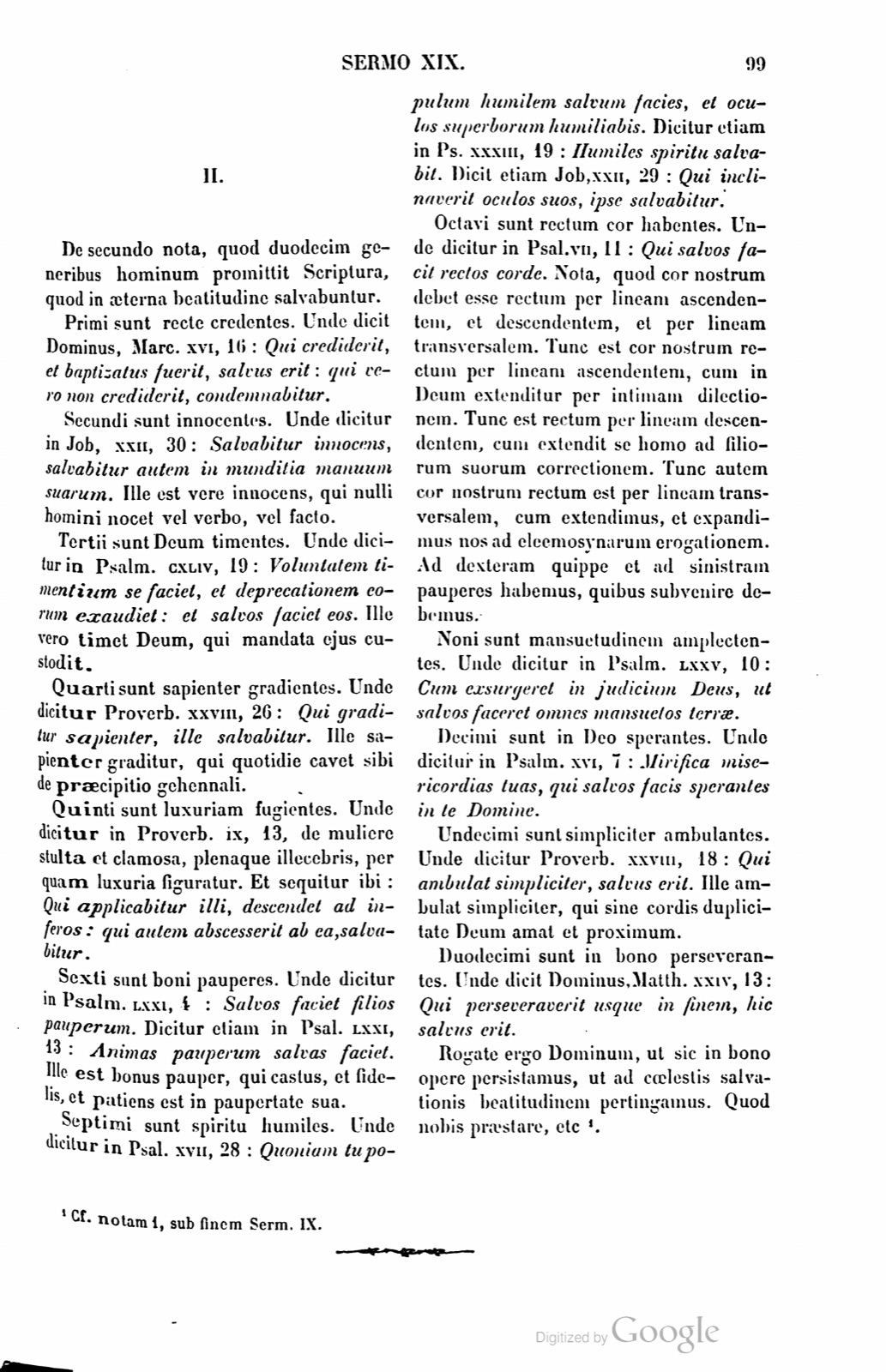
II.
De secundo nota, quod duodecim generibus hominum promittit Scriptura, quod in aeterna beatitudine salvabuntur.
Primi sunt recte credentes. Unde dicit Dominus, Marc. xvi, 16: Qui crediderit, et baptizatus fuerit, salvus erit: qui vero non crediderit, condemnabitur.
Secundi sunt innocentes. Unde dicitur in Job, xxii, 30: Salvabitur innocens, salvabitur autem in munditia manuum suarum. Ille est vere innocens, qui nulli homini nocet vel verbo, vel facto.
Tertii sunt Deum timentes. Unde dicitur in Psalm. cxliv, 19: Voluntatem timentium se faciet, et deprecationem eorum exaudiet: et salvos faciet eos. Ille vero timet Deum, qui mandata ejus custodit.
Quarti sunt sapienter gradientes. Unde dicitur Proverb. xxviii, 26: Qui graditur sapienter, ille salvabitur. Ille sapienter graditur, qui quotidie cavet sibi de praecipitio gehennali.
Quinti sunt luxuriam fugientes. Unde dicitur in Proverb. ix, 13, de muliere stulta et clamosa, plenaque illecebris, per quam luxuria figuratur. Et sequitur ibi: Qui applicabitur illi, descendet ad inferos: qui autem abscesserit ab ea, salvabitur.
Sexti sunt boni pauperes. Unde dicitur in Psalm. lxxi, 4: Salvos faciet filios pauperum. Dicitur etiam in Psal. lxxi, 13: Animas pauperum salvas faciet. Ille est bonus pauper, qui castus, et fidelis, et patiens est in paupertate sua.
Septimi sunt spiritu humiles. Unde dicitur in Psal. xvii, 28: Quoniam tu populum humilem salvum facies, et oculos superborum humiliabis. Dicitur etiam in Ps. xxxiii, 19: Humiles spiritu salvabit. Dicit etiam Job, xxii, 29: Qui inclinaverit oculos suos, ipse salvabitur.
Octavi sunt rectum cor habentes. Unde dicitur in Psal. vii, 11: Qui salvos facit rectos corde. Nota, quod cor nostrum debet esse rectum per lineam ascendentem, et descendentem, et per lineam transversalem. Tunc est cor nostrum rectum per lineam ascendentem, cum in Deum extenditur per intimam dilectionem. Tunc est rectum per lineam descendentem, cum extendit se homo ad filiorum suorum correctionem. Tunc autem cor nostrum rectum est per lineam transversalem, cum extendimus, et expandimus nos ad eleemosynarum erogationem. Ad dexteram quippe et ad sinistram pauperes habemus, quibus subvenire debemus.
Noni sunt mansuetudinem amplectentes. Unde dicitur in Psalm. lxxv, 10: Cum exsurgeret in judicium Deus, ut salvos faceret omnes mansuetos terrae.
Decimi sunt in Deo sperantes. Unde dicitur in Psalm. xvi, 7: Mirifica misericordias tuas, qui salvos facis sperantes in te Domine.
Undecimi sunt simpliciter ambulantes. Unde dicitur Proverb. xxviii, 18: Qui ambulat simpliciter, salvus erit. Ille ambulat simpliciter, qui sine cordis duplicitate Deum amat et proximum.
Duodecimi sunt in bono perseverantes. Unde dicit Dominus, Matth. xxiv, 13: Qui perseveraverit usque in finem, hic salvus erit.
Rogate ergo Dominum, ut sic in bono opere persistamus, ut ad caelestis salvationis beatitudinem pertingamus. Quod nobis praestare, etc. 2
II.
Concerning the second, note that Scripture promises to twelve kinds of human beings that they will be saved in eternal beatitude.
The first are those believing rightly. Hence the Lord says, Mark 16:16: He who has believed and has been baptized will be saved; but he who has not believed will be condemned.
The second are the innocent. Hence it is said in Job 22:30: The innocent will be saved; but he will be saved in the cleanness of his hands. He is truly innocent who harms no human being either by word or by deed.
The third are those fearing God. Hence it is said in Psalm 144:19: He will do the will of those who fear him, and he will hear their prayer, and he will save them. But he truly fears God who keeps his commandments.
The fourth are those walking wisely. Hence Proverbs 28:26 says: He who walks wisely will be saved. He walks wisely who daily guards himself from the precipice of Gehenna.
The fifth are those fleeing luxury. Hence it is said in Proverbs 9:13 concerning the foolish and clamorous woman, full of enticements, through whom luxury is figured. And there it follows: He who is attached to her will descend to the lower regions; but he who has withdrawn from her will be saved.
The sixth are the good poor. Hence it is said in Psalm 71:4: He will save the sons of the poor. It is also said in Psalm 71:13: He will save the souls of the poor. He is the good poor person who is chaste and faithful and patient in his poverty.
The seventh are the humble in spirit. Hence it is said in Psalm 17:28: Because you will make the humble people saved and will humble the eyes of the proud. It is also said in Psalm 33:19: He will save the humble in spirit. Job 22:29 also says: He who has lowered his eyes will himself be saved.
The eighth are those having a right heart. Hence it is said in Psalm 7:11: He who saves the right of heart. Note that our heart ought to be right by an ascending line, and a descending line, and a transverse line. Then our heart is right by an ascending line when it is extended into God through inward love. Then it is right by a descending line when a human being extends himself to the correction of his children. But then our heart is right by a transverse line when we extend and spread ourselves to the giving of alms. For to the right and to the left we have the poor, whom we ought to help.
The ninth are those embracing meekness. Hence it is said in Psalm 75:10: When God rose up into judgment, to save all the meek of the earth.
The tenth are those hoping in God. Hence it is said in Psalm 16:7: Make wonderful your mercies, you who save those hoping in you, O Lord.
The eleventh are those walking simply. Hence Proverbs 28:18 says: He who walks simply will be saved. He walks simply who without duplicity of heart loves God and neighbor.
The twelfth are those persevering in good. Hence the Lord says, Matthew 24:13: He who has persevered to the end, this one will be saved.
Therefore pray to the Lord that we may so persist in good work that we may attain to the beatitude of heavenly salvation. May he grant this to us, etc. 2
If a page does not appear, its photograph has not been uploaded yet.