Works › Sermons for the Seasons of the Year
Volume 13 · p. 96
Sermon XIX. On the Same Sunday
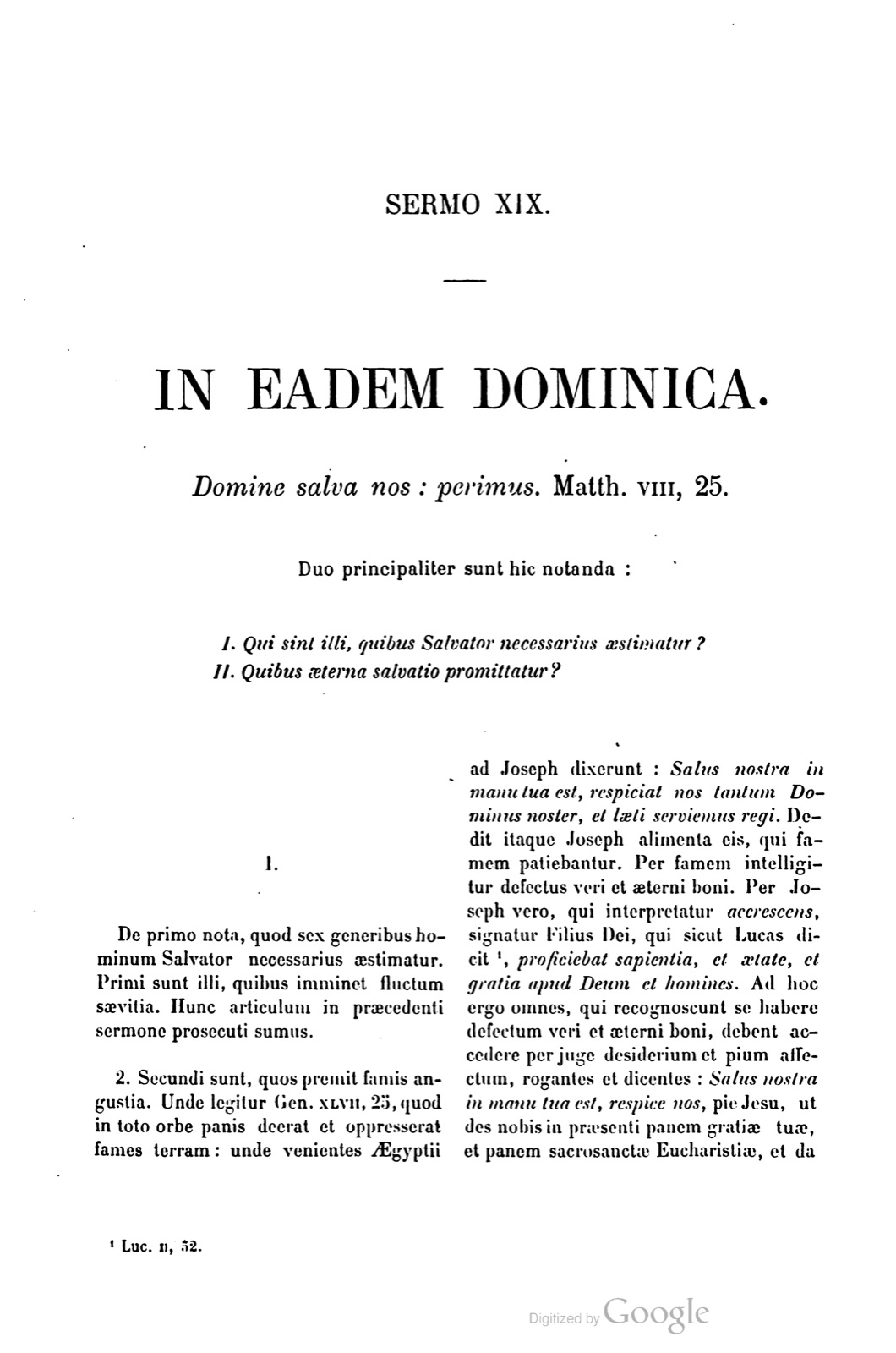
Sermo XIX.
In eadem Dominica.
Domine salva nos: perimus. Matth. viii, 25.
Duo principaliter sunt hic notanda:
I. Qui sint illi, quibus Salvator necessarius aestimatur? II. Quibus aeterna salvatio promittatur?
I.
De primo nota, quod sex generibus hominum Salvator necessarius aestimatur. Primi sunt illi, quibus imminet fluctum saevitia. Hunc articulum in praecedenti sermone prosecuti sumus.
2. Secundi sunt, quos premit famis angustia. Unde legitur Gen. xlvii, 25, quod in toto orbe panis deerat et oppresserat fames terram: unde venientes Aegyptii ad Joseph dixerunt: Salus nostra in manu tua est, respiciat nos tantum Dominus noster, et laeti serviemus regi. Dedit itaque Joseph alimenta eis, qui famem patiebantur. Per famem intelligitur defectus veri et aeterni boni. Per Joseph vero, qui interpretatur accrescens, signatur Filius Dei, qui sicut Lucas dicit 1, proficiebat sapientia, et aetate, et gratia apud Deum et homines. Ad hoc ergo omnes, qui recognoscunt se habere defectum veri et aeterni boni, debent accedere per juge desiderium et pium affectum, rogantes et dicentes: Salus nostra in manu tua est, respice nos, pie Jesu, ut des nobis in praesenti panem gratiae tuae, et panem sacrosanctae Eucharistiae, et da
Sermon XIX.
On the Same Sunday.
Lord, save us; we are perishing. Matthew 8:25.
Two things are principally to be noted here:
I. Who are those for whom the Savior is judged necessary? II. To whom is eternal salvation promised?
I.
Concerning the first, note that the Savior is judged necessary for six kinds of human beings. The first are those upon whom the savagery of waves is threatening. We pursued this article in the preceding sermon.
2. The second are those whom the distress of hunger presses. Hence it is read in Genesis 47:25 that bread was lacking in the whole world and famine had oppressed the earth; hence the Egyptians coming to Joseph said: Our salvation is in your hand; let only our lord look upon us, and gladly we will serve the king. Therefore Joseph gave food to those who were suffering famine. By famine is understood the lack of true and eternal good. But by Joseph, who is interpreted as increasing, the Son of God is signified, who, as Luke says 1, advanced in wisdom and age and grace before God and human beings. Therefore all who recognize that they have a lack of true and eternal good ought to approach him through continual desire and pious affection, asking and saying: Our salvation is in your hand; look upon us, pious Jesus, so that you may give us in the present the bread of your grace, and the bread of the most holy Eucharist, and give
Notes
- Luke 2:52. (Luc. ii, 52.) ↩
If a page does not appear, its photograph has not been uploaded yet.