Works › Sermons for the Seasons of the Year
Volume 13 · pp. 64–70
Sermon XIII. Likewise Concerning the Same
A marker with ≈ is an approximate page boundary, placed by measure of the text; the page photographs remain the authority. In the paired views, clicking a page marker brings that page into view.
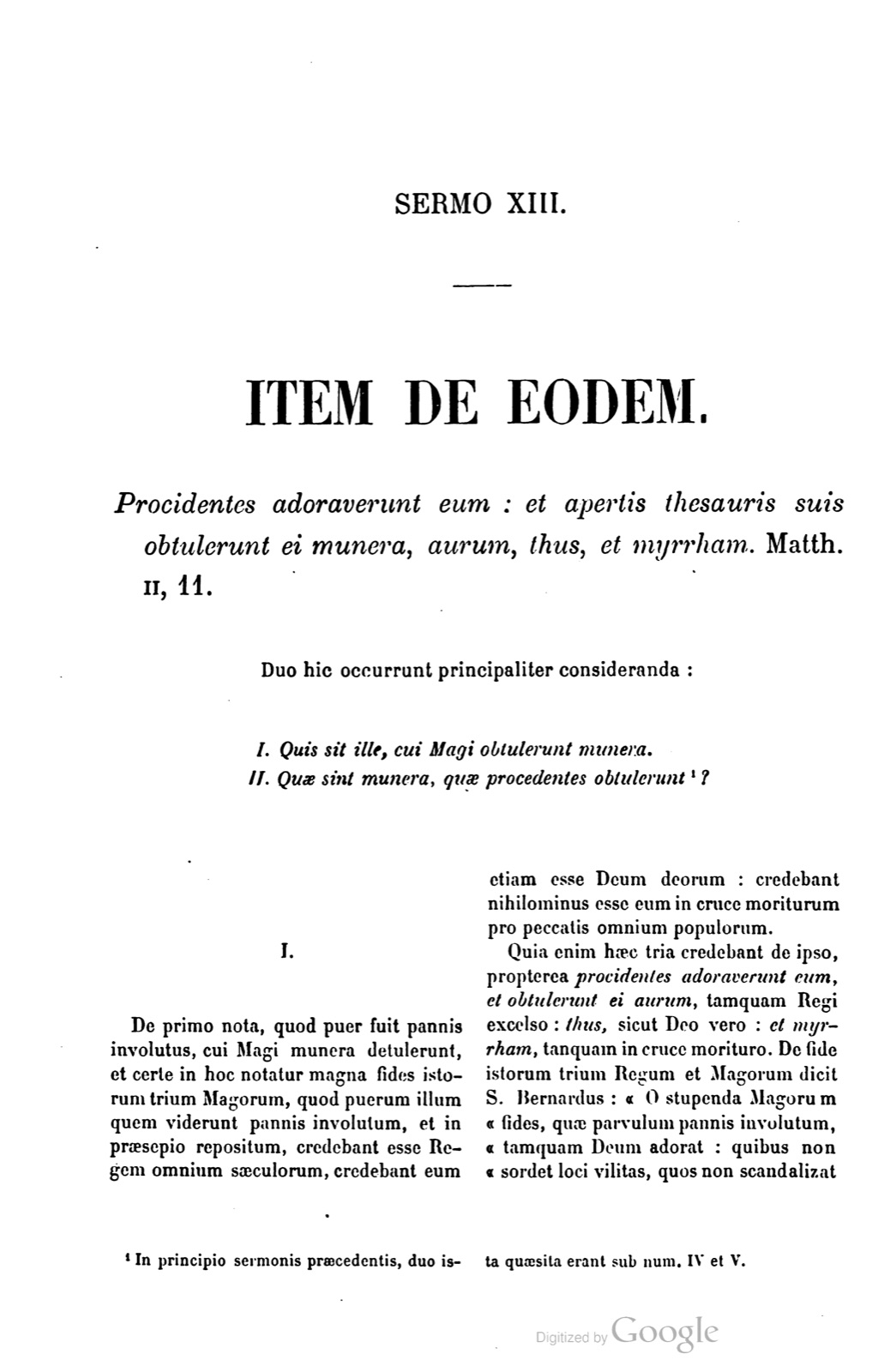
SERMO XIII.
ITEM DE EODEM.
Procidentes adoraverunt eum: et apertis thesauris suis obtulerunt ei munera, aurum, thus, et myrrham. Matth. II, 11.
Duo hic occurrunt principaliter consideranda:
I. Quis sit ille, cui Magi obtulerunt munera. II. Quae sint munera, quae procidentes obtulerunt 1?
I.
De primo nota, quod puer fuit pannis involutus, cui Magi munera detulerunt, et certe in hoc notatur magna fides istorum trium Magorum, quod puerum illum quem viderunt pannis involutum, et in praesepio repositum, credebant esse Regem omnium saeculorum, credebant eum etiam esse Deum deorum: credebant nihilominus esse eum in cruce moriturum pro peccatis omnium populorum.
Quia enim haec tria credebant de ipso, propterea procidentes adoraverunt eum, et obtulerunt ei aurum, tamquam Regi excelso: thus, sicut Deo vero: et myrrham, tanquam in cruce morituro. De fide istorum trium Regum et Magorum dicit S. Bernardus: «O stupenda Magorum fides, quae parvulum pannis involutum, tamquam Deum adorat: quibus non sordet loci vilitas, quos non scandalizat pueri pannositas, quos non offendit pauperculae matris paupertas! major est haec fides latronis in cruce confitentis.»
Et nota, quod puer iste, cui munera deferuntur per myrrham, thus, et aurum exprimitur, quod aperte innuit Secreta hujus diei, quae talis est: «Ecclesiae tuae, quaesumus Domine, dona propitius intuere: quibus non jam aurum, thus, et myrrha profertur; sed quod eisdem muneribus, etc.» Sed quis in altari immolatur et sumitur, nisi Jesus Christus olim in praesepio reclinatus? Igitur puer iste cui a Magis munera deferuntur, myrrha est, quia per eum ira Dei Patris mitigatur. Aurum est, quia per eum cuilibet electus in gloria decoratur.
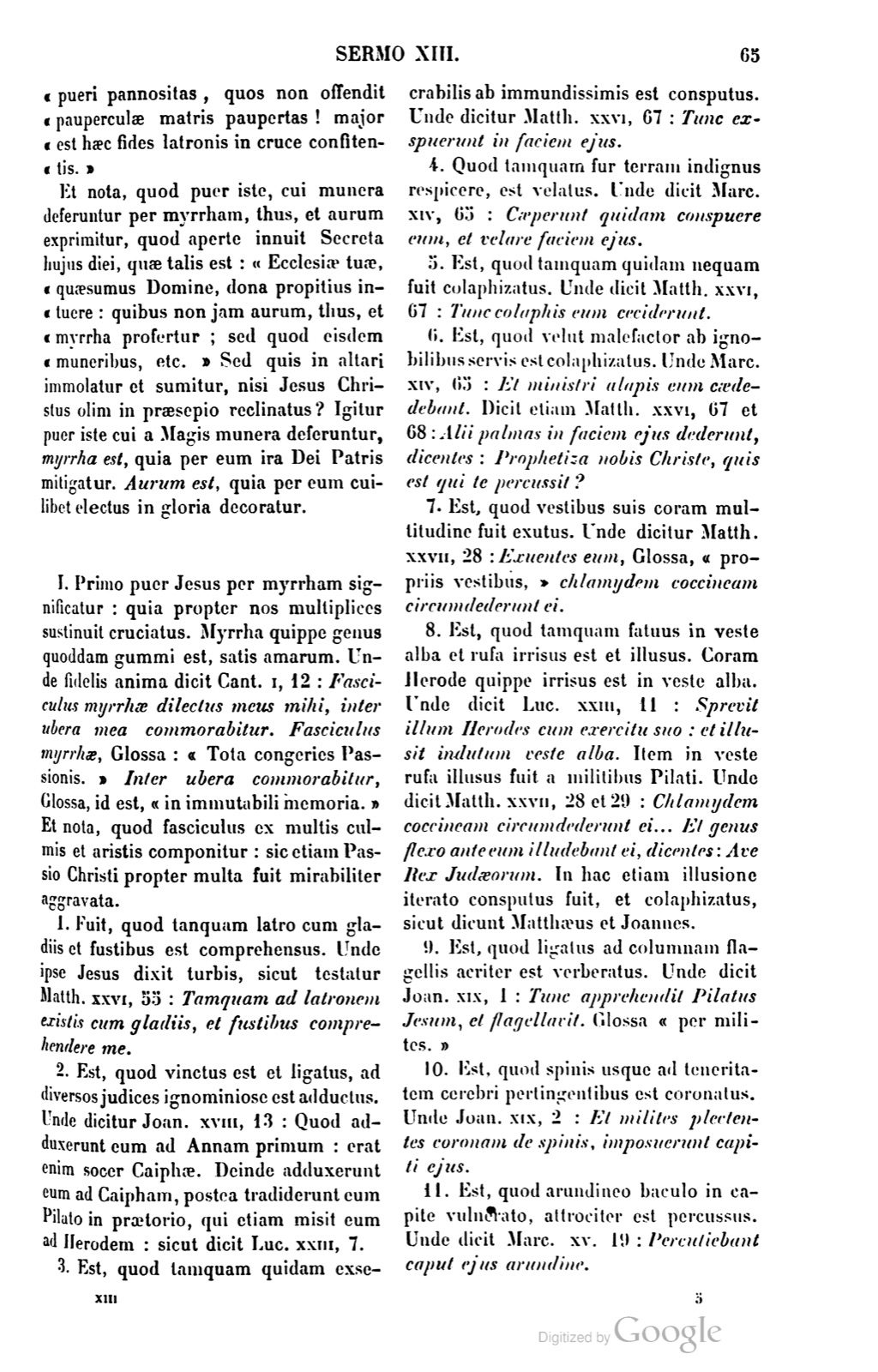
I. Primo puer Jesus per myrrham significatur: quia propter nos multiplices sustinuit cruciatus. Myrrha quippe genus quoddam gummi est, satis amarum. Unde fidelis anima dicit Cant. I, 12: Fasciculus myrrhae dilectus meus mihi, inter ubera mea commorabitur. Fasciculus myrrhae, Glossa: «Tota congeries Passionis.» Inter ubera commorabitur, Glossa, id est, «in immutabili memoria.» Et nota, quod fasciculus ex multis culmis et aristis componitur: sic etiam Passio Christi propter multa fuit mirabiliter aggravata.
1. Fuit, quod tanquam latro cum gladiis et fustibus est comprehensus. Unde ipse Jesus dixit turbis, sicut testatur Matth. XXVI, 55: Tamquam ad latronem existis cum gladiis, et fustibus comprehendere me.
2. Est, quod vinctus est et ligatus, ad diversos judices ignominiose est adductus. Unde dicitur Joan. XVIII, 13: Quod adduxerunt eum ad Annam primum: erat enim socer Caiphae. Deinde adduxerunt eum ad Caipham, postea tradiderunt cum Pilato in praetorio, qui etiam misit eum ad Herodem: sicut dicit Luc. XXIII, 7.
3. Est, quod tamquam quidam exsecrabilis ab immundissimis est consputus. Unde dicitur Matth. XXVI, 67: Tunc exspuerunt in faciem ejus.
4. Quod tamquam fur terram indignus respicere, est velatus. Unde dicit Marc. XIV, 65: Caeperunt quidam conspuere eum, et velare faciem ejus.
SERMON XIII.
LIKEWISE CONCERNING THE SAME.
Falling down, they adored him; and when their treasures had been opened, they offered him gifts: gold, frankincense, and myrrh. Matthew II, 11.
Two things chiefly occur here to be considered:
I. Who is the one to whom the Magi offered gifts? II. What are the gifts which, falling down, they offered 1?
I.
Concerning the first, note that the child to whom the Magi brought gifts was wrapped in cloths, and certainly in this the great faith of those three Magi is noted, because they believed that child whom they saw wrapped in cloths and placed in a manger to be the King of all ages; they believed him also to be the God of gods; nevertheless they believed that he would die on the cross for the sins of all peoples.
For because they believed these three things concerning him, therefore falling down they adored him, and they offered him gold as to a high King, frankincense as to the true God, and myrrh as to one about to die on the cross. Concerning the faith of those three Kings and Magi Saint Bernard says: "O astonishing faith of the Magi, which adores as God a little child wrapped in cloths; to whom the vileness of the place is not filthy, whom the child's cloth-wrapping does not scandalize, whom the poverty of the poor little mother does not offend! This faith is greater than that of the thief confessing on the cross."
And note that this child, to whom gifts are brought, is expressed through myrrh, frankincense, and gold, which the Secret of this day openly suggests, which is such: "Look graciously, O Lord, upon the gifts of your Church, in which now gold, frankincense, and myrrh are not brought forth; but that which by the same gifts, etc." But who is sacrificed and received on the altar, except Jesus Christ once laid in the manger? Therefore this child to whom gifts are brought by the Magi is myrrh, because through him the wrath of God the Father is mitigated. He is gold, because through him each elect person is adorned in glory.
I. First, the child Jesus is signified by myrrh, because for us he sustained manifold torments. For myrrh is a certain kind of gum, sufficiently bitter. Hence the faithful soul says in Canticles I, 12: My beloved is to me a bundle of myrrh; he will dwell between my breasts. Bundle of myrrh, the Gloss: "The whole heap of the Passion." He will dwell between the breasts, the Gloss, that is, "in unchangeable memory." And note that a bundle is composed of many stalks and ears; so also the Passion of Christ was wonderfully made heavy on account of many things.
1. There was this, that he was seized as a thief with swords and clubs. Hence Jesus himself said to the crowds, as Matthew XXVI, 55 testifies: As against a thief you have come out with swords and clubs to seize me.
2. There is this, that bound and tied, he was disgracefully led to different judges. Hence John XVIII, 13 says that they led him first to Annas, for he was the father-in-law of Caiaphas. Then they led him to Caiaphas; afterward they handed him over to Pilate in the praetorium, who also sent him to Herod, as Luke XXIII, 7 says.
3. There is this, that as a certain execrable man he was spat upon by the most unclean. Hence Matthew XXVI, 67 says: Then they spat in his face.
4. That as a thief unworthy to look at the earth, he was veiled. Hence Mark XIV, 65 says: Certain ones began to spit upon him and to veil his face.
5. Est, quod tamquam quidam nequam fuit colaphizatus. Unde dicit Matth. XXVI, 67: Tunc colaphis eum ceciderunt.
6. Est, quod velut malefactor ab ignobilibus servis est colaphizatus. Unde Marc. XIV, 65: Et ministri alapis eum caedebant. Dicit etiam Matth. XXVI, 67 et 68: Alii palmas in faciem ejus dederunt, dicentes: Prophetiza nobis Christe, quis est qui te percussit?
7. Est, quod vestibus suis coram multitudine fuit exutus. Unde dicitur Matth. XXVII, 28: Exuentes eum, Glossa, «propriis vestibus,» chlamydem coccineam circumdederunt ei.
8. Est, quod tamquam fatuus in veste alba et rufa irrisus est et illusus. Coram Herode quippe irrisus est in veste alba. Unde dicit Luc. XXIII, 11: Sprevit illum Herodes cum exercitu suo: et illusit indutum veste alba. Item in veste rufa illusus fuit a militibus Pilati. Unde dicit Matth. XXVII, 28 et 29: Chlamydem coccineam circumdederunt ei... Et genus flexo ante eum illudebant ei, dicentes: Ave Rex Judaeorum. In hac etiam illusione iterato consputus fuit, et colaphizatus, sicut dicunt Matthaeus et Joannes.
9. Est, quod ligatus ad columnam flagellis acriter est verberatus. Unde dicit Joan. XIX, 1: Tunc apprehendit Pilatus Jesum, et flagellavit. Glossa «per milites.»
10. Est, quod spinis usque ad teneritatem cerebri pertingentibus est coronatus. Unde Joan. XIX, 2: Et milites plectentes coronam de spinis, imposuerunt capiti ejus.
11. Est, quod arundineo baculo in capite vulnerato, atrociter est percussus. Unde dicit Marc. XV, 19: Percutiebant caput ejus arundine.
12. Est, quod barbam ejus evellentes, mentum ejus laceraverunt. Unde dicit Isa. LVI, 4: Super quem lusistis? super quem dilatastis os, et ejecistis linguam? Super locum istum dicit Glossa, quod «barbam ejus evulserunt.»
13. Est, quod patibulum crucis humeris ejus imposuerunt. Unde dicit Joan. XIX, 17: Bajulans sibi crucem Jesus exivit in eum, qui dicitur Calvariae locus, Hebraice autem Golgotha.
14. Est, quod in medio latronum tamquam sceleratior ipsis esset, eum crucifixerunt. Unde dicit Joan. XIX, 18: Crucifixerunt Jesum, et cum eo alios duos, Glossa, «latrones,» hinc et hinc, medium autem Jesum.
15. Est, quod violenter eum extendentes cruci durissimis clavis affixerunt. Unde dicitur in Psal. XXI, 17 et 18: Foderunt manus meas et pedes meos: dinumeraverunt omnia ossa mea, id est, dinumerabilia fecerunt prae nimia corporis extensione.
16. Est, quod etiam cruci affixum milites ac Sacerdotum Principes ac Judaeorum seniores blasphemaverunt et irriserunt. Unde dicitur Matth. XXVII, 39 et seq.: Praetereuntes blasphemabant eum moventes capita sua, et dicentes: Vah qui destruis templum Dei, et in triduo reaedificas: salva temetipsum: si Filius Dei es, descende de cruce. Similiter et Principes Sacerdotum illudentes cum Scribis, et senioribus dicebant: Alios salvos fecit, seipsum non potest salvum facere. Si Rex Israel est, descendat nunc de cruce, et credimus ei.
5. There is this, that as a certain wicked man he was struck with fists. Hence Matthew XXVI, 67 says: Then they struck him with fists.
6. There is this, that as an evildoer he was struck with fists by ignoble servants. Hence Mark XIV, 65: And the ministers were beating him with blows. Matthew XXVI, 67 and 68 also says: Others gave palms into his face, saying: Prophesy to us, Christ, who is the one who struck you?
7. There is this, that he was stripped of his garments before the multitude. Hence Matthew XXVII, 28 says: Stripping him, the Gloss says "of his own garments," they put a scarlet cloak around him.
8. There is this, that as a fool in a white and red garment he was mocked and derided. Before Herod indeed he was mocked in a white garment. Hence Luke XXIII, 11 says: Herod with his army despised him and mocked him clothed in a white garment. Likewise he was mocked in a red garment by Pilate's soldiers. Hence Matthew XXVII, 28 and 29 says: They put a scarlet cloak around him... And with knee bent before him they mocked him, saying: Hail, King of the Jews. In this mockery also he was again spat upon and struck with fists, as Matthew and John say.
9. There is this, that tied to the column he was sharply beaten with scourges. Hence John XIX, 1 says: Then Pilate took Jesus and scourged him. The Gloss: "through the soldiers."
10. There is this, that he was crowned with thorns reaching even to the tenderness of the brain. Hence John XIX, 2: And the soldiers, plaiting a crown of thorns, placed it on his head.
11. There is this, that on his wounded head he was struck atrociously with a reed staff. Hence Mark XV, 19 says: They were striking his head with a reed.
12. There is this, that pulling out his beard, they tore his chin. Hence Isaiah LVI, 4 says: Upon whom have you played? upon whom have you widened the mouth and put out the tongue? On that place the Gloss says that "they plucked out his beard."
13. There is this, that they placed the gibbet of the cross upon his shoulders. Hence John XIX, 17 says: Jesus, carrying the cross for himself, went out to the place which is called Calvary, but in Hebrew Golgotha.
14. There is this, that they crucified him in the midst of thieves as though he were more criminal than they. Hence John XIX, 18 says: They crucified Jesus, and with him two others, the Gloss says "thieves," on this side and on that, but Jesus in the middle.
15. There is this, that violently stretching him, they fixed him to the cross with the hardest nails. Hence it is said in Psalm XXI, 17 and 18: They dug through my hands and my feet; they numbered all my bones, that is, they made them countable because of the excessive stretching of the body.
16. There is this, that even when he was fixed to the cross, the soldiers and chief priests and elders of the Jews blasphemed and mocked him. Hence Matthew XXVII, 39 and following says: Those passing by blasphemed him, moving their heads and saying: Bah, you who destroy the temple of God and rebuild it in three days, save yourself; if you are the Son of God, come down from the cross. Similarly the chief priests also, mocking with the scribes and elders, said: He saved others; himself he cannot save. If he is King of Israel, let him now come down from the cross, and we shall believe him.
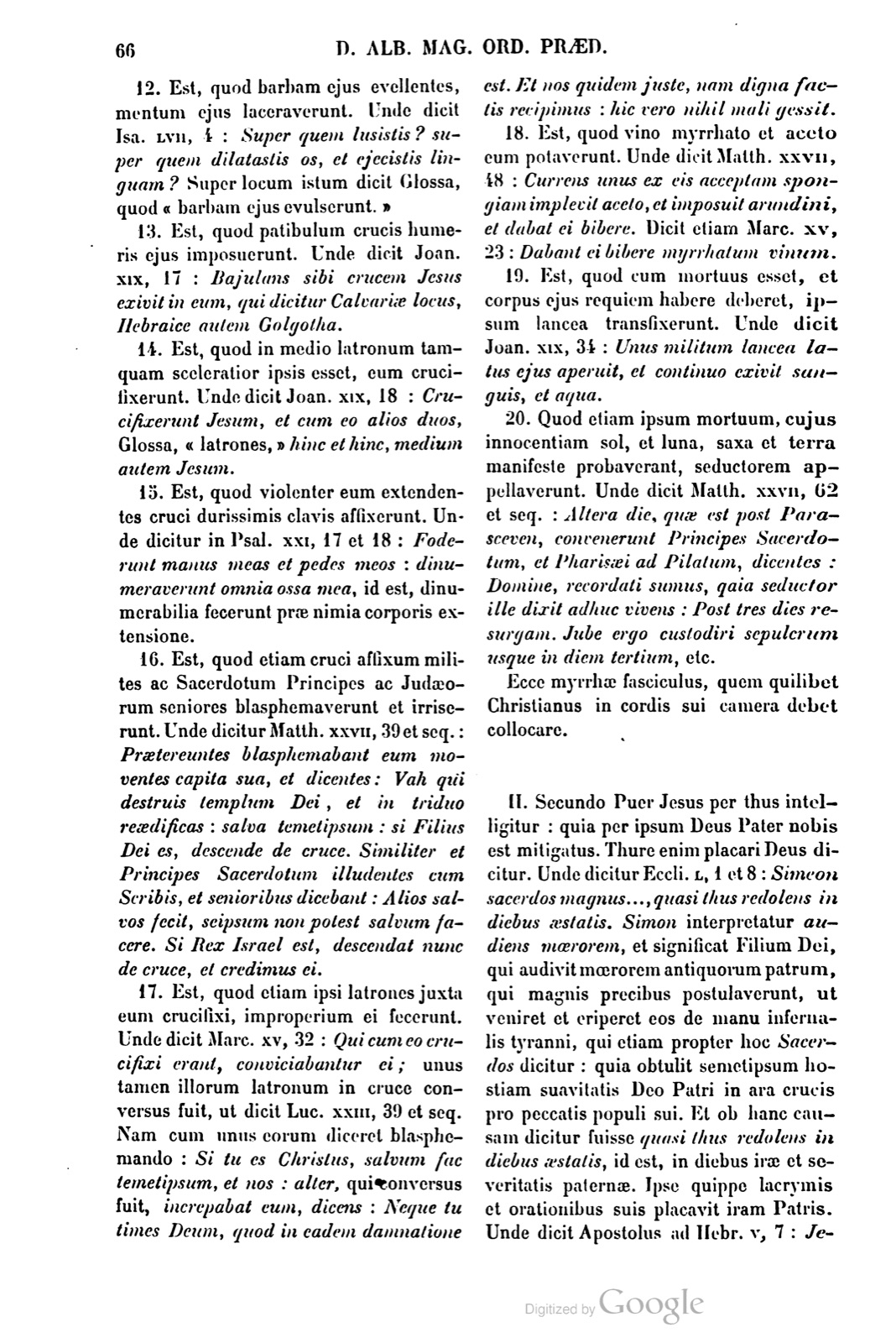
17. Est, quod etiam ipsi latrones juxta eum crucifixi, improperium ei fecerunt. Unde dicit Marc. XV, 32: Qui cum eo crucifixi erant, conviciabantur ei; unus tamen illorum latronum in cruce conversus fuit, ut dicit Luc. XXIII, 39 et seq. Nam cum unus eorum diceret blasphemando: Si tu es Christus, salvum fac temetipsum, et nos: alter, qui conversus fuit, increpabat eum, dicens: Neque tu times Deum, quod in eadem damnatione es. Et nos quidem juste, nam digna factis recipimus: hic vero nihil mali gessit.
18. Est, quod vino myrrhato et aceto cum potaverunt. Unde dicit Matth. XXVII, 48: Currens unus ex eis acceptam spongiam implevit aceto, et imposuit arundini, et dabat ei bibere. Dicit etiam Marc. XV, 23: Dabant ei bibere myrrhatum vinum.
19. Est, quod cum mortuus esset, et corpus ejus requiem habere deberet, ipsum lancea transfixerunt. Unde dicit Joan. XIX, 34: Unus militum lancea latus ejus aperuit, et continuo exivit sanguis, et aqua.
20. Quod etiam ipsum mortuum, cujus innocentiam sol, et luna, saxa et terra manifeste probaverant, seductorem appellaverunt. Unde dicit Matth. XXVII, 62 et seq.: Altera die, quae est post Parasceven, convenerunt Principes Sacerdotum, et Pharisaei ad Pilatum, dicentes: Domine, recordati sumus, quia seductor ille dixit adhuc vivens: Post tres dies resurgam. Jube ergo custodiri sepulcrum usque in diem tertium, etc.
Ecce myrrhae fasciculus, quem quilibet Christianus in cordis sui camera debet collocare.
II. Secundo Puer Jesus per thus intelligitur: quia per ipsum Deus Pater nobis est mitigatus. Thure enim placari Deus dicitur. Unde dicitur Eccli. L, 1 et 8: Simeon sacerdos magnus..., quasi thus redolens in diebus aestatis. Simon interpretatur audiens maerorem, et significat Filium Dei, qui audivit maerorem antiquorum patrum, qui magnis precibus postulaverunt, ut veniret et eriperet eos de manu infernalis tyranni, qui etiam propter hoc Sacerdos dicitur: quia obtulit semetipsum hostiam suavitatis Deo Patri in ara crucis pro peccatis populi sui. Et ob hanc causam dicitur fuisse quasi thus redolens in diebus aestatis, id est, in diebus irae et severitatis paternae. Ipse quippe lacrymis et orationibus suis placavit iram Patris. Unde dicit Apostolus ad Hebr. V, 7: Jesus in diebus carnis suae preces, supplicationesque ad Deum, cum clamore valido, et lacrymis offerens, exauditus est pro sua reverentia.
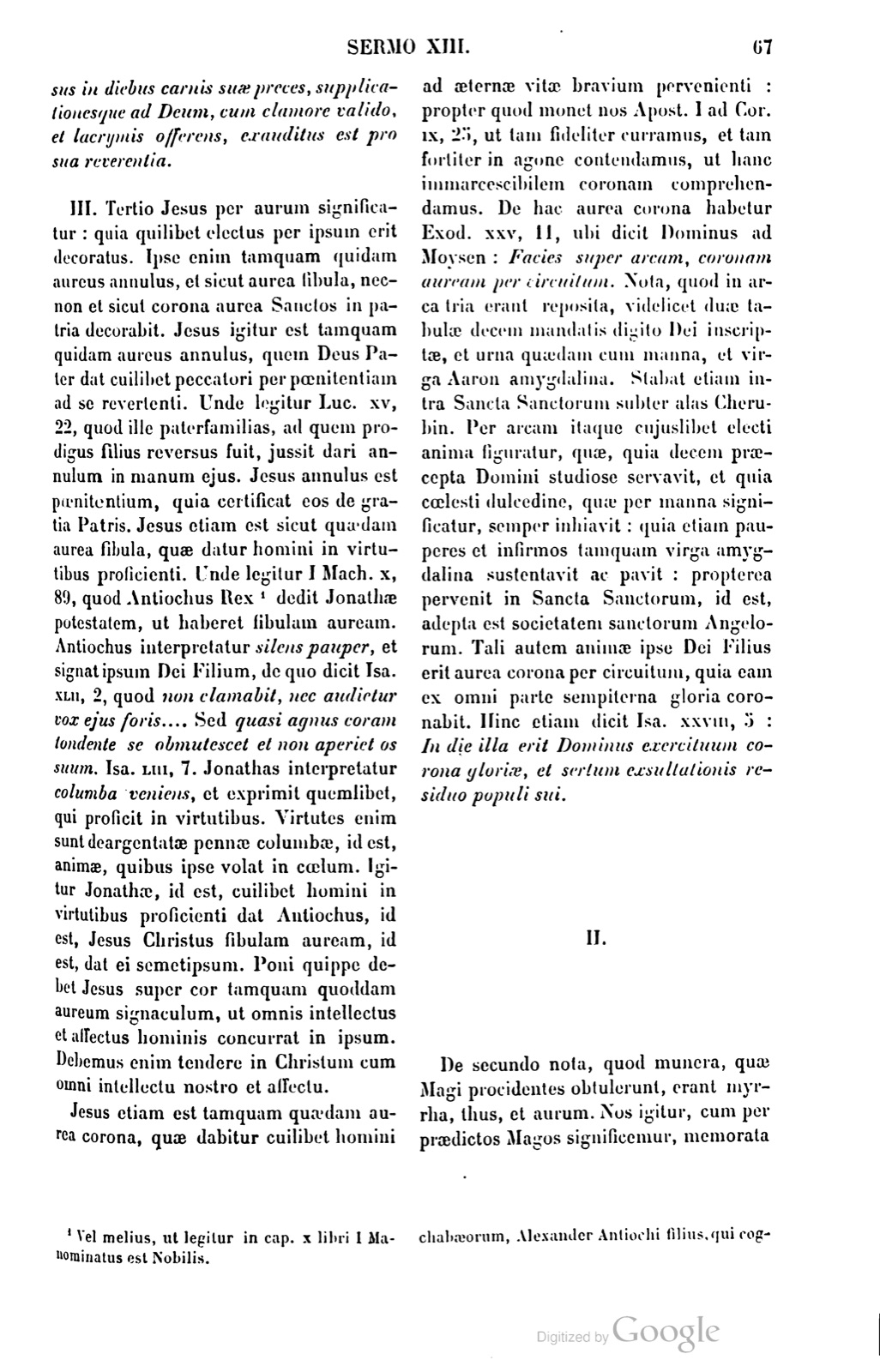
III. Tertio Jesus per aurum significatur: quia quilibet electus per ipsum erit decoratus. Ipse enim tamquam quidam aureus annulus, et sicut aurea fibula, nec non et sicut corona aurea Sanctos in patria decorabit. Jesus igitur est tamquam quidam aureus annulus, quem Deus Pater dat cuilibet peccatori per paenitentiam ad se revertenti. Unde legitur Luc. XV, 22, quod ille paterfamilias, ad quem prodigus filius reversus fuit, jussit dari annulum in manum ejus. Jesus annulus est paenitentium, quia certificat eos de gratia Patris. Jesus etiam est sicut quaedam aurea fibula, quae datur homini in virtutibus proficienti. Unde legitur I Mach. X, 89, quod Antiochus Rex dedit Jonathae potestatem, ut haberet fibulam auream 2. Antiochus interpretatur silens pauper, et signat ipsum Dei Filium, de quo dicit Isa. XLI, 2, quod non clamabit, nec audietur vox ejus foris.... Sed quasi agnus coram tondente se obmutescet et non aperiet os suum. Isa. LIII, 7. Jonathas interpretatur columba veniens, et exprimit quemlibet, qui proficit in virtutibus. Virtutes enim sunt deargentatae pennae columbae, id est, animae, quibus ipse volat in caelum. Igitur Jonathae, id est, cuilibet homini in virtutibus proficienti dat Antiochus, id est, Jesus Christus fibulam auream, id est, dat ei semetipsum. Poni quippe debet Jesus super cor tamquam quoddam aureum signaculum, ut omnis intellectus et affectus hominis concurrat in ipsum. Debemus enim tendere in Christum cum omni intellectu nostro et affectu.
17. There is this, that even the thieves crucified beside him made reproach against him. Hence Mark XV, 32 says: Those who were crucified with him reviled him. Nevertheless one of those thieves was converted on the cross, as Luke XXIII, 39 and following says. For when one of them said, blaspheming: If you are Christ, save yourself and us, the other, who was converted, rebuked him, saying: Do you not fear God, because you are in the same condemnation? And we indeed justly, for we receive things worthy of our deeds; but this man has done nothing evil.
18. There is this, that they gave him myrrhed wine and vinegar to drink. Hence Matthew XXVII, 48 says: One of them, running, took a sponge, filled it with vinegar, and placed it on a reed, and gave him to drink. Mark XV, 23 also says: They gave him myrrhed wine to drink.
19. There is this, that when he was dead, and his body ought to have had rest, they pierced him with a lance. Hence John XIX, 34 says: One of the soldiers opened his side with a lance, and immediately blood and water came out.
20. That also when he was dead, whose innocence the sun and moon, rocks and earth had manifestly proved, they called him a deceiver. Hence Matthew XXVII, 62 and following says: On the next day, which is after the Preparation, the chief priests and Pharisees came together to Pilate, saying: Lord, we have remembered that that deceiver said while still living: After three days I shall rise. Therefore command the tomb to be guarded until the third day, etc.
Behold the bundle of myrrh which every Christian ought to place in the chamber of his heart.
II. Second, the child Jesus is understood by frankincense, because through him God the Father was mitigated for us. For God is said to be appeased by incense. Hence it is said in Ecclesiasticus L, 1 and 8: Simeon the great priest..., like frankincense giving fragrance in the days of summer. Simon is interpreted "hearing sorrow" and signifies the Son of God, who heard the sorrow of the ancient fathers, who with great prayers requested that he would come and snatch them from the hand of the infernal tyrant; he is also called Priest on account of this, because he offered himself as a victim of sweetness to God the Father on the altar of the cross for the sins of his people. And for this cause he is said to have been like frankincense giving fragrance in the days of summer, that is, in the days of wrath and paternal severity. For he appeased the wrath of the Father by his tears and prayers. Hence the Apostle says to the Hebrews V, 7: Jesus in the days of his flesh, offering prayers and supplications to God with a strong cry and tears, was heard because of his reverence.
III. Third, Jesus is signified by gold, because each elect person will be adorned through him. For he, like a certain golden ring, and like a golden clasp, and also like a golden crown, will adorn the Saints in the homeland. Therefore Jesus is like a certain golden ring, which God the Father gives to any sinner returning to him through penance. Hence Luke XV, 22 reads that that householder, to whom the prodigal son returned, ordered a ring to be given into his hand. Jesus is the ring of penitents because he certifies them concerning the grace of the Father. Jesus is also like a certain golden clasp which is given to a man progressing in virtues. Hence I Maccabees X, 89 reads that King Antiochus gave Jonathan power to have a golden clasp 2. Antiochus is interpreted "silent poor man" and marks the Son of God himself, concerning whom Isaiah XLI, 2 says that he will not cry out, nor will his voice be heard outside.... But like a lamb before the one shearing him he will become mute and will not open his mouth, Isaiah LIII, 7. Jonathan is interpreted "a dove coming," and expresses anyone who progresses in virtues. For virtues are the silvered wings of the dove, that is, of the soul, by which he flies into heaven. Therefore to Jonathan, that is, to any man progressing in virtues, Antiochus, that is, Jesus Christ, gives a golden clasp, that is, he gives him himself. For Jesus ought to be placed over the heart like a certain golden seal, so that every understanding and affection of man may run together into him. For we ought to tend into Christ with all our understanding and affection.
Jesus etiam est tamquam quaedam aurea corona, quae dabitur cuilibet homini ad aeternae vitae bravium pervenienti: propter quod monet nos Apost. I ad Cor. IX, 25, ut tam fideliter curramus, et tam fortiter in agone contendamus, ut hanc immarcescibilem coronam comprehendamus. De hac aurea corona habetur Exod. XXV, 11, ubi dicit Dominus ad Moysen: Facies super arcam, coronam auream per circuitum. Nota, quod in arca tria erant reposita, videlicet duae tabulae decem mandatis digito Dei inscriptae, et urna quaedam cum manna, et virga Aaron amygdalina. Stabat etiam intra Sancta Sanctorum subter alas Cherubim. Per arcam itaque cujuslibet electi anima figuratur, quae, quia decem praecepta Domini studiose servavit, et quia caelesti dulcedine, quae per manna significatur, semper inhiavit: quia etiam pauperes et infirmos tamquam virga amygdalina sustentavit ac pavit: propterea pervenit in Sancta Sanctorum, id est, adepta est societatem sanctorum Angelorum. Tali autem animae ipse Dei Filius erit aurea corona per circuitum, quia eam ex omni parte sempiterna gloria coronabit. Hinc etiam dicit Isa. XXVIII, 5: In die illa erit Dominus exercituum corona gloriae, et sertum exsultationis residuo populi sui.
II.
De secundo nota, quod munera, quae Magi procidentes obtulerunt, erant myrrha, thus, et aurum. Nos igitur, cum per praedictos Magos significemur, memorata munera offerre debemus, ut videlicet offeramus myrrham myrrhae, thus thuri, et aurum auro. Per myrrham vero notatur vitae nostrae asperitas, per thus devotionis assiduitas, per aurum pretiosa charitas.
I. Primo igitur offerre debemus Domino myrrham per vitae nostrae asperitatem, ut sicut ipse in corpore suo multa propter nos passus est incommoda, ita et nos propter ipsum aliqua incommoda patiamur. Myrrha autem ista, quae Domino est offerenda, consistit in jejuniis, in vigiliis, in ciliciis et duris stratis, in genuflectionibus et virgarum percussionibus, in peregrinationibus, et in caeteris hujuscemodi corporalibus afflictionibus. Sicut enim myrrha vermes arcet a mortuis corporibus, ita praedicta repellunt ab homine malas cogitationes et noxias voluptates. De hac myrrha dicitur Judith, X, 2 et 3: Descendit Judith in domum suam, lavitque corpus suum, et unxit se myrrho optimo. Per Judith, quae interpretatur confitens, intelligitur quaelibet fidelis anima, quae quotidie confitetur Domino, quoniam bonus, quoniam in saeculum misericordia ejus. Hic autem debet descendere in domum suam per propriae conscientiae discussionem. Debet etiam lavare corpus suum per lacrymarum effusionem et sinceram confessionem. Debet nihilominus corpus suum perungere myrrha bona, meliori, et optima. Myrrham bonam offerunt, qui oculum habent ad infernum, et ideo se hic propter peccata sua castigant et affligunt, ne ibi semper a daemonibus affligantur. Myrrham meliorem offerunt, qui oculum habent ad caelum, et ideo se puniunt et tribulationes perferunt, ut ad societatem Sanctorum, qui illuc per multas tribulationes pervenerunt, postea mittantur. Myrrham optimam offerunt, qui tantum oculum dirigunt in ipsum Deum, et propter hoc se gravibus afflictionibus subjiciunt, ut Passioni suae saltem in aliquo respondeant, et ut de ipso suae dulcedinis fonte eo ardentius postmodum bibant.
Jesus is also like a certain golden crown, which will be given to any man arriving at the prize of eternal life. On account of this the Apostle admonishes us in I Corinthians IX, 25 that we run so faithfully and contend so strongly in the contest that we may grasp this unfading crown. Concerning this golden crown there is material in Exodus XXV, 11, where the Lord says to Moses: You shall make over the ark a golden crown around it. Note that in the ark three things were placed, namely two tablets inscribed by the finger of God with the ten commandments, and a certain urn with manna, and the almond staff of Aaron. It also stood within the Holy of Holies beneath the wings of the Cherubim. Therefore by the ark the soul of any elect person is figured, which, because it zealously kept the ten precepts of the Lord, and because it always longed for the heavenly sweetness which is signified by manna, and because it also sustained and fed the poor and sick like an almond staff, therefore came into the Holy of Holies, that is, obtained the society of the holy Angels. But for such a soul the Son of God himself will be a golden crown all around, because he will crown it on every side with everlasting glory. Hence Isaiah XXVIII, 5 also says: On that day the Lord of hosts will be a crown of glory and a wreath of exultation for the remnant of his people.
II.
Concerning the second, note that the gifts which the Magi, falling down, offered were myrrh, frankincense, and gold. Therefore we, since we are signified by the aforesaid Magi, ought to offer the remembered gifts, namely that we offer myrrh to myrrh, frankincense to frankincense, and gold to gold. But by myrrh the harshness of our life is noted, by frankincense the assiduity of devotion, by gold precious charity.
I. First, therefore, we ought to offer myrrh to the Lord through the harshness of our life, so that just as he in his body suffered many hardships for us, so we also may suffer some hardships for him. But that myrrh which must be offered to the Lord consists in fasts, in vigils, in hair shirts and hard beds, in genuflections and beatings with rods, in pilgrimages, and in the other bodily afflictions of this sort. For just as myrrh keeps worms away from dead bodies, so the aforesaid things repel from man evil thoughts and harmful pleasures. Concerning this myrrh Judith X, 2 and 3 says: Judith went down into her house, and washed her body, and anointed herself with the best myrrh. By Judith, who is interpreted "confessing," any faithful soul is understood, which daily confesses to the Lord that he is good, that his mercy is forever. But here it ought to descend into its house through discussion of its own conscience. It ought also to wash its body through the outpouring of tears and sincere confession. Nevertheless it ought to anoint its body with good, better, and best myrrh. Those offer good myrrh who have their eye toward hell, and therefore here chastise and afflict themselves because of their sins, lest there they be always afflicted by demons. Those offer better myrrh who have their eye toward heaven, and therefore punish themselves and endure tribulations, so that afterward they may be sent to the society of the Saints who reached that place through many tribulations. Those offer the best myrrh who direct their eye only toward God himself, and on account of this subject themselves to grave afflictions, so that they may respond at least in something to his Passion, and so that from that very fountain of his sweetness afterward they may drink more ardently.
II. Secundo debemus Domino thus offerre per devotionis sinceritatem. In hoc autem consistit devotionis sinceritas, ut libenter oremus, et libenter de Domino cogitemus, libenter etiam Ecclesias divinum officium audituri frequentemus, libenter quoque verbo Dei aures nostras accommodemus. De hoc thure dicitur Levit. XXIV, 3 et seq. Et loquitur Dominus ad Moysen: Duodecim panes de similagine super mensam purissimam coram Domino statues...: et pones super eos thus lucidissimum.
Nota, quod per duodecim panes similagineos designantur duodecim gaudia, quae inveniet quaelibet bona anima in purissima mensa sanctae Trinitatis. Primi quatuor panes signant quadruplex gaudium, propter quadruplicis mali amotionem. Alii quatuor panes signant quadriforme gaudium, propter corporis glorificationem. Ultimi quatuor panes exprimunt quadruplex gaudium, de quibus anima spiritualem habebit remunerationem.
Primum igitur gaudium est de vinculorum disruptione. Vincula animae sunt fames, et sitis, et frigus, et aestus, labor, et infirmitas, et caetera incommoda, quibus constringitur in carcere corporis sui. His vinculis disruptis in morte, dicet felix anima: Dirupisti vincula mea, etc. 3
Secundum gaudium est, quia liberata est de malorum hominum impugnatione. Mali enim persequuntur bonos odio cordis, verbis, et factis.
Tertium gaudium est ex daemonum insidiantium conculcatione. Cum enim justa anima erepta fuerit de corpore, tunc super aspidem et basiliscum ambulabis, etc. 4. Per haec enim quatuor animalia daemones figurantur.
II. Second, we ought to offer frankincense to the Lord through sincerity of devotion. Now sincerity of devotion consists in this, that we pray willingly, and think willingly about the Lord, and also willingly frequent churches to hear the divine office, and willingly accommodate our ears to the word of God. Concerning this frankincense Leviticus XXIV, 3 and following says, and the Lord speaks to Moses: You shall set twelve loaves of fine flour on the purest table before the Lord... and you shall place over them the brightest frankincense.
Note that by the twelve loaves of fine flour are designated twelve joys which any good soul will find at the purest table of the holy Trinity. The first four loaves mark a fourfold joy because of the removal of fourfold evil. The other four loaves mark a four-formed joy because of the glorification of the body. The last four loaves express a fourfold joy concerning which the soul will have spiritual remuneration.
Therefore the first joy is from the breaking of chains. The chains of the soul are hunger, thirst, cold, heat, labor, sickness, and the other hardships by which it is constrained in the prison of its body. When these chains have been broken in death, the happy soul will say: You have broken my bonds, etc. 3
The second joy is because it has been freed from the attack of evil men. For the evil persecute the good by hatred of heart, by words, and by deeds.
The third joy is from the trampling of demons lying in wait. For when the just soul has been snatched from the body, then you will walk upon the asp and the basilisk, etc. 4. For through these four animals demons are figured.
Quartum gaudium est, ex infernalium tormentorum evasione. Laetabitur enim justus, cum viderit vindictam 5, id est, laetabitur cum se viderit evasisse locum suppliciorum, ubi exercetur vindicta scelerum et peccatorum.
Alia quatuor gaudia sunt ex corporis glorificatione, videlicet claritas, agilitas, subtilitas, incorruptibilitas, quae quatuor notantur in sole.
Ultima quatuor gaudia, de ipsius animae dote specialiter esse dicuntur, videlicet, omnimoda cognitio, plenissima dilectio, suavissima Dei visio, et ejusdem copiosa et aeterna fruitio. Super istos duodecim panes, id est, super ista duodecim gaudia poni jubetur thus lucidissimum, quia singula praedicta bene considerata mirabilem afferunt homini devotionem. Et ut homo haec duodecim assequatur, assidue debet Domino offerre suam orationem.
III. Tertio debemus aurum Domino offerre per pretiosam charitatem. Sed forte dicet aliquis, ego pauper sum et egenus, et non possum habere aurum quod offeram. Ad quod ego respondebo: Si non habes aurum charitatis, quod offeras, quaere in tribus locis, et satis invenies: videlicet quaere in Ophir, et in Hevilath, et in Tharsis. Per Ophir intelligitur tenera infirmitas Jesu Christi. Per Hevilath aspera Passio. Et per Tharsis jucunda glorificatio.
1. Primo igitur aurum charitatis quaerendum est in Ophir. Unde legitur III Reg. IX, 28, quod servi Salomonis ibant cum classe in Ophir, et sumptum inde aurum detulerunt ad Salomonem Regem. Ophir interpretatur infirmitas, et bene exprimit nobis infantiam Salvatoris nostri. Quid enim infirmius vel fragilius puero noviter nato? Certe hic multum auri, id est, charitatis, invenitur. Vere enim magna fuit charitas, quod illa Dei virtus, quae firmavit orbem terrae, qui non commovebitur, sic pro nobis est infirmata, ut membra infantuli assumeret tenerrima. Talem quippe desideraverant eum antiqui Patres. Unde dicit Isa. LIII, 2 et 3: Et nos desideravimus eum... novissimum virorum, et scientem infirmitatem. Unde etiam Apostolus ad Hebr. IV, 15 et 16, cum gaudio exclamat: Non habemus Pontificem, qui non possit compati infirmitatibus nostris. Qualem igitur habes, o Apostole? subdit: Tentatum autem per omnia pro similitudine absque peccato. Et quid boni nobis ex hoc proveniet? sequitur: Adeamus ergo cum fiducia ad thronum ejus gratiae.
2. Modo forsitan aliquis dicet, quod etiam alibi libenter quaereret aurum, id est, charitatem pretiosam, propter hoc secundo in Hevilath est procedendum. Legitur enim Genes. II, 11 et 12: In terra Hevilath ubi nascitur aurum; et aurum terrae illius optimum est. Hevilath interpretatur dolens vel parturiens, et bene exprimit nobis Passionem Filii Dei. Ibi enim ut dicit Isa. LIII, 4: Vere languore nostro ipse tulit, et dolores nostros ipse portavit. Et in veritate hic multum auri, id est, charitatis, invenitur, unde dicit Apostolus ad Rom. V, 8 et 9: Commendat Deus charitatem suam in nobis: quoniam cum adhuc peccatores essemus secundum tempus, Christus pro nobis mortuus est. Ipse etiam ad Eph. III, 19, flexis genibus orat, ut sciamus supereminentem scientiae claritatem Christi. Ibi dicit Glossa: «Nemo potest charitatis ejus magnitudinem colligere, scilicet, quod Deus factus est homo, quod justus pro impiis, Dominus pro servis, Creator pro creatura moritur.» Ecce quod tantum auri invenitur in dolore Passionis Jesu, quod non potest totum colligi.
The fourth joy is from escape from infernal torments. For the just man will rejoice when he has seen vengeance 5, that is, he will rejoice when he has seen himself to have escaped the place of punishments, where the vengeance of crimes and sins is exercised.
The other four joys are from the glorification of the body, namely brightness, agility, subtlety, incorruptibility; these four are noted in the sun.
The last four joys are said especially to be from the dowry of the soul itself, namely knowledge in every way, the fullest love, the sweetest vision of God, and abundant and eternal enjoyment of the same. Over those twelve loaves, that is, over those twelve joys, the brightest frankincense is commanded to be placed, because each of the aforesaid things, well considered, brings wonderful devotion to a man. And so that a man may attain these twelve, he ought constantly to offer his prayer to the Lord.
III. Third, we ought to offer gold to the Lord through precious charity. But perhaps someone will say: I am poor and needy, and I cannot have gold to offer. To this I shall respond: If you do not have the gold of charity which you may offer, seek in three places, and you will find enough: namely seek in Ophir, and in Hevilath, and in Tharsis. By Ophir the tender weakness of Jesus Christ is understood. By Hevilath, the harsh Passion. And by Tharsis, joyful glorification.
1. First, therefore, the gold of charity must be sought in Ophir. Hence it is read in III Kings IX, 28, that the servants of Solomon went with the fleet to Ophir, and taking gold from there, brought it to King Solomon. Ophir is interpreted weakness, and it well expresses for us the infancy of our Savior. For what is weaker or more fragile than a newly born child? Certainly here much gold, that is, charity, is found. For charity was truly great, that that power of God which established the circle of the earth, which will not be moved, was so weakened for us that he assumed the very tender members of an infant. Indeed the ancient Fathers had desired him as such. Hence Isaiah LIII, 2 and 3 says: And we desired him... the last of men, and knowing weakness. Hence also the Apostle to the Hebrews IV, 15 and 16 exclaims with joy: We do not have a high priest who cannot have compassion on our weaknesses. Therefore what kind do you have, O Apostle? He adds: One tempted in all things according to likeness, without sin. And what good will come to us from this? It follows: Therefore let us approach with confidence to the throne of his grace.
2. Now perhaps someone will say that he would also willingly seek gold elsewhere, that is, precious charity; on account of this, second, one must proceed into Hevilath. For Genesis II, 11 and 12 reads: In the land of Hevilath, where gold is born, and the gold of that land is the best. Hevilath is interpreted grieving or giving birth, and it well expresses for us the Passion of the Son of God. For there, as Isaiah LIII, 4 says: Truly he bore our languor, and he carried our sorrows. And in truth here much gold, that is, charity, is found, whence the Apostle says in Romans V, 8 and 9: God commends his charity in us, because when we were still sinners according to the time, Christ died for us. He also, in Ephesians III, 19, on bent knees prays that we may know the charity of Christ surpassing knowledge. There the Gloss says: "No one can gather the magnitude of his charity, namely, that God was made man, that the just one dies for the impious, the Lord for servants, the Creator for the creature." Behold, so much gold is found in the sorrow of the Passion of Jesus that it cannot all be gathered.
3. Sed quia forte dices, quod libenter haberes aurum alterius generis, propterea tertio eundum est in Tharsis. Unde legitur III Reg. X, quod classis Salomonis ibat in Tharsis per tres annos deferens inde aurum. Tharsis interpretatur exploratio gaudii. Quid igitur per Tharsis intelligitur nisi curia supercaelestis, ubi naturae nostrae thronus elevatus est in excelsis? Unde cantatur: «In excelso throno vidi sedere virum, id est, Filium Dei hominem factum, quem adorat multitudo Angelorum, etc.» Vere hic potest magnum gaudium explorari. Unde dicit Chrysostomus: «Revera magnum et mirabile, et stupore plenum est: carnem nostram sursum sedere, adorari ab Angelis et Archangelis.» Hoc ergo saepius in mente versans excessum patior magna de genere humano imaginans. Verissime hic plurimum auri, id est, charitatis invenitur. Dicit enim Apostolus ad Eph. I, 4 et 6: Deus qui dives est in misericordia, propter nimiam charitatem suam, qua dilexit nos, consedere fecit in caelestibus in Christo Jesu. Consedere, id est, simul sedere, quia vere natura nostra Deo unita sedet cum ipso in throno gloriae suae. Vere magnae charitatis fuit, quod limum nostrum sibi Dei Filius conjunxit, et conjunctum super Cherubim et Seraphim elevavit.
Si imperator Romanus sororem alicujus pauperrimi asinarii vel bubulci duceret in uxorem, et faceret eam consortem imperii sui, magnam gratiam et honorem diceretur fecisse asinario vel bubulco illi. Ita etiam Filius Imperatoris caelestis eximiam in hoc charitatem ostendit, quod carnem nostram assumpsit in sponsam, eamque gloriae suae fecit esse consortem.
Nota, quod quidam homines sunt asinarii, et quidam bubulci. Asinarii sunt illi, qui asino corporis sui onus laboris imponunt, Christoque servire compellunt. Bubulci sunt illi, qui Christo non serviunt, sed tantum porcum corporis sui pascunt. Porcus autem ad hoc comedit, ut comedatur. Ita et corpora illa, quae tam gulose pascunt, tandem a vermibus comedentur.
Cum igitur charissimi, Christus tantam charitatem nobis ostenderit, pro nobis videlicet nascendo, pro nobis moriendo, carnem etiam nostram sursum transferendo, justum est ut nos illum ex toto corde diligamus, ipsique fideliter serviamus, ut sic ante conspectum ipsius clementiae veniamus. Quod nobis, etc.
3. But because perhaps you will say that you would willingly have gold of another kind, therefore third one must go into Tharsis. Hence III Kings X reads that the fleet of Solomon was going to Tharsis for three years, carrying back gold from there. Tharsis is interpreted exploration of joy. What, therefore, is understood by Tharsis except the superheavenly court, where the throne of our nature has been raised on high? Hence it is sung: "On a high throne I saw a man sitting, that is, the Son of God made man, whom the multitude of Angels adores, etc." Truly here great joy can be explored. Hence Chrysostom says: "Truly it is great and wonderful and full of astonishment: our flesh sitting above, adored by Angels and Archangels." Therefore, turning this over often in my mind, I suffer excess, imagining great things concerning the human race. Most truly here very much gold, that is, charity, is found. For the Apostle says in Ephesians I, 4 and 6: God, who is rich in mercy, because of his excessive charity by which he loved us, made us sit together in the heavenly places in Christ Jesus. To sit together, that is, to sit at the same time, because truly our nature united to God sits with him on the throne of his glory. It was truly of great charity that the Son of God joined our mud to himself, and, having joined it, raised it above Cherubim and Seraphim.
If the Roman emperor were to take as wife the sister of some very poor ass-driver or oxherd, and made her consort of his empire, he would be said to have done great grace and honor to that ass-driver or oxherd. So also the Son of the heavenly Emperor showed extraordinary charity in this, that he assumed our flesh as bride and made it consort of his glory.
Note that some men are ass-drivers and some are oxherds. Ass-drivers are those who impose the burden of labor on the ass of their body and compel it to serve Christ. Oxherds are those who do not serve Christ, but only feed the pig of their body. But the pig eats for this, that it may be eaten. So also those bodies which they feed so gluttonously will at last be eaten by worms.
Therefore, dearest ones, since Christ has shown so great a charity to us, namely by being born for us, by dying for us, and also by transferring our flesh above, it is just that we love him from the whole heart and serve him faithfully, so that thus we may come before the sight of his clemency. This to us, etc.
Notes
- At the beginning of the preceding sermon, those two questions had been set under numbers IV and V. (In principio sermonis praecedentis, duo ista quaesita erant sub num. IV et V.) ↩
- Or better, as is read in chapter 10 of the first book of Maccabees, Alexander the son of Antiochus, who was surnamed Noble. (Vel melius, ut legitur in cap. x libri I Machabaeorum, Alexander Antiochi filius, qui cognominatus est Nobilis.) ↩
- Psalm 115:16. (Ps. cxv, 16.) ↩
- Psalm 90:13. (Ps. xc, 13.) ↩
- Psalm 57:11. (Ps. lvii, 11.) ↩
If a page does not appear, its photograph has not been uploaded yet.