Works › Sermons for the Seasons of the Year
Volume 13 · pp. 61–63
Sermon XII, Conclusion
A marker with ≈ is an approximate page boundary, placed by measure of the text; the page photographs remain the authority. In the paired views, clicking a page marker brings that page into view.
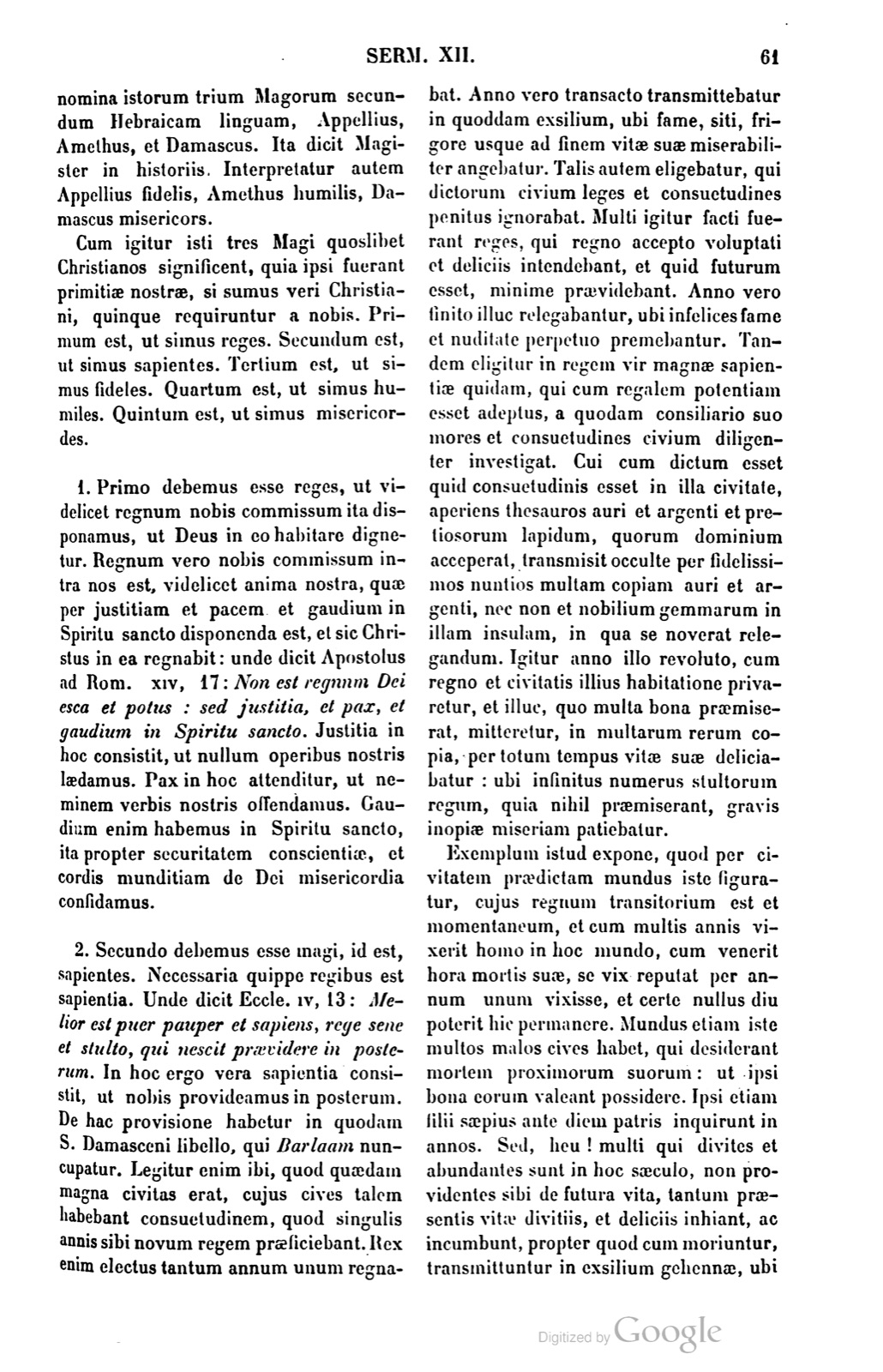
nomina istorum trium Magorum secundum Hebraicam linguam, Appellius, Amethus, et Damascus. Ita dicit Magister in historiis. Interpretatur autem Appellius fidelis, Amethus humilis, Damascus misericors.
Cum igitur isti tres Magi quoslibet Christianos significent, quia ipsi fuerant primitiae nostrae, si sumus veri Christiani, quinque requiruntur a nobis. Primum est, ut simus reges. Secundum est, ut simus sapientes. Tertium est, ut simus fideles. Quartum est, ut simus humiles. Quintum est, ut simus misericordes.
1. Primo debemus esse reges, ut videlicet regnum nobis commissum ita disponamus, ut Deus in eo habitare dignetur. Regnum vero nobis commissum intra nos est, videlicet anima nostra, quae per justitiam et pacem et gaudium in Spiritu sancto disponenda est, et sic Christus in ea regnabit: unde dicit Apostolus ad Rom. XIV, 17: Non est regnum Dei esca et potus: sed justitia, et pax, et gaudium in Spiritu sancto. Justitia in hoc consistit, ut nullum operibus nostris laedamus. Pax in hoc attenditur, ut neminem verbis nostris offendamus. Gaudium enim habemus in Spiritu sancto, ita propter securitatem conscientiae, et cordis munditiam de Dei misericordia confidamus.
2. Secundo debemus esse magi, id est, sapientes. Necessaria quippe regibus est sapientia. Unde dicit Eccle. IV, 13: Melior est puer pauper et sapiens, rege sene et stulto, qui nescit praevidere in posterum. In hoc ergo vera sapientia consistit, ut nobis provideamus in posterum. De hac provisione habetur in quodam S. Damasceni libello, qui Barlaam nuncupatur. Legitur enim ibi, quod quaedam magna civitas erat, cujus cives talem habebant consuetudinem, quod singulis annis sibi novum regem praeficiebant. Rex enim electus tantum annum unum regnabat. Anno vero transacto transmittebatur in quoddam exsilium, ubi fame, siti, frigore usque ad finem vitae suae miserabiliter angebatur. Talis autem eligebatur, qui dictorum civium leges et consuetudines penitus ignorabat. Multi igitur facti fuerant reges, qui regno accepto voluptati et deliciis intendebant, et quid futurum esset, minime praevidebant. Anno vero finito illuc relegabantur, ubi infelices fame et nuditate perpetuo premebantur. Tandem eligitur in regem vir magnae sapientiae quidam, qui cum regalem potentiam esset adeptus, a quodam consiliario suo mores et consuetudines civium diligenter investigat. Cui cum dictum esset quid consuetudinis esset in illa civitate, aperiens thesauros auri et argenti et pretiosorum lapidum, quorum dominium acceperat, transmisit occulte per fidelissimos nuntios multam copiam auri et argenti, nec non et nobilium gemmarum in illam insulam, in qua se noverat relegandum. Igitur anno illo revoluto, cum regno et civitatis illius habitatione privaretur, et illuc, quo multa bona praemiserat, mitteretur, in multarum rerum copia, per totum tempus vitae suae deliciabatur: ubi infinitus numerus stultorum regum, quia nihil praemiserant, gravis inopiae miseriam patiebatur.
Exemplum istud expone, quod per civitatem praedictam mundus iste figuratur, cujus regnum transitorium est et momentaneum, et cum multis annis vixerit homo in hoc mundo, cum venerit hora mortis suae, se vix reputat per annum unum vixisse, et certe nullus diu poterit hic permanere. Mundus etiam iste multos malos cives habet, qui desiderant mortem proximorum suorum: ut ipsi bona eorum valeant possidere. Ipsi etiam filii saepius ante diem patris inquirunt in annos. Sed, heu! multi qui divites et abundantes sunt in hoc saeculo, non providentes sibi de futura vita, tantum praesentis vitae divitiis, et deliciis inhiant, ac incumbunt, propter quod cum moriuntur, transmittuntur in exsilium gehennae, ubi mortis aeternae miseriam et inediam perpetuo patiuntur. Qui vero sapiens est, res suas per manus pauperum, ac religiosorum transmittit in caelum, thesaurizans thesauros suos, ubi neque aerugo, neque tinea demolitur, et ubi fures non effodiunt, nec furantur 1. Ad hoc igitur, ut nobis provideamus in posterum, necessarium est ut nomina trium Magorum moraliter repraesentemus in nobis.
the names of those three Magi according to the Hebrew language are Appellius, Amethus, and Damascus. Thus the Master says in the histories. Now Appellius is interpreted faithful, Amethus humble, Damascus merciful.
Therefore since these three Magi signify any Christians, because they had been our firstfruits, if we are true Christians, five things are required from us. The first is that we be kings. The second is that we be wise. The third is that we be faithful. The fourth is that we be humble. The fifth is that we be merciful.
1. First we ought to be kings, namely so that we may order the kingdom committed to us in such a way that God may deign to dwell in it. But the kingdom committed to us is within us, namely our soul, which must be ordered through justice and peace and joy in the Holy Spirit, and so Christ will reign in it; hence the Apostle says to the Romans XIV, 17: The kingdom of God is not food and drink, but justice and peace and joy in the Holy Spirit. Justice consists in this, that we injure no one by our works. Peace is attended to in this, that we offend no one by our words. For we have joy in the Holy Spirit, in such a way that because of security of conscience and cleanness of heart we trust in God's mercy.
2. Second, we ought to be magi, that is, wise. For wisdom is necessary to kings. Hence Ecclesiastes IV, 13 says: Better is a poor and wise child than an old and foolish king, who does not know how to foresee for the future. Therefore true wisdom consists in this, that we provide for ourselves for the future. Concerning this provision there is material in a certain little book of Saint Damascene, which is called Barlaam. For it is read there that there was a certain great city, whose citizens had such a custom that every year they set a new king over themselves. For the king chosen reigned only one year. But when the year had passed, he was sent into a certain exile, where he was miserably distressed by hunger, thirst, and cold until the end of his life. But such a man was chosen who was completely ignorant of the laws and customs of the aforesaid citizens. Therefore many had been made kings who, when they had received the kingdom, applied themselves to pleasure and delights and least of all foresaw what was going to happen. But when the year had ended, they were banished there where, unhappy, they were perpetually oppressed by hunger and nakedness. At last a certain man of great wisdom is chosen as king; when he had obtained royal power, he carefully investigated from a certain counselor of his the manners and customs of the citizens. When it had been told to him what the custom in that city was, opening the treasures of gold and silver and precious stones whose dominion he had received, he secretly sent through most faithful messengers a great abundance of gold and silver, and also of noble gems, into that island in which he knew he was to be banished. Therefore when that year had revolved, when he was deprived of the kingdom and the habitation of that city, and was sent there whither he had sent many goods ahead, he delighted in abundance of many things through the whole time of his life, where an infinite number of foolish kings, because they had sent nothing ahead, suffered the misery of grave want.
Explain that example thus: by the aforesaid city this world is figured, whose kingdom is transitory and momentary; and although a man has lived many years in this world, when the hour of his death comes, he scarcely considers himself to have lived for one year, and certainly no one will be able to remain here long. This world also has many evil citizens who desire the death of their neighbors, so that they themselves may be able to possess their goods. Even sons themselves rather often inquire into the years before the day of the father. But alas, many who are rich and abundant in this age, not providing for themselves concerning the future life, gape after and lean only upon the riches and delights of the present life; on account of this, when they die, they are sent into the exile of gehenna, where they perpetually suffer the misery and starvation of eternal death. But he who is wise sends his goods into heaven by the hands of the poor and of religious persons, storing up his treasures where neither rust nor moth destroys, and where thieves do not dig through nor steal 1. Therefore for this, that we may provide for ourselves in the future, it is necessary that we morally represent in ourselves the names of the three Magi.
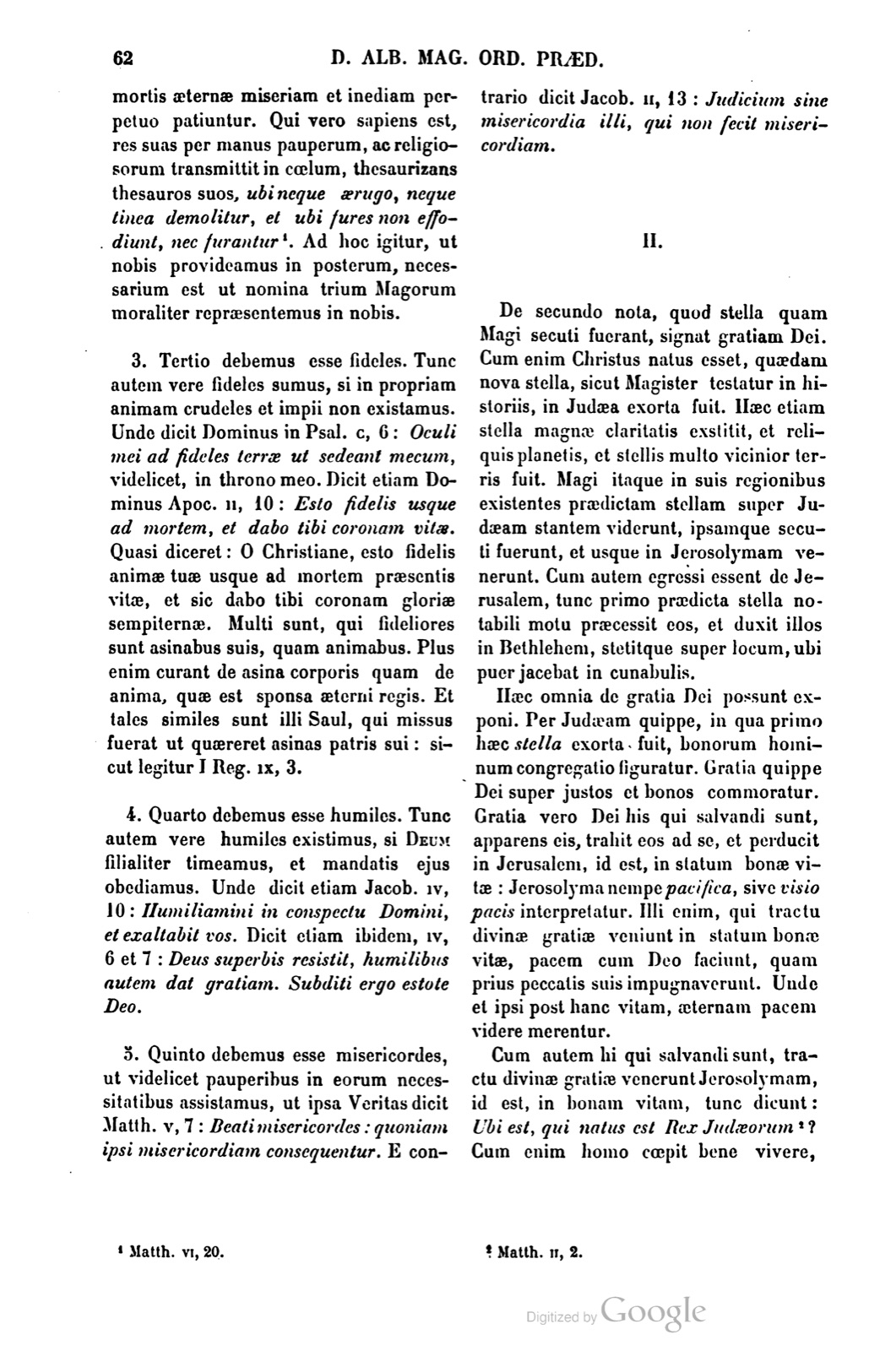
3. Tertio debemus esse fideles. Tunc autem vere fideles sumus, si in propriam animam crudeles et impii non existamus. Unde dicit Dominus in Psal. C, 6: Oculi mei ad fideles terrae ut sedeant mecum, videlicet, in throno meo. Dicit etiam Dominus Apoc. II, 10: Esto fidelis usque ad mortem, et dabo tibi coronam vitae. Quasi diceret: O Christiane, esto fidelis animae tuae usque ad mortem praesentis vitae, et sic dabo tibi coronam gloriae sempiternae. Multi sunt, qui fideliores sunt asinabus suis, quam animabus. Plus enim curant de asina corporis quam de anima, quae est sponsa aeterni regis. Et tales similes sunt illi Saul, qui missus fuerat ut quaereret asinas patris sui: sicut legitur I Reg. IX, 3.
4. Quarto debemus esse humiles. Tunc autem vere humiles existimus, si DEUM filialiter timeamus, et mandatis ejus obediamus. Unde dicit etiam Jacob. IV, 10: Humiliamini in conspectu Domini, et exaltabit vos. Dicit etiam ibidem, IV, 6 et 7: Deus superbis resistit, humilibus autem dat gratiam. Subditi ergo estote Deo.
5. Quinto debemus esse misericordes, ut videlicet pauperibus in eorum necessitatibus assistamus, ut ipsa Veritas dicit Matth. V, 7: Beati misericordes: quoniam ipsi misericordiam consequentur. E contrario dicit Jacob. II, 13: Judicium sine misericordia illi, qui non fecit misericordiam.
II.
De secundo nota, quod stella quam Magi secuti fuerant, signat gratiam Dei. Cum enim Christus natus esset, quaedam nova stella, sicut Magister testatur in historiis, in Judaea exorta fuit. Haec etiam stella magnae claritatis exstitit, et reliquis planetis, et stellis multo vicinior terris fuit. Magi itaque in suis regionibus existentes praedictam stellam super Judaeam stantem viderunt, ipsamque secuti fuerunt, et usque in Jerosolymam venerunt. Cum autem egressi essent de Jerusalem, tunc primo praedicta stella notabili motu praecessit eos, et duxit illos in Bethlehem, stetitque super locum, ubi puer jacebat in cunabulis.
Haec omnia de gratia Dei possunt exponi. Per Judaeam quippe, in qua primo haec stella exorta fuit, bonorum hominum congregatio figuratur. Gratia quippe Dei super justos et bonos commoratur. Gratia vero Dei his qui salvandi sunt, apparens eis, trahit eos ad se, et perducit in Jerusalem, id est, in statum bonae vitae: Jerosolyma nempe pacifica, sive visio pacis interpretatur. Illi enim, qui tractu divinae gratiae veniunt in statum bonae vitae, pacem cum Deo faciunt, quam prius peccatis suis impugnaverunt. Unde et ipsi post hanc vitam, aeternam pacem videre merentur.
Cum autem hi qui salvandi sunt, tractu divinae gratiae venerunt Jerosolymam, id est, in bonam vitam, tunc dicunt: Ubi est, qui natus est Rex Judaeorum 2? Cum enim homo coepit bene vivere, tunc primo sapit ei Deus, et tunc ex magno desiderio quaerit de ipso, ut ipsum plenius possit habere. Nondum tamen videt eum facie ad faciem. Verum cum ex Jerosolyma, id est, ex conversatione bonae vitae egressus fuerit in morte, tunc iterum stella gratiae apparet ei: ut sicut primo traxit hominem ad notitiam Dei, et ad consortium bonorum hominum Deo famulantium: ita tunc ducat eum ante venustam faciem Dei, et ad societatem Angelorum coram Deo laetantium.
3. Third, we ought to be faithful. But then we are truly faithful if we are not cruel and impious toward our own soul. Hence the Lord says in Psalm C, 6: My eyes are upon the faithful of the earth, that they may sit with me, namely on my throne. The Lord also says in Apocalypse II, 10: Be faithful until death, and I will give you the crown of life. As though he said: O Christian, be faithful to your soul until the death of the present life, and so I shall give you the crown of everlasting glory. There are many who are more faithful to their she-asses than to their souls. For they care more about the she-ass of the body than about the soul, which is the bride of the eternal king. And such persons are like that Saul who had been sent to seek his father's she-asses, as is read in I Kings IX, 3.
4. Fourth, we ought to be humble. But then we truly exist as humble, if we fear God filially and obey his commandments. Hence James IV, 10 also says: Be humbled in the sight of the Lord, and he will exalt you. He also says in the same place, IV, 6 and 7: God resists the proud, but gives grace to the humble. Therefore be subject to God.
5. Fifth, we ought to be merciful, namely so that we may assist the poor in their necessities, as Truth itself says in Matthew V, 7: Blessed are the merciful, for they will obtain mercy. On the contrary James II, 13 says: Judgment without mercy to him who has not done mercy.
II.
Concerning the second, note that the star which the Magi had followed marks the grace of God. For when Christ had been born, a certain new star, as the Master testifies in the histories, arose in Judea. This star also was of great brightness and was much nearer the earth than the other planets and stars. Therefore the Magi, existing in their own regions, saw the aforesaid star standing over Judea, and they followed it and came all the way to Jerusalem. But when they had gone out from Jerusalem, then for the first time the aforesaid star with notable motion went before them and led them into Bethlehem, and it stood over the place where the child was lying in swaddling bands.
All these things can be expounded concerning the grace of God. For by Judea, in which this star first arose, the congregation of good men is figured. For the grace of God dwells over the just and good. But the grace of God, appearing to those who are to be saved, draws them to itself and leads them into Jerusalem, that is, into the state of a good life; for Jerusalem is interpreted peaceful or vision of peace. For those who by the drawing of divine grace come into the state of a good life make peace with God, whom previously they attacked by their sins. Hence they themselves after this life deserve to see eternal peace.
But when those who are to be saved by the drawing of divine grace have come to Jerusalem, that is, into the good life, then they say: Where is he who has been born King of the Jews 2? For when a man has begun to live well, then God first tastes sweet to him, and then from great desire he inquires concerning him, so that he may be able to have him more fully. Nevertheless he does not yet see him face to face. But truly when he has gone out from Jerusalem, that is, from the conversation of a good life, in death, then again the star of grace appears to him; so that just as first it drew man to the knowledge of God and to the company of good men serving God, so then it may lead him before the beautiful face of God and to the society of Angels rejoicing before God.
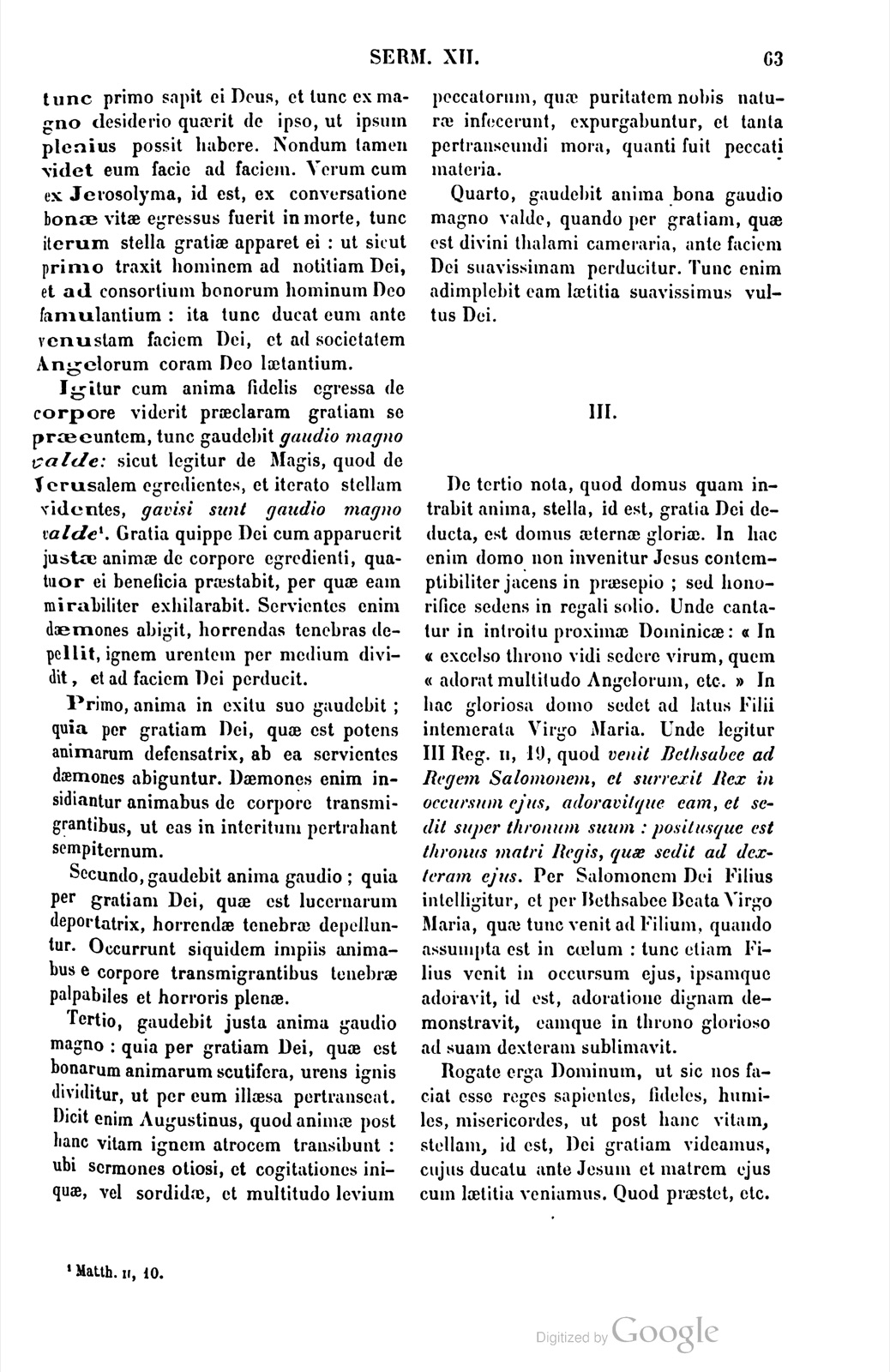
Igitur cum anima fidelis egressa de corpore viderit praeclaram gratiam se praeeuntem, tunc gaudebit gaudio magno valde: sicut legitur de Magis, quod de Jerusalem egredientes, et iterato stellam videntes, gavisi sunt gaudio magno valde 3. Gratia quippe Dei cum apparuerit justae animae de corpore egredienti, quatuor ei beneficia praestabit, per quae eam mirabiliter exhilarabit. Servientes enim daemones abigit, horrendas tenebras depellit, ignem urentem per medium dividit, et ad faciem Dei perducit.
Primo, anima in exitu suo gaudebit; quia per gratiam Dei, quae est potens animarum defensatrix, ab ea servientes daemones abiguntur. Daemones enim insidiantur animabus de corpore transmigrantibus, ut eas in interitum pertrahant sempiternum.
Secundo, gaudebit anima gaudio; quia per gratiam Dei, quae est lucernarum deportatrix, horrendae tenebrae depelluntur. Occurrunt siquidem impiis animabus e corpore transmigrantibus tenebrae palpabiles et horroris plenae.
Tertio, gaudebit justa anima gaudio magno: quia per gratiam Dei, quae est bonarum animarum scutifera, urens ignis dividitur, ut per eum illaesa pertranseat. Dicit enim Augustinus, quod animae post hanc vitam ignem atrocem transibunt: ubi sermones otiosi, et cogitationes iniquae, vel sordidae, et multitudo levium peccatorum, quae puritatem nobis naturae infecerunt, expurgabuntur, et tanta pertranseundi mora, quanti fuit peccati materia.
Quarto, gaudebit anima bona gaudio magno valde, quando per gratiam, quae est divini thalami cameraria, ante faciem Dei suavissimam perducitur. Tunc enim adimplebit eam laetitia suavissimus vultus Dei.
III.
De tertio nota, quod domus quam intrabit anima, stella, id est, gratia Dei deducta, est domus aeternae gloriae. In hac enim domo non invenitur Jesus contemptibiliter jacens in praesepio; sed honorifice sedens in regali solio. Unde cantatur in introitu proximae Dominicae: «In excelso throno vidi sedere virum, quem adorat multitudo Angelorum, etc.» In hac gloriosa domo sedet ad latus Filii intemerata Virgo Maria. Unde legitur III Reg. I, 19, quod venit Bethsabee ad Regem Salomonem, et surrexit Rex in occursum ejus, adoravitque eam, et sedit super thronum suum: positusque est thronus matri Regis, quae sedit ad dexteram ejus. Per Salomonem Dei Filius intelligitur, et per Bethsabee Beata Virgo Maria, quae tunc venit ad Filium, quando assumpta est in caelum: tunc etiam Filius venit in occursum ejus, ipsamque adoravit, id est, adoratione dignam demonstravit, eamque in throno glorioso ad suam dexteram sublimavit.
Rogate ergo Dominum, ut sic nos faciat esse reges sapientes, fideles, humiles, misericordes, ut post hanc vitam, stellam, id est, Dei gratiam videamus, cujus ducatu ante Jesum et matrem ejus cum laetitia veniamus. Quod praestet, etc.
Therefore when the faithful soul, having gone out from the body, has seen bright grace going before it, then it will rejoice with very great joy, as it is read concerning the Magi that, going out from Jerusalem and seeing the star again, they rejoiced with very great joy 3. For when the grace of God has appeared to the just soul departing from the body, it will furnish to it four benefits, by which it will wonderfully gladden it. For it drives away serving demons, dispels horrible darknesses, divides the burning fire through the middle, and leads it to the face of God.
First, the soul will rejoice at its departure, because through the grace of God, which is the powerful defender of souls, serving demons are driven away from it. For demons lie in wait for souls passing from the body, in order to drag them into everlasting destruction.
Second, the soul will rejoice with joy because through the grace of God, which is the bearer of lamps, horrible darknesses are dispelled. For palpable darknesses full of horror meet impious souls passing from the body.
Third, the just soul will rejoice with great joy because through the grace of God, which is the shield-bearer of good souls, the burning fire is divided, so that it may pass through it unharmed. For Augustine says that souls after this life will pass through a harsh fire, where idle words, and wicked or filthy thoughts, and the multitude of light sins which have infected for us the purity of nature, will be purged, and the delay of passing through will be as great as was the matter of sin.
Fourth, the good soul will rejoice with very great joy when through grace, which is the chamberlain of the divine bridal chamber, it is led before the most sweet face of God. For then the most sweet countenance of God will fill it with gladness.
III.
Concerning the third, note that the house which the soul will enter, led by the star, that is, the grace of God, is the house of eternal glory. For in this house Jesus is not found lying contemptibly in a manger, but sitting honorably on a royal throne. Hence it is sung in the introit of the next Sunday: "On a high throne I saw a man sitting, whom the multitude of Angels adores, etc." In this glorious house the spotless Virgin Mary sits at the side of the Son. Hence it is read in III Kings I, 19, that Bathsheba came to King Solomon, and the King rose to meet her, and adored her, and sat upon his throne; and a throne was placed for the mother of the King, who sat at his right hand. By Solomon the Son of God is understood, and by Bathsheba the Blessed Virgin Mary, who then came to the Son when she was assumed into heaven; then also the Son came to meet her and adored her, that is, showed her worthy of adoration, and exalted her on a glorious throne at his right hand.
Therefore pray to the Lord that he may make us thus to be wise kings, faithful, humble, merciful, so that after this life we may see the star, that is, the grace of God, by whose guidance we may come with gladness before Jesus and his mother. May he grant this, etc.
If a page does not appear, its photograph has not been uploaded yet.