Works › Sermons for the Seasons of the Year
Volume 13 · p. 49
Sermon IX conclusion
suavitate intrinsecus a Domino reficiuntur.
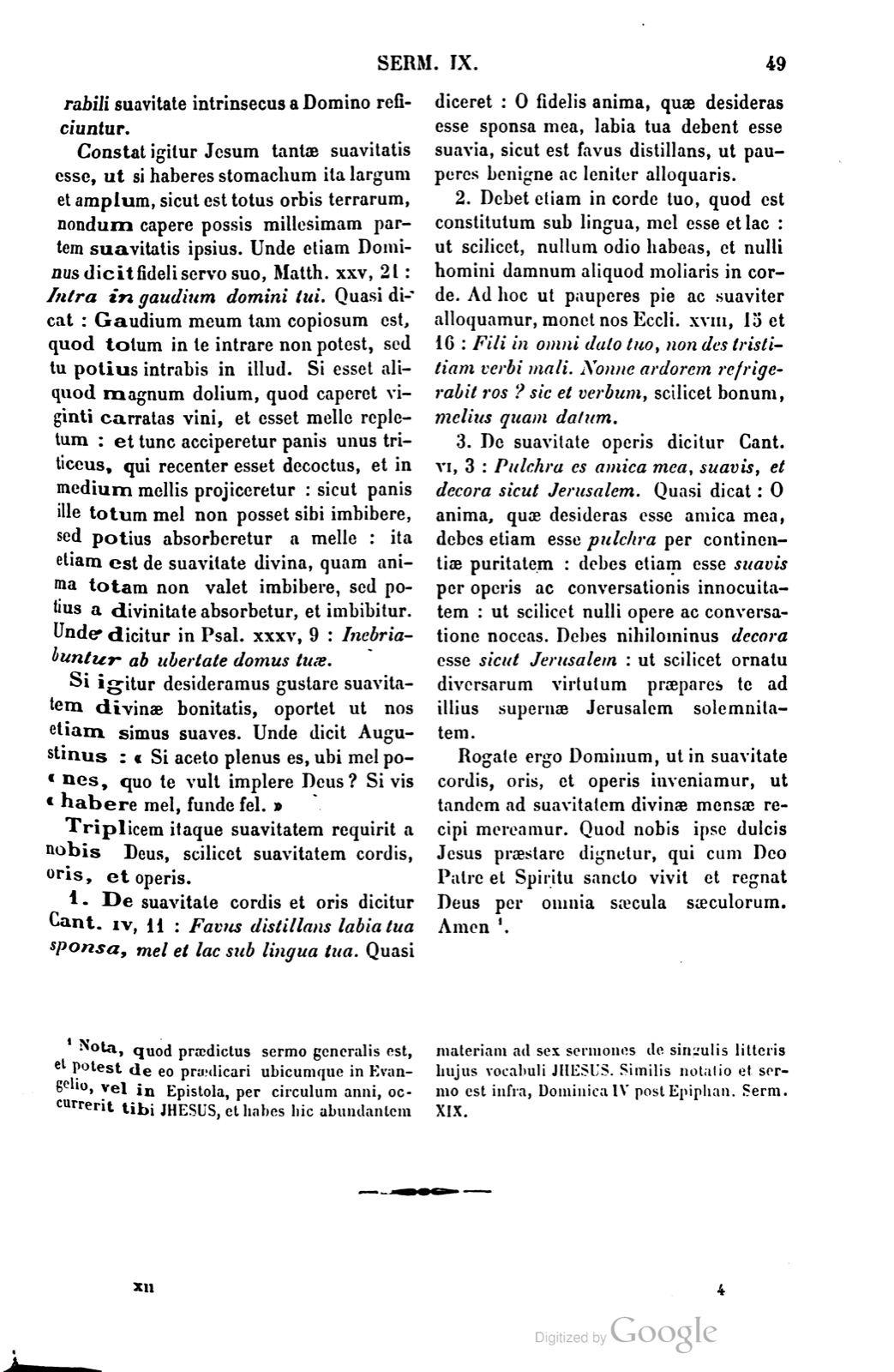
Constat igitur Jesum tantae suavitatis esse, ut si haberes stomachum ita largum et amplum, sicut est totus orbis terrarum, nondum capere possis millesimam partem suavitatis ipsius. Unde etiam Dominus dicit fideli servo suo, Matth. xxv, 21: Intra in gaudium domini tui. Quasi dicat: Gaudium meum tam copiosum est, quod totum in te intrare non potest, sed tu potius intrabis in illud. Si esset aliquod magnum dolium, quod caperet viginti carratas vini, et esset melle repletum: et tunc acciperetur panis unus triticeus, qui recenter esset decoctus, et in medium mellis projiceretur: sicut panis ille totum mel non posset sibi imbibere, sed potius absorberetur a melle: ita etiam est de suavitate divina, quam anima totam non valet imbibere, sed potius a divinitate absorbetur, et imbibitur. Unde dicitur in Psal. xxxv, 9: Inebriabuntur ab ubertate domus tuae.
Si igitur desideramus gustare suavitatem divinae bonitatis, oportet ut nos etiam simus suaves. Unde dicit Augustinus: "Si aceto plenus es, ubi mel pones, quo te vult implere Deus? Si vis habere mel, funde fel."
Triplicem itaque suavitatem requirit a nobis Deus, scilicet suavitatem cordis, oris, et operis. 1. De suavitate cordis et oris dicitur Cant. iv, 11: Favus distillans labia tua sponsa, mel et lac sub lingua tua. Quasi diceret: O fidelis anima, quae desideras esse sponsa mea, labia tua debent esse suavia, sicut est favus distillans, ut pauperes benigne ac leniter alloquaris. 2. Debet etiam in corde tuo, quod est constitutum sub lingua, mel esse et lac: ut scilicet, nullum odio habeas, et nulli homini damnum aliquod moliaris in corde. Ad hoc ut pauperes pie ac suaviter alloquamur, monet nos Eccli. xviii, 15 et 16: Fili in omni dato tuo, non des tristitiam verbi mali. Nonne ardorem refrigerabit ros? sic et verbum, scilicet bonum, melius quam datum. 3. De suavitate operis dicitur Cant. vi, 3: Pulchra es amica mea, suavis, et decora sicut Jerusalem. Quasi dicat: O anima, quae desideras esse amica mea, debes etiam esse pulchra per continentiae puritatem: debes etiam esse suavis per operis ac conversationis innocuitatem: ut scilicet nulli opere ac conversatione noceas. Debes nihilominus decora esse sicut Jerusalem: ut scilicet ornatu diversarum virtutum prepares te ad illius supernae Jerusalem solemnitatem.
Rogate ergo Dominum, ut in suavitate cordis, oris, et operis inveniamur, ut tandem ad suavitatem divinae mensae recipi mereamur. Quod nobis ipse dulcis Jesus praestare dignetur, qui cum Deo Patre et Spiritu sancto vivit et regnat Deus per omnia saecula saeculorum. Amen 1.
sweetness they are refreshed inwardly by the Lord.
Therefore it is certain that Jesus is of such sweetness that if you had a stomach as broad and ample as the whole circle of the earth, you still could not contain the thousandth part of his sweetness. Hence also the Lord says to his faithful servant, Matthew 25:21: Enter into the joy of your lord. As if he were saying: My joy is so abundant that it cannot wholly enter into you, but rather you will enter into it. If there were some great vat that held twenty cartloads of wine and were filled with honey, and then one wheaten loaf that had recently been baked were taken and thrown into the midst of the honey, just as that bread could not drink into itself all the honey, but rather would be absorbed by the honey, so also it is with divine sweetness, which the soul cannot wholly drink in, but rather is absorbed and drunk in by divinity. Hence it is said in Psalm 35:9: They will be made drunk from the abundance of your house.
Therefore if we desire to taste the sweetness of divine goodness, we also must be sweet. Hence Augustine says: "If you are full of vinegar, where will you put the honey with which God wishes to fill you? If you wish to have honey, pour out the gall."
Therefore God requires from us a threefold sweetness, namely sweetness of heart, mouth, and work. 1. Concerning sweetness of heart and mouth it is said in Song of Songs 4:11: Your lips, bride, are a dripping honeycomb; honey and milk are under your tongue. As if he were saying: O faithful soul, who desires to be my bride, your lips ought to be sweet, as a dripping honeycomb is, so that you may address the poor kindly and gently. 2. There ought also to be in your heart, which is placed under the tongue, honey and milk, namely so that you hate no one and devise no harm against any human being in your heart. Ecclesiasticus 18:15 and 16 admonishes us to this, that we should speak to the poor piously and sweetly: Son, in every gift of yours, do not give the sadness of an evil word. Will not dew cool heat? so also a word, namely a good one, is better than a gift. 3. Concerning sweetness of work it is said in Song of Songs 6:3: You are beautiful, my friend, sweet and lovely as Jerusalem. As if he were saying: O soul, who desires to be my friend, you ought also to be beautiful through purity of continence; you ought also to be sweet through harmlessness of work and conduct, namely so that you harm no one by work and conduct. You ought no less to be lovely as Jerusalem, namely so that by the adornment of diverse virtues you prepare yourself for the solemnity of that heavenly Jerusalem.
Therefore pray to the Lord that we may be found in sweetness of heart, mouth, and work, so that at last we may merit to be received to the sweetness of the divine table. May sweet Jesus himself deign to grant this to us, who with God the Father and the Holy Spirit lives and reigns as God through all ages of ages. Amen 1.
Notes
- Note that the aforesaid sermon is general, and one can preach from it wherever in the Gospel or in the Epistle, through the cycle of the year, JHESUS occurs to you; and here you have abundant matter for six sermons concerning the individual letters of this word JHESUS. A similar notation and sermon is below, on the Fourth Sunday after Epiphany, Sermon XIX. (Nota, quod praedictus sermo generalis est, et potest de eo praedicari ubicumque in Evangelio, vel in Epistola, per circulum anni, occurrerit tibi JHESUS, et habes hic abundantem materiam ad sex sermones de singulis litteris hujus vocabuli JHESUS. Similis notatio et sermo est infra, Dominica IV post Epiphan. Serm. XIX.) ↩
If a page does not appear, its photograph has not been uploaded yet.