Works › Sermons for the Seasons of the Year
Volume 13 · pp. 29–34
Sermon VI. On the Nativity of Christ
A marker with ≈ is an approximate page boundary, placed by measure of the text; the page photographs remain the authority. In the paired views, clicking a page marker brings that page into view.
Sermo VI.
De Nativitate Christi.
Verbum caro factum est, etc. Joan. i, 14.
Tria sunt hic principaliter notanda:
I. Quid per hoc, Verbum caro factum est, intelligatur? II. Quare hoc Verbum caro factum est, asseritur? III. Qualiter, et per quid hoc Verbum in nobis habitare dicatur?
I.
De primo nota, quod per Verbum Dei Filius intelligitur. Ipse enim dicitur Verbum quasi verum bonum: hoc autem est verum bonum, quod commendari potest a tribus, scilicet, ab omnis amaritudinis absentia, et ab omnimoda sufficientia, et ab aeterna indesinentia. Et certe ab his tribus commendabilis est Dei Filius, qui propter nos est ex Virgine natus. Ab ipso quippe omnis amaritudo est remotissima, ab ipso etiam emanat beatitudo sufficientissima, in ipso quoque est aeternitas indeficientissima.
1. De primo, scilicet, quod ab ipso sit omnis amaritudo remotissima, dicitur in libro Sap. viii, 9 et 16: Proposui sapientiam, id est, Dei Filium, adducere mihi ad convivendum: sciens quoniam mecum communicabit de bonis, intrans in domum meam, conquiescam cum illa... Non enim habet amaritudinem conversatio illius, nec taedium convictus illius, sed laetitiam et gaudium. Ipse etiam Dei Filius dicit Isa. xxvii, 4: Indignatio non est mihi. Beatus igitur, qui meruit habitare cum isto vero bono.
2. Item, quod ab ipso emanat beatitudo sufficientissima, testatur Eccli. xxiv, 34 et 36: Posuit, subaudi, Deus Pater, David puero suo excitare regem ex ipso fortissimum, in throno honoris sedentem in sempiternum... Qui adimplet quasi Euphrates sensum. Dicit itaque Ecclesiasticus quod Deus Pater posuit, id est, promisit David puero suo, id est, David servo suo, quod videlicet ex ipso, id est, de semine suo excitaret, id est, nasci faceret regem fortissimum, scilicet, Jesum Christum in throno honoris cum Patre sedentem, qui scilicet Dei Filius adimplebit quasi Euphrates, id est, quasi quidam magnus beatitudinis fluvius omnes sensus nostros. Nihil enim in nobis vacuum remanebit, quin per hoc verum bonum suavissima beatitudine repicatur. Unde etiam Psalmista dicit: Adimplebis me laetitia cum vultu tuo 1. Hic est ille verus Eliseus, qui plus habet olei beatitudinis, quam nos vasa offerre possimus. Legitur enim III Regum, 3 et seq., quod cum quaedam mulier inopiam suam conquestata esset Eliseo, dixit ei Eliseus, ut iret et acciperet mutuo vasa non pauca, et infunderet in illa vasa de oleo illo modico, quod se profitebatur habere. Quod etiam mulier fecit, et interim exivit oleum, ut prius vasa, quam oleum deficerent. Sic etiam est de Christo, qui tam sufficiens est et abundans, ut omnia vasa desideriorum nostrorum oleo beatitudinis repleat, et adhuc supererit oleum. De sufficientia etiam hujus veri boni dicitur in Psal. cxliv, 16: Aperis tu manum tuam: et imples omne animal benedictione. O quam felices sunt illi, qui introduci meruerunt in cellarium veri boni, ut ibi inebrientur ab ubertate domus Dei!
Sermon VI.
On the Nativity of Christ.
The Word was made flesh, etc. John 1:14.
Three things are principally to be noted here:
I. What is understood by this, The Word was made flesh? II. Why this Word is asserted to have been made flesh? III. In what way and through what this Word is said to dwell in us?
I.
Concerning the first, note that by the Word the Son of God is understood. For he is called Word as true good; but this is the true good, which can be commended from three things, namely from the absence of every bitterness, and from complete sufficiency, and from eternal unceasingness. And certainly from these three the Son of God, who for our sake was born of the Virgin, is commendable. For every bitterness is most remote from him; from him also most sufficient blessedness flows; in him also is most unfailing eternity.
1. Concerning the first, namely that every bitterness is most remote from him, it is said in the book of Wisdom 8:9 and 16: I proposed to bring wisdom, that is, the Son of God, to live with me, knowing that she will share good things with me; entering into my house, I will rest with her... For her conversation has no bitterness, nor her companionship any weariness, but gladness and joy. The Son of God himself also says in Isaiah 27:4: Indignation is not mine. Blessed, therefore, is the one who has merited to dwell with that true good.
2. Likewise, that most sufficient blessedness flows from him Ecclesiasticus 24:34 and 36 testifies: He placed, supply God the Father, for David his boy, to raise up from him a most strong king sitting on the throne of honor forever... Who fills the sense as the Euphrates. Therefore Ecclesiasticus says that God the Father placed, that is, promised, to David his boy, that is, to David his servant, that from him, that is, from his seed, he would raise up, that is, cause to be born, a most strong king, namely Jesus Christ sitting with the Father on the throne of honor, who, namely the Son of God, will fill as the Euphrates, that is, like a certain great river of blessedness, all our senses. For nothing in us will remain empty without being refreshed through this true good with most sweet blessedness. Hence also the Psalmist says: You will fill me with joy with your face 1. This is that true Elisha who has more oil of blessedness than we can offer vessels. For it is read in 3 Kings, 3 and following, that when a certain woman had complained to Elisha about her want, Elisha told her to go and borrow not a few vessels, and to pour into those vessels from that little oil that she professed she had. The woman also did this, and meanwhile the oil came forth, so that the vessels failed before the oil. So also it is with Christ, who is so sufficient and abundant that he fills all the vessels of our desires with the oil of blessedness, and oil will still remain. Concerning the sufficiency also of this true good it is said in Psalm 144:16: You open your hand and fill every animal with blessing. O how happy are those who have merited to be introduced into the cellar of the true good, so that there they may be made drunk from the abundance of the house of God!
3. Tertium, videlicet quod in Christo, qui est verum bonum, sit aeternitas indeficientissima, testatur Psalm. ci, 12 et 13, ita dicens: Dies mei sicut umbra declinaverunt, et ego sicut faenum arui. Tu autem Domine in aeternum permanes: et memoriale tuum in generationem et generationem. Item dicit in eodem Psal.: Opera manuum tuarum sunt caeli. Ipsi peribunt, tu autem permanes: et omnes sicut vestimentum veterascent. Et sicut opertorium mutabis eos, et mutabuntur: tu autem idem ipse es, et anni tui non deficient 2. Dicit etiam in alio Psalmo: A saeculo usque in saeculum tu es Deus 3. Ipse etiam Dominus de permanentia suae aeternitatis dicit in Malach. iii, 6: Ego Dominus, et non mutor. Bonum est igitur, charissimi, ut applicemus nos ad istud verum bonum, quod semper permanet: ne cadamus in interitum sempiternum. Unde dicit Psalm. lxxii, 28: Mihi adhaerere Deo bonum est, ponere in Domino Deo spem meam.
Nota, e contrario, quod bona hujus mundi non sunt vera, propter tria. Sunt enim multis amaritudinibus infusa et permixta. Sunt etiam vacua, et nequaquam replentia. Sunt etiam instabilia, et nullatenus permanentia. Haec tria testatur Ecclesiastes, ita loquens: Ego Ecclesiastes fui rex in Jerusalem.... Edificavi mihi domos, et plantavi vineas, feci hortos, et pomaria, et consevi ea cuncti generis arboribus: et exstruxi mihi piscinas aquarum, ut irrigarem silvam lignorum germinantium. Possedi servos et ancillas, multamque familiam habui: armenta quoque, et multos ovium greges ultra omnes qui fuerunt ante me in Jerusalem: coacervavi mihi argentum, et aurum, et substantias regum, ac provinciarum: feci mihi cantores, et cantatrices, et delicias filiorum hominum, scyphos, et urceos in ministerio ad vina fundenda: Et supergressus sum opibus omnes, qui ante me fuerunt in Jerusalem: sapientia perseveravit mecum. Et omnia, quae desideraverunt oculi mei, non negavi eis: nec prohibui cor meum quin omni voluntate frueretur, et oblectaret se in his, quae praeparaveram: et hanc ratus sum partem meam, si uterer labore meo. Cumque me convertissem ad omnia opera, quae fecerant manus meae, et ad labores, in quibus frustra sudaveram, vidi in omnibus vanitatem et afflictionem animi, et nihil permanere sub sole 4. Ecce quanta enumerat, quae bona esse reputantur, ac etiam multum in hoc saeculo desiderantur, quae omnia sic concludit, quod asserit se vera conversione rationis in omnibus praefatis reperisse vanitatem et afflictionem animi, et nihil permanere sub sole. Probat igitur, quod bona praesentis saeculi vana sunt, et nullatenus replentia, per hoc quod dicit: Reperi in omnibus vanitatem. Probat etiam, quod multis angustiis et sollicitudinibus sunt perfusa, per hoc quod subdit: Et afflictionem animi. Probat nihilominus, quod instabilia sunt, per hoc quod addit: Et nihil permanere sub sole.
3. The third, namely that in Christ, who is the true good, there is most unfailing eternity, Psalm 101:12 and 13 testifies, saying thus: My days have declined like a shadow, and I have withered like hay. But you, Lord, remain forever, and your memorial from generation to generation. Likewise it says in the same Psalm: The heavens are the works of your hands. They will perish, but you remain; and all will grow old like a garment. And like a covering you will change them, and they will be changed; but you yourself are the same, and your years will not fail 2. He also says in another Psalm: From age to age you are God 3. The Lord himself also says concerning the permanence of his eternity in Malachi 3:6: I am the Lord and I do not change. Therefore, dearly beloved, it is good that we attach ourselves to that true good, which always remains, lest we fall into everlasting destruction. Hence Psalm 72:28 says: It is good for me to cling to God, to place my hope in the Lord God.
Note, on the contrary, that the goods of this world are not true, for three reasons. For they are infused and mixed with many bitternesses. They are also empty and by no means filling. They are also unstable and in no way remaining. Ecclesiastes testifies these three things, speaking thus: I, Ecclesiastes, was king in Jerusalem.... I built houses for myself and planted vineyards; I made gardens and orchards and planted them with trees of every kind; and I built pools of water for myself, to water the forest of sprouting trees. I possessed male and female servants and had a large household; also herds and many flocks of sheep beyond all who were before me in Jerusalem. I heaped up for myself silver and gold and the substances of kings and provinces. I made for myself male singers and female singers and the delights of the sons of men, cups and pitchers for the service of pouring wines. And I surpassed in riches all who were before me in Jerusalem; wisdom remained with me. And all things that my eyes desired I did not deny them, nor did I forbid my heart from enjoying every will and delighting itself in these things that I had prepared; and I thought this my portion, if I used my labor. And when I turned myself to all the works that my hands had made and to the labors in which I had sweated in vain, I saw in all things vanity and affliction of spirit and nothing remaining under the sun 4. Behold how many things he enumerates that are reputed to be goods and are also greatly desired in this age; he concludes all these in such a way that he asserts that by a true turning of reason he found in all the aforesaid things vanity and affliction of spirit and nothing remaining under the sun. Therefore he proves that the goods of the present age are vain and in no way filling by this, that he says: I found vanity in all things. He also proves that they are drenched with many anxieties and cares by this, that he adds: And affliction of spirit. He proves no less that they are unstable by this, that he adds: And nothing remaining under the sun.
Haec etiam ostenduntur in Isa. xxxvi, 6, ubi dicitur, quod Aegyptus est baculus arundineus confractus, cui si innixus fuerit homo, intrabit manum ejus, et perforabit eam. Aegyptus interpretatur maeror, vel tenebrae; et significat mundum istum, in quo boni et justi pro peccatis moerent, et testantur. Mali vero per carnis et oculorum concupiscentias obtenebrantur. Mundus autem iste est quasi baculus arundineus confractus, qui perforat manum innitentis. Per hoc quod dicitur, quod est arundineus, notatur quod bona hujus mundi vana sunt, et non replent cor hominis; sed sunt ad similitudinem arundinis, quae intus est vacua. Unde dicitur Eccli. xiv, 9: Insatiabilis oculus cupidi. Dicit etiam Eccle. v, 9: Avarus non implebitur pecunia. Similiter et Hieronymus ait: "Avaro tam deest quod habet, quam quod non habet." Per hoc etiam quod dicitur, quod est baculus confractus, innuitur quod bona hujus mundi instabilia sunt, et stare non possunt, ut confractum crus stare non potest. Unde et I Joan. ii, 17, dicit quod mundus transit, et concupiscentia ejus. Praeterea per hoc quod additur, cui si innixus fuerit homo, intrabit manum ejus, et perforabit eam, innuitur quod bona hujus saeculi aculeata sunt, et hominem per multas sollicitudines lacerantia. Propter quod et ipsa Veritas comparat in Evangelio bona praesentis saeculi spinis, quae suffocant in homine semen gratiae Dei.
II.
De secundo nota, quod propter quinque causas Verbum caro factum est. 1. Prima est, ut per eum in viam justitiae revocemur. Adam quippe sicut ovis erraverat, ac perierat: propter quod omnem posteritatem post se ad devium inferni sive limbi deduxerat: quia sicut oves positi fuerunt in inferno 5. Sed agnus Dei, ad Patriarcharum et Prophetarum preces, a regalibus sedibus veniens 6, ovem centesimam, scilicet humanum genus quaesivit, inventamque quasi prudens ductor in viam justitiae, ac ad Angelorum societatem revocavit ac reduxit. De hac revocatione legitur in II Reg. xiv, 21 et 23, quod David mediante muliere Thecuite praecepit Joab, ut revocaret Absalom, qui propter fratricidium recesserat Gessur in exsilium. Ait enim David ad Joab: Vade, et revoca puerum Absalom... Surrexit ergo Joab et abiit in Gessur, et adduxit Absalom in Jerusalem. Absalom interpretatur patris amaricatio, et significat Adam, et quemlibet peccatorem. Adam enim et Eva uxor ejus per peccata sua amaricaverunt dulcem Creatorem suum. Quilibet etiam peccator Deum amaricat per peccatum suum. Adam etiam et uxor ejus Eva spirituale fratricidium commiserant: quia gladio inobedientiae spiritum suum occiderant, qui quasi frater est carnis, quivis etiam peccator per malitiam suam occidit animam, sicut dicitur Sap. xvi, 14. Igitur iste Absalom, id est, Adam cum omni posteritate sua expulsus fuit a facie Dei patris in Gessur, quod interpretatur dolor. In doloribus enim et aerumnis infernalibus limbi fuerunt usque ad adventum Filii Dei: quod sciens mulier Thecuites, quae interpretatur buccina eorum, et significat divinam misericordiam, quae semper personat pro miseris peccatoribus, accessit ad David, id est, ad Deum Patrem, et intercessit pro Absalom, id est, pro universo humano genere, postulans eum ab exsilii doloribus revocari. Propterea Deus Pater placatus ad petitionem misericordiae injunxit Joab, qui interpretatur inimicus inimicitiae, et significat Filium Dei, qui inimicitiae, id est, peccatis inimicatur, et amicitiae, id est, virtutibus amicatur. Ipse enim est iniquitatum inimicus, et virtutum amicus. Injunxit, inquam, Deus Pater Filio suo unigenito, ut revocaret per sanguinem suum genus humanum. Quod et factum est. Abiit namque Dei Filius, et induit carnem humanam, in qua multos dolores pertulit, et postremo mortem amarissimam sustinuit, et sic per dolores suos et cruciatus humanum genus ab inferni doloribus eripuit, et in Jerusalem, hoc est, in Dei patris gratiam revocavit.
These things are also shown in Isaiah 36:6, where it is said that Egypt is a broken reed staff; if a man leans upon it, it will enter his hand and pierce it. Egypt is interpreted as sorrow or darkness; and it signifies this world, in which the good and just mourn and testify for sins. But the evil are darkened by the concupiscences of the flesh and of the eyes. This world, then, is like a broken reed staff that pierces the hand of the one leaning upon it. By this, that it is said to be reed-like, it is marked that the goods of this world are vain and do not fill the human heart, but are in the likeness of a reed, which is empty within. Hence Ecclesiasticus 14:9 says: The eye of the covetous man is insatiable. Ecclesiastes 5:9 also says: The avaricious man will not be filled with money. Similarly Jerome too says: "The avaricious man lacks what he has as much as what he does not have." By this also, that it is called a broken staff, it is suggested that the goods of this world are unstable and cannot stand, as a broken leg cannot stand. Hence also 1 John 2:17 says that the world passes away, and its concupiscence. Moreover, by this that it is added, if a man leans upon it, it will enter his hand and pierce it, it is suggested that the goods of this age are sharp-pointed and tear the human being through many cares. On account of this Truth itself in the Gospel compares the goods of the present age to thorns, which choke in a human being the seed of the grace of God.
II.
Concerning the second, note that for five causes the Word was made flesh. 1. The first is that through him we might be called back into the way of justice. For Adam had wandered and perished like a sheep; because of this he had led after himself all his posterity to the byway of hell or limbo, because they were placed in hell like sheep 5. But the Lamb of God, coming from the royal seats 6 at the prayers of the Patriarchs and Prophets, sought the hundredth sheep, namely the human race, and when he had found it, as a prudent leader he called and led it back into the way of justice and to the society of Angels. Concerning this recall it is read in 2 Kings 14:21 and 23, that David, through the mediation of the Tekoite woman, commanded Joab to recall Absalom, who because of fratricide had withdrawn into exile in Geshur. For David said to Joab: Go and recall the boy Absalom... Therefore Joab arose and went to Geshur and brought Absalom into Jerusalem. Absalom is interpreted as the embittering of the father and signifies Adam and any sinner. For Adam and Eve his wife through their sins embittered their sweet Creator. Any sinner also embitters God through his sin. Adam also and Eve his wife had committed spiritual fratricide, because by the sword of disobedience they had killed their spirit, which is as it were the brother of the flesh; any sinner also through his malice kills the soul, as is said in Wisdom 16:14. Therefore that Absalom, that is, Adam with all his posterity, was expelled from the face of God the Father into Geshur, which is interpreted as pain. For they were in the pains and infernal miseries of limbo until the coming of the Son of God. Knowing this, the Tekoite woman, which is interpreted as their trumpet and signifies divine mercy, which always sounds for wretched sinners, approached David, that is, God the Father, and interceded for Absalom, that is, for the whole human race, asking that he be called back from the pains of exile. Therefore God the Father, appeased at the petition of mercy, commanded Joab, which is interpreted enemy of enmity and signifies the Son of God, who is an enemy to enmity, that is, to sins, and a friend to friendship, that is, to virtues. For he is the enemy of iniquities and the friend of virtues. God the Father, I say, commanded his only-begotten Son to call back the human race through his blood. And this was done. For the Son of God went and put on human flesh, in which he bore many pains and at last sustained a most bitter death, and thus through his pains and torments he snatched the human race from the pains of hell and called it back into Jerusalem, that is, into the grace of God the Father.
2. Secunda causa, quare Verbum Dei factum est caro, id est, quare Dei Filius est incarnatus, haec est, ut scilicet per ejus sanguinem a peccatorum sordibus lavaremur. Unde dicit Apostolus ad Hebraeos, ix, 13 et 14: Si sanguis hircorum, et taurorum, et cinis vitulae aspersus inquinatos sanctificat ad emundationem carnis: quanto magis sanguis Christi, qui per Spiritum sanctum semetipsum obtulit immaculatum Deo, emundabit conscientiam nostram ab operibus mortuis, ad serviendum Deo viventi? Hinc etiam dicit Joannes in Apocal. i, 5: Qui dilexit nos et lavit nos a peccatis nostris in sanguine suo. Glossa: "A peccatis originalibus et actualibus." Et nota, quod Baptismus Ecclesiae virtutem illam, quod peccata hominum lavat, accepit a sanguine Christi. Unde dicit Innocentius: "Per sacramentum baptismi, Christi sanguine rubricati culpa remittitur, vitatur periculum, et ad regnum caelorum etiam pervenitur." Caveamus ergo, charissimi, ne animarum nostrarum vestimenta, quae Christus in suo sanguine lavit, rursus immunditiis peccatorum inquinemus.
3. Tertia causa, quare Verbum caro factum est, haec est, ut per eum in peregrinationis hujus mundi itinere cibaremur; et hoc maxime fit per sacramentum Eucharistiae, in quo Dominus ad consolationem et refectionem fidelium suorum carnem suam administrat, et sanguinem propinat. Unde etiam sacramentum illud viaticum appellatur. Propter quod ipse dicit Joan. vi, 56: Caro mea, vere est cibus: et sanguis meus, vere est potus, etc. Optimus est iste cibus, qui facit Dominum manere in nobis, et nos in eo. Igitur ut per Filium Dei cibaremur in hoc exsilio, nasci voluit in Bethlehem, quae domus panis interpretatur. Voluit etiam reponi in praesepio, ut per hoc innueret, quod ipse esset panis peregrinantium, qui non solum a divitibus inveniretur in palatio; sed etiam a pauperibus inveniri posset in praesepio. Mirum est de divitibus et pauperibus, quod tam raro visitant Christi Jesu praesepium, cum tamen saepe visitant praesepia equorum vel jumentorum suorum. Transeamus, charissimi, sicut pastores loquebantur ad invicem: Luc. ii, 15: Transeamus, inquit, usque Bethlehem, et non tantum videamus hoc verbum, quod factum est caro; sed etiam mundo corde sumamus. Per Bethlehem quippe non tantum materialis, sed et supercaelestis Ecclesia figuratur. In materiali namque Ecclesia Christi corpus conficitur, et a devotis Christianis sumitur. In supercaelesti quoque Ecclesia, Dei Filius revelatis oculis adspicitur, et ibi quilibet electus ipso suavissime fruitur.
2. The second cause why the Word of God was made flesh, that is, why the Son of God was incarnate, is this: that through his blood we might be washed from the filths of sins. Hence the Apostle says in Hebrews 9:13 and 14: If the blood of goats and bulls and the ashes of a heifer sprinkled sanctify the defiled unto the cleansing of the flesh, how much more will the blood of Christ, who through the Holy Spirit offered himself immaculate to God, cleanse our conscience from dead works, for serving the living God? Hence also John says in Apocalypse 1:5: Who loved us and washed us from our sins in his blood. The Gloss: "From original and actual sins." And note that the Baptism of the Church received that power, that it washes the sins of human beings, from the blood of Christ. Hence Innocent says: "Through the sacrament of baptism, those reddened by the blood of Christ have fault remitted, danger avoided, and even arrive at the kingdom of heaven." Therefore, dearly beloved, let us beware lest we again defile with the uncleannesses of sins the garments of our souls, which Christ washed in his blood.
3. The third cause why the Word was made flesh is this: that through him we might be fed on the road of the pilgrimage of this world; and this is done especially through the sacrament of the Eucharist, in which the Lord administers his flesh and pours out his blood for the consolation and refreshment of his faithful. Hence also that sacrament is called viaticum. On account of this he himself says in John 6:56: My flesh is truly food, and my blood is truly drink, etc. This is the best food, which makes the Lord remain in us and us in him. Therefore, so that we might be fed through the Son of God in this exile, he willed to be born in Bethlehem, which is interpreted as house of bread. He also willed to be placed in a manger, so that through this he might suggest that he himself was the bread of pilgrims, who would not only be found by the rich in a palace, but also could be found by the poor in a manger. It is wonderful concerning rich and poor persons that they so rarely visit the manger of Christ Jesus, although nevertheless they often visit the mangers of their horses or beasts of burden. Let us pass over, dearly beloved, as the shepherds were speaking to one another in Luke 2:15: Let us pass over, he says, as far as Bethlehem, and let us not only see this word that has been made flesh, but also receive it with a clean heart. For by Bethlehem not only the material Church but also the supercelestial Church is figured. For in the material Church the body of Christ is confected and is received by devout Christians. In the supercelestial Church also, the Son of God is seen with eyes unveiled, and there each elect person most sweetly enjoys him.
4. Quarta causa, quare Verbum caro factum est, haec est, ut per eum in die judicii resuscitaremur. Unde ad ipsum Verbum, quod caro factum est, dicit Joan. vi, 40: Haec est voluntas Patris mei, qui misit me; ut omnis, qui videt Filium, et credit in eum, habeat vitam aeternam, et ego resuscitabo eum in novissimo die. Igitur qui vidit Dei Filium oculis timoris et amoris, et credit in eum vera exhibitione operis, iste resuscitabitur in novissimo die, ut vitam possideat sempiternam. Hinc etiam dicit Osee, vi, 3: Vivificabit nos post duos dies: in die tertia suscitabit nos, et vivemus in conspectu ejus. Scimus, sequemurque ut cognoscamus Dominum.
Nota, quod primus dies est dies fatigationis: multipliciter enim fatigamur in hac vita. Secundus est dies requiei communis, qui est post hanc vitam, quando scilicet Spiritus sanctus dicet animabus justorum, ut requiescant a laboribus suis. Tertius dies est gloriosae remunerationis quando scilicet Filius procurator patrisfamilias operarios suos per denarium gloriae praemiabit. In isto die per ipsum filium suscitabimur, ut semper vivamus, et omnia sciamus, et quaecumque volumus habeamus.
5. Quinta causa, quod Verbum caro factum est, haec est, ut per ipsum in patria deificaremur. Primi quippe nostri parentes deceptori diabolo credentes, quod efficerentur sicut dii, si de fructu vetito comederent: comederunt, et sic, qui prius erant cum honore, comparati sunt jumentis insipientibus, et similes facti sunt illis. Ut autem pristinos honores recuperemus, ipse Dei Filius factus est pro nobis jumentum, stimulos poenalitatum nostrarum vere tolerans, et onerosae crucis perferens cruciatus. Et sic homo, qui in utilitatem inciderat jumentalem, divinitatis similitudinem recuperavit. Unde dicit in Psal. lxxxi, 6: Ego dixi: Dii estis, et filii Excelsi omnes. Quasi dicat: Ego Jesus dixi, id est, laboribus meis effeci, quod vos homines dii estis, id est, eritis et dicemini filii excelsi omnes. Apostolus etiam testatur ad Rom. viii, 17, quod erimus haeredes Dei, cohaeredes autem Christi. Dicit etiam Joannes in praesenti Evangelio, quod ille, qui Verbum caro factum est, quotquot receperunt eum, dedit eis potestatem filios Dei fieri.
4. The fourth cause why the Word was made flesh is this: that through him we might be raised up on the day of judgment. Hence to the Word itself, which was made flesh, John 6:40 says: This is the will of my Father who sent me: that everyone who sees the Son and believes in him may have eternal life, and I will raise him up on the last day. Therefore he who has seen the Son of God with the eyes of fear and love, and believes in him by true showing of work, will be raised up on the last day so that he may possess everlasting life. Hence Hosea 6:3 also says: He will vivify us after two days; on the third day he will raise us up, and we will live in his sight. We know, and we will follow that we may know the Lord.
Note that the first day is the day of weariness, for we are wearied in many ways in this life. The second is the day of common rest, which is after this life, when namely the Holy Spirit will say to the souls of the just that they should rest from their labors. The third day is the day of glorious reward, when namely the Son, steward of the head of the household, will reward his workers with the denarius of glory. On that day we will be raised through the Son himself, so that we may always live, and know all things, and have whatever we will.
5. The fifth cause that the Word was made flesh is this: that through him we might be deified in the fatherland. For our first parents, believing the deceiving devil that they would be made as gods if they ate of the forbidden fruit, ate, and thus those who before were with honor were compared to senseless beasts of burden and were made like them. But so that we might recover the former honors, the Son of God himself was made a beast of burden for us, truly tolerating the goads of our penalties and bearing the torments of the burdensome cross. And thus the human being who had fallen into bestial utility recovered the likeness of divinity. Hence he says in Psalm 81:6: I said: You are gods and all sons of the Most High. As if he were saying: I, Jesus, said, that is, by my labors I effected, that you human beings are gods, that is, you will be and will be called all sons of the Most High. The Apostle also testifies in Romans 8:17 that we will be heirs of God and coheirs of Christ. John also says in the present Gospel that that one who was the Word made flesh, as many as received him, gave them power to become sons of God.
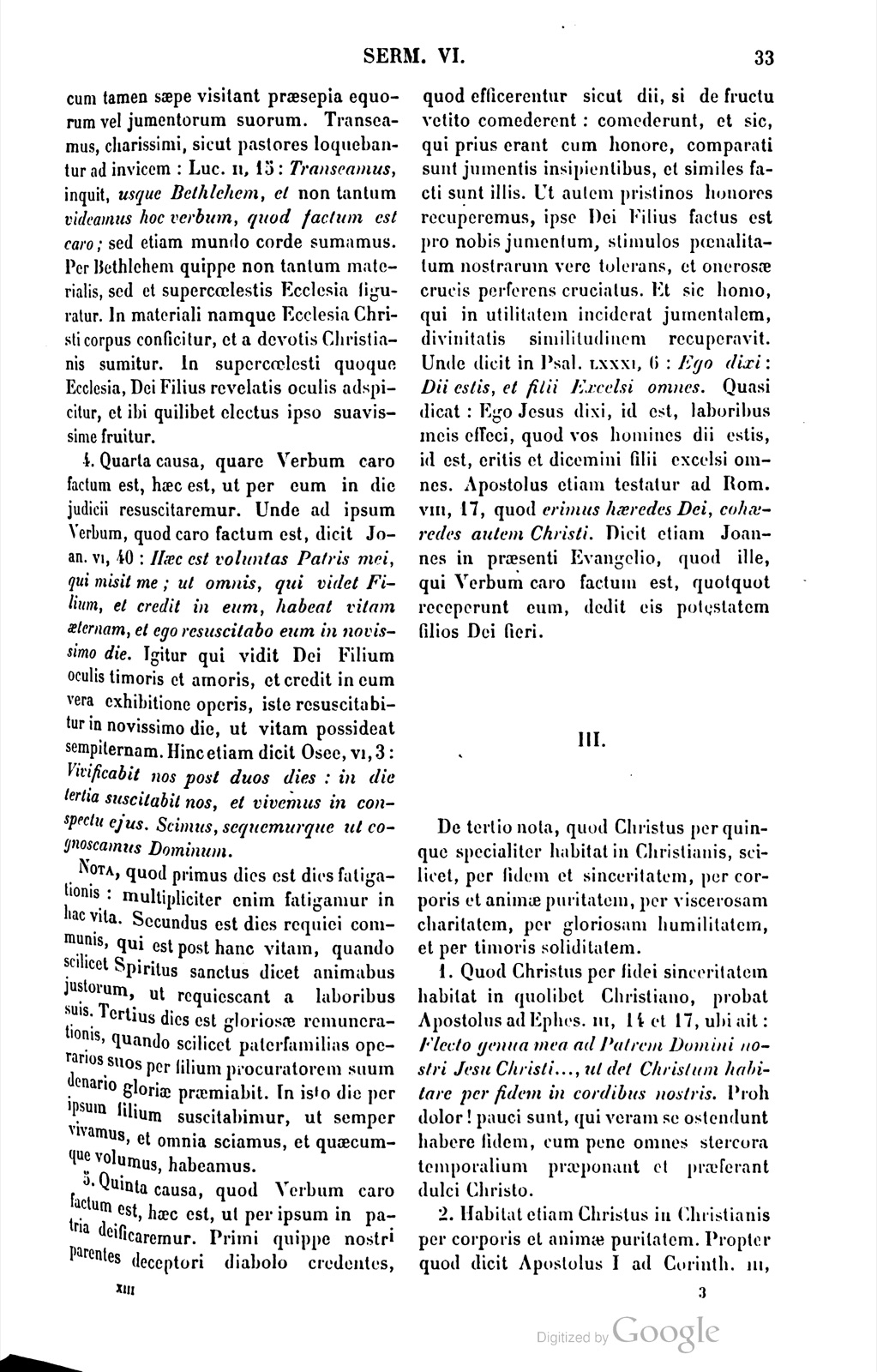
III.
De tertio nota, quod Christus per quinque specialiter habitat in Christianis, scilicet, per fidem et sinceritatem, per corporis et animae puritatem, per viscerosam charitatem, per gloriosam humilitatem, et per timoris soliditatem.
1. Quod Christus per fidei sinceritatem habitat in quolibet Christiano, probat Apostolus ad Ephes. iii, 14 et 17, ubi ait: Flecto genua mea ad Patrem Domini nostri Jesu Christi..., ut det Christum habitare per fidem in cordibus nostris. Proh dolor! pauci sunt, qui veram se ostendunt habere fidem, cum pene omnes stercora temporalium praeponant et praeferant dulci Christo.
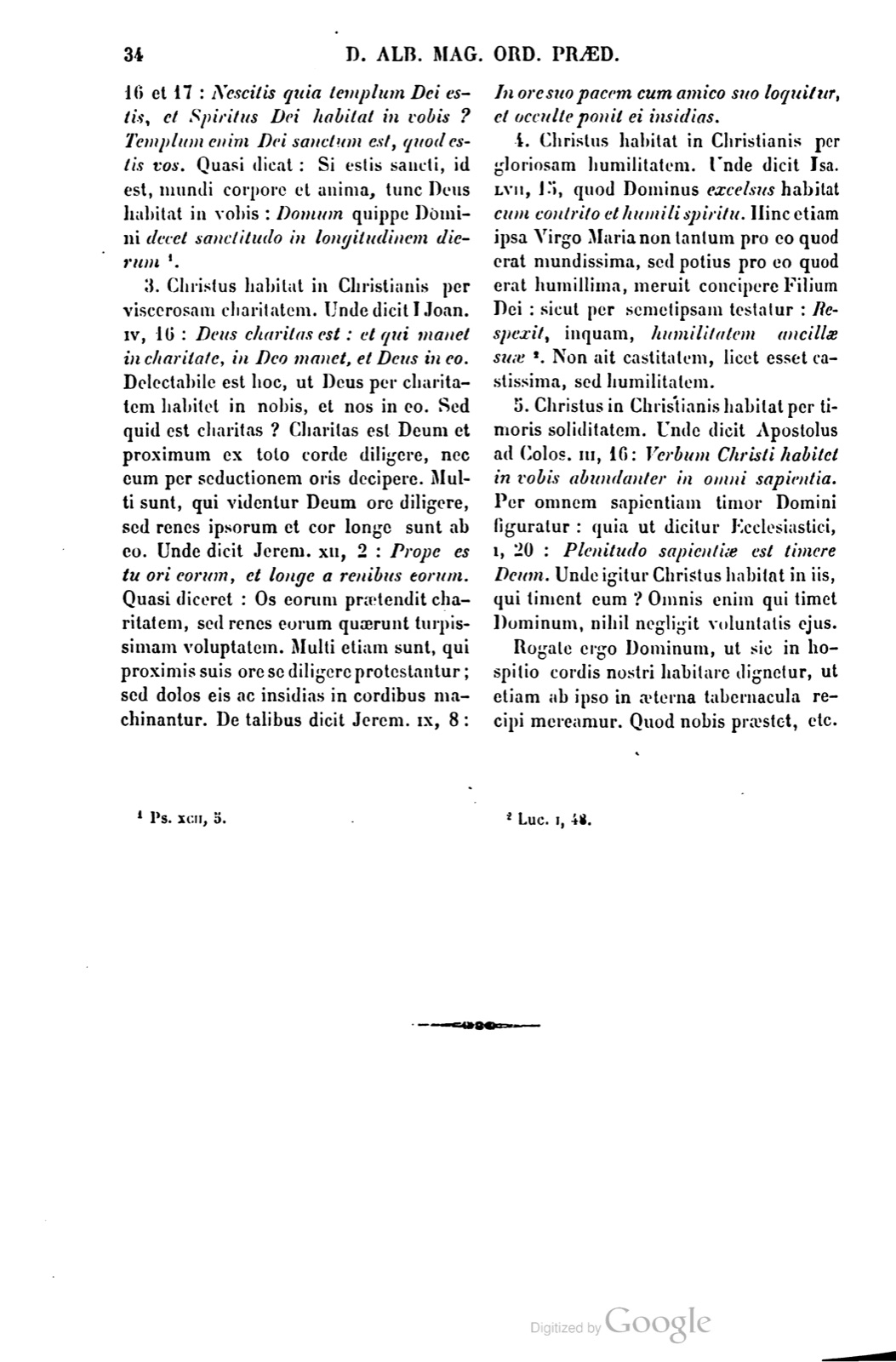
2. Habitat etiam Christus in Christianis per corporis et animae puritatem. Propter quod dicit Apostolus I ad Corinth. iii, 16 et 17: Nescitis quia templum Dei estis, et Spiritus Dei habitat in vobis? Templum enim Dei sanctum est, quod estis vos. Quasi dicat: Si estis sancti, id est, mundi corpore et anima, tunc Deus habitat in vobis: Domum quippe Domini decet sanctitudo in longitudinem dierum 7.
3. Christus habitat in Christianis per viscerosam charitatem. Unde dicit I Joan. iv, 16: Deus charitas est: et qui manet in charitate, in Deo manet, et Deus in eo. Delectabile est hoc, ut Deus per charitatem habitet in nobis, et nos in eo. Sed quid est charitas? Charitas est Deum et proximum ex toto corde diligere, nec eum per seductionem oris decipere. Multi sunt, qui videntur Deum ore diligere, sed renes ipsorum et cor longe sunt ab eo. Unde dicit Jerem. xii, 2: Prope es tu ori eorum, et longe a renibus eorum. Quasi diceret: Os eorum praetendit charitatem, sed renes eorum quaerunt turpissimam voluptatem. Multi etiam sunt, qui proximis suis ore se diligere protestantur; sed dolos eis ac insidias in cordibus machinantur. De talibus dicit Jerem. ix, 8: In ore suo pacem cum amico suo loquitur, et occulte ponit ei insidias.
4. Christus habitat in Christianis per gloriosam humilitatem. Unde dicit Isa. lvii, 15, quod Dominus excelsus habitat cum contrito et humili spiritu. Hinc etiam ipsa Virgo Maria non tantum pro eo quod erat mundissima, sed potius pro eo quod erat humillima, meruit concipere Filium Dei: sicut per semetipsam testatur: Respexit, inquam, humilitatem ancillae suae 8. Non ait castitatem, licet esset castissima, sed humilitatem.
5. Christus in Christianis habitat per timoris soliditatem. Unde dicit Apostolus ad Colos. iii, 16: Verbum Christi habitet in vobis abundanter in omni sapientia. Per omnem sapientiam timor Domini figuratur: quia ut dicitur Ecclesiastici, i, 20: Plenitudo sapientiae est timere Deum. Unde igitur Christus habitat in iis, qui timent eum? Omnis enim qui timet Dominum, nihil negligit voluntatis ejus. Rogate ergo Dominum, ut sic in hospitio cordis nostri habitare dignetur, ut etiam ab ipso in aeterna tabernacula recipi mereamur. Quod nobis praestet, etc.
III.
Concerning the third, note that Christ dwells in Christians especially through five things, namely through faith and sincerity, through purity of body and soul, through heartfelt charity, through glorious humility, and through solidity of fear.
1. That Christ dwells in any Christian through sincerity of faith, the Apostle proves in Ephesians 3:14 and 17, where he says: I bend my knees to the Father of our Lord Jesus Christ..., that he may grant Christ to dwell through faith in our hearts. Alas for sorrow! Few are those who show themselves to have true faith, since almost all set before and prefer the dung of temporal things to sweet Christ.
2. Christ also dwells in Christians through purity of body and soul. On account of this the Apostle says in 1 Corinthians 3:16 and 17: Do you not know that you are the temple of God and that the Spirit of God dwells in you? For the temple of God is holy, which you are. As if he were saying: If you are holy, that is, clean in body and soul, then God dwells in you; for holiness befits the house of the Lord unto length of days 7.
3. Christ dwells in Christians through heartfelt charity. Hence 1 John 4:16 says: God is charity, and he who remains in charity remains in God, and God in him. This is delightful, that God through charity dwells in us and we in him. But what is charity? Charity is to love God and neighbor from the whole heart, and not to deceive him by seduction of the mouth. There are many who seem to love God with the mouth, but their reins and heart are far from him. Hence Jeremiah 12:2 says: You are near to their mouth and far from their reins. As if he were saying: Their mouth pretends charity, but their reins seek the most shameful pleasure. There are also many who profess with the mouth that they love their neighbors, but they devise deceits and snares for them in their hearts. Concerning such persons Jeremiah 9:8 says: With his mouth he speaks peace with his friend, and secretly he sets snares for him.
4. Christ dwells in Christians through glorious humility. Hence Isaiah 57:15 says that the exalted Lord dwells with a contrite and humble spirit. Hence also the Virgin Mary herself merited to conceive the Son of God not so much because she was most clean, but rather because she was most humble, as she herself testifies through herself: He has looked upon, I say, the humility of his handmaid 8. She did not say chastity, although she was most chaste, but humility.
5. Christ dwells in Christians through solidity of fear. Hence the Apostle says in Colossians 3:16: Let the word of Christ dwell in you abundantly in all wisdom. By all wisdom the fear of the Lord is figured, because, as is said in Ecclesiasticus 1:20: The fullness of wisdom is to fear God. Whence therefore does Christ dwell in those who fear him? For everyone who fears the Lord neglects nothing of his will. Therefore pray to the Lord that he may deign so to dwell in the lodging of our heart that we may also merit to be received by him into the eternal tabernacles. May he grant this to us, etc.
Notes
- Psalm 15:11. (Ps. xv, 11.) ↩
- Psalm 101:26, 27, and 28. (Ps. ci, 26, 27 et 28.) ↩
- Psalm 89:2. (Ps. lxxxix, 2.) ↩
- Ecclesiastes 1:12 and 2:4 and following. (Eccles. i, 12 et ii, 4 et seq.) ↩
- Psalm 48:15. (Ps. xlviii, 15.) ↩
- Wisdom 18:15. (Sap. xviii, 15.) ↩
- Psalm 92:5. (Ps. xcii, 5.) ↩
- Luke 1:48. (Luc. i, 48.) ↩
If a page does not appear, its photograph has not been uploaded yet.