Works › Sermons for the Seasons of the Year
Volume 13 · pp. 25–28
Sermon V continuation and conclusion
A marker with ≈ is an approximate page boundary, placed by measure of the text; the page photographs remain the authority. In the paired views, clicking a page marker brings that page into view.
terra bona, quia nullus ibi, nisi bonus sit, recipitur. Dicitur etiam spatiosa, quia nemo ibi propter haereditatis angustiam conqueritur. Quisquis enim in ea est, habet quidquid vult. Est enim terra fluens lacte divinae humanitatis, et fluens melle humanae divinitatis. Christus enim illuc per suam lacteam humanitatem, et melleam divinitatem dilectos suos mirabiliter refocillat.
II. Secundo etiam is, qui natus est, Christus dicitur, id est, unctus. Fuit chrismate tinctus, ut consolaretur in via hujus mundi maerentes. Propter hoc ipse dicit Isa. lxi, 1 et seq.: Spiritus Domini super me, eo quod unxerit Dominus me...: ut consolarer omnes lugentes: ut ponerem consolationem lugentibus Sion: et darem eis coronam pro cinere, oleum gaudii pro luctu, pallium laudis pro spiritu maeroris. Nota, quod tria sunt, quae unicuique secundum exteriorem hominem tristitiam ac moerorem important. Primum est, superborum conculcatio. Secundum est, iniquorum malitiosa detractio. Tertium est, diversarum infirmitatum vexatio.
1. Contra primum consolatur nos Dei Filius, et promittit se nobis daturum coronam pro cinere, id est, pro eo quod a superbis et potentibus quasi cinis sub eorum pedibus conculcamur; spondet nobis, quod nos tamquam reges potentes in suo solio coronabit. 2. Contra secundum, scilicet, contra malitiosam iniquorum detractionem, consolatur nos promittens nobis pro luctu, quem habemus ex impiorum detractione, perpetuae gloriae claritatem: quod scilicet faciet nos lucere, quemadmodum oleum lucet in lampade perpetuae claritatis. 3. Contra tertium, scilicet, contra spiritum maeroris, quem habemus ex gravi vexatione infirmitatum, promittit nobis daturum pallium laudis, id est, corpus sanissimum, in quo semper sibi laudes referamus dicentes, "Gloria tibi Domine." De ista consolatione dicit Eccli. xxxviii, 7: Unguentarius faciet pigmenta suavitatis, et unctiones conficiet sanitatis. Nota quod multi sunt qui faciunt unguenta manuum, vel pedum, vel aliorum membrorum; sed nullus est, qui laesum cor ungere possit, vel sanare, nisi solus Filius Dei: quocirca in omni tribulatione ipsius unguentum est postulandum.
III. Tertio, puer iste, qui natus est, Dominus appellatur. Unde justum est, ut habeat servos sibi fideliter servientes. Hunc Dominum Jerem. xxiii, 5 et 6, Deum Patrem nobis promisisse protestatur, ita inquiens: Ecce dies veniunt, dicit Dominus: et suscitabo David germen justum: et regnabit Rex, et sapiens erit: et faciet judicium et justitiam in terra. In diebus illis salvabitur Juda, et Israel habitabit confidenter: et hoc est nomen, quod vocabunt eum, Dominus justus noster. Dicit itaque Deus Pater: Ecce dies gratiae veniunt, et suscitabo David germen justum, id est, faciam nasci ex semine David meum justum Filium. Et regnabit Rex, sceptrum crucis in humeris suis bajulando humiliter: et sapiens erit, crucis cruciatus patientissime tolerando; et sic faciet judicium, iniquum diabolum iniqua potestate juste privando, et justitiam, animas in captivitate violenter diu tamquam reges potentes detentas liberando. In diebus illis Juda, id est, quilibet laicus Deum confitens salvabitur per veram fidem: et Israel, id est, bonus religiosus, Deum per contemplationem videns, habitabit confidenter, certus de gloria: et hoc est nomen, quod propter haec omnia vocabunt eum, tam laici quam religiosi, Dominus justus noster.
a good land, because no one is received there unless he is good. It is also called spacious, because no one there complains because of the narrowness of the inheritance. For whoever is in it has whatever he wills. For it is a land flowing with the milk of divine humanity and flowing with the honey of human divinity. For Christ there wonderfully refreshes his beloved ones through his milky humanity and honeyed divinity.
II. Secondly also, he who was born is called Christ, that is, anointed. He was stained with chrism so that he might console those mourning on the way of this world. On account of this he himself says in Isaiah 61:1 and following: The Spirit of the Lord is upon me, because the Lord has anointed me... that I might console all who mourn, that I might put consolation for those mourning Zion, and give them a crown for ashes, the oil of gladness for mourning, a garment of praise for the spirit of sorrow. Note that there are three things that bring sadness and sorrow to each one according to the exterior human being. The first is the trampling of the proud. The second is the malicious detraction of the wicked. The third is the vexation of diverse infirmities.
1. Against the first the Son of God consoles us and promises that he will give us a crown for ashes, that is, for the fact that by the proud and powerful we are trampled like ashes under their feet; he pledges to us that he will crown us as powerful kings on his throne. 2. Against the second, namely against the malicious detraction of the wicked, he consoles us by promising us for the mourning that we have from the detraction of the impious the brightness of perpetual glory, namely that he will make us shine just as oil shines in a lamp of perpetual brightness. 3. Against the third, namely against the spirit of sorrow that we have from the grave vexation of infirmities, he promises that he will give us a garment of praise, that is, a most healthy body, in which we may always return praises to him, saying, "Glory to you, Lord." Concerning this consolation Ecclesiasticus 38:7 says: The perfumer will make pigments of sweetness and will compound ointments of health. Note that there are many who make ointments of the hands, or feet, or other members; but there is no one who can anoint or heal the wounded heart except the Son of God alone. Therefore in every tribulation his ointment must be sought.
III. Thirdly, this boy who has been born is called Lord. Hence it is just that he should have servants serving him faithfully. Jeremiah 23:5 and 6 attests that God the Father promised this Lord to us, saying thus: Behold, the days are coming, says the Lord, and I will raise up for David a just shoot; and a King will reign and will be wise, and he will do judgment and justice on the earth. In those days Judah will be saved, and Israel will dwell confidently; and this is the name by which they will call him: The Lord our just one. Therefore God the Father says: Behold, the days of grace are coming, and I will raise up for David a just shoot, that is, I will cause my just Son to be born from the seed of David. And the King will reign, humbly carrying the scepter of the cross on his shoulders; and he will be wise by most patiently tolerating the torments of the cross; and thus he will do judgment by justly depriving the unjust devil of unjust power, and justice by liberating souls violently detained for a long time in captivity like powerful kings. In those days Judah, that is, any layman confessing God, will be saved through true faith; and Israel, that is, a good religious seeing God through contemplation, will dwell confidently, certain of glory; and this is the name by which, because of all these things, both laymen and religious will call him: The Lord our just one.
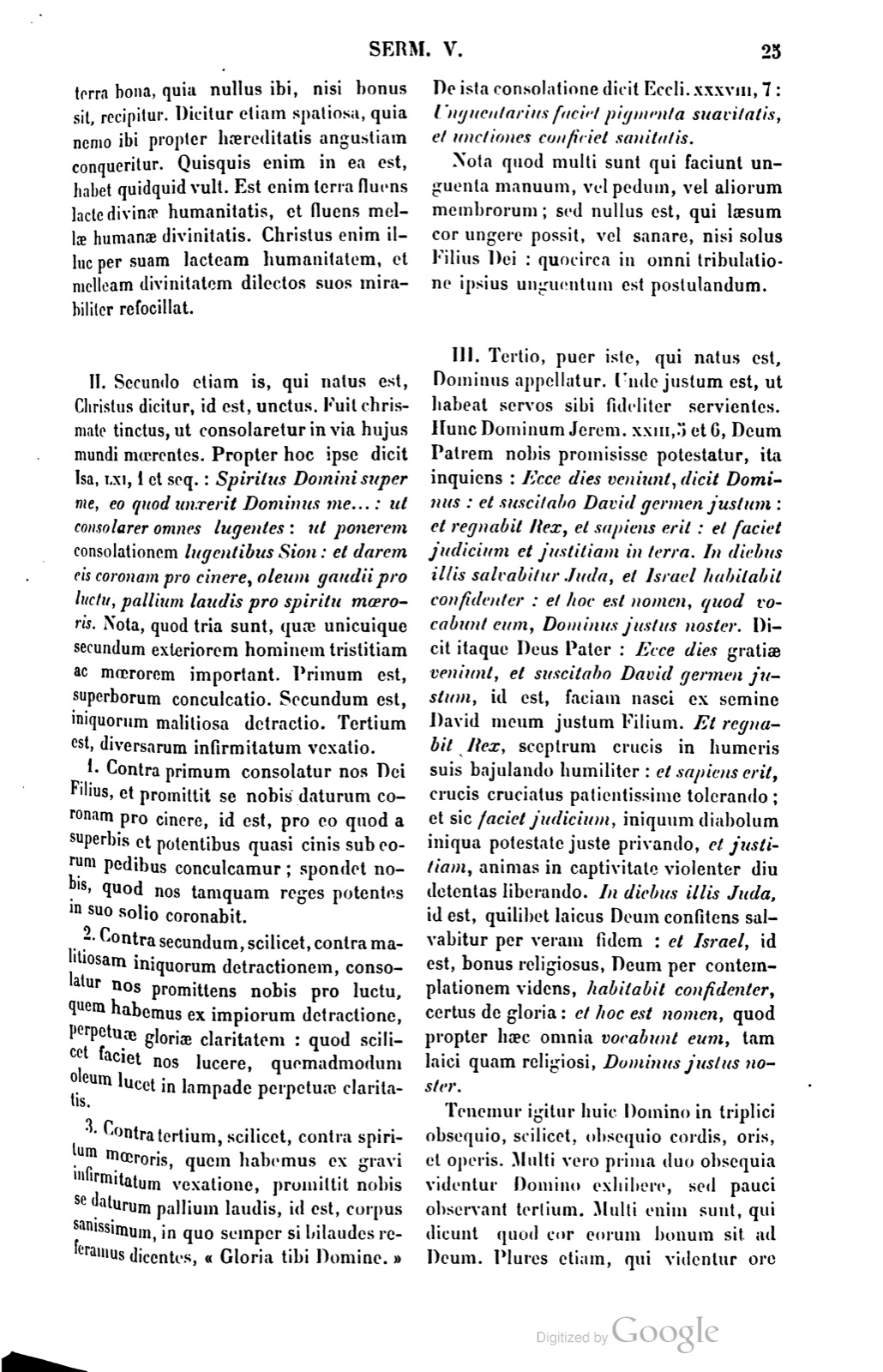
Tenemur igitur huic Domino in triplici obsequio, scilicet, obsequio cordis, oris, et operis. Multi vero prima duo obsequia videntur exhibere, sed pauci sunt, qui tertium observant Domino. Multi enim se dicunt quod cor eorum bonum sit ad Deum. Plures etiam, qui videntur ore servire Domino, sed in tertio signo, scilicet, in opere pene omnes deficiunt. Unde ipse Dominus dicit, Luc. vi, 46: Quid vocatis me Domine, Domine: et non facitis quae dico? id est, vos vocatis corde, "Domine," et ore "Domine," sed non vocatis me operibus, non enim facitis quae dico. Hinc etiam dicit Matth. vii, 21: Non omnis, qui dicit mihi, Domine, Domine, intrabit in regnum caelorum: sed qui facit voluntatem Patris mei, qui in caelis est, ipse intrabit in regnum caelorum. Multi sunt qui dicunt, quod adhuc proposuerint servire Domino: tales dicunt corde, "Domine." Sunt etiam alii, qui protestantur hoc, quod bonum sit et utile servire Domino et tales dicunt ore, "Domine." Sed paucissimi sunt, qui hoc quod corde proposuerunt, et ore commendant ac laudant, operibus exsequuntur: et propterea infiniti excluduntur a regno caelorum.
IV. Quarto, puer iste, qui natus est, David, id est manu fortis dicitur, ut feriat poenis perpetuis delinquentes, et se per poenitentiam non corrigentes. Unde dicitur Sap. xi, 18 et seq.: Non erat impossibilis omnipotens manus tua, quae creavit orbem terrarum ex materia invisa, immittere peccatoribus multitudinem ursorum, aut audaces leones, aut novi generis ira plenas ignotas bestias; aut vaporem igneum spirantes, aut fumi odorem proferentes, aut horrendas ab oculis scintillas emittentes: quarum non solum laesura poterat illos exterminare, sed et adspectus per timorem occidere. Nota, quod describit hic Spiritus sanctus daemones, qui ad praeceptum Domini punient miseros peccatores in inferno. Comparat autem eos ursis, et leonibus, et bestiis ira plenis. Propter hoc vero daemones ursis comparantur: quia sicut ursus animal est inquietissimum, semper existens in motu: sic etiam daemones, qui modo paratissimi et pervicacissimi sunt, et infatigabiles ad cruciandum. Leonibus etiam comparantur: quia leo animal est robustissimum atque fortissimum: sicut etiam daemones robustissimi sunt atque validissimi contra miseros peccatores. Comparantur etiam aliis bestiis ira plenis. Non solum enim daemones sunt ad hoc, ut torqueant peccatores paratissimi atque fortissimi: sunt etiam in cruciatibus inferendis crudelissimi. Unde vocantur bestiae, id est, vastiae a vastando, ira plenae, et non solum illae bestiae cruciant dentibus et ungulis, hoc est, multiplicium poenarum inflictione: sed etiam sui vultus terribilis ostensione. Propter hoc dicuntur vaporem igneum, et fumum de ore et naribus spirare, et horrendas scintillas ex oculis emittere. Et vere si possibile foret, quod peccatores mori possent in inferno, non solum propter cruciatus qui ab his inferrentur, sed etiam propter timorem horribilis vultus illarum mortem incurrerent. De iis bestiis dicitur in Psalm. lxxiii, 19: Ne tradas Domine bestiis animas confitentes tibi. Caveat nobis, o charissimi, Deus ab his bestiis crudelissimis.
Therefore we are bound to this Lord in a threefold service, namely the service of heart, mouth, and work. Many indeed seem to show the first two services, but there are few who observe the third for the Lord. For many say of themselves that their heart is good toward God. There are also many who seem to serve the Lord with the mouth, but in the third sign, namely in work, almost all fail. Hence the Lord himself says in Luke 6:46: Why do you call me Lord, Lord, and do not do the things that I say? that is, you call with the heart, "Lord," and with the mouth, "Lord," but you do not call me by works, for you do not do the things that I say. Hence also Matthew 7:21 says: Not everyone who says to me, Lord, Lord, will enter into the kingdom of heaven, but the one who does the will of my Father who is in heaven, he will enter into the kingdom of heaven. There are many who say that they have still proposed to serve the Lord; such persons say with the heart, "Lord." There are also others who testify that this is good and useful, to serve the Lord, and such persons say with the mouth, "Lord." But very few are those who carry out in works what they have proposed in the heart and commend and praise with the mouth; and therefore infinitely many are excluded from the kingdom of heaven.
IV. Fourthly, this boy who has been born is called David, that is, strong of hand, so that he may strike with perpetual penalties those sinning and not correcting themselves through repentance. Hence it is said in Wisdom 11:18 and following: It was not impossible for your almighty hand, which created the world from unseen matter, to send upon sinners a multitude of bears, or bold lions, or unknown beasts of a new kind full of anger, either breathing fiery vapor, or giving forth the odor of smoke, or sending out horrible sparks from their eyes; not only could the injury of these exterminate them, but even their sight could kill through fear. Note that here the Holy Spirit describes the demons who at the command of the Lord will punish wretched sinners in hell. He compares them to bears, and lions, and beasts full of anger. Demons are compared to bears for this reason: because as the bear is a most restless animal, always existing in motion, so also demons are now most ready and most obstinate and untiring for tormenting. They are also compared to lions because the lion is a most robust and very strong animal; so also demons are most robust and very strong against wretched sinners. They are also compared to other beasts full of anger. For demons are not only most ready and very strong for this, that they may torment sinners; they are also most cruel in inflicting torments. Hence they are called beasts, that is, devastators from devastating, full of anger; and not only do those beasts torment with teeth and claws, that is, by the infliction of manifold punishments, but also by showing their terrible face. On account of this they are said to breathe fiery vapor and smoke from mouth and nostrils and to send out horrible sparks from their eyes. And truly if it were possible that sinners could die in hell, they would incur death not only because of the torments that would be inflicted by these, but also because of fear of their horrible face. Concerning these beasts it is said in Psalm 73:19: Lord, do not hand over to beasts the souls confessing to you. O dearly beloved, may God guard us from these most cruel beasts.
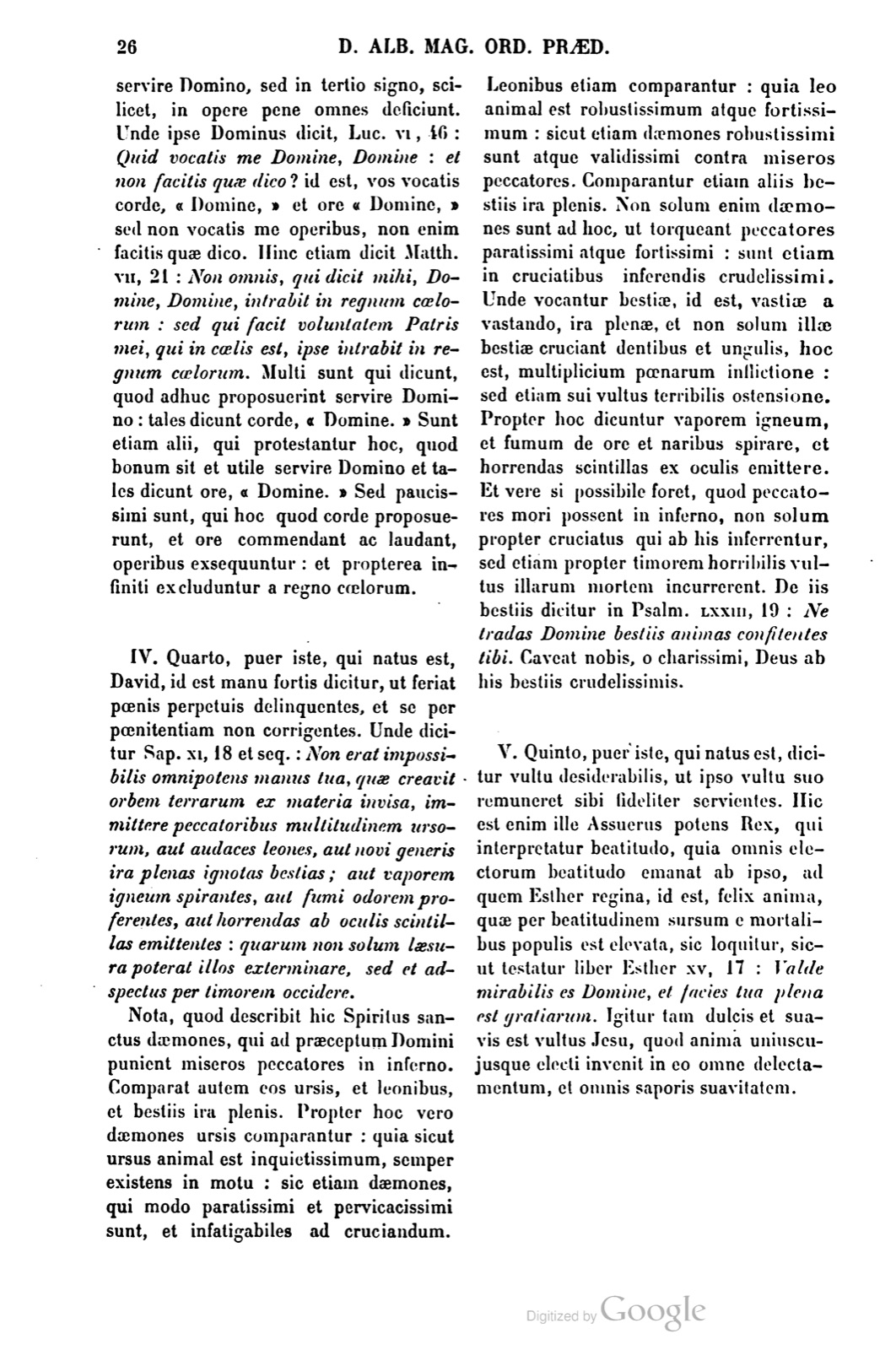
V. Quinto, puer iste, qui natus est, dicitur vultu desiderabilis, ut ipso vultu suo remuneret sibi fideliter servientes. Hic est enim ille Assuerus potens Rex, qui interpretatur beatitudo, quia omnis electorum beatitudo emanat ab ipso, ad quem Esther regina, id est, felix anima, quae per beatitudinem sursum e mortalibus populis est elevata, sic loquitur, sicut testatur liber Esther xv, 17: Valde mirabilis es Domine, et facies tua plena est gratiarum. Igitur tam dulcis et suavis est vultus Jesu, quod anima uniuscujusque electi invenit in eo omne delectamentum, et omnis saporis suavitatem.
IV.
De quarto nota, quod Jesus natus per signum invenitur ab Angelo datum. Unde dicitur in Evangelio praesenti, quod cum Angelus nuntiasset pastoribus Christum esse natum, subjecit: Et hoc vobis signum: Invenietis infantem pannis involutum, et positum in praesepio 1. Dixit etiam Simeon postea ad Mariam matrem ejus, Luc. ii, 34: Ecce positus est hic in signum, cui contradicetur. Nota igitur, quod Dominus, cum natus esset, ostendit nobis in seipso quintuplex signum, scilicet, signum sanctae taciturnitatis, beatae paupertatis, pretiosae puritatis, gloriosae humilitatis, ac egregiae charitatis.
1. Primo igitur signum sanctae taciturnitatis nobis ostenditur, ubi dicitur: Invenietis infantem, id est, puerulum non fantem, scilicet, non loquentem, sed potius vagientem. Quare ergo Dominus ostendit in seipso taciturnitatem? Dicitur enim Proverb. x, 19: In multiloquio non deerit peccatum: qui autem moderatur labia sua, prudentissimus est. Dicitur etiam Eccli. xx, 8: Qui multis utitur verbis, laedet animam suam. Legitur in vita S. Patrum de Abbate Agathone, quod per triennium lapidem in ore suo portavit, donec taciturnitatem disceret. Legitur etiam, quod quidam philosophus interrogatus a quodam, quomodo posset placere Deo et hominibus, respondit: "Si tu optimus fueris in quaeque egeris, et pauca locutus fueris."
2. Secundo, signum beatae paupertatis in Jesu nobis ostenditur, ubi dicitur, pannis involutum: non dicitur bysso vel purpura. Erat enim paupercula Dei genitrix Maria, unde habere non poterat pannos pretiosos. Qui igitur gemunt sub onere paupertatis, respiciant pannosum Jesum, ut consolentur. Unde dicit Isa. xxix, 19: Addent mites in Domino laetitiam, et pauperes homines in sancto Israel, id est, in Christo, exsultabunt. Dicit etiam Seneca de paupertate: "Paupertas expedita et secura est." Comparat inter se pauperum et divitum vultus: "Saepius pauper et fidelius ridet."
V. Fifthly, this boy who has been born is said to be desirable in countenance, so that by his own countenance he may reward those serving him faithfully. For this is that powerful King Ahasuerus, who is interpreted as blessedness, because all the blessedness of the elect flows from him, to whom queen Esther, that is, the happy soul that through blessedness has been lifted upward from mortal peoples, speaks thus, as the book of Esther 15:17 testifies: You are very wonderful, Lord, and your face is full of graces. Therefore the face of Jesus is so sweet and pleasant that the soul of each elect person finds in it every delight and the sweetness of every taste.
IV.
Concerning the fourth, note that Jesus when born is found through the sign given by the Angel. Hence it is said in the present Gospel that when the Angel had announced to the shepherds that Christ had been born, he added: And this is the sign for you: you will find an infant wrapped in cloths and placed in a manger 1. Simeon also afterward said to Mary his mother, Luke 2:34: Behold, this one has been set as a sign that will be contradicted. Therefore note that the Lord, when he had been born, showed us in himself a fivefold sign, namely the sign of holy silence, blessed poverty, precious purity, glorious humility, and excellent charity.
1. First, therefore, the sign of holy silence is shown to us where it is said: You will find an infant, that is, a little boy not speaking, namely not talking, but rather wailing. Why therefore did the Lord show silence in himself? For Proverbs 10:19 says: In much speech sin will not be lacking, but the one who moderates his lips is most prudent. Ecclesiasticus 20:8 also says: He who uses many words will wound his soul. It is read in the life of the Fathers about Abbot Agatho that for three years he carried a stone in his mouth until he learned silence. It is also read that a certain philosopher, asked by someone how he could please God and human beings, answered: "If you have been best in whatever you do, and have spoken few things."
2. Secondly, the sign of blessed poverty is shown to us in Jesus where it is said that he was wrapped in cloths; it is not said in fine linen or purple. For Mary, the little poor mother of God, was poor, and therefore could not have precious cloths. Therefore those who groan under the burden of poverty should look upon the cloth-wrapped Jesus, so that they may be consoled. Hence Isaiah 29:19 says: The meek will add joy in the Lord, and poor human beings will exult in the Holy One of Israel, that is, in Christ. Seneca also says about poverty: "Poverty is unencumbered and secure." He compares with each other the faces of poor and rich persons: "More often and more faithfully the poor person laughs."
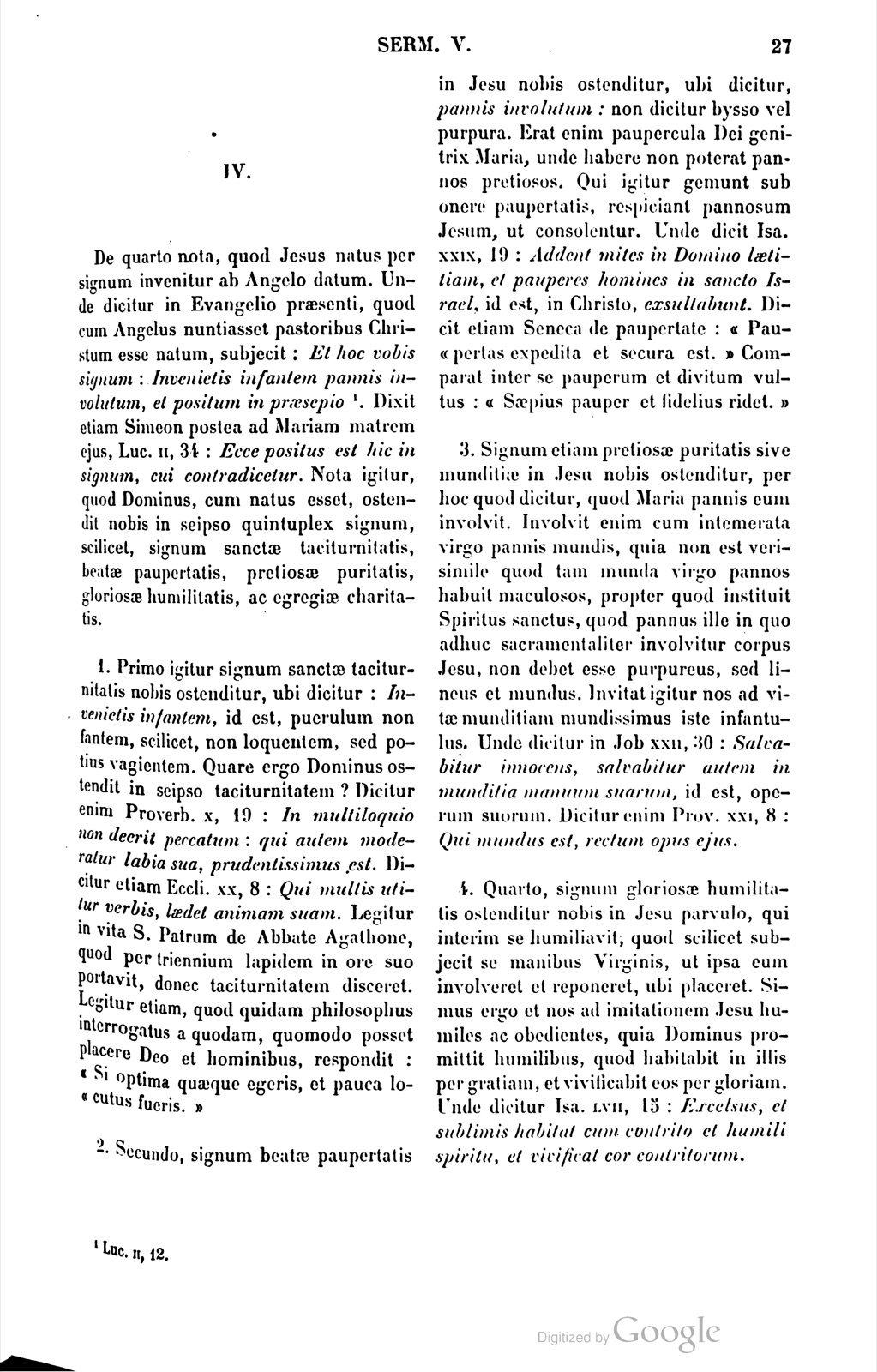
3. Signum etiam pretiosae puritatis sive munditiae in Jesu nobis ostenditur, per hoc quod dicitur, quod Maria pannis eum involvit. Involvit enim eum intemerata virgo pannis mundis, quia non est verisimile quod tam munda virgo pannos habuit maculosos, propter quod instituit Spiritus sanctus, quod pannus ille in quo adhuc sacramentaliter involvitur corpus Jesu, non debet esse purpureus, sed lineus et mundus. Invitat igitur nos ad vitae munditiam mundissimus iste infantulus. Unde dicitur in Job xxii, 30: Salvabitur innocens, salvabitur autem in munditia manuum suarum, id est, operum suorum. Dicitur enim Prov. xxi, 8: Qui mundus est, rectum opus ejus.
4. Quarto, signum gloriosae humilitatis ostenditur nobis in Jesu parvulo, qui interim se humiliavit, quod scilicet subjecit se manibus Virginis, ut ipsa eum involveret et reponeret, ubi placeret. Simus ergo et nos ad imitationem Jesu humiles ac obedientes, quia Dominus promittit humilibus, quod habitabit in illis per gratiam, et vivificabit eos per gloriam. Unde dicitur Isa. lvii, 15: Excelsus, et sublimis habitat cum contrito et humili spiritu, et vivificat cor contritorum.
5. Quinto, signum charitatis egregiae demonstratur in isto infantulo, qui reponi voluit in praesepio, quasi per hoc innueret se communem esse animalibus, pastoribus, et regibus, et omnibus eum habere cupientibus. Unde dicit in Jer. xxxi, 3: In caritate perpetua dilexi te, ideo attraxi te, miserans. Jacet igitur Jesus in praesepio quasi quidam adamas trahens ad se per charitatem jumenta, pastores, et reges. Unde etiam jumenta, pastores, et reges charitatis ei vicem reciprocam rependerunt. Jumenta quippe faenum suum parvulo commodaverunt, pastores devotas laudes ipsi cecinerunt, et reges pretiosa munera obtulerunt.
Imitemur et nos illa bona jumenta, ut scilicet, faenum verum Deo nostro mutuemus, id est, ut eleemosynas nostras pauperibus erogemus. Imitemur etiam pastores, ut Deum devotis laudibus ac orationibus honoremus. Imitemur nihilominus reges, ut Salvatori nostro cor nostrum, et omne opus nostrum quasi munera pretiosa offeramus humiliter. Rogate Dominum, charissimi, ut sic nativitatem ejus celebremus in terris, ut etiam ipsum facie ad faciem laetanter videre mereamur. Amen.
3. The sign also of precious purity or cleanness is shown to us in Jesus through this, that it is said that Mary wrapped him in cloths. For the undefiled virgin wrapped him in clean cloths, because it is not likely that so clean a virgin had stained cloths; on account of which the Holy Spirit instituted that that cloth in which the body of Jesus is still sacramentally wrapped ought not to be purple, but linen and clean. Therefore this most clean little infant invites us to cleanness of life. Hence it is said in Job 22:30: The innocent will be saved, and he will be saved in the cleanness of his hands, that is, of his works. For Proverbs 21:8 says: He who is clean, his work is right.
4. Fourthly, the sign of glorious humility is shown to us in the little Jesus, who in the meantime so humbled himself that, namely, he subjected himself to the hands of the Virgin, so that she might wrap him and place him where it pleased her. Therefore let us also, in imitation of Jesus, be humble and obedient, because the Lord promises the humble that he will dwell in them through grace and will vivify them through glory. Hence Isaiah 57:15 says: The high and sublime one dwells with a contrite and humble spirit and vivifies the heart of the contrite.
5. Fifthly, the sign of excellent charity is demonstrated in this little infant, who wished to be placed in a manger, as if by this he suggested that he was common to the animals, shepherds, and kings, and to all desiring to have him. Hence he says in Jeremiah 31:3: I have loved you with everlasting charity; therefore, pitying, I have drawn you. Therefore Jesus lies in the manger like a certain adamant drawing to himself through charity animals, shepherds, and kings. Hence also the animals, shepherds, and kings repaid to him the reciprocal return of charity. For the animals lent their hay to the little one, the shepherds sang devout praises to him, and the kings offered precious gifts.
Let us also imitate those good beasts of burden, namely so that we may lend true hay to our God, that is, that we may distribute our alms to the poor. Let us also imitate the shepherds, so that we may honor God with devout praises and prayers. Let us no less imitate the kings, so that we may humbly offer to our Savior our heart and every work of ours as precious gifts. Pray to the Lord, dearly beloved, that we may so celebrate his nativity on earth that we may also merit joyfully to see him face to face. Amen.

Notes
- Luke 2:12. (Luc. ii, 12.) ↩
If a page does not appear, its photograph has not been uploaded yet.