Works › Sermons for the Seasons of the Year
Volume 13 · pp. 17–21
Sermon IV. On the Fourth Sunday of Advent
A marker with ≈ is an approximate page boundary, placed by measure of the text; the page photographs remain the authority. In the paired views, clicking a page marker brings that page into view.
SERMO IV.
IN DOMINICA IV ADVENTUS.
Medius vestrum stetit, quem vos nescitis. Ipse est, qui post me venturus est, qui ante me factus est: cujus ego non sum dignus ut solvam ejus corrigiam calceamenti. Joan. I, 26 et 27.
Tria principaliter sunt hic notanda:
I. Quis sit ille, quem Joannes medium stare perhibet et affirmat? II. Quando Dominum per se venturum esse praedicat? III. Quod sit calceamentum, cujus corrigiam se indignum asserit, ut solvat?
I.
De primo nota, quod ille, quem Joannes medium stare perhibet et affirmat, ipse est Dei Filius. Unde notat Glossa super locum istum: «Medius vestrum stetit, quem vos nescitis, id est, praesens vobis apparet corpore.» Hunc etiam Joannes digito demonstravit. Unde immediate post praesens Evangelium dicitur in Joanne: Altera die vidit Joannes Jesum venientem ad se, et ait: Ecce Agnus Dei, ecce qui tollit peccata mundi. Hic est, de quo dixi: Post me venit vir, qui ante me factus est 1. Cum ergo Joannes dicat Jesum stare medium, nota quod Jesus in primo jacuit in medio jumentorum. Secundo sedit in medio Doctorum. Tertio pependit in medio latronum. Quarto stetit in medio Discipulorum. Quinto vero ambulat in medio candelabrorum aureorum.
1. Primo ergo Jesus jacuit in medio jumentorum: quando scilicet intemerata Virgo Maria pannis eum involvit et reclinavit in praesepio: quia non erat ei alius locus in diversorio 2. De hoc dicit Habacuc secundum aliam translationem: In medio duorum animalium cognosceris. Erant autem haec duo animalia bos et asinus, secundum quod videtur in picturis, quae sunt libri laicorum. Jacens ergo Jesus in medio jumentorum ostendit mirabilem humilitatem. Valde enim mirabile fuit, quod divina majestas induit corpus parvuli in stabulo jacentis ac vagientis. Debemus igitur et nos in hac humilitate mirabilem Deum imitari: quia gloriosum praemium humilitati promittitur. Quia scilicet suscipientur a gloria Domini. Unde dicitur Proverb. XXIX, 23: Superbum sequitur humilitas: et humiles spiritu suscipiet gloria.
2. Secundo, Jesus sedit in medio Doctorum. Unde legitur in Luc. II, 46, quod invenerunt Jesum parentes ejus in templo sedentem in medio Doctorum, audientem illos, et interrogantem eos. Per hoc quod Jesus sedit in medio Doctorum audiens et interrogans illos, invitat nos ad studium verae sapientiae. Vera autem sapientia est timere Dominum. Unde dicitur Eccli. I, 20: Plenitudo sapientiae est timere Dominum. Hunc ergo timorem discere debemus: quia qui timent Dominum, custodiunt mandata illius 3. Unde dicitur Eccli. I, 13: Et vere bene erit eis post hanc vitam 4, qui modo timent Dominum. Unde dicit Eccli. I, 19: Timenti Dominum bene erit, et in diebus consummationis illius benedicetur. Post hanc enim vitam Dominus consolabitur filios suos, et tunc eos qui illum timuerunt, gloriosissime benedicet. Ut autem veram sapientiam, id est, timorem Domini discamus, debemus fugere tabernas, ne ibi in medio potatorum sedeamus. Debemus autem frequentare Ecclesias, ut illic verba timoris Domini a Sacerdotibus, et Praedicatoribus audiamus. Unde admonet nos Eccli. VI, 35: In multitudine presbyterum prudentium sta, et sapientiae illorum ex corde conjungere, ut omnem narrationem Dei possis audire.
SERMON IV.
ON THE FOURTH SUNDAY OF ADVENT.
There has stood in the midst of you one whom you do not know. He it is who is to come after me, who was made before me; the strap of whose shoe I am not worthy to loose. John I, 26 and 27.
Three things chiefly are to be noted here:
I. Who is that one whom John declares and affirms to stand in the midst? II. When does he preach that the Lord is to come through himself? III. What is the shoe whose strap he declares himself unworthy to loose?
I.
Concerning the first, note that the one whom John declares and affirms to stand in the midst is the Son of God himself. Hence the Gloss notes on that place: "There has stood in the midst of you one whom you do not know, that is, present to you he appears in body." John also pointed him out with his finger. Hence immediately after the present Gospel it is said in John: On the next day John saw Jesus coming to him, and he said: Behold the Lamb of God, behold him who takes away the sins of the world. This is he of whom I said: After me comes a man who was made before me 1. Therefore, since John says that Jesus stands in the midst, note that Jesus first lay in the midst of beasts of burden. Second, he sat in the midst of the Doctors. Third, he hung in the midst of thieves. Fourth, he stood in the midst of the Disciples. Fifth, truly, he walks in the midst of golden lampstands.
1. First, therefore, Jesus lay in the midst of beasts of burden, namely when the spotless Virgin Mary wrapped him in cloths and laid him in a manger, because there was no other place for him in the inn 2. Concerning this Habakkuk says according to another translation: In the midst of two animals you will be known. Now these two animals were an ox and an ass, according as is seen in pictures, which are the books of laypeople. Therefore Jesus lying in the midst of beasts of burden showed wonderful humility. For it was very wonderful that the divine majesty put on the body of a little child lying and crying in a stable. Therefore we too ought to imitate the wonderful God in this humility, because a glorious reward is promised to humility, namely because the humble will be received by the glory of the Lord. Hence Proverbs XXIX, 23 says: Humility follows the proud man, and glory will receive the humble in spirit.
2. Second, Jesus sat in the midst of the Doctors. Hence it is read in Luke II, 46, that his parents found Jesus in the temple sitting in the midst of the Doctors, hearing them and questioning them. Through the fact that Jesus sat in the midst of the Doctors, hearing and questioning them, he invites us to the study of true wisdom. But true wisdom is to fear the Lord. Hence Ecclesiasticus I, 20 says: The fullness of wisdom is to fear the Lord. Therefore we ought to learn this fear, because those who fear the Lord keep his commandments 3. Hence Ecclesiasticus I, 13 says: And truly it will be well for them after this life 4, who now fear the Lord. Hence Ecclesiasticus I, 19 says: It will be well for the one fearing the Lord, and in the days of his consummation he will be blessed. For after this life the Lord will console his sons, and then he will bless most gloriously those who feared him. But in order that we may learn true wisdom, that is, the fear of the Lord, we ought to flee taverns, lest we sit there in the midst of drinkers. We ought, however, to frequent churches, so that there we may hear the words of the fear of the Lord from priests and preachers. Hence Ecclesiasticus VI, 35 admonishes us: Stand in the multitude of prudent elders, and join yourself from the heart to their wisdom, so that you may be able to hear every narration of God.
3. Tertio, Jesus stetit in medio latronum. Unde dicitur Joan. XIX, 18, quod crucifixerunt Jesum in loco Calvariae, et cum eo alios duos hinc et hinc, medium autem Jesum. Istos duos, in quorum medio Jesus est crucifixus, Lucas appellat nequam, et latrones. Jesus autem stans in medio nequam duorum latronum, quasi sceleratior illis esset, ostendit nobis praeclarissimum exemplum patientiae, quod imitari nos oportet; ut scilicet quando nos homines vel factis, vel verbis indebite perturbant ac gravant, tunc patientes existamus. Si enim Jesus innocentissimus, stans in medio latronum, subsannationes, irrisiones patitur, et cruciatur: non est magnum si et nos, qui in peccatis concepti sumus, et quos mater nostra peperit in doloribus, et qui sine peccato non vivimus, si, inquam, et nos impia malorum hominum verba sustineamus, et facta: alias nimis delicati milites sumus, si volumus regnare cum Christo, et nihil pati pro Christo.
4. Stetit etiam Jesus in medio Discipulorum suorum. Unde dicit Joan. XX, 19: Venit Jesus, videlicet post Resurrectionem, et stetit in medio Discipulorum, et dixit eis: Pax vobis. Jesus igitur stans in medio Discipulorum suorum, exemplo et verbo invitat nos ad charitatem et pacem. Charitas enim mater est pacis. Unde etiam ante Passionem fuit existens inter Discipulos suos, et ministrans eis. Magnum enim signum ostenderat charitatis. Hic etiam dixit, ut ait Luc. XXII, 27: Ego in medio vestrum sum, sicut qui ministrat. Dicit etiam ad eos Joan. XIII, 14 et 15: Si ego lavi pedes vestros, Dominus, et Magister: et vos debetis alter alterius lavare pedes. Exemplum enim dedi vobis, ut quemadmodum ego feci vobis, ita et vos faciatis. Charitatem igitur et pacem Christi exemplo ad invicem habere debemus. Unde scribit Apostolus II ad Timoth. II, 22: Sectare charitatem, et pacem cum iis, qui invocant Dominum de corde puro. Videtur hic Apostolus innuere, quod nullus possit invocare de puro corde, nisi habeat charitatem et pacem, et hoc est sine dubio verissimum.
3. Third, Jesus stood in the midst of thieves. Hence it is said in John XIX, 18, that they crucified Jesus in the place of Calvary, and with him two others on this side and on that, but Jesus in the middle. Luke calls these two, in whose midst Jesus was crucified, wicked men and thieves. But Jesus, standing in the midst of two wicked thieves, as though he were more criminal than they, showed us a most splendid example of patience, which we must imitate; namely, when people unduly disturb and burden us either by deeds or by words, then we should be patient. For if Jesus, most innocent, standing in the midst of thieves, suffers mockeries and derisions and is crucified, it is not a great thing if we also, who were conceived in sins, and whom our mother bore in pains, and who do not live without sin, if, I say, we too sustain the impious words and deeds of evil men; otherwise we are excessively delicate soldiers, if we wish to reign with Christ and suffer nothing for Christ.
4. Jesus also stood in the midst of his Disciples. Hence John XX, 19 says: Jesus came, namely after the Resurrection, and stood in the midst of the Disciples, and said to them: Peace be to you. Therefore Jesus standing in the midst of his Disciples invites us by example and word to charity and peace. For charity is the mother of peace. Hence also before the Passion he was existing among his Disciples and ministering to them. For he had shown a great sign of charity. Here also he said, as Luke XXII, 27 says: I am in the midst of you as one who ministers. He also says to them, John XIII, 14 and 15: If I, the Lord and Master, have washed your feet, you also ought to wash one another's feet. For I have given you an example, that as I have done to you, so you also should do. Therefore, by Christ's example, we ought to have charity and peace toward one another. Hence the Apostle writes in II Timothy II, 22: Follow charity and peace with those who call upon the Lord from a pure heart. Here the Apostle seems to suggest that no one can call upon the Lord from a pure heart unless he has charity and peace, and this is without doubt most true.
5. Quinto, ambulat Christus in medio septem candelabrorum aureorum. Unde dicit Joannes in Apoc. I, 12 et seq.: Vidi septem candelabra aurea: et in medio septem candelabrorum aureorum similem Filio hominis, vestitum podere, et praecinctum ad mamillas zona aurea: et facies ejus sicut sol lucet in virtute sua. Dicitur etiam in Apoc. II, 1 et 2: Haec dicit, qui ambulat in medio septem candelabrorum aureorum: Scio opera tua, et laborem, et patientiam tuam. Nota, quod septem candelabra aurea sunt septem ordines beatorum in regno Dei, scilicet, Angeli, Patriarchae, Prophetae, Apostoli, Martyres, Confessores, Virgines sive Continentes, et omnes alii electi, qui sub istis septem ordinibus comprehenduntur. Unde dicitur ibi, quod septem candelabra, septem Ecclesiae sunt 5, id est, septem congregationes beatorum. Dicuntur autem hi septem ordines candelabra: quia sicut candelabro candela supponitur, quae domum illuminat, ita et isti septem ordines lumen gloriae a sancta Trinitate receperunt, et per totum palatium caeleste relucent.
Inter haec septem candelabra ambulat Filius Dei vestitus podere, id est, indumento humanitatis, et praecinctus ad mamillas aurea zona, charitatis. Lucens etiam sicut sol lucet in sua virtute, serenissimo lumine divinitatis. Ambulat, inquam, Dei Filius inter ista candelabra, quae sunt aurea, id est, ad summam nobilitatem perducta, administrans unicuique electo jucunditatem et exsultationem. Jucunditatem utique propter dotem animae jam collectam. Exsultationem vero, propter dotem corpori repromissam. Propter hoc dicitur Eccli. XV, 6: Jucunditatem et exsultationem thesaurizabit super illum. Ambulans itaque Filius inter aurea candelabra consolatur unumquemque beatum, ita inquiens: Scio opera tua, et laborem, et patientiam tuam 6. Quasi dicat: Scio opera, quae in meo servitio expendisti: scio etiam laborem, quo proximis tuis deservisti: scio nihilominus patientiam, per quam adversa mundi sustinuisti. Unde propter haec tria mercedem perpetuam recepisti.
II.
De secundo nota, quod Jesus, qui olim jacuit, sedit, stetit, et adhuc ambulat in medio, venturus est in die judicii, ut iterum sedeat in medio, scilicet agnorum, et haedorum. Quod autem sessurus sit in judicio in medio agnorum, et haedorum, testatur per seipsum (Matth. XXV, 31 et seq.) ita dicens: Cum venerit Filius hominis in majestate sua, et omnes Angeli ejus cum eo, tunc sedebit super sedem majestatis: et congregabuntur ante eum omnes gentes, et separabit eos ab invicem, sicut pastor segregat oves ab haedis. Et statuet oves quidem a dextris suis, haedos autem a sinistris. Propter multas causas homines Christiani ovibus comparantur. Quarum una haec est, quod scilicet ovis humile animal est, et humiliter alimentum suum decerpit a terra: sicut etiam boni Christiani humiles sunt, et contenti se laboribus suis, vel justis reditibus enutrire. E converso facit haedus, quod est animal scandens rupes et arbores, ut ibi accipiat cibum suum. Ita etiam faciunt mali Christiani, qui volunt per injustitiam divites fieri, et ambiunt honores hujus mundi. In istorum medio Dominus sedebit in judicio, bonos evocans ad regnum, malos vero transmittens ad supplicium.
5. Fifth, Christ walks in the midst of seven golden lampstands. Hence John says in Apocalypse I, 12 and following: I saw seven golden lampstands, and in the midst of the seven golden lampstands one like the Son of Man, clothed with a long robe and girded at the breasts with a golden belt; and his face was as the sun shines in its strength. It is also said in Apocalypse II, 1 and 2: These things says he who walks in the midst of the seven golden lampstands: I know your works, and labor, and your patience. Note that the seven golden lampstands are the seven orders of the blessed in the kingdom of God, namely Angels, Patriarchs, Prophets, Apostles, Martyrs, Confessors, Virgins or Continent persons, and all other elect persons who are comprehended under these seven orders. Hence it is said there that the seven lampstands are seven Churches 5, that is, seven congregations of the blessed. Now these seven orders are called lampstands because, just as a candle is placed on a lampstand, which illuminates the house, so also these seven orders have received the light of glory from the holy Trinity and shine throughout the whole heavenly palace.
Among these seven lampstands the Son of God walks, clothed with a long robe, that is, with the garment of humanity, and girded at the breasts with the golden belt of charity. Shining also as the sun shines in its strength, with the most serene light of divinity. The Son of God walks, I say, among those lampstands, which are golden, that is, brought to the highest nobility, administering joy and exultation to each elect person. Joy indeed on account of the dowry of the soul already gathered. But exultation on account of the dowry promised back to the body. On account of this Ecclesiasticus XV, 6 says: He will heap joy and exultation upon him. Therefore the Son walking among the golden lampstands consoles each blessed one, speaking thus: I know your works, and labor, and your patience 6. As though he said: I know the works which you spent in my service; I know also the labor by which you served your neighbors; I know nevertheless the patience through which you endured the adversities of the world. Hence because of these three things you have received an everlasting reward.
II.
Concerning the second, note that Jesus, who once lay, sat, stood, and still walks in the midst, is to come on the day of judgment, so that again he may sit in the midst, namely of lambs and goats. That he will sit in judgment in the midst of lambs and goats he himself testifies, Matthew XXV, 31 and following, saying thus: When the Son of Man will have come in his majesty, and all his Angels with him, then he will sit upon the seat of majesty; and all nations will be gathered before him, and he will separate them from one another, as a shepherd separates sheep from goats. And he will set the sheep indeed at his right hand, but the goats at his left. Christian people are compared to sheep for many reasons. One of these is that, namely, a sheep is a humble animal and humbly plucks its food from the earth; so also good Christians are humble and content to nourish themselves by their own labors or by just revenues. The goat does the contrary, for it is an animal climbing rocks and trees so that there it may take its food. So also evil Christians act, who wish to become rich through injustice and seek the honors of this world. In the midst of these the Lord will sit in judgment, calling the good to the kingdom, but sending the evil to punishment.
Igitur in Jesu tria considera: quod scilicet veniet ad judicium, utpote Rex potens et sapiens. Unde legitur in hodierno Evangelio, quod Joannes negavit se esse Christum, et Eliam, et Prophetam. Quasi dicat: Jesus cum venit ad judicium, ipse erit Christus, et Elias, et Propheta. Tria enim requiruntur a justo judice. Primum est, ut habeat auctoritatem judicandi a superiore sibi collatam. Secundum est, ut habeat fortitudinem, per quam possit exsequi judicium, iniquorum resistentia non obstante. Tertium est, ut sit sapiens et prudens: ut scilicet sciat, quis sit nocens, et quis innocens: nocentes puniat, et innocentes absolvat.
Propter primum Jesus dicitur Christus, quod interpretatur unctus. Unxit enim eum Deus pater in Regem, ac principem Regem terrae, et constituit eum judicem vivorum et mortuorum. Unde ipse Jesus dicit de seipso, Joan. V, 22 et 23: Pater non judicat quemquam: sed omne judicium dedit Filio; ut omnes honorificent Filium, sicut honorificant Patrem. Et post aliqua subdit verba: Judicium meum justum est 7.
Secundo a judice, requiritur, ut sit fortis et potens; alias judicio suo resisteretur ab iniquis, propter quod et Jesus vocatur Elias, qui interpretatur robustus Dominus. Dicitur enim in Psal. XXIII, 8, quod Jesus Rex gloriae fortis est, et potens. Tam fortis enim et potens est, quod ad nutum ejus omnes impii dispergentur, sicut pulvis, quem projicit ventus a facie terrae. Iste judex ita fortis est, ut aquas pugillo mensuret, et caelos palmo ponderet, et molem terrae tribus digitis appendat, et quod libret montes in pondere, et colles in statera. Unde dicit Isa. XL, 12: Quis mensus est pugillo aquas, et caelos palmo ponderavit? Quis appendit tribus digitis molem terrae, et libravit in pondere montes, et colles in statera? Quasi dicat: Hoc nullus facere posset nisi Dei Filius Jesus Christus. Nequaquam ergo impii potuerunt resistere judici tam potenti et forti.
Therefore consider three things in Jesus: namely, that he will come to judgment as a King powerful and wise. Hence it is read in today's Gospel that John denied that he was Christ, and Elias, and the Prophet. As though he said: When Jesus comes to judgment, he himself will be Christ, and Elias, and the Prophet. For three things are required of a just judge. The first is that he have authority for judging conferred on him by a superior. The second is that he have strength by which he can carry out judgment despite the resistance of the unjust. The third is that he be wise and prudent, namely so that he may know who is guilty and who is innocent; that he may punish the guilty and absolve the innocent.
On account of the first Jesus is called Christ, which is interpreted "anointed." For God the Father anointed him as King and as prince, King of the earth, and established him judge of the living and the dead. Hence Jesus himself says concerning himself, John V, 22 and 23: The Father judges no one, but has given all judgment to the Son, so that all may honor the Son as they honor the Father. And after some words he adds: My judgment is just 7.
Second, it is required of a judge that he be strong and powerful; otherwise his judgment would be resisted by the unjust. On account of this Jesus is also called Elias, which is interpreted "robust Lord." For it is said in Psalm XXIII, 8, that Jesus the King of glory is strong and powerful. For he is so strong and powerful that at his nod all the impious will be scattered like dust which the wind drives from the face of the earth. This judge is so strong that he measures the waters with his fist, weighs the heavens with his palm, suspends the mass of the earth with three fingers, and weighs the mountains in weight and the hills in a balance. Hence Isaiah XL, 12 says: Who has measured the waters with a fist, and weighed the heavens with a palm? Who has suspended the mass of the earth with three fingers, and weighed mountains in weight and hills in a balance? As though he said: No one could do this except the Son of God, Jesus Christ. Therefore the impious will by no means be able to resist so powerful and strong a judge.
Tertio, necesse est, ut judex sit sapiens et discernens, ut scilicet sciat quis innocens sit, et quis nocens; ut innocens liberetur et honoretur, nocens autem morte damnetur. Propter hoc etiam Propheta vocatur, quia Propheta idem quod videns, sicut dicitur I Reg. IX, 9: Qui Propheta dicitur hodie, vocabatur olim Videns. Jesus Propheta est, id est, videns; quia ipse videt omnia. Videt enim omnes cogitationes, et locutiones ac operationes hominum. De primis duobus dicitur Eccli. XLII, 20 et 22: Non praeterit Dominum omnis cogitatus, et non abscondit se ab eo ullus sermo... Et non eget alicujus consilio. De tertio dicitur Eccli. XXXIX, 24 et 23: Opera omnis carnis coram illo, et non est quidquam absconditum ab oculis ejus. A saeculo et usque in saeculum respicit.
III.
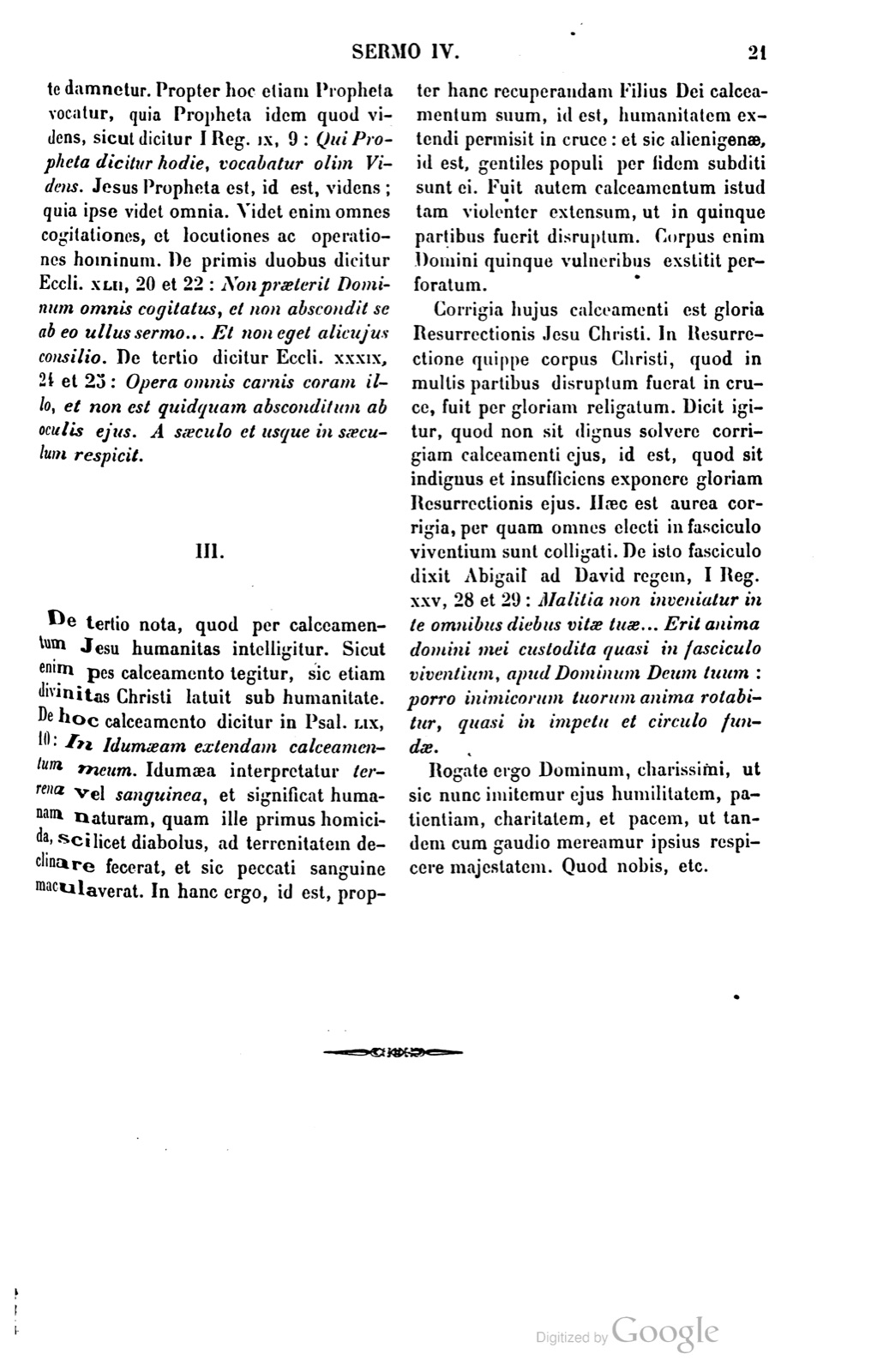
De tertio nota, quod per calceamentum Jesu humanitas intelligitur. Sicut enim pes calceamento tegitur, sic etiam divinitas Christi latuit sub humanitate. De hoc calceamento dicitur in Psal. LIX, 10: In Idumaeam extendam calceamentum meum. Idumaea interpretatur terrena vel sanguinea, et significat humanam naturam, quam ille primus homicida, scilicet diabolus, ad terrenitatem declinare fecerat, et sic peccati sanguine maculaverat. In hanc ergo, id est, propter hanc recuperandam Filius Dei calceamentum suum, id est, humanitatem extendi permisit in cruce: et sic alienigenae, id est, gentiles populi per fidem subditi sunt ei. Fuit autem calceamentum istud tam violenter extensum, ut in quinque partibus fuerit disruptum. Corpus enim Domini quinque vulneribus exstitit perforatum.
Corrigia hujus calceamenti est gloria Resurrectionis Jesu Christi. In Resurrectione quippe corpus Christi, quod in multis partibus disruptum fuerat in cruce, fuit per gloriam religatum. Dicit igitur, quod non sit dignus solvere corrigiam calceamenti ejus, id est, quod sit indignus et insufficiens exponere gloriam Resurrectionis ejus. Haec est aurea corrigia, per quam omnes electi in fasciculo viventium sunt colligati. De isto fasciculo dixit Abigail ad David regem, I Reg. XXV, 28 et 29: Malitia non inveniatur in te omnibus diebus vitae tuae... Erit anima domini mei custodita quasi in fasciculo viventium, apud Dominum Deum tuum: porro inimicorum tuorum anima rotabitur, quasi in impetu et circulo fundae.
Rogate ergo Dominum, charissimi, ut sic nunc imitemur ejus humilitatem, patientiam, charitatem, et pacem, ut tandem cum gaudio mereamur ipsius respicere majestatem. Quod nobis, etc.
Third, it is necessary that the judge be wise and discerning, namely so that he may know who is innocent and who is guilty, so that the innocent may be freed and honored, but the guilty be condemned to death. On account of this he is also called Prophet, because Prophet is the same as seeing, as is said in I Kings IX, 9: He who is today called Prophet was once called Seer. Jesus is Prophet, that is, seeing, because he sees all things. For he sees all thoughts and speeches and works of men. Concerning the first two it is said in Ecclesiasticus XLII, 20 and 22: No thought passes beyond the Lord, and no word hides itself from him... And he does not need anyone's counsel. Concerning the third it is said in Ecclesiasticus XXXIX, 24 and 23: The works of all flesh are before him, and there is nothing hidden from his eyes. From age to age he looks.
III.
Concerning the third, note that by the shoe of Jesus his humanity is understood. For just as a foot is covered by a shoe, so also the divinity of Christ lay hidden under humanity. Concerning this shoe it is said in Psalm LIX, 10: Into Idumaea I will extend my shoe. Idumaea is interpreted "earthly" or "bloody," and signifies human nature, which that first murderer, namely the devil, had made decline toward earthliness and had thus stained with the blood of sin. Therefore into this, that is, for the recovering of this, the Son of God allowed his shoe, that is, his humanity, to be stretched out on the cross; and thus foreigners, that is, the gentile peoples, were subjected to him through faith. But that shoe was stretched so violently that it was torn open in five parts. For the body of the Lord existed pierced through with five wounds.
The strap of this shoe is the glory of the Resurrection of Jesus Christ. For in the Resurrection the body of Christ, which had been torn open in many parts on the cross, was bound together again through glory. Therefore he says that he is not worthy to loose the strap of his shoe, that is, that he is unworthy and insufficient to expound the glory of his Resurrection. This is the golden strap through which all the elect are bound together in the bundle of the living. Concerning that bundle Abigail said to King David, I Kings XXV, 28 and 29: Let malice not be found in you all the days of your life... The soul of my lord will be kept as in the bundle of the living, with the Lord your God; but the soul of your enemies will be spun as in the force and circle of a sling.
Therefore pray to the Lord, dearest ones, that we may now imitate his humility, patience, charity, and peace in such a way that at last with joy we may deserve to behold his majesty. May he grant this to us, etc.
Notes
- John 1:29 and 30. (Joan. i, 29 et 30.) ↩
- Luke 2:7. (Luc. ii, 7.) ↩
- Ecclesiasticus 2:21. (Eccli. ii, 21.) ↩
- The Vulgate text has: For the one fearing the Lord it will be well at the last things. (Textus Vulg. habet: Timenti Dominum bene erit in extremis.) ↩
- Apocalypse 1:20. (Apoc. i, 20.) ↩
- Apocalypse 2:2. (Apoc. ii, 2.) ↩
- John 5:30. (Joan. v, 30.) ↩
If a page does not appear, its photograph has not been uploaded yet.