Works › Sermons for the Seasons of the Year
Volume 13 · pp. 13–16
Sermon III, Continuation and Conclusion
A marker with ≈ is an approximate page boundary, placed by measure of the text; the page photographs remain the authority. In the paired views, clicking a page marker brings that page into view.
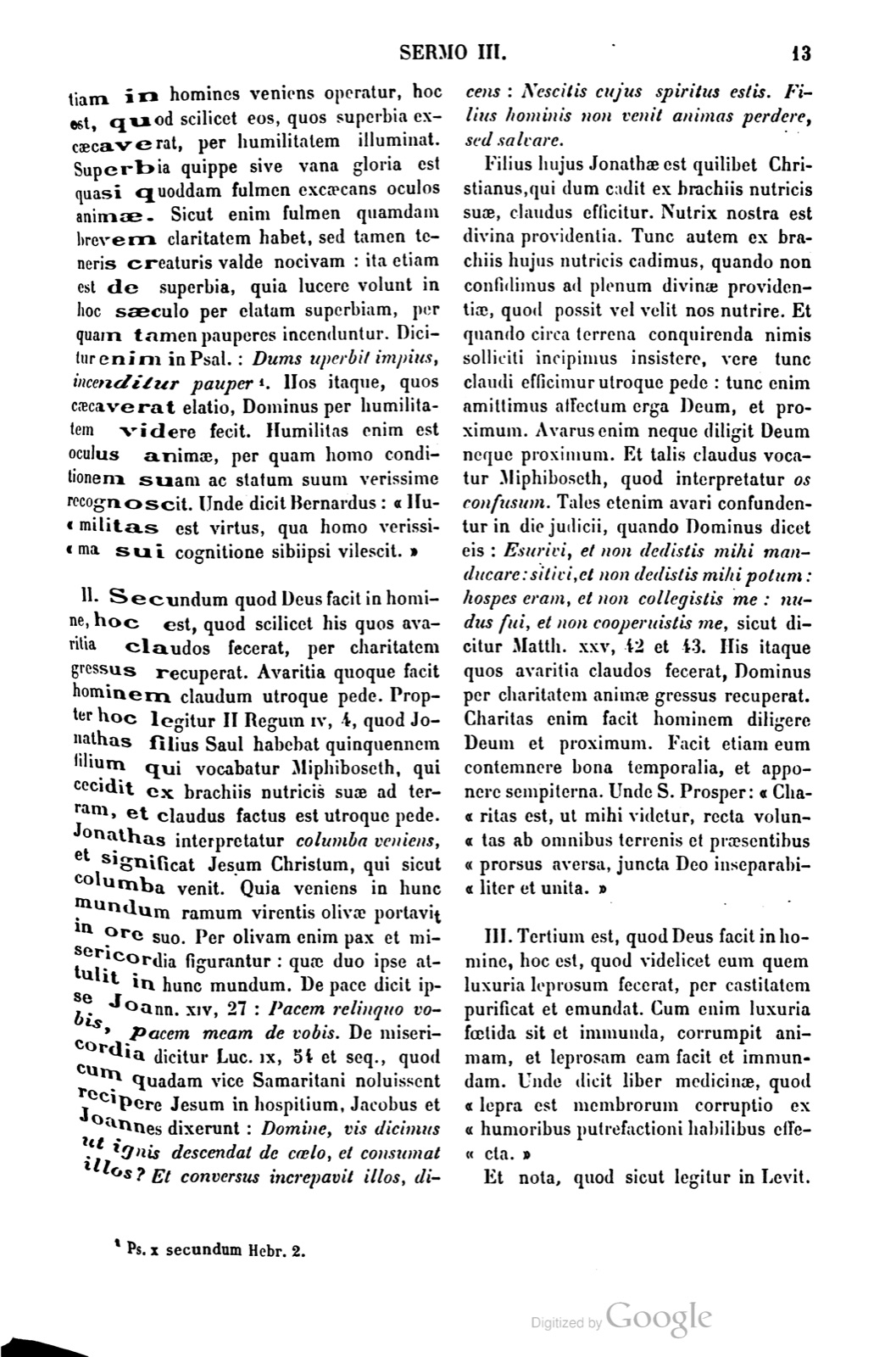
in homines veniens operatur, hoc est, quod scilicet eos, quos superbia excaecaverat, per humilitatem illuminat. Superbia quippe sive vana gloria est quasi quoddam fulmen excaecans oculos animae. Sicut enim fulmen quamdam brevem claritatem habet, sed tamen teneris creaturis valde nocivam: ita etiam est de superbia, quia lucere volunt in hoc saeculo per elatam superbiam, per quam tamen pauperes incenduntur. Dicitur enim in Psal.: Dums uperbit impius, incenditur pauper 1. Hos itaque, quos caecaverat elatio, Dominus per humilitatem videre fecit. Humilitas enim est oculus animae, per quam homo conditionem suam ac statum suum verissime recognoscit. Unde dicit Bernardus: «Humilitas est virtus, qua homo verissima sui cognitione sibiipsi vilescit.»
II. Secundum quod Deus facit in homine, hoc est, quod scilicet his quos avaritia claudos fecerat, per charitatem gressus recuperat. Avaritia quoque facit hominem claudum utroque pede. Propter hoc legitur II Regum IV, 4, quod Jonathas filius Saul habebat quinquennem filium qui vocabatur Miphiboseth, qui cecidit ex brachiis nutricis suae ad terram, et claudus factus est utroque pede. Jonathas interpretatur columba veniens, et significat Jesum Christum, qui sicut columba venit. Quia veniens in hunc mundum ramum virentis olivae portavit in ore suo. Per olivam enim pax et misericordia figurantur: quae duo ipse attulit in hunc mundum. De pace dicit ipse Joann. XIV, 27: Pacem relinquo vobis, pacem meam de vobis. De misericordia dicitur Luc. IX, 54 et seq., quod cum quadam vice Samaritani noluissent recipere Jesum in hospitium, Jacobus et Joannes dixerunt: Domine, vis dicimus ut ignis descendat de caelo, et consumat illos? Et conversus increpavit illos, dicens: Nescitis cujus spiritus estis. Filius hominis non venit animas perdere, sed salvare.
Filius hujus Jonathae est quilibet Christianus, qui dum cadit ex brachiis nutricis suae, claudus efficitur. Nutrix nostra est divina providentia. Tunc autem ex brachiis hujus nutricis cadimus, quando non confidimus ad plenum divinae providentiae, quod possit vel velit nos nutrire. Et quando circa terrena conquirenda nimis solliciti incipimus insistere, vere tunc claudi efficimur utroque pede: tunc enim amittimus affectum erga Deum, et proximum. Avarus enim neque diligit Deum neque proximum. Et talis claudus vocatur Miphiboseth, quod interpretatur os confusum. Tales etenim avari confundentur in die judicii, quando Dominus dicet eis: Esurivi, et non dedistis mihi manducare: sitivi, et non dedistis mihi potum: hospes eram, et non collegistis me: nudus fui, et non cooperuistis me, sicut dicitur Matth. XXV, 42 et 43. His itaque quos avaritia claudos fecerat, Dominus per charitatem animae gressus recuperat. Charitas enim facit hominem diligere Deum et proximum. Facit etiam eum contemnere bona temporalia, et apponere sempiterna. Unde S. Prosper: «Charitas est, ut mihi videtur, recta voluntas ab omnibus terrenis et praesentibus prorsus aversa, juncta Deo inseparabiliter et unita.»
III. Tertium est, quod Deus facit in homine, hoc est, quod videlicet eum quem luxuria leprosum fecerat, per castitatem purificat et emundat. Cum enim luxuria foetida sit et immunda, corrumpit animam, et leprosam eam facit et immundam. Unde dicit liber medicinae, quod «lepra est membrorum corruptio ex humoribus putrefactioni habilibus effecta.» Et nota, quod sicut legitur in Levit. XI, et seq., quadruplex est species leprae, scilicet in cute, in capillis, in veste, et in domo.
coming into human beings, works this, namely, that those whom pride had blinded he enlightens through humility. For pride, or vain glory, is like a certain thunderbolt blinding the eyes of the soul. For just as a thunderbolt has a certain brief brightness, but nevertheless is very harmful to tender creatures, so also it is with pride, because people wish to shine in this age through lofty pride, through which nevertheless the poor are set on fire. For it is said in the Psalm: When the impious man is proud, the poor man is set on fire 1. Therefore those whom elation had blinded, the Lord made to see through humility. For humility is the eye of the soul, through which a man most truly recognizes his own condition and his own state. Hence Bernard says: "Humility is the virtue by which a man, by most true knowledge of himself, becomes vile to himself."
II. The second thing that God does in a man is this, namely, that for those whom avarice had made lame, he restores their steps through charity. Avarice also makes a man lame in both feet. On account of this it is read in II Kings IV, 4, that Jonathan the son of Saul had a five-year-old son who was called Miphiboseth, who fell from the arms of his nurse to the ground, and was made lame in both feet. Jonathan is interpreted "a dove coming," and signifies Jesus Christ, who came like a dove. For coming into this world he carried in his mouth a branch of green olive. By the olive, peace and mercy are figured; these two things he himself brought into this world. Concerning peace he himself says, John XIV, 27: Peace I leave to you, my peace from you. Concerning mercy it is said in Luke IX, 54 and following, that when on a certain occasion the Samaritans had been unwilling to receive Jesus in lodging, James and John said: Lord, do you wish that we say that fire should descend from heaven and consume them? And turning, he rebuked them, saying: You do not know of whose spirit you are. The Son of Man did not come to destroy souls, but to save.
The son of this Jonathan is any Christian, who, when he falls from the arms of his nurse, is made lame. Our nurse is divine providence. But then we fall from the arms of this nurse, when we do not trust fully in divine providence, that it can or wills to nourish us. And when we begin to apply ourselves too anxiously to acquiring earthly things, then truly we are made lame in both feet: for then we lose affection toward God and toward our neighbor. For the avaricious man loves neither God nor neighbor. And such a lame man is called Miphiboseth, which is interpreted "confused mouth." For such avaricious men will be confounded on the day of judgment, when the Lord will say to them: I was hungry, and you did not give me to eat; I was thirsty, and you did not give me drink; I was a guest, and you did not gather me in; I was naked, and you did not cover me, as is said in Matthew XXV, 42 and 43. Therefore for those whom avarice had made lame, the Lord restores the steps of the soul through charity. For charity makes a man love God and neighbor. It also makes him despise temporal goods and set his heart upon everlasting goods. Hence Saint Prosper says: "Charity is, as it seems to me, a right will turned wholly away from all earthly and present things, joined inseparably and united to God."
III. The third thing is what God does in a man, namely, that the one whom lust had made leprous, he purifies and cleanses through chastity. For since lust is foul and unclean, it corrupts the soul and makes it leprous and unclean. Hence the book of medicine says that "leprosy is a corruption of the members, produced from humors liable to putrefaction." And note that, as is read in Leviticus XI and following, there is a fourfold kind of leprosy, namely in the skin, in the hair, in clothing, and in a house.
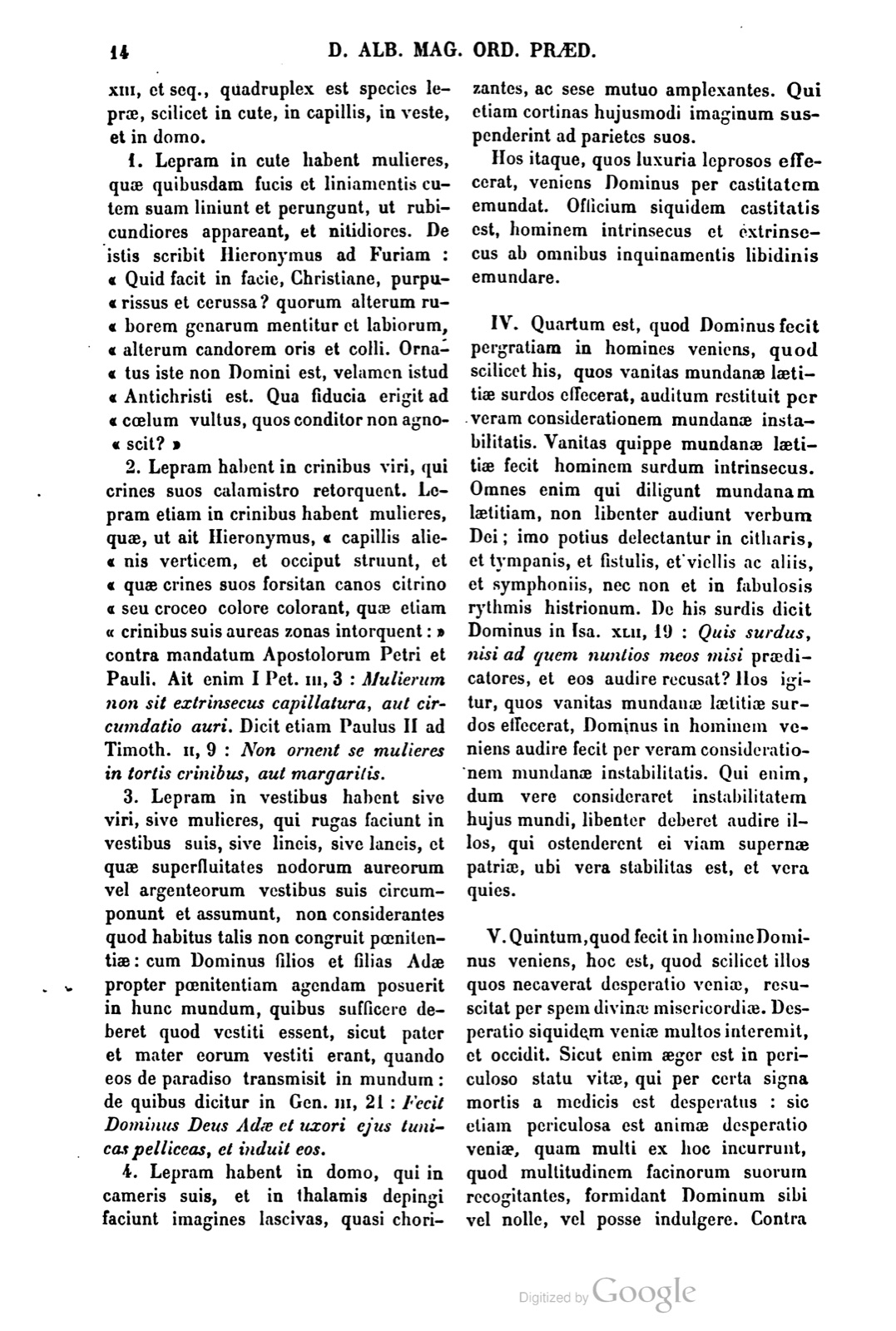
1. Lepram in cute habent mulieres, quae quibusdam fucis et liniamentis cutem suam liniunt et perungunt, ut rubicundiores appareant, et nitidiores. De istis scribit Hieronymus ad Furiam: «Quid facit in facie, Christiane, purpurissus et cerussa? quorum alterum ruborem genarum mentitur et labiorum, alterum candorem oris et colli. Ornatus iste non Domini est, velamen istud Antichristi est. Qua fiducia erigit ad caelum vultus, quos conditor non agnoscit?»
2. Lepram habent in crinibus viri, qui crines suos calamistro retorquent. Lepram etiam in crinibus habent mulieres, quae, ut ait Hieronymus, «capillis alienis verticem, et occiput struunt, et quae crines suos forsitan canos citrino seu croceo colore colorant, quae etiam crinibus suis aureas zonas intorquent»: contra mandatum Apostolorum Petri et Pauli. Ait enim I Pet. III, 3: Mulierum non sit extrinsecus capillatura, aut circumdatio auri. Dicit etiam Paulus II ad Timoth. II, 9: Non ornent se mulieres in tortis crinibus, aut margaritis.
3. Lepram in vestibus habent sive viri, sive mulieres, qui rugas faciunt in vestibus suis, sive lineis, sive laneis, et quae superfluitates nodorum aureorum vel argenteorum vestibus suis circumponunt et assumunt, non considerantes quod habitus talis non congruit paenitentiae: cum Dominus filios et filias Adae propter paenitentiam agendam posuerit in hunc mundum, quibus sufficere deberet quod vestiti essent, sicut pater et mater eorum vestiti erant, quando eos de paradiso transmisit in mundum: de quibus dicitur in Gen. III, 21: Fecit Dominus Deus Adae et uxori ejus tunicas pelliceas, et induit eos.
4. Lepram habent in domo, qui in cameris suis, et in thalamis depingi faciunt imagines lascivas, quasi chorizantes, ac sese mutuo amplexantes. Qui etiam cortinas hujusmodi imaginum suspenderint ad parietes suos. Hos itaque, quos luxuria leprosos effecerat, veniens Dominus per castitatem emundat. Officium siquidem castitatis est, hominem intrinsecus et extrinsecus ab omnibus inquinamentis libidinis emundare.
IV. Quartum est, quod Dominus fecit per gratiam in homines veniens, quod scilicet his, quos vanitas mundanae laetitiae surdos effecerat, auditum restituit per veram considerationem mundanae instabilitatis. Vanitas quippe mundanae laetitiae fecit hominem surdum intrinsecus. Omnes enim qui diligunt mundanam laetitiam, non libenter audiunt verbum Dei; imo potius delectantur in citharis, et tympanis, et fistulis, et viellis ac aliis, et symphoniis, nec non et in fabulosis rythmis histrionum. De his surdis dicit Dominus in Isa. XLII, 19: Quis surdus, nisi ad quem nuntios meos misi praedicatores, et eos audire recusat? Hos igitur, quos vanitas mundanae laetitiae surdos effecerat, Dominus in hominem veniens audire fecit per veram considerationem mundanae instabilitatis. Qui enim dum vere consideraret instabilitatem hujus mundi, libenter deberet audire illos, qui ostenderent ei viam supernae patriae, ubi vera stabilitas est, et vera quies.
1. Women have leprosy in the skin who smear and anoint their skin with certain cosmetics and ointments, so that they may appear redder and brighter. Concerning these Jerome writes to Furia: "What do purple dye and white lead do on the face, Christian woman? one of which counterfeits the redness of cheeks and lips, the other the whiteness of face and neck. That adornment is not the Lord's; that veil is Antichrist's. With what confidence does she raise to heaven faces which the Creator does not recognize?"
2. Men have leprosy in the hair who curl their hair with a curling iron. Women also have leprosy in the hair who, as Jerome says, "build up the crown and the back of the head with others' hair, and who perhaps color their gray hairs with citron-yellow or saffron color, who also twist golden bands into their hair": against the command of the Apostles Peter and Paul. For I Peter III, 3 says: Let women's adornment not be outward braiding of hair or encircling with gold. Paul also says in II Timothy II, 9: Let women not adorn themselves with braided hair or pearls.
3. Men or women have leprosy in garments who make folds in their garments, whether linen or woolen, and who place around and take on their garments excesses of golden or silver knots, not considering that such attire does not befit penance, since the Lord placed the sons and daughters of Adam in this world for doing penance; it ought to have sufficed them that they were clothed as their father and mother were clothed when he sent them from paradise into the world, concerning whom it is said in Genesis III, 21: The Lord God made tunics of skins for Adam and his wife, and clothed them.
4. They have leprosy in the house who cause lascivious images to be painted in their chambers and bedrooms, as though dancing in chorus and mutually embracing one another. They also hang curtains of images of this sort on their walls. Therefore those whom lust had made leprous, the Lord, coming, cleanses through chastity. Indeed the office of chastity is to cleanse a man inwardly and outwardly from all defilements of lust.
IV. The fourth thing that the Lord did, coming through grace into human beings, is that, namely, for those whom the vanity of worldly gladness had made deaf, he restores hearing through the true consideration of worldly instability. For the vanity of worldly gladness made man inwardly deaf. For all who love worldly gladness do not willingly hear the word of God; rather they delight in harps, drums, pipes, vielles and other things, and harmonies, and also in the fabulous rhythms of performers. Concerning these deaf persons the Lord says in Isaiah XLII, 19: Who is deaf, except the one to whom I sent my messengers, the preachers, and he refuses to hear them? Therefore those whom the vanity of worldly gladness had made deaf, the Lord, coming into man, made hear through the true consideration of worldly instability. For one who would truly consider the instability of this world ought gladly to hear those who would show him the way of the heavenly homeland, where there is true stability and true rest.
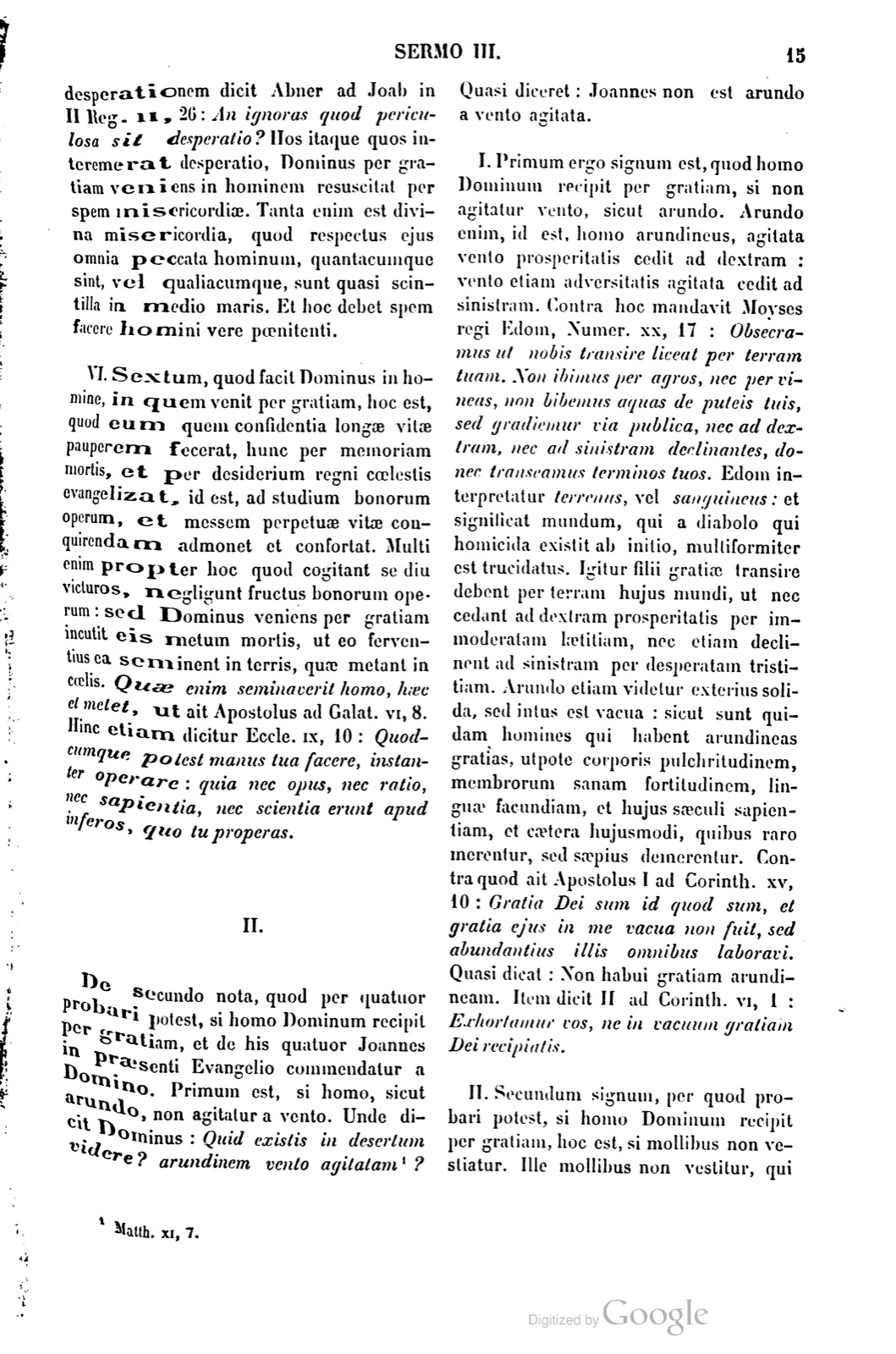
V. Quintum, quod fecit in homine Dominus veniens, hoc est, quod scilicet illos quos necaverat desperatio veniae, resuscitat per spem divinae misericordiae. Desperatio siquidem veniae multos interemit, et occidit. Sicut enim aeger est in periculoso statu vitae, qui per certa signa mortis a medicis est desperatus: sic etiam periculosa est animae desperatio veniae, quam multi ex hoc incurrunt, quod multitudinem facinorum suorum recogitantes, formidant Dominum sibi vel nolle, vel posse indulgere. Contra desperationem dicit Abner ad Joab in II Reg. II, 26: An ignoras quod periculosa sit desperatio? Illos itaque quos interemerat desperatio, Dominus per gratiam veniens in hominem resuscitat per spem misericordiae. Tanta enim est divina misericordia, quod respectus ejus omnia peccata hominum, quantacumque sint, vel qualiacumque, sunt quasi scintilla in medio maris. Et hoc debet spem facere homini vere paenitenti.
VI. Sextum, quod facit Dominus in homine, in quem venit per gratiam, hoc est, quod eum quem confidentia longae vitae pauperem fecerat, hunc per memoriam mortis, et per desiderium regni caelestis evangelizat, id est, ad studium bonorum operum, et messem perpetuae vitae conquirendam admonet et confortat. Multi enim propter hoc quod cogitant se diu victuros, negligunt fructus bonorum operum: sed Dominus veniens per gratiam incutit eis metum mortis, ut eo ferventius ea seminent in terris, quae metant in caelis. Quae enim seminaverit homo, haec et metet, ut ait Apostolus ad Galat. VI, 8. Hinc etiam dicitur Eccle. IX, 10: Quodcumque potest manus tua facere, instanter operare: quia nec opus, nec ratio, nec sapientia, nec scientia erunt apud inferos, quo tu properas.
II.
De secundo nota, quod per quatuor probari potest, si homo Dominum recipit per gratiam in praesenti, et de his quatuor Joannes a Domino in Evangelio commendatur. Primum est, si homo, sicut arundo, non agitatur a vento. Unde dicit Dominus: Quid existis in desertum videre? arundinem vento agitatam 2? Quasi diceret: Joannes non est arundo a vento agitata.
I. Primum ergo signum est, quod homo Dominum recipit per gratiam, si non agitatur vento, sicut arundo. Arundo enim, id est, homo arundineus, agitata vento prosperitatis cedit ad dextram: vento etiam adversitatis agitata cedit ad sinistram. Contra hoc mandavit Moyses regi Edom, Numer. XX, 17: Obsecramus ut nobis transire liceat per terram tuam. Non ibimus per agros, nec per vineas, non bibemus aquas de puteis tuis, sed gradiemur via publica, nec ad dextram, nec ad sinistram declinantes, donec transeamus terminos tuos. Edom interpretatur terrenus, vel sanguineus: et significat mundum, qui a diabolo qui homicida existit ab initio, multiformiter est trucidatus. Igitur filii gratiae transire debent per terram hujus mundi, ut nec cedant ad dextram prosperitatis per immoderatam laetitiam, nec etiam declinent ad sinistram per desperatam tristitiam. Arundo etiam videtur exterius solida, sed intus est vacua: sicut sunt quidam homines qui habent arundineas gratias, utpote corporis pulchritudinem, membrorum sanam fortitudinem, linguae facundiam, et hujus saeculi sapientiam, et caetera hujusmodi, quibus raro merentur, sed saepius demerentur. Contra quod ait Apostolus I ad Corinth. XV, 10: Gratia Dei sum id quod sum, et gratia ejus in me vacua non fuit, sed abundantius illis omnibus laboravi. Quasi dicat: Non habui gratiam arundineam. Item dicit II ad Corinth. VI, 1: Exhortamur vos, ne in vacuum gratiam Dei recipiatis.
V. The fifth thing that the Lord, coming, did in man is this, namely, that those whom despair of pardon had killed, he raises again through hope of divine mercy. Indeed despair of pardon has slain and killed many. For just as a sick man is in a dangerous state of life when by certain signs of death he has been despaired of by physicians, so also despair of pardon for the soul is dangerous, which many incur from this, that, thinking again upon the multitude of their crimes, they fear that the Lord either does not wish or is not able to forgive them. Against despair Abner says to Joab in II Kings II, 26: Do you not know that despair is dangerous? Therefore those whom despair had killed, the Lord, coming through grace into man, raises again through hope of mercy. For divine mercy is so great that, with respect to it, all the sins of men, however many they are, or of whatever kind, are like a spark in the midst of the sea. And this ought to make hope for a truly penitent man.
VI. The sixth thing that the Lord does in a man into whom he comes through grace is this, that the one whom confidence in a long life had made poor, this one he evangelizes through the memory of death and through the desire of the heavenly kingdom, that is, he admonishes and strengthens him for the pursuit of good works and for acquiring the harvest of perpetual life. For many, because they think that they will live long, neglect the fruits of good works; but the Lord, coming through grace, strikes into them fear of death, so that with so much more fervor they may sow those things on earth which they may reap in heaven. For what a man will have sown, this also he will reap, as the Apostle says to the Galatians VI, 8. Hence it is also said in Ecclesiastes IX, 10: Whatever your hand is able to do, do it earnestly, because neither work, nor reason, nor wisdom, nor knowledge will be among the dead, whither you are hastening.
II.
Concerning the second, note that it can be proved through four things whether a man receives the Lord through grace in the present, and concerning these four things John is commended by the Lord in the Gospel. The first is if a man, like a reed, is not shaken by the wind. Hence the Lord says: What did you go out into the desert to see? a reed shaken by the wind 2? As though he said: John is not a reed shaken by the wind.
I. Therefore the first sign that a man receives the Lord through grace is if he is not shaken by the wind like a reed. For a reed, that is, a reed-like man, when shaken by the wind of prosperity, yields to the right; when shaken also by the wind of adversity, he yields to the left. Against this Moses commanded the king of Edom, Numbers XX, 17: We beseech you that we may be permitted to pass through your land. We shall not go through fields, nor through vineyards, we shall not drink waters from your wells, but we shall walk by the public road, turning neither to the right nor to the left, until we pass your borders. Edom is interpreted "earthly" or "bloody," and signifies the world, which by the devil, who exists as a murderer from the beginning, has been slaughtered in many forms. Therefore the sons of grace ought to pass through the land of this world, so that they neither yield to the right of prosperity through immoderate gladness, nor turn aside to the left through desperate sadness. A reed also seems outwardly solid, but within it is empty; so there are certain men who have reed-like graces, such as beauty of body, sound strength of members, eloquence of tongue, and the wisdom of this age, and other such things, by which they rarely merit, but more often demerit. Against this the Apostle says in I Corinthians XV, 10: By the grace of God I am what I am, and his grace in me was not empty, but I labored more abundantly than all of them. As though he said: I did not have reed-like grace. Likewise he says in II Corinthians VI, 1: We exhort you not to receive the grace of God in vain.
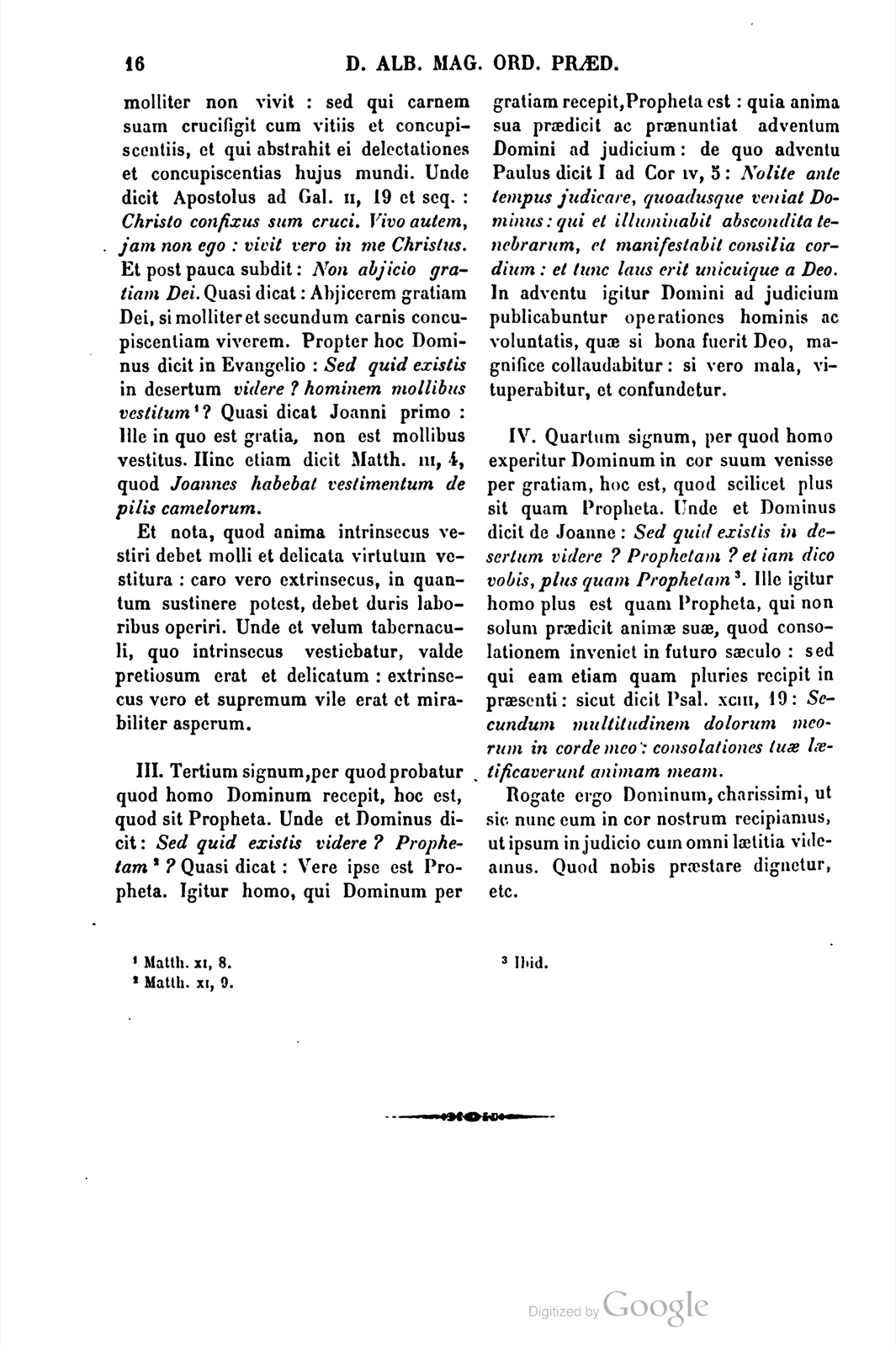
II. Secundum signum, per quod probari potest, si homo Dominum recipit per gratiam, hoc est, si mollibus non vestiatur. Ille mollibus non vestitur, qui molliter non vivit: sed qui carnem suam crucifigit cum vitiis et concupiscentiis, et qui abstrahit ei delectationes et concupiscentias hujus mundi. Unde dicit Apostolus ad Gal. I, 19 et seq.: Christo confixus sum cruci. Vivo autem, jam non ego: vivit vero in me Christus. Et post pauca subdit: Non abjicio gratiam Dei. Quasi dicat: Abjicerem gratiam Dei, si molliter et secundum carnis concupiscentiam viverem. Propter hoc Dominus dicit in Evangelio: Sed quid existis in desertum videre? hominem mollibus vestitum 3? Quasi dicat Joanni primo: Ille in quo est gratia, non est mollibus vestitus. Hinc etiam dicit Matth. I, 4, quod Joannes habebat vestimentum de pilis camelorum.
Et nota, quod anima intrinsecus vestiri debet molli et delicata virtutum vestitura: caro vero extrinsecus, in quantum sustinere potest, debet duris laboribus operiri. Unde et velum tabernaculi, quo intrinsecus vestiebatur, valde pretiosum erat et delicatum: extrinsecus vero et supremum vile erat et mirabiliter asperum.
III. Tertium signum, per quod probatur quod homo Dominum recepit, hoc est, quod sit Propheta. Unde et Dominus dicit: Sed quid existis videre? Prophetam 4? Quasi dicat: Vere ipse est Propheta. Igitur homo, qui Dominum per gratiam recepit, Propheta est: quia anima sua praedicit ac praenuntiat adventum Domini ad judicium: de quo adventu Paulus dicit I ad Cor. IV, 5: Nolite ante tempus judicare, quoadusque veniat Dominus: qui et illuminabit abscondita tenebrarum, et manifestabit consilia cordium: et tunc laus erit unicuique a Deo. In adventu igitur Domini ad judicium publicabuntur operationes hominis ac voluntatis, quae si bona fuerit Deo, magnifice collaudabitur: si vero mala, vituperabitur, et confundetur.
IV. Quartum signum, per quod homo experitur Dominum in cor suum venisse per gratiam, hoc est, quod scilicet plus sit quam Propheta. Unde et Dominus dicit de Joanne: Sed quid existis in desertum videre? Prophetam? et iam dico vobis, plus quam Prophetam 5. Ille igitur homo plus est quam Propheta, qui non solum praedicit animae suae, quod consolationem inveniet in futuro saeculo: sed qui eam etiam quam pluries recipit in praesenti: sicut dicit Psal. XCII, 19: Secundum multitudinem dolorum meorum in corde meo: consolationes tuae laetificaverunt animam meam.
Rogate ergo Dominum, charissimi, ut sic nunc eum in cor nostrum recipiamus, ut ipsum in judicio cum omni laetitia videamus. Quod nobis praestare dignetur, etc.
II. The second sign by which it can be proved whether a man receives the Lord through grace is this, if he is not clothed in soft garments. He is not clothed in soft garments who does not live softly, but who crucifies his flesh with vices and concupiscences, and who withdraws from it the delights and concupiscences of this world. Hence the Apostle says to the Galatians I, 19 and following: I have been fixed with Christ to the cross. Now I live, no longer I; but Christ lives in me. And after a few words he adds: I do not cast away the grace of God. As though he said: I would cast away the grace of God if I lived softly and according to the concupiscence of the flesh. On account of this the Lord says in the Gospel: But what did you go out into the desert to see? a man clothed in soft garments 3? As though he said first concerning John: He in whom there is grace is not clothed in soft garments. Hence also Matthew I, 4 says that John had a garment of camel hairs.
And note that the soul inwardly ought to be clothed with the soft and delicate clothing of virtues; but the flesh outwardly, so far as it can sustain it, ought to be covered with hard labors. Hence also the veil of the tabernacle, with which it was clothed inwardly, was very precious and delicate; but outwardly the highest covering was cheap and wonderfully rough.
III. The third sign by which it is proved that a man has received the Lord is this, that he is a Prophet. Hence the Lord also says: But what did you go out to see? a Prophet 4? As though he said: Truly he is the Prophet. Therefore the man who has received the Lord through grace is a Prophet, because his soul predicts and announces beforehand the coming of the Lord to judgment; concerning this coming Paul says in I Corinthians IV, 5: Do not judge before the time, until the Lord comes, who will both illuminate the hidden things of darkness and manifest the counsels of hearts; and then there will be praise for each one from God. Therefore at the coming of the Lord to judgment the works of a man and of his will will be made public; if it has been good toward God, it will be magnificently praised; but if evil, it will be reproached and confounded.
IV. The fourth sign by which a man experiences that the Lord has come into his heart through grace is this, namely, that he is more than a Prophet. Hence the Lord also says about John: But what did you go out into the desert to see? a Prophet? and now I say to you, more than a Prophet 5. Therefore that man is more than a Prophet who not only predicts to his soul that it will find consolation in the future age, but who also receives that consolation many times in the present, as Psalm XCII, 19 says: According to the multitude of my sorrows in my heart, your consolations have gladdened my soul.
Therefore pray to the Lord, dearest ones, that we may now receive him into our heart in such a way that we may see him in judgment with all gladness. May he deign to grant this to us, etc.
If a page does not appear, its photograph has not been uploaded yet.