Volume 13 · pp. 612–615
Sermon LI. On the Feast of Blessed Catherine, Virgin
A marker with ≈ is an approximate page boundary, placed by measure of the text; the page photographs remain the authority. In the paired views, clicking a page marker brings that page into view.
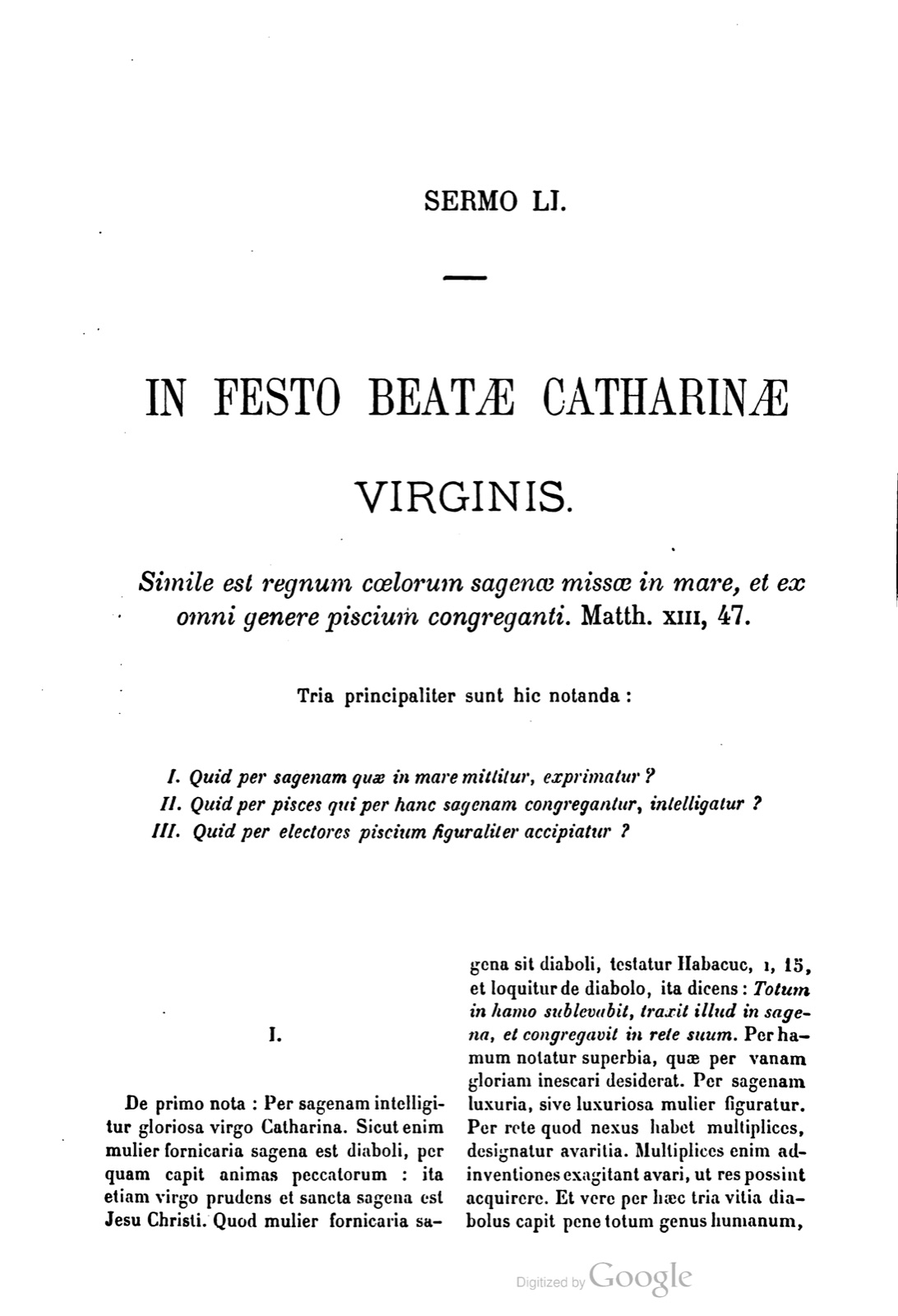
SERMO LI.
IN FESTO BEATÆ CATHARINÆ VIRGINIS.
Simile est regnum cælorum sagenæ missæ in mare, et ex omni genere piscium congreganti. Matth. XIII, 47.
Tria principaliter sunt hic notanda:
I. Quid per sagenam quæ in mare mittitur, exprimatur? II. Quid per pisces qui per hanc sagenam congregantur, intelligatur? III. Quid per electores piscium figuraliter accipiatur?
I.
De primo nota: Per sagenam intelligitur gloriosa virgo Catharina. Sicut enim mulier fornicaria sagena est diaboli, per quam capit animas peccatorum: ita etiam virgo prudens et sancta sagena est Jesu Christi. Quod mulier fornicaria sagena sit diaboli, testatur Habacuc, I, 15, et loquitur de diabolo, ita dicens: Totum in hamo sublevabit, traxit illud in sagena, et congregavit in rete suum. Per hamum notatur superbia, quæ per vanam gloriam inescari desiderat. Per sagenam luxuria, sive luxuriosa mulier figuratur. Per rete quod nexus habet multiplices, designatur avaritia. Multiplices enim adinventiones exagitant avari, ut res possint acquirere. Et vere per hæc tria vitia diabolus capit pene totum genus humanum, et præterea incrassata est pars ejus, et pauci sunt quos Dominus comprehendat.
Igitur Beata Catharina, quia virgo fuit prudens et sancta, sagena fuit Jesu Christi. Hæc enim per prudentiam a Deo sibi collatam cepit quinquaginta magnos Rhetores et Oratores eximios, qui per eam ad fidem conversi, per martyrium ad Dominum pervenerunt. Hæc etiam per sanctitatem virginitatis suæ ipsam reginam Maximini conjugem, et Porphyrium principem militiæ cum multis militibus cepit Christo. Omnes enim ipsi per istam crediderunt, et pro Christo passi fuerunt.
Multum ergo diabolus invidit huic pretiosæ sagenæ, quapropter diversis machinationibus nisus est eam disrumpere per exsecutorem nequitiæ suæ Maximinum. Maximinus enim instigatus a diabolo, præcepit Catharinam nudam cædi, et post in carcerem tenebrosum recludi, inhibuit etiam ne vel panis vel aqua daretur virgini: sed Dominus suam fidelem sagenam non derelinquens, per candidam columbam ipsam in carcere pavit, et per Angelos sua vulnera curavit, ipsumque carcerem copioso lumine illustravit. Post hæc jussit Maximinus ut virgo per quatuor rotas, quarum radiis infixi erant acutissimi clavi, discerperetur: sed Dominus suam sagenam miraculose conservavit illæsam. Demum ut hæc sagena laboris ac utilitatis suæ præmium reciperet, a Domino decollatur. Decollata vero ab Angelis in montem Sinai transportatur, ibique sepulturæ honorifice commendatur, ubi tunc stillare cœpit, et adhuc distillat humorem sanitatis ac gratiæ, quo ipsa a Christo ipsius sponso copiosissime inuncta fuerat et irrigata.
SERMON LI.
ON THE FEAST OF BLESSED CATHERINE, VIRGIN.
The kingdom of heaven is like a net cast into the sea and gathering from every kind of fish. Matthew 13:47.
Three things are principally to be noted here:
I. What is expressed by the net that is cast into the sea? II. What is understood by the fish that are gathered through this net? III. What is figuratively received by the selectors of the fish?
I.
Concerning the first, note: By the net is understood the glorious virgin Catherine. For just as a fornicating woman is the devil's net, through which he captures the souls of sinners, so also a prudent and holy virgin is the net of Jesus Christ. That a fornicating woman is the devil's net Habakkuk 1:15 testifies, and it speaks concerning the devil, saying thus: He will lift up the whole with the hook; he drew it into the net and gathered it into his dragnet. By the hook is marked pride, which desires to be baited through vain glory. By the net luxury, or a luxurious woman, is figured. By the dragnet, which has manifold knots, avarice is designated. For avaricious persons stir up manifold contrivances so that they may acquire things. And truly through these three vices the devil captures almost the whole human race; and besides this his portion has been fattened, and few are those whom the Lord may comprehend.
Therefore Blessed Catherine, because she was a prudent and holy virgin, was the net of Jesus Christ. For through prudence conferred upon her by God she captured fifty great Rhetoricians and excellent Orators, who, converted through her to the faith, came to the Lord through martyrdom. She also through the sanctity of her virginity captured for Christ the queen herself, the wife of Maximinus, and Porphyry the commander of the soldiers with many soldiers. For they all believed through her and suffered for Christ.
Therefore the devil greatly envied this precious net, on account of which by diverse contrivances he tried to break it through Maximinus, the executor of his wickedness. For Maximinus, instigated by the devil, ordered Catherine to be beaten naked and afterward to be shut in a dark prison; he also forbade either bread or water to be given to the virgin. But the Lord, not abandoning his faithful net, fed her in prison through a white dove, and through Angels healed her wounds, and illuminated the prison itself with abundant light. After this Maximinus ordered that the virgin be torn apart by four wheels, in whose spokes very sharp nails had been fixed; but the Lord miraculously preserved his net unharmed. Then, so that this net might receive the reward of her labor and usefulness, she is beheaded by the Lord. But once beheaded, she is carried by Angels to Mount Sinai, and there is honorably commended to burial, where then she began to drip, and still drips, the moisture of health and grace, with which she had been most abundantly anointed and watered by Christ her bridegroom.
Et nota, quod hæc sagena largum pietatis sinum habebat. Cum enim decollanda esset, oravit ad Dominum, ut quicumque passionis suæ memoriam agerent, quicumque etiam in exitu animæ suæ, vel in alia quacumque necessitate eam invocarent, propitiationis divinæ celerem consequerentur effectum, et quod fugerent ab his qui ejus auxilium fideliter implorarent, pestilentiæ, fames, morbus, et clades, et omnis auræ intemperies. Oratione completa, vox de cœlo insonuit promittens ei, quod in omnibus suis petitionibus a Domino foret exaudita.
Imitemur et nos, charissimi, hujus virginis prudentiam, castitatem et pietatem, ut videlicet per prudentiam astutias diaboli caveamus, et per castitatem inquinamenta sæculi fugiamus, per pietatem vero bonis operibus insistamus.
Et NOTA, quod multum indigemus prudentia sive sapientia contra dolos ac versutias diaboli. Ipse enim multa vasa concupiscentiarum offert animæ, ut saltem anima aliquam illarum acceptet. Unde legitur, quod Abbas Macarius quadam vice vidit diabolum euntem ad quoddam claustrum, qui habebat multas pyxides circum circa se pendentes. Quæsivit autem Beatus Macarius quid esset in illis pyxidibus: cui respondit diabolus quod plenæ essent diversis speciebus, et ideo tot secum portaret, ut si alicui non placeret quod esset in una pyxide, daret ei de alia, et sic per ordinem omnes offerret, ut saltem aliquam illarum acceptaret. Castitate etiam indigemus, quia sine ea carnis spurcitias ac sæculi immunditias pertransire non possumus. Indigemus etiam pietate, quia sine ea vacui, et sine fructu bonorum operum in divino examine inveniremur.
And note that this net had a broad bosom of piety. For when she was to be beheaded, she prayed to the Lord that whoever should keep the memory of her passion, whoever also at the departure of his soul or in any other necessity should invoke her, would attain the swift effect of divine propitiation, and that pestilences, famines, disease, slaughter, and every intemperateness of the air would flee from those who faithfully implored her aid. When the prayer was completed, a voice sounded from heaven, promising her that in all her petitions she would be heard by the Lord.
Let us also imitate, dearly beloved, the prudence, chastity, and piety of this virgin, namely so that through prudence we may beware of the devil's craftiness, and through chastity we may flee the stains of the age, but through piety we may persist in good works.
And NOTE that we greatly need prudence or wisdom against the deceits and wiles of the devil. For he offers many vessels of concupiscences to the soul, so that at least the soul may accept one of them. Hence it is read that Abbot Macarius on a certain occasion saw the devil going to a certain cloister, who had many little boxes hanging around him on every side. But Blessed Macarius asked what was in those little boxes; the devil answered him that they were full of diverse kinds, and that therefore he carried so many with him, so that if what was in one box did not please someone, he might give him from another, and so might offer all in order, that at least he would accept one of them. We also need chastity, because without it we cannot pass through the filths of the flesh and the uncleannesses of the age. We also need piety, because without it we would be found empty and without fruit of good works in the divine examination.
NOTA etiam, quod per sagenam divina benignitas exprimitur. Per mare vero mundus iste figuratur, qui ad similitudinem maris inquietus est et amarus: foris enim hominem per plurimas perturbationes inquietat, intus autem per varias sollicitudines amaricat: quod recognovit Paulus, ita dicens II ad Corinth. VII, 5: Nullam requiem habuit caro nostra, sed omnem tribulationem passi sumus: Foris pugnæ, intus timores. Igitur per sagenam divina benignitas exprimitur, quam Deus misit in mare hujus mundi, ut per eam homines trahat ad salutem sive bonos sive malos. Ipse enim non venit tantum vocare justos, sed etiam peccatores, sicut per semetipsum testatur, Matth. IX, 13: Non veni, inquit, vocare justos, sed peccatores.
De hujus sagenæ missione in mare dicit Paulus ad Titum, III, 4, et seq.: Cum benignitas, et humanitas apparuit Salvatoris nostri Dei: non ex operibus justitiæ quæ fecimus nos, sed secundum misericordiam salvos nos fecit: ut justificati gratia ipsius, hæredes simus secundum spem vitæ æternæ. Bona est hæc sagena, quæ ad hoc homines capere nititur, ut habeant vitam æternam. Contrarium facit diabolus, qui propter hoc capit homines, ut morte moriantur æterna.
II.
De secundo nota: Per pisces homines figurantur. Unde dicitur Habacuc, I, 14: Facies homines quasi pisces maris. Ex omni ergo genere piscium, id est, ex omni genere hominum, congregat sagena divinæ benignitatis: Non est enim personarum acceptio apud Deum 1. Non est distinctio Judæi et Græci: nam idem Dominus omnium, dives in omnes, qui invocant illum, sicut dicit Apostolus ad Rom. X, 12. Congregat ergo sagena, id est, benignitas Domini omnes indifferenter, usquequo impleatur. Tunc vero implebitur, cum completus fuerit numerus electorum.
Cum autem impleta fuerit hæc sagena, educetur ad littus. Per littus namque intelligitur judicialis examinatio. In divino enim judicio examinabuntur pisces, id est, homines, quales videlicet fuerint, sive boni, sive mali: propter quod dicit Apostolus, II ad Corinth. V, 10: Omnes nos manifestari oportet ante tribunal Christi, ut referat unusquisque propria corporis, prout gessit, sive bonum, sive malum.
NOTE also that by the net divine benignity is expressed. But by the sea this world is figured, which in the likeness of the sea is restless and bitter; for outwardly it makes a human being restless through very many disturbances, but inwardly it makes him bitter through various anxieties. Paul recognized this, speaking thus in 2 Corinthians 7:5: Our flesh had no rest, but we suffered every tribulation: fightings outside, fears within. Therefore by the net divine benignity is expressed, which God sent into the sea of this world, so that through it he might draw human beings to salvation, whether good or evil. For he did not come only to call the just, but also sinners, as he testifies through himself, Matthew 9:13: I did not come, he says, to call the just, but sinners.
Concerning the sending of this net into the sea Paul says to Titus 3:4 and following: When the benignity and humanity of God our Savior appeared, not from works of justice that we did, but according to mercy he saved us, so that, justified by his grace, we might be heirs according to the hope of eternal life. This net is good, which strives to capture human beings for this, that they may have eternal life. The devil does the contrary, who captures human beings on account of this, that they may die by eternal death.
II.
Concerning the second, note: By fish human beings are figured. Hence Habakkuk 1:14 says: You will make human beings like the fish of the sea. Therefore from every kind of fish, that is, from every kind of human beings, the net of divine benignity gathers; for there is no acceptance of persons with God 1. There is no distinction of Jew and Greek, for the same Lord of all is rich toward all who invoke him, as the Apostle says at Romans 10:12. Therefore the net, that is, the benignity of the Lord, gathers all without distinction until it is filled. But then it will be filled when the number of the elect has been completed.
But when this net has been filled, it will be brought out to the shore. For by the shore is understood judicial examination. For in divine judgment the fish, that is, human beings, will be examined as to what they have been, whether good or evil; on account of this the Apostle says, 2 Corinthians 5:10: We must all be manifested before the tribunal of Christ, so that each one may receive the proper things of the body, according as he has done, whether good or evil.
III.
De tertio nota: Sagenæ eductrices et piscium electrices sunt tres filiæ Dei, videlicet potentia, sapientia, et justitia, quarum cooperatores sunt S. Angeli. Hæ etenim tres filiæ Dei cum consummationem fecerint hujus mundi, eligent bonos pisces, id est, illos homines qui ad bonitatem se converterunt, quamdiu in sagena fuerunt, eligent, inquam, eos in vasa sua, id est, in amplexus Patris, et Filii, et Spiritus sancti. Potentia namque, et sapientia, et justitia in Patre, et Filio, et Spiritu sancto, tamquam in quibusdam vasis requiescunt. Patri quippe attribuitur potentia, Filio sapientia, Spiritui sancto benignitas et justitia. Cum enim Spiritus sanctus sit quasi quidam consiliarius et mediator Patris et Filii, oportet quod ipse sit benignus et justus. O quam felices sunt illi, qui recipi meruerint in beatos amplexus gloriosissimæ Trinitatis!
Mali vero pisces, id est, mali homines, videlicet superbi, iracundi, invidi, avari, acediosi, gulosi, et luxuriosi, et omnes impii, qui homines hominibus sunt injuriosi, separati de medio justorum, foras tunc mittentur per ministerium Angelorum: Exibunt enim Angeli, et separabunt malos de medio justorum, et mittent eos in caminum ignis: ibi erit fletus, et stridor dentium 2.
Nota ergo quadruplicem pœnam quam patientur iniqui. Prima est ignis ustura, secunda perpetua clausura, tertia est amaritudo fletus, quarta est omnimoda inquietudo. Primæ duæ notantur ibi, ubi dicitur: Mittent eos in caminum ignis. Caminus enim accenditur, et cum accensus fuerit, clauditur. Reliquæ duæ pœnæ notantur ibi, ubi subditur: Ibi erit fletus et stridor dentium. Fletus enim ille non erit sine magna amaritudine, nec etiam stridor dentium potest esse sine inquietudine.
Rogate ergo Dominum, charissimi, ut sic a malitia ad bonitatem convertamur, ut in vasa gloriæ recipi mereamur. Quod nobis præstare dignetur Jesus Christus Dominus, etc.
FINIS SERMONUM DE SANCTIS.
Footnotes:
1 Ad Rom. II, 11.
2 Matth. XIII, 49 et 50.
III.
Concerning the third, note: The drawers-out of the net and the selectresses of the fish are three daughters of God, namely power, wisdom, and justice, whose cooperators are the holy Angels. For these three daughters of God, when they have made the consummation of this world, will choose the good fish, that is, those human beings who converted themselves to goodness as long as they were in the net; they will choose them, I say, into their vessels, that is, into the embraces of the Father, and of the Son, and of the Holy Spirit. For power, and wisdom, and justice rest in the Father, and the Son, and the Holy Spirit, as in certain vessels. To the Father indeed power is attributed, to the Son wisdom, to the Holy Spirit benignity and justice. For since the Holy Spirit is as it were a certain counsellor and mediator of the Father and the Son, he must be benign and just. O how happy are those who have deserved to be received into the blessed embraces of the most glorious Trinity!
But the evil fish, that is, evil human beings, namely the proud, the wrathful, the envious, the avaricious, the slothful, the gluttonous, and the luxurious, and all the impious, who as human beings are injurious to human beings, separated from the midst of the just, will then be sent outside through the ministry of Angels: For the Angels will go out and separate the evil from the midst of the just, and will send them into the furnace of fire; there will be weeping and gnashing of teeth 2.
Therefore note the fourfold punishment that the unjust will suffer. The first is the burning of fire, the second perpetual enclosure, the third the bitterness of weeping, the fourth unrest in every way. The first two are marked there where it is said: They will send them into the furnace of fire. For a furnace is kindled, and when it has been kindled, it is closed. The remaining two punishments are marked there where it is added: There will be weeping and gnashing of teeth. For that weeping will not be without great bitterness, nor can the gnashing of teeth be without unrest.
Therefore pray to the Lord, dearly beloved, that we may so be converted from malice to goodness, that we may deserve to be received into the vessels of glory. May the Lord Jesus Christ deign to grant this to us, etc.
END OF THE SERMONS ON THE SAINTS.
Footnotes:
1 To Romans 2:11.
2 Matthew 13:49 and 50.
If a page does not appear, its photograph has not been uploaded yet.