Volume 13 · pp. 608–611
Sermon L. On Saint Clement the Martyr
A marker with ≈ is an approximate page boundary, placed by measure of the text; the page photographs remain the authority. In the paired views, clicking a page marker brings that page into view.
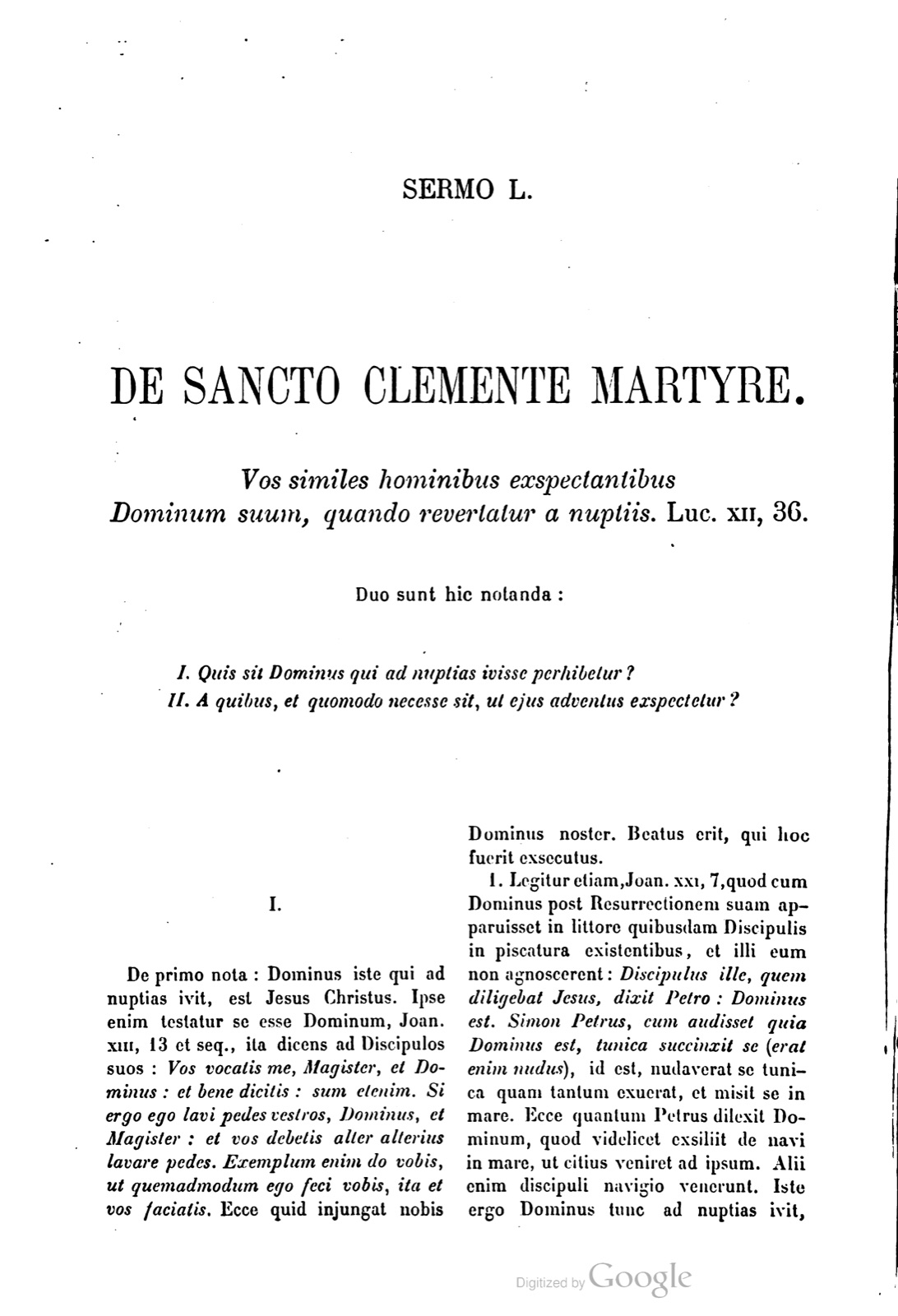
SERMO L.
DE SANCTO CLEMENTE MARTYRE.
Vos similes hominibus exspectantibus Dominum suum, quando revertatur a nuptiis. Luc. XII, 36.
Duo sunt hic notanda:
I. Quis sit Dominus qui ad nuptias ivisse perhibetur? II. A quibus, et quomodo necesse sit, ut ejus adventus exspectetur?
I.
De primo nota: Dominus iste qui ad nuptias ivit, est Jesus Christus. Ipse enim testatur se esse Dominum, Joan. XIII, 13 et seq., ita dicens ad Discipulos suos: Vos vocatis me, Magister, et Dominus: et bene dicitis: sum etenim. Si ergo ego lavi pedes vestros, Dominus, et Magister: et vos debetis alter alterius lavare pedes. Exemplum enim do vobis, ut quemadmodum ego feci vobis, ita et vos faciatis. Ecce quid injungat nobis Dominus noster. Beatus erit, qui hoc fuerit exsecutus.
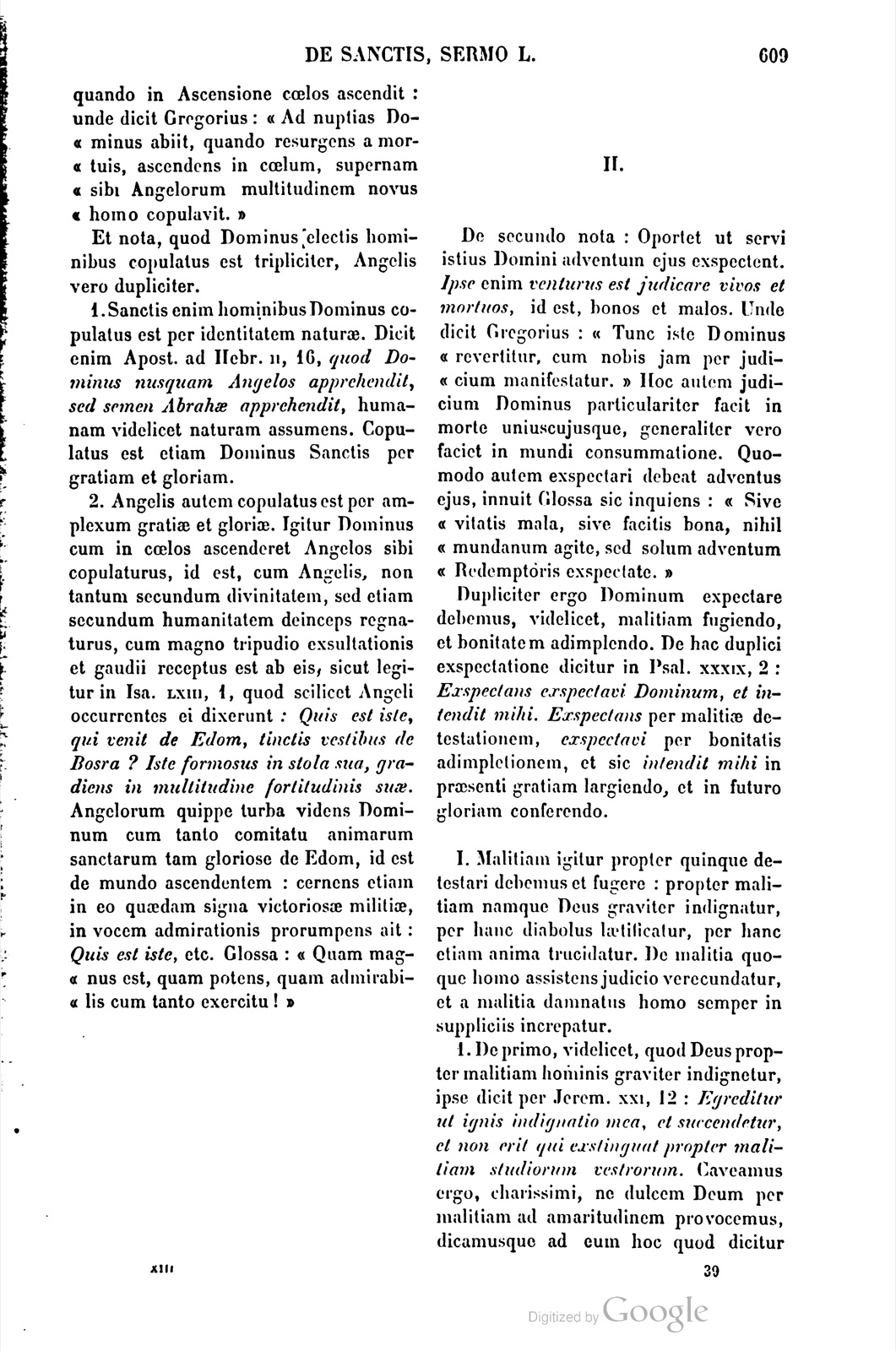
1. Legitur etiam, Joan. XXI, 7, quod cum Dominus post Resurrectionem suam apparuisset in littore quibusdam Discipulis in piscatura existentibus, et illi eum non agnoscerent: Discipulus ille, quem diligebat Jesus, dixit Petro: Dominus est. Simon Petrus, cum audisset quia Dominus est, tunica succinxit se (erat enim nudus), id est, nudaverat se tunica quam tantum exuerat, et misit se in mare. Ecce quantum Petrus dilexit Dominum, quod videlicet exsiliit de navi in mare, ut citius veniret ad ipsum. Alii enim discipuli navigio venerunt. Iste ergo Dominus tunc ad nuptias ivit, quando in Ascensione cælos ascendit: unde dicit Gregorius: « Ad nuptias Dominus abiit, quando resurgens a mortuis, ascendens in cælum, supernam sibi Angelorum multitudinem novus homo copulavit. »
Et nota, quod Dominus electis hominibus copulatus est tripliciter, Angelis vero dupliciter.
1. Sanctis enim hominibus Dominus copulatus est per identitatem naturæ. Dicit enim Apost. ad Hebr. II, 16, quod Dominus nusquam Angelos apprehendit, sed semen Abrahæ apprehendit, humanam videlicet naturam assumens. Copulatus est etiam Dominus Sanctis per gratiam et gloriam.
2. Angelis autem copulatus est per amplexum gratiæ et gloriæ. Igitur Dominus cum in cælos ascenderet Angelos sibi copulaturus, id est, cum Angelis, non tantum secundum divinitatem, sed etiam secundum humanitatem deinceps regnaturus, cum magno tripudio exsultationis et gaudii receptus est ab eis, sicut legitur in Isa. LXIII, 1, quod scilicet Angeli occurrentes ei dixerunt: Quis est iste, qui venit de Edom, tinctis vestibus de Bosra? Iste formosus in stola sua, gradiens in multitudine fortitudinis suæ. Angelorum quippe turba videns Dominum cum tanto comitatu animarum sanctarum tam gloriose de Edom, id est de mundo ascendentem: cernens etiam in eo quædam signa victoriosæ militiæ, in vocem admirationis prorumpens ait: Quis est iste, etc. Glossa: « Quam magnus est, quam potens, quam admirabilis cum tanto exercitu! »
SERMON L.
ON SAINT CLEMENT THE MARTYR.
You are like men waiting for their lord, when he may return from the wedding. Luke 12:36.
Two things are to be noted here:
I. Who is the Lord who is reported to have gone to the wedding? II. By whom, and in what way, is it necessary that his advent be awaited?
I.
Concerning the first, note: That Lord who went to the wedding is Jesus Christ. For he himself testifies that he is Lord, John 13:13 and following, speaking thus to his Disciples: You call me Master and Lord, and you say well, for so I am. Therefore if I, the Lord and Master, have washed your feet, you also ought to wash one another's feet. For I give you an example, that just as I have done to you, so you also may do. Behold what our Lord enjoins upon us. Blessed will be he who has carried this out.
1. It is also read, John 21:7, that when the Lord after his Resurrection had appeared on the shore to certain Disciples existing in fishing, and they did not recognize him, that Disciple whom Jesus loved said to Peter: It is the Lord. Simon Peter, when he had heard that it was the Lord, girded himself with his tunic (for he was naked), that is, he had stripped himself of the tunic which only he had taken off, and cast himself into the sea. Behold how much Peter loved the Lord, namely that he leapt from the boat into the sea so that he might come more quickly to him. For the other disciples came by boat. Therefore that Lord then went to the wedding when in the Ascension he ascended into the heavens; hence Gregory says: "The Lord went away to the wedding when, rising from the dead and ascending into heaven, as a new man he joined to himself the supernal multitude of Angels."
And note that the Lord was joined to elect human beings in three ways, but to Angels in two ways.
1. For to holy human beings the Lord was joined through identity of nature. For the Apostle says at Hebrews 2:16 that the Lord nowhere apprehended Angels, but he apprehended the seed of Abraham, namely by assuming human nature. The Lord was also joined to the Saints through grace and glory.
2. But to Angels he was joined through the embrace of grace and glory. Therefore when the Lord ascended into the heavens, about to join Angels to himself, that is, about to reign henceforth with Angels not only according to divinity but also according to humanity, he was received by them with great leaping of exultation and joy, as is read in Isaiah 63:1, namely that the Angels meeting him said: Who is this, who comes from Edom, with dyed garments from Bozrah? This beautiful one in his robe, walking in the multitude of his strength. For the crowd of Angels, seeing the Lord with such a company of holy souls ascending so gloriously from Edom, that is, from the world, seeing also in him certain signs of victorious warfare, breaking forth into a voice of wonder, said: Who is this, etc. Gloss: "How great he is, how powerful, how admirable with so great an army!"
II.
De secundo nota: Oportet ut servi istius Domini adventum ejus exspectent. Ipse enim venturus est judicare vivos et mortuos, id est, bonos et malos. Unde dicit Gregorius: « Tunc iste Dominus revertitur, cum nobis jam per judicium manifestatur. » Hoc autem judicium Dominus particulariter facit in morte uniuscujusque, generaliter vero faciet in mundi consummatione. Quomodo autem exspectari debeat adventus ejus, innuit Glossa sic inquiens: « Sive vitatis mala, sive facitis bona, nihil mundanum agite, sed solum adventum Redemptoris exspectate. »
Dupliciter ergo Dominum exspectare debemus, videlicet, malitiam fugiendo, et bonitatem adimplendo. De hac duplici exspectatione dicitur in Psal. XXXIX, 2: Exspectans exspectavi Dominum, et intendit mihi. Exspectans per malitiæ detestationem, exspectavi per bonitatis adimpletionem, et sic intendit mihi in præsenti gratiam largiendo, et in futuro gloriam conferendo.
I. Malitiam igitur propter quinque detestari debemus et fugere: propter malitiam namque Deus graviter indignatur, per hanc diabolus lætificatur, per hanc etiam anima trucidatur. De malitia quoque homo assistens judicio verecundatur, et a malitia damnatus homo semper in suppliciis increpatur.
1. De primo, videlicet, quod Deus propter malitiam hominis graviter indignetur, ipse dicit per Jerem. XXI, 12: Egreditur ut ignis indignatio mea, et succendetur, et non erit qui exstinguat propter malitiam studiorum vestrorum. Caveamus ergo, charissimi, ne dulcem Deum per malitiam ad amaritudinem provocemus, dicamusque ad eum hoc quod dicitur I Mach. XIII, 46: Non nobis reddas secundum malitias nostras, sed secundum misericordias tuas.
2. Secundo, per malitiam diabolus lætificatur. Unde dicitur Osee, VII, 3: In malitia sua lætificaverunt regem, id est, diabolum, qui est rex super omnes filios superbiæ. Et nota, quod malitia est funis per quem diabolus peccatores suspendit in infernali patibulo, et nesciret per quod suspenderet eos, nisi ipsi apportarent ei funem per quem suspenderentur. Cum ergo ipse multum delectetur in perditione hominum, mirabiliter lætificat eum, quando ipsimet apportant ei funem per quem suspendantur. Stultum est gloriari in malitia, sicut stultum esset furem gloriari de fune per quem esset strangulandus.
3. Tertio, homo per malitiam occidit animam suam, sicut dicitur, Sap. XVI, 14: Homo occidit animam suam per malitiam. Magnum ergo damnum facit malitia quæ animam, quam Deus sua morte vivificare dignatus est, mortificat et occidit. Quis enim ut rursus vivificetur, deinceps morietur pro ea? Christus enim resurgens ex mortuis jam non moritur, mors illi ultra non dominabitur, sicut dicit Apost. ad Rom. VI, 9.
II.
Concerning the second, note: It is necessary that the servants of that Lord await his advent. For he is going to come to judge the living and the dead, that is, the good and the evil. Hence Gregory says: "Then that Lord returns when now he is manifested to us through judgment." But the Lord makes this judgment particularly at the death of each one, and generally he will make it at the consummation of the world. But in what way his advent ought to be awaited, the Gloss intimates, speaking thus: "Whether you avoid evils or do good things, do nothing worldly, but await only the advent of the Redeemer."
Therefore we ought to await the Lord in two ways, namely by fleeing malice and by fulfilling goodness. Concerning this double awaiting it is said in Psalm 39:2: Waiting, I waited for the Lord, and he attended to me. Waiting through detestation of malice, I waited through fulfillment of goodness, and so he attended to me, by bestowing grace in the present and conferring glory in the future.
I. Therefore we ought to detest and flee malice for five reasons: for on account of malice God is gravely indignant; through this the devil is gladdened; through this also the soul is slaughtered. Concerning malice also a human being standing by at judgment is put to shame, and by malice a damned human being is always rebuked in punishments.
1. Concerning the first, namely that God is gravely indignant on account of a human being's malice, he himself says through Jeremiah 21:12: My indignation will go forth like fire, and it will be kindled, and there will be no one who extinguishes it because of the malice of your pursuits. Therefore let us beware, dearly beloved, lest through malice we provoke the sweet God to bitterness, and let us say to him what is said in 1 Maccabees 13:46: Do not repay us according to our malices, but according to your mercies.
2. Secondly, through malice the devil is gladdened. Hence it is said in Hosea 7:3: In their malice they gladdened the king, that is, the devil, who is king over all the children of pride. And note that malice is the rope by which the devil hangs sinners on the infernal gallows, and he would not know by what he should hang them unless they themselves brought him the rope by which they would be hanged. Therefore since he takes much delight in the perdition of human beings, it wondrously gladdens him when they themselves bring him the rope by which they may be hanged. It is foolish to glory in malice, just as it would be foolish for a thief to glory concerning the rope by which he was to be strangled.
3. Thirdly, a human being kills his soul through malice, as is said, Wisdom 16:14: A human being kills his own soul through malice. Therefore malice does great damage, because it mortifies and kills the soul which God deigned to make alive by his own death. For who will die for it afterward, that it may again be made alive? For Christ rising from the dead now no longer dies; death will no longer dominate him, as the Apostle says at Romans 6:9.
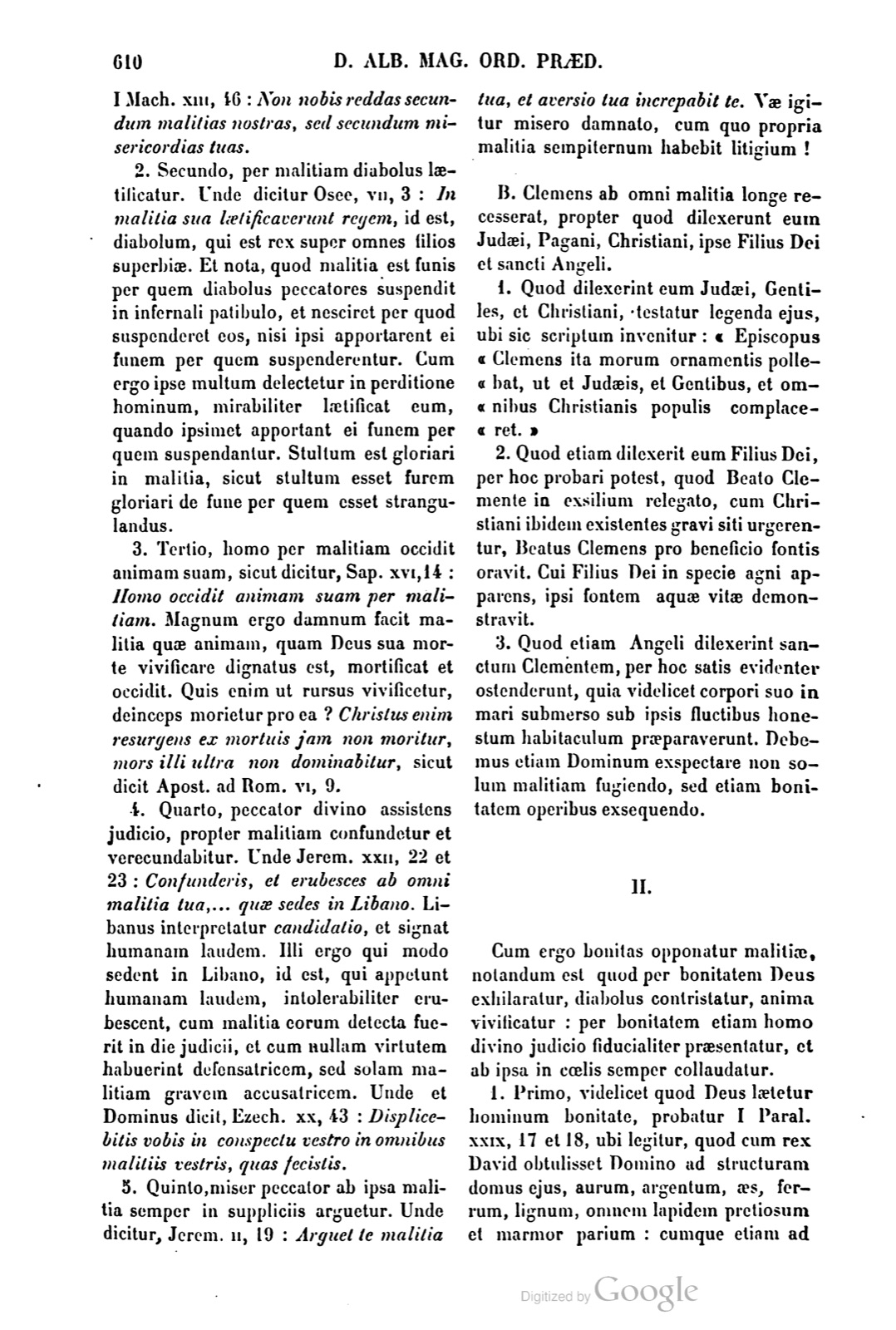
4. Quarto, peccator divino assistens judicio, propter malitiam confundetur et verecundabitur. Unde Jerem. XXII, 22 et 23: Confunderis, et erubesces ab omni malitia tua, ... quæ sedes in Libano. Libanus interpretatur candidatio, et signat humanam laudem. Illi ergo qui modo sedent in Libano, id est, qui appetunt humanam laudem, intolerabiliter erubescent, cum malitia eorum detecta fuerit in die judicii, et cum nullam virtutem habuerint defensatricem, sed solam malitiam gravem accusatricem. Unde et Dominus dicit, Ezech. XX, 43: Displicebitis vobis in conspectu vestro in omnibus malitiis vestris, quas fecistis.
5. Quinto, miser peccator ab ipsa malitia semper in suppliciis arguetur. Unde dicitur, Jerem. II, 19: Arguet te malitia tua, et aversio tua increpabit te. Væ igitur misero damnato, cum quo propria malitia sempiternum habebit litigium!
B. Clemens ab omni malitia longe recesserat, propter quod dilexerunt eum Judæi, Pagani, Christiani, ipse Filius Dei et sancti Angeli.
1. Quod dilexerint eum Judæi, Gentiles, et Christiani, testatur legenda ejus, ubi sic scriptum invenitur: « Episcopus Clemens ita morum ornamentis pollebat, ut et Judæis, et Gentibus, et omnibus Christianis populis complaceret. »
2. Quod etiam dilexerit eum Filius Dei, per hoc probari potest, quod Beato Clemente in exsilium relegato, cum Christiani ibidem existentes gravi siti urgerentur, Beatus Clemens pro beneficio fontis oravit. Cui Filius Dei in specie agni apparens, ipsi fontem aquæ vitæ demonstravit.
3. Quod etiam Angeli dilexerint sanctum Clementem, per hoc satis evidenter ostenderunt, quia videlicet corpori suo in mari submerso sub ipsis fluctibus honestum habitaculum præparaverunt. Debemus etiam Dominum exspectare non solum malitiam fugiendo, sed etiam bonitatem operibus exsequendo.
II.
Cum ergo bonitas opponatur malitiæ, notandum est quod per bonitatem Deus exhilaratur, diabolus contristatur, anima vivificatur: per bonitatem etiam homo divino judicio fiducialiter præsentatur, et ab ipsa in cælis semper collaudatur.
1. Primo, videlicet quod Deus lætetur hominum bonitate, probatur I Paral. XXIX, 17 et 18, ubi legitur, quod cum rex David obtulisset Domino ad structuram domus ejus, aurum, argentum, æs, ferrum, lignum, omnem lapidem pretiosum et marmor parium: cumque etiam ad
Footnotes:
None.
4. Fourthly, the sinner standing by at divine judgment will be confounded and put to shame on account of malice. Hence Jeremiah 22:22 and 23: You will be confounded and blush from all your malice, ... you who sit in Lebanon. Lebanon is interpreted whitening, and signifies human praise. Therefore those who now sit in Lebanon, that is, who desire human praise, will blush intolerably when their malice has been uncovered on the day of judgment, and when they will have no virtue as defender, but only malice as a grave accuser. Hence the Lord also says, Ezekiel 20:43: You will displease yourselves in your own sight in all your malices that you have done.
5. Fifthly, the wretched sinner will always be accused in punishments by malice itself. Hence it is said, Jeremiah 2:19: Your malice will accuse you, and your turning away will rebuke you. Woe, therefore, to the wretched damned person, with whom his own malice will have everlasting litigation!
Blessed Clement had withdrawn far from every malice; on account of this Jews, Pagans, Christians, the Son of God himself, and the holy Angels loved him.
1. That Jews, Gentiles, and Christians loved him, his legend testifies, where it is found written thus: "Bishop Clement was so strong in ornaments of morals that he was pleasing both to Jews, and to Gentiles, and to all Christian peoples."
2. That the Son of God also loved him can be proved through this, that when Blessed Clement had been relegated into exile, and when the Christians existing there were being pressed by grave thirst, Blessed Clement prayed for the benefit of a spring. The Son of God, appearing to him in the form of a lamb, showed him the spring of the water of life.
3. That Angels also loved Saint Clement, they showed this clearly enough through this, namely because for his body, submerged in the sea, they prepared under the very waves an honorable dwelling. We also ought to await the Lord not only by fleeing malice, but also by carrying out goodness with works.
II.
Therefore, since goodness is opposed to malice, it must be noted that through goodness God is cheered, the devil is saddened, the soul is made alive; through goodness also a human being is trustingly presented to divine judgment, and by it is always praised in heaven.
1. First, namely that God is gladdened by the goodness of human beings, is proved in 1 Chronicles 29:17 and 18, where it is read that when King David had offered to the Lord, for the construction of his house, gold, silver, bronze, iron, wood, every precious stone, and Parian marble, and when also at
Footnotes:
None.
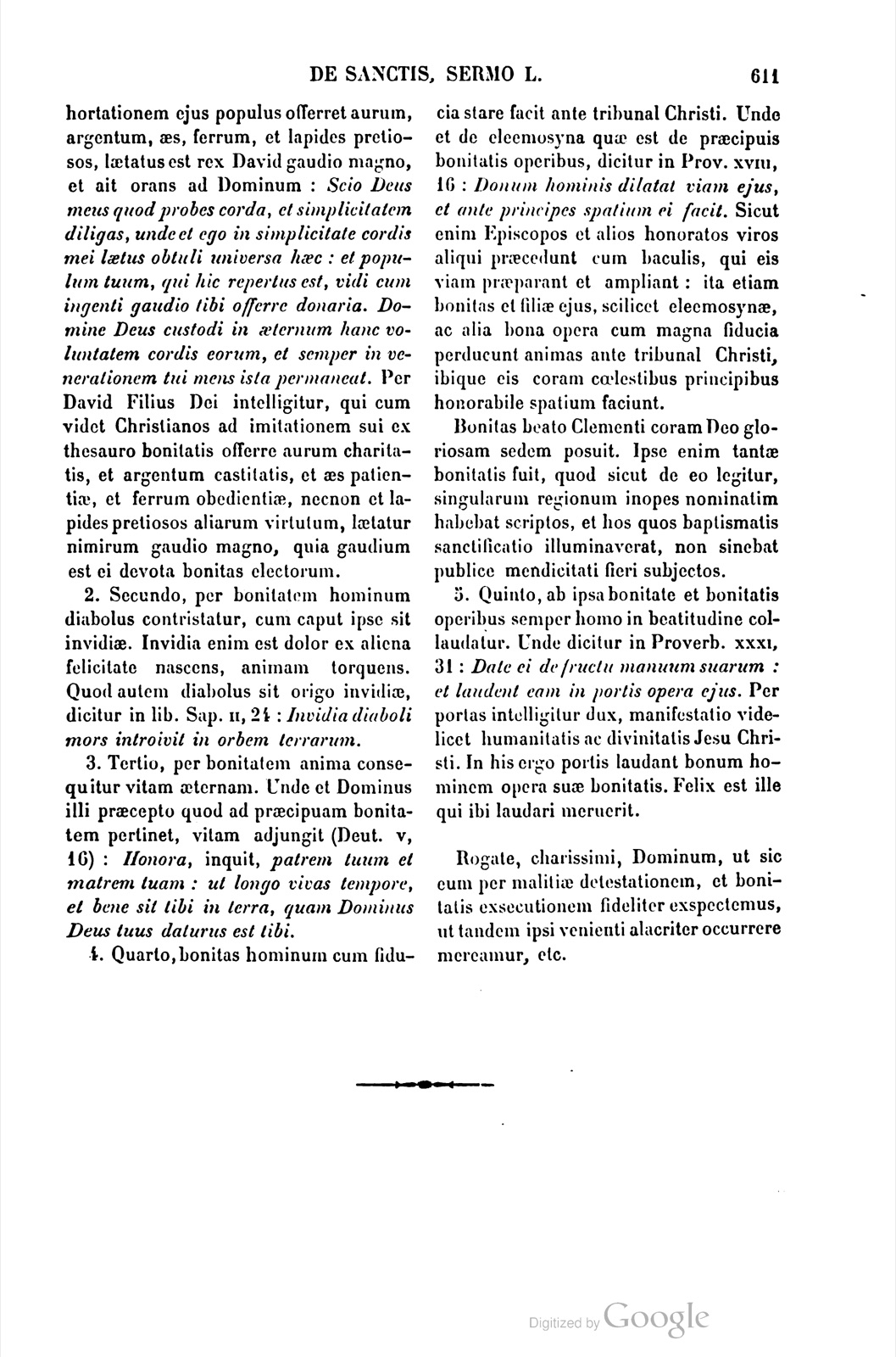
hortationem ejus populus offerret aurum, argentum, æs, ferrum, et lapides pretiosos, lætatus est rex David gaudio magno, et ait orans ad Dominum: Scio Deus meus quod probes corda, et simplicitatem diligas, unde et ego in simplicitate cordis mei lætus obtuli universa hæc et populum tuum, qui hic repertus est, vidi cum ingenti gaudio tibi offerre donaria. Domine Deus custodi in æternum hanc voluntatem cordis eorum, et semper in venerationem tui mens ista permaneat. Per David Filius Dei intelligitur, qui cum videt Christianos ad imitationem sui ex thesauro bonitatis offerre aurum charitatis, et argentum castitatis, et æs patientiæ, et ferrum obedientiæ, necnon et lapides pretiosos aliarum virtutum, lætatur nimirum gaudio magno, quia gaudium est ei devota bonitas electorum.
2. Secundo, per bonitatem hominum diabolus contristatur, cum caput ipse sit invidiæ. Invidia enim est dolor ex aliena felicitate nascens, animam torquens. Quod autem diabolus sit origo invidiæ, dicitur in lib. Sap. II, 24: Invidia diaboli mors introivit in orbem terrarum.
3. Tertio, per bonitatem anima consequitur vitam æternam. Unde et Dominus illi præcepto quod ad præcipuam bonitatem pertinet, vitam adjungit (Deut. V, 16): Honora, inquit, patrem tuum et matrem tuam: ut longo vivas tempore, et bene sit tibi in terra, quam Dominus Deus tuus daturus est tibi.
4. Quarto, bonitas hominum cum fiducia stare facit ante tribunal Christi. Unde et de eleemosyna quæ est de præcipuis bonitatis operibus, dicitur in Prov. XVIII, 16: Donum hominis dilatat viam ejus, et ante principes spatium ei facit. Sicut enim Episcopos et alios honoratos viros aliqui præcedunt cum baculis, qui eis viam præparant et ampliant: ita etiam bonitas et filiæ ejus, scilicet eleemosynæ, ac alia bona opera cum magna fiducia perducunt animas ante tribunal Christi, ibique eis coram cælestibus principibus honorabile spatium faciunt.
Bonitas beato Clementi coram Deo gloriosam sedem posuit. Ipse enim tantæ bonitatis fuit, quod sicut de eo legitur, singularum regionum inopes nominatim habebat scriptos, et hos quos baptismatis sanctificatio illuminaverat, non sinebat publice mendicitati fieri subjectos.
5. Quinto, ab ipsa bonitate et bonitatis operibus semper homo in beatitudine collaudatur. Unde dicitur in Proverb. XXXI, 31: Date ei de fructu manuum suarum: et laudent eam in portis opera ejus. Per portas intelligitur dux, manifestatio videlicet humanitatis ac divinitatis Jesu Christi. In his ergo portis laudant bonum hominem opera suæ bonitatis. Felix est ille qui ibi laudari meruerit.
Rogate, charissimi, Dominum, ut sic eum per malitiæ detestationem, et bonitatis exsecutionem fideliter exspectemus, ut tandem ipsi venienti alacriter occurrere mereamur, etc.
Footnotes:
None.
at his exhortation the people offered gold, silver, bronze, iron, and precious stones, King David was glad with great joy, and praying to the Lord he said: I know, my God, that you prove hearts and love simplicity; hence also I, in the simplicity of my heart, gladly offered all these things, and I saw your people, who have been found here, with immense joy offer gifts to you. Lord God, preserve forever this will of their heart, and may this mind always remain in veneration of you. By David the Son of God is understood, who, when he sees Christians in imitation of himself offering from the treasure of goodness the gold of charity, and the silver of chastity, and the bronze of patience, and the iron of obedience, and also the precious stones of other virtues, is no doubt gladdened with great joy, because the devoted goodness of the elect is a joy to him.
2. Secondly, through the goodness of human beings the devil is saddened, since he himself is the head of envy. For envy is grief born from another's happiness, tormenting the soul. But that the devil is the origin of envy is said in the book of Wisdom 2:24: Through the envy of the devil death entered into the world of lands.
3. Thirdly, through goodness the soul attains eternal life. Hence also the Lord joins life to that precept which pertains to chief goodness (Deuteronomy 5:16): Honor, he says, your father and your mother, that you may live a long time and it may be well for you in the land that the Lord your God will give you.
4. Fourthly, the goodness of human beings makes them stand with confidence before the tribunal of Christ. Hence also concerning alms, which is among the chief works of goodness, it is said in Proverbs 18:16: The gift of a human being enlarges his way and makes space for him before princes. For just as some people precede Bishops and other honored men with staffs, who prepare and enlarge the way for them, so also goodness and her daughters, namely alms and other good works, with great confidence lead souls before the tribunal of Christ, and there make for them an honorable space before the heavenly princes.
Goodness placed a glorious seat before God for Blessed Clement. For he was of such goodness that, as is read concerning him, he had the needy of individual regions written down by name, and those whom the sanctification of baptism had illuminated he did not allow to be made subject publicly to beggary.
5. Fifthly, by goodness itself and by the works of goodness a human being is always praised in blessedness. Hence it is said in Proverbs 31:31: Give her from the fruit of her hands, and let her works praise her in the gates. By gates is understood a leader, namely the manifestation of the humanity and divinity of Jesus Christ. Therefore in these gates the works of his goodness praise the good human being. Happy is the one who has deserved to be praised there.
Pray, dearly beloved, to the Lord, that we may so await him faithfully through detestation of malice and execution of goodness, that at last, when he comes, we may deserve to run to meet him eagerly, etc.
Footnotes:
None.
If a page does not appear, its photograph has not been uploaded yet.