Volume 13 · pp. 601–603
Sermon XLVIII. On Saint Martin
A marker with ≈ is an approximate page boundary, placed by measure of the text; the page photographs remain the authority. In the paired views, clicking a page marker brings that page into view.
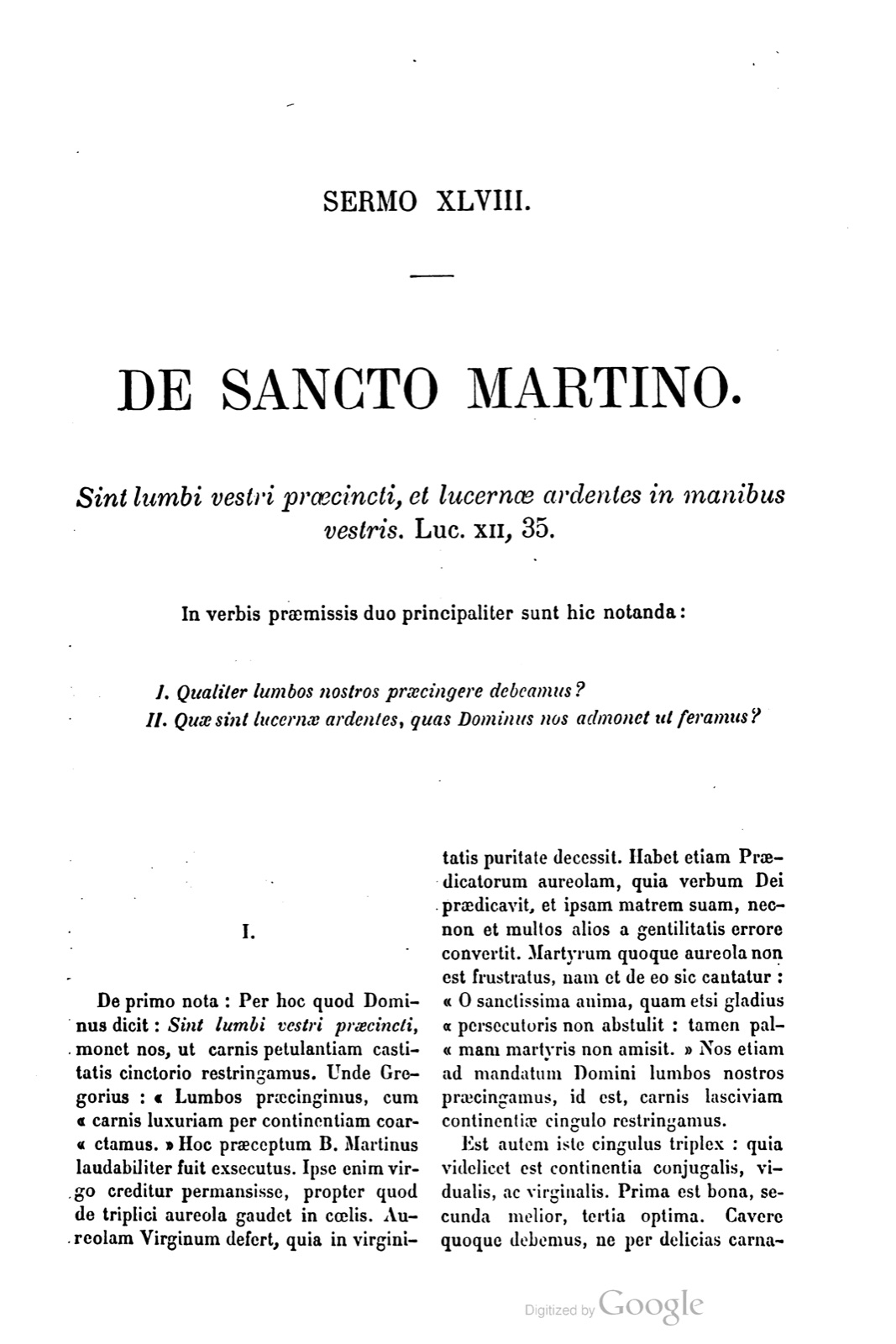
SERMO XLVIII.
DE SANCTO MARTINO.
Sint lumbi vestri præcincti, et lucernæ ardentes in manibus vestris. Luc. XII, 35.
In verbis præmissis duo principaliter sunt hic notanda:
I. Qualiter lumbos nostros præcingere debeamus? II. Quæ sint lucernæ ardentes, quas Dominus nos admonet ut feramus?
I.
De primo nota: Per hoc quod Dominus dicit: Sint lumbi vestri præcincti, monet nos, ut carnis petulantiam castitatis cinctorio restringamus. Unde Gregorius: « Lumbos præcingimus, cum carnis luxuriam per continentiam coarctamus. » Hoc præceptum B. Martinus laudabiliter fuit exsecutus. Ipse enim virgo creditur permansisse, propter quod de triplici aureola gaudet in cælis. Aureolam Virginum defert, quia in virginitatis puritate decessit. Habet etiam Prædicatorum aureolam, quia verbum Dei prædicavit, et ipsam matrem suam, necnon et multos alios a gentilitatis errore convertit. Martyrum quoque aureola non est frustratus, nam et de eo sic cantatur: « O sanctissima anima, quam etsi gladius persecutoris non abstulit: tamen palmam martyris non amisit. » Nos etiam ad mandatum Domini lumbos nostros præcingamus, id est, carnis lasciviam continentiæ cingulo restringamus.
Est autem iste cingulus triplex: quia videlicet est continentia conjugalis, vidualis, ac virginalis. Prima est bona, secunda melior, tertia optima. Cavere quoque debemus, ne per delicias carnales putrescat cingulus castitatis. Unde dixit Dominus ad Jerem. XIII, 1: Vade, et posside tibi lumbare lineum, et pones illud super lumbos tuos, et in aquam non inferes illud. Ibidem subjungitur, quod Dominus dixit ei, ut iret ad Euphraten, et absconderet ibi lumbare suum. Quod cum fecisset, abiit post plurimos dies, et tulit lumbare de loco ubi absconderat illud, et ecce computruerat, ita ut nulli usui aptum esset. Per lumbare lineum castitas intelligitur, quæ a Deo multis obsecrationibus ac laboribus est obtinenda. Circa linum enim multæ sollicitudines ac labores requiruntur. Hinc igitur lumbi, in quibus libidinis est seminarium, sunt accingendi. Caveri autem debet, ne in aquam gulæ et deliciarum carnalium inferatur. Cito quippe in crapula et ebrietatibus castitatis cinctorium perit ac putrescit. Unde et lumbare Jeremiæ apud Euphraten computruit. Euphrates enim frugifer interpretatur, et significat delicias ac abundantias corporales. Et nota, quod non solum lumbi, sed et ipsum cor est præcingendum.
Non solum enim ab opere luxuriæ cavere debemus, sed etiam cavendum est ne eam foveamus in corde, ibique ei collætemur. Unde Joannes, in Apoc. I, 13, vidit in medio septem candelabrorum aureorum, similem Filio hominis, vestitum podere, et præcinctum ad mamillas zona aurea. Poderis qua Joannes Christum indutum vidit, fuit vestis sacerdotalis, et significat castitatem qua totum corpus operiri debet extrinsecus. Zona vero aurea exprimit mentis munditiam, qua cor contra luxuriam muniri debet intrinsecus, ne etiam cogitationes cordis in luxuria delectentur.
SERMON XLVIII.
ON SAINT MARTIN.
Let your loins be girded, and burning lamps in your hands. Luke 12:35.
In the words set before us two things are principally to be noted here:
I. In what way we ought to gird our loins? II. What are the burning lamps that the Lord admonishes us to carry?
I.
Concerning the first, note: Through this, that the Lord says, Let your loins be girded, he admonishes us that we restrain the wantonness of the flesh with the girdle of chastity. Hence Gregory says: "We gird the loins when through continence we constrain the luxury of the flesh." Blessed Martin laudably carried out this precept. For he is believed to have remained a virgin, on account of which he rejoices in heaven concerning a threefold aureole. He carries the aureole of Virgins, because he departed in purity of virginity. He also has the aureole of Preachers, because he preached the word of God and converted his own mother, and also many others, from the error of the Gentiles. He was not cheated of the aureole of Martyrs either, for concerning him it is sung thus: "O most holy soul, whom, although the sword of the persecutor did not take away, nevertheless did not lose the palm of a martyr." Let us also, at the command of the Lord, gird our loins, that is, restrain the lasciviousness of the flesh with the belt of continence.
Now that belt is threefold, because namely there is conjugal, widowed, and virginal continence. The first is good, the second better, the third best. We also ought to beware lest through carnal delights the belt of chastity rot. Hence the Lord said to Jeremiah 13:1: Go, and possess for yourself a linen loincloth, and place it over your loins, and do not put it into water. In the same place it is added that the Lord said to him that he should go to the Euphrates and hide his loincloth there. And when he had done this, after very many days he went away and took the loincloth from the place where he had hidden it, and behold, it had rotted, so that it was fit for no use. By the linen loincloth chastity is understood, which must be obtained from God by many entreaties and labors. For around flax many anxieties and labors are required. Hence therefore the loins, in which is the seed-bed of lust, are to be girded. But care must be taken that it not be put into the water of gluttony and carnal delights. For quickly amid excess and drunkenness the girdle of chastity perishes and rots. Hence also Jeremiah's loincloth rotted at the Euphrates. For Euphrates is interpreted fruitful, and signifies bodily delights and abundances. And note that not only the loins, but also the very heart must be girded.
For we ought not only to beware of the work of luxury, but also to beware lest we foster it in the heart and there delight in it together with it. Hence John, in Apocalypse 1:13, saw in the midst of seven golden candlesticks one like the Son of man, clothed in a long robe, and girded at the breasts with a golden belt. The long robe with which John saw Christ clothed was a priestly garment, and it signifies chastity by which the whole body ought to be covered outwardly. But the golden belt expresses cleanness of mind, by which the heart ought to be fortified inwardly against luxury, lest even the thoughts of the heart delight in luxury.
II.
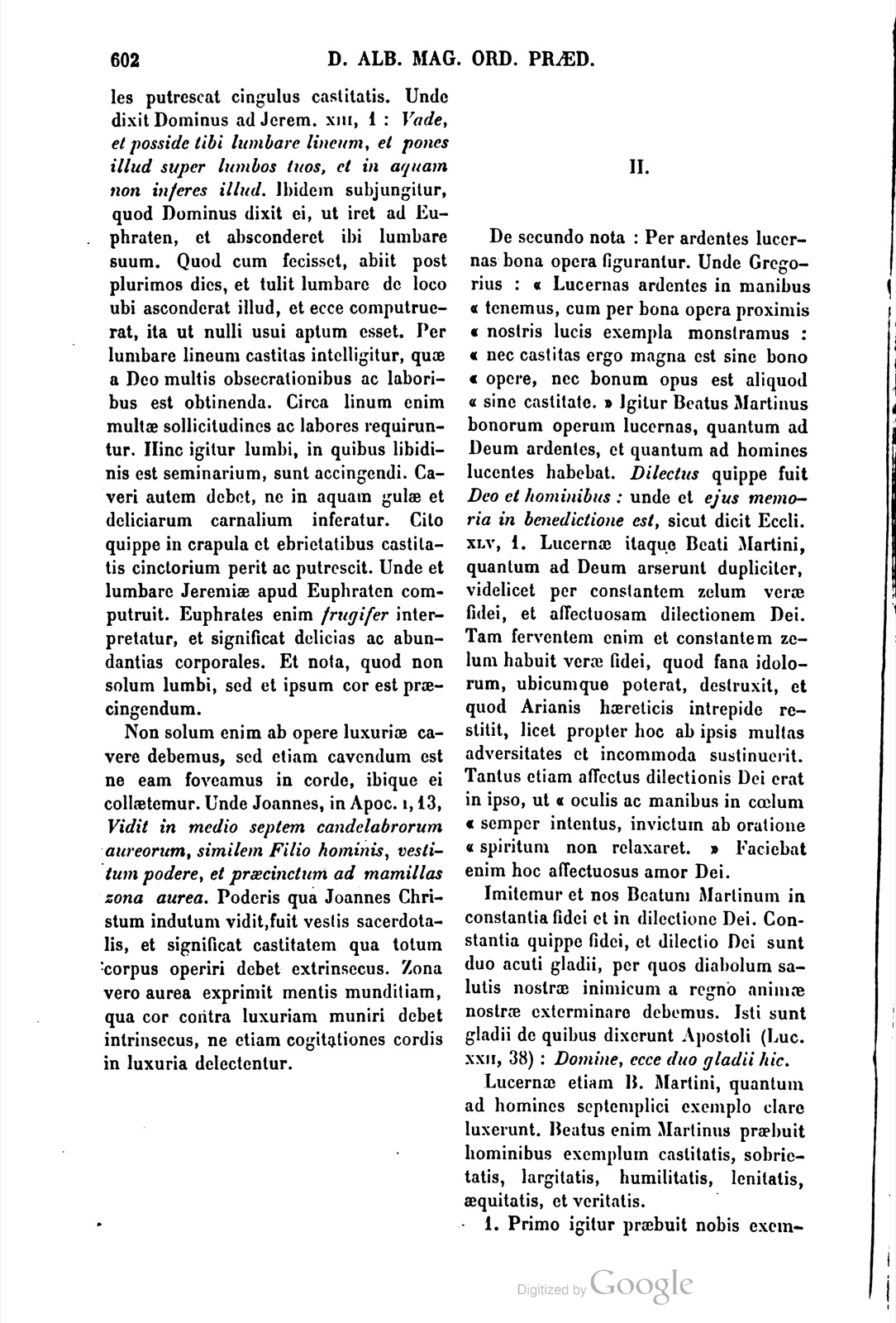
De secundo nota: Per ardentes lucernas bona opera figurantur. Unde Gregorius: « Lucernas ardentes in manibus tenemus, cum per bona opera proximis nostris lucis exempla monstramus: nec castitas ergo magna est sine bono opere, nec bonum opus est aliquod sine castitate. » Igitur Beatus Martinus bonorum operum lucernas, quantum ad Deum ardentes, et quantum ad homines lucentes habebat. Dilectus quippe fuit Deo et hominibus: unde et ejus memoria in benedictione est, sicut dicit Eccli. XLV, 1. Lucernæ itaque Beati Martini, quantum ad Deum arserunt dupliciter, videlicet per constantem zelum veræ fidei, et affectuosam dilectionem Dei. Tam ferventem enim et constantem zelum habuit veræ fidei, quod fana idolorum, ubicumque poterat, destruxit, et quod Arianis hæreticis intrepide restitit, licet propter hoc ab ipsis multas adversitates et incommoda sustinuerit. Tantus etiam affectus dilectionis Dei erat in ipso, ut « oculis ac manibus in cælum semper intentus, invictum ab oratione spiritum non relaxaret. » Faciebat enim hoc affectuosus amor Dei.
Imitemur et nos Beatum Martinum in constantia fidei et in dilectione Dei. Constantia quippe fidei, et dilectio Dei sunt duo acuti gladii, per quos diabolum salutis nostræ inimicum a regno animæ nostræ exterminare debemus. Isti sunt gladii de quibus dixerunt Apostoli (Luc. XXII, 38): Domine, ecce duo gladii hic.
Lucernæ etiam B. Martini, quantum ad homines septemplici exemplo clare luxerunt. Beatus enim Martinus præbuit hominibus exemplum castitatis, sobrietatis, largitatis, humilitatis, lenitatis, æquitatis, et veritatis.
1. Primo igitur præbuit nobis exemplum castitatis. Castissimæ quippe vitæ fuit. Unde diabolum in hora mortis suæ sibi apparentem libera voce præcepit abire: quia nihil immunditiæ in eo poterat invenire. Legitur etiam de eo, quod animam ejus emigrantem Beata Virgo Maria suscepit cum virginum choris. Præterea cum mortuus esset, sicut scriptum invenitur, caro ejus mirabili splendore refulsit. Hæc omnia castitatis ejus argumenta fuerunt.
2. Secundo exhibet sobrietatis exemplum. De tempore quippe militiæ suæ invenitur sic scriptum: « Frugalitatem in eo laudari non est necesse, qua ita usus est, ut jam illo tempore non miles, sed monachus putaretur. »
3. Tertio largitatis demonstrat exemplum. Tantæ enim largitatis et charitatis fuit, ut etiam cum adhuc catechumenus esset, cuidam pauperi pallium suum per mediam partem divideret: quia tunc nihil aliud habuit, quod ei daret. Demum cum in sacerdotio constitutus esset, ipsam tunicam qua ad carnem vestiebatur, exuit et cuidam mendico tribuit.
II.
Concerning the second, note: By the burning lamps good works are figured. Hence Gregory says: "We hold burning lamps in our hands when through good works we show examples of light to our neighbors; therefore chastity is not great without a good work, nor is any good work something without chastity." Therefore Blessed Martin had the lamps of good works, burning as regards God and shining as regards human beings. For he was loved by God and by human beings; hence also his memory is in blessing, as Ecclesiasticus 45:1 says. Therefore the lamps of Blessed Martin burned as regards God in two ways, namely through constant zeal of the true faith and affectionate love of God. For he had such fervent and constant zeal of the true faith that wherever he could he destroyed the shrines of idols, and that he fearlessly resisted the Arian heretics, although on account of this he sustained many adversities and inconveniences from them. Also such affection of the love of God was in him that "with eyes and hands always intent toward heaven, he did not relax his unconquered spirit from prayer." For affectionate love of God did this.
Let us also imitate Blessed Martin in constancy of faith and in love of God. For constancy of faith and love of God are two sharp swords through which we ought to drive out the devil, the enemy of our salvation, from the kingdom of our soul. These are the swords concerning which the Apostles said (Luke 22:38): Lord, behold two swords here.
The lamps of Blessed Martin also, as regards human beings, shone brightly with a sevenfold example. For Blessed Martin furnished to human beings an example of chastity, sobriety, generosity, humility, mildness, equity, and truth.
1. First, therefore, he furnished us an example of chastity. For he was of a most chaste life. Hence, when the devil appeared to him at the hour of his death, he commanded him in a free voice to go away, because he could find nothing of uncleanness in him. It is also read concerning him that the Blessed Virgin Mary received his soul as it was departing, with choirs of virgins. Besides this, when he was dead, as is found written, his flesh shone with wonderful brightness. All these things were proofs of his chastity.
2. Secondly, he displays an example of sobriety. For concerning the time of his military service it is found written thus: "It is not necessary that frugality be praised in him, which he so used that already at that time he was thought not a soldier, but a monk."
3. Thirdly, he demonstrates an example of generosity. For he was of such generosity and charity that even when he was still a catechumen he divided his cloak through the middle for a certain poor man, because at that time he had nothing else that he might give him. Then, when he was established in the priesthood, he took off the very tunic with which he was clothed next to the flesh and gave it to a certain beggar.
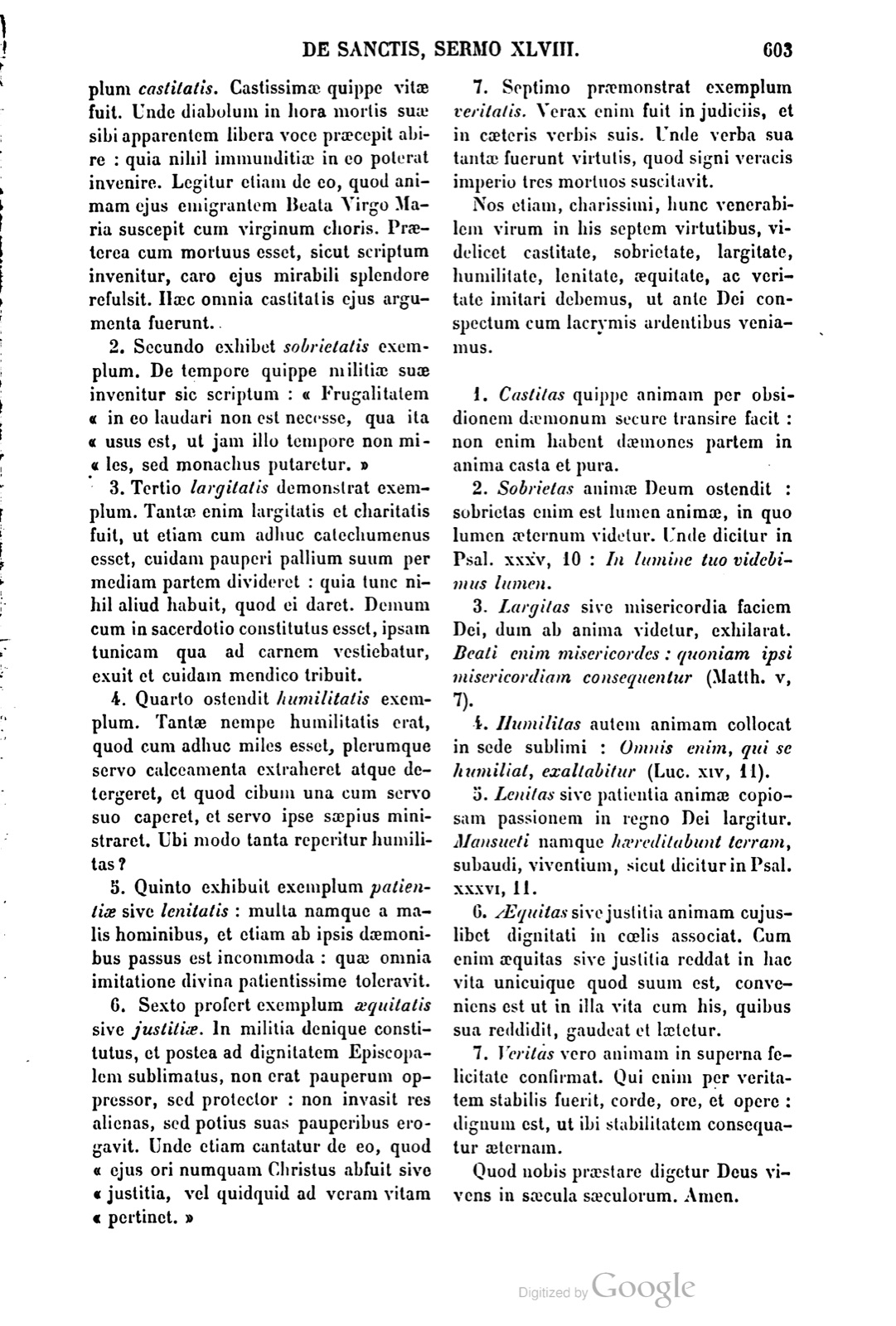
4. Quarto ostendit humilitatis exemplum. Tantæ nempe humilitatis erat, quod cum adhuc miles esset, plerumque servo calceamenta extraheret atque detergeret, et quod cibum una cum servo suo caperet, et servo ipse sæpius ministraret. Ubi modo tanta reperitur humilitas?
5. Quinto exhibuit exemplum patientiæ sive lenitatis: multa namque a malis hominibus, et etiam ab ipsis dæmonibus passus est incommoda: quæ omnia imitatione divina patientissime toleravit.
6. Sexto profert exemplum æquitatis sive justitiæ. In militia denique constitutus, et postea ad dignitatem Episcopalem sublimatus, non erat pauperum oppressor, sed protector: non invasit res alienas, sed potius suas pauperibus erogavit. Unde etiam cantatur de eo, quod « ejus ori numquam Christus abfuit sive justitia, vel quidquid ad veram vitam pertinet. »
7. Septimo præmonstrat exemplum veritatis. Verax enim fuit in judiciis, et in cæteris verbis suis. Unde verba sua tantæ fuerunt virtutis, quod signi veracis imperio tres mortuos suscitavit.
Nos etiam, charissimi, hunc venerabilem virum in his septem virtutibus, videlicet castitate, sobrietate, largitate, humilitate, lenitate, æquitate, ac veritate imitari debemus, ut ante Dei conspectum cum lacrymis ardentibus veniamus.
1. Castitas quippe animam per obsidionem dæmonum secure transire facit: non enim habent dæmones partem in anima casta et pura.
2. Sobrietas animæ Deum ostendit: sobrietas enim est lumen animæ, in quo lumen æternum videtur. Unde dicitur in Psal. XXXV, 10: In lumine tuo videbimus lumen.
3. Largitas sive misericordia faciem Dei, dum ab anima videtur, exhilarat. Beati enim misericordes: quoniam ipsi misericordiam consequentur (Matth. V, 7).
4. Humilitas autem animam collocat in sede sublimi: Omnis enim, qui se humiliat, exaltabitur (Luc. XIV, 11).
5. Lenitas sive patientia animæ copiosam passionem in regno Dei largitur. Mansueti namque hæreditabunt terram, subaudi, viventium, sicut dicitur in Psal. XXXVI, 11.
6. Æquitas sive justitia animam cujuslibet dignitati in cælis associat. Cum enim æquitas sive justitia reddat in hac vita unicuique quod suum est, conveniens est ut in illa vita cum his, quibus sua reddidit, gaudeat et lætetur.
7. Veritas vero animam in superna felicitate confirmat. Qui enim per veritatem stabilis fuerit, corde, ore, et opere: dignum est, ut ibi stabilitatem consequatur æternam.
Quod nobis præstare dignetur Deus vivens in sæcula sæculorum. Amen.
Footnotes:
None.
4. Fourthly, he shows an example of humility. For he was of such humility that, when he was still a soldier, he very often would draw off and wipe a servant's shoes, and that he would take food together with his servant, and would himself rather often minister to the servant. Where now is such humility found?
5. Fifthly, he displayed an example of patience or mildness; for he suffered many inconveniences from evil human beings and even from demons themselves, all of which, in imitation of the divine, he tolerated most patiently.
6. Sixthly, he brings forward an example of equity or justice. For when he was established in military service, and afterward raised to Episcopal dignity, he was not an oppressor of the poor, but a protector; he did not invade the goods of others, but rather bestowed his own upon the poor. Hence it is also sung concerning him, that "Christ was never absent from his mouth, or justice, or whatever pertains to true life."
7. Seventhly, he shows beforehand an example of truth. For he was truthful in judgments and in his other words. Hence his words were of such virtue that, by the command of a truthful sign, he raised three dead persons.
We also, dearly beloved, ought to imitate this venerable man in these seven virtues, namely chastity, sobriety, generosity, humility, mildness, equity, and truth, so that we may come before the sight of God with burning tears.
1. For chastity makes the soul pass securely through the siege of demons; for demons have no part in a chaste and pure soul.
2. Sobriety shows God to the soul; for sobriety is the light of the soul, in which eternal light is seen. Hence it is said in Psalm 35:10: In your light we will see light.
3. Generosity or mercy cheers the face of God while it is seen by the soul. For blessed are the merciful, because they will obtain mercy (Matthew 5:7).
4. But humility places the soul in a high seat; for everyone who humbles himself will be exalted (Luke 14:11).
5. Mildness or patience bestows abundant passion on the soul in the kingdom of God. For the meek will inherit the earth, supply, of the living, as is said in Psalm 36:11.
6. Equity or justice associates the soul with the dignity of each one in heaven. For since equity or justice renders in this life to each one what is his, it is fitting that in that life it rejoice and be glad with those to whom it has rendered their own.
7. But truth confirms the soul in supernal happiness. For he who has been stable through truth, in heart, mouth, and work: it is worthy that there he obtain eternal stability.
May the living God deign to grant this to us forever and ever. Amen.
Footnotes:
None.
If a page does not appear, its photograph has not been uploaded yet.