Volume 13 · pp. 598–600
Sermon XLVII. On the Commemoration of Faithful Souls
A marker with ≈ is an approximate page boundary, placed by measure of the text; the page photographs remain the authority. In the paired views, clicking a page marker brings that page into view.
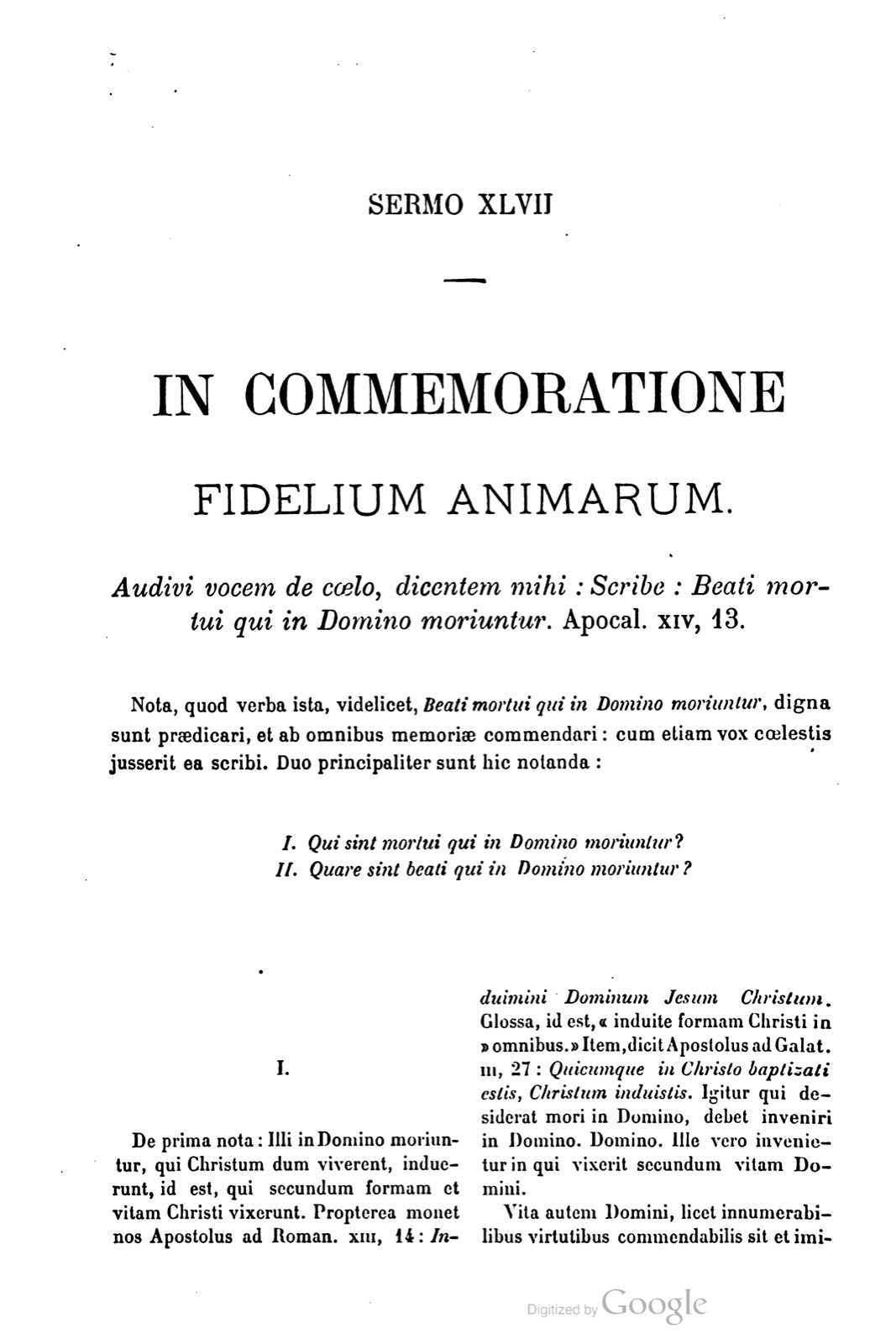
SERMO XLVIJ
IN COMMEMORATIONE FIDELIUM ANIMARUM.
Audivi vocem de cœlo, dicentem mihi: Scribe: Beati mortui qui in Domino moriuntur. Apocal. XIV, 13.
Nota, quod verba ista, videlicet, Beati mortui qui in Domino moriuntur, digna sunt prædicari, et ab omnibus memoriæ commendari: cum etiam vox cœlestis jusserit ea scribi. Duo principaliter sunt hic notanda:
I. Qui sint mortui qui in Domino moriuntur? II. Quare sint beati qui in Domino moriuntur?
I.
De prima nota: Illi in Domino moriuntur, qui Christum dum viverent, induerunt, id est, qui secundum formam et vitam Christi vixerunt. Propterea monet nos Apostolus ad Roman. XIII, 14: Induimini Dominum Jesum Christum. Glossa, id est, « induite formam Christi in omnibus. » Item, dicit Apostolus ad Galat. III, 27: Quicumque in Christo baptizati estis, Christum induistis. Igitur qui desiderat mori in Domino, debet inveniri in Domino. Domino. Ille vero invenietur in Domino qui vixerit secundum vitam Domini.
Vita autem Domini, licet innumerabilibus virtutibus commendabilis sit et imitabilis
Footnotes:
None.
SERMON XLVIJ
ON THE COMMEMORATION OF FAITHFUL SOULS.
I heard a voice from heaven, saying to me: Write: Blessed are the dead who die in the Lord. Apocalypse 14:13.
Note that those words, namely, Blessed are the dead who die in the Lord, are worthy to be preached and to be commended to memory by all, since even the heavenly voice ordered them to be written. Two things principally are to be noted here:
I. Who are the dead who die in the Lord? II. Why are those blessed who die in the Lord?
I.
Concerning the first, note: Those die in the Lord who, while they lived, put on Christ, that is, who lived according to the form and life of Christ. On account of this the Apostle admonishes us at Romans 13:14: Put on the Lord Jesus Christ. Gloss, that is, "put on the form of Christ in all things." Likewise, the Apostle says at Galatians 3:27: Whoever of you have been baptized in Christ, you have put on Christ. Therefore he who desires to die in the Lord ought to be found in the Lord. Lord. But that person will be found in the Lord who has lived according to the life of the Lord.
But the life of the Lord, although it is commendable and imitable by innumerable virtues
Footnotes:
None.
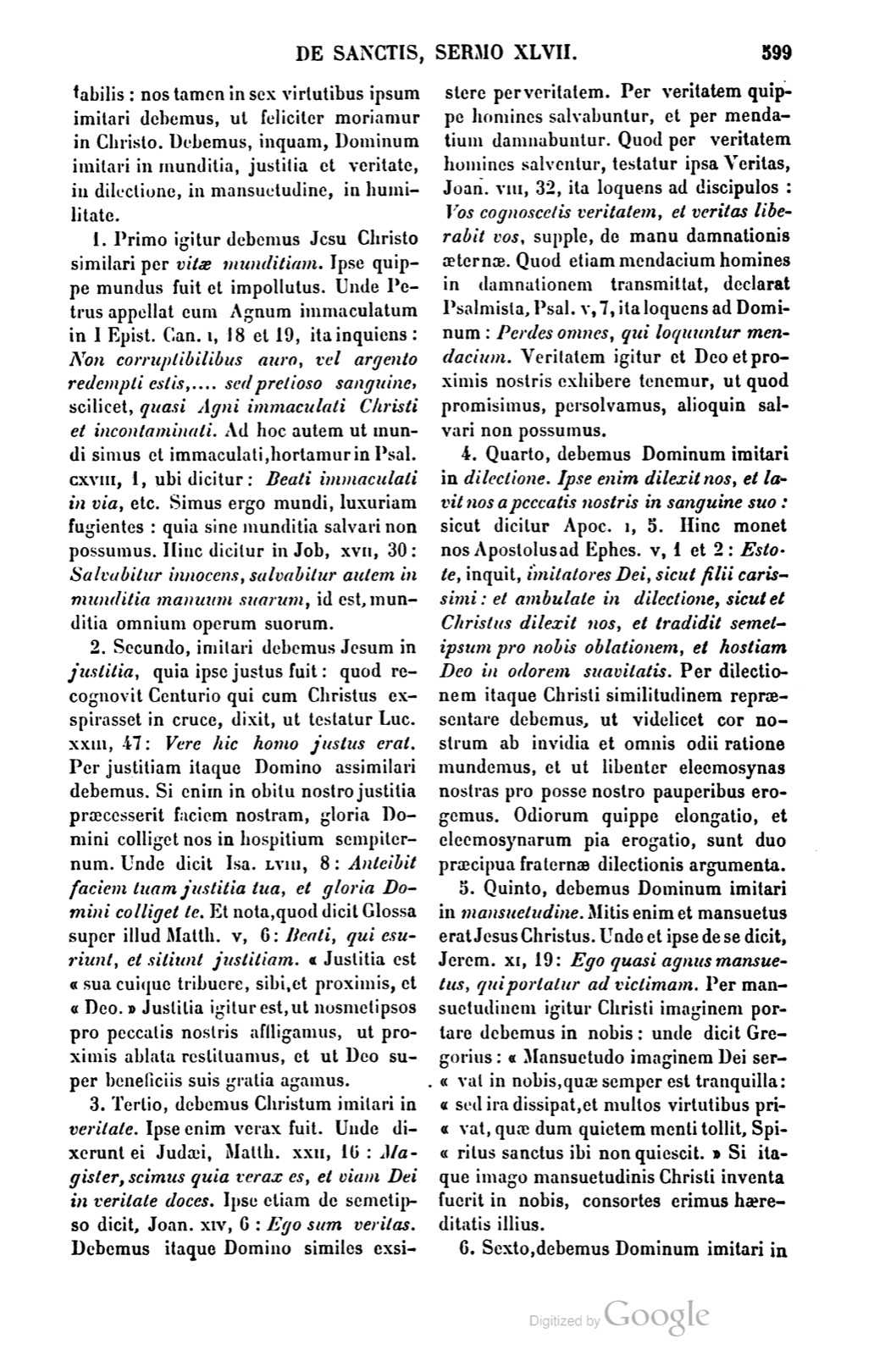
nos tamen in sex virtutibus ipsum imitari debemus, ut feliciter moriamur in Christo. Debemus, inquam, Dominum imitari in munditia, justitia et veritate, in dilectione, in mansuetudine, in humilitate.
1. Primo igitur debemus Jesu Christo similari per vitæ munditiam. Ipse quippe mundus fuit et impollutus. Unde Petrus appellat eum Agnum immaculatum in I Epist. Can. I, 18 et 19, ita inquiens: Non corruptibilibus auro, vel argento redempti estis, .... sed pretioso sanguine, scilicet, quasi Agni immaculati Christi et incontaminati. Ad hoc autem ut mundi simus et immaculati, hortamur in Psal. CXVIII, 1, ubi dicitur: Beati immaculati in via, etc. Simus ergo mundi, luxuriam fugientes: quia sine munditia salvari non possumus. Hinc dicitur in Job, XXII, 30: Salvabitur innocens, salvabitur autem in munditia manuum suarum, id est, munditia omnium operum suorum.
2. Secundo, imitari debemus Jesum in justitia, quia ipse justus fuit: quod recognovit Centurio qui cum Christus exspirasset in cruce, dixit, ut testatur Luc. XXIII, 47: Vere hic homo justus erat. Per justitiam itaque Domino assimilari debemus. Si enim in obitu nostro justitia præcesserit faciem nostram, gloria Domini colliget nos in hospitium sempiternum. Unde dicit Isa. LVIII, 8: Anteibit faciem tuam justitia tua, et gloria Domini colliget te. Et nota, quod dicit Glossa super illud Matth. V, 6: Beati, qui esuriunt, et sitiunt justitiam. « Justitia est sua cuique tribuere, sibi, et proximis, et Deo. » Justitia igitur est, ut nosmetipsos pro peccatis nostris affligamus, ut proximis ablata restituamus, et ut Deo super beneficiis suis gratiam agamus.
3. Tertio, debemus Christum imitari in veritate. Ipse enim verax fuit. Unde dixerunt ei Judæi, Matth. XXII, 16: Magister, scimus quia verax es, et viam Dei in veritate doces. Ipse etiam de semetipso dicit, Joan. XIV, 6: Ego sum veritas. Debemus itaque Domino similes exsistere per veritatem. Per veritatem quippe homines salvabuntur, et per mendacium damnabuntur. Quod per veritatem homines salventur, testatur ipsa Veritas, Joan. VIII, 32, ita loquens ad discipulos: Vos cognoscetis veritatem, et veritas liberabit vos, supple, de manu damnationis æternæ. Quod etiam mendacium homines in damnationem transmittat, declarat Psalmista, Psal. V, 7, ita loquens ad Dominum: Perdes omnes, qui loquuntur mendacium. Veritatem igitur et Deo et proximis nostris exhibere tenemur, ut quod promisimus, persolvamus, alioquin salvari non possumus.
4. Quarto, debemus Dominum imitari in dilectione. Ipse enim dilexit nos, et lavit nos a peccatis nostris in sanguine suo: sicut dicitur Apoc. I, 5. Hinc monet nos Apostolus ad Ephes. V, 1 et 2: Estote, inquit, imitatores Dei, sicut filii carissimi: et ambulate in dilectione, sicut et Christus dilexit nos, et tradidit semetipsum pro nobis oblationem, et hostiam Deo in odorem suavitatis. Per dilectionem itaque Christi similitudinem repræsentare debemus, ut videlicet cor nostrum ab invidia et omnis odii ratione mundemus, et ut libenter eleemosynas nostras pro posse nostro pauperibus erogemus. Odiorum quippe elongatio, et eleemosynarum pia erogatio, sunt duo præcipua fraternæ dilectionis argumenta.
nevertheless we ought to imitate him in six virtues, so that we may die happily in Christ. We ought, I say, to imitate the Lord in cleanness, justice and truth, in love, in meekness, in humility.
1. First, therefore, we ought to be made like Jesus Christ through cleanness of life. For he was clean and unstained. Hence Peter calls him an immaculate Lamb in the First Canonical Epistle 1:18 and 19, speaking thus: You have been redeemed not by corruptible gold or silver, .... but by the precious blood, namely, as of the immaculate and uncontaminated Lamb, Christ. But in order that we may be clean and immaculate, we are exhorted in Psalm 118:1, where it is said: Blessed are the immaculate in the way, etc. Therefore let us be clean, fleeing luxury, because without cleanness we cannot be saved. Hence it is said in Job 22:30: The innocent will be saved, but he will be saved in the cleanness of his hands, that is, in the cleanness of all his works.
2. Secondly, we ought to imitate Jesus in justice, because he himself was just; this the Centurion recognized, who, when Christ had breathed forth on the cross, said, as Luke 23:47 testifies: Truly this man was just. Therefore through justice we ought to be assimilated to the Lord. For if in our death justice has gone before our face, the glory of the Lord will gather us into the everlasting lodging. Hence Isaiah 58:8 says: Your justice will go before your face, and the glory of the Lord will gather you. And note what the Gloss says on that saying, Matthew 5:6: Blessed are those who hunger and thirst for justice. "Justice is to render his own to each, to oneself, and to neighbors, and to God." Therefore justice is that we afflict ourselves for our sins, that we restore to neighbors things taken away, and that we give thanks to God for his benefits.
3. Thirdly, we ought to imitate Christ in truth. For he himself was truthful. Hence the Jews said to him, Matthew 22:16: Master, we know that you are truthful and teach the way of God in truth. He also says of himself, John 14:6: I am the truth. Therefore we ought to exist like the Lord through truth. For through truth human beings will be saved, and through falsehood they will be damned. That human beings are saved through truth, Truth itself testifies, John 8:32, speaking thus to the disciples: You will know the truth, and the truth will free you, supply, from the hand of eternal damnation. That falsehood also sends human beings into damnation, the Psalmist declares, Psalm 5:7, speaking thus to the Lord: You will destroy all who speak falsehood. Therefore we are bound to display truth both to God and to our neighbors, so that what we have promised we may pay; otherwise we cannot be saved.
4. Fourthly, we ought to imitate the Lord in love. For he loved us, and washed us from our sins in his blood, as is said in Apocalypse 1:5. Hence the Apostle admonishes us at Ephesians 5:1 and 2: Be, he says, imitators of God, as most dear children, and walk in love, just as Christ also loved us and handed himself over for us as an offering and a victim to God in the odor of sweetness. Therefore through love we ought to represent Christ's likeness, namely so that we may cleanse our heart from envy and from every ground of hatred, and so that we may willingly bestow our alms upon the poor according to our ability. For the distancing of hatreds and the pious bestowal of alms are two chief proofs of brotherly love.
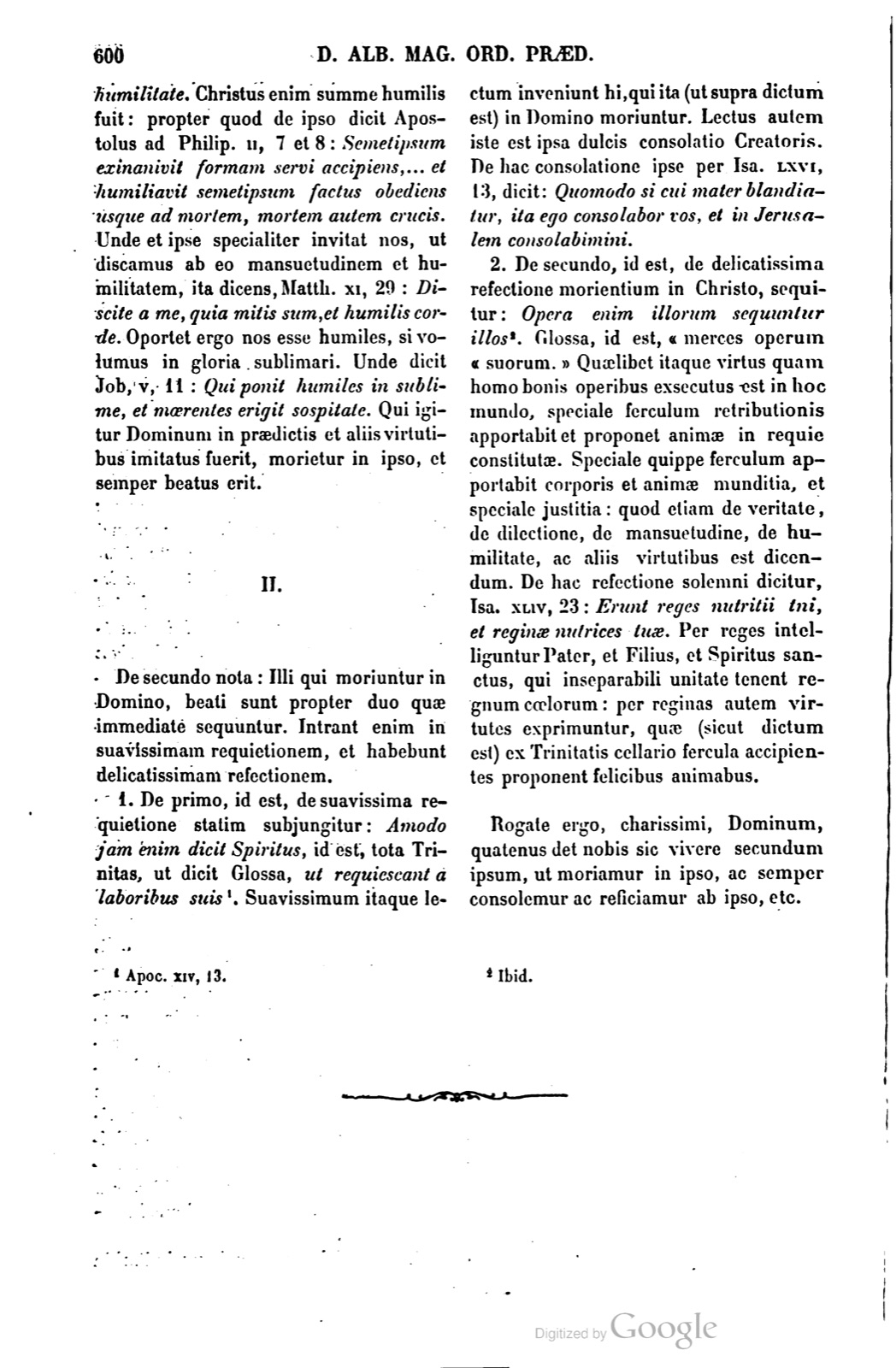
5. Quinto, debemus Dominum imitari in mansuetudine. Mitis enim et mansuetus erat Jesus Christus. Unde et ipse de se dicit, Jerem. XI, 19: Ego quasi agnus mansuetus, qui portatur ad victimam. Per mansuetudinem igitur Christi imaginem portare debemus in nobis: unde dicit Gregorius: « Mansuetudo imaginem Dei servat in nobis, quæ semper est tranquilla: sed ira dissipat, et multos virtutibus privat, quæ dum quietem menti tollit, Spiritus sanctus ibi non quiescit. » Si itaque imago mansuetudinis Christi inventa fuerit in nobis, consortes erimus hæreditatis illius.
6. Sexto, debemus Dominum imitari in humilitate. Christus enim summe humilis fuit: propter quod de ipso dicit Apostolus ad Philip. II, 7 et 8: Semetipsum exinanivit formam servi accipiens, ... et humiliavit semetipsum factus obediens usque ad mortem, mortem autem crucis. Unde et ipse specialiter invitat nos, ut discamus ab eo mansuetudinem et humilitatem, ita dicens, Matth. XI, 29: Discite a me, quia mitis sum, et humilis corde. Oportet ergo nos esse humiles, si volumus in gloria sublimari. Unde dicit Job, V, 11: Qui ponit humiles in sublime, et mærentes erigit sospitate. Qui igitur Dominum in prædictis et aliis virtutibus imitatus fuerit, morietur in ipso, et semper beatus erit.
II.
De secundo nota: Illi qui moriuntur in Domino, beati sunt propter duo quæ immediate sequuntur. Intrant enim in suavissimam requietionem, et habebunt delicatissimam refectionem.
1. De primo, id est, de suavissima requietione statim subjungitur: Amodo jam enim dicit Spiritus, id est, tota Trinitas, ut dicit Glossa, ut requiescant a laboribus suis 1. Suavissimum itaque lectum inveniunt hi, qui ita (ut supra dictum est) in Domino moriuntur. Lectus autem iste est ipsa dulcis consolatio Creatoris. De hac consolatione ipse per Isa. LXVI, 13, dicit: Quomodo si cui mater blandiatur, ita ego consolabor vos, et in Jerusalem consolabimini.
2. De secundo, id est, de delicatissima refectione morientium in Christo, sequitur: Opera enim illorum sequuntur illos 2. Glossa, id est, « merces operum suorum. » Quælibet itaque virtus quam homo bonis operibus exsecutus est in hoc mundo, speciale ferculum retributionis apportabit et proponet animæ in requie constitutæ. Speciale quippe ferculum apportabit corporis et animæ munditia, et speciale justitia: quod etiam de veritate, de dilectione, de mansuetudine, de humilitate, ac aliis virtutibus est dicendum. De hac refectione solemni dicitur, Isa. XLIX, 23: Erunt reges nutritii tui, et reginæ nutrices tuæ. Per reges intelliguntur Pater, et Filius, et Spiritus sanctus, qui inseparabili unitate tenent regnum cælorum: per reginas autem virtutes exprimuntur, quæ (sicut dictum est) ex Trinitatis cellario fercula accipientes proponent felicibus animabus.
Rogate ergo, charissimi, Dominum, quatenus det nobis sic vivere secundum ipsum, ut moriamur in ipso, ac semper consolemur ac reficiamur ab ipso, etc.
Footnotes:
1 Apoc. XIV, 13.
2 Ibid.
5. Fifthly, we ought to imitate the Lord in meekness. For Jesus Christ was mild and meek. Hence he also says of himself, Jeremiah 11:19: I am like a meek lamb that is carried to the victim. Therefore through meekness we ought to carry the image of Christ in ourselves; hence Gregory says: "Meekness preserves the image of God in us, which is always tranquil; but anger scatters it and deprives many of virtues, because, while it takes quiet away from the mind, the Holy Spirit does not rest there." Therefore if the image of Christ's meekness has been found in us, we will be consorts of his inheritance.
6. Sixthly, we ought to imitate the Lord in humility. For Christ was supremely humble; on account of this the Apostle says of him at Philippians 2:7 and 8: He emptied himself, taking the form of a servant, ... and humbled himself, made obedient unto death, even the death of the cross. Hence he also specially invites us to learn meekness and humility from him, speaking thus, Matthew 11:29: Learn from me, because I am meek and humble of heart. Therefore we must be humble, if we wish to be raised on high in glory. Hence Job 5:11 says: He who places the humble on high, and raises the mourning to safety. Therefore he who has imitated the Lord in the aforesaid and other virtues will die in him and will be blessed forever.
II.
Concerning the second, note: Those who die in the Lord are blessed on account of two things that immediately follow. For they enter into most sweet resting, and they will have most delicate refreshment.
1. Concerning the first, that is, concerning the most sweet resting, there is immediately added: For from now on the Spirit already says, that is, the whole Trinity, as the Gloss says, that they may rest from their labors 1. Therefore those who so die in the Lord, as was said above, find a most sweet bed. But that bed is the sweet consolation itself of the Creator. Concerning this consolation he himself says through Isaiah 66:13: As if a mother should caress someone, so I will console you, and in Jerusalem you will be consoled.
2. Concerning the second, that is, concerning the most delicate refreshment of those dying in Christ, there follows: For their works follow them 2. Gloss, that is, "the rewards of their works." Therefore any virtue which a human being has carried out by good works in this world will bring and set before the soul established in rest a special dish of recompense. For cleanness of body and soul will bring a special dish, and justice a special one; this is also to be said concerning truth, concerning love, concerning meekness, concerning humility, and concerning other virtues. Concerning this solemn refreshment it is said, Isaiah 49:23: Kings will be your nurturers, and queens your nurses. By kings are understood the Father, and the Son, and the Holy Spirit, who by inseparable unity hold the kingdom of heaven; but by queens are expressed virtues, which, as was said, receiving dishes from the storeroom of the Trinity will set them before happy souls.
Therefore pray, dearly beloved, to the Lord, that he may grant us so to live according to him, that we may die in him, and may always be consoled and refreshed by him, etc.
Footnotes:
1 Apocalypse 14:13.
2 In the same place.
If a page does not appear, its photograph has not been uploaded yet.