Volume 13 · pp. 542–545
Sermon XXXIII. Likewise on the Assumption of the Blessed Virgin Mary
A marker with ≈ is an approximate page boundary, placed by measure of the text; the page photographs remain the authority. In the paired views, clicking a page marker brings that page into view.
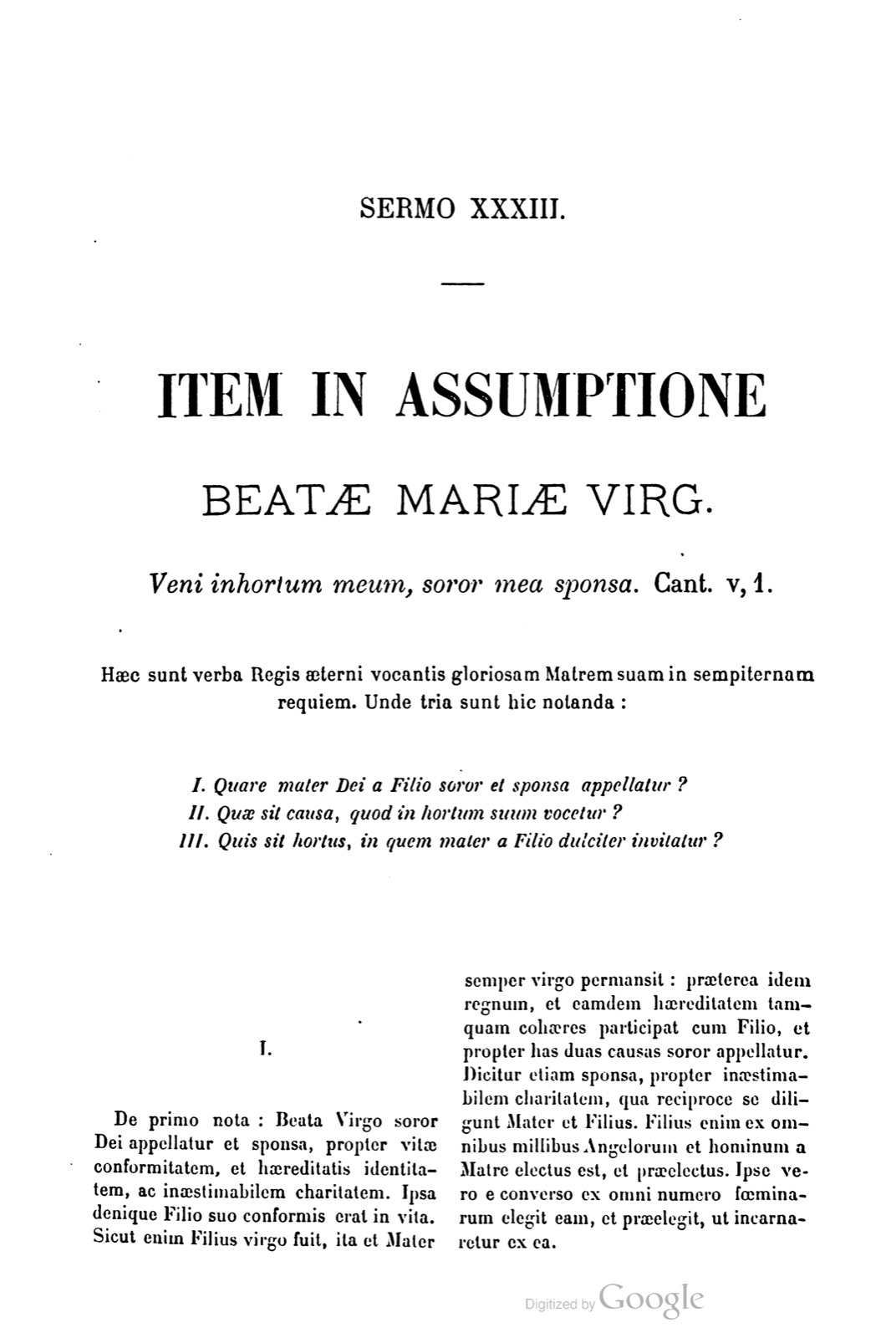
SERMO XXXIII.
ITEM IN ASSUMPTIONE BEATÆ MARIÆ VIRG.
Veni in hortum meum, soror mea sponsa. Cant. V, 1.
Hæc sunt verba Regis æterni vocantis gloriosam Matrem suam in sempiternam requiem. Unde tria sunt hic notanda:
I. Quare mater Dei a Filio soror et sponsa appellatur? II. Quæ sit causa, quod in hortum suum vocetur? III. Quis sit hortus, in quem mater a Filio dulciter invitatur?
I.
De primo nota: Beata Virgo soror Dei appellatur et sponsa, propter vitæ conformitatem, et hæreditatis identitatem, ac inæstimabilem charitatem. Ipsa denique Filio suo conformis erat in vita. Sicut enim Filius virgo fuit, ita et Mater semper virgo permansit: præterea idem regnum, et eamdem hæreditatem tamquam cohæres participat cum Filio, et propter has duas causas soror appellatur. Dicitur etiam sponsa, propter inæstimabilem charitatem, qua reciproce se diligunt Mater et Filius. Filius enim ex omnibus millibus Angelorum et hominum a Matre electus est, et præelectus. Ipse vero e converso ex omni numero fœminarum elegit eam, et præelegit, ut incarnaretur ex ea.
II.
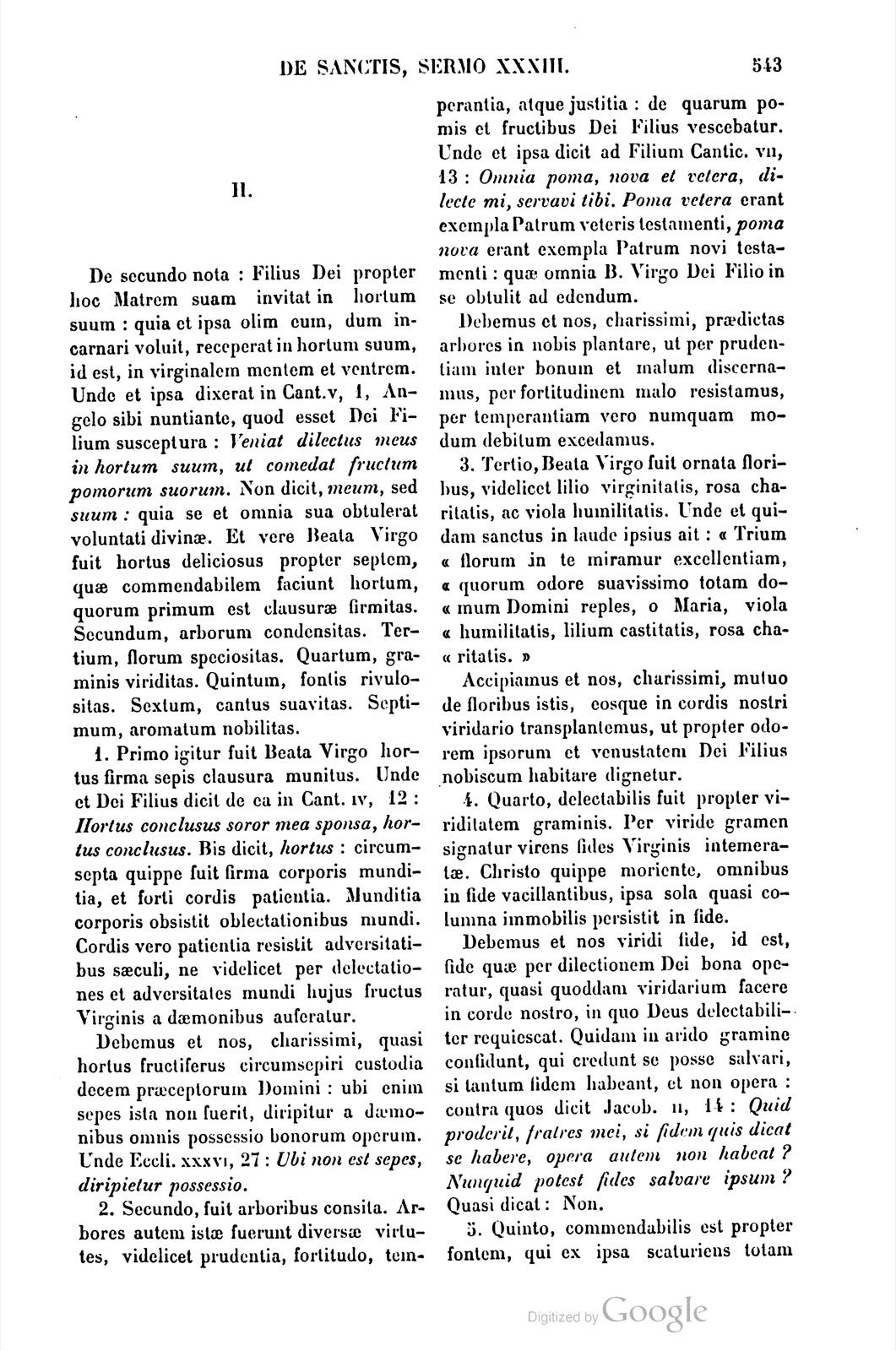
De secundo nota: Filius Dei propter hoc Matrem suam invitat in hortum suum: quia et ipsa olim eum, dum incarnari voluit, receperat in hortum suum, id est, in virginalem mentem et ventrem. Unde et ipsa dixerat in Cant. V, 1, Angelo sibi nuntiante, quod esset Dei Filium susceptura: Veniat dilectus meus in hortum suum, ut comedat fructum pomorum suorum. Non dicit, meum, sed suum: quia se et omnia sua obtulerat voluntati divinæ. Et vere Beata Virgo fuit hortus deliciosus propter septem, quæ commendabilem faciunt hortum, quorum primum est clausuræ firmitas. Secundum, arborum condensitas. Tertium, florum speciositas. Quartum, graminis viriditas. Quintum, fontis rivulositas. Sextum, cantus suavitas. Septimum, aromatum nobilitas.
1. Primo igitur fuit Beata Virgo hortus firma sepis clausura munitus. Unde et Dei Filius dicit de ea in Cant. IV, 12: Hortus conclusus soror mea sponsa, hortus conclusus. Bis dicit, hortus: circumsepta quippe fuit firma corporis munditia, et forti cordis patientia. Munditia corporis obsistit oblectationibus mundi. Cordis vero patientia resistit adversitatibus sæculi, ne videlicet per delectationes et adversitates mundi hujus fructus Virginis a dæmonibus auferatur.
Debemus et nos, charissimi, quasi hortus fructiferus circumsepiri custodia decem præceptorum Domini: ubi enim sepes ista non fuerit, diripitur a dæmonibus omnis possessio bonorum operum. Unde Eccli. XXXVI, 27: Ubi non est sepes, diripietur possessio.
2. Secundo, fuit arboribus consita. Arbores autem istæ fuerunt diversæ virtutes, videlicet prudentia, fortitudo, temperantia, atque justitia: de quarum pomis et fructibus Dei Filius vescebatur. Unde et ipsa dicit ad Filium Cantic. VIII, 13: Omnia poma, nova et vetera, dilecte mi, servavi tibi. Poma vetera erant exempla Patrum veteris testamenti, poma nova erant exempla Patrum novi testamenti: quæ omnia B. Virgo Dei Filio in se obtulit ad edendum.
SERMON XXXIII.
LIKEWISE ON THE ASSUMPTION OF THE BLESSED VIRGIN MARY.
Come into my garden, my sister bride. Song of Songs 5:1.
These are the words of the eternal King calling his glorious Mother into everlasting rest. Hence three things are to be noted here:
I. Why is the Mother of God called sister and bride by the Son? II. What is the cause that she is called into his garden? III. What is the garden into which the Mother is sweetly invited by the Son?
I.
On the first, note: The Blessed Virgin is called sister of God and bride on account of conformity of life, identity of inheritance, and inestimable charity. For she was conformed to her Son in life. For as the Son was virgin, so also the Mother remained always virgin; besides, she shares the same kingdom and the same inheritance as co-heir with the Son, and on account of these two causes she is called sister. She is also called bride on account of the inestimable charity by which Mother and Son love one another reciprocally. For the Son was chosen and preferred by the Mother from all the thousands of Angels and men. But he conversely chose and preferred her from the whole number of women, so that he might be incarnate from her.
II.
On the second, note: For this reason the Son of God invites his Mother into his garden: because she too formerly, when he wished to be incarnate, had received him into her garden, that is, into her virginal mind and womb. Hence she herself had said in Song of Songs 5:1, when the Angel was announcing to her that she would receive the Son of God: Let my beloved come into his garden, so that he may eat the fruit of his apples. She does not say, my, but his, because she had offered herself and all her things to the divine will. And truly the Blessed Virgin was a delightful garden on account of seven things that make a garden commendable. The first of these is firmness of enclosure. The second, density of trees. The third, beauty of flowers. The fourth, greenness of grass. The fifth, rivulet-flowing of a fountain. The sixth, sweetness of song. The seventh, nobility of aromatics.
1. Therefore first the Blessed Virgin was a garden fortified by the firm enclosure of a hedge. Hence also the Son of God says concerning her in Song of Songs 4:12: A garden enclosed is my sister bride, a garden enclosed. Twice he says, garden, for she was surrounded by firm cleanness of body and strong patience of heart. Cleanness of body stands against the delights of the world. But patience of heart resists the adversities of the age, lest, namely, through the delights and adversities of this world, the fruit of the Virgin be taken away by demons.
We too, dearest ones, as a fruitful garden, ought to be surrounded by the keeping of the ten precepts of the Lord; for where that hedge has not been, the whole possession of good works is plundered by demons. Hence Ecclesiasticus 36:27: Where there is no hedge, the possession will be plundered.
2. Secondly, she was planted with trees. But those trees were diverse virtues, namely prudence, fortitude, temperance, and justice; from their apples and fruits the Son of God was fed. Hence she herself says to the Son, Song of Songs 8:13: All the apples, new and old, my beloved, I have kept for you. The old apples were the examples of the Fathers of the Old Testament; the new apples were the examples of the Fathers of the New Testament; all these the Blessed Virgin offered in herself to the Son of God for eating.
Debemus et nos, charissimi, prædictas arbores in nobis plantare, ut per prudentiam inter bonum et malum discernamus, per fortitudinem malo resistamus, per temperantiam vero numquam modum debitum excedamus.
3. Tertio, Beata Virgo fuit ornata floribus, videlicet lilio virginitatis, rosa charitatis, ac viola humilitatis. Unde et quidam sanctus in laude ipsius ait: « Trium florum in te miramur excellentiam, quorum odore suavissimo totam domum Domini reples, o Maria, viola humilitatis, lilium castitatis, rosa charitatis. »
Accipiamus et nos, charissimi, mutuo de floribus istis, eosque in cordis nostri viridario transplantemus, ut propter odorem ipsorum et venustatem Dei Filius nobiscum habitare dignetur.
4. Quarto, delectabilis fuit propter viriditatem graminis. Per viride gramen signatur virens fides Virginis intemeratæ. Christo quippe moriente, omnibus in fide vacillantibus, ipsa sola quasi columna immobilis persistit in fide.
Debemus et nos viridi fide, id est, fide quæ per dilectionem Dei bona operatur, quasi quoddam viridarium facere in corde nostro, in quo Deus delectabiliter requiescat. Quidam in arido gramine confidunt, qui credunt se posse salvari, si tantum fidem habeant, et non opera: contra quos dicit Jacob. II, 14: Quid proderit, fratres mei, si fidem quis dicat se habere, opera autem non habeat? Nunquid potest fides salvare ipsum? Quasi dicat: Non.
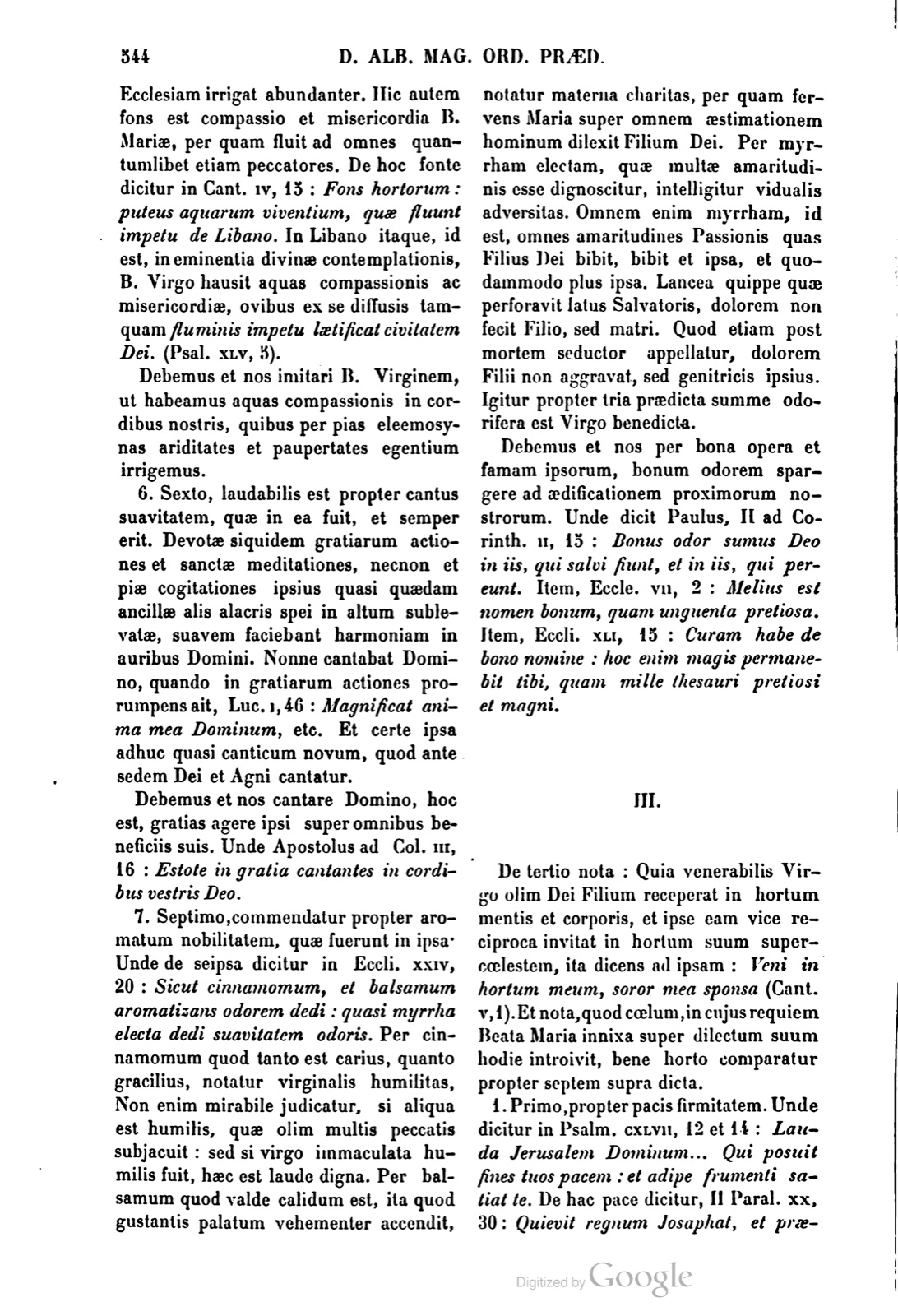
5. Quinto, commendabilis est propter fontem, qui ex ipsa scaturiens totam Ecclesiam irrigat abundanter. Hic autem fons est compassio et misericordia B. Mariæ, per quam fluit ad omnes quantumlibet etiam peccatores. De hoc fonte dicitur in Cant. IV, 15: Fons hortorum: puteus aquarum viventium, quæ fluunt impetu de Libano. In Libano itaque, id est, in eminentia divinæ contemplationis, B. Virgo hausit aquas compassionis ac misericordiæ, quibus ex se diffusis tamquam fluminis impetu lætificat civitatem Dei. (Psal. XLV, 5).
Debemus et nos imitari B. Virginem, ut habeamus aquas compassionis in cordibus nostris, quibus per pias eleemosynas ariditates et paupertates egentium irrigemus.
6. Sexto, laudabilis est propter cantus suavitatem, quæ in ea fuit, et semper erit. Devotæ siquidem gratiarum actiones et sanctæ meditationes, necnon et piæ cogitationes ipsius quasi quædam ancillæ alis alacris spei in altum sublevatæ, suavem faciebant harmoniam in auribus Domini. Nonne cantabat Domino, quando in gratiarum actiones prorumpens ait, Luc. I, 46: Magnificat anima mea Dominum, etc. Et certe ipsa adhuc quasi canticum novum, quod ante sedem Dei et Agni cantatur.
We too, dearest ones, ought to plant the aforesaid trees in ourselves, so that through prudence we may discern between good and evil, through fortitude we may resist evil, but through temperance we may never exceed due measure.
3. Thirdly, the Blessed Virgin was adorned with flowers, namely with the lily of virginity, the rose of charity, and the violet of humility. Hence also a certain saint says in praise of her: "We admire in you the excellence of three flowers, with whose sweetest odor you fill the whole house of the Lord, O Mary, violet of humility, lily of chastity, rose of charity."
Let us too, dearest ones, take from those flowers in turn and transplant them into the little green-place of our heart, so that on account of their odor and loveliness the Son of God may deign to dwell with us.
4. Fourthly, she was delightful on account of the greenness of grass. By green grass is signified the green faith of the unspotted Virgin. For when Christ was dying, while all were wavering in faith, she alone, as an immovable column, persisted in faith.
We too ought with green faith, that is, faith that works good things through love of God, to make as it were a certain green-place in our heart, in which God may rest delightfully. Certain persons trust in dry grass, who believe that they can be saved if they only have faith and not works. Against these James 2:14 says: What will it profit, my brothers, if someone says that he has faith, but does not have works? Can faith save him? As if he were saying: No.
5. Fifthly, she is commendable on account of the fountain that, springing from her, irrigates the whole Church abundantly. But this fountain is the compassion and mercy of Blessed Mary, by which she flows to all, even however great sinners they may be. Concerning this fountain it is said in Song of Songs 4:15: A fountain of gardens, a well of living waters, which flow by force from Lebanon. Therefore in Lebanon, that is, in the eminence of divine contemplation, the Blessed Virgin drew waters of compassion and mercy; these, poured forth from her as by the force of a river, gladden the city of God. (Psalm 45:5.)
We too ought to imitate the Blessed Virgin, so that we may have waters of compassion in our hearts, with which through dutiful alms we may irrigate the drynesses and poverties of the needy.
6. Sixthly, she is praiseworthy on account of the sweetness of song that was in her and always will be. For her devout acts of thanksgiving and holy meditations, and also her dutiful thoughts, like certain handmaids lifted on high by the wings of lively hope, made sweet harmony in the ears of the Lord. Was she not singing to the Lord when, breaking forth into acts of thanksgiving, she said, Luke 1:46: My soul magnifies the Lord, etc.? And certainly she herself still, as it were, a new song, which is sung before the seat of God and of the Lamb.
Debemus et nos cantare Domino, hoc est, gratias agere ipsi super omnibus beneficiis suis. Unde Apostolus ad Col. III, 16: Estote in gratia cantantes in cordibus vestris Deo.
7. Septimo, commendatur propter aromatum nobilitatem, quæ fuerunt in ipsa: Unde de seipsa dicitur in Eccli. XXIV, 20: Sicut cinnamomum, et balsamum aromatizans odorem dedi: quasi myrrha electa dedi suavitatem odoris. Per cinnamomum quod tanto est carius, quanto gracilius, notatur virginalis humilitas. Non enim mirabile judicatur, si aliqua est humilis, quæ olim multis peccatis subjacuit: sed si virgo immaculata humilis fuit, hæc est laude digna. Per balsamum quod valde calidum est, ita quod gustantis palatum vehementer accendit, notatur materna charitas, per quam fervens Maria super omnem æstimationem hominum dilexit Filium Dei. Per myrrham electam, quæ multæ amaritudinis esse dignoscitur, intelligitur vidualis adversitas. Omnem enim myrrham, id est, omnes amaritudines Passionis quas Filius Dei bibit, bibit et ipsa, et quodammodo plus ipsa. Lancea quippe quæ perforavit latus Salvatoris, dolorem non fecit Filio, sed matri. Quod etiam post mortem seductor appellatur, dolorem Filii non aggravat, sed genitricis ipsius. Igitur propter tria prædicta summe odorifera est Virgo benedicta.
Debemus et nos per bona opera et famam ipsorum, bonum odorem spargere ad ædificationem proximorum nostrorum. Unde dicit Paulus, II ad Corinth. II, 15: Bonus odor sumus Deo in iis, qui salvi fiunt, et in iis, qui pereunt. Item, Eccle. VII, 2: Melius est nomen bonum, quam unguenta pretiosa. Item, Eccli. XLI, 15: Curam habe de bono nomine: hoc enim magis permanebit tibi, quam mille thesauri pretiosi et magni.
III.
De tertio nota: Quia venerabilis Virgo olim Dei Filium receperat in hortum mentis et corporis, et ipse eam vice reciproca invitat in hortum suum supercœlestem, ita dicens ad ipsam: Veni in hortum meum, soror mea sponsa (Cant. V, 1). Et nota, quod cælum, in cujus requiem Beata Maria innixa super dilectum suum hodie introivit, bene horto comparatur propter septem supra dicta.
1. Primo, propter pacis firmitatem. Unde dicitur in Psalm. CXLVII, 12 et 14: Lauda Jerusalem Dominum... Qui posuit fines tuos pacem: et adipe frumenti satiat te. De hac pace dicitur, II Paral. XX, 30: Quievit regnum Josaphat, et præbuit ei Deus pacem per circuitum. Josaphat interpretatur ipse judicans, et signat Dei Filium, cui Pater commisit judicium: et certe in hujus regno pax est per circuitum.
We too ought to sing to the Lord, that is, give thanks to him for all his benefits. Hence the Apostle says at Colossians 3:16: Be in grace, singing in your hearts to God.
7. Seventhly, she is commended on account of the nobility of aromatics that were in her. Hence concerning herself it is said in Ecclesiasticus 24:20: Like cinnamon and aromatic balsam I gave odor; like chosen myrrh I gave sweetness of odor. By cinnamon, which is dearer the slenderer it is, is noted virginal humility. For it is not judged wonderful if some woman is humble who formerly was subject to many sins; but if an immaculate virgin was humble, this is worthy of praise. By balsam, which is very hot, so that it vehemently kindles the palate of the one tasting, is noted maternal charity, through which fervent Mary loved the Son of God beyond every estimation of men. By chosen myrrh, which is known to be of much bitterness, is understood widowed adversity. For every myrrh, that is, all the bitternesses of the Passion that the Son of God drank, she herself also drank, and in a certain way she drank more. For the lance that pierced the side of the Savior did not make pain for the Son, but for the mother. The fact also that after death he is called deceiver does not aggravate the sorrow of the Son, but of his mother. Therefore on account of the three aforesaid things the blessed Virgin is supremely odoriferous.
We too ought through good works and the reputation of them to scatter a good odor for the edification of our neighbors. Hence Paul says, 2 Corinthians 2:15: We are a good odor to God in those who are being saved and in those who are perishing. Likewise, Ecclesiastes 7:2: A good name is better than precious ointments. Likewise, Ecclesiasticus 41:15: Have care for a good name; for this will remain to you more than a thousand precious and great treasures.
III.
On the third, note: Because the venerable Virgin formerly had received the Son of God into the garden of mind and body, he himself in reciprocal turn invites her into his super-heavenly garden, speaking thus to her: Come into my garden, my sister bride (Song of Songs 5:1). And note that heaven, into whose rest Blessed Mary, leaning upon her beloved, entered today, is well compared to a garden on account of the seven things said above.
1. First, on account of firmness of peace. Hence it is said in Psalm 147:12 and 14: Praise the Lord, Jerusalem... He who has placed peace as your borders and satisfies you with the fatness of wheat. Concerning this peace it is said, 2 Chronicles 20:30: The kingdom of Josaphat rested, and God gave him peace round about. Josaphat is interpreted he himself judging, and signifies the Son of God, to whom the Father committed judgment; and certainly in his kingdom there is peace round about.
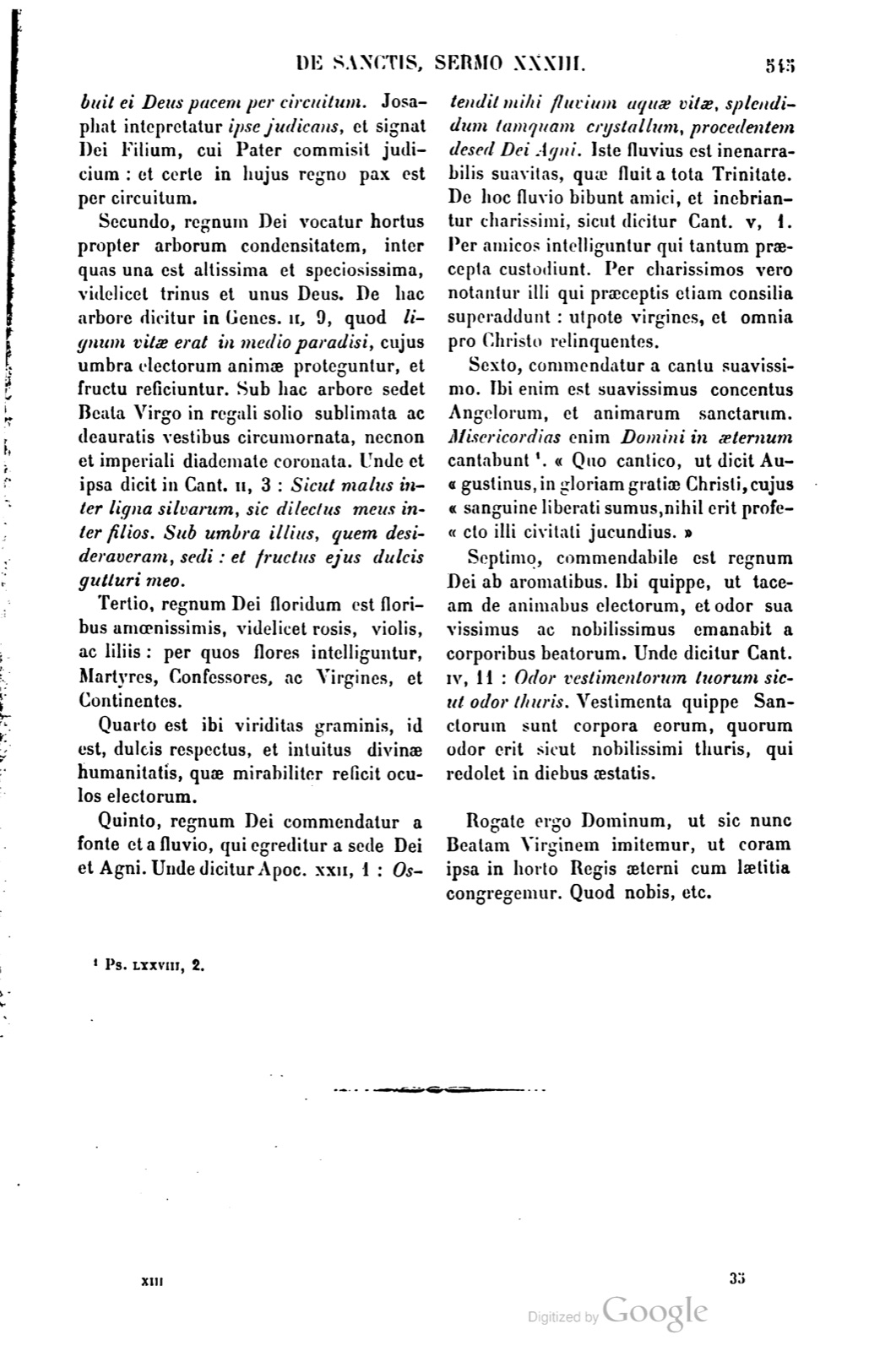
Secundo, regnum Dei vocatur hortus propter arborum condensitatem, inter quas una est altissima et speciosissima, videlicet trinus et unus Deus. De hac arbore dicitur in Genes. II, 9, quod lignum vitæ erat in medio paradisi, cujus umbra electorum animæ proteguntur, et fructu reficiuntur. Sub hac arbore sedet Beata Virgo in regali solio sublimata ac deauratis vestibus circumornata, necnon et imperiali diademate coronata. Unde et ipsa dicit in Cant. II, 3: Sicut malus inter ligna silvarum, sic dilectus meus inter filios. Sub umbra illius, quem desideraveram, sedi: et fructus ejus dulcis gutturi meo.
Tertio, regnum Dei floridum est floribus amœnissimis, videlicet rosis, violis, ac liliis: per quos flores intelliguntur, Martyres, Confessores, ac Virgines, et Continentes.
Quarto est ibi viriditas graminis, id est, dulcis respectus, et intuitus divinæ humanitatis, quæ mirabiliter reficit oculos electorum.
Quinto, regnum Dei commendatur a fonte et a fluvio, qui egreditur a sede Dei et Agni. Unde dicitur Apoc. XXII, 1: Ostendit mihi fluvium aquæ vitæ, splendidum tamquam crystallum, procedentem de sede Dei et Agni. Iste fluvius est inenarrabilis suavitas, quæ fluit a tota Trinitate. De hoc fluvio bibunt amici, et inebriantur charissimi, sicut dicitur Cant. V, 1. Per amicos intelliguntur qui tantum præcepta custodiunt. Per charissimos vero notantur illi qui præceptis etiam consilia superaddunt: utpote virgines, et omnia pro Christo relinquentes.
Sexto, commendatur a cantu suavissimo. Ibi enim est suavissimus concentus Angelorum, et animarum sanctarum. Misericordias enim Domini in æternum cantabunt 1. « Quo cantico, ut dicit Augustinus, in gloriam gratiæ Christi, cujus sanguine liberati sumus, nihil erit profecto illi civitati jucundius. »
Septimo, commendabile est regnum Dei ab aromatibus. Ibi quippe, ut taceam de animabus electorum, et odor suavissimus ac nobilissimus emanabit a corporibus beatorum. Unde dicitur Cant. IV, 11: Odor vestimentorum tuorum sicut odor thuris. Vestimenta quippe Sanctorum sunt corpora eorum, quorum odor erit sicut nobilissimi thuris, qui redolet in diebus æstatis.
Rogate ergo Dominum, ut sic nunc Beatam Virginem imitemur, ut coram ipsa in horto Regis æterni cum lætitia congregemur. Quod nobis, etc.
Secondly, the kingdom of God is called a garden on account of the density of trees, among which one is highest and most beautiful, namely the triune and one God. Concerning this tree it is said in Genesis 2:9 that the tree of life was in the middle of paradise, by whose shade the souls of the elect are protected and by whose fruit they are refreshed. Under this tree the Blessed Virgin sits, raised upon a royal throne and adorned all around with golden garments, and also crowned with an imperial diadem. Hence she herself also says in Song of Songs 2:3: As the apple tree among the trees of the woods, so my beloved among the sons. Under the shade of him whom I had desired, I sat; and his fruit was sweet to my throat.
Thirdly, the kingdom of God is flowery with most pleasant flowers, namely roses, violets, and lilies; by these flowers are understood Martyrs, Confessors, Virgins, and Continent persons.
Fourthly, there is there the greenness of grass, that is, the sweet gaze and looking upon the divine humanity, which wonderfully refreshes the eyes of the elect.
Fifthly, the kingdom of God is commended by the fountain and by the river that comes forth from the seat of God and of the Lamb. Hence Apocalypse 22:1 says: He showed me a river of the water of life, bright as crystal, proceeding from the seat of God and of the Lamb. That river is inexpressible sweetness that flows from the whole Trinity. From this river friends drink, and the dearest become inebriated, as is said in Song of Songs 5:1. By friends are understood those who only keep the precepts. But by the dearest are marked those who add counsels also to the precepts, as virgins, and those leaving all things for Christ.
Sixthly, it is commended by sweetest song. For there is the sweetest harmony of Angels and holy souls. For they will sing the mercies of the Lord forever 1. "By this song," as Augustine says, "unto the glory of the grace of Christ, by whose blood we have been freed, nothing indeed will be more pleasant to that city."
Seventhly, the kingdom of God is commendable by aromatics. For there, to say nothing of the souls of the elect, a most sweet and most noble odor will also emanate from the bodies of the blessed. Hence Song of Songs 4:11 says: The odor of your garments is like the odor of frankincense. For the garments of the Saints are their bodies, whose odor will be like the noblest frankincense, which gives off fragrance in the days of summer.
Therefore pray to the Lord that we may now so imitate the Blessed Virgin that before her we may be gathered with gladness in the garden of the eternal King. May he grant this to us, etc.
Notes
- Psalm 88:2. (Ps. LXXXVIII, 2.) ↩
If a page does not appear, its photograph has not been uploaded yet.