Volume 13 · pp. 533–537
Sermon XXXI. On the Assumption of the Blessed Virgin Mary
A marker with ≈ is an approximate page boundary, placed by measure of the text; the page photographs remain the authority. In the paired views, clicking a page marker brings that page into view.
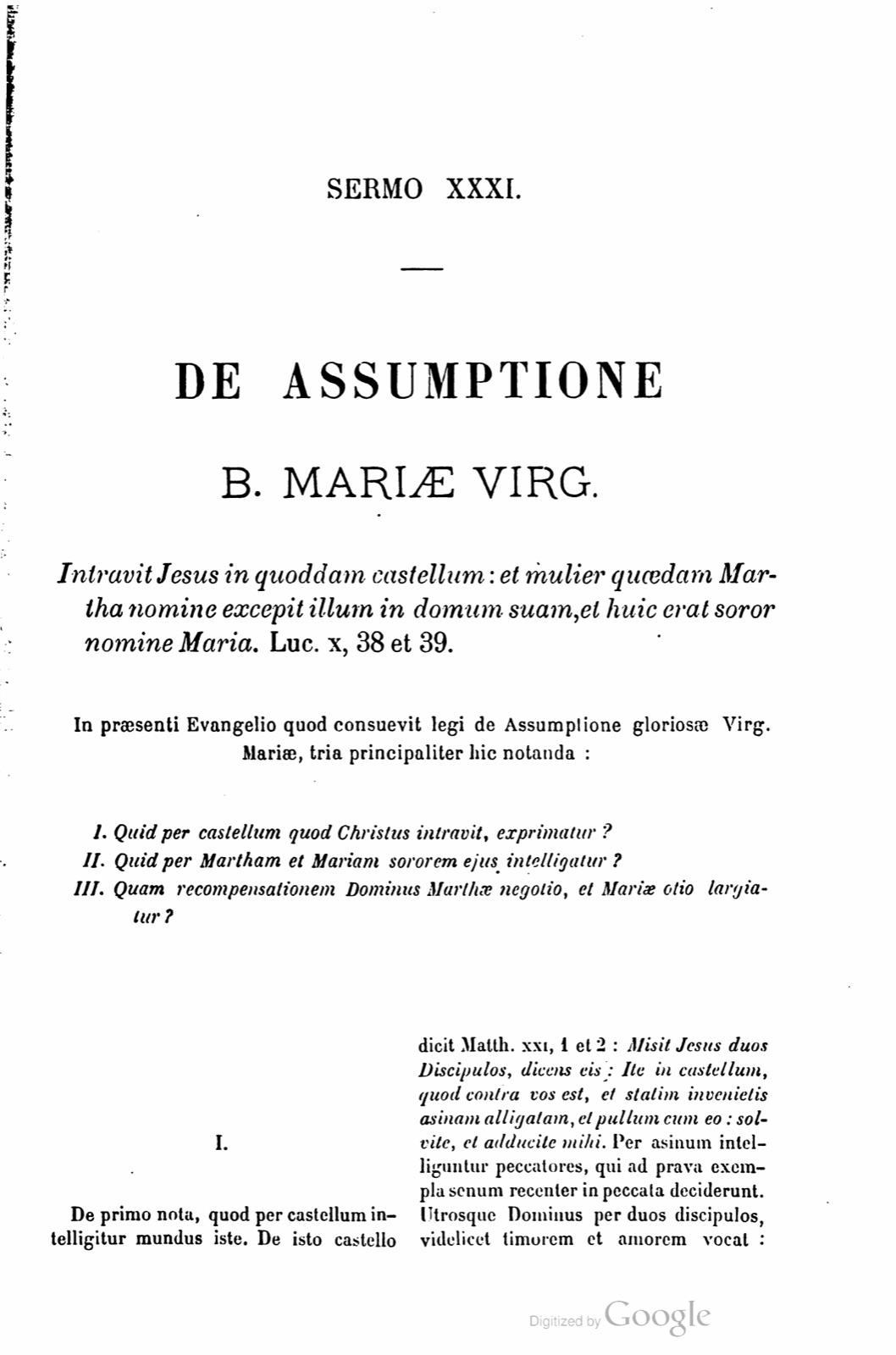
SERMO XXXI.
DE ASSUMPTIONE B. MARIÆ VIRG.
Intravit Jesus in quoddam castellum: et mulier quædam Martha nomine excepit illum in domum suam, et huic erat soror nomine Maria. Luc. X, 38 et 39.
In præsenti Evangelio quod consuevit legi de Assumptione gloriosæ Virg. Mariæ, tria principaliter hic notanda:
I. Quid per castellum quod Christus intravit, exprimatur? II. Quid per Martham et Mariam sororem ejus intelligatur? III. Quam recompensationem Dominus Marthæ negotio, et Mariæ otio largiatur?
I.
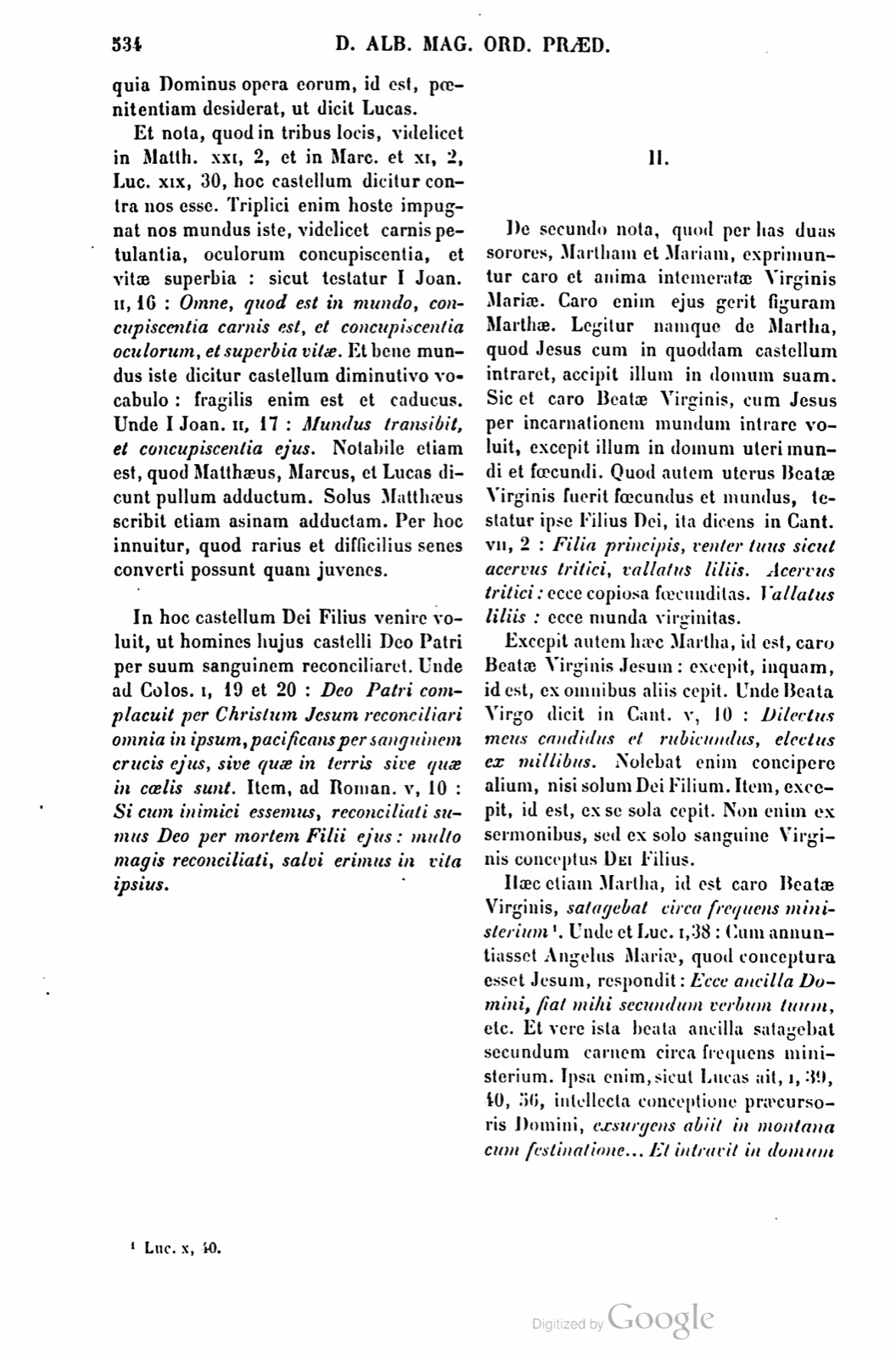
De primo nota, quod per castellum intelligitur mundus iste. De isto castello dicit Matth. XXI, 1 et 2: Misit Jesus duos Discipulos, dicens eis: Ite in castellum, quod contra vos est, et statim invenietis asinam alligatam, et pullum cum eo: solvite, et adducite mihi. Per asinum intelliguntur peccatores, qui ad prava exempla senum recenter in peccata deciderunt. Utrosque Dominus per duos discipulos, videlicet timorem et amorem vocat: quia Dominus opera eorum, id est, pœnitentiam desiderat, ut dicit Lucas.
Et nota, quod in tribus locis, videlicet in Matth. XXI, 2, et in Marc. et XI, 2, Luc. XIX, 30, hoc castellum dicitur contra nos esse. Triplici enim hoste impugnat nos mundus iste, videlicet carnis petulantia, oculorum concupiscentia, et vitæ superbia: sicut testatur I Joan. II, 16: Omne, quod est in mundo, concupiscentia carnis est, et concupiscentia oculorum, et superbia vitæ. Et bene mundus iste dicitur castellum diminutivo vocabulo: fragilis enim est et caducus. Unde I Joan. II, 17: Mundus transibit, et concupiscentia ejus. Notabile etiam est, quod Matthæus, Marcus, et Lucas dicunt pullum adductum. Solus Matthæus scribit etiam asinam adductam. Per hoc innuitur, quod rarius et difficilius senes converti possunt quam juvenes.
In hoc castellum Dei Filius venire voluit, ut homines hujus castelli Deo Patri per suum sanguinem reconciliaret. Unde ad Colos. I, 19 et 20: Deo Patri complacuit per Christum Jesum reconciliari omnia in ipsum, pacificans per sanguinem crucis ejus, sive quæ in terris sive quæ in cælis sunt. Item, ad Roman. V, 10: Si cum inimici essemus, reconciliati sumus Deo per mortem Filii ejus: multo magis reconciliati, salvi erimus in vita ipsius.
II.
De secundo nota, quod per has duas sorores, Martham et Mariam, exprimuntur caro et anima intemeratæ Virginis Mariæ. Caro enim ejus gerit figuram Marthæ. Legitur namque de Martha, quod Jesus cum in quoddam castellum intraret, accipit illum in domum suam. Sic et caro Beatæ Virginis, cum Jesus per incarnationem mundum intrare voluit, excepit illum in domum uteri mundi et fœcundi. Quod autem uterus Beatæ Virginis fuerit fœcundus et mundus, testatur ipse Filius Dei, ita dicens in Cant. VII, 2: Filia principis, venter tuus sicut acervus tritici, vallatus liliis. Acervus tritici: ecce copiosa fœcunditas. Vallatus liliis: ecce munda virginitas.
SERMON XXXI.
ON THE ASSUMPTION OF THE BLESSED VIRGIN MARY.
Jesus entered into a certain castle; and a certain woman, Martha by name, received him into her house, and this woman had a sister named Mary. Luke 10:38 and 39.
In the present Gospel, which is customarily read concerning the Assumption of the glorious Virgin Mary, three things are principally to be noted here:
I. What is expressed by the castle that Christ entered? II. What is understood by Martha and Mary her sister? III. What recompense does the Lord bestow on Martha's business and Mary's leisure?
I.
On the first, note that by the castle is understood this world. Concerning that castle Matthew 21:1 and 2 says: Jesus sent two Disciples, saying to them: Go into the castle that is opposite you, and immediately you will find a she-ass tied, and a colt with her; loose them and bring them to me. By the ass are understood sinners who, following the depraved examples of old persons, have recently fallen into sins. The Lord calls both sorts by two disciples, namely fear and love, because the Lord desires their works, that is, penance, as Luke says.
And note that in three places, namely in Matthew 21:2, and in Mark and 11:2, Luke 19:30, this castle is said to be against us. For this world attacks us with a threefold enemy, namely the petulance of the flesh, the concupiscence of the eyes, and the pride of life, as 1 John 2:16 bears witness: All that is in the world is concupiscence of the flesh and concupiscence of the eyes and pride of life. And this world is well called a castle by a diminutive word: for it is fragile and perishable. Hence 1 John 2:17: The world will pass away, and its concupiscence. It is also notable that Matthew, Mark, and Luke say that the colt was brought. Matthew alone also writes that the she-ass was brought. Through this it is suggested that old persons can be converted more rarely and with greater difficulty than young persons.
The Son of God wished to come into this castle, so that he might reconcile the men of this castle to God the Father through his blood. Hence Colossians 1:19 and 20 says: It pleased God the Father through Christ Jesus that all things be reconciled in him, making peace through the blood of his cross, whether the things that are on earth or the things that are in heaven. Likewise, Romans 5:10: If, when we were enemies, we were reconciled to God through the death of his Son, much more, reconciled, we shall be saved in his life.
II.
On the second, note that by these two sisters, Martha and Mary, are expressed the flesh and the soul of the unspotted Virgin Mary. For her flesh bears the figure of Martha. For one reads concerning Martha that, when Jesus entered into a certain castle, she received him into her house. So also the flesh of the Blessed Virgin, when Jesus wished to enter the world through incarnation, received him into the house of a clean and fruitful womb. But that the womb of the Blessed Virgin was fruitful and clean the Son of God himself bears witness, speaking thus in Song of Songs 7:2: Daughter of the prince, your belly is like a heap of wheat, hedged around with lilies. A heap of wheat: behold copious fruitfulness. Hedged around with lilies: behold clean virginity.
Excepit autem hæc Martha, id est, caro Beatæ Virginis Jesum: excepit, inquam, id est, ex omnibus aliis cepit. Unde Beata Virgo dicit in Cant. V, 10: Dilectus meus candidus et rubicundus, electus ex millibus. Nolebat enim concipere alium, nisi solum Dei Filium. Item, excepit, id est, ex se sola cepit. Non enim ex sermonibus, sed ex solo sanguine Virginis conceptus Dei Filius.
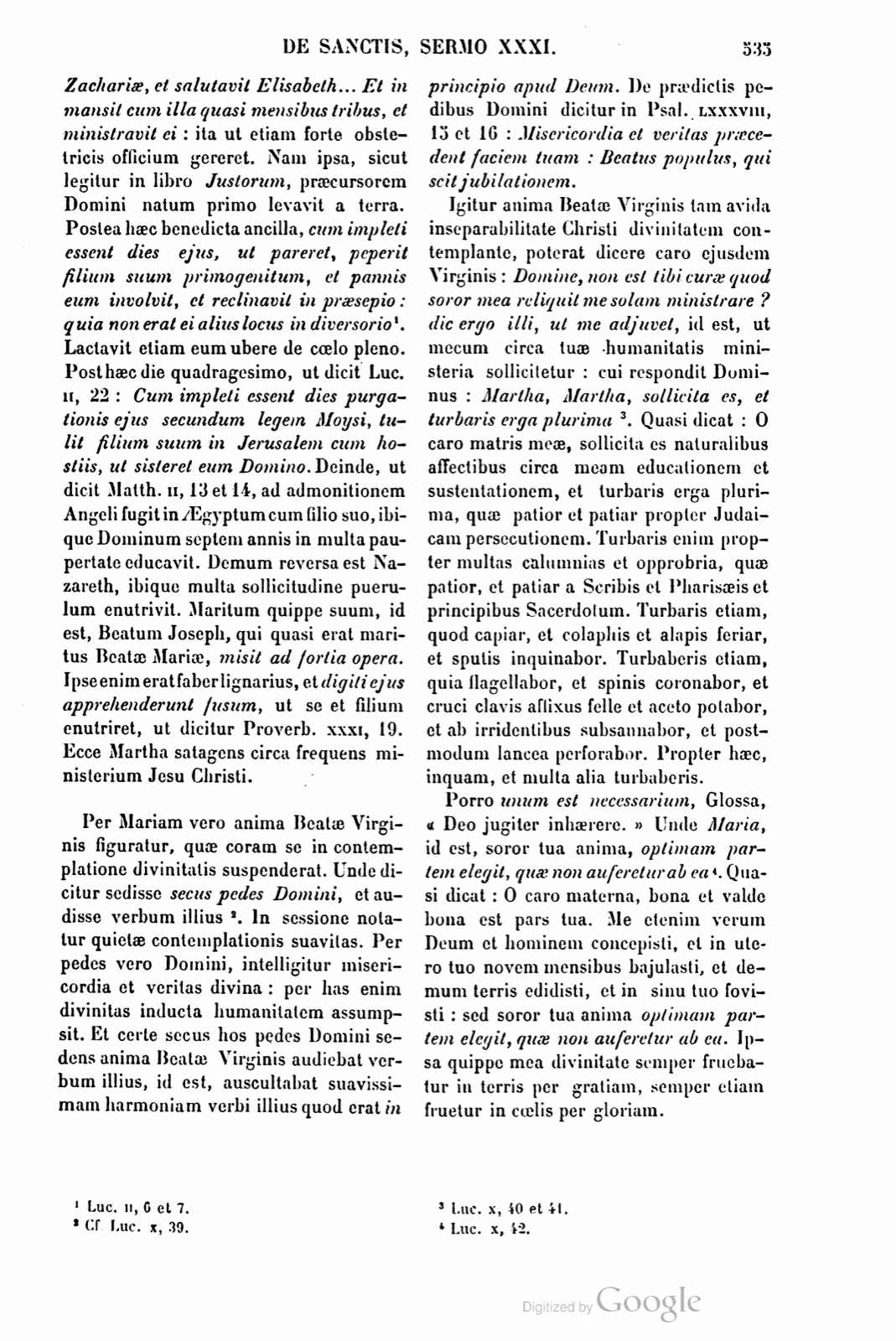
Hæc etiam Martha, id est caro Beatæ Virginis, satagebat circa frequens ministerium 1. Unde et Luc. I, 38: Cum annuntiasset Angelus Mariæ, quod conceptura esset Jesum, respondit: Ecce ancilla Domini, fiat mihi secundum verbum tuum, etc. Et vere ista beata ancilla satagebat secundum carnem circa frequens ministerium. Ipsa enim, sicut Lucas ait, I, 39, 40, 56, intellecta conceptione præcursoris Domini, exsurgens abiit in montana cum festinatione... Et intravit in domum Zachariæ, et salutavit Elisabeth... Et mansit cum illa quasi mensibus tribus, et ministravit ei: ita ut etiam forte obstetricis officium gereret. Nam ipsa, sicut legitur in libro Justorum, præcursorem Domini natum primo levavit a terra. Postea hæc benedicta ancilla, cum impleti essent dies ejus, ut pareret, peperit filium suum primogenitum, et pannis eum involvit, et reclinavit in præsepio: quia non erat ei alius locus in diversorio 2. Lactavit etiam eum ubere de cœlo pleno. Posthæc die quadragesimo, ut dicit Luc. II, 22: Cum impleti essent dies purificationis ejus secundum legem Moysi, tulit filium suum in Jerusalem cum hostiis, ut sisteret eum Domino. Deinde, ut dicit Matth. II, 13 et 14, ad admonitionem Angeli fugit in Ægyptum cum filio suo, ibique Dominum septem annis in multa paupertate educavit. Demum reversa est Nazareth, ibique multa sollicitudine puerulum enutrivit. Maritum quippe suum, id est, Beatum Joseph, qui quasi erat maritus Beatæ Mariæ, misit ad fortia opera. Ipse enim erat faber lignarius, et digiti ejus apprehenderunt fusum, ut se et filium enutriret, ut dicitur Proverb. XXXI, 19. Ecce Martha satagens circa frequens ministerium Jesu Christi.
But this Martha, that is, the flesh of the Blessed Virgin, received Jesus; she received him, I say, that is, she took him from all others. Hence the Blessed Virgin says in Song of Songs 5:10: My beloved is white and ruddy, chosen out of thousands. For she did not wish to conceive another, but only the Son of God. Likewise, she received, that is, she took from herself alone. For the Son of God was conceived not from seeds, but from the blood of the Virgin alone.
This Martha also, that is, the flesh of the Blessed Virgin, was busy about frequent service 1. Hence also Luke 1:38: When the Angel had announced to Mary that she would conceive Jesus, she answered: Behold the handmaid of the Lord; let it be done to me according to your word, etc. And truly that blessed handmaid, according to the flesh, was busy about frequent service. For she herself, as Luke says, 1:39, 40, 56, after the conception of the Lord's precursor had been learned of, rising up, went into the hill country with haste... And she entered into the house of Zechariah and greeted Elizabeth... And she remained with her about three months and ministered to her: so that perhaps she even bore the office of midwife. For she herself, as is read in the book of the Just, first lifted the Lord's precursor from the earth when he was born. Afterward this blessed handmaid, when her days were fulfilled that she should give birth, gave birth to her firstborn son, wrapped him in swaddling-clothes, and laid him in a manger, because there was no other place for her in the inn 2. She also nursed him with a breast full from heaven. After these things, on the fortieth day, as Luke 2:22 says: When the days of her purification according to the law of Moses were fulfilled, she brought her son to Jerusalem with offerings, to present him to the Lord. Then, as Matthew 2:13 and 14 says, at the warning of the Angel she fled into Egypt with her son, and there brought up the Lord for seven years in much poverty. At last she returned to Nazareth, and there nourished the little boy with much solicitude. For her husband, that is, Blessed Joseph, who was as it were the husband of Blessed Mary, she sent to strong works. For he was a worker in wood, and her fingers took hold of the spindle, so that she might nourish herself and her son, as is said in Proverbs 31:19. Behold Martha busy about the frequent service of Jesus Christ.
Per Mariam vero anima Beatæ Virginis figuratur, quæ coram se in contemplatione divinitatis suspenderat. Unde dicitur sedisse secus pedes Domini, et audisse verbum illius 3. In sessione notatur quietæ contemplationis suavitas. Per pedes vero Domini, intelligitur misericordia et veritas divina: per has enim divinitas inducta humanitatem assumpsit. Et certe secus hos pedes Domini sedens anima Beatæ Virginis audiebat verbum illius, id est, auscultabat suavissimam harmoniam verbi illius quod erat in principio apud Deum. De prædictis pedibus Domini dicitur in Psal. LXXXVII, 15 et 16: Misericordia et veritas præcedent faciem tuam: Beatus populus, qui scit jubilationem.
Igitur anima Beatæ Virginis tam avida inseparabilitate Christi divinitatem contemplante, poterat dicere caro ejusdem Virginis: Domine, non est tibi curæ quod soror mea reliquit me solam ministrare? dic ergo illi, ut me adjuvet, id est, ut mecum circa tuæ humanitatis ministeria sollicitetur: cui respondit Dominus: Martha, Martha, sollicita es, et turbaris erga plurima 4. Quasi dicat: O caro matris meæ, sollicita es naturalibus affectibus circa meam educationem et sustentationem, et turbaris erga plurima, quæ patior et patiar propter Judaicam persecutionem. Turbaris enim propter multas calumnias et opprobria, quæ patior, et patiar a Scribis et Pharisæis et principibus Sacerdotum. Turbaris etiam, quod capiar, et colaphis et alapis feriar, et sputis inquinabor. Turbaberis etiam, quia flagellabor, et spinis coronabor, et cruci clavis affixus felle et aceto potabor, et ab irridentibus subsannabor, et postmodum lancea perforabor. Propter hæc, inquam, et multa alia turbaberis.
Porro unum est necessarium, Glossa, « Deo jugiter inhærere. » Unde Maria, id est, soror tua anima, optimam partem elegit, quæ non auferetur ab ea 5. Quasi dicat: O caro materna, bona et valde bona est pars tua. Me etenim verum Deum et hominem concepisti, et in utero tuo novem mensibus bajulasti, et demum terris edidisti, et in sinu tuo fovisti: sed soror tua anima optimam partem elegit, quæ non auferetur ab ea. Ipsa quippe mea divinitate semper fruebatur in terris per gratiam, semper etiam fruetur in cælis per gloriam.
But by Mary the soul of the Blessed Virgin is figured, which had suspended itself before itself in contemplation of the divinity. Hence it is said that she sat beside the feet of the Lord and heard his word 3. In the sitting is noted the sweetness of quiet contemplation. But by the feet of the Lord are understood divine mercy and truth, for through these the divinity, brought in, assumed humanity. And certainly, sitting beside these feet of the Lord, the soul of the Blessed Virgin heard his word, that is, listened to the sweetest harmony of that Word which was in the beginning with God. Concerning the aforesaid feet of the Lord it is said in Psalm 87:15 and 16: Mercy and truth will go before your face. Blessed is the people that knows jubilation.
Therefore, while the soul of the Blessed Virgin was contemplating the divinity of Christ with such greedy inseparability, the flesh of the same Virgin was able to say: Lord, is it not a care to you that my sister has left me alone to minister? Say therefore to her that she help me, that is, that she be solicitous with me about the services of your humanity. To her the Lord answered: Martha, Martha, you are solicitous and are troubled about many things 4. As if he were saying: O flesh of my mother, you are solicitous with natural affections about my upbringing and sustenance, and you are troubled about many things that I suffer and will suffer on account of Jewish persecution. For you are troubled on account of many calumnies and reproaches that I suffer and will suffer from the Scribes and Pharisees and chief priests. You are also troubled that I shall be seized and struck with blows from fists and slaps, and that I shall be defiled with spittle. You will also be troubled because I shall be scourged and crowned with thorns, and, fixed to the cross with nails, shall be given gall and vinegar to drink, and shall be mocked by those deriding, and afterward shall be pierced with a lance. On account of these things, I say, and many others, you will be troubled.
Moreover, one thing is necessary, the Gloss says, "to cleave continually to God." Hence Mary, that is, your sister the soul, has chosen the best part, which will not be taken away from her 5. As if he were saying: O maternal flesh, your part is good and very good. For you conceived me as true God and man, and carried me in your womb for nine months, and at last brought me forth on earth, and cherished me in your bosom: but your sister the soul has chosen the best part, which will not be taken away from her. For she always enjoyed my divinity on earth through grace, and will also always enjoy it in heaven through glory.
III.
De tertio nota, quod hodie Dominus noster Jesus Christus ut matris ministeria recompensaret, excepit eam et ipse in domum suam 6, quam sibi præparaverat ab æterno. Creditur enim a pluribus Sanctis, quod Dominus matrem suam et corpore et anima assumpserit super omnes ordines Angelorum. Excepit ergo eam, id est, excellentius omnibus Angelis et aliis Sanctis suscepit. Et vere dignum fuit, quod ille qui præceperat Exod. XX, 12: Honora patrem tuum et matrem tuam, ut sis longævus super terram, scilicet viventium, ut et ipse corpus matris suæ speciali prærogativa honoraret.
Igitur de domo illa, in quam corpore et anima assumpta est Beata Virgo Maria, legitur in II Paral. VII, 11: Transtulit Rex Salomon filiam Pharaonis de civitate David in domum, quam ædificaverat ei. Salomon interpretatur pacificus, vel retributor, et signat Filium Dei, qui est summe dulcis et pacificus cum electis suis in gloria, qui etiam æterna supplicia retribuit peccatoribus pro suis criminibus et delictis. Pharao interpretatur dissipans virum, et signat Deum excelsum, qui viros, id est, eos qui confidunt in virtute sua, quam cito voluerit, dissipat, et tamquam vas figuli confringet eos. Hujus filia fuit et est Beata Maria. Per civitatem vero David intelligitur militans Ecclesia, de qua dicitur in Cant. IV, 4: Sicut turris David collum tuum, quæ ædificata est cum propugnaculis: mille clypei pendent ex ea, omnis armatura fortium. Sicut enim collum unitur capiti, sic etiam sancta militans Ecclesia unitur Christo capiti per fidem et charitatem. Et certe in hac Ecclesia pendent mille clypei, et omnis armatura fortium, videlicet, exempla sanctorum Patriarcharum, Prophetarum, Apostolorum, Martyrum, Confessorum, Virginum, et omnium electorum, quibus quisque fidelis existens in Ecclesia contra insultus dæmonum protegitur et armatur.
III.
On the third, note that today our Lord Jesus Christ, so that he might recompense his mother's services, himself received her into his house 6, which he had prepared for himself from eternity. For it is believed by several Saints that the Lord assumed his mother, both in body and in soul, above all the orders of Angels. Therefore he received her, that is, he took her up more excellently than all Angels and other Saints. And truly it was fitting that he who had commanded, Exodus 20:12: Honor your father and your mother, that you may be long-lived upon the earth, namely of the living, should himself honor the body of his mother with a special prerogative.
Therefore concerning that house into which the Blessed Virgin Mary was assumed in body and soul, one reads in 2 Chronicles 7:11: King Solomon transferred the daughter of Pharaoh from the city of David into the house that he had built for her. Solomon is interpreted peaceable, or rewarder, and signifies the Son of God, who is supremely sweet and peaceable with his elect in glory, who also renders eternal punishments to sinners for their crimes and faults. Pharaoh is interpreted dissipating a man, and signifies the high God, who dissipates men, that is, those who trust in their own virtue, as quickly as he has wished, and will break them like a potter's vessel. The Blessed Mary was and is his daughter. But by the city of David is understood the militant Church, concerning which it is said in Song of Songs 4:4: Your neck is like the tower of David, which is built with bulwarks; a thousand shields hang from it, all the armor of strong men. For as the neck is united to the head, so also the holy militant Church is united to Christ the head through faith and charity. And certainly in this Church hang a thousand shields and all the armor of strong men, namely the examples of the holy Patriarchs, Prophets, Apostles, Martyrs, Confessors, Virgins, and all the elect, by which every faithful person existing in the Church is protected and armed against the assaults of demons.
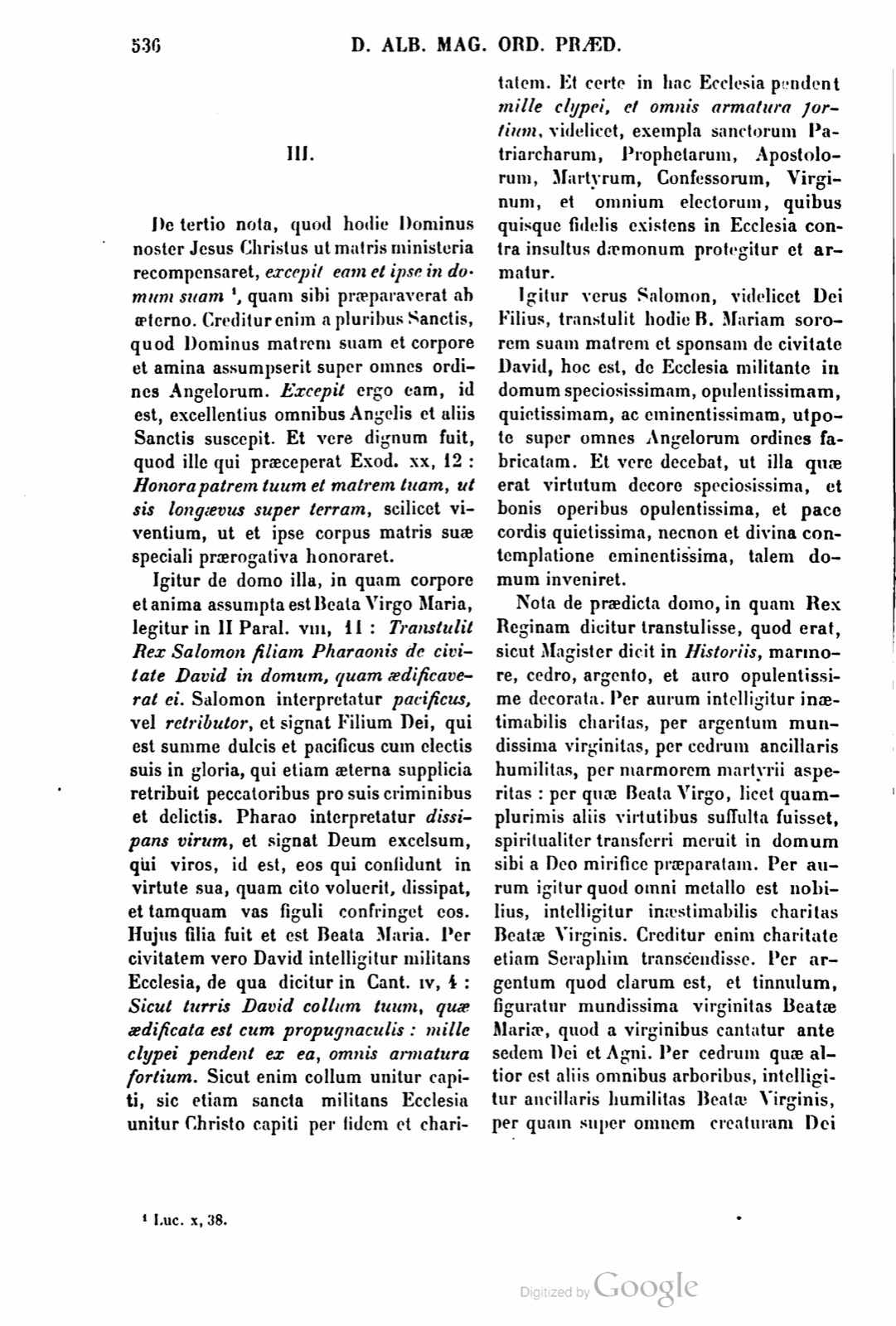
Igitur verus Salomon, videlicet Dei Filius, transtulit hodie B. Mariam sororem suam matrem et sponsam de civitate David, hoc est, de Ecclesia militante in domum speciosissimam, opulentissimam, quietissimam, ac eminentissimam, utpote super omnes Angelorum ordines fabricatam. Et vere decebat, ut illa quæ erat virtutum decore speciosissima, et bonis operibus opulentissima, et pace cordis quietissima, necnon et divina contemplatione eminentissima, talem domum inveniret.
Nota de prædicta domo, in quam Rex Reginam dicitur transtulisse, quod erat, sicut Magister dicit in Historiis, marmore, cedro, argento, et auro opulentissime decorata. Per aurum intelligitur inæstimabilis charitas, per argentum mundissima virginitas, per cedrum ancillaris humilitas, per marmorem martyrii asperitas: per quæ Beata Virgo, licet quamplurimis aliis virtutibus suffulta fuisset, spiritualiter transferri meruit in domum sibi a Deo mirifice præparatam. Per aurum igitur quod omni metallo est nobilius, intelligitur inestimabilis charitas Beatæ Virginis. Creditur enim charitate etiam Seraphim transcendisse. Per argentum quod clarum est, et tinnulum, figuratur mundissima virginitas Beatæ Mariæ, quod a virginibus cantatur ante sedem Dei et Agni. Per cedrum quæ altior est aliis omnibus arboribus, intelligitur ancillaris humilitas Beatæ Virginis, per quam super omnem creaturam Dei cœlestem ac terrestrem meruit exaltari. Per marmor quod serram patitur, et quandoque rubeis maculis est respersum, notatur martyrii asperitas, quæ erat in visceribus et corde Beatæ Mariæ. Unde dixerat ei Simeon, Luc. II, 35: Tuam ipsius animam pertransibit gladius. Hieronymus: « Constat quod alii Sancti, etsi passi sunt pro Christo in carne: tamen in anima, quia immortalis est, pati non potuerunt. Beata vero Dei genitrix, quia in ea parte passa est, quæ impassibilis habetur, ideo, ut ita fatear, quia spiritualiter et atrocius passa est gladio Passionis Christi, plus quam martyr fuit. »
Rogate ergo Dominum, ut sic gloriosæ Matri ejus in hac vita serviamus, ut claritatem ejus in patria videamus. Quod, etc.
Therefore the true Solomon, namely the Son of God, today transferred Blessed Mary, his sister, mother, and bride, from the city of David, that is, from the militant Church, into a most beautiful, most wealthy, most quiet, and most eminent house, as built above all the orders of Angels. And truly it was fitting that she who was most beautiful by the adornment of virtues, most wealthy in good works, most quiet by peace of heart, and also most eminent by divine contemplation, should find such a house.
Concerning the aforesaid house, into which the King is said to have transferred the Queen, note that it was, as the Master says in the Histories, most wealthily adorned with marble, cedar, silver, and gold. By gold is understood inestimable charity; by silver, most clean virginity; by cedar, handmaidenly humility; by marble, the harshness of martyrdom. Through these the Blessed Virgin, although she had been supported by very many other virtues, deserved to be transferred spiritually into a house wondrously prepared for her by God. Therefore by gold, which is nobler than every metal, is understood the inestimable charity of the Blessed Virgin. For it is believed that she surpassed even the Seraphim in charity. By silver, which is bright and ringing, is figured the most clean virginity of Blessed Mary, which is sung by virgins before the seat of God and of the Lamb. By cedar, which is higher than all other trees, is understood the handmaidenly humility of the Blessed Virgin, through which she deserved to be exalted above every creature of God, heavenly and earthly. By marble, which endures the saw and is sometimes sprinkled with red spots, is noted the harshness of martyrdom that was in the inward parts and heart of Blessed Mary. Hence Simeon had said to her, Luke 2:35: A sword will pass through your own soul. Jerome: "It is agreed that other Saints, even if they suffered for Christ in the flesh, nevertheless in the soul, because it is immortal, they could not suffer. But the Blessed God-bearer, because she suffered in that part which is held impassible, therefore, so that I may confess it thus, because she suffered spiritually and more fiercely by the sword of the Passion of Christ, was more than a martyr."
Therefore pray to the Lord that we may so serve his glorious Mother in this life that we may see her brightness in the fatherland. May he grant this, etc.

If a page does not appear, its photograph has not been uploaded yet.