Volume 13 · pp. 529–532
Sermon XXX. On the Same Feast of Saint Lawrence
A marker with ≈ is an approximate page boundary, placed by measure of the text; the page photographs remain the authority. In the paired views, clicking a page marker brings that page into view.
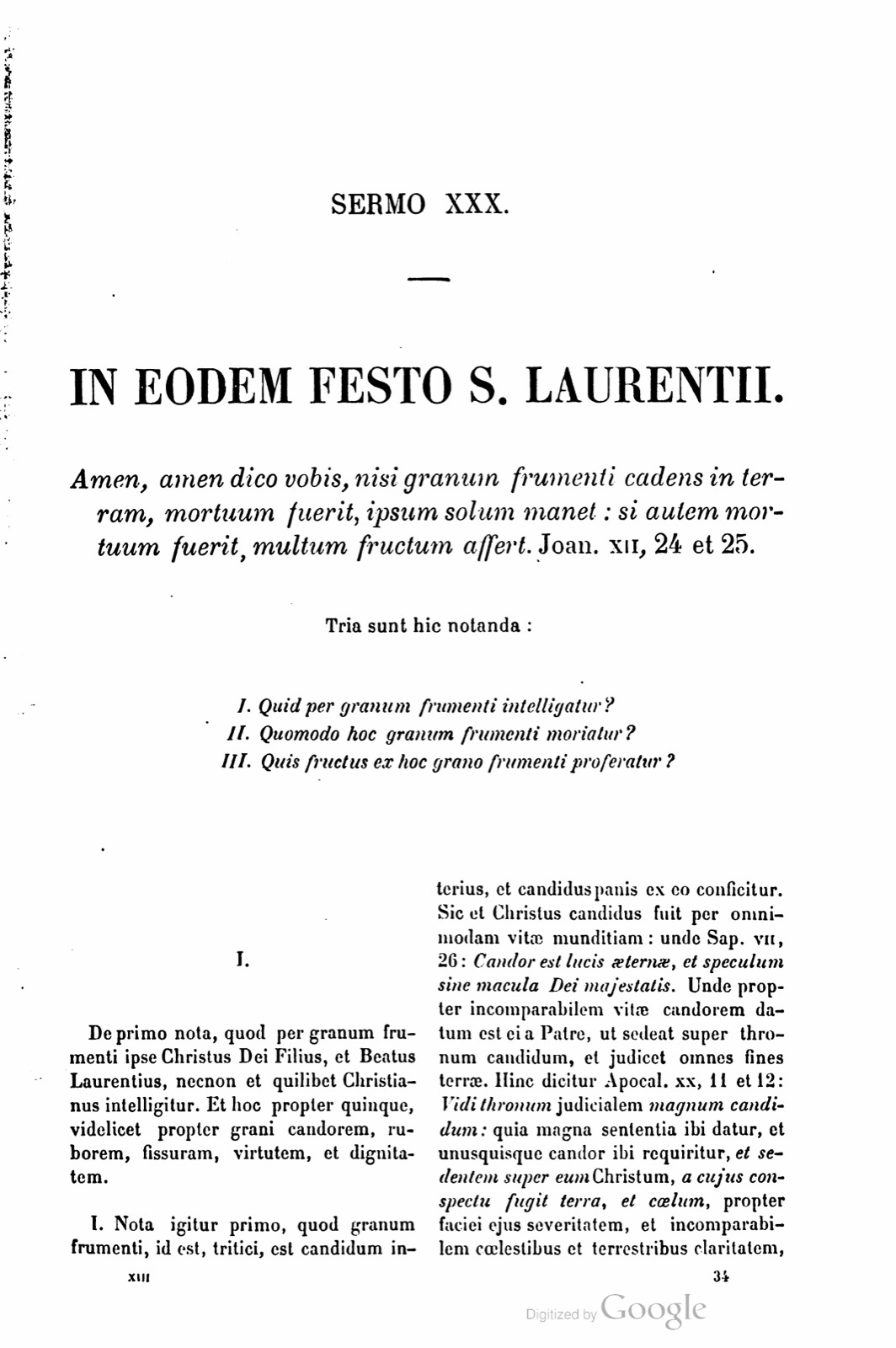
SERMO XXX.
IN EODEM FESTO S. LAURENTII.
Amen, amen dico vobis, nisi granum frumenti cadens in terram, mortuum fuerit, ipsum solum manet: si autem mortuum fuerit, multum fructum affert. Joan. XII, 24 et 25.
Tria sunt hic notanda:
I. Quid per granum frumenti intelligatur? II. Quomodo hoc granum frumenti moriatur? III. Quis fructus ex hoc grano frumenti proferatur?
I.
De primo nota, quod per granum frumenti ipse Christus Dei Filius, et Beatus Laurentius, necnon et quilibet Christianus intelligitur. Et hoc propter quinque, videlicet propter grani candorem, ruborem, fissuram, virtutem, et dignitatem.
I. Nota igitur primo, quod granum frumenti, id est, tritici, est candidum interius, et candidus panis ex eo conficitur. Sic et Christus candidus fuit per omnimodam vitæ munditiam: unde Sap. VII, 26: Candor est lucis æternæ, et speculum sine macula Dei majestatis. Unde propter incomparabilem vitæ candorem datum est ei a Patre, ut sedeat super thronum candidum, et judicet omnes fines terræ. Hinc dicitur Apocal. XX, 11 et 12: Vidi thronum judicialem magnum candidum: quia magna sententia ibi datur, et unusquisque candor ibi requiritur, et sedentem super eum Christum, a cujus conspectu fugit terra, et cælum, propter faciei ejus severitatem, et incomparabilem cœlestibus et terrestribus claritatem, et locus non est inventus eis, in quem judicium Dei effugerent. Et vidi mortuos magnos, et pusillos, id est, nobiles et ignobiles, vel divites et pauperes, stantes in conspectu throni, et libri conscientiarum aperti sunt: et alius Liber, qui est vitæ, apertus est, id est, Christus qui ostendet ibi cicatrices quinque vulnerum suorum: et judicati sunt mortui ex his, quæ scripta erant in libris secundum opera ipsorum.
Candidus etiam fuit Beatus Laurentius per vitæ puritatem. Unde etiam cantatur de eo, « quod puritate innocentis vitæ, fortissimæque mortis triumpho, Apostolico se consortio sociavit. »
Debemus etiam et nos candidi esse per cordis puritatem, et corporis castitatem. Legitur etiam, Apoc. XIX, 7 et 8: Venerunt nuptiæ Agni, et uxor ejus præparavit se. Et datum est illi ut cooperiat se byssino splendenti, et candido. Sponsa Agni est fidelis anima, quæ oportet ut se cooperiat byssino splendenti et candido, id est, munditia mentis et corporis, ut sit digna recipi in felices amplexus illius immaculati Agni, videlicet Jesu Christi: si hoc non fecerit, non erit sponsa Agni, sed sponsa draconis. Eccle. IX, 8: Omni tempore sint vestimenta tua candida.
SERMON XXX.
ON THE SAME FEAST OF SAINT LAWRENCE.
Amen, amen I say to you, unless the grain of wheat falling into the earth has died, it remains alone; but if it has died, it bears much fruit. John 12:24 and 25.
Three things are to be noted here:
I. What is understood by the grain of wheat? II. How does this grain of wheat die? III. What fruit is brought forth from this grain of wheat?
I.
On the first, note that by the grain of wheat is understood Christ himself, the Son of God, and Blessed Lawrence, and also any Christian whatsoever. And this on account of five things, namely on account of the grain's whiteness, redness, cleft, virtue, and dignity.
I. Therefore note first that a grain of wheat, that is, of wheat-corn, is white within, and white bread is made from it. So also Christ was white through every sort of cleanness of life; hence Wisdom 7:26: He is the brightness of eternal light, and the spotless mirror of God's majesty. Hence on account of the incomparable whiteness of his life it was given to him by the Father that he should sit upon a white throne and judge all the ends of the earth. Hence Apocalypse 20:11 and 12 says: I saw a great white judicial throne, because there a great sentence is given, and every whiteness is required there, and Christ sitting upon it, from whose sight earth and heaven fled away on account of the severity of his face and his incomparable brightness to heavenly and earthly things; and no place was found for them into which they might flee the judgment of God. And I saw the dead, great and small, that is, noble and ignoble, or rich and poor, standing before the throne; and the books of consciences were opened; and another Book, which is of life, was opened, that is, Christ, who will show there the scars of his five wounds; and the dead were judged from those things that were written in the books according to their works.
Blessed Lawrence also was white through purity of life. Hence it is also sung concerning him "that by the purity of innocent life and by the triumph of a most strong death, he joined himself to apostolic fellowship."
We too ought also to be white through purity of heart and chastity of body. One also reads, Apocalypse 19:7 and 8: The nuptials of the Lamb have come, and his wife has prepared herself. And it was given to her that she should cover herself with shining and white fine linen. The bride of the Lamb is the faithful soul, which must cover itself with shining and white fine linen, that is, with cleanness of mind and body, so that it may be worthy to be received into the happy embraces of that immaculate Lamb, namely Jesus Christ. If it has not done this, it will not be the bride of the Lamb, but the bride of the dragon. Ecclesiastes 9:8: At every time let your garments be white.
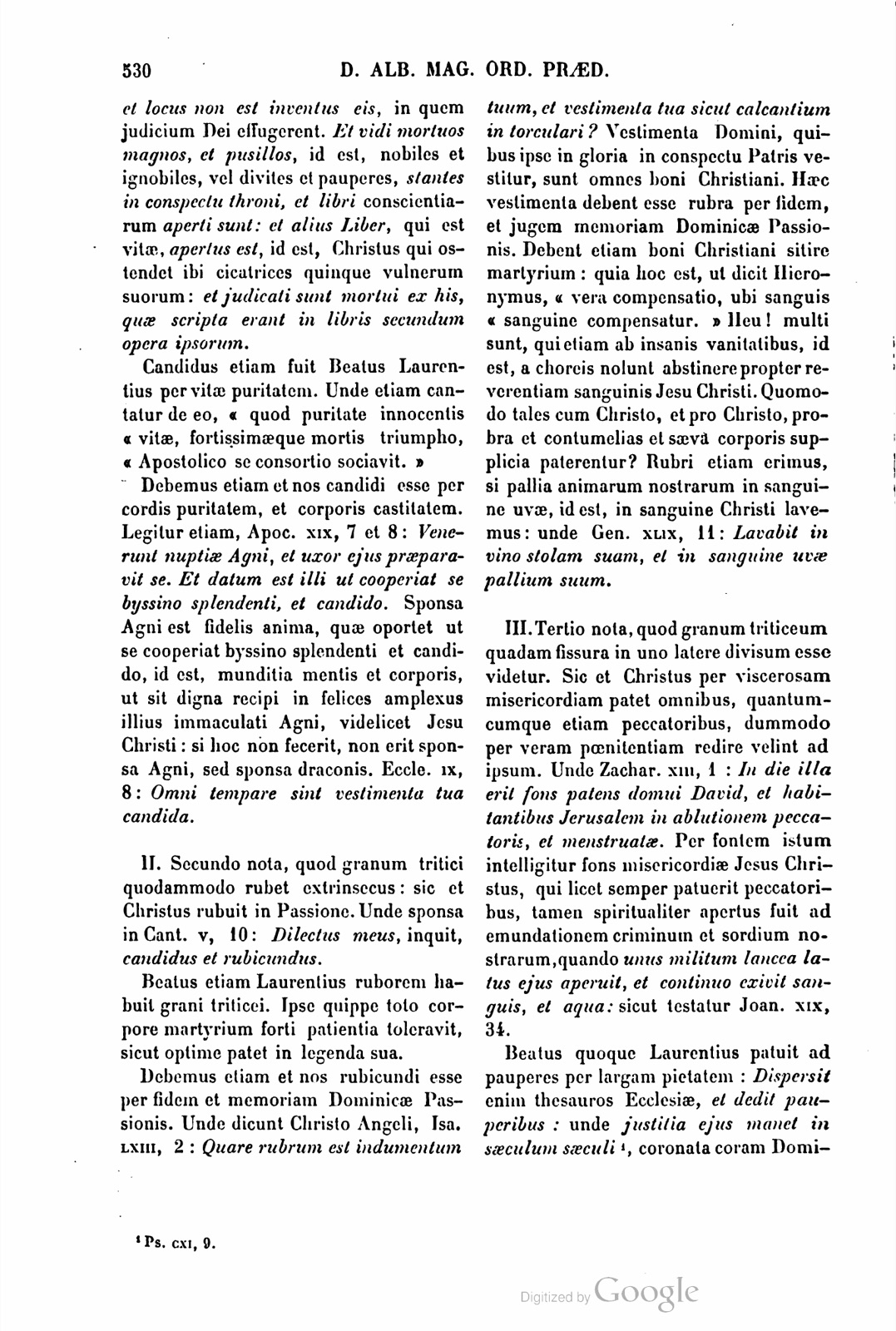
II. Secundo nota, quod granum tritici quodammodo rubet extrinsecus: sic et Christus rubuit in Passione. Unde sponsa in Cant. V, 10: Dilectus meus, inquit, candidus et rubicundus.
Beatus etiam Laurentius ruborem habuit grani triticei. Ipse quippe toto corpore martyrium forti patientia toleravit, sicut optime patet in legenda sua.
Debemus etiam et nos rubicundi esse per fidem et memoriam Dominicæ Passionis. Unde dicunt Christo Angeli, Isa. LXIII, 2: Quare rubrum est indumentum tuum, et vestimenta tua sicut calcantium in torculari? Vestimenta Domini, quibus ipse in gloria in conspectu Patris vestitur, sunt omnes boni Christiani. Hæc vestimenta debent esse rubra per fidem, et jugem memoriam Dominicæ Passionis. Debent etiam boni Christiani sitire martyrium: quia hoc est, ut dicit Hieronymus, « vera compensatio, ubi sanguis sanguine compensatur. » Heu! multi sunt, qui etiam ab insanis vanitatibus, id est, a choreis nolunt abstinere propter reverentiam sanguinis Jesu Christi. Quomodo tales cum Christo, et pro Christo, probra et contumelias et sæva corporis supplicia paterentur? Rubri etiam erimus, si pallia animarum nostrarum in sanguine uvæ, id est, in sanguine Christi lavemus: unde Gen. XLIX, 11: Lavabit in vino stolam suam, et in sanguine uvæ pallium suum.
III. Tertio nota, quod granum triticeum quadam fissura in uno latere divisum esse videtur. Sic et Christus per viscerosam misericordiam patet omnibus, quantumcumque etiam peccatoribus, dummodo per veram pœnitentiam redire velint ad ipsum. Unde Zachar. XIII, 1: In die illa erit fons patens domui David, et habitantibus Jerusalem in ablutionem peccatoris, et menstruatæ. Per fontem istum intelligitur fons misericordiæ Jesus Christus, qui licet semper patuerit peccatoribus, tamen spiritualiter apertus fuit ad emundationem criminum et sordium nostrarum, quando unus militum lancea latus ejus aperuit, et continuo exivit sanguis, et aqua: sicut testatur Joan. XIX, 34.
II. Secondly note that a grain of wheat is in a certain manner red externally: so also Christ was red in the Passion. Hence the bride in Song of Songs 5:10 says: My beloved, she says, is white and ruddy.
Blessed Lawrence also had the redness of a grain of wheat. For he endured martyrdom in his whole body with strong patience, as is very clearly evident in his legend.
We too ought also to be ruddy through faith and remembrance of the Lord's Passion. Hence the Angels say to Christ, Isaiah 63:2: Why is your garment red, and your garments like those of persons treading in the winepress? The garments of the Lord, with which he himself is clothed in glory in the sight of the Father, are all good Christians. These garments ought to be red through faith and continual remembrance of the Lord's Passion. Good Christians ought also to thirst for martyrdom, because this is, as Jerome says, "the true compensation, where blood is compensated by blood." Alas! there are many who are unwilling to abstain even from mad vanities, that is, from dances, on account of reverence for the blood of Jesus Christ. How would such persons suffer with Christ and for Christ reproaches and insults and savage punishments of the body? We shall also be red if we wash the cloaks of our souls in the blood of the grape, that is, in the blood of Christ; hence Genesis 49:11: He will wash his robe in wine, and his cloak in the blood of the grape.
III. Thirdly note that a grain of wheat seems to be divided by a certain cleft on one side. So also Christ, through viscereal mercy, lies open to all, however great sinners they may be, provided that through true penance they wish to return to him. Hence Zechariah 13:1: On that day there will be a fountain open to the house of David and to the inhabitants of Jerusalem for the washing of the sinner and of the menstruous woman. By that fountain is understood the fountain of mercy, Jesus Christ, who, although he has always lain open to sinners, nevertheless was spiritually opened for the cleansing of our crimes and filths when one of the soldiers opened his side with a lance, and immediately blood and water came out, as John 19:34 bears witness.
Beatus quoque Laurentius patuit ad pauperes per largam pietatem: Dispersit enim thesauros Ecclesiæ, et dedit pauperibus: unde justitia ejus manet in sæculum sæculi 1, coronata coram Domino. Ipse quippe sciens scriptum: Qui parce seminat, parce et metet 2: copiose seminavit, ut et copiose meteret.
Debemus et nos etiam cor et manus habere apertas per compassionem et misericordiæ largitatem. Unde dicitur Proverb. XXXI, 20: Manum suam aperuit inopi, et palmas suas extendit ad pauperem. Qui modo aperit cor et manum per compassionem et largitatem, certe ipsi aperientur portæ justitiæ: sicut dicitur in Psal. CXVII, 19: Aperite mihi portas justitiæ, ingressus in eas confitebor Domino. Hæc sunt verba piæ animæ.
IV. Quarto nota, quod granum frumenti virtutem habet confortativam. Sic et de Christo, qui est ille panis vivus qui de cœlo descendit, dicitur in Ps. CIII, 15: Panis cor hominis confirmet. Multi sunt, quorum animæ nauseant super pane isto suavissimo, et propterea sicut fœnum arescit cor ipsorum. Unde in Psal. CI, 5: Percussus sum ut fœnum, et aruit cor meum: qui oblitus sum comedere panem meum.
Beatus etiam Laurentius exemplo suæ patientiæ quam habuit in tormentis, multos confortavit et confortat. Unde signatus est per illum panem similagineum, qui assus in craticula, oleoque conspersus olim Domino consuevit offerri, sicut habetur in Levit. II, 7. Nam et ipse tamquam panis assatus fuit in craticula, ut debiles eo amplius confortaret.
Blessed Lawrence also lay open to the poor through abundant dutiful kindness: for he scattered the treasures of the Church and gave to the poor; hence his justice remains forever 1, crowned before the Lord. For he, knowing the Scripture, He who sows sparingly will also reap sparingly 2, sowed abundantly so that he might also reap abundantly.
We too ought also to have heart and hands open through compassion and the largess of mercy. Hence Proverbs 31:20 says: She opened her hand to the needy, and stretched out her palms to the poor. He who now opens heart and hand through compassion and largess, certainly the gates of justice will be opened to him: as is said in Psalm 117:19: Open to me the gates of justice; entering into them I shall confess to the Lord. These are the words of a pious soul.
IV. Fourthly note that the grain of wheat has a strengthening virtue. So also concerning Christ, who is that living bread who descended from heaven, it is said in Psalm 103:15: Bread should strengthen the heart of man. There are many whose souls feel nausea at that sweetest bread, and therefore their heart dries up like hay. Hence in Psalm 101:5: I have been struck like hay, and my heart has dried up, because I forgot to eat my bread.
Blessed Lawrence also, by the example of his patience that he had in torments, strengthened and strengthens many. Hence he was signified by that bread of fine flour, which, roasted on a small grate and sprinkled with oil, once used to be offered to the Lord, as is found in Leviticus 2:7. For he too was roasted like bread on a small grate, so that he might strengthen the weak more abundantly by it.
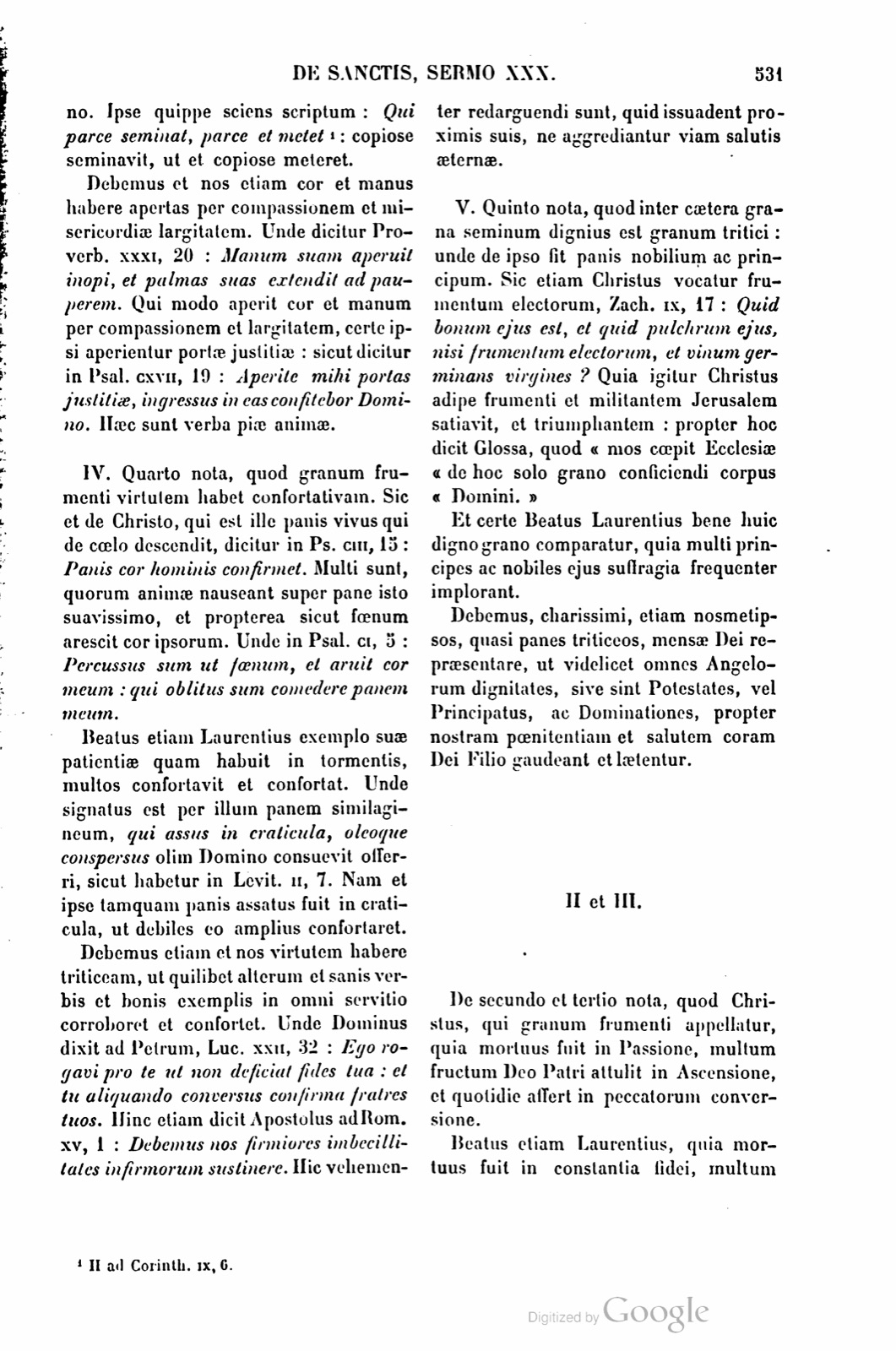
Debemus etiam et nos virtutem habere triticeam, ut quilibet alterum et sanis verbis et bonis exemplis in omni servitio corroboret et confortet. Unde Dominus dixit ad Petrum, Luc. XXII, 32: Ego rogavi pro te ut non deficiat fides tua: et tu aliquando conversus confirma fratres tuos. Hinc etiam dicit Apostolus ad Rom. XV, 1: Debemus nos firmiores imbecillitates infirmorum sustinere. Hic vehementer redarguendi sunt, qui suadent proximis suis, ne aggrediantur viam salutis æternæ.
V. Quinto nota, quod inter cætera grana seminum dignius est granum tritici: unde de ipso fit panis nobilium ac principum. Sic etiam Christus vocatur frumentum electorum, Zach. IX, 17: Quid bonum ejus est, et quid pulchrum ejus, nisi frumentum electorum, et vinum germinans virgines? Quia igitur Christus adipe frumenti et militantem Jerusalem satiavit, et triumphantem: propter hoc dicit Glossa, quod « mos cœpit Ecclesiæ de hoc solo grano conficiendi corpus Domini. »
Et certe Beatus Laurentius bene huic digno grano comparatur, quia multi principes ac nobiles ejus suffragia frequenter implorant.
Debemus, charissimi, etiam nosmetipsos, quasi panes triticeos, mensæ Dei repræsentare, ut videlicet omnes Angelorum dignitates, sive sint Potestates, vel Principatus, ac Dominationes, propter nostram pœnitentiam et salutem coram Dei Filio gaudeant et lætentur.
II et III.
De secundo et tertio nota, quod Christus, qui granum frumenti appellatur, quia mortuus fuit in Passione, multum fructum Deo Patri attulit in Ascensione, et quotidie affert in peccatorum conversione.
Beatus etiam Laurentius, quia mortuus fuit in constantia fidei, multum fructum gaudiorum invenit in præsentia dulcis Jesu.
Unde, charissimi, bonum est, ut nos vitiis et concupiscentiis hujus mundi quotidie moriamur, ut et nos animabus nostris fructum æternæ beatitudinis afferre mereamur. Quod, etc.
We too ought also to have a wheat-like virtue, so that anyone may strengthen and fortify another, both with sound words and with good examples, in every service. Hence the Lord said to Peter, Luke 22:32: I have prayed for you that your faith may not fail; and you, once converted, confirm your brothers. Hence also the Apostle says at Romans 15:1: We who are stronger ought to sustain the weaknesses of the infirm. Here those are vehemently to be rebuked who persuade their neighbors not to enter upon the way of eternal salvation.
V. Fifthly note that among the other grains of seeds the grain of wheat is more worthy; hence from it is made the bread of nobles and princes. So also Christ is called the wheat of the elect, Zechariah 9:17: What is his good, and what is his beauty, except the wheat of the elect and wine causing virgins to spring forth? Therefore because Christ has satisfied both militant Jerusalem and triumphant Jerusalem with the fatness of wheat, on account of this the Gloss says that "the custom of the Church began of confecting the body of the Lord from this grain alone."
And certainly Blessed Lawrence is well compared to this worthy grain, because many princes and nobles frequently implore his suffrages.
We too, dearest ones, ought also to present ourselves, as wheaten breads, to the table of God, namely so that all the dignities of Angels, whether they are Powers or Principalities and Dominations, may rejoice and be glad before the Son of God on account of our penance and salvation.
II and III.
On the second and third note that Christ, who is called the grain of wheat, because he died in the Passion, brought much fruit to God the Father in the Ascension, and daily brings it in the conversion of sinners.
Blessed Lawrence also, because he died in the constancy of faith, found much fruit of joys in the presence of sweet Jesus.
Hence, dearest ones, it is good that we daily die to the vices and concupiscences of this world, so that we too may deserve to bring the fruit of eternal beatitude to our souls. May he grant this, etc.

If a page does not appear, its photograph has not been uploaded yet.