Volume 13 · pp. 499–501
Sermon XX. On the Finding of the Holy Cross
A marker with ≈ is an approximate page boundary, placed by measure of the text; the page photographs remain the authority. In the paired views, clicking a page marker brings that page into view.
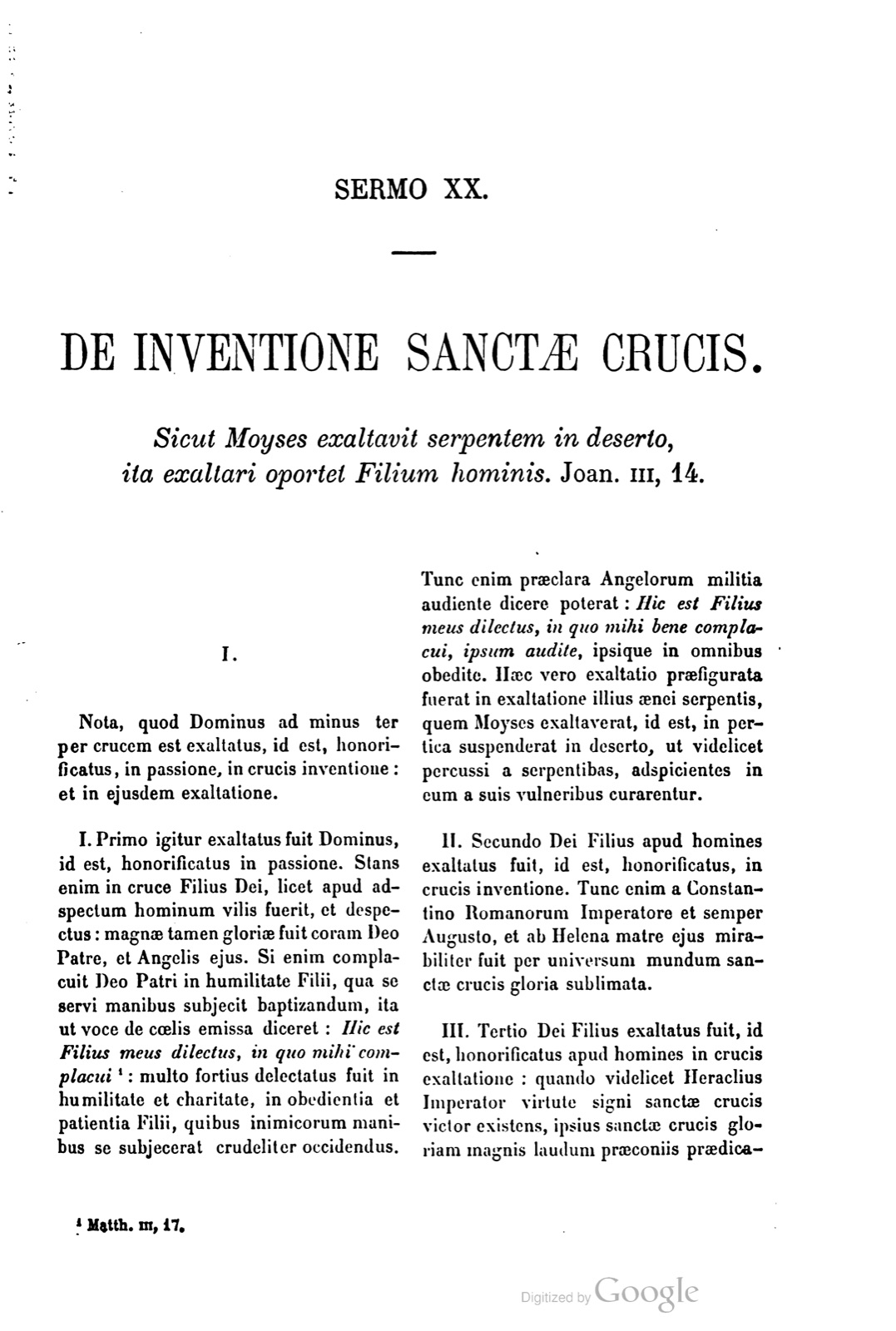
SERMO XX.
DE INVENTIONE SANCTÆ CRUCIS.
Sicut Moyses exaltavit serpentem in deserto, ita exaltari oportet Filium hominis. Joan. III, 14.
I.
Nota, quod Dominus ad minus ter per crucem est exaltatus, id est, honorificatus, in passione, in crucis inventione: et in ejusdem exaltatione.
I. Primo igitur exaltatus fuit Dominus, id est, honorificatus in passione. Stans enim in cruce Filius Dei, licet apud adspectum hominum vilis fuerit, et despectus: magnæ tamen gloriæ fuit coram Deo Patre, et Angelis ejus. Si enim complacuit Deo Patri in humilitate Filii, qua se servi manibus subjecit baptizandum, ita ut voce de cœlis emissa diceret: Hic est Filius meus dilectus, in quo mihi complacui 1: multo fortius delectatus fuit in humilitate et charitate, in obedientia et patientia Filii, quibus inimicorum manibus se subjecerat crudeliter occidendus. Tunc enim præclara Angelorum militia audiente dicere poterat: Hic est Filius meus dilectus, in quo mihi bene complacui, ipsum audite, ipsique in omnibus obedite. Hæc vero exaltatio præfigurata fuerat in exaltatione illius ænei serpentis, quem Moyses exaltaverat, id est, in pertica suspenderat in deserto, ut videlicet percussi a serpentibus, adspicientes in eum a suis vulneribus curarentur.
II. Secundo Dei Filius apud homines exaltatus fuit, id est, honorificatus, in crucis inventione. Tunc enim a Constantino Romanorum Imperatore et semper Augusto, et ab Helena matre ejus mirabiliter fuit per universum mundum sanctæ crucis gloria sublimata.
III. Tertio Dei Filius exaltatus fuit, id est, honorificatus apud homines in crucis exaltatione: quando videlicet Heraclius Imperator virtute signi sanctæ crucis victor existens, ipsius sanctæ crucis gloriam magnis laudum præconiis prædicavit. Cum igitur Dominus per crucem materialem tam multiplici exaltatione, et apud Deum et homines exaltari meruerit, oportet ut et nos inveniamur in cruce, si æternæ beatitudinis exaltationem assequi desideramus.
II.
Et nota, quod sicut a quibusdam creditur, et firmiter asseritur, quinque ligna ad crucem Dominicam concurrerunt, videlicet lignum cedrinum, cypressinum, palmæ, rosæ, et olivæ. Et hæc ligna notantur in ordine, Eccli. XXIV, 17, 18 et 19, ubi in persona crucis dicitur. Quasi cedrus exaltata sum in Libano, et quasi cypressus in monte Sion: quasi palma exaltata sum in Cades, et quasi plantatio rosæ in Jericho: quasi oliva speciosa in campis. Per hæc vero ligna notantur fervens contritio, pura confessio, eleemosynarum largitio, carnis maceratio, et devota oratio.
SERMON XX.
ON THE FINDING OF THE HOLY CROSS.
As Moses lifted up the serpent in the desert, so must the Son of Man be lifted up. John 3:14.
I.
Note that the Lord was exalted, that is, honored, at least three times through the cross: in the Passion, in the finding of the cross, and in the exaltation of the same.
I. First, therefore, the Lord was exalted, that is, honored, in the Passion. For the Son of God, standing on the cross, although in the sight of men he was vile and despised, nevertheless was of great glory before God the Father and his Angels. For if he pleased God the Father in the humility of the Son, by which he subjected himself to be baptized by the hands of a servant, so that, a voice having been sent from the heavens, he would say: This is my beloved Son, in whom I have been pleased 1, much more strongly was he delighted in the humility and charity, in the obedience and patience of the Son, by which he had subjected himself to the hands of enemies to be cruelly killed. For then, with the splendid soldiery of Angels hearing, he could say: This is my beloved Son, in whom I have been well pleased; hear him, and obey him in all things. But this exaltation had been prefigured in the exaltation of that bronze serpent, which Moses had exalted, that is, had hung on a pole in the desert, namely so that those struck by serpents, looking upon him, might be cured from their wounds.
II. Secondly, the Son of God was exalted among men, that is, honored, in the finding of the cross. For then by Constantine, Emperor of the Romans and always Augustus, and by Helena his mother, the glory of the holy cross was wonderfully raised up through the whole world.
III. Thirdly, the Son of God was exalted, that is, honored among men, in the exaltation of the cross, namely when the Emperor Heraclius, existing as victor by the power of the sign of the holy cross, proclaimed the glory of that holy cross with great heraldings of praises. Therefore since the Lord merited to be exalted, both before God and before men, by such manifold exaltation through the material cross, it is necessary that we too be found on a cross, if we desire to attain the exaltation of eternal blessedness.
II.
And note that, as is believed and firmly asserted by certain people, five woods came together for the Lord's cross, namely cedar wood, cypress wood, palm wood, rose wood, and olive wood. And these woods are noted in order in Ecclesiasticus 24:17, 18, and 19, where it is said in the person of the cross: I was exalted like a cedar in Lebanon and like a cypress on Mount Sion; I was exalted like a palm in Kadesh and like a planting of rose in Jericho, like a beautiful olive tree in the fields. But by these woods are noted fervent contrition, pure confession, bestowal of alms, maceration of the flesh, and devout prayer.
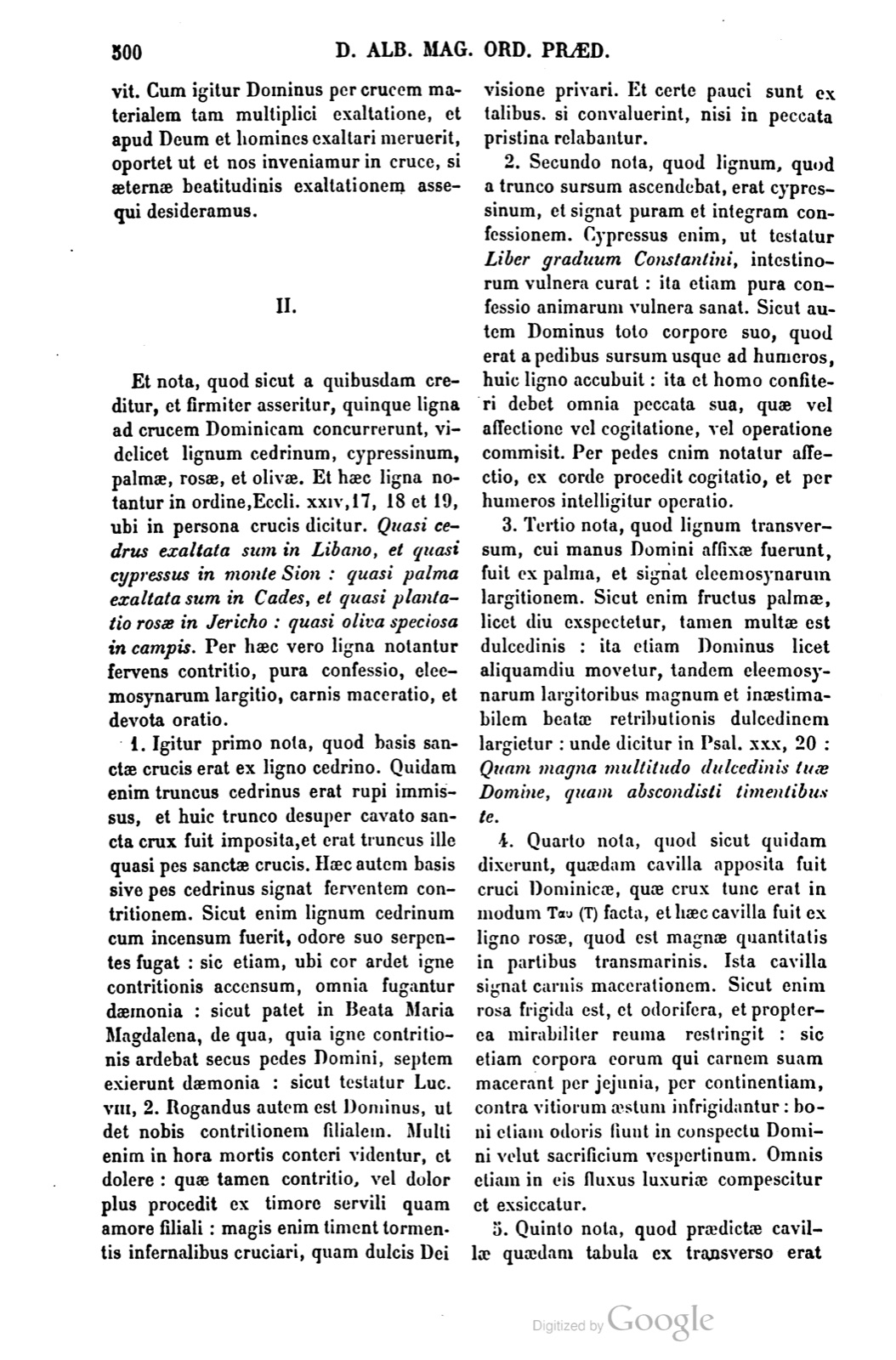
1. Igitur primo nota, quod basis sanctæ crucis erat ex ligno cedrino. Quidam enim truncus cedrinus erat rupi immissus, et huic trunco desuper cavato sancta crux fuit imposita, et erat truncus ille quasi pes sanctæ crucis. Hæc autem basis sive pes cedrinus signat ferventem contritionem. Sicut enim lignum cedrinum cum incensum fuerit, odore suo serpentes fugat: sic etiam, ubi cor ardet igne contritionis accensum, omnia fugantur dæmonia: sicut patet in Beata Maria Magdalena, de qua, quia igne contritionis ardebat secus pedes Domini, septem exierunt dæmonia: sicut testatur Luc. VIII, 2. Rogandus autem est Dominus, ut det nobis contritionem filialem. Multi enim in hora mortis conteri videntur, et dolere: quæ tamen contritio, vel dolor plus procedit ex timore servili quam amore filiali: magis enim timent tormentis infernalibus cruciari, quam dulcis Dei visione privari. Et certe pauci sunt ex talibus, si convaluerint, nisi in peccata pristina relabantur.
2. Secundo nota, quod lignum, quod a trunco sursum ascendebat, erat cypressinum, et signat puram et integram confessionem. Cypressus enim, ut testatur Liber graduum Constantini, intestinorum vulnera curat: ita etiam pura confessio animarum vulnera sanat. Sicut autem Dominus toto corpore suo, quod erat a pedibus sursum usque ad humeros, huic ligno accubuit: ita et homo confiteri debet omnia peccata sua, quæ vel affectione vel cogitatione, vel operatione commisit. Per pedes enim notatur affectio, ex corde procedit cogitatio, et per humeros intelligitur operatio.
3. Tertio nota, quod lignum transversum, cui manus Domini affixæ fuerunt, fuit ex palma, et signat eleemosynarum largitionem. Sicut enim fructus palmæ, licet diu exspectetur, tamen multæ est dulcedinis: ita etiam Dominus licet aliquamdiu movetur, tandem eleemosynarum largitoribus magnum et inæstimabilem beatæ retributionis dulcedinem largietur: unde dicitur in Psal. XXX, 20: Quam magna multitudo dulcedinis tuæ Domine, quam abscondisti timentibus te.
4. Quarto nota, quod sicut quidam dixerunt, quædam cavilla apposita fuit cruci Dominicæ, quæ crux tunc erat in modum Tau (T) facta, et hæc cavilla fuit ex ligno rosæ, quod est magnæ quantitatis in partibus transmarinis. Ista cavilla signat carnis macerationem. Sicut enim rosa frigida est, et odorifera, et propterea mirabiliter reuma restringit: sic etiam corpora eorum qui carnem suam macerant per jejunia, per continentiam, contra vitiorum æstum infrigidantur: boni etiam odoris fiunt in conspectu Domini velut sacrificium vespertinum. Omnis etiam in eis fluxus luxuriæ compescitur et exsiccatur.
1. Therefore first note that the base of the holy cross was from cedar wood. For a certain cedar trunk was set into rock, and upon this trunk, hollowed out above, the holy cross was placed, and that trunk was as it were the foot of the holy cross. But this base or cedar foot signifies fervent contrition. For just as cedar wood, when it has been burned, drives away serpents by its odor, so also, where the heart burns kindled by the fire of contrition, all demons are put to flight, as is clear in Blessed Mary Magdalene, from whom, because she burned with the fire of contrition beside the feet of the Lord, seven demons went out, as Luke 8:2 testifies. But the Lord must be asked to give us filial contrition. For many at the hour of death seem to be contrite and to grieve; yet that contrition or grief proceeds more from servile fear than from filial love, for they fear more to be tortured by infernal torments than to be deprived of the sweet vision of God. And certainly there are few such persons who, if they recover, do not fall back into their former sins.
2. Secondly note that the wood which ascended upward from the trunk was cypress, and signifies pure and entire confession. For the cypress, as the Book of the Degrees of Constantine testifies, heals wounds of the intestines; so also pure confession heals wounds of souls. But just as the Lord lay against this wood with his whole body, which was from the feet upward to the shoulders, so too a man ought to confess all his sins which he has committed either by affection or thought or operation. For affection is noted by the feet, thought proceeds from the heart, and operation is understood by the shoulders.
3. Thirdly note that the transverse wood, to which the Lord's hands were fastened, was from palm, and signifies the bestowal of alms. For just as the fruit of the palm, although awaited for a long time, is nevertheless of much sweetness, so also the Lord, although he is moved for some time, will at last lavish on the givers of alms the great and inestimable sweetness of blessed retribution; hence it is said in Psalm 30:20: How great is the multitude of your sweetness, Lord, which you have hidden for those fearing you.
4. Fourthly note that, as certain people have said, a certain peg was added to the Lord's cross, which cross was then made in the form of Tau (T), and this peg was from rose wood, which is of great quantity in the parts across the sea. That peg signifies maceration of the flesh. For just as the rose is cold and fragrant, and on account of this wonderfully restrains rheum, so also the bodies of those who macerate their flesh through fasts and through continence are cooled against the heat of vices; they also become of good odor in the sight of the Lord, like an evening sacrifice. Every flow of lust in them is also restrained and dried up.
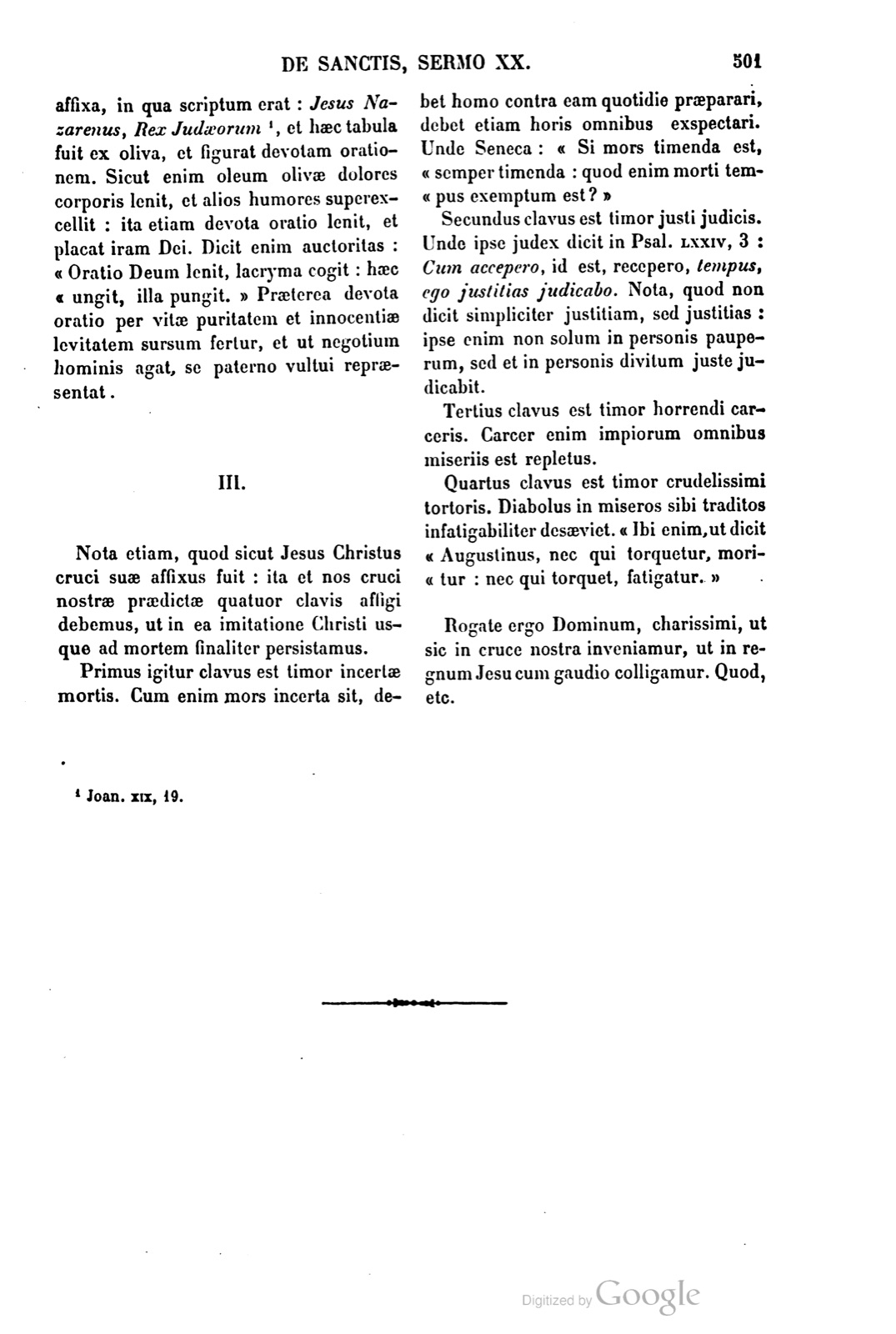
5. Quinto nota, quod prædictæ cavillæ quædam tabula ex transverso erat affixa, in qua scriptum erat: Jesus Nazarenus, Rex Judæorum 2, et hæc tabula fuit ex oliva, et figurat devotam orationem. Sicut enim oleum olivæ dolores corporis lenit, et alios humores superexcellit: ita etiam devota oratio lenit, et placat iram Dei. Dicit enim auctoritas: « Oratio Deum lenit, lacryma cogit: hæc ungit, illa pungit. » Præterea devota oratio per vitæ puritatem et innocentiæ levitatem sursum fertur, et ut negotium hominis agat, se paterno vultui repræsentat.
III.
Nota etiam, quod sicut Jesus Christus cruci suæ affixus fuit: ita et nos cruci nostræ prædictæ quatuor clavis affigi debemus, ut in ea imitatione Christi usque ad mortem finaliter persistamus.
Primus igitur clavus est timor incertæ mortis. Cum enim mors incerta sit, debet homo contra eam quotidie præparari, debet etiam horis omnibus exspectari. Unde Seneca: « Si mors timenda est, semper timenda: quod enim morti tempus exemptum est? »
Secundus clavus est timor justi judicis. Unde ipse judex dicit in Psal. LXXIV, 3: Cum accepero, id est, recepero, tempus, ego justitias judicabo. Nota, quod non dicit simpliciter justitiam, sed justitias: ipse enim non solum in personis pauperum, sed et in personis divitum juste judicabit.
Tertius clavus est timor horrendi carceris. Carcer enim impiorum omnibus miseriis est repletus.
Quartus clavus est timor crudelissimi tortoris. Diabolus in miseros sibi traditos infatigabiliter desæviet. « Ibi enim, ut dicit Augustinus, nec qui torquetur, moritur: nec qui torquet, fatigatur. »
Rogate ergo Dominum, charissimi, ut sic in cruce nostra inveniamur, ut in regnum Jesu cum gaudio colligamur. Quod, etc.
5. Fifthly note that to the aforesaid peg a certain tablet was fastened crosswise, on which was written: Jesus of Nazareth, King of the Jews 2, and this tablet was from olive, and figures devout prayer. For just as olive oil soothes the pains of the body and surpasses the other humors, so also devout prayer soothes and placates the anger of God. For an authority says: "Prayer soothes God, a tear compels him; this one anoints, that one pierces." Moreover devout prayer is borne upward through purity of life and the lightness of innocence, and, in order that it may conduct the business of man, presents itself to the paternal face.
III.
Note also that just as Jesus Christ was fixed to his cross, so also we ought to be fixed to our aforesaid cross by four nails, so that in it, in imitation of Christ, we may finally persist even to death.
Therefore the first nail is fear of uncertain death. For since death is uncertain, a man ought to be prepared against it daily; it ought also to be awaited at every hour. Hence Seneca: "If death is to be feared, it is always to be feared; for what time is exempt from death?"
The second nail is fear of the just judge. Hence the judge himself says in Psalm 74:3: When I have accepted, that is, received, the time, I will judge justices. Note that he does not simply say justice, but justices; for he himself will judge justly not only in the persons of the poor, but also in the persons of the rich.
The third nail is fear of the dreadful prison. For the prison of the impious is filled with all miseries.
The fourth nail is fear of the most cruel torturer. The devil will rage tirelessly against the wretched ones handed over to him. "For there, as Augustine says, neither does he who is tortured die, nor is he who tortures wearied."
Therefore pray to the Lord, dearest ones, that we may so be found on our cross, that we may be gathered with joy into the kingdom of Jesus. May he grant this, etc.
If a page does not appear, its photograph has not been uploaded yet.