Volume 13 · pp. 496–498
Sermon XIX. On the Feast of Saints Philip and James, Apostles
A marker with ≈ is an approximate page boundary, placed by measure of the text; the page photographs remain the authority. In the paired views, clicking a page marker brings that page into view.
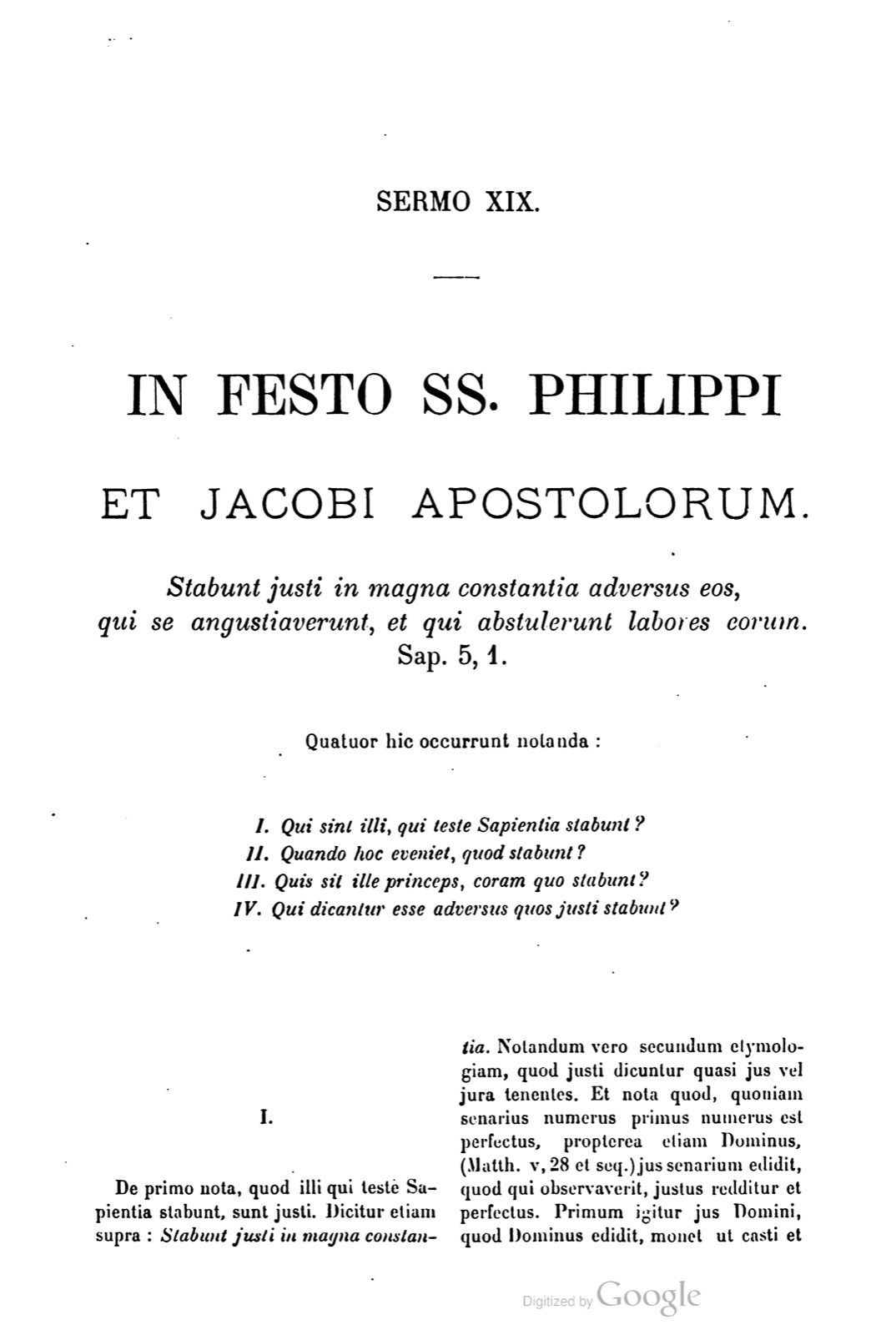
SERMO XIX.
IN FESTO SS. PHILIPPI ET JACOBI APOSTOLORUM.
Stabunt justi in magna constantia adversus eos, qui se angustiaverunt, et qui abstulerunt labores eorum. Sap. V, 1.
Quatuor hic occurrunt notanda:
I. Qui sint illi, qui teste Sapientia stabunt? II. Quando hoc eveniet, quod stabunt? III. Quis sit ille princeps, coram quo stabunt? IV. Qui dicantur esse adversus quos justi stabunt?
I.
De primo nota, quod illi qui teste Sapientia stabunt, sunt justi. Dicitur etiam supra: Stabunt justi in magna constantia. Notandum vero secundum etymologiam, quod justi dicuntur quasi jus vel jura tenentes. Et nota quod, quoniam senarius numerus primus numerus est perfectus, propterea etiam Dominus, (Matth. V, 28 et seq.) jus senarium edidit, quod qui observaverit, justus redditur et perfectus. Primum igitur jus Domini, quod Dominus edidit, monet ut casti et mundi etiam mentaliter existamus. Secundum, ut nullum juramentum sine necessitate proferamus. Tertium, ut corruptelam mendacii fugiamus. Quartum, ut contra injurias per patientiam muniamur. Quintum, ut opera veræ charitatis exsequamur. Sextum, ut justi coram Deo in omnibus inveniamur.
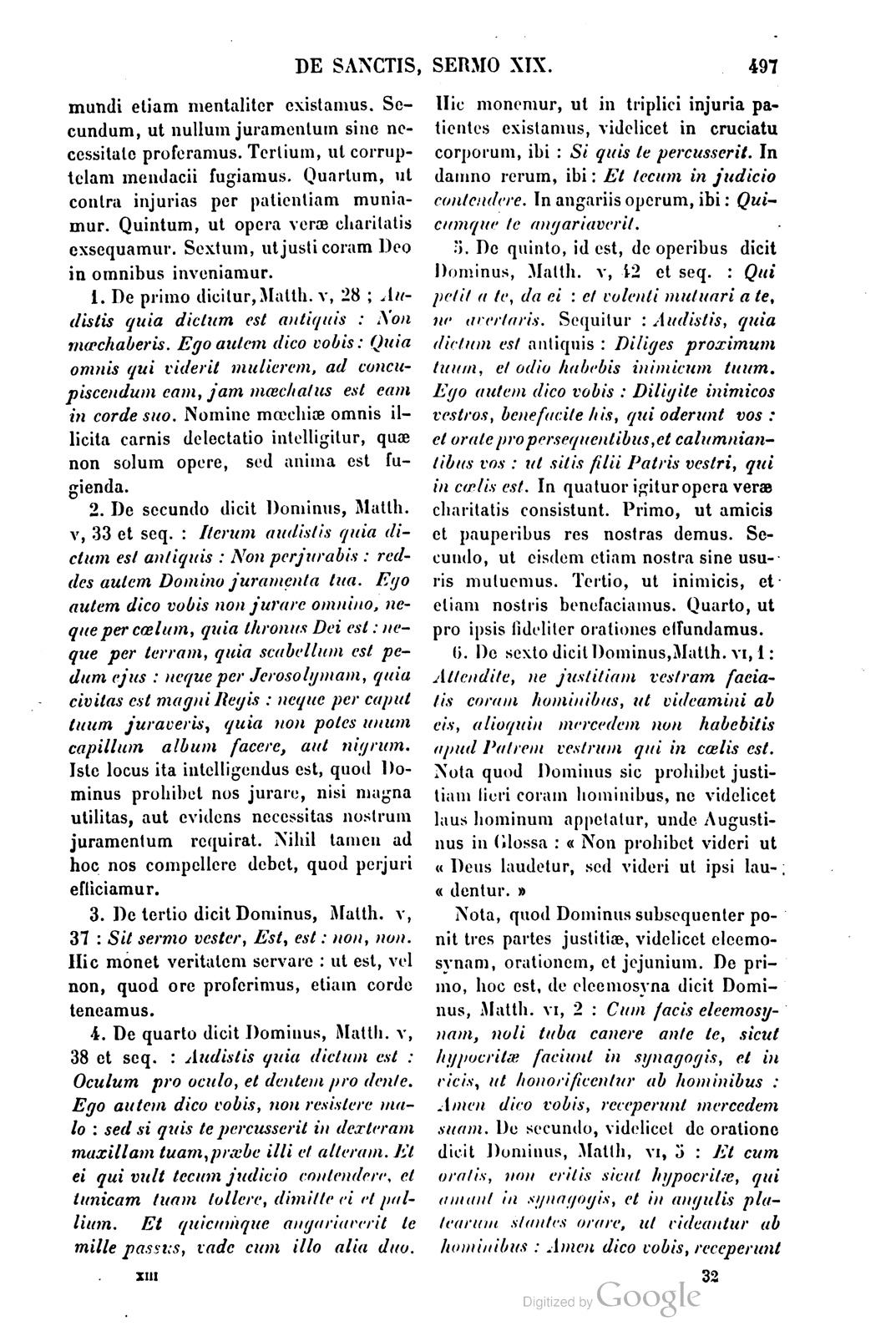
1. De primo dicitur, Matth. V, 28: Audistis quia dictum est antiquis: Non mæchaberis. Ego autem dico vobis: Quia omnis qui viderit mulierem, ad concupiscendum eam, jam mæchatus est eam in corde suo. Nomine mæchiæ omnis illicita carnis delectatio intelligitur, quæ non solum opere, sed anima est fugienda.
2. De secundo dicit Dominus, Matth. V, 33 et seq.: Iterum audistis quia dictum est antiquis: Non perjurabis: reddes autem Domino juramenta tua. Ego autem dico vobis non jurare omnino, neque per cœlum, quia thronus Dei est: neque per terram, quia scabellum est pedum ejus: neque per Jerosolymam, quia civitas est magni Regis: neque per caput tuum juraveris, quia non potes unum capillum album facere, aut nigrum. Iste locus ita intelligendus est, quod Dominus prohibet nos jurare, nisi magna utilitas, aut evidens necessitas nostrum juramentum requirat. Nihil tamen ad hoc nos compellere debet, quod perjuri efficiamur.
3. De tertio dicit Dominus, Matth. V, 37: Sit sermo vester, Est, est: non, non. Hic monet veritatem servare: ut est, vel non, quod ore proferimus, etiam corde teneamus.
4. De quarto dicit Dominus, Matth. V, 38 et seq.: Audistis quia dictum est: Oculum pro oculo, et dentem pro dente. Ego autem dico vobis, non resistere malo: sed si quis te percusserit in dexteram maxillam tuam, præbe illi et alteram. Et ei qui vult tecum judicio contendere, et tunicam tuam tollere, dimitte ei et pallium. Et quicumque angariaverit te mille passus, vade cum illo alia duo. Hic monemur, ut in triplici injuria patientes existamus, videlicet in cruciatu corporum, ibi: Si quis te percusserit. In damno rerum, ibi: Et tecum in judicio contendere. In angariis operum, ibi: Quicumque te angariaverit.
SERMON XIX.
ON THE FEAST OF SAINTS PHILIP AND JAMES, APOSTLES.
The just will stand in great constancy against those who have distressed them and who have taken away their labors. Wisdom 5:1.
Here four things occur to be noted:
I. Who are those who, with Wisdom as witness, will stand? II. When will this happen, that they will stand? III. Who is that prince before whom they will stand? IV. Who are said to be those against whom the just will stand?
I.
On the first, note that those who, with Wisdom as witness, will stand are the just. It is also said above: The just will stand in great constancy. But it must be noted according to etymology that just men are so called as if holding right or rights. And note that, because the number six is the first perfect number, on that account the Lord also, Matthew 5:28 and following, issued a sixfold right; whoever has observed it is rendered just and perfect. Therefore the first right of the Lord, which the Lord issued, admonishes that we exist as chaste and clean even mentally. The second, that we bring forth no oath without necessity. The third, that we flee the corruption of lying. The fourth, that we be fortified against injuries through patience. The fifth, that we carry out the works of true charity. The sixth, that we be found just before God in all things.
1. Concerning the first it is said, Matthew 5:28: You have heard that it was said to the ancients: You shall not commit adultery. But I say to you: Because everyone who has looked at a woman in order to desire her has already committed adultery with her in his heart. Under the name of adultery every illicit delight of the flesh is understood, which is to be fled not only in work but in soul.
2. Concerning the second the Lord says, Matthew 5:33 and following: Again you have heard that it was said to the ancients: You shall not perjure yourself, but you shall render your oaths to the Lord. But I say to you not to swear at all, neither by heaven, because it is the throne of God, nor by earth, because it is the footstool of his feet, nor by Jerusalem, because it is the city of the great King, nor shall you swear by your head, because you cannot make one hair white or black. This place is to be understood thus: that the Lord prohibits us to swear unless great usefulness or evident necessity requires our oath. Yet nothing ought to compel us to this, that we become perjurers.
3. Concerning the third the Lord says, Matthew 5:37: Let your speech be Yes, yes; no, no. Here he admonishes us to preserve truth, so that we may hold also in the heart the yes or no that we bring forth by mouth.
4. Concerning the fourth the Lord says, Matthew 5:38 and following: You have heard that it was said: An eye for an eye and a tooth for a tooth. But I say to you, not to resist evil; but if anyone has struck you on your right cheek, offer him the other also. And to him who wishes to contend with you in judgment and to take your tunic, leave to him also your cloak. And whoever has compelled you for a thousand paces, go with him another two. Here we are admonished to exist as patient in threefold injury, namely in torture of bodies, there: If anyone has struck you; in loss of things, there: And to contend with you in judgment; in forced services of works, there: Whoever has compelled you.
5. De quinto, id est, de operibus dicit Dominus, Matth. V, 42 et seq.: Qui petit a te, da ei: et volenti mutuari a te, ne avertaris. Sequitur: Audistis, quia dictum est antiquis: Diliges proximum tuum, et odio habebis inimicum tuum. Ego autem dico vobis: Diligite inimicos vestros, benefacite his, qui oderunt vos: et orate pro persequentibus, et calumniantibus vos: ut sitis filii Patris vestri, qui in cælis est. In quatuor igitur opera veræ charitatis consistunt. Primo, ut amicis et pauperibus res nostras demus. Secundo, ut eisdem etiam nostra sine usuris mutuemus. Tertio, ut inimicis, et etiam nostris benefaciamus. Quarto, ut pro ipsis fideliter orationes effundamus.
6. De sexto dicit Dominus, Matth. VI, 1: Attendite, ne justitiam vestram faciatis coram hominibus, ut videamini ab eis, alioquin mercedem non habebitis apud Patrem vestrum qui in cælis est. Nota quod Dominus sic prohibet justitiam fieri coram hominibus, ne videlicet laus hominum appetatur, unde Augustinus in Glossa: « Non prohibet videri ut Deus laudetur, sed videri ut ipsi laudentur. »
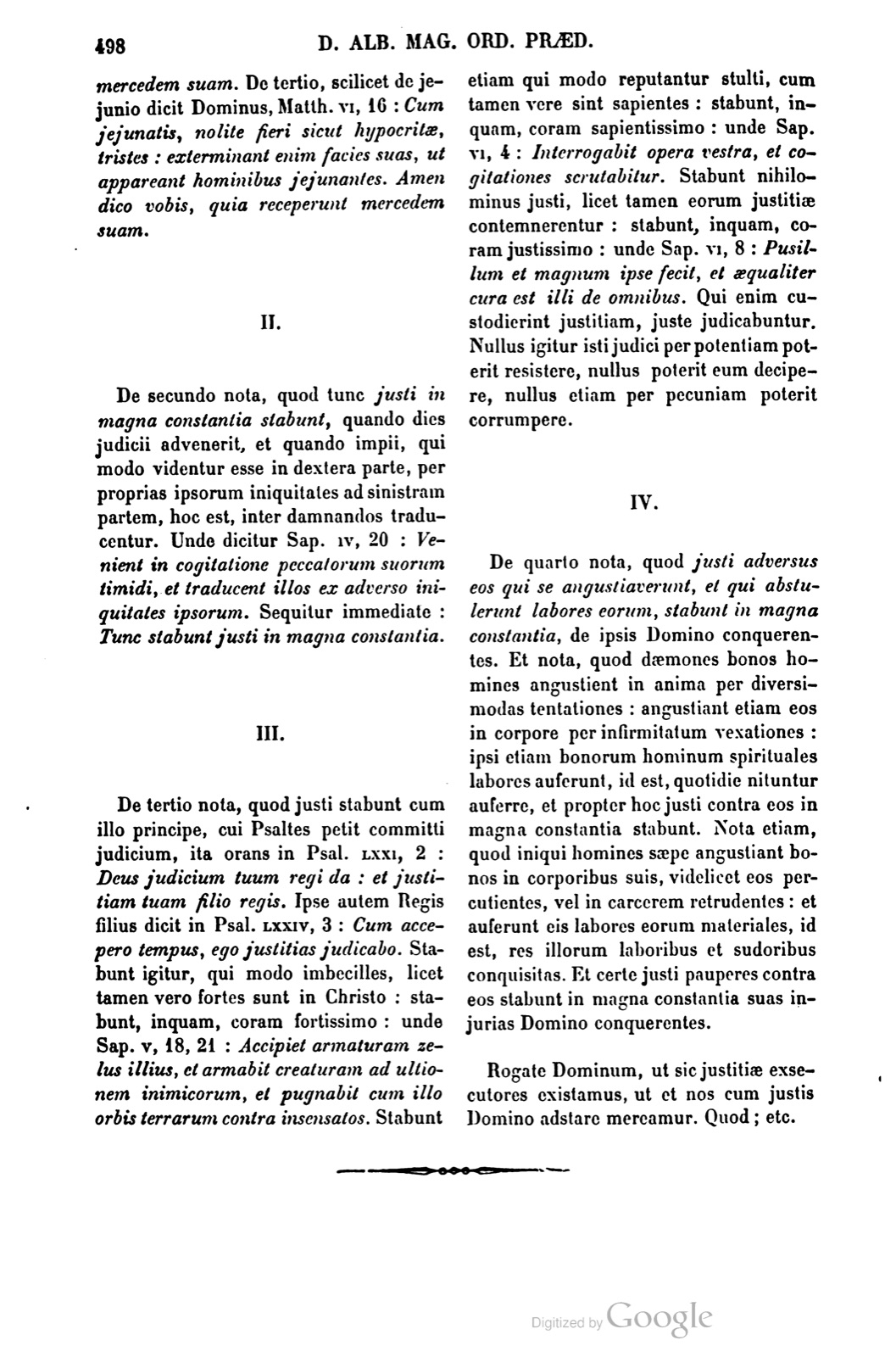
Nota, quod Dominus subsequenter ponit tres partes justitiæ, videlicet eleemosynam, orationem, et jejunium. De primo, hoc est, de eleemosyna dicit Dominus, Matth. VI, 2: Cum facis eleemosynam, noli tuba canere ante te, sicut hypocritæ faciunt in synagogis, et in vicis, ut honorificentur ab hominibus: Amen dico vobis, receperunt mercedem suam. De secundo, videlicet de oratione dicit Dominus, Matth. VI, 5: Et cum oratis, non eritis sicut hypocritæ, qui amant in synagogis, et in angulis platearum stantes orare, ut videantur ab hominibus: Amen dico vobis, receperunt mercedem suam. De tertio, scilicet de jejunio dicit Dominus, Matth. VI, 16: Cum jejunatis, nolite fieri sicut hypocritæ, tristes: exterminant enim facies suas, ut appareant hominibus jejunantes. Amen dico vobis, quia receperunt mercedem suam.
II.
De secundo nota, quod tunc justi in magna constantia stabunt, quando dies judicii advenerit, et quando impii, qui modo videntur esse in dextera parte, per proprias ipsorum iniquitates ad sinistram partem, hoc est, inter damnandos traducentur. Unde dicitur Sap. IV, 20: Venient in cogitatione peccatorum suorum timidi, et traducent illos ex adverso iniquitates ipsorum. Sequitur immediate: Tunc stabunt justi in magna constantia.
5. Concerning the fifth, that is, concerning works, the Lord says, Matthew 5:42 and following: Give to him who asks of you, and do not turn away from him who wishes to borrow from you. It follows: You have heard that it was said to the ancients: You shall love your neighbor and hate your enemy. But I say to you: Love your enemies, do good to those who hate you, and pray for those persecuting and slandering you, so that you may be sons of your Father who is in heaven. Therefore the works of true charity consist in four things. First, that we give our things to friends and the poor. Secondly, that we also lend our things to the same without usuries. Thirdly, that we do good to enemies, even ours. Fourthly, that we faithfully pour out prayers for them.
6. Concerning the sixth the Lord says, Matthew 6:1: Take heed that you do not do your justice before men so that you may be seen by them; otherwise you will not have reward with your Father who is in heaven. Note that the Lord thus forbids justice to be done before men, namely lest the praise of men be sought; hence Augustine in the Gloss says: "He does not prohibit being seen so that God may be praised, but being seen so that they themselves may be praised."
Note that the Lord subsequently places three parts of justice, namely almsgiving, prayer, and fasting. Concerning the first, that is, concerning almsgiving, the Lord says, Matthew 6:2: When you give alms, do not sound a trumpet before you, as hypocrites do in synagogues and in streets, so that they may be honored by men. Amen I say to you, they have received their reward. Concerning the second, namely concerning prayer, the Lord says, Matthew 6:5: And when you pray, you will not be like hypocrites, who love to pray standing in synagogues and on the corners of streets, so that they may be seen by men. Amen I say to you, they have received their reward. Concerning the third, that is, concerning fasting, the Lord says, Matthew 6:16: When you fast, do not become like hypocrites, sorrowful; for they disfigure their faces so that they may appear to men to be fasting. Amen I say to you that they have received their reward.
II.
On the second, note that then the just will stand in great constancy, when the day of judgment has arrived, and when the impious, who now seem to be on the right side, are brought over by their own iniquities to the left side, that is, among those to be damned. Hence it is said in Wisdom 4:20: They will come fearful in the thought of their sins, and their iniquities will bring them across from the opposite side. Immediately it follows: Then the just will stand in great constancy.
III.
De tertio nota, quod justi stabunt cum illo principe, cui Psaltes petit committi judicium, ita orans in Psal. LXXI, 2: Deus judicium tuum regi da: et justitiam tuam filio regis. Ipse autem Regis filius dicit in Psal. LXXIV, 3: Cum accepero tempus, ego justitias judicabo. Stabunt igitur, qui modo imbecilles, licet tamen vero fortes sunt in Christo: stabunt, inquam, coram fortissimo: unde Sap. V, 18, 21: Accipiet armaturam zelus illius, et armabit creaturam ad ultionem inimicorum, et pugnabit cum illo orbis terrarum contra insensatos. Stabunt etiam qui modo reputantur stulti, cum tamen vere sint sapientes: stabunt, inquam, coram sapientissimo: unde Sap. VI, 4: Interrogabit opera vestra, et cogitationes scrutabitur. Stabunt nihilominus justi, licet tamen eorum justitiæ contemnerentur: stabunt, inquam, coram justissimo: unde Sap. VI, 8: Pusillum et magnum ipse fecit, et æqualiter cura est illi de omnibus. Qui enim custodierint justitiam, juste judicabuntur. Nullus igitur isti judici per potentiam poterit resistere, nullus poterit eum decipere, nullus etiam per pecuniam poterit corrumpere.
IV.
De quarto nota, quod justi adversus eos qui se angustiaverunt, et qui abstulerunt labores eorum, stabunt in magna constantia, de ipsis Domino conquerentes. Et nota, quod dæmones bonos homines angustient in anima per diversimodas tentationes: angustiant etiam eos in corpore per infirmitatum vexationes: ipsi etiam bonorum hominum spirituales labores auferunt, id est, quotidie nituntur auferre, et propter hoc justi contra eos in magna constantia stabunt. Nota etiam, quod iniqui homines sæpe angustiant bonos in corporibus suis, videlicet eos percutientes, vel in carcerem retrudentes: et auferunt eis labores eorum materiales, id est, res illorum laboribus et sudoribus conquisitas. Et certe justi pauperes contra eos stabunt in magna constantia suas injurias Domino conquerentes.
Rogate Dominum, ut sic justitiæ exsecutores existamus, ut et nos cum justis Domino adstare mereamur. Quod; etc.
III.
On the third, note that the just will stand with that prince to whom the Psalmist asks judgment to be committed, praying thus in Psalm 71:2: O God, give your judgment to the king, and your justice to the son of the king. But the Son of the King says in Psalm 74:3: When I have received the time, I will judge justices. Therefore those who now are weak, though truly strong in Christ, will stand; they will stand, I say, before the strongest one; hence Wisdom 5:18, 21: His zeal will take armor, and will arm creation for vengeance on enemies, and the world of lands will fight with him against the senseless. Those also who now are reckoned foolish, although truly they are wise, will stand; they will stand, I say, before the wisest one; hence Wisdom 6:4: He will interrogate your works and search your thoughts. Nevertheless the just will stand, although their justices were contemned; they will stand, I say, before the most just one; hence Wisdom 6:8: He himself made the small and the great, and equally there is care to him concerning all. For those who have guarded justice will be judged justly. Therefore no one will be able to resist that judge by power, no one will be able to deceive him, no one also will be able to corrupt him by money.
IV.
On the fourth, note that the just will stand in great constancy against those who distressed them and who took away their labors, complaining to the Lord about them. And note that demons distress good men in the soul through diverse temptations; they also distress them in body through vexations of infirmities; they themselves also take away the spiritual labors of good men, that is, they daily strive to take them away, and on account of this the just will stand against them in great constancy. Note also that wicked men often distress the good in their bodies, namely by striking them or thrusting them back into prison; and they take away from them their material labors, that is, their things acquired by labors and sweats. And certainly the just poor will stand against them in great constancy, complaining of their injuries to the Lord.
Pray to the Lord, that we may so exist as executors of justice, that we too with the just may merit to stand by the Lord. May he grant this; etc.
If a page does not appear, its photograph has not been uploaded yet.