Volume 13 · pp. 426–430
Sermon V. On Blessed John the Evangelist
A marker with ≈ is an approximate page boundary, placed by measure of the text; the page photographs remain the authority. In the paired views, clicking a page marker brings that page into view.
SERMO V.
DE BEATO JOANNE EVANGELISTA.
Conversus Petrus vidit illum discipulum, quem diligebat Jesus, sequentem. Joan. XXI, 20.
Nota, quod quatuor sunt hic prima facie prænotanda:
I. Quare se Joannes discipulum Domini fuisse protestetur? II. Per quid Dominus eum specialiter dilexisse probetur? III. Quando Jesum secutus ostendatur? IV. Quale præmium propter hoc accepit, quia Jesum fideliter sequebatur?
I.
De primo nota, quod ideo B. Joannes Evangelista discipulus Domini specialiter asseritur, quia illas quatuor lectiones, quas ille magnus et verax Magister Jesus legit, didicit, et operibus adimplevit. Prima fuit lectio virgineæ veritatis. Secunda fuit inæstimabilis humilitatis. Tertia fuit deificæ charitatis. Quarta fuit eximiæ patientiæ seu lenitatis. Primam legit in utero seu gremio virginali. Secundam legit in præsepio jumentali. Tertiam legit in strato cœnaculo. Quartam legit in crucis patibulo.
I. In prima igitur lectione, quam ille bonus Magister Jesus legit in utero seu gremio virginali, virginea puritas mirabiliter commendatur. Per hoc enim quod Christus de Virgine tantum concipi et nasci dignatus est, et per hoc quod tantum virginea ubera sugere voluit, omnibus hominibus manifeste dat intelligere, quod super omnia amplectitur, et omnium statui hominum præfert virgineam puritatem. Unde scribit Hieronymus contra Jovinianum, super locum illum: Ecce virgo concipiet in utero: "Si non præfertur nuptiis virginitas, Spiritus sanctus cur maritatam, cur viduam non elegit?" 2. Nam illo tempore erat et Anna filia Phanuelis de tribu Aser, insignis pudicitiæ et semper vacans orationibus, et jejuniis in templo Dei. Ideo Beatus Joannes Evangelista ex ipsa divina revelatione sciens Christum summe virginitatem diligere, spreta copula conjugali, virgo permansit in ævum. 3. Unde cantatur in quodam Responsorio: "Diligebat Jesus Joannem, quem specialis prærogativa castitatis, ampliori dilectione fecerat dignum: quia virgo electus ab ipso, virgo in ævum permansit." Beatus est ergo, qui cum Joanne propter Christum virgo permanserit. 4. Valde autem miser, et infelix est, qui tamquam jumentum putrescens in stercore suo, in immunditia fornicationis decesserit. Dicit enim Apostolus ad Hebr. XIII, 4: Fornicatores et adulteros judicabit Deus. Glossa, "æternaliter condemnabit."
II. Secundo Dominus legit lectionem incomparabilis humilitatis, jacens in præsepio. Nonne enim inæstimabilis erat humilitas, quod ille, quem "cælum et cæli cælorum capere non possunt, sicut dicitur 4. Resp. 8, in arcto præsepio reponi voluit," pannis paupertatis involutus? Hanc lectionem iste bonus discipulus didicit, et opere exsecutus fuit, quod ex eo manifeste probari potest. 1. Quod nusquam, neque in Evangelio suo, neque in epistolis suis, neque in Apocalypsi sua, Apostolum se nominat, sed tantum discipulum, et servum Jesu Christi. 2. Humilitas etiam Joannis in hoc perpendi potest, quod cum, annuntiante Maria Magdalena Christum esse sublatum, præcurrisset Petro, et venisset prior ad monumentum, non tamen intravit, nisi Petrus prius intrasset. Licet enim eum Petro præcurrere fecisset juventutis celeritas, ne tamen sepulcrum prior intraret, revocavit eum humilitas. 3. Huic etiam Dominus humilitatis magister, humilem virginem, scilicet matrem suam, quæ se reputavit ancillam, non Dominam, humili virgini, scilicet Joanni, qui se non Apostolum nominat, sed discipulum vel servum, in cruce specialiter commendavit. Nos etiam humilitatem Joannis imitari debemus: plus enim placet Domino intrinseca cordis humilitas, quam extrinsecarum rerum paupertas. Unde Hieronymus scribit ad Oceanum: "Plus est animum deposuisse quam cultum: difficilius arrogantia quam auro caremus, et gemmis. His enim abjectis, interdum gloriosis tumemus sordibus, et vendibilem paupertatem populari auræ offerimus."
SERMON V.
ON BLESSED JOHN THE EVANGELIST.
Peter, having turned, saw that disciple, whom Jesus loved, following. John 21:20.
Note that four things are here to be marked beforehand at first sight:
I. Why does John declare that he was a disciple of the Lord? II. Through what is it proved that the Lord loved him especially? III. When is he shown to have followed Jesus? IV. What reward did he receive on account of this, because he faithfully followed Jesus?
I.
On the first, note that Blessed John the Evangelist is therefore especially asserted to be the disciple of the Lord, because he learned those four lessons which that great and truthful Teacher Jesus read, and fulfilled them by works. The first was the lesson of virginal truth. The second was of inestimable humility. The third was of deifying charity. The fourth was of extraordinary patience or gentleness. He read the first in the virginal womb or lap. He read the second in the animal manger. He read the third in the prepared upper room. He read the fourth on the gibbet of the cross.
I. Therefore in the first lesson, which that good Teacher Jesus read in the virginal womb or lap, virginal purity is marvelously commended. For through this, that Christ deigned to be conceived and born only from a Virgin, and through this, that he wished to suck only virginal breasts, he plainly gives all men to understand that above all things he embraces virginal purity and prefers it to the state of all men. Hence Jerome writes against Jovinian, on that place: Behold, a virgin shall conceive in the womb: "If virginity is not preferred to marriage, why did the Holy Spirit not choose a married woman, why not a widow?" 2. For at that time there was also Anna, daughter of Phanuel, of the tribe of Asher, remarkable in modesty and always occupied with prayers and fasts in the temple of God. Therefore Blessed John the Evangelist, knowing from divine revelation itself that Christ supremely loves virginity, despising the bond of marriage, remained a virgin forever. 3. Hence it is sung in a certain Responsory: "Jesus loved John, whom the special prerogative of chastity had made worthy of a fuller love, because, chosen by him a virgin, he remained a virgin forever." Blessed therefore is he who with John has remained a virgin on account of Christ. 4. But very wretched and unhappy is he who, like a beast rotting in its own dung, has departed in the uncleanness of fornication. For the Apostle says at Hebrews 13:4: Fornicators and adulterers God will judge. The Gloss says, "he will condemn eternally."
II. Secondly, the Lord read the lesson of incomparable humility, lying in a manger. For was it not inestimable humility that he whom "heaven and the heavens of heavens cannot contain, as is said in the fourth responsory, eighth, wished to be placed in a narrow manger," wrapped in the cloths of poverty? This good disciple learned this lesson and carried it out in work, which can be clearly proved from this. 1. That nowhere, neither in his Gospel, nor in his epistles, nor in his Apocalypse, does he name himself an Apostle, but only a disciple and servant of Jesus Christ. 2. The humility of John can also be considered in this, that when, with Mary Magdalene announcing that Christ had been taken away, he had run ahead of Peter and had come first to the monument, nevertheless he did not enter unless Peter had entered first. For although the swiftness of youth had made him run ahead of Peter, humility called him back lest he enter the sepulcher first. 3. To this man also the Lord, the teacher of humility, specially commended on the cross the humble virgin, namely his mother, who reckoned herself a handmaid, not a Lady, to a humble virgin, namely John, who does not name himself an Apostle but a disciple or servant. We also ought to imitate the humility of John; for inward humility of heart pleases the Lord more than outward poverty of things. Hence Jerome writes to Oceanus: "It is more to have laid aside the mind than the dress; we lack arrogance with more difficulty than gold and gems. For when these have been cast away, we sometimes swell with glorious filth and offer saleable poverty to the popular breeze."
III. Tertio Dominus sedens in cænaculo grandi strato, secundum quod dicit Marc. XIV, 15, docuit lectionem deificæ charitatis. Asserit enim Joan. XIII, 34, quod cœna facta... dixit Jesus discipulis suis: Mandatum novum do vobis: Ut diligatis invicem, sicut dilexi vos. Vel Joan. XV, 12: Hoc est præceptum meum, ut diligatis invicem, sicut dilexi vos. Sequitur aliquibus verbis interpositis 1: Hæc mando vobis, ut diligatis invicem. Ecce quomodo bonus Magister discipulis suis inculcat lectionem charitatis. Hanc lectionem iste dilectus discipulus optime commendavit memoriæ suæ. Unde et ipse scribit Ecclesiæ fidelibus in prima Canonica sua, III, 11: Charissimi, hæc est annuntiatio, quam audistis ab initio, ut diligatis alterutrum. Item, IV, 7: Charissimi, diligamus nos invicem: quia charitas ex Deo est. Item, ibi dicit: Si sic Deus dilexit nos: et nos debemus alterutrum diligere sic 2.
Igitur cum Jesus ter nobis præcipiat, ut nos diligamus invicem, et Joannes nos ter invitet ad idem, omni homini perspicuum esse potest, quod debemus invicem diligere corde, ore, et opere. Corde, ne aliquem odio habeamus. Omnis enim qui odit fratrem suum, homicida est (I Joan. III, 15). Ore, ne aliquem lingua nostra lædamus. Unde Dominus Matth. XII, 37: Ex verbis tuis justificaberis, et ex verbis tuis condemnaberis. Opere, ut animas nostras pro proximis nostris in necessitate ponamus, et ut de substantia nostra pauperibus subveniamus. De utroque dicit I Joan. III, 16 et 17: In hoc cognovimus charitatem Dei, quoniam ille animam suam pro nobis posuit: et nos debemus pro fratribus animas ponere. Qui habuerit substantiam hujus mundi, et viderit fratrem suum necessitatem habere, et clauserit viscera sua ab eo: quomodo charitas Dei manet in eo?
IV. Quarto legit Dominus lectionem eximiæ lenitatis, et patientiæ in crucis patibulo.
III. Thirdly, the Lord, sitting in a large prepared upper room, according to what Mark 14:15 says, taught the lesson of deifying charity. For John 13:34 asserts that, when supper had been made... Jesus said to his disciples: A new commandment I give to you: that you love one another as I have loved you. Or John 15:12: This is my precept, that you love one another as I have loved you. It follows, with some words placed between 1: These things I command you, that you love one another. Behold how the good Teacher impresses the lesson of charity upon his disciples. This lesson that beloved disciple committed most excellently to his memory. Hence he himself writes to the faithful of the Church in his first canonical epistle, 3:11: Dearest ones, this is the announcement which you have heard from the beginning, that you love one another. Likewise, 4:7: Dearest ones, let us love one another, because charity is from God. Likewise, there he says: If God so loved us, we also ought to love one another in this way 2.
Therefore, since Jesus three times commands us to love one another, and John three times invites us to the same thing, it can be evident to every man that we ought to love one another in heart, mouth, and work. In heart, lest we hold anyone in hatred. For everyone who hates his brother is a murderer (1 John 3:15). In mouth, lest we injure anyone with our tongue. Hence the Lord says, Matthew 12:37: From your words you will be justified, and from your words you will be condemned. In work, that we should lay down our souls for our neighbors in necessity, and that from our substance we should relieve the poor. Concerning both John says in 1 John 3:16 and 17: In this we have known the charity of God, because he laid down his soul for us; and we ought to lay down our souls for the brothers. Whoever has the substance of this world, and sees his brother have necessity, and closes his inward parts from him: how does the charity of God remain in him?
IV. Fourthly, the Lord read the lesson of extraordinary gentleness and patience on the gibbet of the cross.
1. Dum enim staret cruci affixus dicebat, sicut ait Luc. XXIII, 34: Pater, dimitte illis: non enim sciunt quid faciunt. Super hunc locum dicit Anselmus in libro de Beata sufficientia: "Qualis est hic, qui in cunctis pressuris suis nec semel os suum aperuit, ut aut querelæ, aut excusationis, aut comminationis, aut maledicti verbum adversus maledicos canes illos proferret, et novissime verbum benedictionis, quale a sæculo non est auditum, super inimicos suos effudit? Quid hoc viro mansuetius, quid benignius, anima mea, vidisti?"
2. Ex hac igitur lectione, et præcedenti quadam correctione Domini, Joannes charus discipulus factus est mansuetissimus. Legitur enim in Luc. IX, 54 et seq., quod cum quadam vice Jesus præmisisset nuntios ante conspectum suum in quamdam civitatem Samaritanorum, ut pararent illi hospitium: Samaritani non receperunt eum. Quod cum vidissent discipuli ejus, Jacobus et Joannes dixerunt: Domine, vis dicimus ut ignis descendat de cælo, et consummat illos? Et conversus Jesus increpavit illos, et dixit: Nescitis, cujus spiritus estis. Filius hominis non venit animas perdere, sed salvare. Cum igitur Joannes super impatientia sua, et zelo indignationis sic correptus esset a Domino, factus est postmodum patientissimus, et clementissimus, præsertim cum postea assistens cruci in tam clementi patientia Magistrum suum Jesum dolores suos et injurias cerneret tolerare.
Hinc est, quod cum tempore persecutionis missus esset Joannes in dolium ferventis olei, fervens oleum in ipsum sævire non poterat, quia nil sævitiæ invenit in ipso. Ideo refert Tertullianus, quod Joannes Evangelista a Nerone missus in ferventis olei dolium, purior et vegetior exierit, quam intraverit.
Nos etiam, charissimi, ad imitationem Beati Joannis, debemus esse discipuli Jesu Christi. 1. Præsertim cum ipse propter hoc, ut nos doctrinam et disciplinam suscipiamus ab ipso, pro nobis primus graves disciplinas pertulit impiorum. Unde dicit Isa. L, 6: Corpus meum dedi percutientibus, et genas meas vellentibus: faciem meam non averti ab increpantibus, et conspuentibus in me. Dicit etiam Isa. de eo, LIII, 5: Ipse vulneratus est propter iniquitates nostras, attritus est propter scelera nostra: disciplina pacis nostræ super eum, et livore ejus sanati sumus.
2. Itaque cum Jesus pro nobis disciplinas suscepit ab impiis, multo dignius nos disciplinam debemus suscipere pii Patris. Unde monet nos Apostolus ad Hebr. XII, 7: In disciplina perseverate. Tamquam filiis vobis offert se Deus: quis enim filius, quem non corripit pater?
Discipulos itaque Jesu oportet esse disciplinatos. Quod autem disciplinati simus, per tria debemus ostendere.
1. Primum est, ut male agere caveamus. Unde Eccli. XL, 31: Vir disciplinatus, et eruditus custodit se. A quo vero custodiet se? Certe ne faciat malum.
1. For while he was standing fixed to the cross he was saying, as Luke 23:34 says: Father, forgive them; for they do not know what they are doing. On this place Anselm says in the book On Blessed Sufficiency: "What sort of one is this, who in all his pressures not once opened his mouth so that he might utter against those accursed dogs a word either of complaint, or of excuse, or of threat, or of curse, and at the very last poured out upon his enemies a word of blessing such as has not been heard from the age? What more meek, what kinder than this man, my soul, have you seen?"
2. Therefore from this lesson, and from a certain preceding correction of the Lord, John the dear disciple was made most meek. For it is read in Luke 9:54 and following that, on a certain occasion, when Jesus had sent messengers ahead before his face into a certain city of the Samaritans, so that they might prepare lodging for him, the Samaritans did not receive him. When his disciples James and John had seen this, they said: Lord, do you wish that we say that fire should descend from heaven and consume them? And Jesus, turning, rebuked them and said: You do not know of whose spirit you are. The Son of Man did not come to destroy souls, but to save them. Therefore, since John had thus been corrected by the Lord concerning his impatience and zeal of indignation, afterward he was made most patient and most merciful, especially since afterward, standing by the cross, he perceived his Teacher Jesus bearing his pains and injuries in such merciful patience.
Hence it is that when in the time of persecution John had been sent into a vat of boiling oil, the boiling oil was not able to rage against him, because it found nothing of savagery in him. Therefore Tertullian reports that John the Evangelist, sent by Nero into a vat of boiling oil, came out purer and more vigorous than he had entered.
We also, dearest ones, in imitation of Blessed John, ought to be disciples of Jesus Christ. 1. Especially since he himself, for this reason, that we might receive doctrine and discipline from him, first endured for us the grave disciplines of the impious. Hence Isaiah 50:6 says: I gave my body to those striking me, and my cheeks to those plucking them; I did not turn away my face from those rebuking and spitting upon me. Isaiah also says concerning him, 53:5: He was wounded on account of our iniquities; he was bruised on account of our crimes; the discipline of our peace was upon him, and by his bruise we are healed.
2. And so, since Jesus received disciplines from the impious for us, much more worthily ought we receive discipline from the pious Father. Hence the Apostle admonishes us at Hebrews 12:7: Persevere in discipline. God offers himself to you as to sons; for what son is there whom the father does not correct?
Therefore the disciples of Jesus must be disciplined. But that we are disciplined we ought to show through three things.
1. The first is that we should beware of doing evil. Hence Sirach 40:31: A disciplined and instructed man keeps himself. But from what will he keep himself? Certainly lest he do evil.
2. Sed quia sunt nonnulli, qui licet abstineant a malis, bonis tamen operibus non multum insudant: propter hoc scire oportet, ut bona opera faciamus. Inde dicit Jacob. III, 13: Quis sapiens et disciplinatus inter vos? ostendat ex bona conversatione operationem suam in mansuetudine sapientiæ. Hinc etiam ipse Dominus dicit in Evang. Joan. XV, 8: In hoc clarificatus est Pater meus, ut fructum plurimum afferatis, et efficiamini mei discipuli. Quasi diceret: Si plurimum afferatis bonorum operum, per hoc patet quod mei estis discipuli.
3. Quia multi sunt, qui hoc graviter sustinent, quod cum bonis intendant operibus, vel flagellentur a Domino, vel corripiantur ab hominibus: propter hoc oportet, ut nec Domini, nec hominum correptionem moleste feramus. Hinc est, quod dicit Eccli. X, 28: Vir prudens et disciplinatus non murmurabit correptus. Flagellat enim Dominus in præsenti sæculo, ne damnet in futuro. Unde dicit Apostolus, I ad Corinth. XI, 32: Dum judicamur autem, a Domino corripimur, ut non cum hoc mundo damnemur. De tribus supra dictis dicitur in Psal. XXXIII, 15: Diverte a malo, ecce primum: et fac bonum, ecce secundum: inquire pacem, id est, intus quære per patientiam: ecce tertium 3.
II.
De secundo nota, quod Jesus Joannem per tria se familiarius dilexisse demonstrat.
1. Primum est, quia ei sinum suum et pectus ad recumbendum non negavit. Unde dicitur Joan. XIII, 21 et seq.: Cum dixisset Jesus discipulis suis: Amen, amen dico vobis: quia unus ex vobis me tradet. Adspiciebant ad invicem discipuli, hæsitantes de quo diceret. Erat ergo recumbens unus ex discipulis ejus in sinu Jesu, quem diligebat Jesus: Innuit ergo huic Simon Petrus, et dixit ei: Quis est, de quo dicit? Itaque cum recubuisset ille supra pectus Jesu: dicit ei: Domine, quis est? Respondit Jesus: Ille est, cui ego intinctum panem porrexero.
2. Secundum, quia ei matrem suam intemeratam specialiter commendavit. Unde dicit Joan. XIX, 26 et 27: Cum vidisset Jesus matrem, et discipulum stantem, quem diligebat, dicit matri suæ: Mulier, ecce filius tuus. Deinde dicit discipulo: Ecce mater tua. Et ex illa hora accepit eam discipulus in sua, Glossa, "matre," id est, ita obsequiosus fuit ei, ac si esset mater sua.
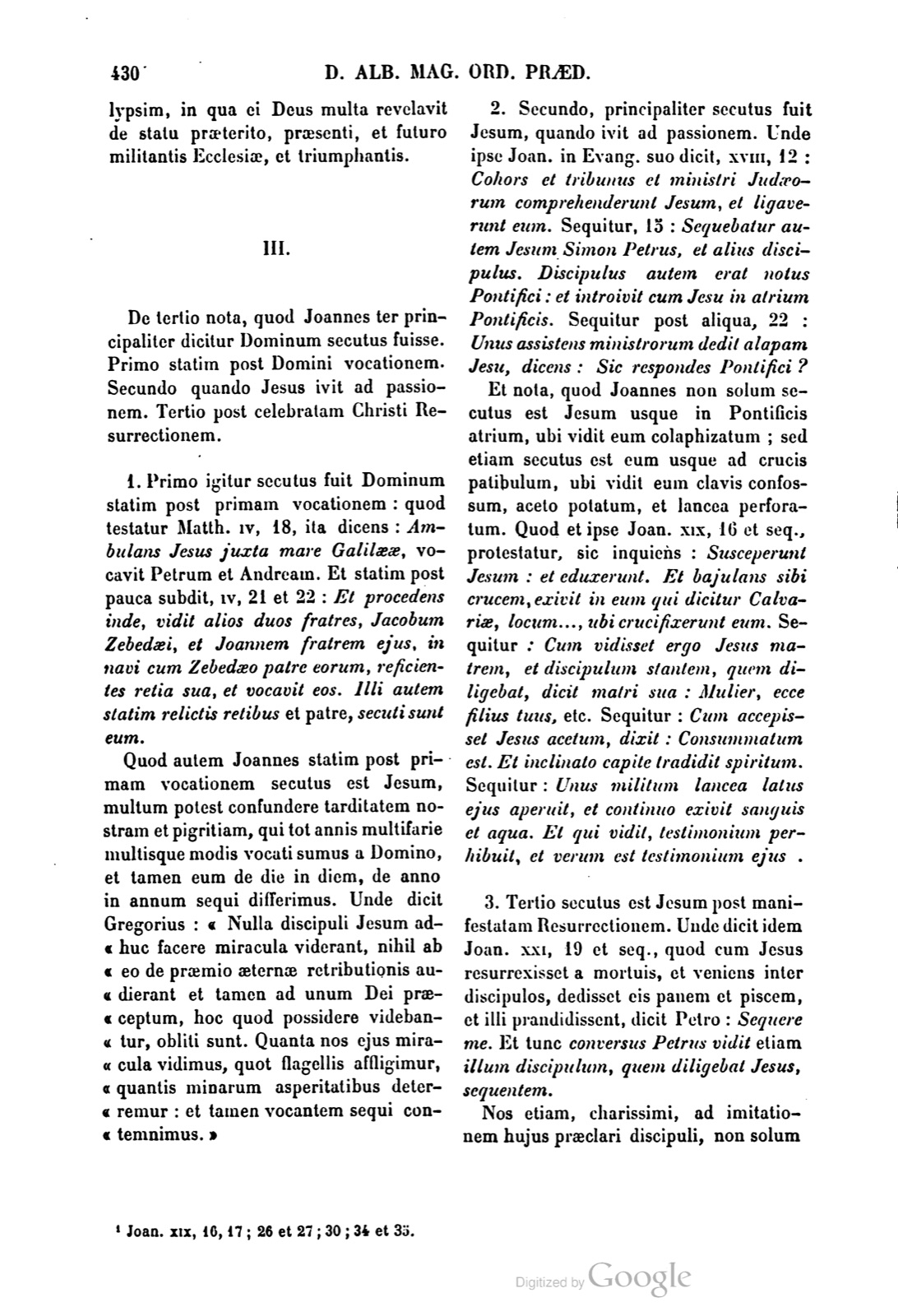
3. Tertium est, quod ei secreta sua occultissima revelavit. Unde ipse Joannes in principio Evangelii sui quasi quædam aquila de superna cœlesti hierarchia advolans, innotescere fecit nobis divinitatem Verbi incarnati, ita scribens: In principio erat Verbum, et Verbum erat apud Deum, etc. 4. Scribit etiam Apocalypsim, in qua ei Deus multa revelavit de statu præterito, præsenti, et futuro militantis Ecclesiæ, et triumphantis.
III.
De tertio nota, quod Joannes ter principaliter dicitur Dominum secutus fuisse. Primo statim post Domini vocationem. Secundo quando Jesus ivit ad passionem. Tertio post celebratam Christi Resurrectionem.
2. But because there are some who, although they abstain from evils, nevertheless do not sweat much over good works, on account of this it is necessary to know that we should do good works. Hence James 3:13 says: Who is wise and disciplined among you? Let him show from good conversation his work in the meekness of wisdom. Hence also the Lord himself says in the Gospel of John 15:8: In this my Father is glorified, that you bring forth very much fruit and become my disciples. As if he were saying: If you bring forth very much of good works, through this it is clear that you are my disciples.
3. Because there are many who bear this gravely, that while they aim at good works, they are either scourged by the Lord or corrected by men, on account of this it is necessary that we bear neither the correction of the Lord nor that of men with annoyance. Hence it is that Sirach 10:28 says: A prudent and disciplined man will not murmur when corrected. For the Lord scourges in the present age, lest he condemn in the future. Hence the Apostle says, 1 Corinthians 11:32: But when we are judged, we are corrected by the Lord, so that we may not be condemned with this world. Concerning the three things said above it is said in Psalm 33:15: Turn away from evil, behold the first; and do good, behold the second; seek peace, that is, seek inwardly through patience: behold the third 3.
II.
On the second, note that Jesus shows through three things that he loved John more familiarly.
1. The first is because he did not deny him his bosom and breast for reclining. Hence it is said in John 13:21 and following: When Jesus had said to his disciples: Amen, amen I say to you, that one of you will betray me, the disciples were looking at one another, hesitating of whom he was speaking. Therefore one of his disciples, whom Jesus loved, was reclining in the bosom of Jesus. Therefore Simon Peter nodded to this one and said to him: Who is it, concerning whom he speaks? And so, when that one had reclined upon the breast of Jesus, he says to him: Lord, who is it? Jesus answered: It is he to whom I shall offer the dipped bread.
2. The second, because he specially commended to him his undefiled mother. Hence John 19:26 and 27 says: When Jesus had seen his mother, and the disciple standing, whom he loved, he says to his mother: Woman, behold your son. Then he says to the disciple: Behold your mother. And from that hour the disciple took her into his own, the Gloss says, "mother," that is, he was so obedient to her as if she were his mother.
3. The third is that he revealed to him his most hidden secrets. Hence John himself, in the beginning of his Gospel, flying as it were like a certain eagle from the supernal heavenly hierarchy, made known to us the divinity of the incarnate Word, writing thus: In the beginning was the Word, and the Word was with God, etc. 4. He also writes the Apocalypse, in which God revealed many things to him concerning the past, present, and future state of the Church militant and triumphant.
III.
On the third, note that John is said to have followed the Lord principally three times: first immediately after the Lord's calling; secondly when Jesus went to the Passion; thirdly after the celebrated Resurrection of Christ.
1. Primo igitur secutus fuit Dominum statim post primam vocationem: quod testatur Matth. IV, 18, ita dicens: Ambulans Jesus juxta mare Galilææ, vocavit Petrum et Andream. Et statim post pauca subdit, IV, 21 et 22: Et procedens inde, vidit alios duos fratres, Jacobum Zebedæi, et Joannem fratrem ejus, in navi cum Zebedæo patre eorum, reficientes retia sua, et vocavit eos. Illi autem statim relictis retibus et patre, secuti sunt eum.
Quod autem Joannes statim post primam vocationem secutus est Jesum, multum potest confundere tarditatem nostram et pigritiam, qui tot annis multifarie multisque modis vocati sumus a Domino, et tamen eum de die in diem, de anno in annum sequi differimus. Unde dicit Gregorius: "Nulla discipuli Jesum adhuc facere miracula viderant, nihil ab eo de præmio æternæ retributionis audierant et tamen ad unum Dei præceptum, hoc quod possidere videbantur, obliti sunt. Quanta nos ejus miracula vidimus, quot flagellis affligimur, quantis minarum asperitatibus deterremur: et tamen vocantem sequi contemnimus."
2. Secundo, principaliter secutus fuit Jesum, quando ivit ad passionem. Unde ipse Joan. in Evang. suo dicit, XVIII, 12: Cohors et tribunus et ministri Judæorum comprehenderunt Jesum, et ligaverunt eum. Sequitur, 15: Sequebatur autem Jesum Simon Petrus, et alius discipulus. Discipulus autem erat notus Pontifici: et introivit cum Jesu in atrium Pontificis. Sequitur post aliqua, 22: Unus assistens ministrorum dedit alapam Jesu, dicens: Sic respondes Pontifici?
Et nota, quod Joannes non solum secutus est Jesum usque in Pontificis atrium, ubi vidit eum colaphizatum; sed etiam secutus est eum usque ad crucis patibulum, ubi vidit eum clavis confossum, aceto potatum, et lancea perforatum. Quod et ipse Joan. XIX, 16 et seq., protestatur, sic inquiens: Susceperunt Jesum: et eduxerunt. Et bajulans sibi crucem, exivit in eum qui dicitur Calvariæ, locum..., ubi crucifixerunt eum. Sequitur: Cum vidisset ergo Jesus matrem, et discipulum stantem, quem diligebat, dicit matri sua: Mulier, ecce filius tuus, etc. Sequitur: Cum accepisset Jesus acetum, dixit: Consummatum est. Et inclinato capite tradidit spiritum. Sequitur: Unus militum lancea latus ejus aperuit, et continuo exivit sanguis et aqua. Et qui vidit, testimonium perhibuit, et verum est testimonium ejus 5.
3. Tertio secutus est Jesum post manifestatam Resurrectionem. Unde dicit idem Joan. XXI, 19 et seq., quod cum Jesus resurrexisset a mortuis, et veniens inter discipulos, dedisset eis panem et piscem, et illi prandidissent, dicit Petro: Sequere me. Et tunc conversus Petrus vidit etiam illum discipulum, quem diligebat Jesus, sequentem.
Nos etiam, charissimi, ad imitationem hujus præclari discipuli, non solum
1. Therefore first he followed the Lord immediately after the first calling, which Matthew 4:18 testifies, speaking thus: Jesus, walking beside the sea of Galilee, called Peter and Andrew. And immediately after a few words he adds, 4:21 and 22: And proceeding thence, he saw two other brothers, James of Zebedee and John his brother, in the boat with Zebedee their father, repairing their nets, and he called them. But they, immediately leaving the nets and their father, followed him.
But the fact that John followed Jesus immediately after the first calling can greatly confound our slowness and laziness, we who for so many years, in many ways and by many modes, have been called by the Lord, and yet from day to day, from year to year, delay to follow him. Hence Gregory says: "The disciples had not yet seen Jesus do miracles; they had heard nothing from him concerning the reward of eternal recompense, and nevertheless at one command of God they forgot this which they seemed to possess. How many miracles of his we have seen, by how many scourges we are afflicted, by how many rough threats we are frightened; and nevertheless we despise following him when he calls."
2. Secondly, principally he followed Jesus when he went to the Passion. Hence John himself says in his Gospel, 18:12: The cohort and the tribune and the ministers of the Jews seized Jesus and bound him. It follows, 15: But Simon Peter was following Jesus, and another disciple. But the disciple was known to the High Priest, and he entered with Jesus into the court of the High Priest. It follows after some things, 22: One of the attending ministers gave Jesus a slap, saying: Do you answer the High Priest in this way?
And note that John not only followed Jesus into the court of the High Priest, where he saw him struck with fists, but also followed him even to the gibbet of the cross, where he saw him pierced with nails, given vinegar to drink, and pierced by a lance. John himself also declares this, 19:16 and following, speaking thus: They received Jesus and led him out. And carrying the cross for himself, he went out to that which is called the place of Calvary..., where they crucified him. It follows: Therefore when Jesus had seen his mother and the disciple standing, whom he loved, he says to his mother: Woman, behold your son, etc. It follows: When Jesus had received the vinegar, he said: It is consummated. And with his head inclined he handed over the spirit. It follows: One of the soldiers opened his side with a lance, and immediately blood and water came out. And he who saw has borne testimony, and his testimony is true 5.
3. Thirdly he followed Jesus after the manifested Resurrection. Hence the same John says, 21:19 and following, that when Jesus had risen from the dead, and, coming among the disciples, had given them bread and fish, and they had breakfasted, he says to Peter: Follow me. And then Peter, having turned, also saw that disciple, whom Jesus loved, following.
We also, dearest ones, in imitation of this renowned disciple, not only
Notes
- John 15:17. (Joan. XV, 17.) ↩
- 1 John 4:11. (I Joan. IV, 11.) ↩
- Compare also Psalm 36:27: Turn aside from evil, and do good, and dwell unto age of age. (Cf. etiam Psalm. XXXVI, 27: Declina a malo, et fac bonum, et inhabita in sæculum sæculi.) ↩
- John 1:1 and following. (Joan. I, 1 et seq.) ↩
- John 19:16, 17; 26 and 27; 30; 34 and 35. (Joan. XIX, 16, 17; 26 et 27; 30; 34 et 35.) ↩
If a page does not appear, its photograph has not been uploaded yet.