Volume 13 · pp. 420–425
Sermon IV. On Blessed Stephen
A marker with ≈ is an approximate page boundary, placed by measure of the text; the page photographs remain the authority. In the paired views, clicking a page marker brings that page into view.
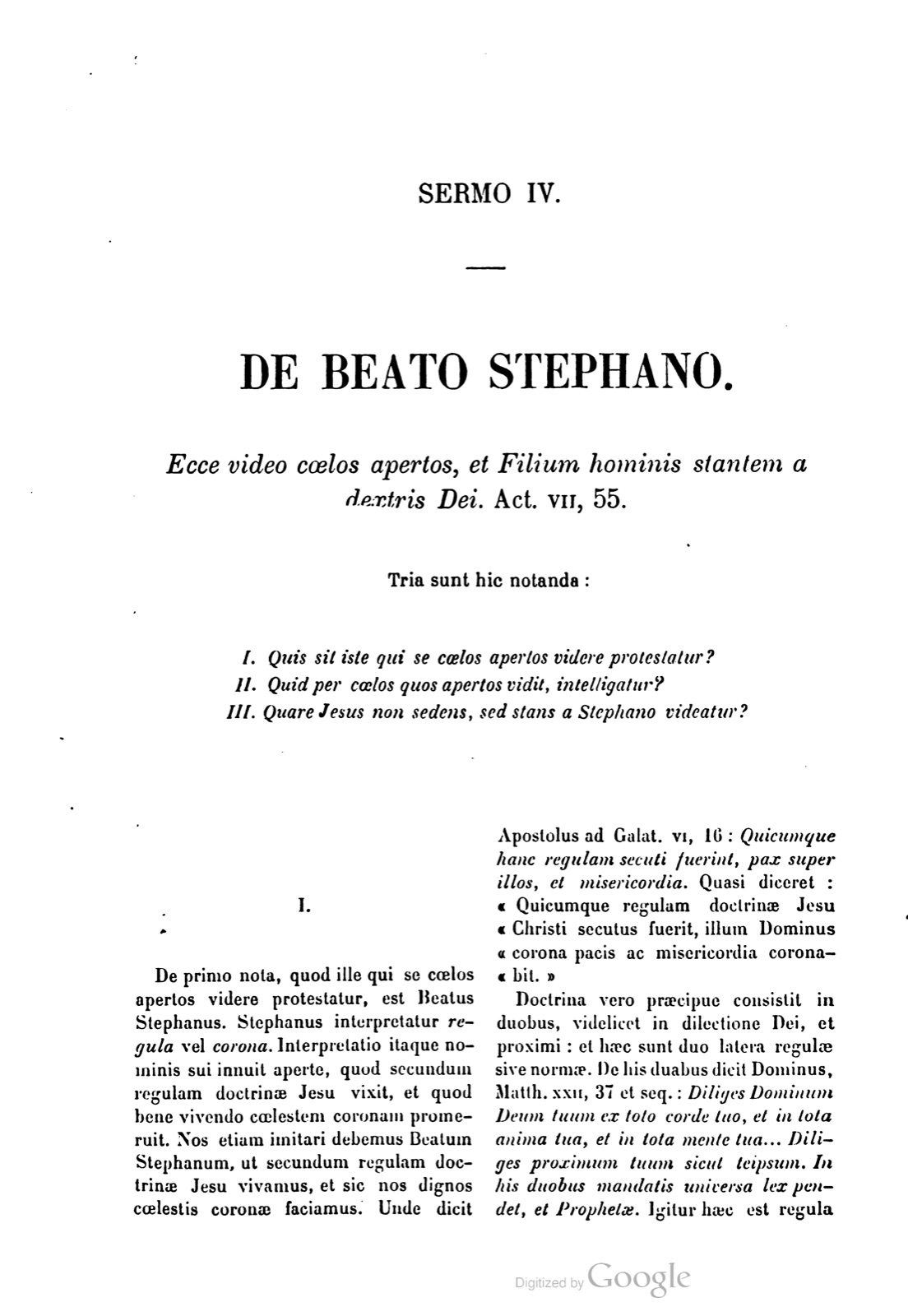
SERMO IV.
DE BEATO STEPHANO.
Ecce video cælos apertos, et Filium hominis stantem a dextris Dei. Act. VII, 55.
Tria sunt hic notanda:
I. Quis sit iste qui se cælos apertos videre protestatur? II. Quid per cælos quos apertos vidit, intelligatur? III. Quare Jesus non sedens, sed stans a Stephano videatur?
I.
De primo nota, quod ille qui se cælos apertos videre protestatur, est Beatus Stephanus. Stephanus interpretatur regula vel corona. Interpretatio itaque nominis sui innuit aperte, quod secundum regulam doctrinæ Jesu vixit, et quod bene vivendo cœlestem coronam promeruit. Nos etiam imitari debemus Beatum Stephanum, ut secundum regulam doctrinæ Jesu vivamus, et sic nos dignos cœlestis coronæ faciamus. Unde dicit Apostolus ad Galat. VI, 16: Quicumque hanc regulam secuti fuerint, pax super illos, et misericordia. Quasi diceret: "Quicumque regulam doctrinæ Jesu Christi secutus fuerit, illum Dominus corona pacis ac misericordiæ coronabit."
Doctrina vero præcipue consistit in duobus, videlicet in dilectione Dei, et proximi: et hæc sunt duo latera regulæ sive normæ. De his duabus dicit Dominus, Matth. XXII, 37 et seq.: Diliges Dominum Deum tuum ex toto corde tuo, et in tota anima tua, et in tota mente tua... Diliges proximum tuum sicut teipsum. In his duobus mandatis universa lex pendet, et Prophetæ. Igitur hæc est regula sive norma, quæ dirigit nos ad coronam perpetuæ gloriæ, ut videlicet Deum et proximum omni studio diligamus. Qui enim Deum vere diligit, præceptis suis universis devote intendit. Qui etiam proximum sincere diligit, nec verbis eum, nec factis offendit.
II.
De secundo nota, quod per cælos quos Stephanus apertos vidit, intelliguntur novem ordines electorum. Primus ordo est parvulorum recenter post baptismum morientium. Secundus ordo est viduarum et conjugatorum pænitentium. Tertius virginum sanctarum. Quartus est sanctorum Confessorum, Pontificum, et Doctorum. Quintus est sanctorum Martyrum. Sextus est sanctorum Prophetarum. Septimus est sanctorum Apostolorum. Nonus est Angelorum. Super hos vero novem ordines thronus Beatæ Virginis collocatus est ad dexteram humanitatis Jesu Christi, quæ scilicet humanitas in ipsius sanctæ Trinitatis cælo dulciter requiescit.
Prædicti vero novem ordines electorum, per novem cælos de quibus loquuntur Philosophi, figurantur.
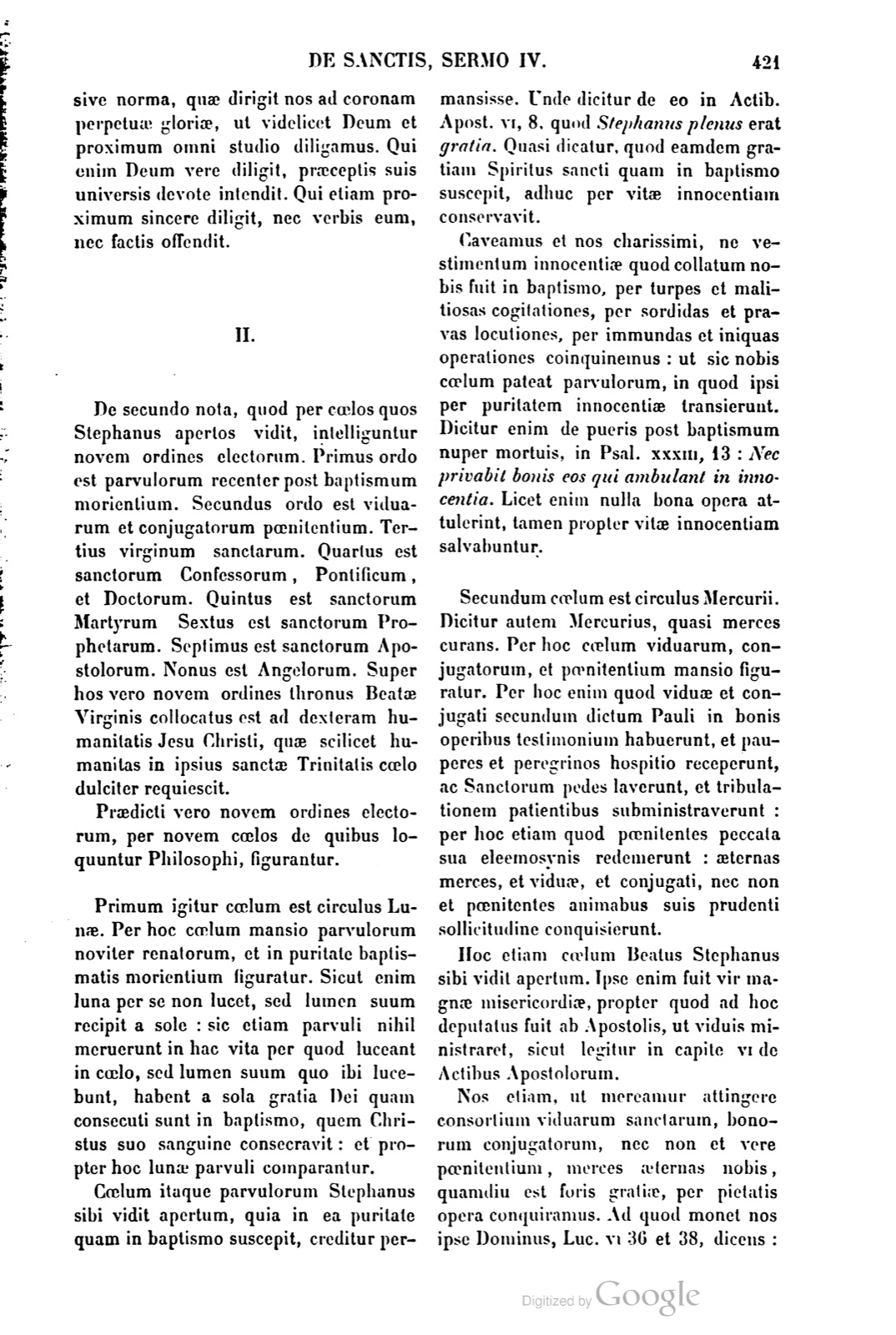
Primum igitur cælum est circulus Lunæ. Per hoc cælum mansio parvulorum noviter renatorum, et in puritate baptismatis morientium figuratur. Sicut enim luna per se non lucet, sed lumen suum recipit a sole: sic etiam parvuli nihil meruerunt in hac vita per quod luceant in cælo, sed lumen suum quo ibi lucebunt, habent a sola gratia Dei quam consecuti sunt in baptismo, quem Christus suo sanguine consecravit: et propter hoc lunæ parvuli comparantur.
Cœlum itaque parvulorum Stephanus sibi vidit apertum, quia in ea puritate quam in baptismo suscepit, creditur permansisse. Unde dicitur de eo in Actib. Apost. VI, 8, quod Stephanus plenus erat gratia. Quasi dicatur, quod eamdem gratiam Spiritus sancti quam in baptismo suscepit, adhuc per vitæ innocentiam conservavit.
SERMON IV.
ON BLESSED STEPHEN.
Behold, I see the heavens opened, and the Son of Man standing at the right hand of God. Acts 7:55.
Three things are to be noted here:
I. Who is that man who declares that he sees the heavens opened? II. What is understood by the heavens which he saw opened? III. Why is Jesus seen by Stephen not sitting, but standing?
I.
On the first, note that the one who declares that he sees the heavens opened is Blessed Stephen. Stephen is interpreted rule or crown. Therefore the interpretation of his name openly suggests that he lived according to the rule of the doctrine of Jesus, and that by living well he merited the heavenly crown. We also ought to imitate Blessed Stephen, so that we may live according to the rule of the doctrine of Jesus, and thus make ourselves worthy of the heavenly crown. Hence the Apostle says to Galatians 6:16: Whoever have followed this rule, peace upon them, and mercy. As if he were saying: "Whoever has followed the rule of the doctrine of Jesus Christ, him the Lord will crown with the crown of peace and mercy."
But doctrine consists chiefly in two things, namely in love of God and of neighbor; and these are the two sides of the rule or norm. Concerning these two the Lord says, Matthew 22:37 and following: You shall love the Lord your God from your whole heart, and in your whole soul, and in your whole mind... You shall love your neighbor as yourself. On these two commandments the whole law depends, and the Prophets. Therefore this is the rule or norm which directs us to the crown of perpetual glory, namely that we should love God and neighbor with every zeal. For he who truly loves God devoutly applies himself to all his commandments. He also who sincerely loves his neighbor offends him neither by words nor by deeds.
II.
On the second, note that by the heavens which Stephen saw opened are understood the nine orders of the elect. The first order is of little children dying recently after baptism. The second order is of widows and married penitents. The third is of holy virgins. The fourth is of holy Confessors, Pontiffs, and Doctors. The fifth is of holy Martyrs. The sixth is of holy Prophets. The seventh is of holy Apostles. The ninth is of Angels. But above these nine orders the throne of the Blessed Virgin has been placed at the right hand of the humanity of Jesus Christ, which humanity, namely, sweetly rests in the heaven of the holy Trinity itself.
But the aforesaid nine orders of the elect are figured by the nine heavens concerning which the Philosophers speak.
Therefore the first heaven is the circle of the Moon. By this heaven is figured the dwelling of little children newly reborn and dying in the purity of baptism. For as the moon does not shine through itself, but receives its light from the sun, so also little children have merited nothing in this life by which they may shine in heaven, but the light by which they will shine there they have from the grace of God alone, which they obtained in baptism, which Christ consecrated by his blood; and on account of this little children are compared to the moon.
Therefore Stephen saw the heaven of little children opened to himself, because he is believed to have remained in that purity which he received in baptism. Hence it is said concerning him in Acts of the Apostles 6:8 that Stephen was full of grace. As if it were said that the same grace of the Holy Spirit which he received in baptism, he still preserved through innocence of life.
Caveamus et nos charissimi, ne vestimentum innocentiæ quod collatum nobis fuit in baptismo, per turpes et malitiosas cogitationes, per sordidas et pravas locutiones, per immundas et iniquas operationes coinquinemus: ut sic nobis cœlum pateat parvulorum, in quod ipsi per puritatem innocentiæ transierunt. Dicitur enim de pueris post baptismum nuper mortuis, in Psal. XXXII, 13: Nec privabit bonis eos qui ambulant in innocentia. Licet enim nulla bona opera attulerint, tamen propter vitæ innocentiam salvabuntur.
Secundum cælum est circulus Mercurii. Dicitur autem Mercurius, quasi merces curans. Per hoc cælum viduarum, conjugatorum, et pænitentium mansio figuratur. Per hoc enim quod viduæ et conjugati secundum dictum Pauli in bonis operibus testimonium habuerunt, et pauperes et peregrinos hospitio receperunt, ac Sanctorum pedes laverunt, et tribulationem patientibus subministraverunt: per hoc etiam quod pænitentes peccata sua eleemosynis redemerunt: æternas merces, et viduæ, et conjugati, nec non et pænitentes animabus suis prudenti sollicitudine conquisierunt.
Hoc etiam cælum Beatus Stephanus sibi vidit apertum. Ipse enim fuit vir magnæ misericordiæ, propter quod ad hoc deputatus fuit ab Apostolis, ut viduis ministraret, sicut legitur in capite VI de Actibus Apostolorum.
Nos etiam, ut mereamur attingere consortium viduarum sanctarum, bonorum conjugatorum, nec non et vere pænitentium, merces æternas nobis, quamdiu est foris gratiæ, per pietatis opera conquiramus. Ad quod monet nos ipse Dominus, Luc. VI, 36 et 38, dicens: Estote misericordes sicut et Pater vester misericors est... Date, et dabitur vobis. Et quid dabitur nobis, Domine? Sequitur: Mensuram bonam, et confertam, et coagitatam, et supereffluentem dabunt Angeli in sinum vestrum. Sed, heu! multi sunt qui merces eleemosynarum suarum mittunt in saccum pertusum, sicut dicit Aggæus, I, 6: Qui mercedes congregavit, misit eas in sacculum pertusum. Illi eleemosynas suas mittunt in saccum pertusum, qui licet dent eleemosynas, prædari tamen, et furari, usuras accipere, et alios dolos agere non desistunt. Illi etiam eleemosynas mittunt in saccum pertusum, qui eas propter appetitum vanæ gloriæ largiuntur. Rapinæ quippe, furtum, et usura, et fraudum malitia, nec non et vana gloria eleemosynam ante Deum ascendere non permittunt.
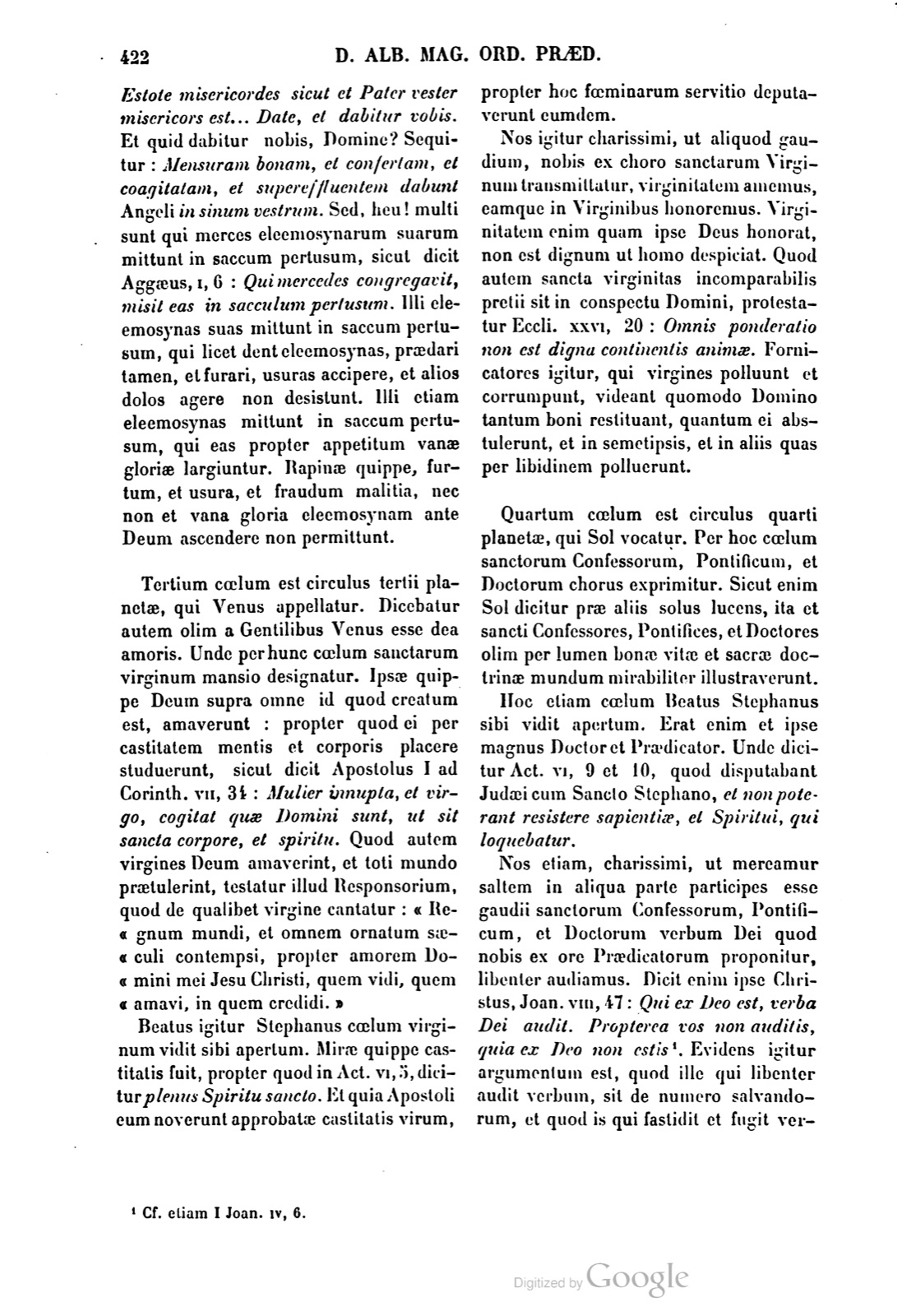
Tertium cælum est circulus tertii planetæ, qui Venus appellatur. Dicebatur autem olim a Gentilibus Venus esse dea amoris. Unde per hunc cælum sanctarum virginum mansio designatur. Ipsæ quippe Deum supra omne id quod creatum est, amaverunt: propter quod ei per castitatem mentis et corporis placere studuerunt, sicut dicit Apostolus I ad Corinth. VII, 34: Mulier innupta, et virgo, cogitat quæ Domini sunt, ut sit sancta corpore, et spiritu. Quod autem virgines Deum amaverint, et toti mundo prætulerint, testatur illud Responsorium, quod de qualibet virgine cantatur: "Regnum mundi, et omnem ornatum sæculi contempsi, propter amorem Domini mei Jesu Christi, quem vidi, quem amavi, in quem credidi."
Let us also beware, dearest ones, lest we defile the garment of innocence which was conferred on us in baptism by base and malicious thoughts, by filthy and depraved speeches, by unclean and unjust works, so that thus the heaven of little children may lie open to us, into which they themselves passed through purity of innocence. For it is said concerning children lately dead after baptism, in Psalm 32:13: Nor will he deprive of good things those who walk in innocence. For although they brought no good works, nevertheless they will be saved on account of innocence of life.
The second heaven is the circle of Mercury. Mercury is so called as if caring for reward. By this heaven is figured the dwelling of widows, married persons, and penitents. For by this, that widows and married persons, according to the saying of Paul, had testimony in good works, and received the poor and pilgrims in hospitality, and washed the feet of the Saints, and supplied those suffering tribulation; and also by this, that penitents redeemed their sins by alms; both widows and married persons, and also penitents, acquired eternal rewards for their souls with prudent solicitude.
Blessed Stephen also saw this heaven opened to himself. For he was a man of great mercy, on account of which he was appointed by the Apostles to this, that he should minister to widows, as is read in chapter 6 of the Acts of the Apostles.
We also, that we may merit to reach the fellowship of holy widows, good married persons, and also truly penitent persons, let us acquire eternal rewards for ourselves, as long as it is outside grace, through works of piety. To this the Lord himself admonishes us, Luke 6:36 and 38, saying: Be merciful as your Father also is merciful... Give, and it will be given to you. And what will be given to us, Lord? It follows: A good measure, and pressed down, and shaken together, and overflowing, the Angels will give into your bosom. But, alas, many there are who send the rewards of their alms into a pierced sack, as Haggai 1:6 says: He who gathered wages put them into a pierced little sack. Those send their alms into a pierced sack who, although they give alms, nevertheless do not cease to plunder, and steal, receive usuries, and commit other frauds. Those also send alms into a pierced sack who bestow them on account of the appetite for vainglory. For robberies, theft, usury, and the malice of frauds, and also vainglory, do not permit alms to ascend before God.
The third heaven is the circle of the third planet, which is called Venus. But once by the Gentiles Venus was said to be the goddess of love. Hence by this heaven is designated the dwelling of holy virgins. For they loved God above everything that has been created; on account of which they strove to please him through chastity of mind and body, as the Apostle says in 1 Corinthians 7:34: The unmarried woman and the virgin thinks about the things that are of the Lord, so that she may be holy in body and spirit. But that virgins loved God and preferred him to the whole world is attested by that Responsory which is sung concerning any virgin: "The kingdom of the world and every adornment of the age I have despised, on account of the love of my Lord Jesus Christ, whom I have seen, whom I have loved, in whom I have believed."
Beatus igitur Stephanus cælum virginum vidit sibi apertum. Miræ quippe castitatis fuit, propter quod in Act. VI, 5, dicitur plenus Spiritu sancto. Et quia Apostoli eum noverunt approbatæ castitatis virum, propter hoc fœminarum servitio deputaverunt eumdem.
Nos igitur charissimi, ut aliquod gaudium, nobis ex choro sanctarum Virginum transmittatur, virginitatem amemus, eamque in Virginibus honoremus. Virginitatem enim quam ipse Deus honorat, non est dignum ut homo despiciat. Quod autem sancta virginitas incomparabilis pretii sit in conspectu Domini, protestatur Eccli. XXVI, 20: Omnis ponderatio non est digna continentis animæ. Fornicatores igitur, qui virgines polluunt et corrumpunt, videant quomodo Domino tantum boni restituant, quantum ei abstulerunt, et in semetipsis, et in aliis quas per libidinem polluerunt.
Quartum cælum est circulus quarti planetæ, qui Sol vocatur. Per hoc cælum sanctorum Confessorum, Pontificum, et Doctorum chorus exprimitur. Sicut enim Sol dicitur præ aliis solus lucens, ita et sancti Confessores, Pontifices, et Doctores olim per lumen bonæ vitæ et sacræ doctrinæ mundum mirabiliter illustraverunt.
Hoc etiam cælum Beatus Stephanus sibi vidit apertum. Erat enim et ipse magnus Doctor et Prædicator. Unde dicitur Act. VI, 9 et 10, quod disputabant Judæi cum Sancto Stephano, et non poterant resistere sapientiæ, et Spiritui, qui loquebatur.
Nos etiam, charissimi, ut mereamur saltem in aliqua parte participes esse gaudii sanctorum Confessorum, Pontificum, et Doctorum verbum Dei quod nobis ex ore Prædicatorum proponitur, libenter audiamus. Dicit enim ipse Christus, Joan. VIII, 47: Qui ex Deo est, verba Dei audit. Propterea vos non auditis, quia ex Deo non estis 1. Evidens igitur argumentum est, quod ille qui libenter audit verbum, sit de numero salvandorum, et quod is qui fastidit et fugit verbum Christi, sit inter reprobos deputandus.
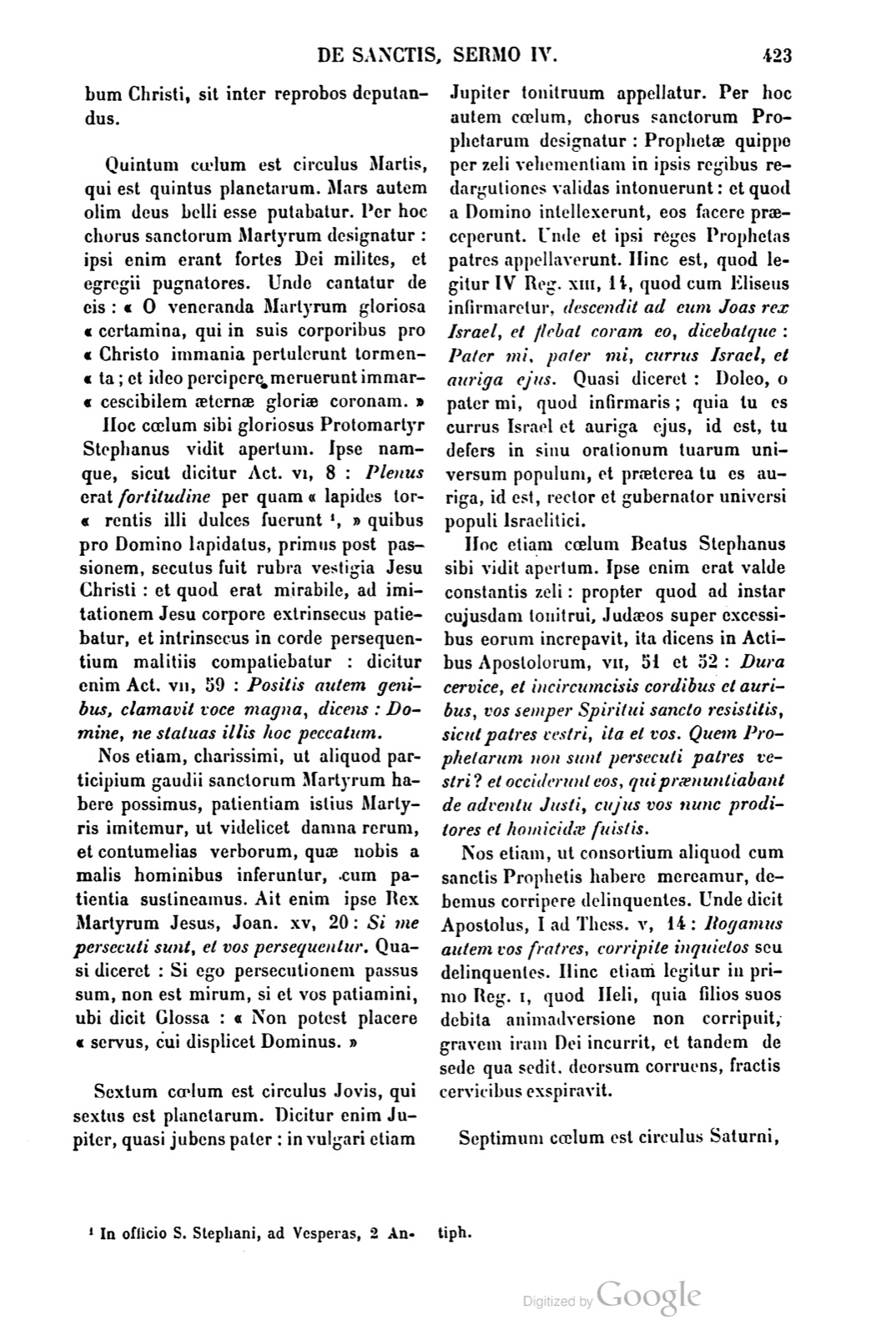
Quintum cælum est circulus Martis, qui est quintus planetarum. Mars autem olim deus belli esse putabatur. Per hoc chorus sanctorum Martyrum designatur: ipsi enim erant fortes Dei milites, et egregii pugnatores. Unde cantatur de eis: "O veneranda Martyrum gloriosa certamina, qui in suis corporibus pro Christo immania pertulerunt tormenta; et ideo percipere meruerunt immarcescibilem æternæ gloriæ coronam."
Hoc cælum sibi gloriosus Protomartyr Stephanus vidit apertum. Ipse namque, sicut dicitur Act. VI, 8: Plenus erat fortitudine per quam "lapides torrentis illi dulces fuerunt 2," quibus pro Domino lapidatus, primus post passionem, secutus fuit rubra vestigia Jesu Christi: et quod erat mirabile, ad imitationem Jesu corpore extrinsecus patiebatur, et intrinsecus in corde persequentium malitiis compatiebatur: dicitur enim Act. VII, 59: Positis autem genibus, clamavit voce magna, dicens: Domine, ne statuas illis hoc peccatum.
Therefore Blessed Stephen saw the heaven of virgins opened to himself. For he was of marvelous chastity, on account of which in Acts 6:5 he is said to be full of the Holy Spirit. And because the Apostles knew him as a man of approved chastity, on account of this they appointed him to the service of women.
Therefore we, dearest ones, so that some joy may be sent to us from the choir of holy Virgins, should love virginity and honor it in Virgins. For the virginity which God himself honors is not worthy to be despised by man. But that holy virginity is of incomparable price in the sight of the Lord is declared by Sirach 26:20: Every weighing is not worthy of a continent soul. Therefore fornicators, who pollute and corrupt virgins, should see how they may restore to the Lord as much good as they have taken away from him, both in themselves and in others whom they polluted through lust.
The fourth heaven is the circle of the fourth planet, which is called the Sun. By this heaven is expressed the choir of holy Confessors, Pontiffs, and Doctors. For as the Sun is said to shine alone before the others, so also the holy Confessors, Pontiffs, and Doctors once marvelously illuminated the world by the light of good life and sacred doctrine.
Blessed Stephen also saw this heaven opened to himself. For he himself was also a great Doctor and Preacher. Hence it is said in Acts 6:9 and 10 that the Jews disputed with Saint Stephen and were not able to resist the wisdom and the Spirit who was speaking.
We also, dearest ones, so that we may merit at least in some part to be sharers of the joy of the holy Confessors, Pontiffs, and Doctors, should willingly hear the word of God which is set before us from the mouth of Preachers. For Christ himself says, John 8:47: He who is from God hears the words of God. Therefore you do not hear, because you are not from God 1. Therefore it is an evident argument that he who willingly hears the word is of the number of those to be saved, and that he who loathes and flees the word of Christ is to be counted among the reprobate.
The fifth heaven is the circle of Mars, which is the fifth of the planets. But Mars was once thought to be the god of war. By this is designated the choir of holy Martyrs; for they were strong soldiers of God and outstanding fighters. Hence it is sung concerning them: "O venerable glorious contests of the Martyrs, who in their bodies endured monstrous torments for Christ, and therefore merited to receive the unfading crown of eternal glory."
The glorious Protomartyr Stephen saw this heaven opened to himself. For he himself, as is said in Acts 6:8, was full of fortitude, through which "the stones of the torrent were sweet to him 2"; by these, having been stoned for the Lord, he was the first after the Passion to follow the red footprints of Jesus Christ; and what was marvelous, in imitation of Jesus he suffered outwardly in body, and inwardly in heart he had compassion on the malices of those persecuting him; for it is said in Acts 7:59: But having placed his knees, he cried out with a loud voice, saying: Lord, do not set down this sin for them.
Nos etiam, charissimi, ut aliquod participium gaudii sanctorum Martyrum habere possimus, patientiam istius Martyris imitemur, ut videlicet damna rerum, et contumelias verborum, quæ nobis a malis hominibus inferuntur, cum patientia sustineamus. Ait enim ipse Rex Martyrum Jesus, Joan. XV, 20: Si me persecuti sunt, et vos persequentur. Quasi diceret: Si ego persecutionem passus sum, non est mirum, si et vos patiamini, ubi dicit Glossa: "Non potest placere servus, cui displicet Dominus."
Sextum cælum est circulus Jovis, qui sextus est planetarum. Dicitur enim Jupiter, quasi jubens pater: in vulgari etiam Jupiter tonitruum appellatur. Per hoc autem cœlum, chorus sanctorum Prophetarum designatur: Prophetæ quippe per zeli vehementiam in ipsis regibus redargutiones validas intonuerunt: et quod a Domino intellexerunt, eos facere præceperunt. Unde et ipsi reges Prophetas patres appellaverunt. Hinc est, quod legitur IV Reg. XIII, 14, quod cum Eliseus infirmaretur, descendit ad eum Joas rex Israel, et flebat coram eo, dicebatque: Pater mi, pater mi, currus Israel, et auriga ejus. Quasi diceret: Doleo, o pater mi, quod infirmaris; quia tu es currus Israel et auriga ejus, id est, tu defers in sinu orationum tuarum universum populum, et præterea tu es auriga, id est, rector et gubernator universi populi Israelitici.
Hoc etiam cælum Beatus Stephanus sibi vidit apertum. Ipse enim erat valde constantis zeli: propter quod ad instar cujusdam tonitrui, Judæos super excessibus eorum increpavit, ita dicens in Actibus Apostolorum, VII, 51 et 52: Dura cervice, et incircumcisis cordibus et auribus, vos semper Spiritui sancto resistitis, sicut patres vestri, ita et vos. Quem Prophetarum non sunt persecuti patres vestri? et occiderunt eos, qui prænuntiabant de adventu Justi, cujus vos nunc proditores et homicidæ fuistis.
Nos etiam, ut consortium aliquod cum sanctis Prophetis habere mereamur, debemus corripere delinquentes. Unde dicit Apostolus, I ad Thess. V, 14: Rogamus autem vos fratres, corripite inquietos seu delinquentes. Hinc etiam legitur in primo Reg. I, quod Heli, quia filios suos debita animadversione non corripuit, gravem iram Dei incurrit, et tandem de sede qua sedit, deorsum corruens, fractis cervicibus exspiravit.
Septimum cælum est circulus Saturni, qui est supremus planetarum. Dicitur autem Saturnus quasi satorum Deus. Per istud cælum designatur chorus venerabilium Patriarcharum, qui erant boni satores; semen enim fidei et religionis seminaverunt in corda suorum. Dicit etenim Eccli. XLIV, 1 et 4: Laudemus viros gloriosos, et parentes nostros in generatione sua... Qui virtute prudentiæ suæ nuntiaverunt populis sanctissima verba. Abraham enim, fidem et legem, quam accepit a Domino, seminavit in cor filii sui Isaac: Isaac autem religionem acceptam a patre, filio suo Jacob recommendavit: ille quoque cultum unius Dei transmisit in duodecim filios suos: et sic per successiones, quilibet Patriarcharum fidem rectam, et vitam bonam transmisit ad posteros suos.
We also, dearest ones, so that we may be able to have some participation in the joy of the holy Martyrs, should imitate the patience of this Martyr, namely so that we may sustain with patience the losses of things and the insults of words which are brought upon us by evil men. For Jesus himself, the King of Martyrs, says, John 15:20: If they have persecuted me, they will also persecute you. As if he were saying: If I suffered persecution, it is not marvelous if you also suffer; where the Gloss says: "The servant cannot be pleasing to one to whom the Lord is displeasing."
The sixth heaven is the circle of Jove, which is the sixth of the planets. For Jupiter is so called as if commanding father; in the common tongue also Jupiter is called thunder. But by this heaven is designated the choir of holy Prophets. For the Prophets, through the vehemence of zeal, thundered strong rebukes against kings themselves, and they commanded them to do what they understood from the Lord. Hence the kings themselves also called the Prophets fathers. Hence it is read in 4 Kings 13:14 that when Elisha was sick, Joash king of Israel went down to him and wept before him, and said: My father, my father, the chariot of Israel and its charioteer. As if he were saying: I grieve, my father, that you are sick, because you are the chariot of Israel and its charioteer, that is, you carry the whole people in the bosom of your prayers; and besides, you are the charioteer, that is, the ruler and governor of the whole Israelite people.
Blessed Stephen also saw this heaven opened to himself. For he was of very constant zeal; on account of which, after the likeness of a certain thunder, he rebuked the Jews concerning their excesses, saying thus in the Acts of the Apostles 7:51 and 52: Stiff-necked and uncircumcised in hearts and ears, you always resist the Holy Spirit; as your fathers did, so also do you. Which of the Prophets did your fathers not persecute? and they killed those who foretold the coming of the Just One, of whom you now have been betrayers and murderers.
We also, so that we may merit to have some fellowship with the holy Prophets, ought to correct those who are delinquent. Hence the Apostle says in 1 Thessalonians 5:14: But we ask you, brothers, correct the restless or delinquent. Hence also it is read in 1 Kings 1 that Eli, because he did not correct his sons with due rebuke, incurred the grave wrath of God, and at last, falling down from the seat on which he sat, breathed out his life with his neck broken.
The seventh heaven is the circle of Saturn, which is the highest of the planets. But Saturn is so called as if god of the sown things. By that heaven is designated the choir of venerable Patriarchs, who were good sowers; for they sowed the seed of faith and religion in the hearts of their own. For Sirach 44:1 and 4 says: Let us praise glorious men and our parents in their generation... Who by the virtue of their prudence announced most holy words to the peoples. For Abraham sowed in the heart of his son Isaac the faith and law which he received from the Lord; but Isaac entrusted to his son Jacob the religion received from his father; he also transmitted the worship of the one God to his twelve sons; and thus through successions each of the Patriarchs transmitted right faith and good life to his descendants.
Cœlum itaque Patriarcharum Beatus Stephanus sibi vidit apertum; nam et ipse veræ fidei verus domesticus et hospes fuit. Unde dicitur Act. VI, 5, quod elegerunt Apostoli Stephanum virum plenum fide.
Nos etiam charissimi, ut aliquam portionem accipiamus beatitudinis sanctorum Patriarcharum, in fide illa quam docet nos sancta mater Ecclesia, fideliter persistamus: ait enim Apostolus ad Hebr. XI, 6: Sine fide impossibile est placere Deo. Quod autem fidem cum bonis operibus hospitari debeamus, testatur Jacob. II, 20 et 21: Vis scire, o homo inanis, quoniam fides sine operibus mortua est? Abraham pater noster, nonne ex operibus justificatus est, offerens Isaac filium super altare? Vides igitur, quoniam fides cooperabatur operibus illius, et ex operibus fides consummata est.
Octavum cælum est signifer circulus sive zodiacus, in quo duodecim emicant signa, quæ designant in qua parte cæli sol sit, vel ad quam partem perveniat. Singuli etiam menses anni per hæc duodecim signa signantur. Sunt autem hæc signa: Cancer, Leo, Virgo, Libra, Scorpio, Sagittarius, Capricornus, Aquarius, Pisces, Aries, Taurus, et Gemini. Per istud cælum chorus sanctorum Apostolorum non incongrue figuratur. Apostoli quippe signis et miraculis quæ fecerunt in terris, solem justitiæ Jesum Christum hominibus in infidelitatis membris existentibus, clarissime monstraverunt. Mittens enim Dominus Apostolos in mundum, dedit eis potestatem, ut facerent signa et miracula: unde dicit Lucas, IX, 1 et 2: Convocatis Jesus duodecim Apostolis, dedit illis virtutem et potestatem super omnia dæmonia, et ut langores cararent. Et misit illos prædicare regnum Dei, et sanare infirmos.
Hoc etiam cælum Beatus Stephanus meritis suis vidit apertum. Nam et ipse faciebat prodigia et signa magna in populo, sicut legitur Act. Apost. VI, 8.
Nos etiam, charissimi, ut saltem in aliquo gaudio sanctorum Apostolorum mereamur esse consortes, signa et miracula faciamus. Sed quomodo faciemus signa et miracula? ut dæmonia ejiciamus, et novas linguas habeamus, et serpentes tollamus, et sine nocumento venenum bibamus, et ut super ægros, ut bene habeant, manus imponamus: sicut dicit Dominus, Marci, XVI, 17 et 18: Signa eos qui crediderint, hæc sequentur: In nomine meo dæmonia ejicient: linguis loquentur novis: serpentes tollent: et si mortiferum quid biberint, non eis nocebit: super ægros manus imponent, et bene habebunt. 1. Ille dæmonia ejicit, qui vere de peccatis suis conteritur, atque pure confitetur, nec non et dignam pro eis satisfactionem exsequitur: per veram quippe pænitentiam dæmonia ejiciuntur ab anima. 2. Ille loquitur novis linguis, qui dolos, et malitias, ac turpitudines exstirpat a lingua sua: eamque deinceps divino exhibet obsequio per devotas orationes et devotas gratiarum actiones, et per bonas ac utiles locutiones. 3. Ille serpentes tollit, qui malorum persecutiones hominum sustinet patienter. Mali quippe homines serpentibus comparantur. 4. Ille etiam sine nocumento venenum bibit, qui ad probra et contumelias malorum hominum non movetur. 5. Ille quoque super ægros manus imponit, et bene habebunt, qui exemplo bonorum operum infirmum et debilem peccatorem roborat, et confortat ad bene vivendum.
Therefore Blessed Stephen saw the heaven of the Patriarchs opened to himself; for he himself also was a true member of the household and guest of true faith. Hence it is said in Acts 6:5 that the Apostles chose Stephen, a man full of faith.
We also, dearest ones, so that we may receive some portion of the blessedness of the holy Patriarchs, should faithfully persist in that faith which holy mother Church teaches us; for the Apostle says to Hebrews 11:6: Without faith it is impossible to please God. But that we ought to lodge faith together with good works, James 2:20 and 21 testifies: Do you wish to know, O empty man, that faith without works is dead? Was not Abraham our father justified from works, offering Isaac his son upon the altar? Therefore you see that faith was cooperating with his works, and from works faith was consummated.
The eighth heaven is the sign-bearing circle or zodiac, in which the twelve signs shine out, which designate in what part of heaven the sun is, or to what part it may come. The individual months of the year are also marked by these twelve signs. But these are the signs: Cancer, Leo, Virgo, Libra, Scorpio, Sagittarius, Capricorn, Aquarius, Pisces, Aries, Taurus, and Gemini. By that heaven the choir of holy Apostles is not unfittingly figured. For the Apostles, by the signs and miracles which they did on earth, most clearly showed Jesus Christ, the sun of justice, to men existing in the members of unbelief. For the Lord, sending the Apostles into the world, gave them power, that they might do signs and miracles; hence Luke 9:1 and 2 says: Jesus, having called together the twelve Apostles, gave them virtue and power over all demons, and that languors should be healed. And he sent them to preach the kingdom of God and to heal the sick.
Blessed Stephen also saw this heaven opened to himself by his merits. For he himself also did prodigies and great signs among the people, as is read in Acts of the Apostles 6:8.
We also, dearest ones, so that we may merit to be companions at least in some joy of the holy Apostles, should do signs and miracles. But how shall we do signs and miracles? We should cast out demons, and have new tongues, and take up serpents, and drink poison without harm, and impose hands upon the sick so that they may be well, as the Lord says, Mark 16:17 and 18: These signs will follow those who have believed: In my name they will cast out demons; they will speak with new tongues; they will take up serpents; and if they drink any deadly thing, it will not harm them; they will impose hands upon the sick, and they will be well. 1. He casts out demons who is truly contrite for his sins, and purely confesses, and also performs fitting satisfaction for them; for through true penance demons are cast out from the soul. 2. He speaks with new tongues who roots out deceits, malices, and turpitudes from his tongue, and thereafter presents it for divine service through devout prayers and devout thanksgivings, and through good and useful speeches. 3. He takes up serpents who patiently sustains the persecutions of evil men. For evil men are compared to serpents. 4. He also drinks poison without harm who is not moved by the reproaches and insults of evil men. 5. He also imposes hands upon the sick, and they will be well, who by the example of good works strengthens and comforts the sick and weak sinner toward living well.
Nonum cælum est circulus siderum, sive stellarum firmamentum. Et per cœlum istud exprimitur chorus omnium Angelorum. Sicut enim stellæ in firmamento sunt fixæ immobiliter: sic etiam sancti Angeli in Deo sunt confirmati, quod deinceps ab eo cadere nequaquam possunt. Præterea sicut stellæ cum firmamento volvuntur: ita etiam sancti Angeli voluntati Dei assentiunt, eamque numquam resistentes exsequuntur.
Hoc etiam cælum Beatus Stephanus animæ suæ vidit apertum. Erat enim et ipse quasi quidam Angelus Dei. Unde dicitur in Actibus, VI, 15: Intuentes eum omnes qui sedebant in concilio, viderunt faciem ejus tamquam faciem Angeli.
Nos etiam, charissimi, ut aliquod participium cum sanctis Angelis mereamur habere, debemus exsequi voluntatem Dei: unde et quotidie petimus in oratione Dominica: Fiat voluntas tua sicut in cælo, et in terra. Quasi dicamus: Sic et nos, o Pater et Domine, fac tuæ voluntati in terra fideliter obedire. Sed quæ est voluntas Dei? Certe ut caste vivamus, et bona opera faciamus. De primo dicit Paulus, I ad Thess. IV, 3: Hæc est voluntas Dei, sanctificatio vestra: ut abstineatis vos a fornicatione. De secundo dicitur I Pet. II, 15: Sic est voluntas Dei, ut bene facientes obmutescere faciatis imprudentium hominum ignorantiam.
Decimum cælum secundum Philosophos est firmamentum majus, quod omnes prædictos circulos sive cælos movere facit. Per hoc cælum ipsa sancta Trinitas ac individua unitas figuratur. Deus enim a nullo movetur, sed ipse potius movet omne id quod creavit. Unde dicit Paulus: In ipso vivimus, et movemur, et sumus 3.
Igitur Beatus Stephanus non solum omnium electorum cælos, sed etiam ipsius sanctæ Trinitatis cœlum animæ suæ vidit apertum: unde dicitur in Act. VII, 55: Dum autem esset Stephanus plenus Spiritu sancto, intendens in cælum, vidit gloriam Dei, et Jesum stantem a dextris Dei. Et ait: Ecce video cælos apertos, et Filium hominis stantem a dextris Dei.
Nos etiam, charissimi, corde, ore, et opere Patri, et Filio, et Spiritui sancto serviamus: ut post labores hujus exsilii ab ipso sanctæ Trinitatis fonte perpetuum solatium hauriamus.
III.
De tertio nota, quod propter hoc Beatus Stephanus Jesum vidit stantem, et non sedentem, ut videlicet martyrio suo, jam ad se venturo, osculum palmamque porrigeret et coronam. Quæ nobis, etc.
The ninth heaven is the circle of the stars, or the firmament of the stars. And by this heaven is expressed the choir of all Angels. For as the stars are fixed immovably in the firmament, so also the holy Angels have been confirmed in God, so that henceforth they cannot in any way fall away from him. Moreover, as the stars are revolved with the firmament, so also the holy Angels assent to the will of God and carry it out, never resisting it.
Blessed Stephen also saw this heaven opened to his soul. For he himself was also as it were a certain Angel of God. Hence it is said in Acts 6:15: All who were sitting in the council, looking upon him, saw his face as the face of an Angel.
We also, dearest ones, so that we may merit to have some participation with the holy Angels, ought to execute the will of God; hence also daily we ask in the Lord's prayer: Your will be done, as in heaven, and on earth. As if we were saying: Thus make us also, O Father and Lord, obey your will faithfully on earth. But what is the will of God? Certainly that we live chastely and do good works. Concerning the first Paul says, 1 Thessalonians 4:3: This is the will of God, your sanctification: that you abstain from fornication. Concerning the second it is said in 1 Peter 2:15: Thus is the will of God, that by doing good you should make mute the ignorance of imprudent men.
The tenth heaven, according to the Philosophers, is the greater firmament, which makes all the aforesaid circles or heavens move. By this heaven the holy Trinity itself and undivided unity is figured. For God is moved by no one, but he himself rather moves everything that he created. Hence Paul says: In him we live, and are moved, and are 3.
Therefore Blessed Stephen saw opened not only the heavens of all the elect, but also the heaven of the holy Trinity itself for his soul; hence it is said in Acts 7:55: But when Stephen was full of the Holy Spirit, looking intently into heaven, he saw the glory of God and Jesus standing at the right hand of God. And he said: Behold, I see the heavens opened, and the Son of Man standing at the right hand of God.
We also, dearest ones, should serve the Father, and the Son, and the Holy Spirit with heart, mouth, and work, so that after the labors of this exile we may draw perpetual consolation from the very fountain of the holy Trinity.
III.
On the third, note that on account of this Blessed Stephen saw Jesus standing and not sitting, namely so that, with his martyrdom now about to come to him, he might offer him the kiss, the palm, and the crown. May this be granted to us, etc.
If a page does not appear, its photograph has not been uploaded yet.