Works › Sermons on the Most Holy Sacrament of the Eucharist
Volume 13 · pp. 753–756
Part VI. On the Twelve Effects of Christ’s Body against Twelve Languors. Sermon XXI
A marker with ≈ is an approximate page boundary, placed by measure of the text; the page photographs remain the authority. In the paired views, clicking a page marker brings that page into view.
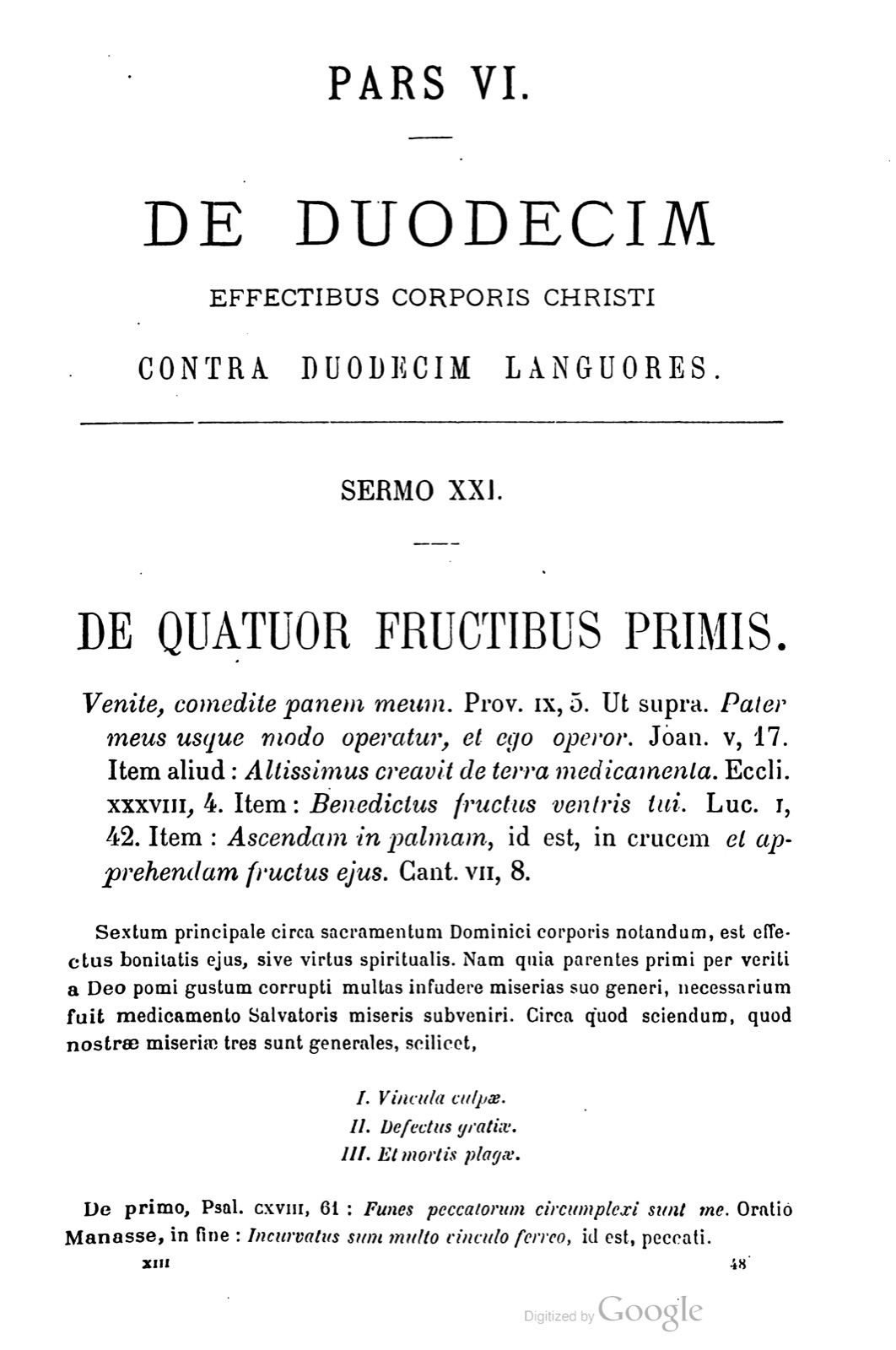
### Pars VI
### De duodecim effectibus corporis Christi contra duodecim languores
### Sermo XXI
### De quatuor fructibus primis
Venite, comedite panem meum. Prov. ix, 5. Ut supra. Pater meus usque modo operatur, et ego operor. Joan. v, 17. Item aliud: Altissimus creavit de terra medicamenta. Eccli. xxxviii, 4. Item: Benedictus fructus ventris tui. Luc. i, 42. Item: Ascendam in palmam, id est, in crucem et apprehendam fructus ejus. Cant. vii, 8.
Sextum principale circa sacramentum Dominici corporis notandum, est effectus bonitatis ejus, sive virtus spiritualis. Nam quia parentes primi per vetiti a Deo pomi gustum corrupti multas infudere miserias suo generi, necessarium fuit medicamento Salvatoris miseris subveniri. Circa quod sciendum, quod nostrae miseriae tres sunt generales, scilicet,
I. Vincula culpae.
II. Defectus gratiae.
III. Et mortis plaga.
De primo, Psal. cxviii, 61: Funes peccatorum circumplexi sunt me. Oratio Manasse, in fine: Incurvatus sum multo vinculo ferreo, id est, peccati.
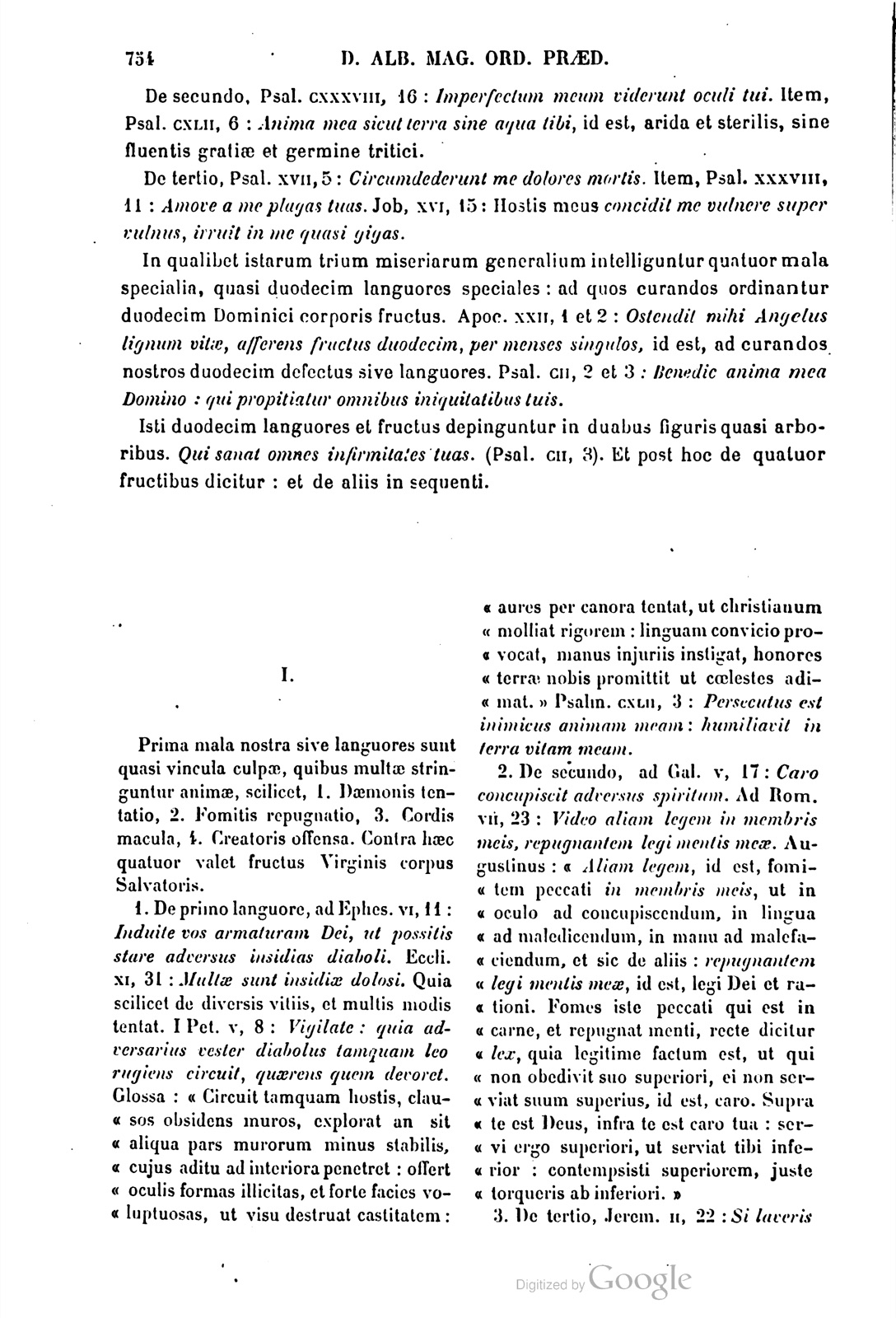
De secundo, Psal. cxxxviii, 16: Imperfectum meum viderunt oculi tui. Item, Psal. cxli, 6: Anima mea sicut terra sine aqua tibi, id est, arida et sterilis, sine fluentis gratiae et germine tritici.
De tertio, Psal. xvii, 5: Circumdederunt me dolores mortis. Item, Psal. xxxviii, 11: Amove a me plagas tuas. Job, xvi, 15: Hostis meus concidit me vulnere super vulnus, irruit in me quasi gigas.
In qualibet istarum trium miseriarum generalium intelliguntur quatuor mala specialia, quasi duodecim languores speciales: ad quos curandos ordinantur duodecim Dominici corporis fructus. Apoc. xxii, 1 et 2: Ostendit mihi Angelus lignum vitae, afferens fructus duodecim, per menses singulos, id est, ad curandos nostros duodecim defectus sive languores. Psal. cii, 2 et 3: Benedic anima mea Domino: qui propitiatur omnibus iniquitatibus tuis.
Isti duodecim languores et fructus depinguntur in duabus figuris quasi arboribus. Qui sanat omnes infirmitates tuas. (Psal. cii, 3). Et post hoc de quatuor fructibus dicitur: et de aliis in sequenti.
### Part VI
### On the Twelve Effects of Christ's Body against Twelve Languors
### Sermon XXI
### On the First Four Fruits
Come, eat my bread. Proverbs 9:5. As above. My Father works until now, and I work. John 5:17. Likewise another text: The Most High created medicines from the earth. Ecclesiasticus 38:4. Likewise: Blessed is the fruit of your womb. Luke 1:42. Likewise: I will climb the palm, that is, the cross, and I will grasp its fruits. Song of Songs 7:8.
The sixth principal thing to be noted concerning the sacrament of the Lord's body is the effect of its goodness, or its spiritual power. For because the first parents, corrupted through the taste of the fruit forbidden by God, poured many miseries into their race, it was necessary that the wretched be helped by the medicine of the Savior. Concerning this one must know that our miseries are three general ones, namely:
I. The bonds of fault.
II. Defect of grace.
III. And the plague of death.
Concerning the first, Psalm 118:61: The cords of sins have wrapped around me. The Prayer of Manasseh, at the end: I am bent down by a great iron chain, that is, of sin.
Concerning the second, Psalm 138:16: Your eyes saw my imperfect thing. Likewise, Psalm 141:6: My soul is like earth without water for you, that is, dry and sterile, without the streams of grace and the sprout of wheat.
Concerning the third, Psalm 17:5: The sorrows of death have surrounded me. Likewise, Psalm 38:11: Remove your plagues from me. Job 16:15: My enemy cut me with wound upon wound; he rushed upon me like a giant.
In any of these three general miseries are understood four special evils, as if twelve special languors, for the curing of which twelve fruits of the Lord's body are ordained. Apocalypse 22:1 and 2: The Angel showed me the tree of life, bearing twelve fruits, month by month, that is, for curing our twelve defects or languors. Psalm 102:2 and 3: Bless the Lord, my soul, who is propitiated toward all your iniquities.
These twelve languors and fruits are depicted in two figures as if in trees. He heals all your infirmities. (Psalm 102:3). And after this something is said concerning the four fruits, and concerning the others in the following sermon.
I.
Prima mala nostra sive languores sunt quasi vincula culpae, quibus multae stringuntur animae, scilicet, 1. Daemonis tentatio, 2. Fomitis repugnatio, 3. Cordis macula, 4. Creatoris offensa. Contra haec quatuor valet fructus Virginis corpus Salvatoris.
1. De primo languore, ad Ephes. vi, 11: Induite vos armaturam Dei, ut possitis stare adversus insidias diaboli. Eccli. xi, 31: Multae sunt insidiae dolosi. Quia scilicet de diversis vitiis, et multis modis tentat. I Pet. v, 8: Vigilate: quia adversarius vester diabolus tamquam leo rugiens circuit, quaerens quem devoret. Glossa: "Circuit tamquam hostis, clausos obsidens muros, explorat an sit aliqua pars murorum minus stabilis, cujus aditu ad interiora penetret: offert oculis formas illicitas, et forte facies voluptuosas, ut visu destruat castitatem: aures per canora tentat, ut christianum molliat rigorem: linguam convicio provocat, manus injuriis instigat, honores terrae nobis promittit ut caelestes adimat." Psalm. cxlii, 3: Persecutus est inimicus animam meam: humiliavit in terra vitam meam.
2. De secundo, ad Gal. v, 17: Caro concupiscit adversus spiritum. Ad Rom. vii, 23: Video aliam legem in membris meis, repugnantem legi mentis meae. Augustinus: "Aliam legem, id est, fomitem peccati in membris meis, ut in oculo ad concupiscendum, in lingua ad maledicendum, in manu ad malefaciendum, et sic de aliis: repugnantem legi mentis meae, id est, legi Dei et rationi. Fomes iste peccati qui est in carne, et repugnat menti, recte dicitur lex, quia legitime factum est, ut qui non obedivit suo superiori, ei non serviat suum superius, id est, caro. Supra te est Deus, infra te est caro tua: servi ergo superiori, ut serviat tibi inferior: contempsisti superiorem, juste torqueris ab inferiori."
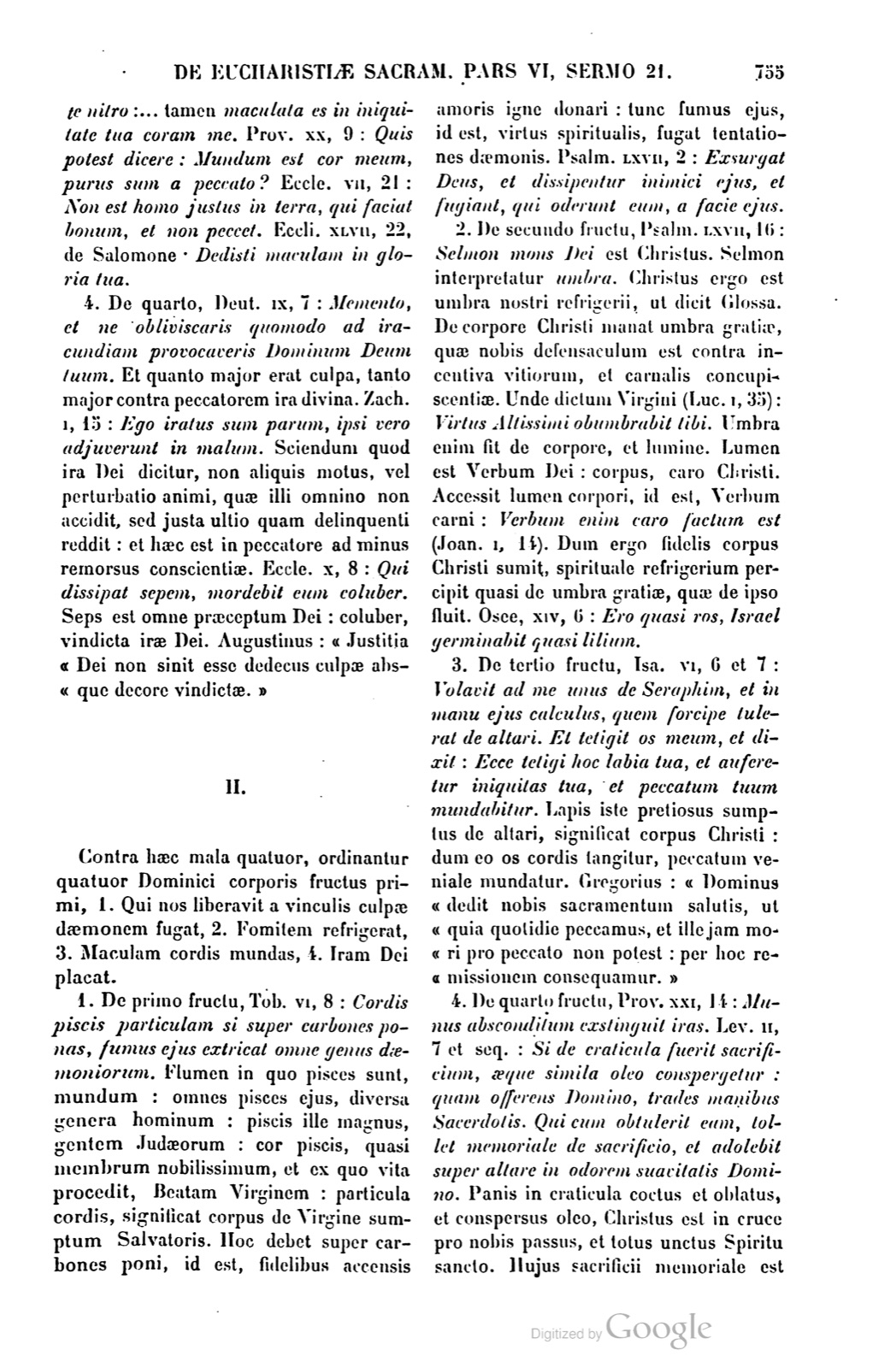
3. De tertio, Jerem. ii, 22: Si laveris te nitro: ... tamen maculata es in iniquitate tua coram me. Prov. xx, 9: Quis potest dicere: Mundum est cor meum, purus sum a peccato? Eccle. vii, 21: Non est homo justus in terra, qui faciat bonum, et non peccet. Eccli. xlvii, 22, de Salomone: Dedisti maculam in gloria tua.
I.
Our first evils or languors are like the bonds of fault, by which many souls are bound, namely 1. temptation of the demon, 2. the resistance of the tinder of sin, 3. stain of the heart, 4. offense of the Creator. Against these four the fruit of the Virgin, the body of the Savior, avails.
1. Concerning the first languor, Ephesians 6:11: Put on the armor of God, so that you may be able to stand against the snares of the devil. Ecclesiasticus 11:31: Many are the snares of the deceitful one, because namely he tempts from diverse vices and in many ways. 1 Peter 5:8: Watch, because your adversary the devil, like a roaring lion, goes around seeking whom he may devour. The Gloss says: "He goes around like an enemy, besieging closed walls; he explores whether some part of the walls is less firm, through whose entrance he may penetrate to the interior. He offers unlawful forms and perhaps pleasurable faces to the eyes, so that by sight he may destroy chastity; he tempts the ears through melodious things, so that he may soften Christian rigor; he provokes the tongue by insult, stirs the hands by injuries, promises us honors of earth so that he may take away heavenly ones." Psalm 142:3: The enemy has persecuted my soul; he has humbled my life on the earth.
2. Concerning the second, Galatians 5:17: The flesh lusts against the spirit. Romans 7:23: I see another law in my members, fighting against the law of my mind. Augustine says: "Another law, that is, the tinder of sin in my members, as in the eye for lusting, in the tongue for cursing, in the hand for doing evil, and so concerning the others; fighting against the law of my mind, that is, the law of God and reason. This tinder of sin which is in the flesh and fights against the mind is rightly called law, because it was done legitimately that for him who did not obey his superior, his own superior, that is, flesh, should not serve him. Above you is God, below you is your flesh; therefore serve the superior, so that the inferior may serve you. You despised the superior; justly are you tortured by the inferior."
3. Concerning the third, Jeremiah 2:22: If you wash yourself with nitre, ... nevertheless you are stained in your iniquity before me. Proverbs 20:9: Who can say: My heart is clean; I am pure from sin? Ecclesiastes 7:21: There is no just man on the earth who does good and does not sin. Ecclesiasticus 47:22, concerning Solomon: You gave a stain in your glory.
4. De quarto, Deut. ix, 7: Memento, et ne obliviscaris quomodo ad iracundiam provocaveris Dominum Deum tuum. Et quanto major erat culpa, tanto major contra peccatorem ira divina. Zach. i, 15: Ego iratus sum parum, ipsi vero adjuverunt in malum. Sciendum quod ira Dei dicitur, non aliquis motus, vel perturbatio animi, quae illi omnino non accidit, sed justa ultio quam delinquenti reddit: et haec est in peccatore ad minus remorsus conscientiae. Eccle. x, 8: Qui dissipat sepem, mordebit eum coluber. Seps est omne praeceptum Dei: coluber, vindicta irae Dei. Augustinus: "Justitia Dei non sinit esse dedecus culpae absque decore vindictae."
II.
Contra haec mala quatuor, ordinantur quatuor Dominici corporis fructus primi, 1. Qui nos liberavit a vinculis culpae daemonem fugat, 2. Fomitem refrigerat, 3. Maculam cordis mundat, 4. Iram Dei placat.
1. De primo fructu, Tob. vi, 8: Cordis piscis particulam si super carbones ponas, fumus ejus extricat omne genus daemoniorum. Flumen in quo pisces sunt, mundum: omnes pisces ejus, diversa genera hominum: piscis ille magnus, gentem Judaeorum: cor piscis, quasi membrum nobilissimum, et ex quo vita procedit, Beatam Virginem: particula cordis, significat corpus de Virgine sumptum Salvatoris. Hoc debet super carbones poni, id est, fidelibus accensis amoris igne donari: tunc fumus ejus, id est, virtus spiritualis, fugat tentationes daemonis. Psalm. lxvii, 2: Exsurgat Deus, et dissipentur inimici ejus, et fugiant, qui oderunt eum, a facie ejus.
2. De secundo fructu, Psalm. lxvii, 16: Selmon mons Dei est Christus. Selmon interpretatur umbra. Christus ergo est umbra nostri refrigerii, ut dicit Glossa. De corpore Christi manat umbra gratiae, quae nobis defensaculum est contra incentiva vitiorum, et carnalis concupiscentiae. Unde dictum Virgini (Luc. i, 35): Virtus Altissimi obumbrabit tibi. Umbra enim fit de corpore, et lumine. Lumen est Verbum Dei: corpus, caro Christi. Accessit lumen corpori, id est, Verbum carni: Verbum enim caro factum est (Joan. i, 14). Dum ergo fidelis corpus Christi sumit, spirituale refrigerium percipit quasi de umbra gratiae, quae de ipso fluit. Osee, xiv, 6: Ero quasi ros, Israel germinabit quasi lilium.
4. Concerning the fourth, Deuteronomy 9:7: Remember, and do not forget how you provoked the Lord your God to anger. And the greater the fault was, the greater divine anger was against the sinner. Zechariah 1:15: I was angry a little, but they helped toward evil. One must know that the anger of God is said to be not some motion or disturbance of soul, which does not at all happen to him, but the just vengeance which he renders to the delinquent; and this is in the sinner at least the remorse of conscience. Ecclesiastes 10:8: He who destroys a hedge, the serpent will bite him. The hedge is every precept of God; the serpent is the vengeance of the anger of God. Augustine says: "The justice of God does not allow the disgrace of fault to be without the beauty of vengeance."
II.
Against these four evils are ordained the first four fruits of the Lord's body: 1. it, which freed us from the bonds of fault, puts the demon to flight; 2. it cools the tinder of sin; 3. it cleanses the stain of the heart; 4. it appeases the anger of God.
1. Concerning the first fruit, Tobit 6:8: If you place a small part of the fish's heart upon coals, its smoke drives out every kind of demons. The river in which the fish are is the world; all its fish are the diverse kinds of men; that great fish is the Jewish people; the heart of the fish, as the most noble member and that from which life proceeds, is the Blessed Virgin; the small part of the heart signifies the body of the Savior taken from the Virgin. This must be placed upon coals, that is, given to the faithful kindled by the fire of love; then its smoke, that is, its spiritual power, drives away the temptations of the demon. Psalm 67:2: Let God arise, and let his enemies be scattered, and let those who hate him flee from his face.
2. Concerning the second fruit, Psalm 67:16: Selmon, the mountain of God, is Christ. Selmon is interpreted shadow. Therefore Christ is the shadow of our coolness, as the Gloss says. From the body of Christ flows the shadow of grace, which is a protection for us against the incentives of vices and of carnal concupiscence. Hence it was said to the Virgin (Luke 1:35): The power of the Most High will overshadow you. For shadow is made from body and light. The light is the Word of God; the body, the flesh of Christ. The light approached the body, that is, the Word approached flesh, for the Word was made flesh (John 1:14). Therefore when the faithful person receives the body of Christ, he receives spiritual coolness as if from the shadow of grace which flows from him. Hosea 14:6: I will be like dew; Israel will sprout like the lily.
3. De tertio fructu, Isa. vi, 6 et 7: Volavit ad me unus de Seraphim, et in manu ejus calculus, quem forcipe tulerat de altari. Et tetigit os meum, et dixit: Ecce tetigi hoc labia tua, et auferetur iniquitas tua, et peccatum tuum mundabitur. Lapis iste pretiosus sumptus de altari, significat corpus Christi: dum eo os cordis tangitur, peccatum veniale mundatur. Gregorius: "Dominus dedit nobis sacramentum salutis, ut quia quotidie peccamus, et ille jam mori pro peccato non potest: per hoc remissionem consequamur."
4. De quarto fructu, Prov. xxi, 14: Munus absconditum exstinguit iras. Lev. ii, 7 et seq.: Si de craticula fuerit sacrificium, aeque simila oleo conspergetur: quam offerens Domino, trades manibus Sacerdotis. Qui cum obtulerit eam, tollet memoriale de sacrificio, et adolebit super altare in odorem suavitatis Domino. Panis in craticula coctus et oblatus, et conspersus oleo, Christus est in cruce pro nobis passus, et totus unctus Spiritu sancto. Hujus sacrificii memoriale est hostia Ecclesiae quae offertur in memoriam passionis Dominicae. Haec debet super altare adoleri, id est, accendi: quia in corde fideli cum fervore desiderii, et devotionis suscipitur. Hic odor suavitatis est Domino, id est, tam grata Deo ut ob ejus gratiam iram suam remittat, et nos sibi reconciliet, et ad aeternam pacem perducat. Amen.
3. Concerning the third fruit, Isaiah 6:6 and 7: One of the Seraphim flew to me, and in his hand was a small stone which he had taken from the altar with tongs. And he touched my mouth and said: Behold, I have touched your lips with this, and your iniquity will be taken away, and your sin will be cleansed. That precious stone taken from the altar signifies the body of Christ; when the mouth of the heart is touched by it, venial sin is cleansed. Gregory says: "The Lord gave us the sacrament of salvation so that, because we sin daily and he can no longer die for sin, through this we may obtain remission."
4. Concerning the fourth fruit, Proverbs 21:14: A hidden gift extinguishes angers. Leviticus 2:7 and following: If the sacrifice is from the griddle, it will likewise be sprinkled with fine flour in oil; offering it to the Lord, you will hand it to the hands of the Priest. When he has offered it, he will take a memorial from the sacrifice and burn it upon the altar as an odor of sweetness to the Lord. The bread cooked on the griddle, offered, and sprinkled with oil is Christ, who suffered for us on the cross and was wholly anointed with the Holy Spirit. The memorial of this sacrifice is the host of the Church which is offered in memory of the Lord's Passion. This ought to be burned upon the altar, that is, kindled, because it is received in the faithful heart with fervor of desire and devotion. This odor of sweetness is for the Lord, that is, so pleasing to God that on account of its grace he remits his anger, reconciles us to himself, and leads us to eternal peace. Amen.

If a page does not appear, its photograph has not been uploaded yet.