Works › Sermons on the Most Holy Sacrament of the Eucharist
Volume 13 · pp. 715–718
Sermon XII. On the Third Marvel in Consecration
A marker with ≈ is an approximate page boundary, placed by measure of the text; the page photographs remain the authority. In the paired views, clicking a page marker brings that page into view.
### Sermo XII
### De tertio mirabili in consecratione
Venite, comedite, etc. Prov. ix, 5. Ut supra. Mirabilia opera tua, etc. Psal. cxxxviii, 14.
III.
Tertium mirabile signum, imo mirabilissimum signum in consecratione Sacramenti altaris est, quod mutatur in corpus Christi panis tota substantia: sic tamen, ut maneant panis accidentia, id est, color, odor, et sapor, et hujusmodi corpus Christi circumstantia et nostris sensibus objecta. Quod enim in consecratione panis mutatur in corpus Christi, jam supra probatum est. Et quod manent accidentia humanis sensibus objecta, patet. Talis mutatio est supernaturalis, et dicitur proprie conversio sive transsubstantiatio: quia similis ei per omnia non invenitur in natura. Quod cum divina virtute in hoc sacramento possit fieri, triplici similitudine potest ostendi:
I. Sumitur de gratia prophetali.
II. De conversatione spirituali.
III. De mutatione naturali.
I. Prima similitudo quod substantia panis in corpus Christi potest transmutari, ita ut accidentia maneant, sumitur de gratia prophetali. Hinc est quod IV Reg. ii, 21, dicitur: Eliseus misit sal in aquas amaras, et conversae sunt in dulces. In qua conversione quatuor consideranda sunt, scilicet continens, et contentum: operans, et operatum. Continens est species illa, sive claritas exterior aquarum quae manet. Contentum, amaritudo interior. Operans est gratia prophetalis. Operatum est dulcedo subsequens aquarum. Primum, scilicet continens, id est, species aquarum exterior manet. Secundum, scilicet contentum, id est, amaritudo interior transit, atque mutatur in quartum, scilicet operatum, id est, in dulcedinem: et hoc per tertium, scilicet per operans, id est, per gratiam prophetalem.
Sic est quodammodo in mutatione panis in corpus Christi. Primum enim, scilicet continens, id est, species panis exterior manet. Secundum, scilicet contentum, id est, substantia panis interior mutatur in quartum, id est, in corpus Christi: et hoc per tertium, scilicet per operans, id est, per verbum Dei.
II. Secunda similitudo ejusdem sumitur de conversatione spirituali. De prima, I Reg. x, 6, dicit Samuel ad Saul, qui significat peccatorem: Insiliet in te Spiritus Domini, et mutaberis. In qua mutatione sive conversione, quatuor jam supra dicta consideranda sunt, scilicet continens, contentum, operans, et operatum. In statu enim peccati videtur homo exterior pulcher et sanus: sed homo interior amaritudine et peccati veneno plenus est, et aegrotus. Hic dum per Spiritum Dei convertitur, specie corporis manente exteriori, amaritudo et languor peccati interior in dulcedinem et sanitatem gratiae commutatur. Primum ergo, scilicet species corporis exterior manet. Secundum, scilicet amaritudo peccati interior transit in quartum, scilicet in dulcedinem gratiae: et hoc per tertium, scilicet per Spiritum Dei, et sic fit, ut jam dictum est, in conversione panis in corpus Christi. Eugenius ad quemdam conversum: « Quanta et quam celebranda beneficia vis divinae bonitatis operatur, et quomodo tibi novum et impossibile esse non debeat, quod in Christi substantiam terrena convertantur, teipsum interroga, qui praeterita vilitate deposita subito novam indutus es dignitatem. In exteriori nihil additum, totum est in interiori mutatum. »
### Sermon XII
### On the Third Marvel in Consecration
Come, eat, etc. Proverbs 9:5. As above. Your works are marvelous, etc. Psalm 138:14.
III.
The third marvelous sign, indeed the most marvelous sign, in the consecration of the Sacrament of the altar is that the whole substance of bread is changed into the body of Christ, yet in such a way that the accidents of bread remain, that is, color, odor, and taste, and circumstances of Christ's body of this kind, objected to our senses. For that in the consecration of bread it is changed into the body of Christ has already been proved above. And that the accidents objected to human senses remain is evident. Such a change is supernatural, and is properly called conversion or transubstantiation, because one like it in all respects is not found in nature. That this can happen in this sacrament by divine power can be shown by a threefold likeness:
I. It is taken from prophetic grace.
II. From spiritual conduct.
III. From natural change.
I. The first likeness, that the substance of bread can be transmuted into the body of Christ in such a way that the accidents remain, is taken from prophetic grace. Hence it is that in 4 Kings 2:21 it is said: Elisha sent salt into the bitter waters, and they were converted into sweet ones. In that conversion four things must be considered, namely container and contained, operator and operated. The container is that species, or exterior brightness, of the waters which remains. The contained is the interior bitterness. The operator is prophetic grace. The operated is the subsequent sweetness of the waters. The first, namely the container, that is, the exterior species of the waters, remains. The second, namely the contained, that is, the interior bitterness, passes over and is changed into the fourth, namely the operated, that is, into sweetness; and this happens through the third, namely through the operator, that is, through prophetic grace.
So it is in a certain way in the change of bread into the body of Christ. For the first, namely the container, that is, the exterior species of bread, remains. The second, namely the contained, that is, the interior substance of bread, is changed into the fourth, that is, into the body of Christ; and this happens through the third, namely through the operator, that is, through the word of God.
II. The second likeness of the same matter is taken from spiritual conduct. Concerning the first, 1 Kings 10:6, Samuel says to Saul, who signifies the sinner: The Spirit of the Lord will leap upon you, and you will be changed. In this mutation or conversion the four things already named above must be considered, namely container, contained, operator, and operated. For in the state of sin the exterior man seems beautiful and healthy, but the interior man is full of bitterness and the poison of sin, and is sick. When this man is converted by the Spirit of God, the exterior species of the body remaining, the bitterness and sickness of interior sin is changed into the sweetness and health of grace. Therefore the first, namely the exterior species of the body, remains. The second, namely the interior bitterness of sin, passes into the fourth, namely into the sweetness of grace; and this happens through the third, namely through the Spirit of God; and thus it happens, as has already been said, in the conversion of bread into the body of Christ. Eugenius says to a certain converted man: "How great and how worthy to be celebrated are the benefits which the force of divine goodness works, and how it ought not to be new and impossible to you that earthly things are converted into the substance of Christ, ask yourself, you who, with past vileness laid aside, have suddenly been clothed with new dignity. Nothing has been added in the exterior; everything has been changed in the interior."
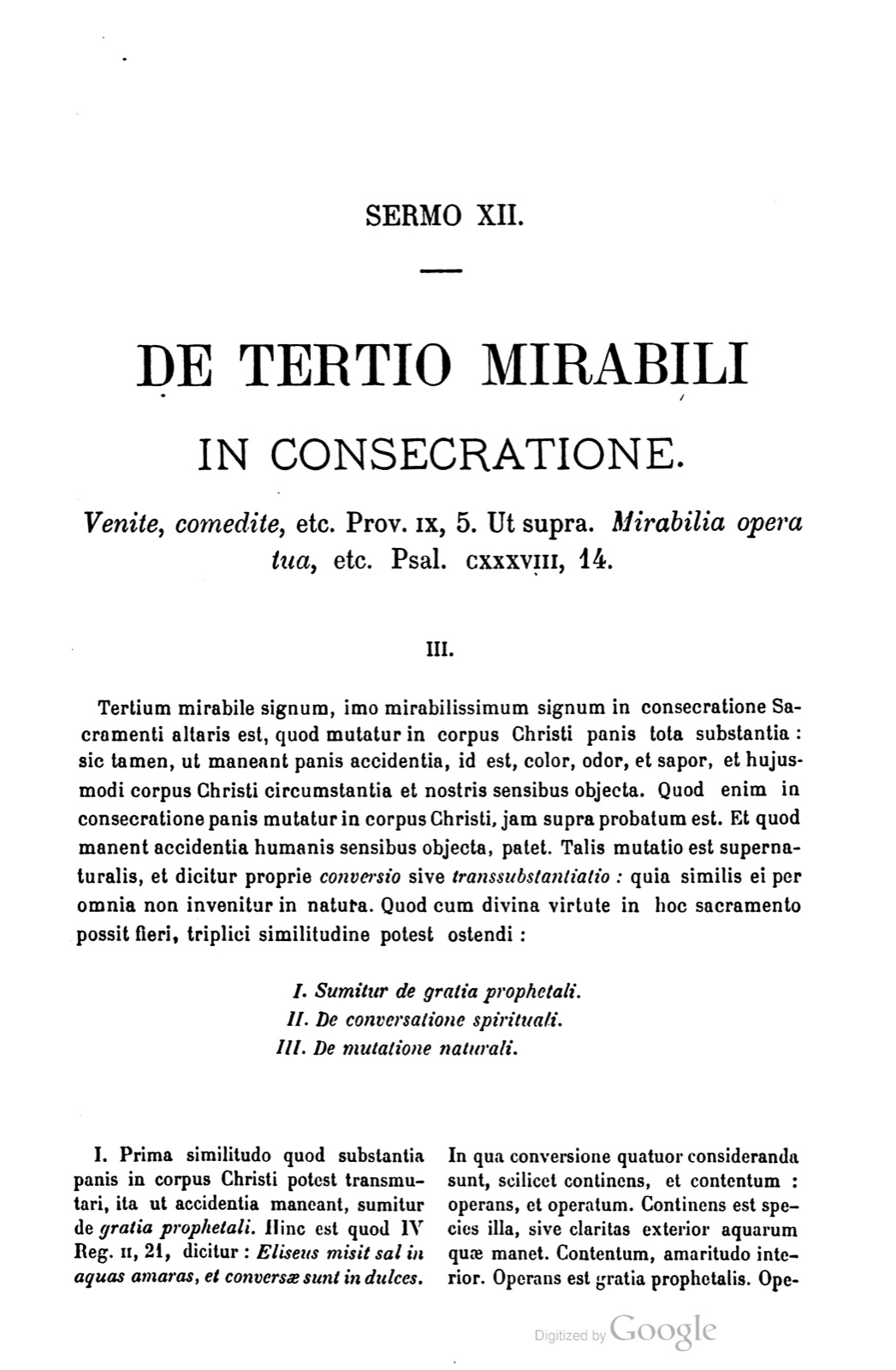
III. Tertia ergo similitudo ejusdem sumitur de mutatione naturali. Videmus enim quod ponuntur ova sub ave, ut sub gallina, vel columba: et per naturam mutantur in carnem, imo in aviculam vivam. In hac mutatione similiter illa quatuor quae jam dicta sunt, possumus invenire. Ibi enim est continens, scilicet testa, quasi species ovi exterior: et contentum, scilicet vitellum, quasi substantia ovi interior: et operans, scilicet natura: et operatum, scilicet caro pulli, imo integrum corpus pulli vivi. Primum scilicet testa, sive species exterior manet. Secundum, scilicet vitellum, sive substantia interior transit et mutatur in quartum, scilicet in corpus pulli vivum: et hoc per tertium, scilicet operantem naturam. Et mira similitudo: quia testa diebus aliquibus integra manente, exterius videtur quasi adhuc sit ovum, quod non est ovum, sed vivi pulli integrum corpus testa velatum. Sicut ergo in hac re columba per naturam, sic in sacramento altaris operatur Spiritus sanctus per suam omnipotentem virtutem. Hinc est quod in columbae specie super Christum apparuit, Luc. iii, 22. Hinc etiam Genes. i, 2: Spiritus Dei ferebatur super aquas, verum « sicut avis fovens ova, » dicit Glossa. Ergo si ponis sub ave unum, vel duo, vel plura ova, vertit ea per naturam interius in carnem, testa manente exterius: quanto magis si ponas in altari unam hostiam panis, vel duas sive centum, sive mille vel plurimas, manente panis exterius specie, Spiritus sanctus eas repente interius in corpus Christi sua virtute convertit. Augustinus: « Cum panis per manus hominis ad illam visibilem speciem perducatur, non tamen sacrificatur: ut sit tam dignum sacramentum, nisi operante invisibiliter Spiritu Dei. Quia sicut de Virgine per Spiritum sanctum vera caro Christi sine coitu est formata: ita per eumdem de substantia panis mystice idem corpus Christi consecratur. » Attende quod dicit, de substantia panis, non quod sit materia corporis Christi, sed quia panis convertitur in corpus Christi, unde versus:
III. Therefore the third likeness of the same matter is taken from natural change. For we see that eggs are placed under a bird, as under a hen or dove, and by nature they are changed into flesh, indeed into a living little bird. In this change similarly we can find those four things which have already been named. For there is the container, namely the shell, as the exterior species of the egg, and the contained, namely the yolk, as the interior substance of the egg, and the operator, namely nature, and the operated, namely the flesh of the chick, indeed the whole body of the living chick. The first, namely the shell or exterior species, remains. The second, namely the yolk or interior substance, passes over and is changed into the fourth, namely into the living body of the chick; and this happens through the third, namely through operating nature. And the likeness is marvelous, because while the shell remains whole for some days, outwardly it seems as if it were still an egg, which is not an egg, but the whole body of a living chick veiled by a shell. Therefore just as in this thing the dove works through nature, so in the sacrament of the altar the Holy Spirit works through his omnipotent power. Hence it is that he appeared over Christ in the species of a dove, Luke 3:22. Hence also Genesis 1:2: The Spirit of God was borne over the waters, truly "as a bird warming eggs," says the Gloss. Therefore if you place under a bird one egg, or two, or several eggs, it turns them inwardly by nature into flesh, the shell remaining outwardly; how much more, if you place on the altar one host of bread, or two or a hundred, or a thousand or very many, the exterior species of bread remaining, does the Holy Spirit suddenly convert them inwardly into the body of Christ by his power. Augustine says: "Although bread is brought by the hands of man to that visible species, nevertheless it is not sacrificed so as to be so worthy a sacrament unless the Spirit of God works invisibly. Because just as true flesh of Christ was formed from the Virgin through the Holy Spirit without intercourse, so through the same Spirit from the substance of bread the same body of Christ is mystically consecrated." Attend to what he says, "from the substance of bread," not because it is the matter of the body of Christ, but because bread is converted into the body of Christ; hence the verse:
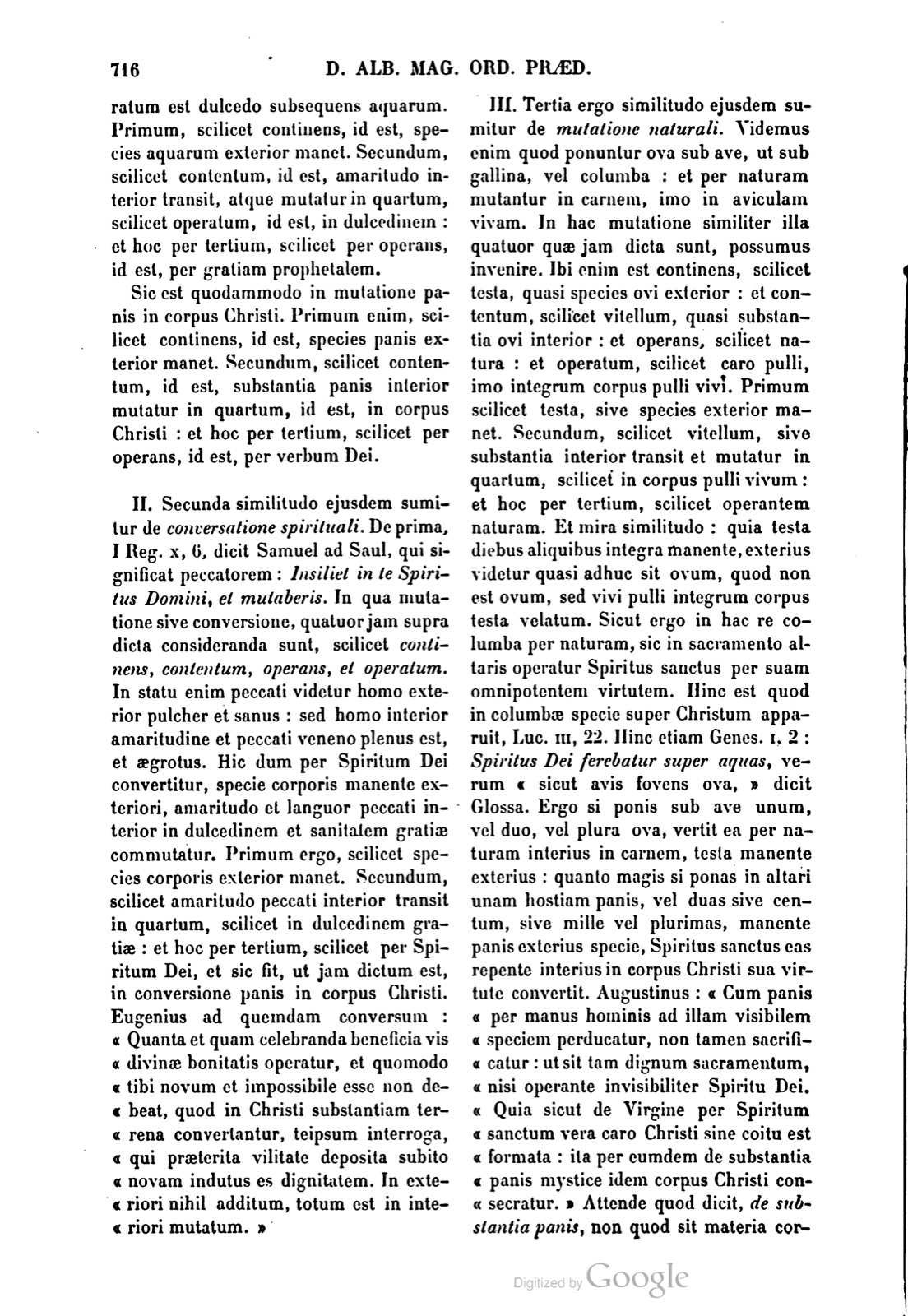
Corpus de pane, corpus de Virgine. Primum
De conversivum, sed materiale secundum.
Hinc moraliter notandum est, quod cum irrationalis creatura, scilicet panis, per Verbum Dei et Spiritum ejus in melius convertitur: quanta sit peccatoris duritia, qui multis verbis, et Spiritus sancti circa se operationibus ad conversionem non perducitur. Jerem. v, 3: Induraverunt facies suas supra petram, et noluerunt reverti. Haec induratio finalis impoenitentia est, cujus triplex causa assignari potest. Prima, longa consuetudo peccandi. Secunda, incredulitas de justitia Dei. Tertia, seductio inimici.
1. De prima, Sap. xiv, 16: Convalescente iniqua consuetudine, hic error tamquam lex custoditus est. Jer. xiii, 23: Si mutare potest Aethiops pellem suam, aut pardus varietates suas: et vos poteritis benefacere, cum didiceritis malum. Glossa: « Consuetudo peccandi, quodammodo in naturam transit. » Sed quod hominibus impossibile est, Deo est possibile, ut non Aethiops vel pardus, id est, longaevi peccatores suam naturam per se mutare videantur, sed Deus qui in illis operatur. Augustinus: « Vocabas me, Domine, et suspirabam ligatus, non ferro alieno, sed mea ferrea voluntate. Velle enim meum tenebat inimicus, et inde mihi catenam fecerat, et constrinxerat me. » Quippe ex voluntate perversa facta est libido: et dum servitur libidini, facta est consuetudo: et dum consuetudini non resistitur, facta est necessitas.
Body from bread, body from the Virgin. The first
is conversive from it, but the second material.
Hence morally it must be noted that when an irrational creature, namely bread, is converted into something better through the Word of God and his Spirit, how great is the hardness of the sinner who by many words and by operations of the Holy Spirit around him is not brought to conversion. Jeremiah 5:3: They hardened their faces above rock, and they refused to return. This hardening is final impenitence, of which a threefold cause can be assigned. The first is long custom of sinning. The second is unbelief concerning the justice of God. The third is the seduction of the enemy.
1. Concerning the first, Wisdom 14:16: As the wicked custom grew strong, this error was kept as law. Jeremiah 13:23: If the Ethiopian can change his skin, or the leopard its spots, then you also will be able to do good, when you have learned evil. The Gloss says: "The custom of sinning in a certain way passes into nature." But what is impossible for men is possible for God, so that the Ethiopian or leopard, that is, long-lived sinners, should not seem to change their nature by themselves, but God who works in them. Augustine says: "You were calling me, O Lord, and I was sighing, bound not by another's iron, but by my own iron will. For my willing held the enemy, and from it he had made a chain for me and had bound me." Indeed from a perverse will desire was made; and while desire is served, custom was made; and while custom is not resisted, necessity was made.
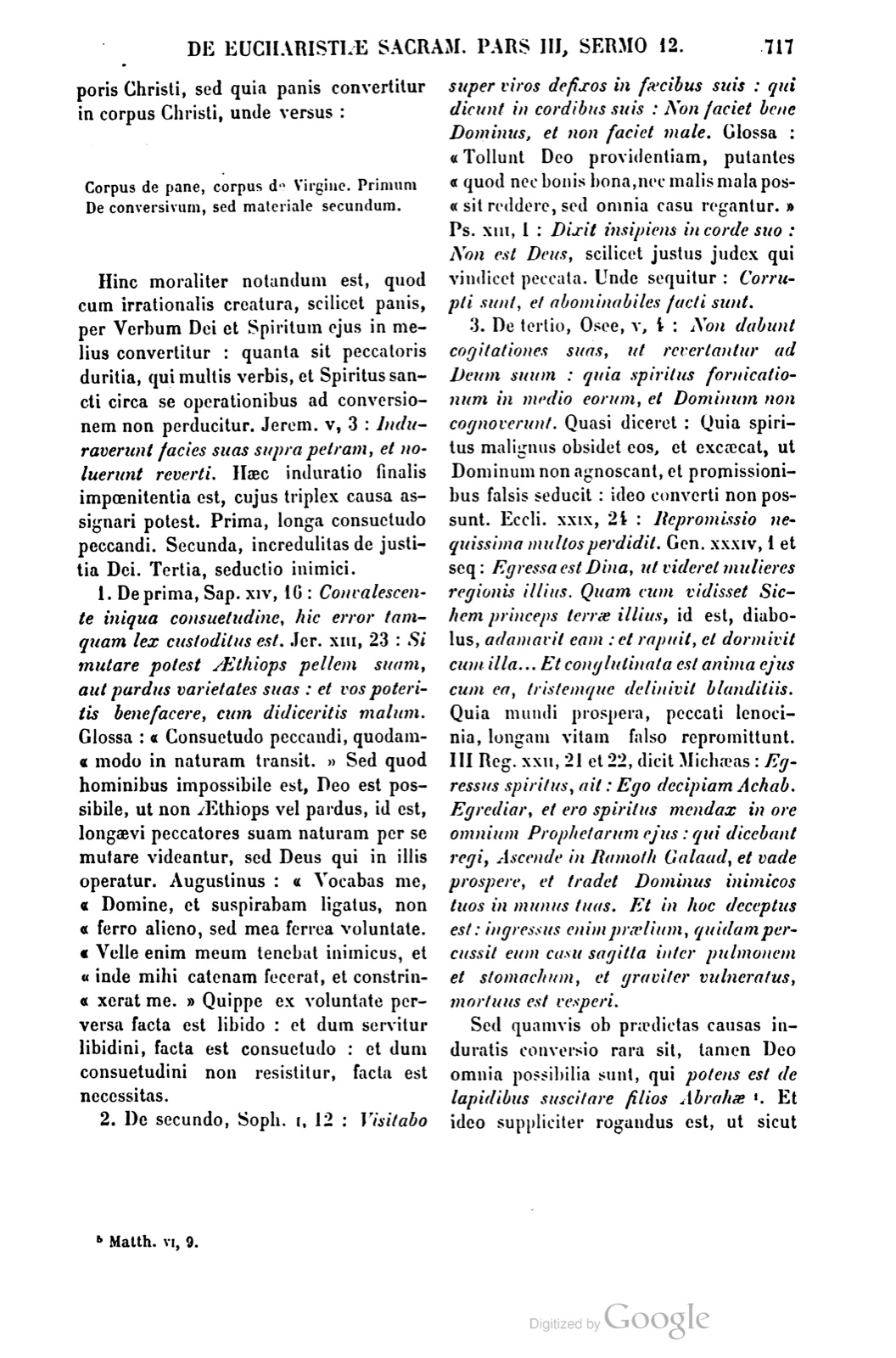
2. De secundo, Soph. i, 12: Visitabo super viros defixos in faecibus suis: qui dicunt in cordibus suis: Non faciet bene Dominus, et non faciet male. Glossa: « Tollunt Deo providentiam, putantes quod nec bonis bona, nec malis mala possit reddere, sed omnia casu regantur. » Ps. xiii, 1: Dixit insipiens in corde suo: Non est Deus, scilicet justus judex qui vindicet peccata. Unde sequitur: Corrupti sunt, et abominabiles facti sunt.
3. De tertio, Osee, v, 4: Non dabunt cogitationes suas, ut revertantur ad Deum suum: quia spiritus fornicationum in medio eorum, et Dominum non cognoverunt. Quasi diceret: Quia spiritus malignus obsidet eos, et excaecat, ut Dominum non agnoscant, et promissionibus falsis seducit: ideo converti non possunt. Eccli. xxix, 24: Repromissio nequissima multos perdidit. Gen. xxxiv, 1 et seq.: Egressa est Dina, ut videret mulieres regionis illius. Quam cum vidisset Sichem princeps terrae illius, id est, diabolus, adamavit eam: et rapuit, et dormivit cum illa... Et conglutinata est anima ejus cum ea, tristemque delinivit blanditiis. Quia mundi prospera, peccati lenocinia, longam vitam falso repromittunt. III Reg. xxii, 21 et 22, dicit Michaeas: Egressus spiritus, ait: Ego decipiam Achab. Egrediar, et ero spiritus mendax in ore omnium Prophetarum ejus: qui dicebant regi, Ascende in Ramoth Galaad, et vade prospere, et tradet Dominus inimicos tuos in manus tuas. Et in hoc deceptus est: ingressus enim proelium, quidam percussit eum casu sagitta inter pulmonem et stomachum, et graviter vulneratus, mortuus est vesperi.
Sed quamvis ob praedictas causas induratis conversio rara sit, tamen Deo omnia possibilia sunt, qui potens est de lapidibus suscitare filios Abrahae1. Et ideo suppliciter rogandus est, ut sicut Spiritus sancti virtute creaturam panis in corpus suum convertit, ita nos in similitudinem imaginis bonitatis suae, et in corpus suum mysticum convertat: ut simus unum cum ipso2 in praesenti per gratiam, et in futuro per gloriam. Amen.
2. Concerning the second, Zephaniah 1:12: I will visit upon the men fixed in their dregs, who say in their hearts: The Lord will not do good, and he will not do evil. The Gloss says: "They take providence away from God, thinking that he can render neither good things to the good nor evil things to the evil, but that all things are ruled by chance." Psalm 13:1: The fool has said in his heart: There is no God, namely no just judge who avenges sins. Hence it follows: They have been corrupted and made abominable.
3. Concerning the third, Hosea 5:4: They will not give their thoughts so as to return to their God, because the spirit of fornications is in their midst, and they have not known the Lord. As if he were saying: Because the malignant spirit besieges them and blinds them so that they do not recognize the Lord, and seduces them by false promises, therefore they cannot be converted. Ecclesiasticus 29:24: A most wicked promise has destroyed many. Genesis 34:1 and following: Dinah went out to see the women of that region. When Shechem, the prince of that land, that is, the devil, had seen her, he loved her, and seized her, and slept with her... And his soul was glued together with her, and he soothed the sad woman with flatteries. Because the prosperous things of the world, the enticements of sin, falsely promise long life. 3 Kings 22:21 and 22, Micaiah says: A spirit went out and said: I will deceive Ahab. I will go out and be a lying spirit in the mouth of all his Prophets, who were saying to the king: Go up to Ramoth Gilead, and go prosperously, and the Lord will hand your enemies into your hands. And in this he was deceived; for when he entered battle, someone struck him by chance with an arrow between the lung and the stomach, and seriously wounded, he died in the evening.
But although conversion is rare for those hardened on account of the aforesaid causes, nevertheless all things are possible to God, who is able from stones to raise up sons of Abraham1. And therefore he must be begged supplicantly that just as by the power of the Holy Spirit he converts the creature of bread into his body, so he may convert us into the likeness of the image of his goodness, and into his mystical body, so that we may be one with him2 in the present through grace, and in the future through glory. Amen.

If a page does not appear, its photograph has not been uploaded yet.