Works › Sermons on the Most Holy Sacrament of the Eucharist
Volume 13 · pp. 695–698
Part II. On the Form of Donation. Sermon VII. That the Body Is Given Veiled
A marker with ≈ is an approximate page boundary, placed by measure of the text; the page photographs remain the authority. In the paired views, clicking a page marker brings that page into view.
### Pars II
### De forma donationis
### Sermo VII
### I. Quod corpus datur velatum
Venite, comedite panem meum, etc. Prov. ix, 5.
Quomodo potest hic nobis dare carnem suam ad manducandum? Joan. vi, 53.
Sacramentum regis abscondere bonum est. Tob. xii, 7.
Secundum principaliter circa sacramentum Dominici corporis notandum, est forma donationis. Et circa hanc tria sunt consideranda. Primum est quod Dominus dat corpus suum velatum. Secundum quod dat velatum sub specie panis. Tertium quod dat sub specie panis triticei.
Primum circa formam donationis Dominici corporis considerandum est, quod datur velatum, non nudum, secundum illud Apocal. ii, 17: Dabo manna absconditum, quasi cibum coelestem velatum. Sed quia ex hoc humanus sensus terretur, et miratur, cum aliud videtur, et aliud credi jubetur: hujus velaminis quadruplex ratio sapientiae Dei potest assignari.
I. Est indignitas malorum.
II. Fides bonorum.
III. Instructio morum.
IV. Imbecillitas omnium.
De primis duobus potest hic dici et de aliis in sequenti.
I.
Prima ratio, quare Dominus corpus suum dat velatum est indignitas pravorum, quae exigit ut veletur, sicut aeger oculus, ut sibi sol et quodlibet lumen tegatur. Et in hoc benignissime agit cum eis misericordia Salvatoris: si enim pravi nudum corpus viderent, et hoc a fidelibus manducari, ex ipso adspectu scandalizarentur, et tripliciter male perirent, 1. In corde per errorem, 2. In lingua per detractionem, 3. In anima per spiritualem mortem.
1. De primo, Joan. vi, 56 et 67: Caro mea, vere est cibus: et sanguis meus, vere est potus. Sequitur: Ex hoc multi discipulorum ejus abierunt retro, quasi abhorrentes verba de humana carne comedenda. Ambrosius: « Forte dices, quomodo vera est caro, quomodo verus sanguis, quia similitudinem non vides carnis? attende ubi discipuli Christi audientes, quod carnem suam daret manducandam, recedebant, solus Petrus dixit: Verba vitae aeternae habes, ad quem ibimus (Joan. vi, 69)? Ne ergo plures scandalizarentur, et ne velut quidam esset horror humanae carnis, sed maneret gloria Salvatoris, ideo in similitudine accipis sacramentum, sed verae naturae gloriam virtutemque consequeris. »
2. De secundo, in eodem, vi, 52 et 53, ubi Dominus dixit: Panis, quem ego dabo, caro mea est pro mundi vita? Litigabant ergo Judaei ad invicem dicentes: Quomodo potest hic nobis carnem suam dare, ad manducandum? Litigatio hujusmodi, murmur, et detractio est de nuda manducatione corporis Christi, et ideo debuit velari. Psal. liv, 13: Si is, qui odorat me, super me mala locutus fuisset: abscondissem me forsitan ab eo.
### Part II
### On the Form of Donation
### Sermon VII
### I. That the Body Is Given Veiled
Come, eat my bread, etc. Proverbs 9:5.
How can this man give us his flesh to eat? John 6:53.
It is good to hide the sacrament of the king. Tobit 12:7.
The second thing principally to be noted concerning the sacrament of the Lord's body is the form of donation. And concerning this, three things are to be considered. The first is that the Lord gives his body veiled. The second, that he gives it veiled under the species of bread. The third, that he gives it under the species of wheaten bread.
The first thing to be considered concerning the form of donation of the Lord's body is that it is given veiled, not naked, according to that saying of Apocalypse 2:17: I will give the hidden manna, as if heavenly food veiled. But because from this the human sense is frightened and wonders, since one thing is seen and another is commanded to be believed, a fourfold reason of God's wisdom for this veil can be assigned.
I. It is the unworthiness of the wicked.
II. The faith of the good.
III. Instruction of morals.
IV. The weakness of all.
Concerning the first two things something can be said here, and concerning the others in what follows.
I.
The first reason why the Lord gives his body veiled is the unworthiness of the depraved, which requires that it be veiled, just as a sick eye requires that the sun and any light be covered for it. And in this the mercy of the Savior acts most kindly with them: for if the depraved saw the naked body and that it was eaten by the faithful, from the very sight they would be scandalized and would perish badly in three ways: 1. In heart through error, 2. In tongue through detraction, 3. In soul through spiritual death.
1. Concerning the first, John 6:56 and 67: My flesh is truly food, and my blood is truly drink. It follows: From this many of his disciples went back, as if abhorring the words concerning human flesh to be eaten. Ambrose: "Perhaps you say, how is the flesh true, how is the blood true, since you do not see the likeness of flesh? Attend to where the disciples of Christ, hearing that he would give his flesh to be eaten, were withdrawing; Peter alone said: You have the words of eternal life; to whom shall we go (John 6:69)? Therefore lest more be scandalized, and lest there be as it were a certain horror of human flesh, but the glory of the Savior remain, for this reason you receive the sacrament in likeness, but you obtain the glory and power of the true nature."
2. Concerning the second, in the same place, 6:52 and 53, where the Lord said: The bread which I will give is my flesh for the life of the world. Therefore the Jews were disputing among themselves, saying: How can this man give us his flesh to eat? Disputation of this sort, murmuring, and detraction is about the naked eating of the body of Christ, and therefore it ought to be veiled. Psalm 54:13: If he who smells me had spoken evils against me, perhaps I would have hidden myself from him.
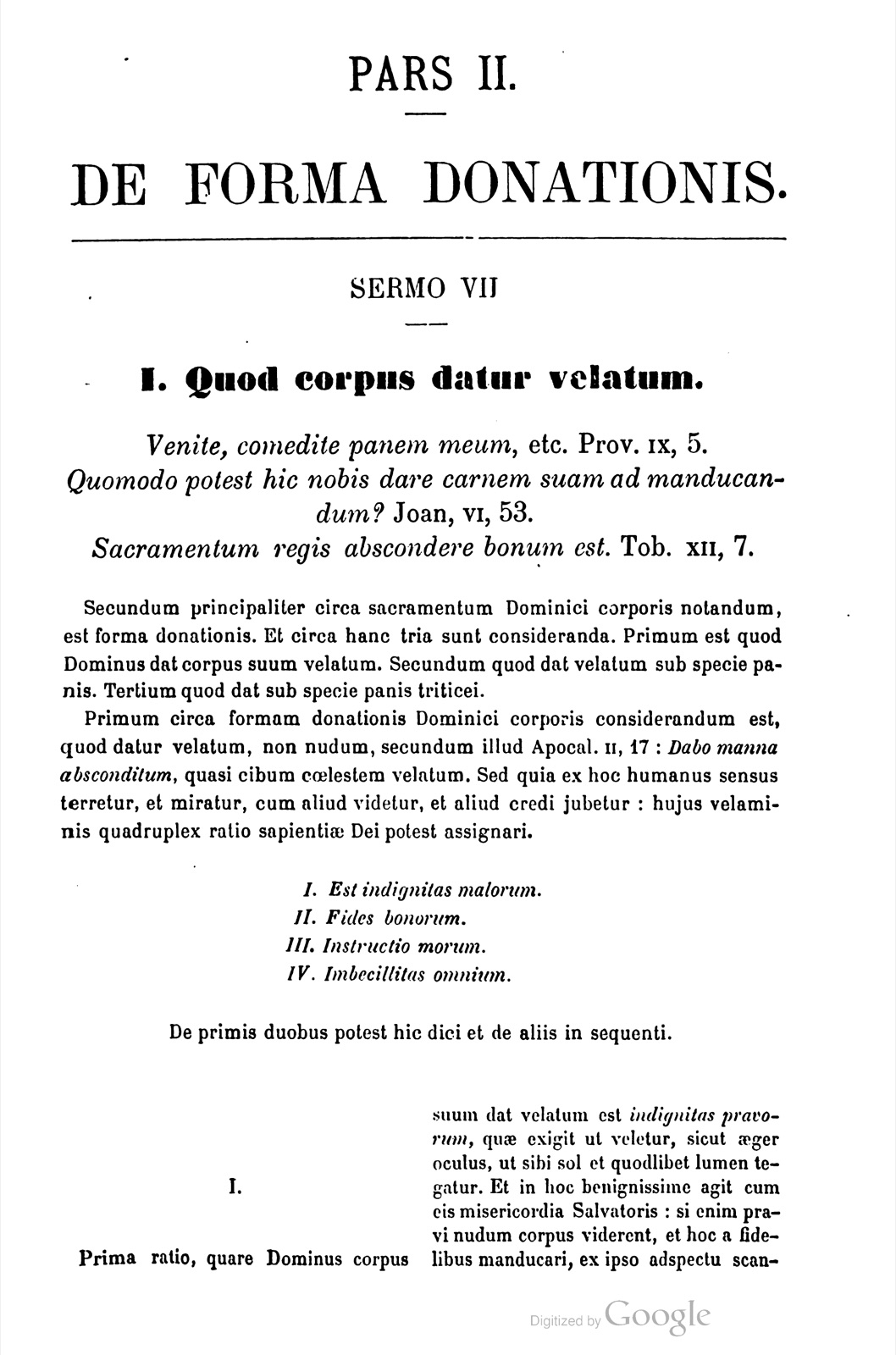
3. De tertio, Num. iv, 19: Aaron et filii ejus intrabunt, ipsi disponent opera, id est, operient sacramenta. Alii nulla curiositate videant quae sunt in sanctuario priusquam involvantur, alioquin morientur. I Reg. vi, 19: Percussit Dominus multos eo quod vidissent arcam Domini, quasi scilicet non licebat eis eam videre detectam. Arca signat corpus Domini quod malignis est velandum, ne spiritualiter moriantur, si videant nudum, quia causa suae caecitatis putarent esse phantasticum. Eccli. i, 22 et 23: In pluribus operibus Dei ne fueris curiosus. Non est enim tibi necessarium ea, quae abscondita sunt, videre oculis tuis.
II.
Secunda ratio est fides bonorum. Et haec ratio potest in tria distingui, quae exigunt hoc velari, scilicet, 1. Fidei esse verum, 2. Infidelitatis primae remedium, 3. Et Fidei meritum.
1. Primo fidei esse verum exigit, ut corpus Christi veletur. Ad Hebr. xi, 1: Fides est argumentum rerum non apparentium. Ut enim dicit Augustinus: « Fides est credere, quod non vides », id est, credere verbis Dei de re occulta, quae vere est, et tamen eam oculis non vides. Nam de re quam videmus, scientiam potius quam fidem habemus. I Pet. i, 8: Christus est in quem non videntes creditis.
II. Quatenus culpae infidelitatis respondeat modus congruus satisfactionis. Unde sicut primorum parentum incredulitas incepit ex auditu verbi diaboli, suadentis cibum habentem quodammodo mortem velatam, et in eo sunt sensus eorum vane delectati: sic congruit ut fides salvandorum incipiat ex auditu verbi Salvatoris, suadentis cibum habentem veram vitam absconditam, et in quo nostri sensus sint pie decepti praeter auditum, ut scilicet fides sit ex auditu tantum, et non ex visu, vel ex aliis sensibus: auditus autem per verbum Christi.
Hoc pulchre figuratum est Gen. xxvii, 27. In benedictione Jacob, ubi sensus Isaac decepti sunt, putantis sentire Esau, dum sensit similitudinem ejus qua velatus erat Jacob, unde sciendum quod in illa figura Dominici corporis quatuor erant personae, scilicet Isaac, et Rebecca, qui masculus et foemina, significant duas naturas in nobis, id est, corpus et animam: masculus qui magis solet esse manifestus et exterioribus plus intendit, significat exteriorem hominem, id est, corpus nostrum cum sensibus suis: foemina quae domi residens familiam regit, signat interiorem hominem, id est, fidelem animam, quae suae salutis et aliorum curam gerit. Jacob bonus et formosus habitans in tabernaculis, quem diligit Rebecca, id est, fidelis anima, signat verum corpus Christi. Esau quem amat Isaac, id est, corpus, eo quod cibis ejus vescitur, signat substantiam panis cum accidentibus, scilicet colore, sapore, et caeteris.
3. Concerning the third, Numbers 4:19: Aaron and his sons will enter; they themselves will arrange the works, that is, cover the sacraments. Let others with no curiosity see the things which are in the sanctuary before they are wrapped, otherwise they will die. 1 Kings 6:19: The Lord struck many because they had seen the ark of the Lord, as though, namely, it was not lawful for them to see it uncovered. The ark signifies the body of the Lord which is to be veiled for the malignant, lest they die spiritually if they see it naked, because because of their blindness they would think it to be phantastic. Ecclesiasticus 1:22 and 23: In the many works of God do not be curious. For it is not necessary for you to see with your eyes the things that are hidden.
II.
The second reason is the faith of the good. And this reason can be distinguished into three things which require this to be veiled, namely, 1. The true being of faith, 2. The remedy of the first unbelief, 3. And the merit of faith.
1. First, the true being of faith requires that the body of Christ be veiled. Hebrews 11:1: Faith is the proof of things not appearing. For as Augustine says: "Faith is to believe what you do not see," that is, to believe the words of God about a hidden thing which truly is, and yet you do not see it with your eyes. For concerning a thing which we see, we have knowledge rather than faith. 1 Peter 1:8: Christ is he in whom, not seeing, you believe.
II. Insofar as a fitting mode of satisfaction should correspond to the fault of unbelief. Hence just as the unbelief of the first parents began from the hearing of the word of the devil, persuading a food having death in some way veiled, and in it their senses were vainly delighted, so it is fitting that the faith of those to be saved begin from the hearing of the word of the Savior, persuading a food having true life hidden, and in which our senses are devoutly deceived except hearing, so that faith may be from hearing alone and not from sight or from the other senses; but hearing through the word of Christ.
This was beautifully figured in Genesis 27:27, in the blessing of Jacob, where the senses of Isaac were deceived, since he thought he perceived Esau while he perceived the likeness of him by which Jacob was veiled. Hence one must know that in that figure of the Lord's body there were four persons, namely Isaac and Rebecca, who, male and female, signify two natures in us, that is, body and soul: the male, who usually is more manifest and attends more to exterior things, signifies the exterior man, that is, our body with its senses; the female, who remains at home and rules the household, signifies the interior man, that is, the faithful soul, which bears care for her own salvation and that of others. Jacob, good and beautiful, dwelling in tents, whom Rebecca loves, that is, the faithful soul, signifies the true body of Christ. Esau, whom Isaac loves, that is, the body, because he is fed with his foods, signifies the substance of bread with accidents, namely color, taste, and the rest.
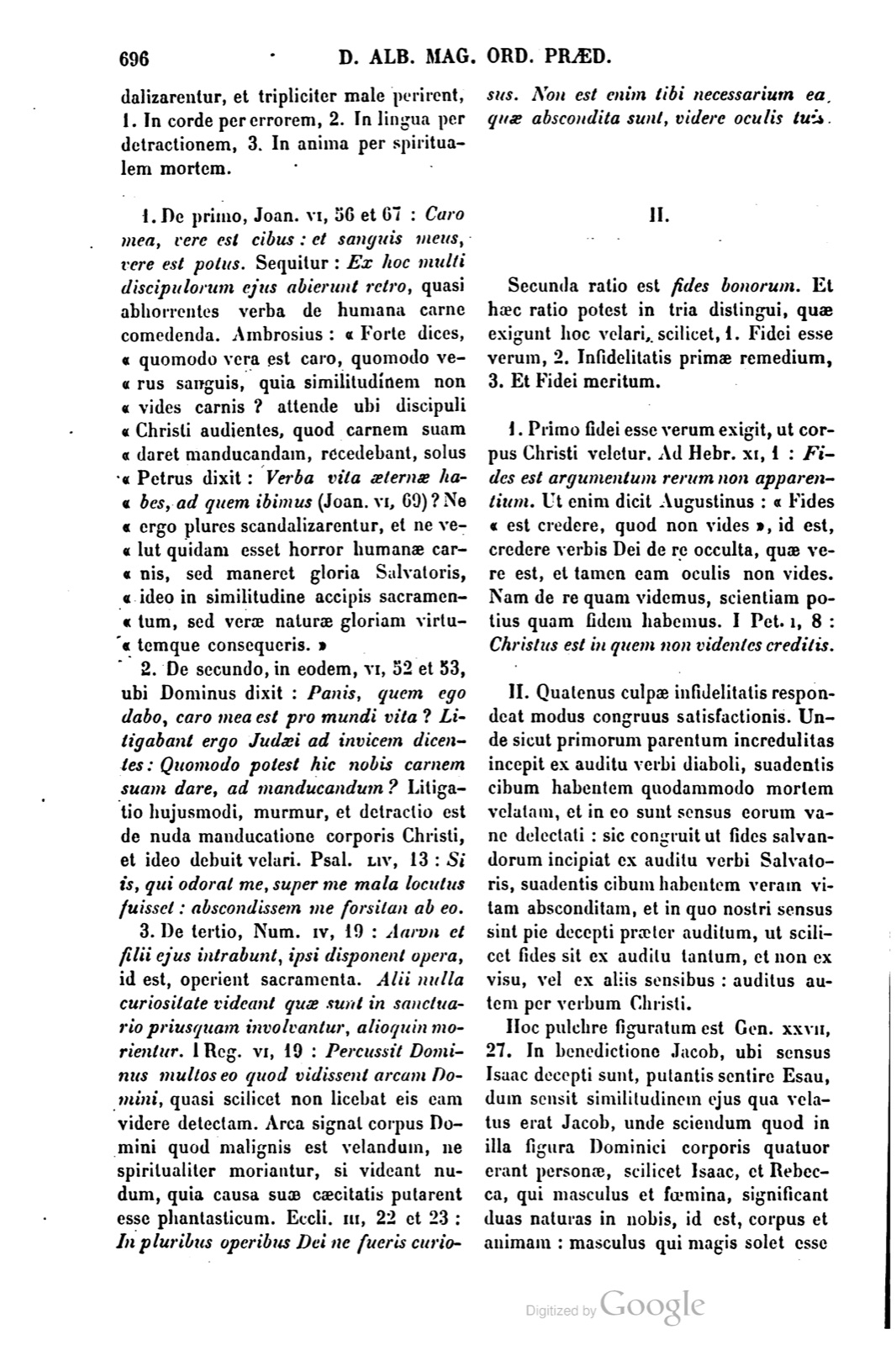
Cum itaque Isaac quasi homo exterior, id est, Sacerdos benedicere debet Esau, id est, panem, Esau recedit, id est, substantia panis, sed similitudo Esau, scilicet vestes cum odore, pelles pilosae, cibus cum sapore, id est, accidentia panis sive similitudo, scilicet color, sapor, odor, durities, manent circa Jacob, id est, corpus Christi: unde in his omnibus sensus Isaac, id est, corporis nostri falluntur.
1. Ibi fallitur visus caliginosus Isaac, id est, debilis corporis nostri, quia putat prae oculis habere Esau, id est, panem, et habet tantum vestes ejus, id est, speciem panis, et sub illa latet Jacob velatus, id est, corpus Christi.
2. Ibi fallitur gustus Isaac, id est, corporis nostri: quia putat gustare, et comedere cibum Esau, id est, panem, et gustat tantum similitudinem ejus.
3. Ibi fallitur olfactus Isaac, id est, corporis nostri, quia putat sentire Esau, id est, panem qui vere non est ibi, sed sentit odorem vestimentorum ejus, id est, formam panis quibus vestitus est Jacob, id est, velatum corpus Christi.
4. Ibi fallitur tactus Isaac, id est, corporis nostri, quia putat tangere Esau, id est, panem, et tangit pelliculas similes Esau, id est, similitudinem sive speciem panis, quibus velatus est Jacob, id est, corpus Christi. Sapiens erat Isaac, sed in judicio cognoscendi Esau fallebatur.
Sic homo noster exterior in judicio panis altaris sensibus fallitur praeterquam in auditu, unde ait: Vox quidem, vox Jacob: sed manus, manus sunt Esau1. Manus quas tango, sunt Esau, nihil falsius. Vox quam audio dicentem: Ego sum, vox Jacob est, nihil verius. Similiter sacramentum quod tango, substantia panis est, nihil falsius. Vox Christi dicentis: Hoc est corpus meum, nihil verius.
And so when Isaac, as the exterior man, that is, the Priest, ought to bless Esau, that is, the bread, Esau withdraws, that is, the substance of bread; but the likeness of Esau, namely the garments with odor, the hairy skins, the food with taste, that is, the accidents of bread or the likeness, namely color, taste, odor, hardness, remain around Jacob, that is, the body of Christ. Hence in all these things the senses of Isaac, that is, of our body, are deceived.
1. There the dim sight of Isaac is deceived, that is, of our weak body, because it thinks it has before its eyes Esau, that is, bread, and has only his garments, that is, the species of bread; and under that Jacob lies hidden, veiled, that is, the body of Christ.
2. There the taste of Isaac is deceived, that is, of our body, because it thinks it tastes and eats the food of Esau, that is, bread, and tastes only the likeness of it.
3. There the smell of Isaac is deceived, that is, of our body, because it thinks it senses Esau, that is, bread, which truly is not there, but senses the odor of his garments, that is, the form of bread with which Jacob is clothed, that is, the veiled body of Christ.
4. There the touch of Isaac is deceived, that is, of our body, because it thinks it touches Esau, that is, bread, and touches little skins like Esau, that is, the likeness or species of bread by which Jacob is veiled, that is, the body of Christ. Isaac was wise, but in the judgment of knowing Esau he was deceived.
Thus our exterior man in the judgment of the bread of the altar is deceived in the senses except in hearing. Hence he says: The voice indeed is the voice of Jacob, but the hands are the hands of Esau1. The hands which I touch are Esau: nothing more false. The voice which I hear saying, I am, is the voice of Jacob: nothing more true. Similarly, the sacrament which I touch is the substance of bread: nothing more false. The voice of Christ saying, This is my body: nothing more true.
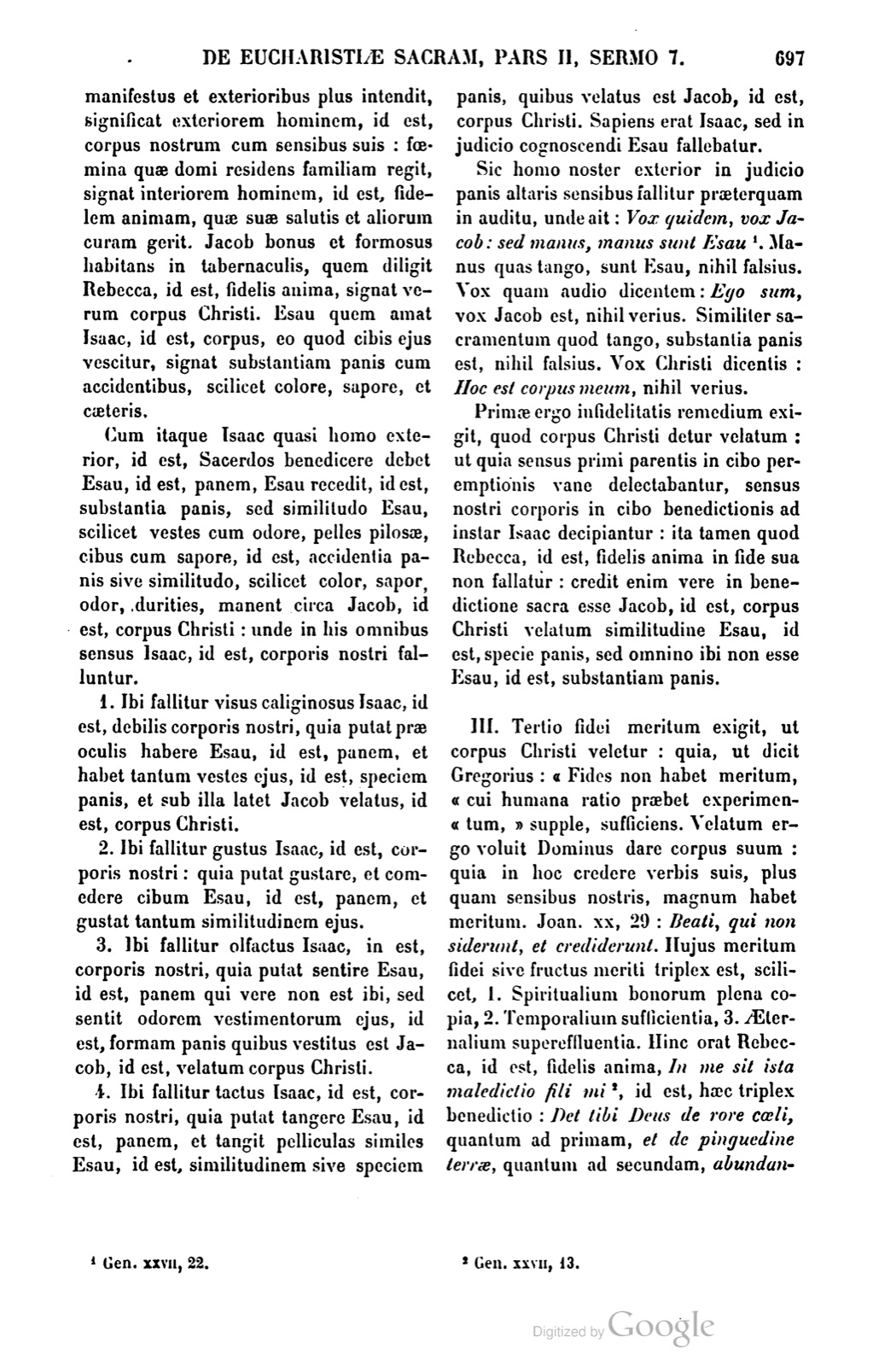
Primae ergo infidelitatis remedium exigit, quod corpus Christi detur velatum: ut quia sensus primi parentis in cibo peremptionis vane delectabantur, sensus nostri corporis in cibo benedictionis ad instar Isaac decipiantur: ita tamen quod Rebecca, id est, fidelis anima in fide sua non fallatur: credit enim vere in benedictione sacra esse Jacob, id est, corpus Christi velatum similitudine Esau, id est, specie panis, sed omnino ibi non esse Esau, id est, substantiam panis.
III. Tertio fidei meritum exigit, ut corpus Christi veletur: quia, ut dicit Gregorius: « Fides non habet meritum, cui humana ratio praebet experimentum, » supple, sufficiens. Velatum ergo voluit Dominus dare corpus suum: quia in hoc credere verbis suis, plus quam sensibus nostris, magnum habet meritum. Joan. xx, 29: Beati, qui non viderunt, et crediderunt. Hujus meritum fidei sive fructus meriti triplex est, scilicet, 1. Spiritualium bonorum plena copia, 2. Temporalium sufficientia, 3. Aeternalium supereffluentia. Hinc orat Rebecca, id est, fidelis anima, In me sit ista maledictio fili mi2, id est, haec triplex benedictio: Det tibi Deus de rore caeli, quantum ad primam, et de pinguedine terrae, quantum ad secundam, abundantiam frumenti et vini3, quantum ad tertiam.
1. De primo, Joan. vii, 38 et 39: Qui credit in me, ... flumina de ventre ejus fluent aquae vivae. Hoc autem dixit de Spiritu, quem accepturi erant credentes in eum. Osee, xiv, 6: Ero quasi ros, Israel germinabit quasi lilium.
2. De secundo, ad Hebr. xi, 33: Sancti per fidem vicerunt regna, adepti sunt repromissiones, scilicet temporalium. Isa. i, 19: Si volueritis et audieritis me, bona terrae comedetis. Matth. vi, 33: Quaerite primum regnum Dei, recte credendo: et justitiam ejus, juste vivendo: et haec omnia adjicientur vobis.
3. De tertio, I Pet. i, 8 et 9: Credentes in Christum quem non videtis, exsultabitis laetitia inenarrabili, et glorificata: reportantes finem fidei vestrae, salutem animarum. Prov. i, 33: Qui me audierit, absque terrore requiescet, et abundantia perfruetur, timore malorum sublato. Amen.
Therefore the remedy of the first unbelief requires that the body of Christ be given veiled, so that because the senses of the first parent were vainly delighted in the food of destruction, the senses of our body in the food of blessing may be deceived after the likeness of Isaac: yet in such a way that Rebecca, that is, the faithful soul, is not deceived in her faith. For she truly believes that in the sacred blessing there is Jacob, that is, the body of Christ veiled by the likeness of Esau, that is, by the species of bread, but that Esau, that is, the substance of bread, is not there at all.
III. Thirdly, the merit of faith requires that the body of Christ be veiled, because, as Gregory says: "Faith does not have merit, for which human reason supplies proof," supply, sufficient proof. Therefore the Lord willed to give his body veiled, because in this, to believe his words more than our senses has great merit. John 20:29: Blessed are those who have not seen and have believed. The merit of this faith, or the fruit of merit, is threefold, namely, 1. Full abundance of spiritual goods, 2. Sufficiency of temporal goods, 3. Superabundance of eternal goods. Hence Rebecca prays, that is, the faithful soul: Let that curse be upon me, my son2, that is, this threefold blessing: May God give you of the dew of heaven, as to the first, and of the fatness of the earth, as to the second, abundance of grain and wine3, as to the third.
1. Concerning the first, John 7:38 and 39: He who believes in me, ... rivers of living water will flow from his belly. But he said this concerning the Spirit, whom those believing in him were going to receive. Hosea 14:6: I will be like dew; Israel will germinate like a lily.
2. Concerning the second, Hebrews 11:33: The Saints through faith conquered kingdoms, obtained promises, namely of temporal things. Isaiah 1:19: If you will and hear me, you will eat the goods of the land. Matthew 6:33: Seek first the kingdom of God, by believing rightly, and his justice, by living justly, and all these things will be added to you.
3. Concerning the third, 1 Peter 1:8 and 9: Believing in Christ whom you do not see, you will exult with unspeakable and glorified joy, carrying back the end of your faith, the salvation of souls. Proverbs 1:33: He who hears me will rest without terror and will enjoy abundance, the fear of evils having been removed. Amen.
If a page does not appear, its photograph has not been uploaded yet.