Works › Posterior Analytics, Books I–II
Volume 2 · pp. 174–176
Chapter IV. Whether the way of introduction into definition is through the definition of definition or of the contrary.
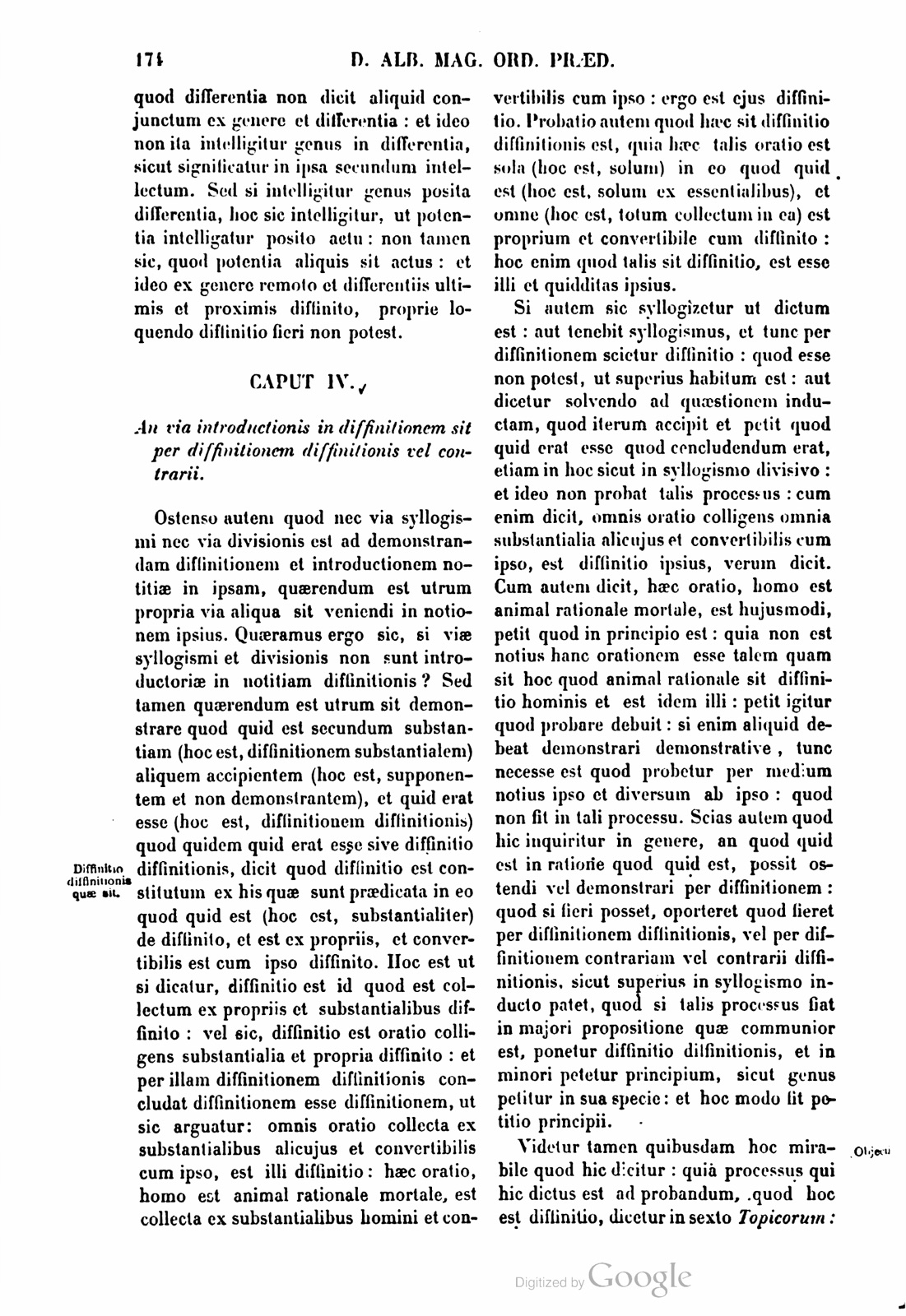
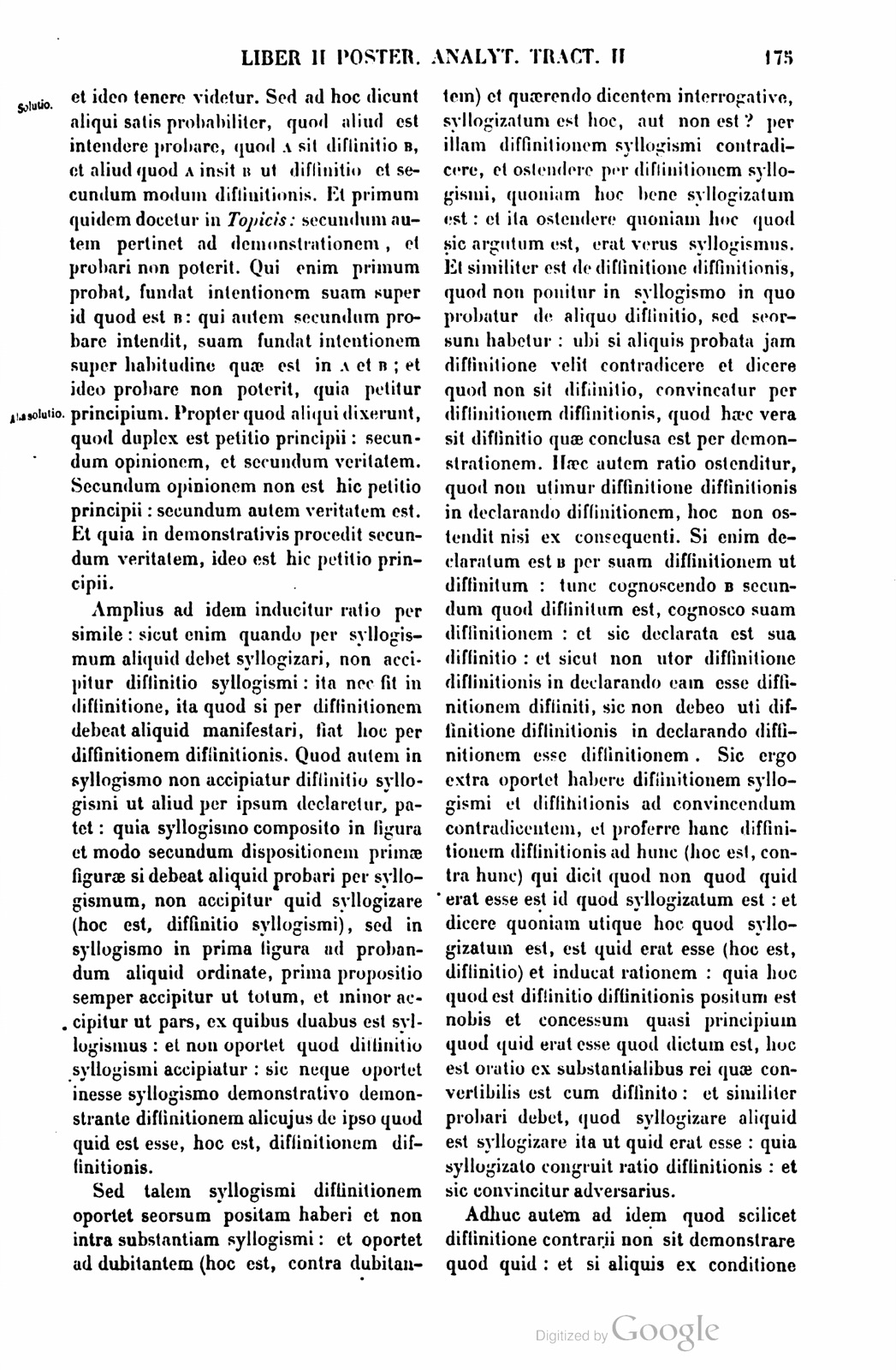
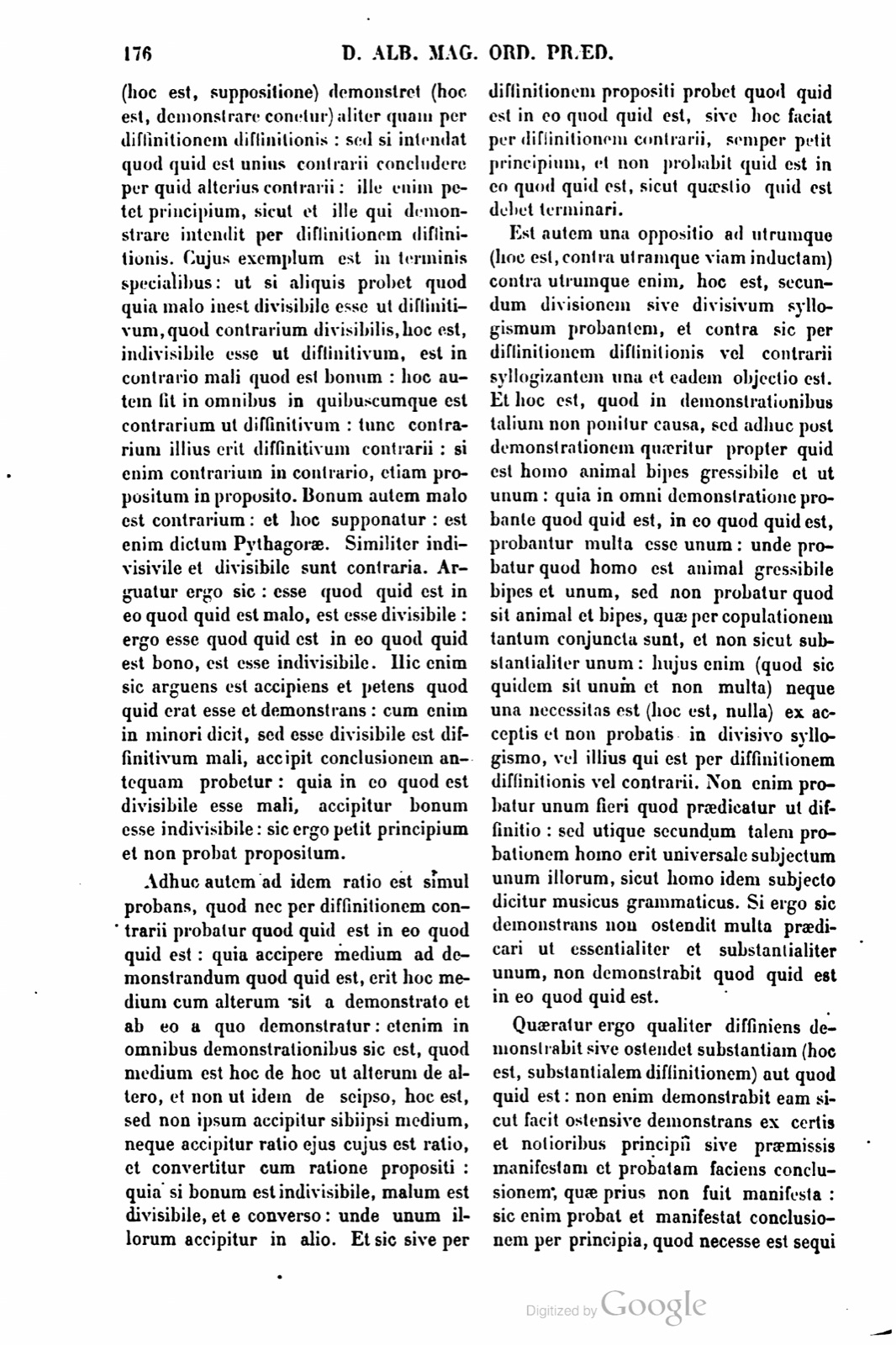
CAPUT IV. An via introductionis in diffinitionem sit per diffinitionem diffinitionis vel contrarii. Ostenso autem quod nec via syllogismi nec via divisionis est ad demonstrandam diffinitionem et introductionem notitiae in ipsam, quaerendum est utrum propria via aliqua sit veniendi in notionem ipsius. Quaeramus ergo sic, si viae syllogismi et divisionis non sunt introductoriae in notitiam diffinitionis? Sed tamen quaerendum est utrum sit demonstrare quod quid est secundum substantiam (hoc est, diffinitionem substantialem) aliquem accipientem (hoc est, supponentem et non demonstrantem), et quid erat esse (hoc est, diffinitionem diffinitionis) quod quidem quid erat esse sive diffinitio diffinitionis, dicit quod diffinitio est constitutum ex his quae sunt praedicata in eo quod quid est (hoc est, substantialiter) de diffinito, et est ex propriis, et convertibilis est cum ipso diffinito. Hoc est ut si dicatur, diffinitio est id quod est collectum ex propriis et substantialibus diffinito: vel sic, diffinitio est oratio colligens substantialia et propria diffinito: et per illam diffinitionem diffinitionis concludat diffinitionem esse diffinitionem, ut sic arguatur: omnis oratio collecta ex substantialibus alicujus et convertibilis cum ipso, est illi diffinitio: haec oratio, homo est animal rationale mortale, est collecta ex substantialibus homini et convertibilis cum ipso: ergo est ejus diffinitio. <marginal-label>Diffinitio diffinitionis quae sit.</marginal-label> Probatio autem quod haec sit diffinitio diffinitionis est, quia haec talis oratio est sola (hoc est, solum) in eo quod quid est (hoc est, solum ex essentialibus), et omne (hoc est, totum collectum in ea) est proprium et convertibile cum diffinito: hoc enim quod talis sit diffinitio, est esse illi et quidditas ipsius. Si autem sic syllogizetur ut dictum est: aut tenebit syllogismus, et tunc per diffinitionem scietur diffinitio: quod esse non potest, ut superius habitum est: aut dicetur solvendo ad quaestionem inductam, quod iterum accipit et petit quod quid erat esse quod concludendum erat, etiam in hoc sicut in syllogismo divisivo: et ideo non probat talis processus: cum enim dicit, omnis oratio colligens omnia substantialia alicujus et convertibilis cum ipso, est diffinitio ipsius, verum dicit. Cum autem dicit, haec oratio, homo est animal rationale mortale, est hujusmodi, petit quod in principio est: quia non est notius hanc orationem esse talem quam sit hoc quod animal rationale sit diffinitio hominis et est idem illi: petit igitur quod probare debuit: si enim aliquid debeat demonstrari demonstrative, tunc necesse est quod probetur per medium notius ipso et diversum ab ipso: quod non fit in tali processu. Scias autem quod hic inquiritur in genere, an quod quid est in ratione quod quid est, possit ostendi vel demonstrari per diffinitionem: quod si fieri posset, oporteret quod fieret per diffinitionem diffinitionis, vel per diffinitionem contrariam vel contrarii diffinitionis, sicut superius in syllogismo inducto patet, quod si talis processus fiat in majori propositione quae communior est, ponetur diffinitio diffinitionis, et in minori petetur principium, sicut genus petitur in sua specie: et hoc modo fit petitio principii. <marginal-label>Objectio.</marginal-label> Videtur tamen quibusdam hoc mirabile quod hic dicitur: quia processus qui hic dictus est ad probandum, quod hoc est diffinitio, dicetur in sexto Topicorum: et ideo tenere videtur. <marginal-label>Solutio.</marginal-label> Sed ad hoc dicunt aliqui satis probabiliter, quod aliud est intendere probare, quod A sit diffinitio B, et aliud quod A insit B ut diffinitio et secundum modum diffinitionis. Et primum quidem docetur in Topicis: secundum autem pertinet ad demonstrationem, et sic probari non poterit. Qui enim primum probat, fundat intentionem suam super id quod est B: qui autem secundum probare intendit, suam fundat intentionem super habitudine quae est inter A et B; et ideo probare non poterit, quia petitur principium. <marginal-label>Alia solutio.</marginal-label> Propter quod aliqui dixerunt, quod duplex est petitio principii: secundum opinionem, et secundum veritatem. Secundum opinionem non est hic petitio principii: secundum autem veritatem est. Et quia in demonstrativis procedit secundum veritatem, ideo est hic petitio principii. Amplius ad idem inducitur ratio per simile: sicut enim quando per syllogismum aliquid debet syllogizari, non accipitur diffinitio syllogismi: ita nec fit in diffinitione, ita quod si per diffinitionem debeat aliquid manifestari, fiat hoc per diffinitionem diffinitionis. Quod autem in syllogismo non accipiatur diffinitio syllogismi ut aliud per ipsum declaretur, patet: quia syllogismo composito in figura et modo secundum dispositionem primae figurae si debeat aliquid probari per syllogismum, non accipitur quid syllogizare (hoc est, diffinitio syllogismi), sed in syllogismo in prima figura ad probandum aliquid ordinate, prima propositio semper accipitur ut totum, et minor accipitur ut pars, ex quibus duabus est syllogismus: et non oportet quod diffinitio syllogismi accipiatur: sic neque oportet inesse syllogismo demonstrativo demonstrante diffinitionem alicujus de ipso quod quid est esse, hoc est, diffinitionem diffinitionis. Sed talem syllogismi diffinitionem oportet seorsum positam haberi et non intra substantiam syllogismi: et oportet ad dubitantem (hoc est, contra dubitantem) et quaerendo dicentem interrogative, syllogizatum est hoc, aut non est? per illam diffinitionem syllogismi contradicere, et ostendere per diffinitionem syllogismi, quoniam hoc bene syllogizatum est: et ita ostendere quoniam hoc quod argutum est, erat verus syllogismus. Et similiter est de diffinitione diffinitionis, quod non ponitur in syllogismo in quo probatur de aliquo diffinitio, sed seorsum habetur: ubi si aliquis probata jam diffinitione velit contradicere et dicere quod non sit diffinitio, convincatur per diffinitionem diffinitionis, quod haec vera sit diffinitio quae conclusa est per demonstrationem. Haec autem ratio ostenditur, quod non utimur diffinitione diffinitionis in declarando diffinitionem, hoc non ostendit nisi ex consequenti. Si enim declaratum est B per suam diffinitionem ut diffinitum: tunc cognoscendo B secundum quod diffinitum est, cognosco suam diffinitionem: et sic declarata est sua diffinitio: et sicut non utor diffinitione diffinitionis in declarando eam esse diffinitionem diffiniti, sic non debeo uti diffinitione diffinitionis in declarando diffinitionem esse diffinitionem. Sic ergo extra oportet habere diffinitionem syllogismi et diffinitionis ad convincendum contradicentem, et proferre hanc diffinitionem diffinitionis ad hunc (hoc est, contra hunc) qui dicit quod non quod quid erat esse est id quod syllogizatum est: et dicere quoniam utique hoc quod syllogizatum est, est quid erat esse (hoc est, diffinitio) et inducat rationem: quia hoc quod est diffinitio diffinitionis positum est nobis et concessum quasi principium quod quid erat esse quod dictum est, hoc est oratio ex substantialibus rei quae convertibilis est cum diffinito: et similiter probari debet, quod syllogizare aliquid est syllogizare ita ut quid erat esse: quia syllogizato congruit ratio diffinitionis: et sic convincitur adversarius. Adhuc autem ad idem quod scilicet diffinitione contrarii non sit demonstrare quod quid: et si aliquis ex conditione (hoc est, suppositione) demonstret (hoc est, demonstrare conetur) aliter quam per diffinitionem diffinitionis: sed si intendat quod quid est unius contrarii concludere per quid alterius contrarii: ille enim petit principium, sicut et ille qui demonstrare intendit per diffinitionem diffinitionis. Cujus exemplum est in terminis specialibus: ut si aliquis probet quod quia malo inest divisibile esse ut diffinitivum, quod contrarium divisibilis, hoc est, indivisibile esse ut diffinitivum, est in contrario mali quod est bonum: hoc autem fit in omnibus in quibuscumque est contrarium ut diffinitivum: tunc contrarium illius erit diffinitivum contrarii: si enim contrarium in contrario, etiam propositum in proposito. Bonum autem malo est contrarium: et hoc supponatur: est enim dictum Pythagorae. Similiter indivisibile et divisibile sunt contraria. Arguatur ergo sic: esse quod quid est in eo quod quid est malo, est esse divisibile: ergo esse quod quid est in eo quod quid est bono, est esse indivisibile. Hic enim sic arguens est accipiens et petens quod quid erat esse et demonstrans: cum enim in minori dicit, sed esse divisibile est diffinitivum mali, accipit conclusionem antequam probetur: quia in eo quod est divisibile esse mali, accipitur bonum esse indivisibile: sic ergo petit principium et non probat propositum. Adhuc autem ad idem ratio est simul probans, quod nec per diffinitionem contrarii probatur quod quid est in eo quod quid est: quia accipere medium ad demonstrandum quod quid est, erit hoc medium cum alterum sit a demonstrato et ab eo a quo demonstratur: etenim in omnibus demonstrationibus sic est, quod medium est hoc de hoc ut alterum de altero, et non ut idem de seipso, hoc est, sed non ipsum accipitur sibi ipsi medium, neque accipitur ratio ejus cujus est ratio, et convertitur cum ratione propositi: quia si bonum est indivisibile, malum est divisibile, et e converso: unde unum illorum accipitur in alio. Et sic sive per diffinitionem propositi probet quod quid est in eo quod quid est, sive hoc faciat per diffinitionem contrarii, semper petit principium, et non probabit quid est in eo quod quid est, sicut quaestio quid est debet terminari. Est autem una oppositio ad utrumque (hoc est, contra utramque viam inductam) contra utrumque enim, hoc est, secundum divisionem sive divisivum syllogismum probantem, et contra sic per diffinitionem diffinitionis vel contrarii syllogizantem una et eadem objectio est. Et hoc est, quod in demonstrationibus talium non ponitur causa, sed adhuc post demonstrationem quaeritur propter quid est homo animal bipes gressibile et ut unum: quia in omni demonstratione probante quod quid est, in eo quod quid est, probantur multa esse unum: unde probatur quod homo est animal gressibile bipes et unum, sed non probatur quod sit animal et bipes, quae per copulationem tantum conjuncta sunt, et non sicut substantialiter unum: hujus enim (quod sic quidem sit unum et non multa) neque una necessitas est (hoc est, nulla) ex acceptis et non probatis in divisivo syllogismo, vel illius qui est per diffinitionem diffinitionis vel contrarii. Non enim probatur unum fieri quod praedicatur ut diffinitio: sed utique secundum talem probationem homo erit universale subjectum unum illorum, sicut homo idem subjecto dicitur musicus grammaticus. Si ergo sic demonstrans non ostendit multa praedicari ut essentialiter et substantialiter unum, non demonstrabit quod quid est in eo quod quid est. Quaeratur ergo qualiter diffiniens demonstrabit sive ostendet substantiam (hoc est, substantialem diffinitionem) aut quod quid est: non enim demonstrabit eam sicut facit ostensive demonstrans ex certis et notioribus principii sive praemissis manifestam et probatam faciens conclusionem, quae prius non fuit manifesta: sic enim probat et manifestat conclusionem per principia, quod necesse est sequi conclusionem: et esse cum illa altera quae sunt praemissa ex quibus sequitur conclusio: ratio enim sic demonstrans est demonstratio et non diffinitio: neque diffiniens sic ex principiis certis procedere potest ad diffinitionis manifestationem. Neque iterum diffiniens manifestare potest diffinitionem in eo quod quid est, sicut inducens singularia, cum ipsa singularia manifesta sint: hoc tamen de singularibus manifestum est, quod omnia sic sunt uno modo secundum praedicari per compositionem, et nulla sit instantia: quia sunt omnia talia id quod quodlibet est tale cui nihil aliter est quam aliis: sed sicut est in uno, ita et in aliis: talis enim tali syllogismo inducto non quid est demonstrat, sed quia sive quoniam est affirmative, vel negative demonstrat quoniam non est: et non demonstrat quid est in eo quod quid est, quia aliud est quia est, et aliud quid est: et sicut sunt diversae quaestiones, ita diversas vias habent suae determinationis. Quis igitur est alius modus relictus quo quaestio quid valeat determinari, ex quo nec ostensive per demonstrationem, nec per syllogismum divisivum, neque per diffinitionem diffinitionis, nec per diffinitionem contrarii valet determinari: nec aliquis dicat quod sensibili demonstratione diffiniens demonstret diffinitionem in eo quod quid est in intelligibilibus, et non in sensibilibus non demonstrabit hoc sensu aut digito.
CHAPTER IV. Whether the way of introduction into definition is through the definition of definition or of the contrary. But when it has been shown that neither the way of syllogism nor the way of division is for demonstrating definition and the introduction of knowledge into it, one must ask whether there is some proper way of coming into the notion of it. Therefore let us ask thus, if the ways of syllogism and division are not introductory into knowledge of definition. But nevertheless it must be asked whether there is demonstrating that which is what it is according to substance, that is, substantial definition, by someone accepting, that is, supposing and not demonstrating, and what it was to be, that is, the definition of definition. This very what it was to be, or definition of definition, says that definition is constituted from those things which are predicates in that which is what it is, that is, substantially, of the defined, and is from proper things, and is convertible with the defined itself. This is as if it is said, definition is that which is gathered from proper and substantial things belonging to the defined; or thus, definition is a speech gathering substantial and proper things belonging to the defined. And through that definition of definition let him conclude definition to be definition, so that it is argued thus: every speech gathered from the substantial things of something and convertible with it is a definition for it; this speech, human being is rational mortal animal, is gathered from substantial things belonging to human being and is convertible with it; therefore it is its definition. <marginal-label>What the definition of definition is.</marginal-label> But the proof that this is the definition of definition is that such a speech is alone, that is, only, in that which is what it is, that is, only from essentials, and every thing, that is, the whole gathered in it, is proper and convertible with the defined; for that such a thing is a definition is the being for it and its quiddity. But if it is syllogized thus, as has been said, either the syllogism will hold, and then definition will be known through definition, which cannot be, as was had above, or it will be said by solving the question brought in that again he accepts and begs what it was to be which was to be concluded, in this too just as in the divisive syllogism; and therefore such a process does not prove. For when he says, every speech gathering all the substantial things of something and convertible with it is its definition, he speaks truly. But when he says, this speech, human being is rational mortal animal, is of this kind, he begs what is in the principle, because it is not better known that this speech is such than that rational animal is the definition of human being, and it is the same as it. Therefore he begs what he ought to have proved. For if something ought to be demonstrated demonstratively, then it must necessarily be proved through a middle better known than it and diverse from it, which is not done in such a process. But you should know that here it is inquired in general whether what it is in the account of what it is can be shown or demonstrated through definition. But if this could be done, it would have to be done through the definition of definition, or through the contrary definition or definition of the contrary, just as above in the syllogism brought in it is clear that, if such a process is made in the major proposition, which is more common, the definition of definition will be placed, and in the minor the principle will be begged, just as genus is begged in its species; and in this way there is begging of the principle. <marginal-label>Objection.</marginal-label> Nevertheless what is said here seems marvelous to certain people, because the process that has been stated here for proving that this is a definition will be stated in the sixth book of the Topics; and therefore it seems to hold. <marginal-label>Solution.</marginal-label> But to this some speak quite probably and say that it is one thing to intend to prove that A is the definition of B, and another that A belongs to B as definition and according to the mode of definition. And the first indeed is taught in the Topics; but the second pertains to demonstration, and thus it cannot be proved. For one who proves the first founds his intention upon that which B is; but one who intends to prove the second founds his intention upon the relation that is between A and B; and therefore he will not be able to prove it, because the principle is begged. <marginal-label>Another solution.</marginal-label> For this reason certain people said that there is a twofold begging of the principle, according to opinion and according to truth. According to opinion there is not begging of the principle here, but according to truth there is. And because in demonstrative matters one proceeds according to truth, therefore there is begging of the principle here. Further, for the same point, a reason is brought in through a similar case: for just as, when something ought to be syllogized through syllogism, the definition of syllogism is not accepted, so neither is it done in definition, in such a way that if something ought to be manifested through definition, this should be done through the definition of definition. But that the definition of syllogism is not accepted in syllogism so that another thing is declared through it is clear, because, when a syllogism has been composed in figure and mode according to the disposition of the first figure, if something ought to be proved through syllogism, what it is to syllogize, that is, the definition of syllogism, is not accepted; but in a syllogism in the first figure for proving something in an ordered way, the first proposition is always accepted as the whole, and the minor is accepted as the part, from which two there is a syllogism; and it is not necessary that the definition of syllogism be accepted. Thus neither is it necessary that there belong to a demonstrative syllogism demonstrating the definition of something concerning it what it is to be, that is, the definition of definition. But such a definition of syllogism must be had placed separately and not within the substance of the syllogism; and it is necessary against one doubting, that is, against the doubter, and against one saying by asking interrogatively, has this been syllogized, or has it not, to contradict through that definition of syllogism and to show through the definition of syllogism that this has been syllogized well; and thus to show that this which has been argued was a true syllogism. And similarly it is concerning the definition of definition, which is not placed in the syllogism in which definition is proved of something, but is had separately; where, if someone, after the definition has now been proved, wishes to contradict and say that it is not a definition, he is convicted through the definition of definition that this is a true definition which has been concluded through demonstration. But this reason shows that we do not use the definition of definition in declaring definition; it shows this only consequently. For if B has been declared through its definition as defined, then by knowing B according as it is defined, I know its definition; and thus its definition has been declared. And just as I do not use the definition of definition in declaring it to be the definition of the defined, so I ought not to use the definition of definition in declaring definition to be definition. Thus, therefore, it is necessary to have the definition of syllogism and of definition outside, for convicting the one contradicting, and to bring forth this definition of definition to this one, that is, against this one, who says that the what it was to be is not that which has been syllogized; and to say that certainly this which has been syllogized is what it was to be, that is, definition, and to bring in the reason, because this which is the definition of definition has been posited for us and conceded as a principle, namely what it was to be which has been said, that is, a speech from the substantial things of the thing which is convertible with the defined. And similarly it ought to be proved that to syllogize something is to syllogize thus as what it was to be, because the account of definition fits what has been syllogized; and thus the adversary is convicted. Moreover for the same point, namely that to demonstrate what through the definition of the contrary is not possible, and if someone from a condition, that is, a supposition, demonstrates, that is, attempts to demonstrate, otherwise than through the definition of definition, but if he intends to conclude what one contrary is through the what of the other contrary, he begs the principle, just as also the one who intends to demonstrate through the definition of definition does. The example of this is in special terms: as if someone proves that, because to be divisible belongs to evil as definitive, the contrary of divisible, that is, to be indivisible as definitive, is in the contrary of evil, which is good. But this happens in all things in which there is a contrary as definitive; then the contrary of that will be definitive of the contrary; for if the contrary is in the contrary, also the proposed thing is in the proposed thing. But good is contrary to evil, and let this be supposed, for it is the saying of Pythagoras. Similarly indivisible and divisible are contraries. Therefore let it be argued thus: the being which is what it is in that which is what it is for evil is to be divisible; therefore the being which is what it is in that which is what it is for good is to be indivisible. For here the one arguing thus is accepting and begging and demonstrating what it was to be; for when in the minor he says, but to be divisible is definitive of evil, he accepts the conclusion before it is proved, because in that which is to be divisible of evil, good to be indivisible is accepted. Thus, therefore, he begs the principle and does not prove the proposed thing. Moreover for the same point there is a reason proving at the same time that not even through the definition of the contrary is what it is in that which is what it is proved, because to accept a middle for demonstrating what it is will be this middle, since it is one thing from the demonstrated thing and from that from which it is demonstrated. For in all demonstrations it is thus, that the middle is this of this as one thing of another, and not as the same of itself, that is, it is not accepted as a middle for itself, nor is the account of that of which it is the account accepted, and converted with the account of the proposed thing, because if good is indivisible, evil is divisible, and conversely. Hence one of those is accepted in the other. And thus whether through the definition of the proposed thing he proves what it is in that which is what it is, or whether he does this through the definition of the contrary, he always begs the principle, and he will not prove what it is in that which is what it is, as the question what it is ought to be terminated. But there is one opposition against both, that is, against each way brought in; for against both, that is, according to division or the divisive syllogism proving, and against one syllogizing thus through the definition of definition or of the contrary, there is one and the same objection. And this is that in demonstrations of such things a cause is not posited, but after the demonstration one still asks on account of what human being is two-footed walking animal and as one, because in every demonstration proving what it is in that which is what it is, many things are proved to be one. Hence it is proved that a human being is walking two-footed animal and one, but it is not proved that it is animal and two-footed, which are joined only through copulation and not as substantially one. For of this, namely that it is thus one and not many, there is not even one necessity, that is, none, from the things accepted and not proved in the divisive syllogism, or in that which is through the definition of definition or of the contrary. For the one thing which is predicated as definition is not proved to come to be one; but certainly according to such a proof human being will be the one universal subject of those things, just as human being, the same in subject, is said to be musical and grammatical. Therefore if one demonstrating thus does not show many things to be predicated as essentially and substantially one, he will not demonstrate what it is in that which is what it is. Therefore let it be asked in what way one defining will demonstrate or show substance, that is, substantial definition, or what it is. For he will not demonstrate it as one demonstrating ostensively does from certain and better-known principles or premises, making manifest and proved a conclusion which previously was not manifest; for thus he proves and manifests the conclusion through principles, because the conclusion must follow and be with those other things which are the premises from which the conclusion follows. For an account demonstrating in this way is demonstration and not definition; nor can one defining proceed thus from certain principles to the manifestation of definition. Nor again can one defining manifest definition in that which is what it is as one inducing singulars does, since the singulars themselves are manifest. Nevertheless this is manifest concerning singulars, that all are thus in one mode according to being predicated through composition, and that there is no instance against it, because they are all such: that which anything is is such, to which nothing is otherwise than to the others; but as it is in one, so also in the others. For such a one by such an induced syllogism does not demonstrate what it is, but demonstrates that or because it is affirmatively, or negatively demonstrates that it is not; and he does not demonstrate what it is in that which is what it is, because that it is is one thing, and what it is another; and just as the questions are diverse, so they have diverse ways of their determination. Therefore what is the other mode left by which the question what may be determined, since it cannot be determined ostensively through demonstration, nor through divisive syllogism, nor through the definition of definition, nor through the definition of the contrary; nor let anyone say that one defining demonstrates definition in that which is what it is in intelligible things by a sensible demonstration, and not in sensible things; he will not demonstrate this by sense or finger.
If a page does not appear, its photograph has not been uploaded yet.