Works › Posterior Analytics, Books I–II
Volume 2 · pp. 73–84
Treatise III, Chapter II Continuation. On the Use of Complex Principles in Demonstrations
A marker with ≈ is an approximate page boundary, placed by measure of the text; the page photographs remain the authority. In the paired views, clicking a page marker brings that page into view.
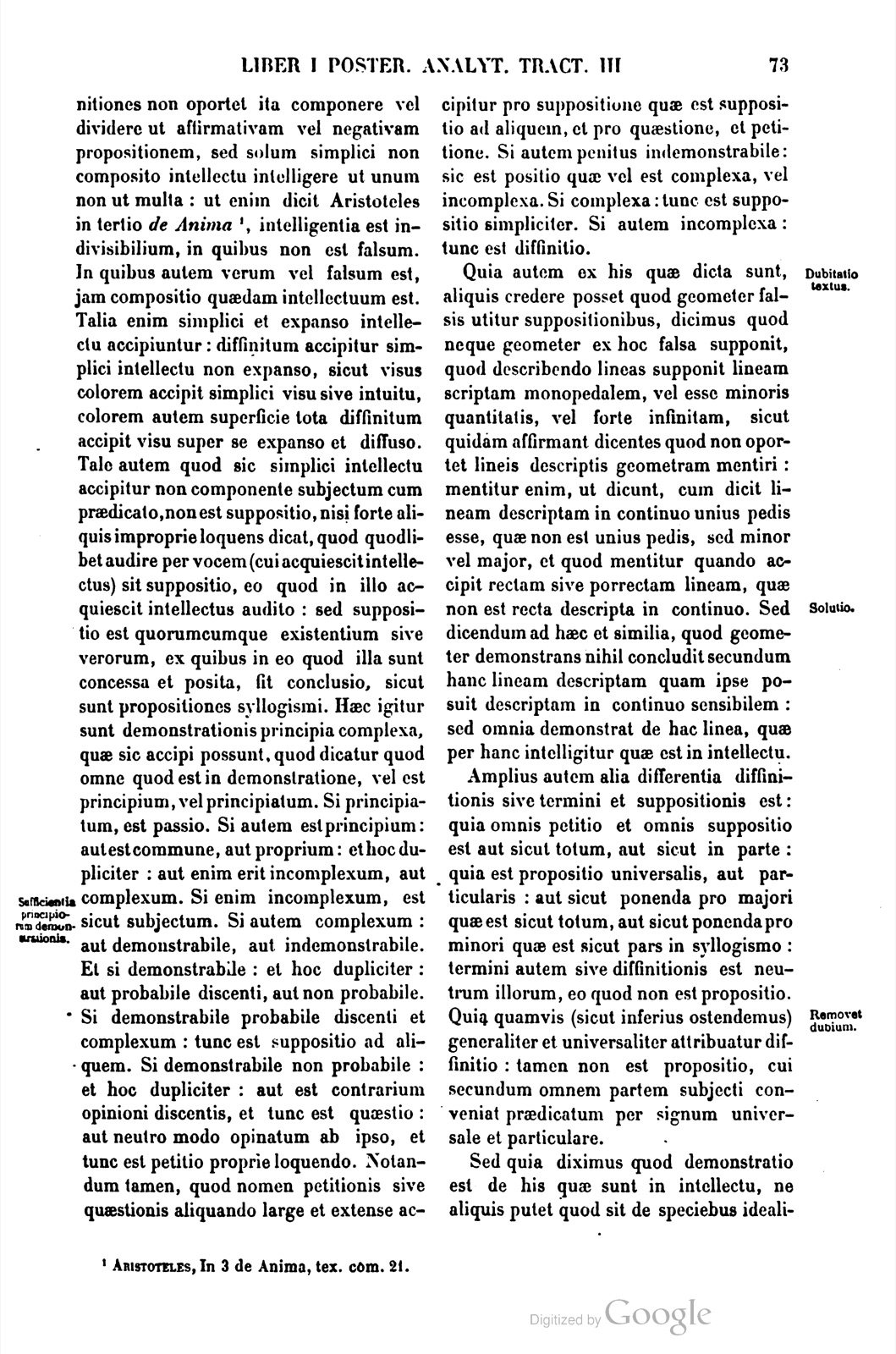
non oportet ita componere vel dividere ut affirmativam vel negativam propositionem, sed solum simplici non composito intellectu intelligere ut unum non ut multa: ut enim dicit Aristoteles in tertio de Anima 1, intelligentia est indivisibilium, in quibus non est falsum. In quibus autem verum vel falsum est, jam compositio quaedam intellectuum est. Talia enim simplici et expanso intellectu accipiuntur: diffinitum accipitur simplici intellectu non expanso, sicut visus colorem accipit simplici visu sive intuitu, colorem autem superficie tota diffinitum accipit visu super se expanso et diffuso. Tale autem quod sic simplici intellectu accipitur non componente subjectum cum praedicato, non est suppositio, nisi forte aliquis improprie loquens dicat, quod quodlibet audire per vocem, cui acquiescit intellectus, sit suppositio, eo quod in illo acquiescit intellectus audito: sed suppositio est quorumcumque existentium sive verorum, ex quibus in eo quod illa sunt concessa et posita, fit conclusio, sicut sunt propositiones syllogismi. Haec igitur sunt demonstrationis principia complexa, quae sic accipi possunt, quod dicatur quod omne quod est in demonstratione, vel est principium, vel principiatum. Si principiatum, est passio. Si autem est principium: aut est commune, aut proprium: et hoc dupliciter: aut enim erit incomplexum, aut complexum. Si enim incomplexum, est aut demonstrabile, aut indemonstrabile. Et si demonstrabile: et hoc dupliciter: aut probabile discenti, aut non probabile. Si demonstrabile probabile discenti et complexum: tunc est suppositio ad aliquem. Si demonstrabile non probabile: et hoc dupliciter: aut est contrarium opinioni discentis, et tunc est quaestio: aut neutro modo opinatum ab ipso, et tunc est petitio proprie loquendo. Notandum tamen, quod nomen petitionis sive quaestionis aliquando large et extense accipitur pro suppositione quae est suppositio ad aliquem, et pro quaestione, et petitione. Si autem penitus indemonstrabile: sic est positio quae vel est complexa, vel incomplexa. Si complexa: tunc est suppositio simpliciter. Si autem incomplexa: tunc est diffinitio.
Quia autem ex his quae dicta sunt, aliquis credere posset quod geometer falsis utitur suppositionibus, dicimus quod neque geometer ex hoc falsa supponit, quod describendo lineas supponit lineam scriptam monopedalem, vel esse minoris quantitatis, vel forte infinitam, sicut quidam affirmant dicentes quod non oportet lineis descriptis geometram mentiri: mentitur enim, ut dicunt, cum dicit lineam descriptam in continuo unius pedis esse, quae non est unius pedis, sed minor vel major, et quod mentitur quando accipit rectam sive porrectam lineam, quae non est recta descripta in continuo. Sed dicendum ad haec et similia, quod geometer demonstrans nihil concludit secundum hanc lineam descriptam quam ipse posuit descriptam in continuo sensibilem: sed omnia demonstrat de hac linea, quae per hanc intelligitur quae est in intellectu.
Amplius autem alia differentia diffinitionis sive termini et suppositionis est: quia omnis petitio et omnis suppositio est aut sicut totum, aut sicut in parte: quia est propositio universalis, aut particularis: aut sicut ponenda pro majori quae est sicut totum, aut sicut ponenda pro minori quae est sicut pars in syllogismo: termini autem sive diffinitionis est neutrum illorum, eo quod non est propositio. Quia quamvis, sicut inferius ostendemus, generaliter et universaliter attribuatur diffinitio: tamen non est propositio, cui secundum omnem partem subjecti conveniat praedicatum per signum universale et particulare.
Sed quia diximus quod demonstratio est de his quae sunt in intellectu, ne aliquis putet quod sit de speciebus idealibus, quas Plato posuit esse in intellectu, et secundum esse non esse in rebus singularibus, sed extra ea: dicimus quod species quidem tales esse, quae extra res singulares sunt, aut unum aliquid separatum, extra multa, hoc est, multitudinem singularium secundum esse non necesse est, propter hoc quod dictum est de lineis in intellectu existentibus, de quibus est demonstratio: non enim propter hoc si erit de his demonstratio quae in intellectu sunt, necesse est tales esse species sive formas. Tamen verum est dicere quod necesse est universale de quo fit demonstratio, esse unum quod sit de multis quoad praedicationem vel actu vel aptitudine: hoc enim est necesse si sit universale: non enim erit vel esse poterit universale, nisi hoc sit quod sit unum de multis et in multis: si vero non sit universale, medium in demonstratione non erit: quia, sicut ante habitum est, demonstratio de singulari esse non poterit: et si non sit medium, non potest esse demonstratio: quia omnis demonstratio est per medium quod est de omni et semper: oportet namque medium demonstrationis aliquod universale unum et idem esse de pluribus et non aequivocum in omni demonstratione. Dico autem unum secundum rationem, et idem secundum substantiam et naturam, ut sit nomen unum et ratio substantiae eadem et non diversa. Taliter igitur in usu demonstrationis ostensivae se habent principia completa.
it is not necessary so to compose or divide them as an affirmative or negative proposition, but only to understand them by a simple, non-composed intellect as one and not as many. For as Aristotle says in the third book On the Soul 1, understanding is of indivisible things, in which there is no falsity. But in those things in which there is truth or falsity, there is already a certain composition of understandings. For such things are received by a simple and expanded intellect; the thing defined is received by a simple intellect that is not expanded, just as sight receives color by simple sight or intuition, but receives color defined over the whole surface by sight expanded and diffused over it. But such a thing, which is thus received by a simple intellect not composing subject with predicate, is not a supposition, unless perhaps someone, speaking improperly, should say that anything heard through a word, to which the intellect assents, is a supposition, because the intellect assents to that thing once it is heard. But supposition belongs to whatever existing or true things from which, insofar as they are conceded and posited, a conclusion is made, as are the propositions of a syllogism. Therefore these are the complex principles of demonstration, which can be received in such a way that it is said that everything which is in demonstration is either a principle or something principled. If it is something principled, it is a property. But if it is a principle, it is either common or proper; and this in two ways, for it will be either incomplex or complex. For if it is incomplex, it is either demonstrable or indemonstrable. And if it is demonstrable, this is in two ways: either probable to the learner or not probable. If it is demonstrable, probable to the learner, and complex, then it is a supposition in relation to someone. If it is demonstrable and not probable, this too is in two ways: either it is contrary to the learner's opinion, and then it is a question, or it is opined by him in neither mode, and then it is a petition properly speaking. Yet it must be noted that the name of petition or question is sometimes taken broadly and extensively for a supposition which is a supposition in relation to someone, and for a question, and for a petition. But if it is wholly indemonstrable, then it is a position which is either complex or incomplex. If it is complex, then it is a supposition simply. But if it is incomplex, then it is a definition.
But because from the things that have been said someone could believe that the geometer uses false suppositions, we say that the geometer does not on this account suppose false things, because by describing lines he supposes the written line to be one foot long, or to be of a lesser quantity, or perhaps to be infinite, as certain persons affirm when they say that it is not fitting for a geometer to lie in described lines. For, as they say, he lies when he says that a line described in a continuum is of one foot, when it is not of one foot but less or greater, and that he lies when he receives a straight or extended line which is not a straight line described in a continuum. But to these and similar things it must be said that the geometer, while demonstrating, concludes nothing according to this described line which he himself has posited as described in a sensible continuum, but demonstrates all things about this line, which is understood through this line, and which exists in the intellect.
Moreover, another difference between definition or term and supposition is this: every petition and every supposition is either as a whole or as in a part, because it is a universal proposition or a particular proposition, or as something to be posited for the major, which is as the whole, or as something to be posited for the minor, which is as the part in the syllogism. But a term or definition is neither of those, because it is not a proposition. For although, as we shall show below, a definition is attributed generally and universally, nevertheless it is not a proposition to which a predicate belongs according to every part of the subject through a universal and particular sign.
But because we have said that demonstration is about those things which are in the intellect, lest someone think that it is about ideal species which Plato posited to be in the intellect and, according to being, not to exist in singular things but outside them, we say that it is not necessary, on account of what has been said about lines existing in the intellect, about which there is demonstration, that there be such species, which are outside singular things, or some one separated thing outside many, that is, outside the multitude of singulars according to being. For on this account, if there will be demonstration about those things which are in the intellect, it is not necessary that there be such species or forms. Yet it is true to say that the universal about which demonstration is made must be one thing which is of many with respect to predication, either in act or in aptitude; for this is necessary if it is universal. For it will not be, nor will it be able to be, universal unless it is this, that it is one of many and in many. But if it is not universal, there will be no middle in demonstration, because, as was had before, there will not be able to be demonstration of a singular; and if there is no middle, there cannot be demonstration, because every demonstration is through a middle which is of every and always. For the middle of demonstration must be some universal, one and the same, about many things, and not equivocal in every demonstration. But I call it one according to account, and the same according to substance and nature, so that there is one name and the same, not diverse, account of substance. Therefore in such a way the complete principles are related in the use of ostensive demonstration.
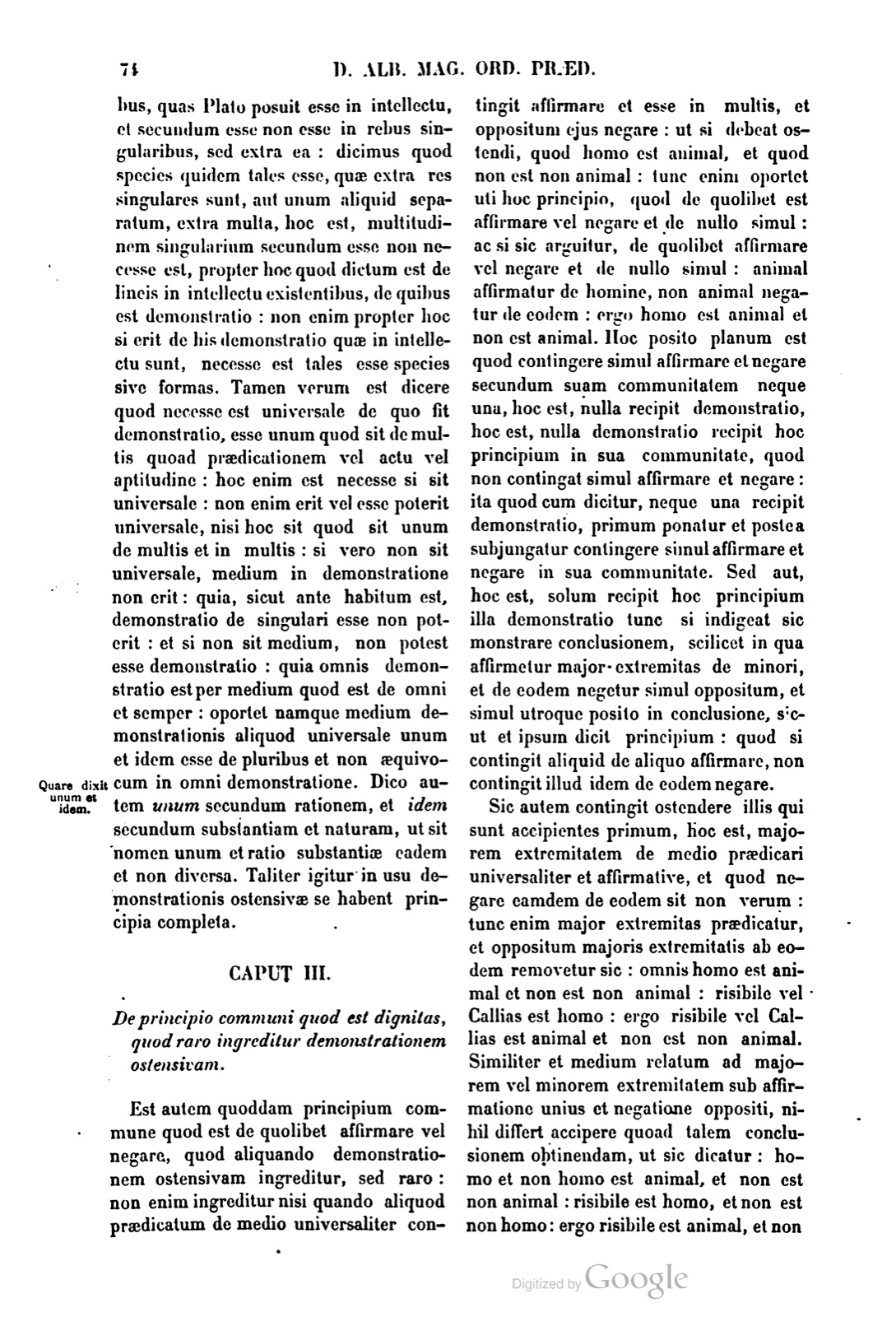
Caput III. De principio communi quod est dignitas, quod raro ingreditur demonstrationem ostensivam.
Est autem quoddam principium commune quod est de quolibet affirmare vel negare, quod aliquando demonstrationem ostensivam ingreditur, sed raro: non enim ingreditur nisi quando aliquod praedicatum de medio universaliter contingit affirmare et esse in multis, et oppositum ejus negare: ut si debeat ostendi, quod homo est animal, et quod non est non animal: tunc enim oportet uti hoc principio, quod de quolibet est affirmare vel negare et de nullo simul: ac si sic arguitur, de quolibet affirmare vel negare et de nullo simul: animal affirmatur de homine, non animal negatur de eodem: ergo homo est animal et non est non animal. Hoc posito planum est quod contingere simul affirmare et negare secundum suam communitatem neque una, hoc est, nulla recipit demonstratio, hoc est, nulla demonstratio recipit hoc principium in sua communitate, quod non contingat simul affirmare et negare: ita quod cum dicitur, neque una recipit demonstratio, primum ponatur et postea subjungatur contingere simul affirmare et negare in sua communitate. Sed aut, hoc est, solum recipit hoc principium illa demonstratio tunc si indigeat sic monstrare conclusionem, scilicet in qua affirmetur major extremitas de minori, et de eodem negetur simul oppositum, et simul utroque posito in conclusione, sicut et ipsum dicit principium: quod si contingit aliquid de aliquo affirmare, non contingit illud idem de eodem negare.
Sic autem contingit ostendere illis qui sunt accipientes primum, hoc est, majorem extremitatem de medio praedicari universaliter et affirmative, et quod negare eamdem de eodem sit non verum: tunc enim major extremitas praedicatur, et oppositum majoris extremitatis ab eodem removetur sic: omnis homo est animal et non est non animal: risibile vel Callias est homo: ergo risibile vel Callias est animal et non est non animal. Similiter et medium relatum ad majorem vel minorem extremitatem sub affirmatione unius et negatione oppositi, nihil differt accipere quoad talem conclusionem obtinendam, ut sic dicatur: homo et non homo est animal, et non est non animal: risibile est homo, et non est non homo: ergo risibile est animal, et non est non animal: sic enim medium accipitur esse et non esse. Similiter autem quoad talem conclusionem obtinendam nihil differt minorem extremitatem ad medium et ad majorem extremitatem esse relatam sub affirmatione et negatione, et hoc est, esse et non esse: si enim assignetur homo de homine singulari, hoc est, de aliquo homine singulari, ut de Callia, de quo sit verum dicere animal, et non sit verum dicere non animal: quamvis tamen verum sit dicere, aliquid quod non est homo, est animal, ut asinus: tamen adhuc eadem habebitur conclusio sic: omnis homo est animal et non est non animal: Callias et non Callias est homo: ergo Callias et non Callias est animal et non est non animal.
Chapter III. On the common principle which is a dignity, which rarely enters ostensive demonstration.
There is, moreover, a certain common principle, which is this: that concerning anything whatever there is affirmation or negation, and this principle sometimes enters ostensive demonstration, but rarely. For it does not enter except when some predicate can be affirmed universally of the middle, and can be in many things, and the opposite of that predicate can be denied. Thus, if it must be shown that man is animal and that man is not non-animal, then it is necessary to use this principle, that of anything whatever there is affirmation or negation and of nothing both at once. It is as if one argues thus: concerning anything whatever there is affirmation or negation and concerning nothing are both at once; animal is affirmed of man, and non-animal is denied of the same; therefore man is animal and is not non-animal. Once this is posited, it is plain that no demonstration, that is, not one demonstration, or no demonstration at all, receives the possibility of affirming and denying at the same time according to its commonness; that is, no demonstration receives this principle in its commonness, namely that it is not possible to affirm and deny at the same time. Thus when it is said, "no demonstration receives," let the first part be posited and afterward let there be joined under it the expression that affirming and denying together is possible in its commonness. But, or rather only, that demonstration receives this principle at that time if it needs to show a conclusion in this way, namely one in which the major extreme is affirmed of the minor and at the same time the opposite is denied of the same, and both are posited together in the conclusion, just as the principle itself says: if it is possible to affirm something of something, it is not possible to deny that same thing of the same thing.
But thus it happens to show this to those who receive the first, that is, the major extreme, as predicated of the middle universally and affirmatively, and that to deny the same thing of the same is not true. For then the major extreme is predicated, and the opposite of the major extreme is removed from the same thing thus: every man is animal and is not non-animal; risible or Callias is man; therefore risible or Callias is animal and is not non-animal. Similarly, for obtaining such a conclusion, it makes no difference to receive the middle related to the major or minor extreme under the affirmation of one and the negation of the opposite, so that it is said thus: man and non-man is animal and is not non-animal; risible is man and is not non-man; therefore risible is animal and is not non-animal. For in this way the middle is received as being and not being. Likewise, for obtaining such a conclusion it makes no difference that the minor extreme is related to the middle and to the major extreme under affirmation and negation, and this is being and not being. For if man is assigned of a singular man, that is, of some singular man, as of Callias, of whom it is true to say animal and not true to say non-animal, although nevertheless it is true to say that something which is not man is animal, as an ass is, nevertheless the same conclusion will still be had thus: every man is animal and is not non-animal; Callias and non-Callias is man; therefore Callias and non-Callias is animal and is not non-animal.
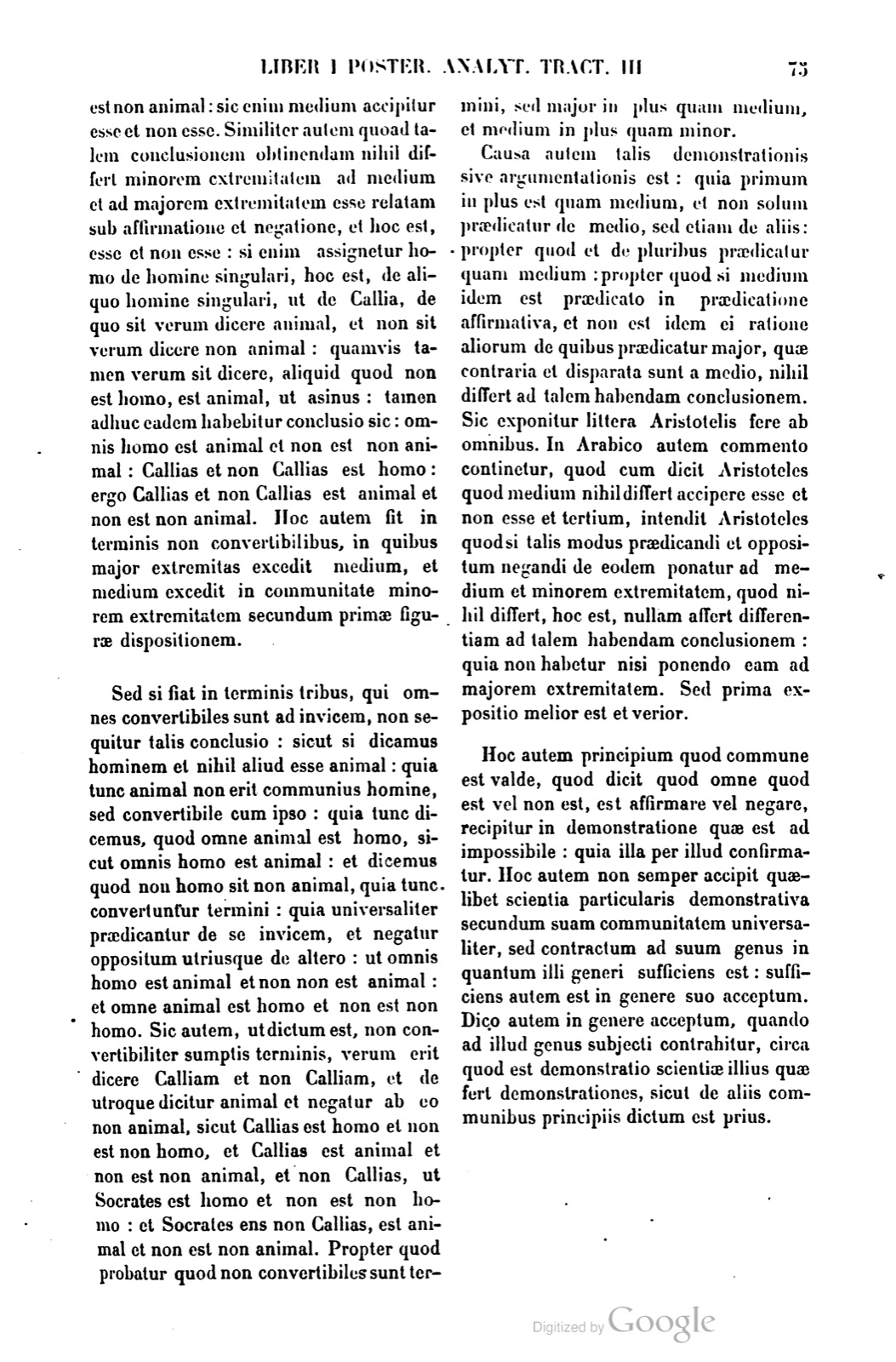
Hoc autem fit in terminis non convertibilibus, in quibus major extremitas excedit medium, et medium excedit in communitate minorem extremitatem secundum primae figurae dispositionem. Sed si fiat in terminis tribus, qui omnes convertibiles sunt ad invicem, non sequitur talis conclusio: sicut si dicamus hominem et nihil aliud esse animal: quia tunc animal non erit communius homine, sed convertibile cum ipso: quia tunc dicemus, quod omne animal est homo, sicut omnis homo est animal: et dicemus quod non homo sit non animal, quia tunc convertuntur termini: quia universaliter praedicantur de se invicem, et negatur oppositum utriusque de altero: ut omnis homo est animal et non non est animal: et omne animal est homo et non est non homo. Sic autem, ut dictum est, non convertibiliter sumptis terminis, verum erit dicere Calliam et non Calliam, et de utroque dicitur animal et negatur ab eo non animal, sicut Callias est homo et non est non homo, et Callias est animal et non est non animal, et non Callias, ut Socrates est homo et non est non homo: et Socrates ens non Callias, est animal et non est non animal. Propter quod probatur quod non convertibiles sunt termini, sed major in plus quam medium, et medium in plus quam minor.
Causa autem talis demonstrationis argumentationis est: quia primum in plus est quam medium, et non solum praedicatur de medio, sed etiam de aliis: propter quod et de pluribus praedicatur quam medium: propter quod si medium idem est praedicato in praedicatione affirmativa, et non est idem ei ratione aliorum de quibus praedicatur major, quae contraria et disparata sunt a medio, nihil differt ad talem habendam conclusionem. Sic exponitur littera Aristotelis fere ab omnibus. In Arabico autem commento continetur, quod cum dicit Aristoteles quod medium nihil differt accipere esse et non esse et tertium, intendit Aristoteles quod si talis modus praedicandi et oppositum negandi de eodem ponatur ad medium et minorem extremitatem, quod nihil differt, hoc est, nullam affert differentiam ad talem habendam conclusionem: quia non habetur nisi ponendo eam ad majorem extremitatem. Sed prima expositio melior est et verior.
Hoc autem principium quod commune est valde, quod dicit quod omne quod est vel non est, est affirmare vel negare, recipitur in demonstratione quae est ad impossibile: quia illa per illud confirmatur. Hoc autem non semper accipit quaelibet scientia particularis demonstrativa secundum suam communitatem universaliter, sed contractum ad suum genus in quantum illi generi sufficiens est: sufficiens autem est in genere suo acceptum. Dico autem in genere acceptum, quando ad illud genus subjecti contrahitur, circa quod est demonstratio scientiae illius quae fert demonstrationes, sicut de aliis communibus principiis dictum est prius.
But this occurs in non-convertible terms, in which the major extreme exceeds the middle, and the middle exceeds the minor extreme in commonness according to the disposition of the first figure. But if it occurs in three terms which are all convertible with one another, such a conclusion does not follow, as if we were to say that man and nothing else is animal, because then animal will not be more common than man, but convertible with it. For then we shall say that every animal is man, just as every man is animal; and we shall say that non-man is non-animal, because then the terms are converted, since they are predicated of one another universally, and the opposite of each is denied of the other, as every man is animal and is not not animal, and every animal is man and is not non-man. But when the terms are taken non-convertibly in this way, as has been said, it will be true to say Callias and non-Callias, and animal is said of each and non-animal is denied of it, just as Callias is man and is not non-man, and Callias is animal and is not non-animal; and non-Callias, as Socrates, is man and is not non-man, and Socrates, being non-Callias, is animal and is not non-animal. On account of this it is proved that the terms are not convertible, but the major is broader than the middle, and the middle broader than the minor.
But the cause of the argumentation of such a demonstration is that the first is broader than the middle, and is not only predicated of the middle, but also of other things; on account of this it is also predicated of more things than the middle is. On account of this, if the middle is the same as the predicate in affirmative predication, and is not the same as it by reason of the other things of which the major is predicated, which are contrary and disparate from the middle, it differs in nothing, or makes no difference, for having such a conclusion. The text of Aristotle is explained in this way by almost everyone. But in the Arabic commentary it is contained that, when Aristotle says that it makes no difference to receive the middle as being and not being and the third, Aristotle intends that if such a mode of predicating and of denying the opposite of the same thing is posited for the middle and for the minor extreme, it makes no difference, that is, it brings no difference at all for having such a conclusion, because the conclusion is had only by positing this mode for the major extreme. But the first exposition is better and truer.
But this principle, which is very common, which says that everything which is or is not is subject to affirmation or negation, is received in the demonstration which is to the impossible, because that demonstration is confirmed through that principle. But not every particular demonstrative science always receives this principle according to its universal commonness, but receives it contracted to its own genus insofar as it is sufficient for that genus; and it is sufficient when it is received in its own genus. Now I call it received in a genus when it is contracted to that genus of subject around which the demonstration of that science is concerned, the science which brings forth demonstrations, as was said before about the other common principles.
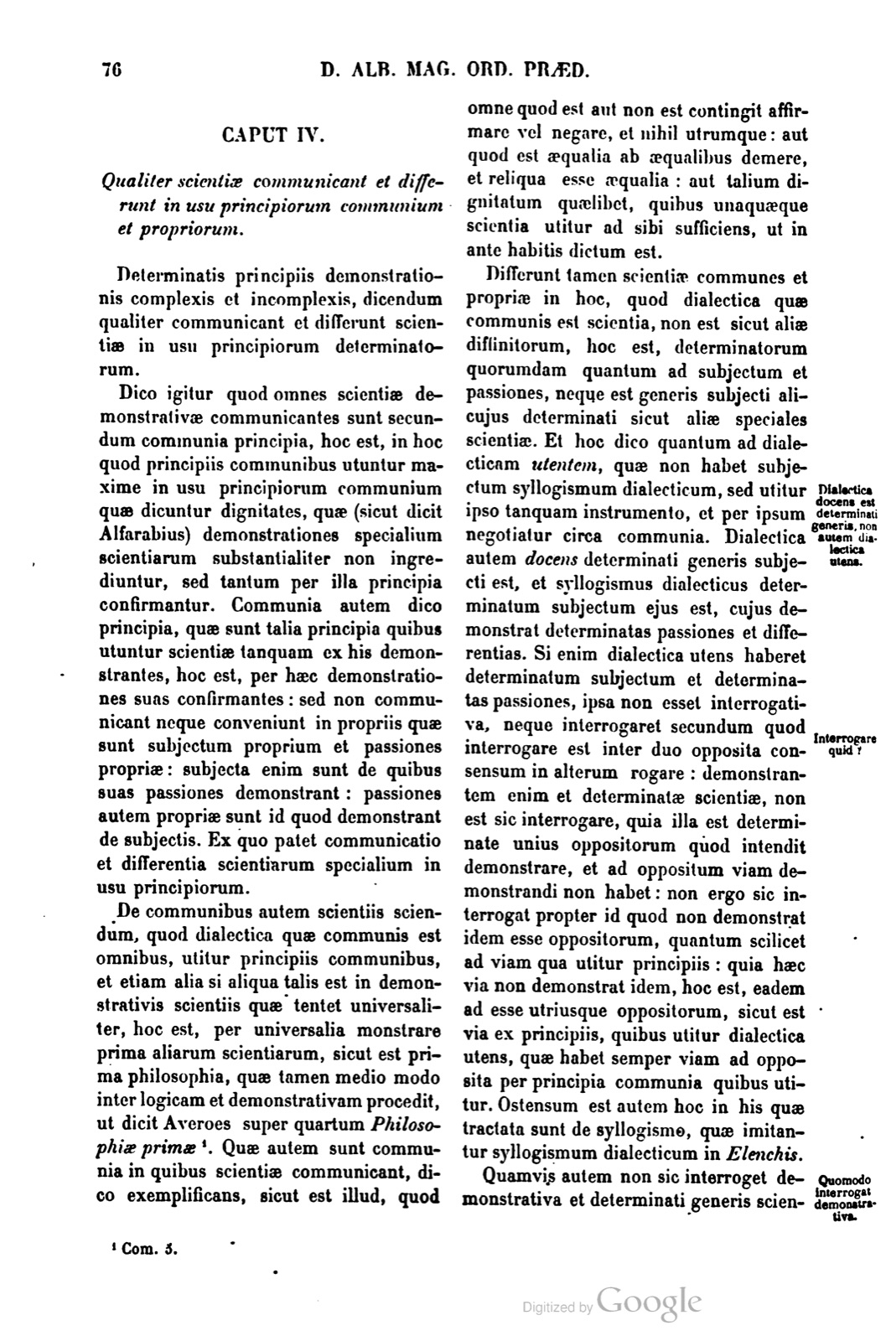
Caput IV. Qualiter scientiae communicant et differunt in usu principiorum communium et propriorum.
Determinatis principiis demonstrationis complexis et incomplexis, dicendum qualiter communicant et differunt scientiae in usu principiorum determinatorum.
Dico igitur quod omnes scientiae demonstrativae communicantes sunt secundum communia principia, hoc est, in hoc quod principiis communibus utuntur maxime in usu principiorum communium quae dicuntur dignitates, quae, sicut dicit Alfarabius, demonstrationes specialium scientiarum substantialiter non ingrediuntur, sed tantum per illa principia confirmantur. Communia autem dico principia, quae sunt talia principia quibus utuntur scientiae tanquam ex his demonstrantes, hoc est, per haec demonstrationes suas confirmantes: sed non communicant neque conveniunt in propriis quae sunt subjectum proprium et passiones propriae: subjecta enim sunt de quibus suas passiones demonstrant: passiones autem propriae sunt id quod demonstrant de subjectis. Ex quo patet communicatio et differentia scientiarum specialium in usu principiorum.
De communibus autem scientiis sciendum, quod dialectica quae communis est omnibus, utitur principiis communibus, et etiam alia si aliqua talis est in demonstrativis scientiis quae tentet universaliter, hoc est, per universalia monstrare prima aliarum scientiarum, sicut est prima philosophia, quae tamen medio modo inter logicam et demonstrativam procedit, ut dicit Averroes super quartum Philosophiae primae 2. Quae autem sunt communia in quibus scientiae communicant, dico exemplificans, sicut est illud, quod omne quod est aut non est contingit affirmare vel negare, et nihil utrumque: aut quod est aequalia ab aequalibus demere, et reliqua esse aequalia: aut talium dignitatum quaelibet, quibus unaquaeque scientia utitur ad sibi sufficiens, ut in ante habitis dictum est.
Differunt tamen scientiae communes et propriae in hoc, quod dialectica quae communis est scientia, non est sicut aliae diffinitorum, hoc est, determinatorum quorumdam quantum ad subjectum et passiones, neque est generis subjecti alicujus determinati sicut aliae speciales scientiae. Et hoc dico quantum ad dialecticam utentem, quae non habet subjectum syllogismum dialecticum, sed utitur ipso tanquam instrumento, et per ipsum negotiatur circa communia. Dialectica autem docens determinati generis subjecti est, et syllogismus dialecticus determinatum subjectum ejus est, cujus demonstrat determinatas passiones et differentias. Si enim dialectica utens haberet determinatum subjectum et determinatas passiones, ipsa non esset interrogativa, neque interrogaret secundum quod interrogare est inter duo opposita consensum in alterum rogare: demonstrantem enim et determinatae scientiae, non est sic interrogare, quia illa est determinate unius oppositorum quod intendit demonstrare, et ad oppositum viam demonstrandi non habet: non ergo sic interrogat propter id quod non demonstrat idem esse oppositorum, quantum scilicet ad viam qua utitur principiis: quia haec via non demonstrat idem, hoc est, eadem ad esse utriusque oppositorum, sicut est via ex principiis, quibus utitur dialectica utens, quae habet semper viam ad opposita per principia communia quibus utitur. Ostensum est autem hoc in his quae tractata sunt de syllogismo, quae imitantur syllogismum dialecticum in Elenchis.
Chapter IV. How sciences communicate and differ in the use of common and proper principles.
Once the complex and incomplex principles of demonstration have been determined, it must be said how sciences communicate and differ in the use of the determined principles.
Therefore I say that all demonstrative sciences communicate according to common principles, that is, in this, that they use common principles, especially in the use of the common principles which are called dignities. These, as Alfarabi says, do not enter substantially into the demonstrations of the special sciences, but the demonstrations are only confirmed through those principles. But I call common principles those principles which are such that the sciences use them as if demonstrating from them, that is, confirming their demonstrations through them. But they do not communicate or agree in proper things, which are the proper subject and the proper properties. For subjects are the things about which they demonstrate their properties; but proper properties are what they demonstrate of the subjects. From this the communication and difference of the special sciences in the use of principles is clear.
But concerning common sciences it must be known that dialectic, which is common to all, uses common principles; and also another science, if there is some such science among the demonstrative sciences, which attempts universally, that is, through universals, to show the first things of the other sciences, as first philosophy does, which nevertheless proceeds in a middle mode between logic and demonstrative science, as Averroes says on the fourth book of the Metaphysics 2. But the common things in which sciences communicate, I say by giving examples, are such as that of everything which is or is not it is possible to affirm or deny, and nothing is both; or that equal things are taken away from equal things and the remaining things are equal; or any of such dignities which each science uses sufficiently for itself, as was said in the preceding matters.
Yet common and proper sciences differ in this, that dialectic, which is a common science, is not like the other sciences of defined things, that is, of certain determinate things with respect to subject and properties, nor is it of some determinate subject genus as the other special sciences are. And I say this with respect to dialectic as using, which does not have the dialectical syllogism as its subject, but uses it as an instrument and, through it, conducts business concerning common things. But dialectic as teaching is of a determinate genus of subject, and the dialectical syllogism is its determinate subject, of which it demonstrates determinate properties and differences. For if dialectic as using had a determinate subject and determinate properties, it would not be interrogative, nor would it ask questions according as to ask is to seek agreement toward one of two opposites. For it does not belong to the one demonstrating, and to a determinate science, to ask questions in this way, because what it intends to demonstrate belongs determinately to one of the opposites, and it does not have a way of demonstrating toward the opposite. Therefore it does not ask in this way on account of the fact that it does not demonstrate that the being of opposites is the same, namely with respect to the way by which it uses principles; because this way does not demonstrate the same thing, that is, the same things, toward the being of each opposite, as does the way from principles which dialectic as using employs, which always has a way toward opposites through the common principles which it uses. But this has been shown in those things which have been treated concerning syllogism, which imitate the dialectical syllogism in the Elenchi.
Quamvis autem non sic interroget demonstrativa et determinati generis scientia, sicut logica, ut inter duo opposita consensum in alterum quodlibet interroget: tamen alio modo interrogat secundum quod interrogatur respondens ad instruendum opponentem de quo opponat vel ostendat. Hoc autem probatur ex hoc quod in scientia demonstrativa syllogistica interrogatio, quae quaestio est et conclusio, et propositio contradictionis est idem: primo enim est quaestio, et secundo conclusio, et tertio jam probata ad alterum aliquid ulterius probandum est propositio: et haec tria sunt in substantia idem, quamvis ratione differant. Propositiones autem propriae secundum unamquamque scientiam sunt, ex quibus ut propriis est syllogismus illius scientiae et ad propriam de subjecto passionem demonstrandam. Interrogatio enim et propositio quae est altera pars contradictionis, substantia sunt idem: propositiones autem propriae secundum unamquamque scientiam sunt, ex quibus ut propriis est syllogismus secundum unamquamque scientiam: sequitur quod utique erit aliqua determinati generis interrogatio determinati scibilis, ex quibus propositionibus vel interrogationibus ille fit syllogismus, qui secundum unamquamque scientiam est proprius: quia si interrogatio et propositio sunt substantia idem, si concedatur quod propositio propria est, sequitur quod interrogatio propria erit sive quaestio.
Et ex quo in propriis interrogationibus et propositionibus differunt determinatae et demonstrativae scientiae, manifestum est quod non omnis interrogatio demonstrativae scientiae erit geometrica neque medicinalis. Similiter autem est et in aliis particularibus scientiis, quod quaelibet habet suas proprias interrogationes et propositiones: sed interrogationes vel propositiones geometricae sunt, de quibus utique demonstratur aliquid quod vere geometricum est, et de quibus est geometria: aut si non est de his de quibus vere est geometria, est tamen de his de quibus demonstratur aliquid geometrice, sicut est speculativa, hoc est, perspectiva quae geometriae subalternatur: in illis enim, quia geometria dicit propter quid, interrogationes et propositiones geometricae sunt. Similiter autem est et in aliis scientiis subalternatis et subalternantibus. Et de his quidem sic geometrice subalternatis dico rationem dicentem propter quid ponendam esse ex geometricis principiis et conclusionibus: quia sic se habent: quod subalternans dicit causam eorum quae sunt in subalternata. Sed geometricae vel alterius specialis demonstrativae scientiae dico rationem et causam non ponendam esse de suis principiis secundum quod est geometrica: quia nulla scientia particularis rationem reddit de suis principiis, sed relinquit et supponit de eis quod sunt, et superior et communis scientia de eis reddit rationem suae veritatis. Similiter autem est et in aliis scientiis determinatis quantum ad hoc quod de suis principiis non reddunt rationem.
But although demonstrative science and a science of a determinate genus does not ask questions in this way, as logic does, so that it asks between two opposites for agreement toward either one, nevertheless it asks in another way, according as the respondent is questioned in order to instruct the objector about what he should object to or show. This is proved from the fact that in demonstrative science a syllogistic interrogation, which is a question and a conclusion, and the proposition of a contradiction are the same. For first it is a question, secondly a conclusion, and third, once it has already been proved for the further proving of something else, it is a proposition; and these three are the same in substance, although they differ in account. But the proper propositions according to each science are those from which, as proper ones, there is a syllogism of that science and for demonstrating the proper property of the subject. For an interrogation and the proposition which is the other part of a contradiction are the same in substance; but the proper propositions according to each science are those from which, as proper ones, there is a syllogism according to each science. Therefore it follows that there will certainly be some interrogation of a determinate genus and of a determinate knowable thing from which propositions or interrogations that syllogism is made which is proper according to each science. For if interrogation and proposition are the same in substance, if it is conceded that a proposition is proper, it follows that the interrogation or question will be proper.
And because determinate and demonstrative sciences differ in their proper interrogations and propositions, it is manifest that not every interrogation of demonstrative science will be geometrical or medicinal. Likewise it is so in the other particular sciences, because each has its own proper interrogations and propositions. But geometrical interrogations or propositions are those about which something that is truly geometrical is demonstrated, and about which geometry is concerned; or if it is not about those things about which geometry is truly concerned, it is nevertheless about those things about which something is demonstrated geometrically, as the speculative science is, that is, perspective, which is subalternated to geometry. For in those things, because geometry states the reason why, the interrogations and propositions are geometrical. Similarly it is also in other subalternated and subalternating sciences. And concerning these things subalternated geometrically in this way, I say that the account stating the reason why must be posited from geometrical principles and conclusions, because they are so related that the subalternating science states the cause of those things which are in the subalternated science. But I say that the account and cause of geometry, or of another special demonstrative science, is not to be posited from its own principles according as it is geometry, because no particular science gives an account of its own principles, but leaves and supposes concerning them that they are, and a superior and common science gives an account of their truth. Likewise it is also in the other determinate sciences with respect to the fact that they do not give an account of their own principles.
Ex quo patet quod non est conveniens unumquemque scientem in aliqua scientia omnem interrogare interrogationem sive quaestionem: quia de principiis non est interrogandum ab illo sciente, qui principiis utitur in scientia determinata: neque cujuslibet scientis indeterminata est scientia respondere de unoquoque generaliter interrogato, sed de his interrogatis conveniens est quemlibet scientem respondere quae sunt secundum scientiam in qua est sciens determinata, et sunt sub principiis suae propriae scientiae. Si autem disputat geometer cum geometra secundum quod est geometer, hoc est, secundum quod est ex propriis geometriae principiis disputatis, sic manifestum est quod bene et disputat et interrogat, si ex his quae geometricae proprie sunt, aliquid interrogatorum demonstrat. Si vero non sic disputat, nec ex talibus demonstrat aliquid interrogatorum, non bene disputat. Manifestum autem est hoc ex hoc quod taliter ex propriis disputatis non arguit geometram si demonstrat, sed aut, hoc est, solum secundum accidens, hoc est, per aliud, sicut si ex arithmeticis cum geometra aliquis disputans arguat ipsum. Propter quod patet quod non erit proprie in non geometricis principiis vel subalternatis eis de geometria disputandum: in talibus enim latebit eum et obviare nesciet ei qui prave disputat. Prave autem dico disputare, qui non ex propriis disputat. Similiter autem et in aliis se habet scientiis particularibus demonstrativis.
Ex his autem quae dicta sunt, tres resultant quaestiones 3. Quaeratur igitur primo, quoniam quia sunt geometricae interrogationes ex propriis geometriae principiis acceptae, nonne sunt et non geometricae? et similis interrogatio vel quaestio est secundum unamquamque scientiam particularem. Secunda quaestio est interrogatio quae facit quamcumque ignorantiam in geometria, sit geometrica, aut non? et constat quod interrogatio quae facit ignorantiam negationis, nullo modo est de geometria, sicut interrogatio facta per terminos alterius scientiae. Et tertia quaestio est, utrum syllogismus secundum ignorantiam, hoc est, qui facit ignorantiam in geometrica vel alia scientia particulari, sicut ille qui est ex oppositis principiorum illius scientiae, in qua inducit fallaciam, hoc est, concludit falsum: aut sit paralogismus secundum aliquam fallaciam, sicut ille qui est secundum geometriam, hoc est, ex oppositis principiorum geometriae, aut ex aliqua alia arte vel scientia particulari, ex cujus oppositis principiorum procedit.
Solvuntur autem inductae quaestiones dicendo ad primam, quod sunt interrogationes quaedam non geometricae neque secundum formam neque materiam, ut musicae interrogationes, sive propositiones nullo modo sunt geometricae, ita etiam quod nullo modo sunt in geometria neque secundum subalternationem relatae ad invicem. Ad secundam quaestionem dicendum est per distinctionem, quod est ignorantia negationis purae et secundum materiam et secundum formam, sicut illa quae est in propositionibus non geometricis, eo quod alterius sunt scientiae, ut musicae: et quaedam est ignorantia pravae dispositionis, et haec est ignorantia per contradictionem opposita, quia est circa eamdem materiam et non habet formam. Dicendum ergo quod de geometria interrogatio non facit ignorantiam, sicut ea propositio vel interrogatio quae dicit parallelas subire. Ex hac enim aliquis opinatur hoc falsum, quod aequidistantes concurrunt: et sic facit ignorantiam. Haec autem est geometrica quodammodo, quia quoad materiam: et est non geometrica alio modo, quia non secundum formam geometrica, quia formam geometricae in demonstratione non servat, cum nec praedicatum per se in subjecto, nec subjectum praedicato, sed oppositum praedicati dicatur inesse subjecto: et haec est ignorantia pravae dispositionis, quia est circa geometrica secundum oppositum principium demonstrationis. Duplex enim est non geometricum, sicut et dupliciter dicitur in musicis arythmon, hoc est, sine rythmo. Non geometricum enim dicitur uno modo in non habendo aliquid geometricum, sicut arythmon, id est, non habendo aliquid rythmi nec formam nec materiam. Alterum dicitur in prave habendo geometricum aliquid, sicut arythmon in prave habendo aliquid materiale rythmi: et his duobus modis dicitur ignorantia haec propositio non geometrica faciens ignorantiam. Et ignorantia, hoc est, propositio ignorantiam faciens per pravas dispositiones, sive ignorantia quae est ex hujusmodis principiis sive propositionibus, causata quae sunt geometricae per materiam, non geometricae per formam, est ignorantia scientiae contraria: illa vero quae negationis secundum contradictionem, illa non contraria, sed contradictoria: quia non est secundum eamdem materiam sicut sunt contraria, sicut musica interrogatio ad geometricam se habet 4.
From this it is clear that it is not fitting for everyone knowing in some science to ask every interrogation or question, because about principles one must not ask from that knower who uses the principles in a determinate science. Nor is the science of just any knower indeterminate so as to answer about anything generally asked, but it is fitting for each knower to respond to those things asked which are according to the determinate science in which he is knowing and are under the principles of his own proper science. But if a geometer disputes with a geometer according as he is a geometer, that is, according as the things disputed are from the proper principles of geometry, then it is manifest that he both disputes and questions well if from those things which are properly geometrical he demonstrates something among the things asked. But if he does not dispute in this way, nor demonstrates something among the things asked from such things, he does not dispute well. This is manifest from the fact that, when disputing in this way from proper principles, he does not argue against the geometer if he demonstrates, except according to accident, that is, through another thing, as if someone disputing with a geometer from arithmetical things should argue against him. On account of this it is clear that one should not properly dispute about geometry in principles that are not geometrical or in things subalternated to them; for in such things it will be hidden from him and he will not know how to meet the one who disputes wrongly. But I call someone disputing wrongly who does not dispute from proper principles. Similarly this holds also in the other particular demonstrative sciences.
From the things that have been said, three questions result 3. Therefore first let it be asked: since there are geometrical interrogations received from the proper principles of geometry, are they not also non-geometrical? And there is a similar interrogation or question according to each particular science. The second question is whether an interrogation which makes any ignorance whatever in geometry is geometrical or not. And it is clear that an interrogation which makes an ignorance of negation in no way belongs to geometry, as an interrogation made through the terms of another science. And the third question is whether a syllogism according to ignorance, that is, one which makes ignorance in geometry or another particular science, as that one which is from the opposites of the principles of that science in which it introduces fallacy, that is, concludes the false, is a paralogism according to some fallacy, as one that is according to geometry, that is, from the opposites of the principles of geometry, or from some other art or particular science from whose opposed principles it proceeds.
But the introduced questions are solved by saying to the first that there are certain interrogations that are not geometrical either according to form or according to matter, as musical interrogations or propositions are in no way geometrical, so that they are in no way in geometry nor related to one another according to subalternation. To the second question it must be said by distinction that there is an ignorance of pure negation both according to matter and according to form, as that which is in non-geometrical propositions, because they belong to another science, as to music; and there is a certain ignorance of bad disposition, and this is the ignorance opposed by contradiction, because it is about the same matter and does not have the form. Therefore it must be said that an interrogation concerning geometry does not make ignorance, as that proposition or interrogation does which says that parallels meet. For from this someone opines this falsehood, that equidistant lines meet, and so it makes ignorance. But this is geometrical in one way, because with respect to matter, and non-geometrical in another way, because it is not geometrical according to form, since it does not preserve the form of geometry in demonstration, since neither the predicate is said to be per se in the subject, nor the subject in the predicate, but the opposite of the predicate is said to be present in the subject. And this is ignorance of bad disposition, because it is about geometrical things according to the opposite principle of demonstration. For non-geometrical is twofold, just as arythmon, that is, without rhythm, is said in two ways in music. For non-geometrical is said in one mode by not having anything geometrical, as arythmon, that is, by not having anything of rhythm, neither form nor matter. The other is said by badly having something geometrical, as arythmon in badly having something material of rhythm. And in these two modes this ignorance-making non-geometrical proposition is called ignorance. And ignorance, that is, a proposition causing ignorance through bad dispositions, or ignorance which is caused from principles or propositions of this sort which are geometrical by matter and non-geometrical by form, is an ignorance contrary to science. But that ignorance which is of negation according to contradiction is not contrary but contradictory, because it is not according to the same matter as contraries are, as a musical interrogation is related to a geometrical one 4.
Solutio autem tertiae quaestionis jam patere potest ex solutione quaestionis secundae: in dialecticis enim potest esse paralogismus secundum aliquam sophisticam importunitatem, in doctrinis sive demonstrativis non similiter paralogismus sicut in dialecticis. Et hujus causa est, quia medium in doctrinalibus semper in duplici est habitudine: est enim de hoc quod est minor extremitas de omni et per se et secundum ipsum: et hoc iterum quod est major extremitas est de illo quod est medium de omni et per se secundum id quod praedicatur, et quod praedicatum est, non dicitur omne, ita quod signum distributivum ad praedicatum feratur: quia propositio falsa esset, ut homo est omne animal 5. Haec autem quae scilicet sunt in doctrinis, sunt certa et non multiplicia, nec aliquam apparentiam sophisticam habentia, sicut patet: quia sunt ea quae videntur in re demonstrata, quae sunt intellecta: quando enim intellecta distribuuntur in re et demonstrantur, tunc certificantur ad unum quod intelligitur, et non faciunt sophisticam apparentiam alterius.
The solution of the third question can now be clear from the solution of the second question. For in dialectical matters there can be a paralogism according to some sophistical importunity; in doctrinal or demonstrative matters there is not similarly a paralogism as in dialectical matters. And the cause of this is that the middle in doctrinal matters is always in a double relation: for it is of this which is the minor extreme, of every and per se and according to itself; and again the major extreme is of that which is the middle, of every and per se according to that which is predicated, and what is predicated is not called every, so that the distributive sign would be carried to the predicate, because the proposition would be false, as "man is every animal" would be 5. But these things, namely those which are in doctrinal matters, are certain and not multiple, nor have any sophistical appearance, as is clear, because they are those things which are seen in the demonstrated thing and are understood. For when understood things are distributed in the thing and demonstrated, then they are made certain toward the one thing which is understood, and they do not make a sophistical appearance of another thing.
Sed in rationibus logicis, quae sunt circa communia ad rem non determinata, latet hoc: et aliquando videtur esse in talibus quod non est. Hujus autem exemplum est sicut si quaeratur et dicatur, quid autem, supple dicendum, in tali interrogatione quaerente, suntne carmina circulus? Hoc enim in doctrinis statim per ipsam descriptionem circuli in plano factam, manifestum est, quod non sunt carmina circulus: quia figura descripta ostendit, quod circulus non potest esse carmen. Sed in omnibus logicis etiam hoc latet. Si enim sic arguam: circulus est figura plana, una linea contenta; et assumam: carmen est circulus: ergo carmen est figura plana, una linea contenta. Patet quod in logica prima propositio distinguenda per aequivocationem, et minor tunc neganda, et conclusio falsa. In doctrinalibus autem major concedenda, et minor per figurae descriptionem ad visum ostenditur falsa. Hoc quidam aliter exponunt, quod scilicet intellectus simpliciter et non multipliciter sicut et visus: et non est curandum.
Caput V. De differentiis inter logicam et scientias speciales.
Differentia autem inter logicam et scientias speciales est, quod in doctrinalibus sive in demonstrativis scientiis non oportet instantiam ferre in ipsum quod universaliter proponitur sicut propositio inducta per particulare. Cujus causa sive ratio est, quia in doctrinalibus sicut propositio non est, quae non in pluribus nec in omnibus, ita nec est instantia: talis enim propositio non est in omnibus, cum omnis propositio demonstrativa in omnibus sit et universalis: ex universalibus autem in doctrinalibus est omnis syllogismus: quia, sicut habitum est, de particulari non probatur passio nisi per accidens: propter quod manifestum est quod nec proprie instantia. In omnibus enim verum est, quod in omni scientia eaedem substantia sunt propositiones et instantiae, quamvis ratione differant. Cujus probatio est: quia quicumque fert aliquam instantiam, illam etiam eamdem facit propositionem syllogizando oppositum, sive sit dialectica instantia et propositio, sive demonstrativa instantia et propositio. Dialecticis autem per propositionem particularem et singularem contingit instare in propositione universali inductiva, hoc est, quae per inductionem probatur.
Secunda differentia est haec, quod in demonstrativis sive doctrinalibus contingit quosdam demonstratores non syllogizare, hoc est, non secundum formam generalem syllogismi in Prioribus determinatam 6: eo quod in demonstrativis contingit in terminis convertibilibus in secunda figura ex affirmativis syllogizare, quod est contra formam syllogismi in dialecticis determinatam, quando scilicet accipiunt media utrisque extremitatibus convertibiliter inhaerentia: sic enim fit dispositio secundae figurae in qua medium bis praedicatur. Hoc autem in dialecticis non contingit. Hunc modum Caeneus Philosophus fecit in syllogizando: volens enim probare Caeneus, quod ignis ut formale elementum est facilis generationis, et ideo primum elementorum immediate a motu orbis generatum, sic syllogizavit: quidquid in multiplicata analogia se habet ad alterum, citius generatur: ignis in multiplicata analogia se habet ad quodlibet elementum: ergo facilis est generationis et citius generatur. Et sic formandus est syllogismus: velocis est generationis, quod in multiplicata analogia se habet ad alterum: ignis in multiplicata analogia se habet ad quodlibet alterum: ergo cito generatur sive velocis generationis est. Dicitur autem in multiplicata analogia ignis se habere ad alterum: quia ex uno pugillo terrae multi pugilli fiunt aquae, et ex uno pugillo aquae multi pugilli fiunt aeris, et ex uno pugillo aeris multi pugilli fiunt ignis: et sic ignis formalior est omnibus aliis: et quanto aliquid formalius est, tanto est velocioris generationis: in multiplicata analogia sic esse aliquid, convertitur cum eo quod est esse facilis generationis. Propter quod gratia materiae et in secunda figura aliquando syllogizatur ex talibus: quoniam medium est causa majoris extremitatis et minor extremitas continetur sub majori: et ideo per tale medium concluditur de ipsa, sicut patet in syllogismo inducto. Ex sic ergo acceptis in terminis convertibilibus aliquando syllogizare contingit: sed tamen non videtur, eo quod forma syllogizandi non servatur. Haec est secunda differentia.
But in logical reasonings, which concern common things not determined to a thing, this is hidden, and sometimes that which is not in such matters seems to be. An example of this is as if it is asked and said what, supply "must be said," in such an interrogation asking whether poems are a circle. For in doctrinal matters, immediately through the very description of the circle made on a plane, it is manifest that poems are not a circle, because the described figure shows that a circle cannot be a poem. But in all logical matters this too is hidden. For if I argue thus: a circle is a plane figure contained by one line; and I assume: a poem is a circle; therefore a poem is a plane figure contained by one line. It is clear that in logic the first proposition must be distinguished through equivocation, and then the minor must be denied, and the conclusion is false. But in doctrinal matters the major must be conceded, and the minor is shown false to sight through the description of the figure. Certain persons explain this otherwise, namely that the intellect is simple and not multiple, as also sight is; and this is not to be cared for.
Chapter V. On the differences between logic and the special sciences.
But the difference between logic and the special sciences is that in doctrinal or demonstrative sciences one must not bring an instance against that which is proposed universally as a proposition induced through a particular. The cause or reason for this is that in doctrinal matters, just as there is no proposition which is not in many nor in all, so neither is there an instance; for such a proposition is not in all things, since every demonstrative proposition is in all things and universal. But in doctrinal matters every syllogism is from universals, because, as has been had, a property is not proved of a particular except by accident. On account of this it is manifest that neither is there properly an instance. For in all matters it is true that in every science propositions and instances are the same in substance, although they differ in account. The proof of this is that whoever brings some instance also makes that same thing a proposition by syllogizing the opposite, whether it is a dialectical instance and proposition or a demonstrative instance and proposition. But in dialectical matters it happens that one raises an instance by a particular and singular proposition against an inductive universal proposition, that is, one which is proved through induction.
The second difference is this: in demonstrative or doctrinal matters it happens that certain demonstrators do not syllogize, that is, do not syllogize according to the general form of syllogism determined in the Priors 6. This is because in demonstrative matters it happens that one syllogizes in convertible terms in the second figure from affirmatives, which is contrary to the form of syllogism determined in dialectical matters, namely when they receive middles inhering convertibly in both extremes; for thus there is made the disposition of the second figure in which the middle is predicated twice. But this does not happen in dialectical matters. The philosopher Caeneus made this mode in syllogizing: for Caeneus, wishing to prove that fire, as a formal element, is of easy generation and therefore is the first of the elements generated immediately by the motion of the sphere, syllogized thus: whatever is related to another in multiplied analogy is generated more quickly; fire is related to any element whatever in multiplied analogy; therefore it is of easy generation and is generated more quickly. And the syllogism must be formed thus: that which is related to another in multiplied analogy is of swift generation; fire is related to any other thing whatever in multiplied analogy; therefore it is generated quickly or is of swift generation. But fire is said to be related to another in multiplied analogy because from one handful of earth many handfuls of water are made, and from one handful of water many handfuls of air are made, and from one handful of air many handfuls of fire are made. And thus fire is more formal than all the others; and the more formal something is, the swifter its generation is. To be something in multiplied analogy in this way is converted with being of easy generation. On account of this, by reason of the matter and in the second figure, one sometimes syllogizes from such things, since the middle is the cause of the major extreme and the minor extreme is contained under the major. And therefore through such a middle it is concluded of it, as is clear in the induced syllogism. Therefore from things received in this way in convertible terms, it sometimes happens to syllogize; yet nevertheless it does not seem so, because the form of syllogizing is not preserved. This is the second difference.
Tertia autem differentia inter dialecticam et demonstrativam est, quod in dialecticis est difficilis resolutio, in doctrinalibus autem facilior: et hujus tres dabimus causas. Quarum una et prima est: facilius enim est resolvere uno modo composita, quam pluribus modis composita: pluribus autem modis composita sunt in verum et falsum composita, quam in verum composita tantum: in verum ergo tantum composita facilius est resolvere, quam composita in verum et falsum. Propter quod si in dialecticis esset impossibile ex falso verum syllogizare sive monstrare, facile utique esset resolvere syllogismum dialecticum: quia tunc utique in omni materia converteretur conclusio super praemissas. Cujus exemplum est: quia si A esset conclusio vera quae sequeretur ex B praemissa, scilicet posito quod ex falsis non verum syllogizaretur: tunc sicut sequitur per viam generationis, si B est, A est: sic sequeretur resolvendo, si A est, B est: sic enim A esset verum et conclusio aliqua: hoc autem cum sit, ea utique erunt vera quae novi vera esse in praemissis: novi enim illa sicut conclusionis principia: unde novi ea quoniam vera sunt: et haec sunt B, quia praemissae per A significantur: ex his enim talibus praemissis tanquam notis et scitis demonstratur quoniam illud verum quod est in conclusione. Hoc autem patet in his quae maxime sunt demonstrativa, quae sunt mathematica: termini enim qui sunt in mathematicis maxime convertuntur, eo quod pro medio nullum accidens, hoc est, accidentale recipiunt: sed pro mediis accipiunt vel recipiunt diffinitiones, et in hoc differunt ab his syllogismis qui sunt in dialecticis, hoc est, in dialecticis qui sunt per modum dialogi, in hoc quod opponens interrogat consensum respondentis.
But the third difference between dialectical and demonstrative science is that in dialectical matters resolution is difficult, but in doctrinal matters it is easier; and of this we shall give three causes. One and the first of these is that it is easier to resolve things composed in one mode than things composed in several modes. But things composed into the true and false are composed in more modes than things composed into the true only. Therefore it is easier to resolve things composed into the true only than things composed into the true and false. On account of this, if in dialectical matters it were impossible to syllogize or show a truth from what is false, it would certainly be easy to resolve a dialectical syllogism, because then in every matter the conclusion would be converted back upon the premises. An example of this is that if A were a true conclusion which followed from premise B, namely with it posited that a truth would not be syllogized from false things, then just as it follows by the way of generation, if B is, A is, so it would follow by resolving: if A is, B is. For thus A would be true and some conclusion; but since this is so, those things which I knew to be true in the premises will certainly be true. For I knew those as principles of the conclusion; hence I knew them because they are true, and these are B, because the premises are signified through A. For from such premises as known and scientifically known it is demonstrated that that true thing which is in the conclusion is so. But this is clear in those things which are most of all demonstrative, namely mathematical things; for the terms which are in mathematics are converted most of all, because they receive no accident, that is, nothing accidental, as a middle, but receive or take definitions as middles; and in this they differ from those syllogisms which are in dialectical matters, that is, those dialectical syllogisms which are by way of dialogue, in this, that the objector asks for the agreement of the respondent.
Quarta differentia est inter dialecticam et demonstrativam, quod quoad unam et eamdem conclusionem non sunt multa media in demonstrativis: sed in dialecticis sunt multa media ad unam et eamdem conclusionem. Cujus causa est, quod demonstrationes non augentur per immediata, nisi in post assumendo, scilicet continue sub subjecto de quo probatur passio, sicut sub figura triangulus, et sub triangulo isosceles; cujus exemplum, ut de B quod sub A sumptum est dicatur A, et B dicatur de C quod proxime est sub ipso: et hoc modo sumatur C dici de D, et hoc in infinitum, si sumptio unius sub alio procedit in infinitum: ulterius enim probabitur, quod stat etiam superius et ad inferius. Aliter tamen dicunt aliqui et bene satis, quod theoremata demonstrationum sic habent procedere, quod unum semper probatur ex alio, quod aliter non procederet demonstratio ex immediatis, sicut patet in theorematibus Euclidis per totam geometriam: et numerus hoc modo procedit in infinitum unitatis additione: et passiones aliae probantur de binario et aliae de trinario, et sic in infinitum. Similiter figurae geometriae in infinitum procedent lineae vel superficiei additione, ut trigonum, tetragonum, pentagonum, et sic de aliis in infinitum, de quibus omnibus diversae probantur passiones.
Augentur et demonstrationes in latus, hoc est, ad lateralem latitudinem, quando sub eodem accipiuntur opposita lateraliter coaequaeva, ut asinus, leo, lupus, sub animali: trigonum, tetragonum, pentagonum, sub figura: quamvis non sit omnino simile, quia figurae quamvis sint differentes specie, denominatione tamen numeri specificantur, sicut trigonum, tetragonum: et ideo in generatione una est potentia in altera ex ea protractione actuali linearum: et ideo trigonum est in tetragono. Hujus autem augmenti ad latus exemplum est in terminis transcendentibus, sicut si A aliqua passio communis demonstretur de duobus vel pluribus subjectis coaequaevis, ut de C subjecto, et de E subjecto, sicut sensibile de homine et de equo, sicut si de multis numeris lateraliter acceptis demonstretur, quod quilibet illorum est numerus quantus: aut si demonstretur, quod quilibet est infinitus numerus in potentia per additionem principii suae generationis, sicut docet Pythagoras in primo Arithmeticae generationem numerorum pariter parium et pariter imparium, et impariter parium et impariter imparium, et in proportionibus similiter: omnis generatio numerorum est ex aliquo usque in infinitum dispositis numeris: quae dispositio principium est generationis talium numerorum.
The fourth difference between dialectical and demonstrative science is that with respect to one and the same conclusion there are not many middles in demonstrative matters, but in dialectical matters there are many middles for one and the same conclusion. The cause of this is that demonstrations are not increased through immediates except by assuming afterward, namely continuously under the subject about which the property is proved, as triangle under figure and isosceles under triangle. An example of this is that of B, which is taken under A, A is said, and B is said of C, which is immediately under it; and in this mode C is taken to be said of D, and this to infinity, if the taking of one thing under another proceeds to infinity. For it will be proved later that it also stands both above and below. Yet others say otherwise, and well enough, that the theorems of demonstrations have to proceed in this way, that one is always proved from another, because otherwise demonstration would not proceed from immediates, as is clear in the theorems of Euclid through the whole of geometry. And number proceeds in this mode to infinity by the addition of unity; and some properties are proved of binary number and others of ternary number, and so to infinity. Likewise figures of geometry will proceed to infinity by the addition of line or surface, as triangle, tetragon, pentagon, and so with the others to infinity, about all of which diverse properties are proved.
Demonstrations are also increased to the side, that is, toward lateral breadth, when opposites laterally coequal are received under the same thing, as ass, lion, and wolf under animal; triangle, tetragon, and pentagon under figure. Yet it is not entirely similar, because figures, although they are different in species, are nevertheless specified by the denomination of number, as triangle and tetragon are; and therefore in one generation there is potency in another from that actual drawing out of lines, and therefore triangle is in tetragon. But the example of this increase to the side is in transcendent and demonstrative terms, as if we say that A is some common property demonstrated of two or several coeval subjects, as of subject C and subject E, as sensible is demonstrated of man and horse; or as if it is demonstrated of many numbers received laterally that any one of them is a quantified number; or if it is demonstrated that any one is an infinite number in potency through the addition of the principle of its generation, as Pythagoras teaches in the first book of Arithmetic concerning the generation of evenly even and evenly odd numbers, and unevenly even and unevenly odd numbers, and similarly in proportions. Every generation of numbers is from something up to numbers disposed to infinity; and that disposition is the principle of the generation of such numbers.
Hujus autem exemplum est in terminis transcendentibus et demonstrativis, sicut si dicamus, quod A sit passio numeri quanti, sicut quod sit numerus finitus vel infinitus, ut perfectus vel imperfectus, vel abundans vel diminutus vel in alia numeri passione: et hoc est quod dicit Aristoteles quod numerus quantus, aut infinitus sit: haec autem, id est, talis passio sit in quo est A, ac si dicat, haec passio per litteram A designetur quae erit major extremitas: impar autem numerus quantus sit in quo sit B, et erit medium in demonstratione: impar autem numerus sit in quo est littera C, et erit in demonstratione minor extremitas. Secundum hanc itaque dispositionem est conclusum A de C per B, quia omne B est A, et omne C B. Item ab alio littera ponatur, quod par numerus quantus sit D medium: et ponatur quod par numerus sit in quo est E, quod erit minor extremitas: et A remanet sicut prius passio finiti vel infiniti numeri: tali ergo facta dispositione concluditur A de E per D medium, sicut prius conclusa fuit de C per medium B, et sic in latus augentur demonstrationes.
Sed attende quod cum in post augentur non potest esse, quod passio quae superiori inest per se et secundum ipsum et de omni, insit etiam in inferiori per se et secundum ipsum, sed inerit ei essentialiter et de omni et non per se et secundum ipsum. Eodem autem modo non potest esse, quod eadem passio secundum ipsum et per se insit opposito coaequaevo, sed de omni potest esse in duobus oppositis: et ideo dictum est de demonstratione communiter dicta et non de demonstratione potissima. Quidam tamen dicunt, quod quando in post assumendo descenditur sub subjecto, dicitur etiam in post assumendo descendi in praedicato quod est passio, ut si isosceles accipitur sub triangulo, debet etiam sub passione habere tres aequos duobus rectis, descendi ad tales tres quales habet isosceles. Similiter quando augentur ad latus et accipitur oppositum subjecti, dicunt quod etiam debet accipi oppositum passionis. Sed primum magis est secundum intentionem Aristotelis.
But an example of this is in transcendent and demonstrative terms, as if we say that A is the property of quantified number, as that it is a finite or infinite number, such as perfect or imperfect, or abundant or diminished, or in some other property of number. And this is what Aristotle says, that number as quantified, or infinite, is. But this, that is, such a property, is in that in which A is, as if he were saying that this property is designated by the letter A, which will be the major extreme. But let odd quantified number be that in which B is, and it will be the middle in the demonstration; and let odd number be that in which the letter C is, and it will be the minor extreme in the demonstration. According to this disposition, therefore, A is concluded of C through B, because every B is A, and every C is B. Again from another letter let it be posited that even quantified number is middle D; and let it be posited that even number is that in which E is, which will be the minor extreme. And A remains, as before, the property of finite or infinite number. Therefore, when such a disposition has been made, A is concluded of E through middle D, just as previously it was concluded of C through middle B, and thus demonstrations are increased to the side.
But attend that when demonstrations are increased afterward, it cannot be that the property which is present to the superior per se and according to itself and of every is also present to the inferior per se and according to itself, but it will be present to it essentially and of every, and not per se and according to itself. In the same mode it cannot be that the same property according to itself and per se is present to the coeval opposite, but it can be of every in two opposites; and therefore what has been said concerns demonstration commonly so called and not the most powerful demonstration. Yet certain persons say that when there is a descent by assuming afterward under the subject, there is also said to be a descent, by assuming afterward, in the predicate which is the property, as if isosceles is received under triangle, then under the property "to have three equal to two right angles" there must also be a descent to such three angles as the isosceles has. Likewise, when they are increased to the side and the opposite of the subject is received, they say that the opposite of the property must also be received. But the first is more according to the intention of Aristotle.
Caput VI. Qualiter differunt demonstratio quia et demonstratio propter quid in eadem scientia sumptae 7.
Sic autem ex praecedentibus determinata demonstratione potissima propter quid, cum sit etiam demonstratio quia, quae minus est potens et tamen refertur ad principia demonstrationis quae dicta sunt de omni et per se et secundum ipsum, conveniens est hic determinare de differentiis harum demonstrationum, secundum quod differunt in una et eadem scientia ambae existentes, et secundum quod differunt existentes in diversis. Et primo harum determinemus differentias in una et eadem scientia.
Dicimus igitur quod quia differt scire quia et scire propter quid, oportet quod differant istae duae scientiae sive isti duo modi sciendi: et sic alia est scientia quia, et alia propter quid. Et si differunt scientiae, necesse est quod differant etiam demonstrationes quia scilicet et propter quid, quae sunt causae talium scientiarum. Primum quidem in eadem scientia acceptae dictae demonstrationes, et in una et eadem scientia acceptae differunt dupliciter. Uno quidem modo dicitur scientia quia si fiat syllogismus demonstrativus per id quod est non medium, hoc est, si fiat per mediatum medium: tale enim medium est non medium, quia non est immediatum: immediatum autem debet esse medium, et hoc est tantum transcendens medium et non convertibile cum extremis: hoc enim non erit sufficiens et proxima causa: tunc enim in tali medio non accipitur prima causa, hoc est, proxima et convertibilis: per tale igitur transcendens medium non generatur nisi scientia quia: sed quae est scientia propter quid, est scientia generata ex medio quod est prima, hoc est, proxima et essentialis conclusionis causa. Alio vero modo secundo fit demonstratio quia in eadem scientia quia, quando in demonstratione accipitur pro medio id quod non est medium, hoc est, aliquid quod est immediatum, sed est non medium in hoc quod immediatum est non causa, ut quando fit demonstratio per immediatum effectum et cum causa convertibile: tunc enim fit per convertentia sive per convertibilia et proxima, et sic per notius quoad nos: nihil enim prohibet inter ea quae aeque et convertibiliter praedicantur, sicut causa proxima et causatum, id quod est non causa, sed effectus, esse notius quoad nos: et tunc quoad instructionem necessariam utilius est demonstrare per effectum quam per causam: et ideo tunc per hanc scientiam quae est quia erit demonstratio 8.
Hujus autem exemplum est, ut volens demonstrare, quod planetae sunt prope per id quod non scintillant: sic enim causa concluditur per effectum: sit enim in quo est littera C planetae, quod est subjectum: et in quo est littera B sit non scintillare, quod est medium: in quo autem est littera A quod est major extremitas, sit prope esse, secundum quod concludi debet de minori extremitate: verum igitur erit dicere in tali syllogismo demonstrativo B medium de C minori extremitate in minori propositione: planetae enim non scintillant: sed etiam A majorem extremitatem verum est dicere de B medio in majori propositione: verum est enim non scintillans prope esse: veritas enim hujus accipitur per inductionem in sensu de quolibet planeta factam: necesse est ergo A ipsi B inesse in conclusione: et sic demonstratum est demonstratione quia, quod erraticae prope sunt. Hic ergo syllogismus non est demonstratio propter quid, sed quia: quia planetae non ex hoc quod scintillant, prope sunt, sed e converso propter hoc quod prope sunt, non scintillant: et ideo in isto syllogismo demonstrata est causa per suum effectum.
Chapter VI. How demonstration that and demonstration why differ when taken in the same science 7.
Thus, with the most powerful demonstration, the demonstration why, having been determined from the preceding matters, since there is also demonstration that, which is less powerful and yet is referred to the principles of demonstration which have been stated, namely of every, per se, and according to itself, it is fitting here to determine the differences of these demonstrations, according as both demonstrations differ while existing in one and the same science, and according as both demonstrations differ while existing in diverse sciences. And first let us determine the differences of these demonstrations in one and the same science.
Therefore we say that because to know that and to know why differ, these two sciences, or these two modes of knowing, must also differ. And thus one is science that, and the other is science why. And if the sciences differ, it is necessary that the demonstrations also differ, namely demonstration that and demonstration why, which are the causes of such sciences. First, the aforesaid demonstrations received in the same science, and received in one and the same science, differ in two ways. In one way, science that is said to occur if a demonstrative syllogism is made through that which is not a middle, that is, if the syllogism is made through a mediated middle. For such a middle is not a middle, because it is not immediate; but the immediate ought to be the middle, and this is only a transcendent middle and is not convertible with the extremes, for it will not be the sufficient and proximate cause. For then, in such a middle, the first cause is not received, that is, the proximate and convertible cause. Therefore through such a transcendent middle only science that is generated. But science why is science generated from a middle which is the first, that is, from the proximate and essential cause of the conclusion. In another, second mode, demonstration that is made in the same science because, in demonstration, that is received as middle which is not a middle, that is, something which is immediate but is not a middle in this respect, namely that, although it is immediate, nevertheless it is not a cause, as when demonstration is made through an immediate effect convertible with the cause. For then it is made through things converted, or convertible, and proximate, and thus through what is better known to us. For nothing prevents, among things which are predicated equally and convertibly, as a proximate cause and the caused thing are, that what is not the cause but is the effect be better known to us. And then, with respect to necessary instruction, it is more useful to demonstrate through the effect than through the cause; and therefore then through this science, which is science that, there will be a demonstration 8.
An example of this is when someone wishes to demonstrate that the planets are near through the fact that they do not twinkle. For in this way a cause is concluded through an effect. Let that in which the letter C is be planets, which is the subject; and let that in which the letter B is be not to twinkle, which is the middle; but let that in which the letter A is, which is the major extreme, be to be near, according as it must be concluded of the minor extreme. Therefore in such a demonstrative syllogism it will be true to say the middle B of the minor extreme C in the minor proposition, for planets do not twinkle. But it is also true to say A, the major extreme, of the middle B in the major proposition, for what does not twinkle is near. For the truth of this is received through induction made in sense concerning each planet. Therefore A must be present to B in the conclusion, and thus it has been demonstrated by demonstration that, and not by demonstration why, that the wandering stars are near. Therefore this syllogism is not a demonstration why, but a demonstration that, because the planets are not near on account of the fact that they twinkle, but conversely, because they are near, on this account they do not twinkle. And therefore in this syllogism the cause has been demonstrated through its effect.
Contingit autem e converso per alterum quod est causa, alterum quod est effectus demonstrare: et erit propter quid demonstratio: sicut si ponamus quod C littera quae est minor extremitas, sit erraticae sive planetae: sed in quo est B littera medium et causa, sit prope esse: A autem major extremitas sit non scintillare, sic, omne B est A, omne C B, ergo omne C A: tunc pro medio accepta est prima, hoc est, immediata et proxima causa.
Iterum fit per effectum demonstratio quia, ut si demonstret aliquis in astrologia, quod luna circularis sit sive sphaerica per incrementa, hoc est, per modum incrementorum et decrementorum, quod corniculata sunt et sphaericitatem lineae ostendunt, quod est per signum effectus causam demonstrare: et ideo sic ipsius quia et non propter quid fit demonstratio, et ipsius quia effectus est syllogismus sic: omne quod ad solem relatum, incrementa per recessum a sole corniculata accipit, sphaericum est: luna sic ad solem relata, incrementa luminis accipit: ergo est sphaerica vel circularis: sic enim ipsius quia per effectum probata causa factus est syllogismus. Si autem e converso ponatur medium quod vere causa est, tunc fiet syllogismus propter quid: non enim luna propter augmenta corniculata circularis est: sed e contra quia circularis est, ideo augmenta corniculata accipit. Et ponatur lunam esse in quo C quod est minor extremitas: in quo autem B medium sit augmentum tale accipere: in quo autem A major extremitas sit esse circulare, sic, omne B A, omne C B, ergo omne C A, sive omne circulare recipiens lumen a sole, conversum ad solem, augmenta luminis circulariter accipit: luna est sphaerica, lumen a sole accipiens: ergo augmenta luminis a sole circulariter accipit.
In quibus autem demonstrationibus media quae sunt effectus, non convertuntur cum causa, eo quod non est effectus immediatus, et tamen medium est effectus et non causa, et effectus tamen ille mediatus notior quoad nos: si fiat demonstratio per talem effectum, iterum erit demonstratio per talem effectum demonstratio quia, et non demonstratio propter quid: sed debilioris virtutis erit haec demonstratio quam si fiat per effectum immediatum: sicut si demonstraretur lunam esse sphaericam per hoc quod ipsa existens sub sole, motu circulari a sole per distantiam, talia accipit corniculata incrementa. Sic ergo per effectum fit demonstratio quia, et non propter quid, secundum primum et unum modum et principalem.
Amplius autem secundo modo fit demonstratio quia in his in quibus medium quod est causa, ponitur extra extrema excellens utrumque extremorum: in talibus enim medium est causa remota non convertibilis et non sufficiens ad causandum effectum secundum seipsam. Unde in his talibus ipsis quia et non ejus quod est propter quid, demonstratio est: non enim datur proxima causa et essentialis et convertibilis per tale medium. Hujus autem exemplum est, ut si quaestio fiat qua demonstrari debeat quare paries non respirat, et ponatur causa remota per quam hoc demonstratur dicendo, quod causa ejus quod paries non respirat, est quia non est animal: si enim hoc quod est non esse animal, non respirandi causa esset, tunc oporteret quod oppositum hujus esset causa oppositi, ita scilicet quod aliquid esse animal, esset causa quare respirat: quia si negatio causa est ipsius non esse sive negationis, tunc affirmatio erit causa esse sive affirmationis: hoc enim est in omnibus causis immediatis verum: sicut si elementa in complexione sine mensura esse calida, et sine mensura esse frigida, quod est negatio aequalitatis calidi et frigidi in complexione, est causa non sanandi, hoc est, negationis sanitatis: tunc cum mensura aequalitatis complexionis esse calida, et cum mensura esse frigida, quod est affirmatio, est causa sanandi sive sanitatis, quod est etiam affirmatio. Similiter autem in omnibus talibus quae immediatae sunt causae, quod si affirmatio ipsius esse est causa, et negationem oportet esse causam ipsius non esse. In his autem quae dicta sunt sic demonstratis per causam communem et transcendentem non contingit quod dictum est, quod scilicet affirmatio non est causa affirmationis: dispositio autem terminorum, quia medium excedit extrema et est primum positione, indicat, quod talis syllogismus est in media figura. Hujus autem exemplum in terminis transcendentibus est, ut dicamus, quod A medium positione sit animal: id autem in quo est A quod est major extremitas, sit non respirare: in quo autem est C minor extremitas, sit paries: secundum igitur hanc dispositionem A inest omni illi in quo est B, omne enim respirans est animal: in C autem nullo est A, et sic sequitur in secundo secundae, quod neque B in C nullo est, hoc est, quod nullum C est B: non igitur respirat paries.
But conversely it happens to demonstrate one thing which is an effect through another thing which is the cause, and then it will be demonstration why. Thus let us posit that the letter C, which is the minor extreme, is the wandering stars or planets; but that in which the letter B is, which is the middle and cause, is to be near; and let A, the major extreme, be not to twinkle, thus: every B is A, every C is B, therefore every C is A. Then the first cause, that is, the immediate and proximate cause, has been received as the middle.
Again, demonstration that is made through an effect, as if someone in astrology demonstrates that the moon is circular or spherical through its increments, that is, through the mode of increments and decrements, which are crescent-shaped and show the sphericity of the line, which is to demonstrate a cause through a sign of the effect. And therefore in this way a demonstration is made of that and not why, and the syllogism of that through the effect is thus: everything which, when related to the sun, receives crescent-shaped increments through recession from the sun is spherical; the moon, related to the sun in this way, receives increments of light; therefore it is spherical or circular. For thus a syllogism of that has been made through an effect, with the cause proved. But if, conversely, the middle which truly is the cause is posited, then a syllogism why will be made. For the moon is not circular because of crescent-shaped increases; rather, conversely, because it is circular, it therefore receives crescent-shaped increases. And let the moon be that in which C is, which is the minor extreme; but let that in which B, the middle, is be receiving such an increase; and let that in which A, the major extreme, is be circular being, thus: every B is A, every C is B, therefore every C is A, or every circular thing receiving light from the sun, turned toward the sun, receives increments of light circularly; the moon is spherical, receiving light from the sun; therefore it receives increments of light circularly from the sun.
But in demonstrations in which middles which are effects are not converted with the cause, because the effect is not immediate, and nevertheless the middle is an effect and not a cause, and yet that mediated effect is better known to us: if demonstration is made through such an effect, again demonstration through such an effect will be demonstration that and not demonstration why, but this demonstration will be of weaker power than if it were made through an immediate effect. For example, if the moon were demonstrated to be spherical through this, that while it exists under the sun, by circular motion from the sun through distance, it receives such crescent-shaped increments. Thus therefore demonstration that is made through an effect, and not demonstration why, according to the first and one principal mode.
Moreover, demonstration that is made in a second mode in those cases in which the middle which is the cause is posited outside the extremes, exceeding each of the extremes. For in such cases the middle is a remote cause, not convertible and not sufficient for causing the effect according to itself. Hence in such things the demonstration is of that itself and not of what is why, for a proximate and essential and convertible cause is not given through such a middle. An example of this is if a question is made by which it must be demonstrated why a wall does not breathe, and a remote cause is posited through which this is demonstrated by saying that the cause of the wall's not breathing is that it is not an animal. For if this, namely not being animal, were the cause of not breathing, then the opposite of this would have to be the cause of the opposite, namely in such a way that being something animal would be the cause why it breathes, because if negation is the cause of not-being or of negation itself, then affirmation will be the cause of being or of affirmation. For this is true in all immediate causes, as if elements in a complexion being hot without measure and cold without measure, which is the negation of equality of hot and cold in the complexion, is the cause of not healing, that is, of the negation of health, then being hot with the measure of equality of the complexion, and being cold with measure, which is affirmation, is the cause of healing or of health, which is also affirmation. Likewise, in all such things which are immediate causes, if the affirmation of being itself is a cause, the negation must also be the cause of not-being itself. But in these things which have been stated, demonstrated thus through a common and transcendent cause, what has been said does not happen, namely that affirmation is not the cause of affirmation. But the disposition of the terms, because the middle exceeds the extremes and is first in position, indicates that such a syllogism is in the middle figure. An example of this in transcendent terms is as follows: let us say that A, the middle in position, is animal; but let that in which A is, which is the major extreme, be not to breathe; and let that in which C, the minor extreme, is be wall. Therefore according to this disposition A is present to every one in which B is, for every breathing thing is animal; but A is in no C, and thus it follows in the second mode of the second figure that B is in no C, that is, that no C is B. Therefore a wall does not breathe.
Haec enim quae sunt de numero hujusmodi causarum excedentium, comparantur dictis extremis secundum excellentiam, id est, quae excedunt extrema et non convertuntur cum eis: hoc autem dicere est assignare causam plurimum distantem ab extremis. Sicut est illud quod Anacharsides Philosophus pro causa assignavit, quod in Scythis sive in Scythia, quae terra Sclavorum est, non sunt sibillatores sive tibicines: dixit enim esse causam hujus, quia non sunt ibi vites. Cum non esse in Scythia vites valde remota causa sit ad hoc quod non sint tibicines in Scythia. Vites enim vinum faciunt: vinum autem laetificat: laetitia autem causa est quae tibiam canere facit. Similiter autem causa remota quare non respirat paries est, quod non est animal: animal enim esse, et hoc animal esse circa superiora calens, et sufflativum ad mitigationem illius caloris pulmonem habens, causa est respirandi. Haec autem in libro de Respirando et Inspirando dicta sunt. Secundum autem eamdem scientiam et secundum dispositionem eorum quae ostendunt scientiam quia, et scientiam propter quid, sunt hae quae dictae sunt differentiae ejus quod est quia, sive syllogismi qui ostendit quia, ad eum syllogismum qui est propter quid.
For those things which are from the number of causes exceeding in this way are compared to the aforesaid extremes according to excellence, that is, they are causes which exceed the extremes and are not converted with them. But to say this is to assign a cause very much distant from the extremes. Such is what the philosopher Anacharsides assigned as a cause, namely that among the Scythians or in Scythia, which is the land of the Slavs, there are no whistlers or flute players. For he said that the cause of this was that there are no vines there. Since the non-being of vines in Scythia is a very remote cause with respect to this, that there are not flute players in Scythia. For vines make wine; but wine makes glad; and gladness is the cause which makes someone play the flute. Likewise the remote cause why a wall does not breathe is that it is not an animal; for to be an animal, and to be this animal, hot around the upper parts and having a lung that blows for the mitigation of that heat, is the cause of breathing. But these things have been said in the book On Respiration and Inspiration. According to the same science, then, and according to the disposition of those things which show science that and science why, these are the differences that have been stated of what is that, or of the syllogism which shows that, in relation to that syllogism which is why.
Caput VII. De differentia demonstrationis quia et propter quid in diversis scientiis.
Alio autem modo differt demonstratio propter quid ab ipsa demonstratione quia, in hoc quod per aliam scientiam utrumque istorum est speculari: ita scilicet.
Chapter VII. On the difference between demonstration that and why in diverse sciences.
But in another mode demonstration why differs from demonstration that itself in this, that each of these is to be considered through another science: in this way, namely.
Notes
- Aristotle, in the third book On the Soul, text-commentary 21. (ARISTOTELES, In 3 de Anima, tex. com. 21.) ↩
- Commentary 5. (Com. 5.) ↩
- Note that some expositors wish that there be only two questions, not three. P. J. (Nota quod aliqui expositores volunt quod sint nisi duae quaestiones, non tres. P. J.) ↩
- Hence more simply: ignorance of disposition is contrary to science; but ignorance of negation is contradictory to science. P. J. (Unde simplicius: ignorantia dispositionis est contraria scientiae: ignorantia vero negationis est contradictoria scientiae. P. J.) ↩
- If a universal sign is placed at the predicate, the proposition becomes false, as is clear in the book Perihermenias. (Si signum universale ponitur ad praedicatum, propositio fit falsa, ut patet in libro Perihermenias.) ↩
- See this in the first book of the Priors, in the title concerning the second figure. (Vide hoc in I Priorum, in titulo de secunda figura.) ↩
- Note that there is disagreement among expositors whether he intends to speak of the difference between demonstration that and demonstration why, or between knowing that and knowing why; nevertheless these opinions can be harmonized. P. J. (Nota quod est discordia inter expositores, utrum intendat loqui de differentia inter demonstrationem quia et propter quid, an inter scire quia et propter quid: possunt tamen concordari istae opiniones. P. J.) ↩
- Through these words one argument of the other opinion can be solved, which bases itself on Aristotle's words placed at the beginning of this chapter. (Per haec verba potest solvi una ratio alterius opinionis quae fundat se in verbis Aristotelis positis in principio hujus capituli.) ↩
If a page does not appear, its photograph has not been uploaded yet.