Works › Prior Analytics, Books I–II
Volume 1 · pp. 701–712
Book II of the Prior Analytics, Tractate I, Chapters IV-IX (part)
A marker with ≈ is an approximate page boundary, placed by measure of the text; the page photographs remain the authority. In the paired views, clicking a page marker brings that page into view.
B C autem in toto sumatur falsa: tunc enim erit syllogismus verae conclusionis: nihil enim est quod prohibeat A majorem extremitatem et omni B medio inesse, et idem A omni C inesse: et tamen B medium nulli C inerit minori extremitati: sicut si sumatur in terminis in his quaecumque sunt specie subalternae ejusdem generis, sicut equus et homo sub animali sunt. Subalternas autem hic species dicimus, quae sub uno et eodem genere ex aequo continentur: animal enim genus et equo et homini omni inest: equus autem nulli homini inest. Si ergo in majori sumatur A inesse omni B, major in toto erit vera: et si sumatur in minori B omni C inesse, minor in toto erit falsa, sequitur conclusio vera, quod scilicet omne C est A, cum tamen propositio quae est B C in toto sit falsa.
Similiter autem est in secundo primae si privativa sumpta sit A B major propositio, et sit in toto vera: contingit enim A majus extremum nulli B et nulli C inesse, medio scilicet et minori extremo: et contingit quod B medium nulli C minori inest extremo, sicut se habet genus ad species sumptas ex alio genere, sicut animal ad musicam et medicinam (quae sunt species scientiae) se habet: nam animal neque musicae inest universaliter, neque medicinae, neque musica quae medium est inest medicinae quae est minus extremum. Si ergo tali sumptione terminorum facta, sumatur A nulli B inesse, erit vera in toto propositio: et si sumatur B omni C inesse minori, in toto falsa erit minor propositio: et sequitur ex taliter falsa minori vera conclusio, scilicet quod nullum C sit A, sive nulla musica sit medicina.
Similiter autem si propositio minor quae est B C non sit in toto falsa, sed sit falsa in aliquo, adhuc sic ex taliter falsa minori sequitur vera conclusio: taliter enim se habentibus terminis nihil prohibet quin A insit omni B in majori, et etiam insit omni C in minori propositione, sicut genus ad speciem et differentiam se habet, sicut animal inest omni homini et omni gressibili secundum esse sumpto: homo autem quod est medium, alicui inest gressibili et non omni. Si ergo A sumatur inesse omni B, et B omni C, sequitur quod A omni C inerit, quod erit verum in conclusione: et sequitur ex majori in toto vera et minori in parte falsa.
Similiter autem sequitur verum ex altera (hoc est, minori) in parte falsa et majori in toto vera in secundo modo primae figurae, quando privativa est A B major propositio: contingit enim invenire terminos, in quibus A majus extremum neque B neque C nulli inest: et tamen B medium alicui inest minori extremo, sicut aliquod genus sumptum se habet ad speciem et differentiam quae sumuntur ex alio sive diverso genere: nam animal quod est genus, neque ulli prudentiae inest (quae est species scientiae) neque inest ulli contemplationi (quae est differentia scientiae). Prudentia autem inest alicui contemplationi: quia aliqua contemplatio sive contemplativa virtus est prudentia. Si ergo sumatur A nulli B inesse in majori, erit in toto vera major, B autem sumatur omni C inesse in minori (et erit tunc minor in parte falsa), sequitur quod nulli C inest A, quod est vera conclusio: quia nulla prudentia est animal, et nulla contemplatio est animal. Sic igitur patet qualiter in universalibus primae figurae ex utrisque falsis et ex altera falsa vera sequitur conclusio.
Si autem hic quaeritur, cum in universalibus syllogismis primae figurae octo sint combinationes (scilicet aut enim est utraque falsa, aut altera: si utraque aut in toto, aut in parte: adhuc si altera falsa, aut major, aut minor: et tunc aut major in toto et minor in parte, aut e converso: sic enim octo fiunt conjugationes) quare sex manifestatae sunt, duae autem omittuntur, quarum altera habet majorem in toto falsam et minorem in parte falsam, reliqua autem e converso minorem in toto falsam et majorem in parte falsam. Et dici potest ad hoc, quod illae duae intelliguntur per illas duas ubi altera in toto falsa, et altera non in toto falsa: et ita etiam fit in aliis figuris, in quibus dictae duae combinationes omittuntur.
but B C is wholly taken as false: then there will be a syllogism of a true conclusion. For nothing prevents A, the major extreme, from belonging to every B, the middle, and that same A from belonging to every C, and yet B, the middle, from belonging to no C, the minor extreme, as if it is taken in terms in those things which are subalternate species of the same genus, as horse and human being are under animal. Here we call those species subalternate which are contained equally under one and the same genus: for animal as genus belongs to every horse and every human being, but horse belongs to no human being. Therefore, if in the major A is taken to belong to every B, the major will be wholly true; and if in the minor B is taken to belong to every C, the minor will be wholly false; nevertheless a true conclusion follows, namely that every C is A, although the proposition B C is wholly false.
Similarly it is so in the second mode of the first figure if A B is taken as a privative major proposition and is wholly true. For it can happen that A, the greater extreme, belongs to no B and to no C, namely to the middle and the minor extreme; and it can happen that B, the middle, belongs to no C, the minor extreme, as a genus is related to species taken from another genus, as animal is related to music and medicine, which are species of knowledge. For animal belongs universally neither to music nor to medicine, nor does music, which is the middle, belong to medicine, which is the lesser extreme. Therefore, when such an assumption of terms has been made, if A is taken to belong to no B, the proposition will be wholly true; and if B is taken to belong to every C as minor, the minor proposition will be wholly false; and from such a false minor a true conclusion follows, namely that no C is A, or no music is medicine.
Likewise, if the minor proposition B C is not wholly false, but is false in something, even so a true conclusion follows from such a false minor. For with the terms so disposed, nothing prevents A from belonging to every B in the major and also to every C in the minor proposition, as genus is related to species and difference, as animal belongs to every human being and to every walking thing taken according to being. But human being, which is the middle, belongs to some walking thing and not to every walking thing. Therefore, if A is taken to belong to every B, and B to every C, it follows that A will belong to every C, which will be true in the conclusion; and it follows from a wholly true major and a minor false in part.
Likewise truth follows from the other premise, that is, the minor, false in part, while the major is wholly true, in the second mode of the first figure, when A B, the major proposition, is privative. For it is possible to find terms in which A, the major extreme, belongs neither to B nor to C, and yet B, the middle, belongs to some minor extreme, as some genus taken is related to a species and a difference which are taken from another or different genus. For animal, which is the genus, belongs neither to any prudence, which is a species of knowledge, nor to any contemplation, which is a difference of knowledge. But prudence belongs to some contemplation, because some contemplation or contemplative virtue is prudence. Therefore, if A is taken to belong to no B in the major, the major will be wholly true, but B is taken to belong to every C in the minor, and then the minor will be false in part; it follows that A belongs to no C, which is a true conclusion, because no prudence is an animal and no contemplation is an animal. Thus, therefore, it is clear how in universal syllogisms of the first figure truth follows from both false premises and from one false premise.
But if it is asked here why, since in universal syllogisms of the first figure there are eight combinations, namely either both premises are false or one is false; if both, either wholly or in part; again, if one is false, either the major or the minor; and then either the major wholly and the minor in part, or conversely, for in this way eight conjunctions are made, six have been made manifest while two are omitted, of which one has the major wholly false and the minor false in part, while the remaining one conversely has the minor wholly false and the major false in part: it can be said to this that those two are understood through those two cases where one premise is wholly false and the other not wholly false; and so it is also in the other figures, in which the said two combinations are omitted.
Si autem quaeritur, utrum illae duae combinationes quae omittuntur, utiles sint respectu verae conclusionis? Dicendum quod illa quae habet majorem falsam in toto, potest in conclusionem veram. Cujus exemplum est in primo modo primae sic, omne album est animal: omnis corvus albus: ergo omnis corvus animal. In secundo autem primae sic, nullum nigrum est animal: omnis nix nigra: ergo nulla nix animal. Illa vero conjugatio quae habet majorem totam falsam, et minorem in parte falsam, non potest in conclusionem veram: ideo quia oportet contradictoriam conclusionis veram esse: quia ex contraria majoris (quae vera est) et subalterna minoris (quae similiter vera est) sequitur contradictoria conclusionis: et ideo non potest conclusio vera esse sic se habentibus praemissis, quod major sit in toto falsa, et minor in parte sit falsa.
Si autem quaeritur quare majori in toto falsa existente non potest conclusio esse vera, praecipue cum conclusio possit esse vera, utraque praemissarum in toto existente falsa, ubi plus est de falsitate respectu conclusionis, quam ubi major tantum est in toto falsa? Et dicendum quod hoc aliquo modo posset esse, si praemissae talis syllogismi dicerent propter quid respectu conclusionis verae: nunc autem non est ita. Quia ergo utraque existente in toto falsa potest major extremitas continere minorem, vel etiam esse disparata ab ea, ideo vere potest una affirmari de alia vel ab ea removeri. Quia vero tantum majori existente in toto falsa, oportet majorem extremitatem continere minorem vel secundum totum vel secundum partem: si enim in affirmativo syllogismo minor est vera, oportet quod contineat eam secundum totum: si autem in parte est falsa, tunc continet eam secundum partem: in negativo autem syllogismo est major extremitas disparata ad minorem secundum totum vel secundum partem tantum: et ideo non potest major extremitas vere affirmari vel negari de tota minori extremitate: propter quod non potest ibi esse conclusio vera.
Si autem quaeritur, quare minori in toto falsa sequitur vera conclusio, et non majori in toto falsa? Adhuc etiam, quare majori in parte falsa et non in toto sequitur conclusio vera? Dicendum quod si minor est in toto falsa, tunc medium et minor extremitas sunt disparata: et nihil prohibet aliquid unum et idem disparatis inesse, sicut patet in syllogismo affirmativo, ut animal inest homini et equo. Similiter nihil prohibet unum et idem removeri ab utroque disparatorum, ut lapis removetur et ab homine et ab equo: et ideo minori tota falsa potest conclusio esse vera. Si autem major sit in toto falsa: aut hoc erit in syllogismo affirmativo, aut in negativo. Si in affirmativo: aut ergo minor est vera, et tunc repugnat major extremitas minori sicut et medio; aut minor est in parte falsa, et tunc major extremitas pro parte repugnat minori extremitati: et neutro istorum modorum major extremitas vere potest affirmari de minori universaliter. Sed si fuerit in negativo syllogismo: aut ergo minor est vera, et tunc major extremitas sub se continet minorem: aut in parte est falsa, et tunc major extremitas continet minorem in parte: et neutro istorum modorum vere et universaliter poterit removeri major extremitas de minori. Et sic majori existente falsa (quocumque se habeat minor) non potest sequi vera conclusio. Minori autem in toto existente falsa, bene poterit sequi conclusio vera. Sic igitur patet quando et propter quid in modis universalibus primae figurae sequitur verum ex falso.
But if it is asked whether those two combinations which are omitted are useful with respect to a true conclusion, one must say that the one which has the major wholly false can reach a true conclusion. An example of this is in the first mode of the first figure thus: every white thing is an animal; every raven is white; therefore every raven is an animal. But in the second mode of the first figure thus: no black thing is an animal; every snow is black; therefore no snow is an animal. But that conjunction which has the major wholly false and the minor false in part cannot reach a true conclusion, because the contradictory of the conclusion must be true; for from the contrary of the major, which is true, and the subaltern of the minor, which is likewise true, there follows the contradictory of the conclusion; and therefore the conclusion cannot be true when the premises are so disposed that the major is wholly false and the minor is false in part.
But if it is asked why, when the major is wholly false, the conclusion cannot be true, especially since the conclusion can be true when both premises are wholly false, where there is more falsity with respect to the conclusion than where only the major is wholly false, one must say that this could be so in some way if the premises of such a syllogism were said to be propter quid with respect to the true conclusion; but now it is not so. Therefore, because when both premises are wholly false the major extreme can contain the minor, or even be disparate from it, one can truly be affirmed of the other or removed from it. But because, when only the major is wholly false, the major extreme must contain the minor either according to the whole or according to part, for if in an affirmative syllogism the minor is true, it must contain it according to the whole, but if it is false in part, then it contains it according to part; while in a negative syllogism the major extreme is disparate from the minor according to the whole or only according to part, therefore the major extreme cannot truly be affirmed or denied of the whole minor extreme; on account of this there cannot be a true conclusion there.
But if it is asked why a true conclusion follows when the minor is wholly false, and not when the major is wholly false, and again why a true conclusion follows when the major is false in part and not wholly, one must say that if the minor is wholly false, then the middle and the minor extreme are disparate, and nothing prevents one and the same thing from belonging to disparates, as is clear in an affirmative syllogism, for animal belongs to human being and horse. Likewise nothing prevents one and the same thing from being removed from both disparates, as stone is removed from human being and horse; and therefore, when the minor is wholly false, the conclusion can be true. But if the major is wholly false, this will be either in an affirmative syllogism or in a negative one. If in an affirmative syllogism, then either the minor is true, and then the major extreme is repugnant to the minor as also to the middle, or the minor is false in part, and then the major extreme is in part repugnant to the minor extreme; and in neither of these ways can the major extreme be truly affirmed universally of the minor. But if it is in a negative syllogism, then either the minor is true, and then the major extreme contains the minor under itself, or it is false in part, and then the major extreme contains the minor in part; and in neither of these ways can the major extreme truly and universally be removed from the minor. And thus, when the major is false, however the minor is disposed, a true conclusion cannot follow. But when the minor is wholly false, a true conclusion can indeed follow. Thus, therefore, it is clear when and why in the universal modes of the first figure truth follows from falsehood.
CAPUT V.
Qualiter in particularibus syllogismis primae figurae contingit verum ex falso syllogizare.
In particularibus etiam syllogismis contingit verum ex falso syllogizare, et prima propositione in toto falsa, altera autem vera: sic enim contingit veram syllogizare conclusionem. Adhuc autem iterum contingit verum ex falso syllogizare si prima non in toto, sed in aliquo sit falsa, et altera (minor scilicet) sit vera. Adhuc autem hoc idem contingit si major universalis sit vera, et altera particularis minor sit falsa. Adhuc autem hoc idem contingit ex utrisque falsis. Cujus probatio est: quia in prima ponatur, quod A major extremitas nulli B insit medio, et quod idem A insit alicui C in conclusione, et quod B insit alicui C in minori propositione, sicut in his terminis, animal, nix, album: animal enim nulli inest nivi: albo autem alicui inest animal. Si igitur in his terminis medium ponatur nix, primum autem extremum ponatur animal, et sumatur A quidem toti B inesse, et sumatur B alicui C inesse, erit A B major propositio in toto falsa, B C autem propositio minor vera erit: et sequitur conclusio vera sic, omnis nix animal: quoddam album nix: ergo quoddam album animal: et est in tertio primae, et est conclusio vera ex prima in toto falsa.
Similiter autem sequitur conclusio vera cum privativa est A B major propositio, sicut in quarto primae: contingit enim A majorem extremitatem toti universaliter inesse B medio in majori propositione, et idem A contingit non inesse alicui C, ita quod B medium alicui A particulariter insit, sicut animal omni inest homini, et ipsum animal non sequitur aliquod album: quia quoddam album non est animal: et homo inest alicui albo: propter quod si inter istos terminos medium ponatur esse homo, et si sumatur A nulli B inesse, et B sumatur alicui C inesse, sequitur quod quoddam C non est A, et vera erit conclusio, cum major sit in toto falsa quae est A B propositio, et minor vera.
Similiter si non in toto falsa, sed in aliquo falsa sumatur A B major propositio: adhuc enim etiam isto modo erit conclusio vera ex tali falsa syllogizata: nihil enim prohibet, quod A major extremitas insit particulariter, et B medio et A minori extremitati, et quod B medium insit particulariter alicui C, ut in his terminis, animal, pulchrum, magnum: animal enim inest alicui pulchro, et animal inest alicui magno, et pulchrum inest alicui magno. Si ergo tali positione terminorum facta sumatur A omni B inesse, et B alicui C inesse: tunc A B quidem propositio in parte aliqua falsa erit, B C autem minor propositio erit vera: et sequitur conclusio vera: scilicet quod aliquod C insit A. Similiter autem est in quarto primae quando privativa est A B major propositio: nam iidem termini erunt, et similiter quoad medium et extrema positi ad demonstrandum, sicut cuilibet etiam parum scienti patere potest.
Rursum si e converso fiat, ita quod A B quidem propositio major sit vera, B C autem minor propositio sit falsa: sic enim iterum sequitur conclusio vera. Cujus ratio est: quia nihil prohibet, quod A majus extremum insit toti B medio, et quod idem A in conclusione insit alicui C, et quod B medium nulli insit C in minori propositione. Cujus exemplum est in his terminis, animal, cygnus, nigrum: animal enim cygno quidem omni inest, et idem animal inest alicui nigro particulariter, sed cygnus nulli inest nigro: propter quod si sumatur A omni B inesse, et B dicatur inesse alicui C, vera erit conclusio, scilicet quod aliquod C est A, cum tamen falsa sit B C minor propositio.
Similiter autem verum sequitur hoc modo ex falso in quarto modo primae figurae, si privativa sit A B major propositio: contingit enim A majus extremum B quidem nulli inesse: et idem A contingit alicui C minori extremitati non inesse, et contingit quod B medium nulli C minori inest in minori propositione: sicut si sumatur genus aliquod comparatum ad speciem et accidens, quae sunt sub alio genere: nam animal nulli numero inest, qui est species quantitatis: animal tamen inest alicui albo quod est accidens diversi generis a quantitate: et numerus nulli inest albo per essentialem praedicationem. Si ergo tali positione terminorum facta, medium quidem nulli B inesse, B autem dicatur inesse alicui C, sequitur quod A alicui C non inerit, quod est verum, et A B quidem propositio major fuit vera, B C autem minor propositio fuit falsa.
CHAPTER V.
How in particular syllogisms of the first figure it is possible to syllogize truth from falsehood.
In particular syllogisms also it is possible to syllogize truth from falsehood, with the first proposition wholly false and the other true; for in this way it is possible to syllogize a true conclusion. Again, it is also possible to syllogize truth from falsehood if the first proposition is not wholly false but is false in something, and the other, namely the minor, is true. Again, the same thing is possible if the universal major is true and the other, the particular minor, is false. Again, this same thing is possible from both false premises. The proof is this: first let it be posited that A, the major extreme, belongs to no B as middle, and that the same A belongs to some C in the conclusion, and that B belongs to some C in the minor proposition, as in these terms: animal, snow, white. For animal belongs to no snow, but animal belongs to some white thing. Therefore, if in these terms snow is posited as the middle and animal is posited as the first extreme, and A is taken to belong to the whole of B, and B is taken to belong to some C, the major proposition A B will be wholly false, but the minor proposition B C will be true; and a true conclusion follows thus: every snow is an animal; some white thing is snow; therefore some white thing is an animal. This is in the third mode of the first figure, and it is a true conclusion from a first proposition wholly false.
Likewise a true conclusion follows when A B is a privative major proposition, as in the fourth mode of the first figure. For it can happen that A, the major extreme, belongs universally to the whole of B, the middle, in the major proposition, and that the same A does not belong to some C, so that B as middle belongs particularly to some A, as animal belongs to every human being, and animal itself does not follow some white thing, because some white thing is not an animal; and human being belongs to some white thing. Therefore, if among these terms the middle is posited as human being, and A is taken to belong to no B, and B is taken to belong to some C, it follows that some C is not A, and the conclusion will be true, although the major A B is wholly false and the minor is true.
Likewise, if the major proposition A B is taken not as wholly false but as false in something, then in this way too a true conclusion will be syllogized from such a false proposition. For nothing prevents A, the major extreme, from belonging particularly both to B the middle and to the minor extreme, and B the middle from belonging particularly to some C, as in these terms: animal, beautiful, great. For animal belongs to some beautiful thing, and animal belongs to some great thing, and beautiful belongs to some great thing. Therefore, when the terms have been so posited, if A is taken to belong to every B and B to some C, then the proposition A B will be false in some part, but the minor proposition B C will be true; and a true conclusion follows, namely that some C belongs to A. It is similar in the fourth mode of the first figure when A B is a privative major proposition; for the same terms will be used, and similarly they are posited with respect to middle and extremes for demonstrating it, as can be clear even to anyone with little knowledge.
Again, if the converse is done, so that A B, the major proposition, is true, but B C, the minor proposition, is false, then again a true conclusion follows. The reason for this is that nothing prevents A, the greater extreme, from belonging to the whole of B, the middle, and the same A from belonging to some C in the conclusion, while B the middle belongs to no C in the minor proposition. An example is in these terms: animal, swan, black. For animal belongs to every swan, and that same animal belongs particularly to some black thing, but swan belongs to no black thing; on account of this, if A is taken to belong to every B and B is said to belong to some C, the conclusion will be true, namely that some C is A, although the minor proposition B C is false.
Likewise truth follows in this way from falsehood in the fourth mode of the first figure, if A B is a privative major proposition. For it can happen that A, the greater extreme, belongs to no B, and the same A does not belong to some C, the minor extreme, and it can happen that B, the middle, belongs to no C, the minor, in the minor proposition; as if some genus is taken in comparison with a species and an accident which are under another genus. For animal belongs to no number, which is a species of quantity; nevertheless animal belongs to some white thing, which is an accident of a genus different from quantity; and number belongs to no white thing by essential predication. Therefore, when such a position of terms has been made, if the middle is taken to belong to no B, but B is said to belong to some C, it follows that A will not belong to some C, which is true; and the major proposition A B was true, but the minor proposition B C was false.
Adhuc autem si major ponatur in aliquo et non in toto falsa, ut A B, et ponatur etiam falsa propositio minor quae est B C, sequitur ex utrisque falsis conclusio vera. Cujus causa est: quia nihil prohibet A majus extremum et alicui B medio et alicui C minori extremitati inesse, B autem nulli C inesse in minori propositione: sicut si tales terminos sumamus, quod B medium sit contrarium C minori extremitati, et ambo haec contraria sint accidentia eidem generi, sicut animal, album, nigrum: animal enim inest alicui albo, et alicui nigro, album autem nulli inest nigro. Si ergo tali sumptione facta terminorum, A sumatur omni B inesse, et B sumatur inesse alicui C, sequitur quod aliquod C est A, et erit vera conclusio ex falsis. Similiter autem verum sequitur ex falso, si privativa sumatur A B major propositio in quarto primae: nam iidem termini et in ordine medii et extremorum similiter sumpti sunt ad demonstrandum et istud et antecedens, sicut cuilibet etiam parum scienti patere potest.
Et adhuc ex utrisque etiam falsis sequitur conclusio vera. Possibile est enim A majus extremum B quidem nulli inesse: et idem A inesse alicui C, et quod B medium nulli C insit, sicut se habet genus aliquod ad species et accidens quod accidit speciebus ex alio genere sumptis, sicut sunt animal, numerus, album: animal enim numero quidem nulli inest, et idem animal inest alicui albo, et numerus nulli inest albo. Si ergo tali facta terminorum sumptione, A sumatur omni B inesse, et B alicui C dicatur inesse, sequitur quod aliquod C est A, et conclusio quidem erit vera: propositiones autem ambae erunt falsae.
Et hoc similiter est quando A B major propositio est privativa, sicut in quarto primae: quia nihil prohibet A majus extremum B medio toti inesse, et idem A alicui C minori non inesse in conclusione, et B nulli C inesse in minori propositione, ut in his terminis, animal, cygnus, nigrum: animal enim inest omni cygno, et animal alicui nigro non inest, cygnus autem nulli inest nigro: et ideo si sumatur A nulli B inesse, et dicatur B alicui C inesse in minori, sequetur quod A alicui C non inest, et est conclusio vera: propositiones autem ambae falsae.
Notandum autem quod in particularibus syllogismis quinque sunt combinationes sive complexiones quae positae sunt. Aut enim utraque est falsa, aut altera. Si utraque est falsa: aut ergo major est in toto falsa, aut in parte: et sic sunt duae. Si autem altera est falsa: aut major, aut minor. Si minor, jam sunt tres. Aut major, et haec vel in toto, vel in parte: et sic sunt quinque.
Si autem quaeritur quod cum modi particulares ab universalibus descendant, et in modis universalibus majori tota falsa non sequitur verum, quomodo possit esse quod in modis particularibus majori tota falsa sequitur verum? Dicendum autem ad hoc, quod cum major extremitas disparata est a minori secundum partem: quia minor est particularis, et continet major extremitas minorem secundum partem, et non secundum totum, quantum est de virtute minoris: et ideo potest major extremitas inesse minori secundum partem, vel ab ea removeri secundum partem. Aliter autem est in modis universalibus, ubi in conclusione debet major affirmari de toto minori, vel universaliter et in toto removeri ab ipso, sicut patet per antedicta. Ad id autem quod dicitur, quod particulares ab universalibus descendunt, dicendum quod in ipso descensu particularium ab universalibus ablata est causa verae conclusionis: propter quod non potest conclusio universalis esse vera in talibus: et ideo in particularibus nihil prohibet conclusionem veram esse, quamvis major in toto sit falsa.
Again, if the major is posited as false in something and not wholly, as A B, and the minor proposition B C is also posited as false, a true conclusion follows from both false premises. The cause is that nothing prevents A, the greater extreme, from belonging both to some B, the middle, and to some C, the minor extreme, while B belongs to no C in the minor proposition. Thus, if we take such terms that B the middle is contrary to C the minor extreme, and both these contraries are accidents of the same genus, as animal, white, black: for animal belongs to some white thing and to some black thing, but white belongs to no black thing. Therefore, when such an assumption of terms has been made, if A is taken to belong to every B and B is taken to belong to some C, it follows that some C is A, and there will be a true conclusion from falsehoods. Likewise truth follows from falsehood if A B is taken as a privative major proposition in the fourth mode of the first figure; for the same terms, taken similarly in the order of middle and extremes, serve to demonstrate both this and the preceding point, as can be clear even to anyone with little knowledge.
And again, from both false premises a true conclusion also follows. For it is possible that A, the greater extreme, belongs to no B, and that the same A belongs to some C, and that B the middle belongs to no C, as some genus is related to a species and to an accident which belongs to species taken from another genus, such as animal, number, white. For animal belongs to no number, and the same animal belongs to some white thing, and number belongs to no white thing. Therefore, when such an assumption of terms has been made, if A is taken to belong to every B and B is said to belong to some C, it follows that some C is A, and the conclusion will indeed be true, while both propositions will be false.
And this is similarly so when the major proposition A B is privative, as in the fourth mode of the first figure, because nothing prevents A, the greater extreme, from belonging to the whole of B as middle, and the same A from not belonging to some C, the minor, in the conclusion, and B from belonging to no C in the minor proposition, as in these terms: animal, swan, black. For animal belongs to every swan, and animal does not belong to some black thing, but swan belongs to no black thing. Therefore, if A is taken to belong to no B, and B is said to belong to some C in the minor, it will follow that A does not belong to some C, and the conclusion is true, but both propositions are false.
It must be noted that in particular syllogisms there are five combinations or complexions which have been posited. For either both premises are false, or one is false. If both are false, then either the major is wholly false or false in part; and so there are two. But if one is false, it is either the major or the minor. If it is the minor, now there are three. Or it is the major, and this either wholly or in part; and so there are five.
But if it is asked, since particular modes descend from universals, and in universal modes truth does not follow when the major is wholly false, how it can be that in particular modes truth follows when the major is wholly false, one must say to this that when the major extreme is disparate from the minor according to part, because the minor is particular, and the major extreme contains the minor according to part and not according to the whole as far as concerns the force of the minor, therefore the major extreme can belong to the minor according to part, or be removed from it according to part. But it is otherwise in universal modes, where in the conclusion the major must be affirmed of the whole minor, or universally and wholly removed from it, as is clear through what has been said before. To what is said, that particulars descend from universals, one must say that in the very descent of particulars from universals the cause of the true conclusion has been removed; on account of this the universal conclusion cannot be true in such cases, and therefore in particulars nothing prevents the conclusion from being true, although the major is wholly false.
CAPUT VI.
Qualiter verum sequitur ex falso in secunda figura in universalibus syllogismis.
In media autem figura omnino qualitercumque variatis propositionibus falsis vel altera falsa quacumque, sive in toto, sive in parte, per falsa verum syllogizare contingit. Et utrisque propositionibus falsis sumptis in toto, vel in aliquo (sive in parte) utraque sumpta propositione, contingit etiam hac quidem vera sumpta, illa autem aut in toto vel in aliquo falsa, utralibet propositione falsa vel in toto vel in parte posita. Adhuc autem hoc idem contingit, si utraeque in aliquo (hoc est, in parte) falsae sint. Adhuc autem idem contingit, si haec sive una sit simpliciter vera, illa autem (sive alia) sit in aliquo falsa. Adhuc autem hoc idem contingit, si haec quidem sit in toto falsa, illa vero in aliquo, sive in parte sit vera: et haec variatio est tam in universalibus quam in particularibus syllogismis.
Accipiamus enim terminos A B C, et sit A medium, B majus, et C minus extremum: et accipiamus, quod A nulli B insit in majori propositione, et idem A insit omni C in minori propositione: cujus exemplum est, ut animal medium nulli inest lapidi, et idem animal inest omni equo. His ita positis, si contrariae harum duarum accipiantur praemissae propositiones, ita quod sumatur A quidem omni B inesse, et idem A sumatur nulli C inesse, in secundo secundae ex totis falsis propositionibus erit vera conclusio, sic, omnis lapis est animal: nullus equus est animal: ergo nullus equus est lapis.
Similiter autem est in primo secundae, et in eisdem terminis demonstratur. Si enim sumatur A tale quod omni B insit, et idem A nulli C insit, et sumantur contrariae illarum et transmutentur propositiones sic, nullus lapis est animal: omnis equus est animal: idem erit syllogismus quantum ad materiam, eo quod in eisdem fit terminis.
Similiter autem rursus quando altera praemissarum est falsa: et primo ostendamus hoc quando altera est tota falsa, et altera tota vera: nihil enim prohibet quin A tale sit medium quod omni B et omni C insit secundum rem, et quod B majus extremum nulli inerit C minori extremo: sicut si genus aliquod ponatur medium praedicatum de speciebus coaequaevis, quae non se sibi subalternant: nam animal sic et equo omni et omni homini inest, et universaliter praedicatur de ipsis, et homo nulli inest equo, quia nullus homo est equus. Si ergo sumatur animal huic quidem speciei omni inesse, illa erit in toto vera: et sumatur alteri speciei nulli inesse animal, illa erit in toto falsa: et sequitur conclusio vera ad quodlibet extremorum posita privativa propositione, sive ad majus (sicut fit in primo modo secundae) sive ad minorem, sicut fit in secundo secundae.
Similiter autem ex altera falsa sequitur conclusio vera, si altera propositionum non sit in toto falsa, sed in parte, dummodo altera sit in toto vera: possibile est enim tale medium esse A, quod B alicui inest et idem A medium inest omni C minori extremitati, ut animal inest alicui albo, et idem animal inest omni corvo, et album nulli inest corvo. Si ergo sumatur in contrariis propositionibus A quidem nulli inesse B erit propositio major non in toto falsa sed in parte: et sumatur idem A toti inesse C universaliter, erit A B propositio major in aliquo falsa, A C autem propositio minor erit in toto vera: et sequitur conclusio vera sic, nullum album animal: omnis corvus animal: ergo nullus corvus album: et est primus modus secundae.
CHAPTER VI.
How truth follows from falsehood in the second figure in universal syllogisms.
In the middle figure, however, in every way whatsoever, when false propositions are varied or when either proposition whatsoever is false, whether wholly or in part, it is possible to syllogize truth through falsehoods. And when both propositions are taken as false, wholly or in something, that is, in part, with each proposition taken, it is also possible when this one is taken as true and that one as either wholly false or false in something, with either proposition posited as false wholly or in part. Again, the same thing is possible if both are false in something, that is, in part. Again, the same thing is possible if this one or one proposition is simply true, while that one, or the other, is false in something. Again, the same thing is possible if this one is wholly false, but that one is true in something or in part; and this variation belongs both to universal and to particular syllogisms.
For let us take terms A B C, and let A be the middle, B the greater extreme, and C the lesser extreme; and let us take that A belongs to no B in the major proposition, and that the same A belongs to every C in the minor proposition. An example is that animal, the middle, belongs to no stone, and that same animal belongs to every horse. With these so posited, if the contrary premises of these two are accepted, so that A is taken to belong to every B and the same A is taken to belong to no C, in the second mode of the second figure there will be a true conclusion from wholly false propositions, thus: every stone is an animal; no horse is an animal; therefore no horse is a stone.
It is similar in the first mode of the second figure, and it is demonstrated in the same terms. For if A is taken as such that it belongs to every B, and the same A belongs to no C, and the contraries of those propositions are taken and the propositions are transmuted thus, no stone is an animal; every horse is an animal, the syllogism will be the same with respect to matter, because it is made in the same terms.
Likewise, again, when one of the premises is false, and first let us show this when one is wholly false and the other wholly true. For nothing prevents A from being such a middle that it belongs to every B and every C according to reality, and that B, the greater extreme, will belong to no C, the minor extreme; as if some genus is posited as the middle predicated of coequal species which are not subalternated to one another. For animal in this way belongs to every horse and to every human being, and is predicated universally of them, and human being belongs to no horse, because no human being is a horse. Therefore, if animal is taken to belong to this species universally, that proposition will be wholly true; and if animal is taken to belong to no instance of the other species, that proposition will be wholly false. And a true conclusion follows with the privative proposition posited at either extreme, whether at the greater, as happens in the first mode of the second figure, or at the lesser, as happens in the second mode of the second figure.
Likewise a true conclusion follows from one false premise if one of the propositions is not wholly false but false in part, provided that the other is wholly true. For it is possible that A is such a middle that it belongs to some B and the same A as middle belongs to every C, the minor extreme, as animal belongs to some white thing, and that same animal belongs to every raven, and white belongs to no raven. Therefore, if in the contrary propositions A is taken to belong to no B, the major proposition will be not wholly false but false in part; and if the same A is taken to belong universally to the whole of C, A B, the major proposition, will be false in something, but A C, the minor proposition, will be wholly true. And a true conclusion follows thus: no white thing is an animal; every raven is an animal; therefore no raven is white. This is the first mode of the second figure.
Si autem transponatur ad minorem privativa propositio, erit in eisdem terminis in secundo modo secundae idem syllogismus, et per eosdem terminos, sicut diximus, hujus est demonstratio.
Adhuc autem idem sequitur si affirmativa propositio ponatur in aliquo esse falsa, et privativa ponatur in toto vera. Nihil enim prohibet A tale esse medium, quod B alicui inest particulariter secundum rem, et idem A toti sive omni C non inest (hoc est, quod nulli C inest) et quod B majus extremum nulli inest C minori: sicut animal medium inest albo quidem alicui, et idem animal nulli inest pici, et album nulli inest pici: propter quod si sumatur, quod A insit omni et toti B, et idem A nulli insit C, tunc A B propositio major erit in aliquo falsa, A C autem minor propositio erit in toto universaliter vera: et sequitur conclusio vera sic, omne album animal: nulla pix animal: ergo nulla pix album, et tales syllogismos facile est formare.
Idem autem est quoad hoc quod ex falso sequatur verum, si utraeque propositiones sumantur non in toto falsae: ex talibus enim sequitur conclusio vera. Possibile est enim A medium et B alicui et alicui C inesse, majori scilicet et minori extremitatibus: ita tamen, quod B majus extremum nulli C minori insit extremo secundum rem, sicut in his terminis, animal, album, nigrum: animal enim inest alicui albo, et idem animal inest alicui nigro, et album nulli inest nigro. Si ergo taliter positis terminis sumatur A quidem omni B inesse, et idem A sumatur nulli C inesse: ambae quidem propositiones in aliquo et non in toto falsae erunt, et conclusio erit vera sic, omne album animal: nullum nigrum animal: ergo nullum nigrum album.
Similiter sequitur verum ex utrisque in parte falsis si privativa transumatur et fiat major, sicut in primo secundae figurae, et per eosdem terminos qui positi sunt, animal, album, nigrum, facilis est demonstratio.
Attende autem hic quod in universalibus secundae figurae octo sunt conjugationes: quia aut utraque est falsa, aut altera. Et si utraque est falsa: hoc fit quadrupliciter: quia aut utraque in toto est falsa, aut utraque in parte falsa, aut major in toto falsa et minor in parte, aut e converso major in parte et minor in toto falsa. Si autem fit ex altera falsa, hoc iterum fit quadrupliciter: quia aut major est falsa et minor vera: et hoc dupliciter, quod major sit in toto vel in parte falsa: aut minor est falsa et major vera: et hoc similiter duplicatur secundum totum, vel secundum partem. Duae ex his hic omissae sunt, et sex positae: sunt enim istae duae omissae, ubi altera est in toto falsa, et altera in parte. Sed hoc planum est per ante dicta: quia satis intelliguntur per illas in quibus altera est in toto falsa, et altera vera.
Si autem quaeritur, utrum utraque illarum possit in conclusionem veram? Dicendum quod sic: quia universaliter omnes conjugationes quae sunt in secunda figura, possunt in conclusionem veram.
Contra hoc tamen videtur esse, quod secunda figura descendit a prima: et ideo sicut conjugatio quae est ex prima tota falsa et minori vera vel in parte falsa, non potest in conclusionem veram: ita videtur, quod nec in secunda. Fiat enim syllogismus in prima figura ex majori tota falsa, et convertatur postea major, et erit syllogismus in secunda figura ex majori tota falsa, et non erit conclusio vera, sicut nec in prima. Ad hoc autem dicendum quod in prima figura majori tota falsa, et minori vel vera vel in parte falsa, erit minor extremitas sub majori vel secundum totum vel secundum partem: et ideo non potest ab ea removeri major extremitas universaliter in syllogismo qui est secundus primae. In secunda autem figura erit minor extremitas disparata a majori: et ideo potest major a minori removeri universaliter: et ideo non sequitur: quia licet se sic habentibus terminis in prima figura non possit esse conclusio vera, potest tamen in secunda: diversitas enim in situ medii et extremorum causat diversitatem istam in prima figura et secunda. Si enim convertatur major quae est in toto falsa, non est necesse eam in quam convertitur esse in toto falsam: haec enim in toto falsa est, nullus homo est animal, et sua conversa (quae est nullum animal est homo) non est in toto falsa: et universaliter loquendo nunquam erit tam conversa quam ea in quam convertitur in toto falsa, nisi in his in quibus termini sunt convertibiles: et ideo major in toto inferre poterit conclusionem veram in secunda figura: quod non poterit facere in prima.
But if the privative proposition is transposed to the minor, in the same terms in the second mode of the second figure there will be the same syllogism, and through the same terms, as we said, there is the demonstration of this.
Again the same follows if the affirmative proposition is posited as false in something, and the privative is posited as wholly true. For nothing prevents A from being such a middle that it belongs particularly to some B according to reality, and the same A does not belong to the whole or every C, that is, it belongs to no C, and B, the greater extreme, belongs to no C, the minor. Thus animal as middle belongs to some white thing, and that same animal belongs to no magpie, and white belongs to no magpie. On account of this, if it is taken that A belongs to every and the whole B, and that the same A belongs to no C, then the major proposition A B will be false in something, but the minor proposition A C will be wholly and universally true; and a true conclusion follows thus: every white thing is an animal; no magpie is an animal; therefore no magpie is white. Such syllogisms are easy to form.
It is the same with respect to this, that truth follows from falsehood, if both propositions are taken as not wholly false. For from such propositions a true conclusion follows. For it is possible that A as middle belongs to some B and to some C, namely to the greater and lesser extremes, yet so that B, the greater extreme, belongs to no C, the lesser extreme, according to reality, as in these terms: animal, white, black. For animal belongs to some white thing, and the same animal belongs to some black thing, and white belongs to no black thing. Therefore, with terms so posited, if A is taken to belong to every B and the same A is taken to belong to no C, both propositions will indeed be false in something and not wholly, and the conclusion will be true thus: every white thing is an animal; no black thing is an animal; therefore no black thing is white.
Truth similarly follows from both premises false in part if the privative proposition is transferred and made the major, as in the first mode of the second figure, and through the same terms which have been posited, animal, white, black, the demonstration is easy.
Attend here, however, that in universals of the second figure there are eight conjunctions, because either both premises are false or one is false. And if both are false, this happens in four ways: either both are wholly false, or both are false in part, or the major is wholly false and the minor in part, or conversely the major is in part and the minor wholly false. But if it is made from one false premise, this again happens in four ways: either the major is false and the minor true, and this in two ways, because the major may be wholly or partly false; or the minor is false and the major true, and this is similarly doubled according to whole or part. Two of these have been omitted here and six posited: for those two omitted are where one is wholly false and the other in part. But this is plain through what has been said before, because they are sufficiently understood through those in which one is wholly false and the other true.
But if it is asked whether each of those can reach a true conclusion, one must say yes, because universally all conjunctions which are in the second figure can reach a true conclusion.
Against this, however, it seems that the second figure descends from the first; and therefore just as the conjunction which is from a wholly false first proposition and a true or partly false minor cannot reach a true conclusion, so it seems that neither can it in the second. For let a syllogism be made in the first figure from a wholly false major, and afterward let the major be converted, and there will be a syllogism in the second figure from a wholly false major, and the conclusion will not be true, just as neither in the first. To this one must say that in the first figure, with the major wholly false and the minor either true or false in part, the minor extreme will be under the major either according to the whole or according to part; and therefore the major extreme cannot be universally removed from it in the syllogism which is the second of the first figure. But in the second figure the minor extreme will be disparate from the major, and therefore the major can be removed universally from the minor. Therefore it does not follow, because although with the terms so disposed in the first figure there cannot be a true conclusion, there can be one in the second; for the diversity in the position of the middle and the extremes causes this diversity in the first figure and the second. For if the major which is wholly false is converted, it is not necessary that the proposition into which it is converted be wholly false: for this proposition is wholly false, no human being is an animal, and its converse, no animal is a human being, is not wholly false. And, speaking universally, both the converse and that into which it is converted will never be wholly false except in those cases in which the terms are convertible. Therefore a wholly false major will be able to infer a true conclusion in the second figure, which it could not do in the first.
Si autem aliquis objiciat quod secundum hoc sic se habentibus terminis erit conclusio vera in prima figura: eadem enim conclusio concluditur in secundo primae, et in primo secundae: et non differunt nisi in conversione majoris: et ideo si vera est conclusio in primo secundae, videtur etiam vera esse in secundo primae. Sed dicendum ad hoc, quod cum conclusio sit vera in primo secundae, et major sit in toto falsa, conversa majori erit syllogismus in prima figura: sed major erit in parte falsa, et non in toto, sicut jam patuit per ante dicta.
CAPUT VII.
Qualiter verum sequitur ex falso in secundae figurae particularibus syllogismis.
Hoc autem (quod verum ex falso sequitur in secunda figura) manifestum est etiam in particularibus syllogismis: nihil enim prohibet A medium tale quidem accipere, quod B quidem omni inest, et idem A inest alicui C particulariter, ita quod B alicui C particulariter non inest: ut animal inest omni homini, et idem animal inest alicui albo secundum rem, et homo non inerit particulariter alicui albo. Si ergo taliter se habentibus terminis ponatur A quidem nulli B inesse, et idem A ponatur alicui C inesse, erit universalis propositio in toto falsa, particularis autem vera, et erit conclusio vera, sic, nullus homo animal: quoddam album animal: ergo quoddam album non est homo: et est syllogismus in tertio secundae.
Similiter sequitur conclusio ex majori in toto falsa et minori vera, si major propositio A B affirmativa universalis esse ponatur, sicut fit in quarto secundae. Possibile est enim in terminis invenire in quibus A quidem nulli inest B, et idem A alicui C non inerit particulariter: ut animal nulli inest inanimato: animal autem inest alicui albo: et in conclusione inanimatum non inerit albo alicui particulariter. Si ergo (tali posita terminorum secundum rem ipsam habitudine) A inesse omni B ponatur, et A alicui C non inesse, A B quidem propositio universalis affirmativa erit in toto falsa, A C autem minor propositio erit vera: et sequetur conclusio vera, sic, omne inanimatum animal: quoddam album non est animal: ergo quoddam album non est inanimatum. Est syllogismus in quarto secundae.
Adhuc sequetur verum ex falso si ponatur universalis esse vera et particularis falsa: nihil enim prohibet, quod A medium neque sequatur B ut praedicatum de ipso, neque etiam sequatur C ut praedicatum de illo, et quod B majus extremum alicui C minori extremo non insit particulariter: sicut animal nulli inest numero: neque inest alicui inanimato: et numerus etiam non sequitur inanimatum ut praedicatum de ipso. Si ergo sic se habentibus terminis ponatur A quidem nulli B inesse, et idem A ponatur inesse alicui C, conclusio quidem vera erit, et universalis propositio erit vera major, particularis autem minor erit falsa, sic, nullum inanimatum animal: quidam numerus animal: ergo quidam numerus non est inanimatum.
But if someone objects that according to this, with the terms so disposed, there will be a true conclusion in the first figure, for the same conclusion is concluded in the second mode of the first figure and in the first mode of the second, and they differ only in the conversion of the major; and therefore, if the conclusion is true in the first mode of the second figure, it seems also to be true in the second mode of the first, one must say to this that, since the conclusion is true in the first mode of the second figure and the major is wholly false, when the major is converted there will be a syllogism in the first figure; but the major will be false in part and not wholly, as was already clear through what has been said before.
CHAPTER VII.
How truth follows from falsehood in particular syllogisms of the second figure.
This, that truth follows from falsehood in the second figure, is also manifest in particular syllogisms. For nothing prevents taking A as a middle of such a kind that B belongs to every instance of it, and the same A belongs particularly to some C, so that B does not belong particularly to some C; for animal belongs to every human being, and the same animal belongs to some white thing according to reality, and human being will not belong particularly to some white thing. Therefore, with the terms so disposed, if A is posited to belong to no B, and the same A is posited to belong to some C, the universal proposition will be wholly false, but the particular will be true, and the conclusion will be true thus: no human being is an animal; some white thing is an animal; therefore some white thing is not a human being. This is a syllogism in the third mode of the second figure.
Similarly a conclusion follows from a wholly false major and a true minor, if the major proposition A B is posited as a universal affirmative, as happens in the fourth mode of the second figure. For it is possible to find terms in which A belongs to no B, and the same A will not belong particularly to some C: as animal belongs to no inanimate thing, but animal belongs to some white thing, and in the conclusion inanimate will not belong particularly to some white thing. Therefore, when such a relation of the terms according to the reality itself has been posited, if A is posited to belong to every B and A not to belong to some C, the universal affirmative proposition A B will indeed be wholly false, but the minor proposition A C will be true; and a true conclusion will follow thus: every inanimate thing is an animal; some white thing is not an animal; therefore some white thing is not inanimate. This is a syllogism in the fourth mode of the second figure.
Again truth will follow from falsehood if the universal proposition is posited as true and the particular as false. For nothing prevents A as middle from neither following B as predicated of it, nor following C as predicated of it, and B, the greater extreme, from not belonging particularly to some C, the lesser extreme: as animal belongs to no number, nor to some inanimate thing, and number also does not follow inanimate as predicated of it. Therefore, with the terms so disposed, if A is posited to belong to no B, and the same A is posited to belong to some C, the conclusion indeed will be true, and the universal proposition, the major, will be true, but the particular minor will be false, thus: no inanimate thing is an animal; some number is an animal; therefore some number is not inanimate.
Similiter autem conclusio vera sequitur si universalis ponatur affirmativa et vera, et particularis negativa et falsa, sicut est in quarto secundae: cujus ratio est, quia possibile est A medium et B majori et C minori toti inesse universaliter secundum rem, et quod B majus extremum aliquod C minus extremum non sequatur ut praedicatum de ipso, sicut se habet genus ad speciem et differentiam secundum esse consideratam: animal enim genus sequitur omnem hominem: et omne gressibile sequitur universaliter praedicatum de ipsis: homo vero non sequitur omne gressibile praedicatum de ipso: et ideo si in syllogismo sumatur in majori A quidem toti et omni inesse B, et idem animal in minori sumatur alicui C non inesse particulariter, universalis quidem propositio erit vera, particularis autem falsa, et conclusio erit vera, sic, omnis homo animal: quoddam gressibile non est animal: ergo quoddam gressibile non est homo.
Manifestum autem est adhuc etiam in particularibus syllogismis, quoniam ex utrisque falsis praemissis erit conclusio vera. Cujus ratio est: quia contingit A medium in aliquibus terminis et B et C extremitatibus, huic quidem omni, illi vero nulli inesse et indifferenter: et quod B non sequatur aliquod C particulariter negatum ab ipso. Sic igitur se habentibus terminis, si sumatur in majori propositione, quod A quidem nulli B inest, et idem A alicui inest C, propositiones quidem ambae erunt falsae, conclusio autem vera.
Similiter autem est etiam quando universalis propositio est praedicativa (sicut est in quarto secundae) et cum particularis est privativa. Et hujus ratio est: quia possibile est, quod A medium nullum sequatur B, ita quod nullum B sit A, et quod idem A sequatur omne C, et quod B alicui C non insit particulariter, ut animal nullam quidem disciplinam, et idem animal sequitur omnem hominem, quia nulla disciplina est animal: omnis autem homo animal. Si autem taliter se habentibus terminis sumatur A toti B inesse, et idem A dicatur non sequi quoddam C, sed particulariter ab eo removeri, propositiones ambae erunt falsae, conclusio autem vera, sic, omnis disciplina animal: quidam homo non est animal: ergo quidam homo non est disciplina. Et est syllogismus in quarto secundae.
Est autem hic notandum quod in particularibus syllogismis quinque sunt conjugationes: aut enim utraque est falsa: et tunc major aut est in toto falsa, aut in parte, aut tantum altera est falsa: et haec, aut major, aut minor: et utraque istarum, aut in toto, aut in parte. Et sic patet quod sunt quinque, quarum duae hic omissae sunt: una quidem habens majorem falsam in parte, et minorem veram, vel minorem falsam: istae enim satis intelligi possunt per eas quae positae sunt: omnes enim conjugationes quae fiunt in secunda figura, possunt in conclusionem veram.
CAPUT VIII.
Qualiter syllogizatur verum ex falso in syllogismis tertiae figurae et universalibus et particularibus.
Erit autem et in postrema figura per utrasque falsas et totas et in parte, sive sit utraque falsa, sive altera falsa et altera vera. Et quando una quidem in aliquo falsa est, et alia in toto vera, sive e converso, una quidem in toto falsa, et reliqua in aliquo vera, et quotquot modis aliter secundum verum et falsum contingit transumere sive variando combinare propositiones, semper et in omni sequitur ex falso verum.
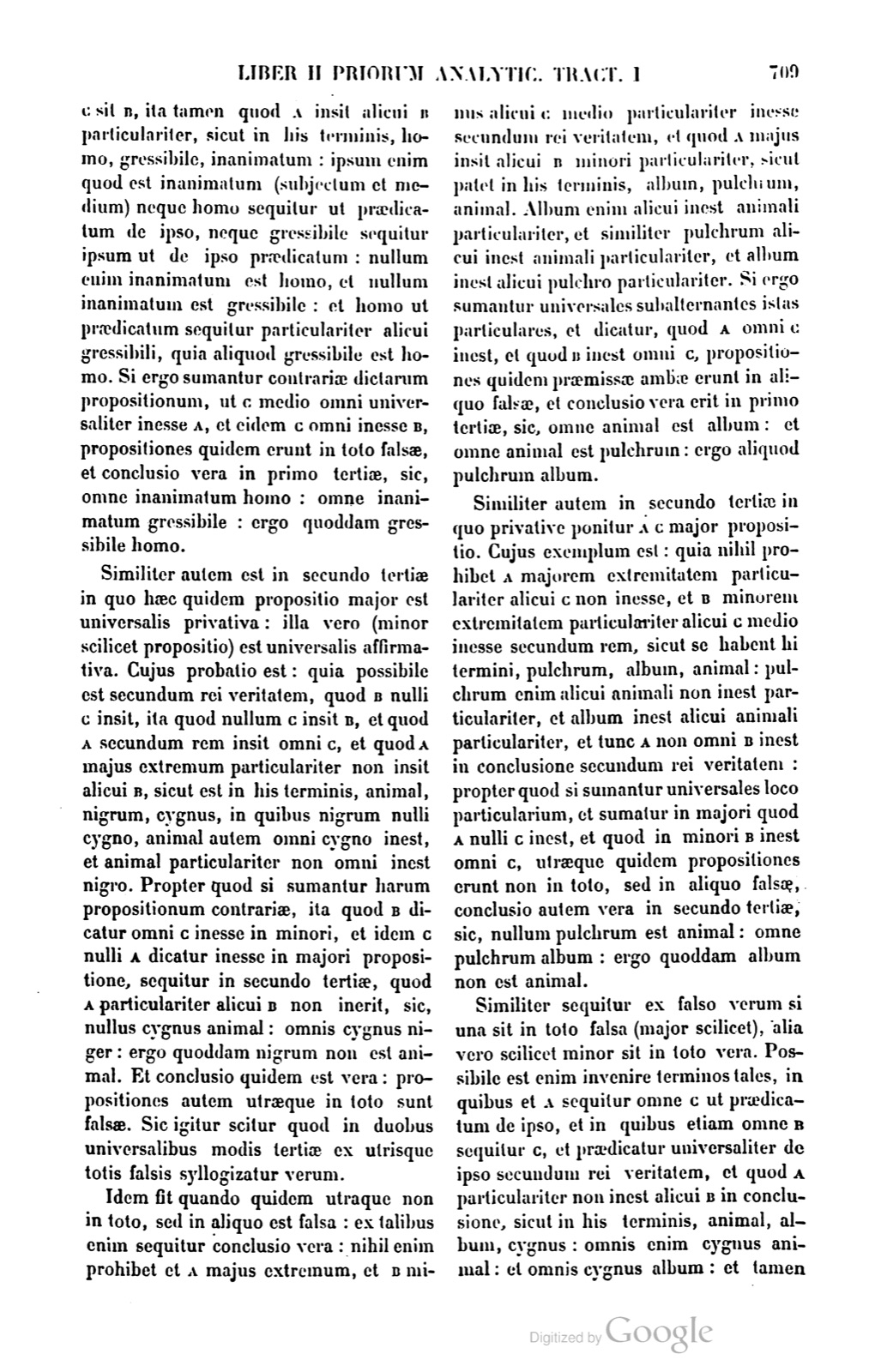
Hoc autem statim probatur in primo tertiae: nihil enim prohibet (C posito medio, et A majori extremitate, B autem minori) secundum rem neque A majus extremum, neque B minus extremum, nulli C inesse, ita quod nullum C sit A et nullum C sit B, ita tamen quod A insit alicui B particulariter, sicut in his terminis, homo, gressibile, inanimatum: ipsum enim quod est inanimatum (subjectum et medium) neque homo sequitur ut praedicatum de ipso, neque gressibile sequitur ipsum ut de ipso praedicatum: nullum enim inanimatum est homo, et nullum inanimatum est gressibile: et homo ut praedicatum sequitur particulariter alicui gressibili, quia aliquod gressibile est homo. Si ergo sumantur contrariae dictarum propositionum, ut A medio omni universaliter inesse A, et eidem C omni inesse B, propositiones quidem erunt in toto falsae, et conclusio vera in primo tertiae, sic, omne inanimatum homo: omne inanimatum gressibile: ergo quoddam gressibile homo.
Likewise a true conclusion follows if the universal is posited as affirmative and true, and the particular negative as false, as in the fourth mode of the second figure. The reason is that it is possible for A as middle to belong universally according to reality to the whole of both B, the major, and C, the minor, and for B, the major extreme, not to follow some C, the lesser extreme, as predicated of it, as genus is related to species and difference considered according to being. For animal as genus follows every human being, and every walking thing follows universally as predicated of them; but human being does not follow every walking thing as predicated of it. And therefore if in the syllogism A is taken in the major to belong to the whole and every B, and the same animal is taken in the minor not to belong particularly to some C, the universal proposition will be true, but the particular false, and the conclusion will be true thus: every human being is an animal; some walking thing is not an animal; therefore some walking thing is not a human being.
It is further manifest also in particular syllogisms that from both false premises there will be a true conclusion. The reason is that it can happen that A as middle, in some terms and with respect to B and C as extremes, belongs to this one universally and to that one in no way, or indifferently; and that B does not follow some C particularly denied of it. Therefore, with the terms so disposed, if in the major proposition it is taken that A belongs to no B, and the same A belongs to some C, both propositions indeed will be false, but the conclusion true.
Likewise it is also so when the universal proposition is predicative, as in the fourth mode of the second figure, and when the particular is privative. The reason is that it is possible that A as middle follows no B, so that no B is A, and that the same A follows every C, and that B does not belong particularly to some C, as animal follows no discipline, and the same animal follows every human being, because no discipline is an animal, but every human being is an animal. But if, with the terms so disposed, A is taken to belong to the whole B, and the same A is said not to follow some C but to be removed particularly from it, both propositions will be false, but the conclusion true, thus: every discipline is an animal; some human being is not an animal; therefore some human being is not a discipline. This is a syllogism in the fourth mode of the second figure.
Here it must be noted that in particular syllogisms there are five conjunctions: for either both premises are false, and then the major is either wholly false or false in part; or only one is false, and this is either the major or the minor, and each of those is either wholly or in part. Thus it is clear that there are five, of which two have been omitted here: one having the major false in part and the minor true, or the minor false. For these can be sufficiently understood through those that have been posited; all conjunctions which are made in the second figure can reach a true conclusion.
CHAPTER VIII.
How truth is syllogized from falsehood in syllogisms of the third figure, both universal and particular.
In the last figure also, through both false premises, whether wholly false or in part, whether both are false or one false and the other true, and when one indeed is false in something and the other wholly true, or conversely, one wholly false and the remaining one true in something, and in whatever other ways it is possible to transfer or varyingly combine propositions according to truth and falsity, always and in every case truth follows from falsehood.
This is immediately proved in the first mode of the third figure. For nothing prevents, with C posited as middle, A as major extreme, and B as minor, neither A the greater extreme nor B the lesser extreme from belonging to any C according to reality, so that no C is A and no C is B, and yet A belongs particularly to some B, as in these terms: human being, walking thing, inanimate. For that which is inanimate, the subject and middle, neither is followed by human being as predicated of it, nor is it followed by walking thing as predicated of it; for no inanimate thing is a human being, and no inanimate thing is walking. And human being as predicate follows particularly upon some walking thing, because some walking thing is a human being. Therefore, if the contraries of the propositions mentioned are taken, so that A is said to belong universally to every middle C, and B to belong to that same every C, the propositions indeed will be wholly false, and the conclusion true in the first mode of the third figure thus: every inanimate thing is a human being; every inanimate thing is walking; therefore some walking thing is a human being.
Similiter autem est in secundo tertiae in quo haec quidem propositio major est universalis privativa: illa vero (minor scilicet propositio) est universalis affirmativa. Cujus probatio est: quia possibile est secundum rei veritatem, quod B nulli C insit, ita quod nullum C insit B, et quod A secundum rem insit omni C, et quod A majus extremum particulariter non insit alicui B, sicut est in his terminis, animal, nigrum, cygnus, in quibus nigrum nulli cygno, animal autem omni cygno inest, et animal particulariter non omni inest nigro. Propter quod si sumantur harum propositionum contrariae, ita quod B dicatur omni C inesse in minori, et idem C nulli A dicatur inesse in majori propositione, sequitur in secundo tertiae, quod A particulariter alicui B non inerit, sic, nullus cygnus animal: omnis cygnus niger: ergo quoddam nigrum non est animal. Et conclusio quidem est vera: propositiones autem utraeque in toto sunt falsae. Sic igitur scitur quod in duobus universalibus modis tertiae ex utrisque totis falsis syllogizatur verum.
Idem fit quando quidem utraque non in toto, sed in aliquo est falsa: ex talibus enim sequitur conclusio vera: nihil enim prohibet et A majus extremum, et B minus alicui A medio particulariter inesse secundum rei veritatem, et quod A majus insit alicui B minori particulariter, sicut patet in his terminis, album, pulchrum, animal. Album enim alicui inest animali particulariter, et similiter pulchrum alicui inest animali particulariter, et album inest alicui pulchro particulariter. Si ergo sumantur universales subalternantes istas particulares, et dicatur, quod A omni C inest, et quod B inest omni C, propositiones quidem praemissae ambae erunt in aliquo falsae, et conclusio vera erit in primo tertiae, sic, omne animal est album: et omne animal est pulchrum: ergo aliquod pulchrum album.
Similiter autem in secundo tertiae in quo privative ponitur A C major propositio. Cujus exemplum est: quia nihil prohibet A majorem extremitatem particulariter alicui A non inesse, et B minorem extremitatem particulariter alicui A medio inesse secundum rem, sicut se habent hi termini, pulchrum, album, animal: pulchrum enim alicui animali non inest particulariter, et album inest alicui animali particulariter, et tunc A non omni B inest in conclusione secundum rei veritatem: propter quod si sumantur universales loco particularium, et sumatur in majori quod A nulli C inest, et quod in minori B inest omni C, utraeque quidem propositiones erunt non in toto, sed in aliquo falsae, conclusio autem vera in secundo tertiae, sic, nullum pulchrum est animal: omne pulchrum album: ergo quoddam album non est animal.
Similiter sequitur ex falso verum si una sit in toto falsa (major scilicet), alia vero scilicet minor sit in toto vera. Possibile est enim invenire terminos tales, in quibus et A sequitur omne C ut praedicatum de ipso, et in quibus etiam omne B sequitur C, et praedicatur universaliter de ipso secundum rei veritatem, et quod A particulariter non inest alicui B in conclusione, sicut in his terminis, animal, album, cygnus: omnis enim cygnus animal: et omnis cygnus album: et tamen non omne album animal: taliter igitur positis terminis, si sumatur B quidem toti C universaliter inesse in minori, et sumatur A toti C non inesse in majori universaliter, B C quidem propositio minor in toto erit vera, A C autem propositio major tota erit falsa, et conclusio erit vera, sic, nullus cygnus animal: omnis cygnus album: ergo quoddam album non est animal. Et est in secundo tertiae.
It is similar in the second mode of the third figure, in which the major proposition is universal privative, while the other, namely the minor proposition, is universal affirmative. The proof is that it is possible according to the truth of the thing that B belongs to no C, so that no C belongs to B, and that A according to reality belongs to every C, and that A, the greater extreme, particularly does not belong to some B, as in these terms: animal, black, swan. In these, black belongs to no swan, but animal belongs to every swan, and animal does not particularly belong to every black thing. On account of this, if the contraries of these propositions are taken, so that B is said to belong to every C in the minor, and the same C is said to belong to no A in the major proposition, it follows in the second mode of the third figure that A will particularly not belong to some B, thus: no swan is an animal; every swan is black; therefore some black thing is not an animal. And the conclusion indeed is true, while both propositions are wholly false. Thus, therefore, it is known that in the two universal modes of the third figure truth is syllogized from both wholly false premises.
The same happens when neither premise is wholly false, but each is false in something; for from such premises a true conclusion follows. Nothing prevents both A, the greater extreme, and B, the lesser, from belonging particularly to some A as middle according to the truth of the thing, and A the greater from belonging particularly to some B the lesser, as is clear in these terms: white, beautiful, animal. For white belongs particularly to some animal, and likewise beautiful belongs particularly to some animal, and white belongs particularly to some beautiful thing. Therefore, if universals subalternating these particulars are taken, and it is said that A belongs to every C and that B belongs to every C, the propositions laid down as premises will indeed both be false in something, and the conclusion will be true in the first mode of the third figure, thus: every animal is white; and every animal is beautiful; therefore some beautiful thing is white.
Similarly in the second mode of the third figure, in which A C, the major proposition, is posited privatively. The example is that nothing prevents A, the major extreme, from particularly not belonging to some A, and B, the minor extreme, from particularly belonging to some A as middle according to reality, as these terms are related: beautiful, white, animal. For beautiful particularly does not belong to some animal, and white particularly belongs to some animal, and then A does not belong to every B in the conclusion according to the truth of the thing. On account of this, if universals are taken in place of particulars, and it is taken in the major that A belongs to no C, and in the minor that B belongs to every C, both propositions indeed will be not wholly but partly false, and the conclusion true in the second mode of the third figure thus: no beautiful thing is an animal; every beautiful thing is white; therefore some white thing is not an animal.
Likewise truth follows from falsehood if one premise is wholly false, namely the major, but the other, namely the minor, is wholly true. For it is possible to find such terms in which A follows every C as predicated of it, and in which also every B follows C and is predicated universally of it according to the truth of the thing, and in which A does not particularly belong to some B in the conclusion, as in these terms: animal, white, swan. For every swan is an animal, and every swan is white, and yet not every white thing is an animal. With the terms so posited, then, if B is taken to belong universally to the whole C in the minor, and A is taken universally not to belong to the whole C in the major, the minor proposition B C will indeed be wholly true, but the major proposition A C wholly false, and the conclusion will be true thus: no swan is an animal; every swan is white; therefore some white thing is not an animal. This is in the second mode of the third figure.
Similiter autem est si B C minor propositio ponatur esse in toto falsa, A C autem major ponatur in toto vera: nam iidem termini sunt per quos hoc demonstratur, nigrum scilicet, cygnus, inanimatum, sic, nullus cygnus inanimatum: omnis cygnus niger: ergo quoddam nigrum non est inanimatum. Et est in secundo tertiae.
Idem autem fit in primo tertiae si utraeque praemissae assumantur affirmativae, et concludatur particularis affirmativa. Nihil enim prohibet tales invenire terminos, in quibus secundum rei veritatem A sequitur omne C, et A secundum rem toti C non inest universaliter, et quod tamen secundum rem A inest alicui A particulariter, sicut est in his terminis, animal, nigrum, cygnus: omni enim cygno sequitur animal: est enim omnis cygnus animal: nigrum vero nulli cygno sequitur: et nigrum inest ut praedicatum particulariter alicui animali. Si ergo sumantur contrariae istarum, et sumatur A inesse omni C et sumatur B inesse omni C, erit B C minor propositio in toto vera, A C autem major propositio erit in toto falsa: et sequitur conclusio vera, sic, omnis cygnus niger: omnis cygnus animal: ergo quoddam animal nigrum.
Similiter autem est quando A C propositio major sumitur in toto vera, et B C minor sumitur in toto falsa: nam per eosdem terminos transpositos est demonstratio, sic, omnis cygnus animal: omnis cygnus niger: ergo quoddam nigrum animal.
Rursum si secundum aliam variationem in universalibus syllogismis factam sumatur una praemissarum tota vera, et alia sumatur in aliquo falsa, et non in toto, adhuc in tertia figura sequitur verum ex falso: possibile est enim secundum rem, quod minus extremum omni C insit universaliter, et quod secundum rei veritatem A majus extremum particulariter insit alicui C, et quod A insit alicui B particulariter, ut in his terminis, bipes, pulchrum, homo: bipes enim inest omni homini, quia omnis homo est bipes: pulchrum autem non omni homini inest: et similiter pulchrum inest alicui bipedi secundum rem. Si ergo contrario modo sumantur propositiones, ita quod A dicatur omni et toti inesse C, et similiter B dicatur in minori toti inesse C, tunc in primo tertiae B C minor propositio in toto erit vera, A C autem major propositio in aliquo erit falsa, et conclusio erit vera, sic, omne bipes pulchrum: omne bipes animal: ergo quoddam animal pulchrum. Et est syllogismus in primo tertiae.
Similiter autem sequitur verum ex falso in primo tertiae si A C major propositio sumatur tota vera, B C autem minori propositione falsa sumpta secundum partem: transpositis enim eisdem terminis ut extremitas major fiat minor et e converso, erit demonstratio, sic, omne bipes animal: omne bipes pulchrum: ergo quoddam pulchrum animal.
Idem autem fit in secundo tertiae cum haec quidem praemissarum est privativa, alia vero fuerit affirmativa universalis, minor scilicet: quoniam enim evenit in aliquibus terminis secundum rei veritatem A quidem toti C inesse in minori, A autem secundum rem alicui C tantum particulariter inesse: et quando sic habent propositiones et termini, tunc non omni B inest A in conclusione. Si ergo sumatur in minori B toti et omni C inesse, A autem sumatur nulli C inesse in majori privativa, privativa quidem major erit in aliquo falsa, altera autem universalis affirmativa erit in toto vera, et sequitur conclusio vera in secundo tertiae, sic, nullum bipes pulchrum, omne bipes animal: ergo quoddam animal non est pulchrum.
It is similar if the minor proposition B C is posited as wholly false, while the major A C is posited as wholly true; for the same terms, namely black, swan, inanimate, demonstrate this thus: no swan is inanimate; every swan is black; therefore some black thing is not inanimate. And this is in the second mode of the third figure.
The same thing happens in the first mode of the third figure if both premises are assumed as affirmative and a particular affirmative is concluded. For nothing prevents finding such terms in which, according to the truth of the thing, A follows every C, and A according to reality does not belong universally to the whole of C, and nevertheless according to reality A belongs particularly to some A, as in these terms: animal, black, swan. For animal follows every swan, since every swan is an animal; but black follows no swan, and black belongs particularly as predicate to some animal. Therefore, if the contraries of those are taken, and A is taken to belong to every C and B is taken to belong to every C, the minor proposition B C will be wholly true, but the major proposition A C will be wholly false; and a true conclusion follows thus: every swan is black; every swan is an animal; therefore some animal is black.
It is similar when the major proposition A C is taken as wholly true and the minor B C is taken as wholly false, for the demonstration is through the same terms transposed, thus: every swan is an animal; every swan is black; therefore some black thing is an animal.
Again, if according to another variation made in universal syllogisms one of the premises is taken as wholly true and the other is taken as false in something and not wholly, still in the third figure truth follows from falsehood. For it is possible according to reality that the lesser extreme belongs universally to every C, and that according to the truth of the thing A, the greater extreme, particularly belongs to some C, and that A belongs particularly to some B, as in these terms: two-footed, beautiful, human being. For two-footed belongs to every human being, because every human being is two-footed; but beautiful does not belong to every human being; and similarly beautiful belongs to some two-footed thing according to reality. Therefore, if the propositions are taken in the contrary way, so that A is said to belong to every and the whole C, and likewise B is said in the minor to belong to the whole C, then in the first mode of the third figure the minor proposition B C will be wholly true, but the major proposition A C will be false in something, and the conclusion will be true thus: every two-footed thing is beautiful; every two-footed thing is an animal; therefore some animal is beautiful. And it is a syllogism in the first mode of the third figure.
Likewise truth follows from falsehood in the first mode of the third figure if the major proposition A C is taken as wholly true, while the minor proposition B C is taken as false according to part. For when the same terms have been transposed so that the major extreme becomes minor and conversely, there will be the demonstration thus: every two-footed thing is an animal; every two-footed thing is beautiful; therefore some beautiful thing is an animal.
The same happens in the second mode of the third figure when one of the premises is privative and the other, namely the minor, is universal affirmative. For because it happens in some terms according to the truth of the thing that A belongs to the whole of C in the minor, but that A according to reality belongs only particularly to some C, and when the propositions and terms are so disposed, then A does not belong to every B in the conclusion: therefore, if B is taken in the minor to belong to the whole and every C, but A is taken to belong to no C in the privative major, the privative major indeed will be false in something, while the other universal affirmative will be wholly true, and a true conclusion follows in the second mode of the third figure thus: no two-footed thing is beautiful; every two-footed thing is an animal; therefore some animal is not beautiful.
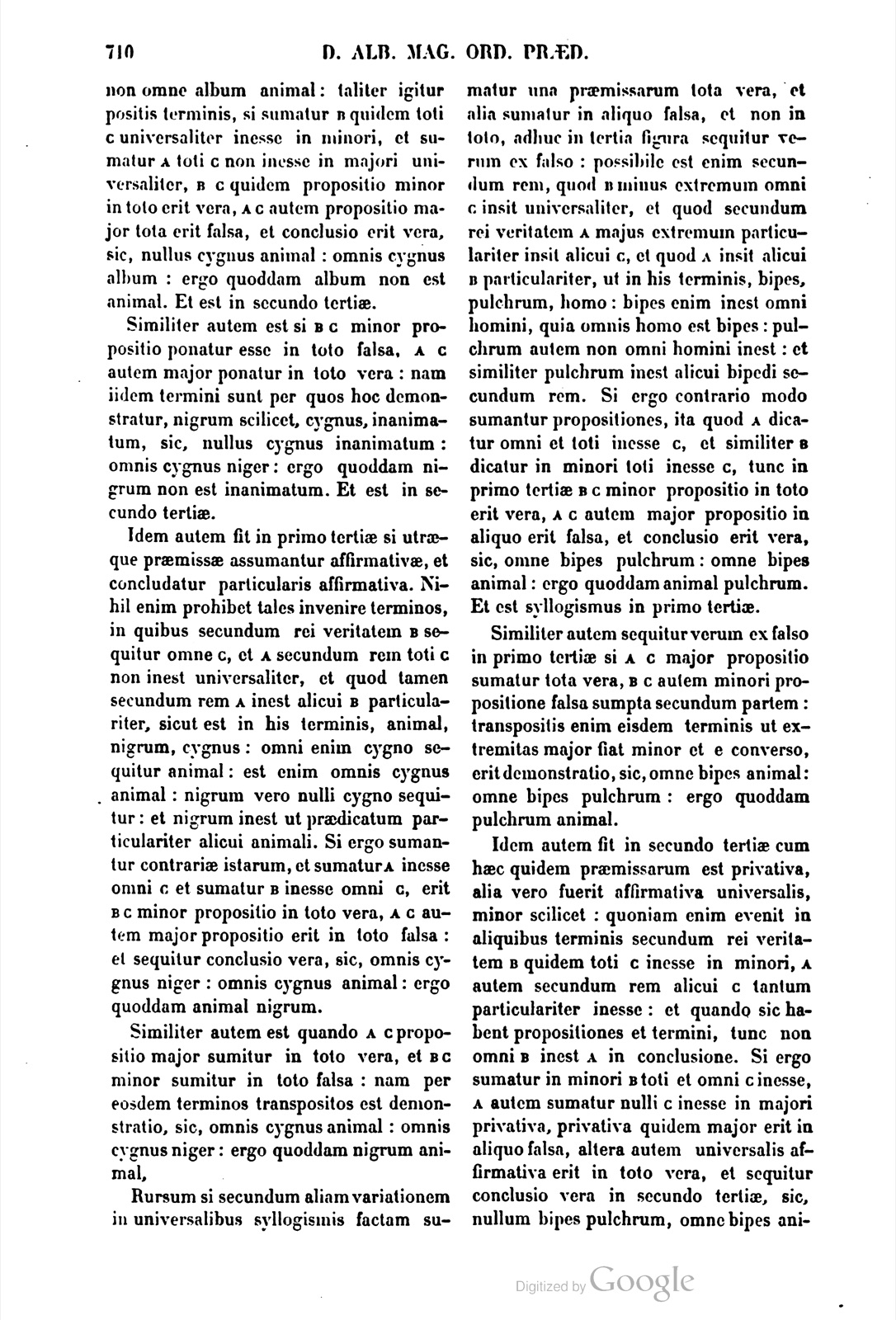
Rursum autem (cum jam immediate ante ostensum est, quoniam cum A nulli C inest secundum rem, et quod B inest alicui C particulariter secundum rem: tunc evenit secundum veritatem, quod A alicui B non inest in conclusione) ex hoc eodem manifestum est, quoniam etiam cum A C propositio major tota est vera, B C autem propositio minor in aliquo falsa, contingit conclusionem esse veram. Si enim sic se habentibus terminis et propositionibus, sumatur quod A nulli C inest in majori, et quod B inest omni C in minori, A C quidem major propositio erit in toto vera, B C autem propositio minor in aliquo erit falsa, sic, nullum nigrum cygnus: omne nigrum animal: ergo quoddam animal non est cygnus.
Cum autem ista varietas jam ostensa sit in universalibus syllogismis, manifestum est etiam, quoniam in omnibus particularibus tertiae figurae syllogismis omnino et universaliter secundum omnem varietatem propositionum contingit verum per falsa vel per falsum syllogizare: nam iidem termini sunt sumendi ad demonstrationem et quando universales, et quando particulares sumuntur praemissae propositiones, negativi quidem ad negativos, affirmativi autem ad affirmativos referantur mutata quantitate alterius propositionis, sicut diximus in categoricis sive praedicativis (hoc est, affirmativis syllogismis) sicut in tertio et quarto tertiae, qui sumuntur juxta primum ejusdem figurae. In privativis autem syllogismis sumantur privativi, sicut in quinto et sexto tertiae, qui sumuntur juxta secundum modum ejusdem tertiae: nihil enim differt in tertia figura, quae particulariter concludit (quantum ad terminorum positionem sive sumptionem) cum nulli inest secundum rem omni sumere per contrarium inesse: sic et universaliter in omni variatione propositionum quae inducta est, si sumptum est particulariter alicui inesse, hoc universaliter alicui inesse sumere in terminorum positione. Potest enim particularis sumi sub universali in eisdem terminis. Similiter autem est etiam in privativis syllogismis acceptis sub secundo tertiae, ita quod particularis sub universali sumatur: nec oportet hos syllogismos formare, quia faciles considerata habitudine terminorum in universalibus.
Est autem hic attendendum sicut in aliis, quod in universalibus tertiae figurae sunt octo combinationes: aut enim utraque est falsa, aut tantum altera. Si utraque: aut in toto, aut in parte, aut major in toto, et minor in parte, aut e converso minor in toto et major in parte. Si autem tantum altera est falsa: aut major, aut minor. Si major: aut in toto falsa, aut in parte: et si minor, aut in toto, aut in parte. Et sic sunt octo conjugationes, quarum duae omissae sunt, illae scilicet quae habent alteram in toto falsam, et alteram in parte falsam: quia illae satis intelliguntur per illas quae habent alteram in toto falsam et alteram veram.
Si autem aliquis objiciat dicens, quod prima figura per conversionem minoris facit tertiam, et sic major primae figurae adhuc manet in tertia: sed majori tota falsa non concludebatur conclusio vera in prima figura, minori existente vera vel partim falsa: ergo videtur, quod nec in tertia majori tota falsa existente, et altera vera vel partim falsa, possit esse conclusio vera. Dicendum quod illa ratio non valet: tria enim sunt in causa, quare in tali habitudine propositionum non poterat esse conclusio vera in prima figura, quorum unum est falsitas majoris in toto, secundum acceptio conclusionis universalis, tertium autem talis situs medii ad extrema, quod minus extremum accipitur sub medio, et medium sub majori extremo: et quocumque istorum trium deficiente poterit sequi conclusio vera ex sic falsa, vel falsis: unde in syllogismis particularibus primae figurae (sicut dictum est) se habentibus propositionibus poterit esse vera conclusio particularis. Et similiter in universalibus secundae figurae, et in syllogismis tertiae figurae similiter.
Again, since immediately before it was shown that when A belongs to no C according to reality and B belongs particularly to some C according to reality, then it happens according to truth that A does not belong to some B in the conclusion, from this same point it is manifest that, even when A C, the major proposition, is wholly true, but B C, the minor proposition, is false in something, it can happen that the conclusion is true. For if, with the terms and propositions so disposed, it is taken that A belongs to no C in the major and that B belongs to every C in the minor, A C, the major proposition, will indeed be wholly true, but B C, the minor proposition, will be false in something, thus: no black thing is a swan; every black thing is an animal; therefore some animal is not a swan.
Since this variety has now been shown in universal syllogisms, it is also manifest that in all particular syllogisms of the third figure, absolutely and universally according to every variety of propositions, it is possible to syllogize truth through falsehoods or through falsehood. For the same terms are to be taken for demonstration both when the premises are taken universally and when they are taken particularly; the negative are referred to the negative, and the affirmative to the affirmative, with the quantity of one proposition changed, as we said in categorical or predicative syllogisms, that is, affirmative syllogisms, as in the third and fourth modes of the third figure, which are taken next to the first mode of the same figure. But in privative syllogisms the privative ones are to be taken, as in the fifth and sixth modes of the third figure, which are taken next to the second mode of that same third figure. For in the third figure, which concludes particularly, nothing differs, with respect to the position or assumption of the terms, when, where something belongs to no instance according to reality, one takes by the contrary that it belongs to every instance; so too universally in every variation of propositions which has been introduced, if it has been taken to belong particularly to something, to take this as belonging universally to something in the position of the terms. For a particular can be taken under a universal in the same terms. It is similar also in privative syllogisms accepted under the second mode of the third figure, so that a particular is taken under a universal; nor is it necessary to form these syllogisms, because they are easy when the relation of terms in the universals has been considered.
Here, as in the other cases, it must be attended that in the universal syllogisms of the third figure there are eight combinations: either both premises are false, or only one. If both are false, then either wholly, or in part, or the major wholly and the minor in part, or conversely the minor wholly and the major in part. But if only one is false, it is either the major or the minor. If the major, it is either wholly false or in part; and if the minor, either wholly or in part. Thus there are eight conjunctions, of which two have been omitted, namely those which have one premise wholly false and the other false in part; for those are sufficiently understood through those which have one premise wholly false and the other true.
But if someone objects, saying that the first figure makes the third through conversion of the minor, and thus the major of the first figure still remains in the third, but when the major was wholly false a true conclusion was not concluded in the first figure while the minor was true or partly false; therefore it seems that neither in the third figure, when the major is wholly false and the other premise true or partly false, can the conclusion be true. One must say that that reasoning is not valid. For three things are part of the cause why, in such a relation of propositions, there could not be a true conclusion in the first figure: one is the falsity of the major wholly; the second is the taking of a universal conclusion; and the third is such a position of the middle with respect to the extremes, that the lesser extreme is taken under the middle and the middle under the major extreme. When any one of these three is lacking, a true conclusion will be able to follow from a premise false in that way, or from false premises. Hence in the particular syllogisms of the first figure, as was said, when the propositions are so disposed, there can be a true particular conclusion. And similarly in the universal syllogisms of the second figure, and similarly in syllogisms of the third figure.
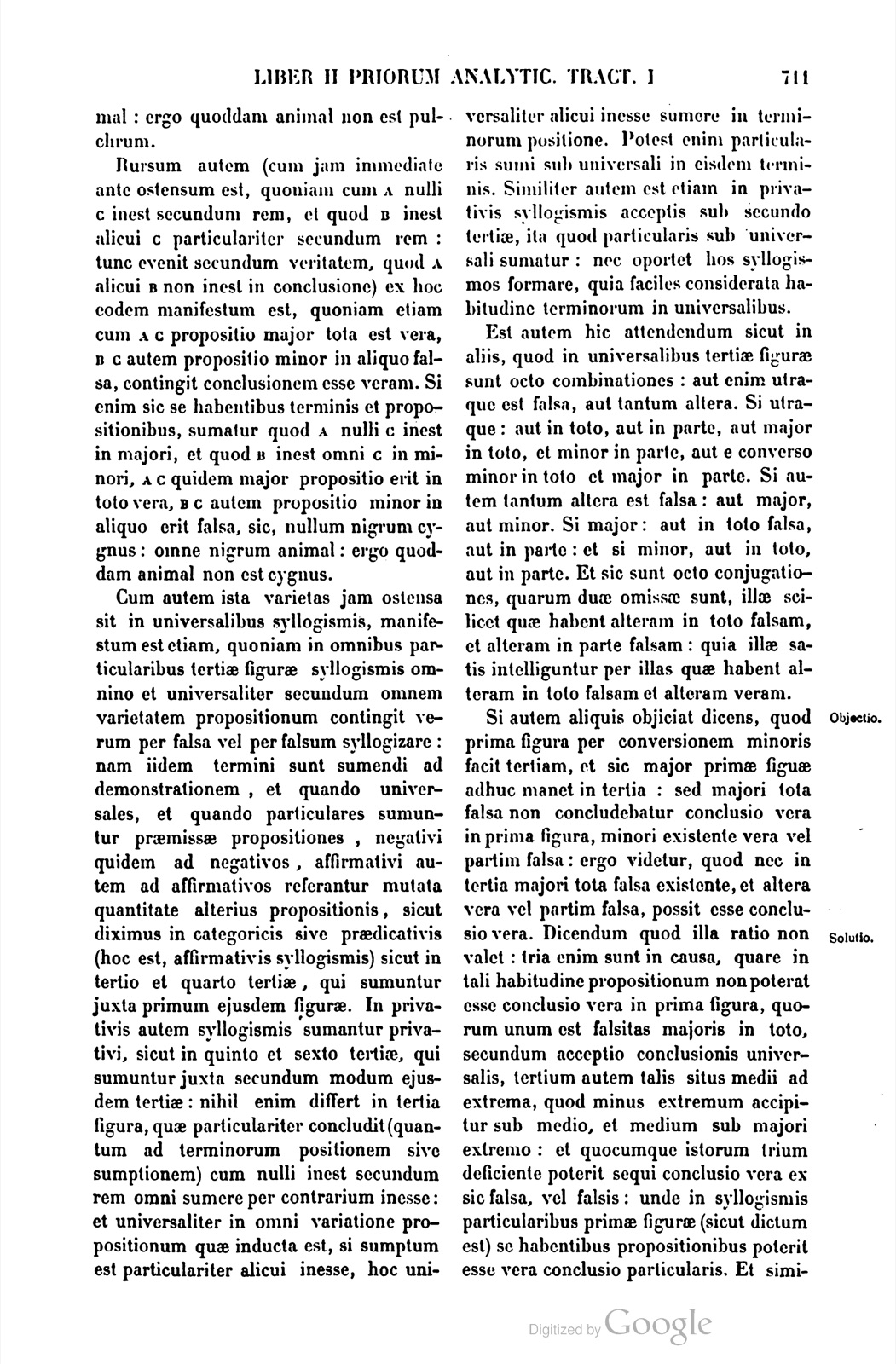
Est etiam notandum, quod in syllogismis particularibus tertiae figurae sunt quinque conjugationes in hac habitudine propositionum sicut et in aliis, et omnes utiles. Aut enim est utraque falsa: et hoc dupliciter, scilicet vel in toto falsa, vel in parte falsa: vel altera tantum est falsa, et hoc vel particulari, vel universali: et hoc dupliciter, aut in toto, aut in parte.
In summa autem notandum est, quod in omnibus figuris in universalibus syllogismis sunt octo conjugationes, et in particularibus sunt quinque, et omnes generaliter possunt in conclusionem veram, exceptis duabus conjugationibus universalium syllogismorum primae figurae, ubi major est in toto falsa, minor autem vel vera, vel in parte falsa.
Sunt tamen qui generaliter objiciunt contra omnia quae de omnibus figuris in hoc capitulo dicta sunt et in praehabitis de hac materia tractatibus: dicunt enim quod falsitas est privatio veritatis, sicut negatio privatio est affirmationis. Sed ex minori negativa non fit syllogismus in prima figura et tertia, nec ex ambabus negativis fit syllogismus in aliqua figura. Ergo nec ex minori falsa fiet syllogismus in prima et tertia, neque ex utraque falsa fit syllogismus in aliqua figurarum, ut videtur. Ad hoc autem dicendum quod ad syllogismum primae et secundae figurae sufficit minorem propositionem esse affirmativam secundum sermonem: et hoc quidem etiam sufficit in omnibus figuris: non enim exigitur quod affirmativa positiva sit secundum se, sive secundum rem: sed sufficit quod sit positiva secundum sermonem solum quantum ad figuram et modum syllogismi.
CAPUT IX.
De probatione, quod verum non sequitur ex falso, nisi quia et non propter quid.
Cum autem praemissae se habeant ad conclusionem, sicut antecedens et principium, conclusio autem ad praemissas, sicut consequens, manifestum est quoniam si sit conclusio falsa, necesse ea falsa esse ex quibus (ut propositionibus) est oratio syllogistica, aut omnia sive ambo, aut aliqua sive altera praemissarum: et haec est causa ejus quod probatum est primo, scilicet quod falsum non sequitur ex vero. Quando autem vera est conclusio, non necesse est veras esse praemissas: quia non est necesse, quod posito consequente vero ponatur antecedens: et ideo conclusione vera existente non est necesse principia esse vera in quid sive in quoddam, sive omnia, sive ambo: sed cum nullum sit verum praemissorum in syllogismis, contingit adhuc conclusionem esse veram similiter sicut quando praemissae sunt verae: et haec est causa ejus quod secundo probatum fuit, scilicet quod verum sequatur ex falso.
Causa autem ejus quod dictum est, haec est: quia quando duo sic se habent ad invicem, ut cum unum sit vel esse dicatur, ex essentiali et naturali consequentia necesse sit esse reliquum, sicut se habent antecedens et consequens, quando consequens actu est de intellectu antecedentis, tunc cum hoc non sit (quod est consequens), sequitur alterum non esse quod est antecedens: quia destructo consequente destruitur antecedens: cum autem sit consequens, non propter hoc necesse est antecedens.
Ad idem autem antecedens cum sit et non sit (hoc est, acceptum secundum esse et non esse) impossibile est idem esse consequens. Dico autem hoc exponendo in terminis, ut cum dicimus, quod sit A antecedens album, et quod B consequens
It must also be noted that in particular syllogisms of the third figure there are five conjunctions in this relation of propositions as in the others, and all are useful. For either both premises are false, and this in two ways, namely either wholly false or false in part; or only one is false, and this either in the particular or in the universal, and this in two ways, either wholly or in part.
In sum, however, it must be noted that in all figures, in universal syllogisms there are eight conjunctions, and in particulars there are five, and all generally can reach a true conclusion, except two conjunctions of universal syllogisms of the first figure, where the major is wholly false and the minor is either true or false in part.
Nevertheless there are some who object generally against all the things which have been said about all figures in this chapter and in the preceding tractates on this matter. For they say that falsity is the privation of truth, just as negation is the privation of affirmation. But from a negative minor there is no syllogism in the first and third figure, nor is a syllogism made from two negatives in any figure. Therefore neither will a syllogism be made from a false minor in the first and third, nor from both false premises in any of the figures, as it seems. To this one must say that for a syllogism of the first and second figure it suffices that the minor proposition be affirmative according to speech; and indeed this suffices also in all figures. For it is not required that the affirmative be positive according to itself, or according to reality; it suffices that it be positive according to speech alone as regards the figure and mode of the syllogism.
CHAPTER IX.
On the proof that truth does not follow from falsehood except quia and not propter quid.
Since premises are related to the conclusion as antecedent and principle, but the conclusion is related to the premises as consequent, it is manifest that if the conclusion is false, those things from which the syllogistic discourse is made, as from propositions, must be false, either all or both, or some or one of the premises. And this is the cause of what was proved first, namely that falsehood does not follow from truth. But when the conclusion is true, it is not necessary that the premises be true, because it is not necessary that, when a true consequent is posited, the antecedent be posited. And therefore, when the conclusion is true, it is not necessary that the principles be true in some respect or in some one thing, either all or both; but when none of the premises in syllogisms is true, it can still happen that the conclusion is true, similarly as when the premises are true. And this is the cause of what was proved second, namely that truth follows from falsehood.
The cause of what has been said is this: when two things are so related to one another that, when one exists or is said to exist, by an essential and natural consequence the remaining one must exist, as antecedent and consequent are related when the consequent is actually of the understanding of the antecedent, then when this, which is the consequent, does not exist, it follows that the other, which is the antecedent, does not exist, because when the consequent has been destroyed the antecedent is destroyed. But when the consequent exists, on account of this it is not necessary that the antecedent exist.
It is impossible that the same consequent belong to the same antecedent when it both exists and does not exist, that is, when it is taken according to being and non-being. I say this by explaining in terms: as when we say that A, the antecedent, is white, and that B, the consequent,
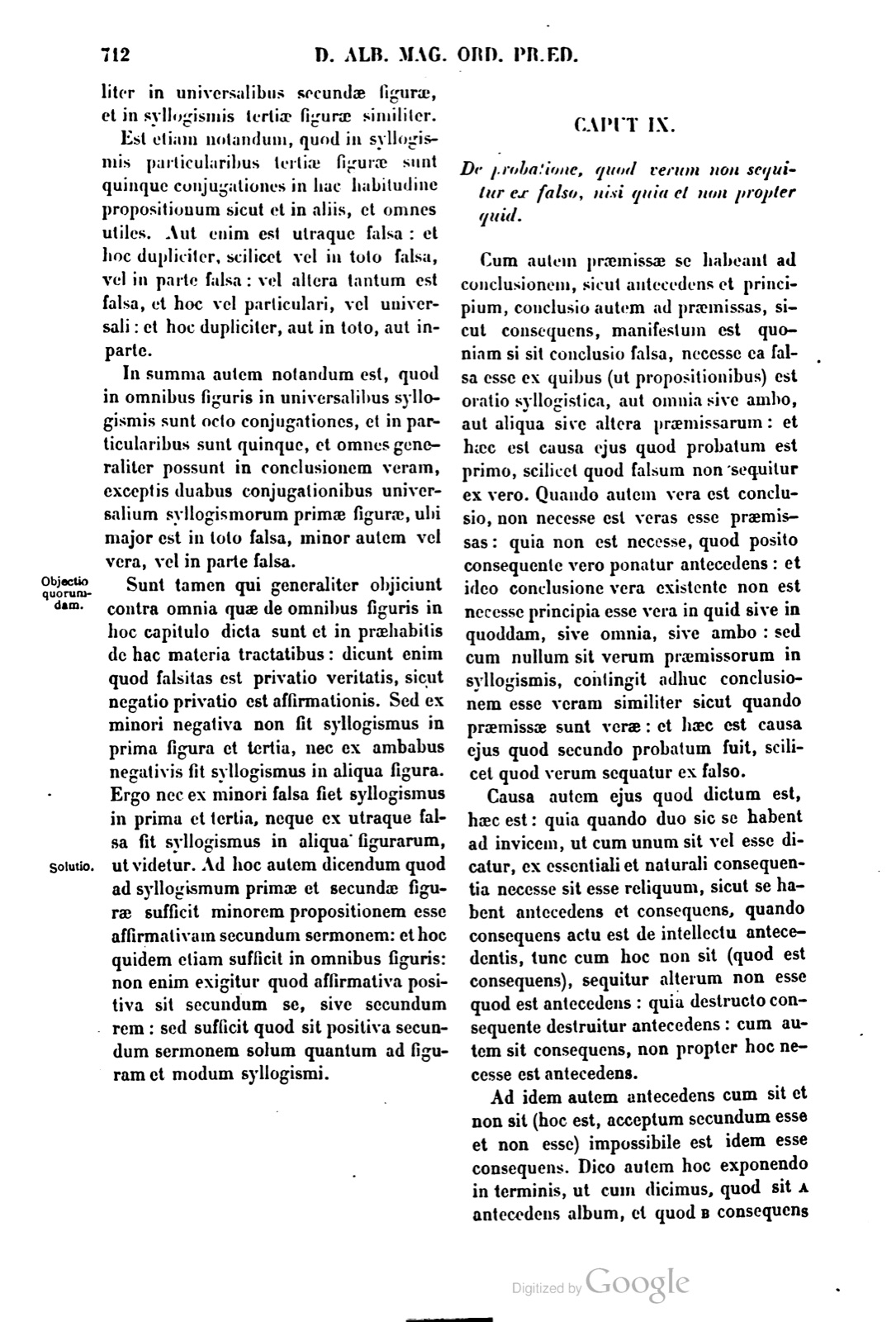
If a page does not appear, its photograph has not been uploaded yet.