Works › Prior Analytics, Books I–II
Volume 1 · pp. 483–485
Chapter XV. On the removal of an error that could occur.
A marker with ≈ is an approximate page boundary, placed by measure of the text; the page photographs remain the authority. In the paired views, clicking a page marker brings that page into view.
CAPUT XV. De remotione erroris qui posset incidere.
Sed quia hic diximus affirmativas et negativas ad compositionem dicti referentes affirmationem et negationem in earum propositionum quae inductae sunt conversione, ne putet aliquis affirmativam vel negativam esse propositionem, per hoc quod est affirmativa vel negativa esse vel dicti, sed potius per hoc quod est affirmativa vel negativa modi, ideo dicimus quod nunc quoad propositam intentionem tantum sit nobis manifestum quomodo contingere nulli aut alicui non inesse (modo affirmato et dicto universaliter vel particulariter negato) affirmativam habet figuram et speciem: et est propositio affirmativa vel negativa quae est de modo affirmato vel negato, sicut in Perihermenias dictum est. Hujus autem ratio est: quia contingit in modalibus et omnibus propositionibus de inesse quae ad hoc similiter ordinantur: quia sicut est vel esse (quibus est praedicatur ut adjacens praedicatum subjecto) facit affirmativam propositionem: et a quibuscumque ut adjacens per negationem removetur, facit negativam propositionem: et hic ita est omnino sive universaliter, sicut patet in exemplis, ut est bonum, est non bonum: vel est simpliciter non hoc, hoc est, non homo, vel non asinus: omnes enim illae sunt affirmativae: et similiter est in modalibus de modo affirmato vel negato. Hoc autem etiam melius ostendetur per sequentia.
Secundum conversiones autem propositiones de contingenti similiter se habebunt aliis, ut dictum est, excepto quod universalis negativa de contingente nato vel infinito non convertitur in terminis. Quamvis quidam contra hoc objicientes contrarium probare videantur hoc modo. Dicunt enim quod universalis negativa de contingente nato vel infinito convertitur, sed non in eadem acceptione contingentis, sed convertitur ad contingens communiter acceptum. Objiciunt ergo secundum hunc modum dicentes, quod id quod per se inest superiori, inest cuilibet suorum inferiorum. Sed converti in terminis universalem negativam inest contingenti communi sive alto: inest ergo cuilibet suorum inferiorum: inest ergo tam contingenti nato quam infinito: et sic universalis negativa de contingente nato et de contingente infinito convertuntur in terminis.
Adhuc autem si aliqua duo convertuntur, eodem utrique addito adhuc convertuntur: sed istae duae convertuntur, nullum B est A, et nullum A est B, quocumque modo sumantur inesse sive contingenter sive ex necessitate: ergo eodem addito utrobique adhuc convertuntur: additur autem idem sic, nullum B contingit esse A, et nullum A contingit esse B: ergo convertuntur adhuc: et sic convertitur universalis negativa de contingenti nato et infinito: hoc enim additur utrobique.
CHAPTER XV. On the removal of an error that could occur.
But because here we have called affirmative and negative those propositions which, in the conversion of the propositions that have been introduced, refer affirmation and negation to the composition of the dictum, lest someone think that a proposition is affirmative or negative because the being or dictum is affirmative or negative, but rather because the mode is affirmative or negative, therefore we say that, now, as regards only the proposed intention, this much should be manifest to us: how "to happen to belong to none" or "to happen not to belong to some" (with the mode affirmed and the dictum negated universally or particularly) has an affirmative figure and species; and it is an affirmative or negative proposition which is about the mode affirmed or negated, as was said in Perihermenias. The reason for this is that it happens in modal propositions and in all propositions of inherence which are similarly ordered to this: because just as "is" or "to be" (in which "is" is predicated as a predicate adjacent to the subject) makes an affirmative proposition, so from whatever things it is removed as adjacent through negation, it makes a negative proposition; and here it is entirely so, either universally, as is clear in examples, such as "it is good," "it is not good," or "it is simply not this," that is, "not a man," or "not an ass": for all those are affirmative; and similarly it is in modals concerning a mode affirmed or negated. But this will also be shown better through what follows.
According to conversions, however, propositions about the contingent will stand in like manner with the others, as has been said, except that the universal negative concerning the contingent by nature or the indefinite contingent is not converted in terms. Although certain persons, objecting against this, seem to prove the contrary in this way. For they say that the universal negative concerning the contingent by nature or the indefinite contingent is converted, but not in the same acceptance of contingency; rather it is converted to contingency taken commonly. Therefore they object according to this manner, saying that what belongs per se to a superior belongs to any of its inferiors. But being converted in terms belongs to the common or high contingent; therefore it belongs to any of its inferiors; therefore it belongs both to the contingent by nature and to the indefinite contingent; and thus the universal negative concerning the contingent by nature and concerning the indefinite contingent are converted in terms.
Again, if any two things are converted, then when the same thing is added to each, they are still converted; but these two are converted, "no B is A" and "no A is B," in whatever way they are taken, whether as inherence, contingently, or from necessity; therefore when the same thing is added on each side, they are still converted. Now the same thing is added in this way: "no B happens to be A," and "no A happens to be B"; therefore they are still converted; and thus the universal negative concerning the contingent by nature and the indefinite contingent is converted, for this is added on each side.
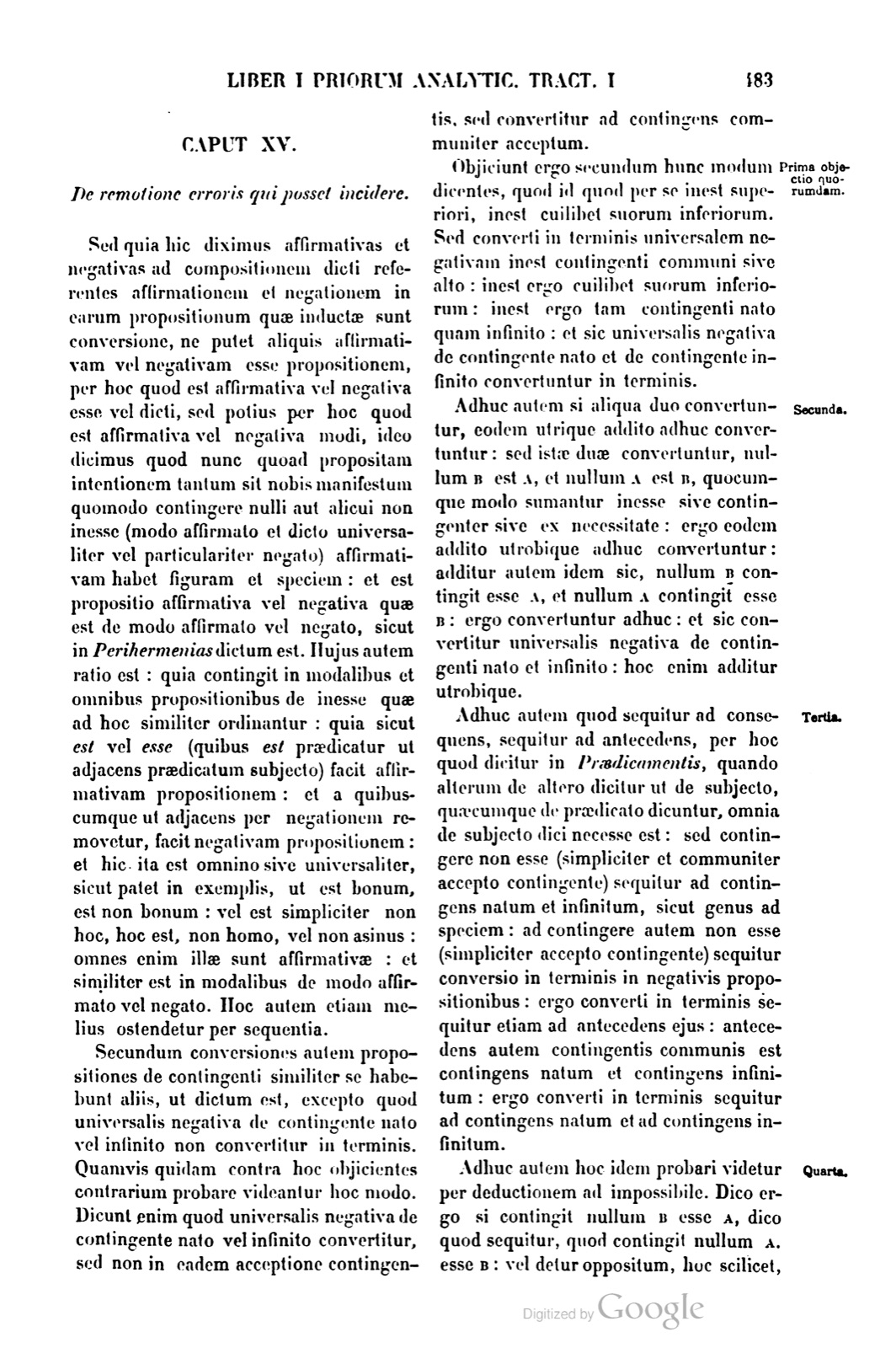
Adhuc autem quod sequitur ad consequens, sequitur ad antecedens, per hoc quod dicitur in Praedicamentis, quando alterum de altero dicitur ut de subjecto, quaecumque de praedicato dicuntur, omnia de subjecto dici necesse est: sed contingere non esse (simpliciter et communiter accepto contingente) sequitur ad contingens natum et infinitum, sicut genus ad speciem: ad contingere autem non esse (simpliciter accepto contingente) sequitur conversio in terminis in negativis propositionibus: ergo converti in terminis sequitur etiam ad antecedens ejus: antecedens autem contingentis communis est contingens natum et contingens infinitum: ergo converti in terminis sequitur ad contingens natum et ad contingens infinitum.
Adhuc autem hoc idem probari videtur per deductionem ad impossibile. Dico ergo si contingit nullum B esse A, dico quod sequitur, quod contingit nullum A esse B: vel detur oppositum, hoc scilicet, non contingit nullum A esse B, posito tamen quod contingit nullum B esse A. Sed haec, non contingit nullum A esse B, convertitur cum hac, necesse est aliquod A esse B; et si necesse est aliquod A esse B, sequitur quod necesse est aliquod B esse A: et haec est incompossibilis primae quae dixit, contingit nullum B esse A: videtur igitur quod conversio stet et sit bona.
Ad haec autem et similia per antedicta solvere non est difficile. Dicendum enim sicut prius, quod negativa de contingenti nato vel infinito, non convertitur in terminis, sicut dictum est. Ad id autem quod objicitur, dicendum quod per naturam contingentis communiter dicti sive alti (quae invenitur in contingenti nato et in contingenti infinito sicut invenitur natura generis in speciebus) potest fieri conversio in contingenti nato et infinito: sed respiciendo ad propriam naturam contingentis nati et infiniti conversio fieri non potest, propter causam quae in ante habitis de conversione universalis affirmativae dicta est: et per hoc patet solutio ad primum et tertium.
Ad id autem quod objicitur, si aliqua duo convertuntur, quod addito utrobique eodem adhuc convertuntur. Dicendum quod si id quod utrobique additur, ejusdem virtutis est et acceptionis in utroque, tunc verum est quod dicitur. Si autem non sit unius acceptionis in utroque, tunc non oportet quod convertantur. Cum autem sic dicitur, contingit nullum B esse A, contingit notat contingens natum vel infinitum: et cum convertitur, sic dicitur, contingit nullum A esse B, notatur contingens commune, quod pro possibili ponitur: et hoc manifestum fit, quando ponitur in terminis significativis: si enim dicatur sic, contingit nullum hominem esse album, notatur contingens ad utrumlibet. Si autem convertatur et dicatur sic, contingit nullum album esse hominem, notatur contingens pro possibili, quod est contingens commune: unde iste sensus est, contingit nullum album esse hominem, hoc est, non necesse est aliquod album esse hominem. Diximus autem in ante habitis, quod contingens commune determinatur per non necessarium solum nullo addito.
Again, what follows upon the consequent follows upon the antecedent, by what is said in the Categories: when one thing is said of another as of a subject, whatever is said of the predicate must all be said of the subject. But "to happen not to be" (contingency taken simply and commonly) follows upon the contingent by nature and the indefinite contingent, as genus upon species; and upon "to happen not to be" (contingency taken simply) there follows conversion in terms in negative propositions; therefore being converted in terms also follows upon its antecedent. But the antecedent of common contingency is the contingent by nature and the indefinite contingent; therefore being converted in terms follows upon the contingent by nature and upon the indefinite contingent.
Again, this same thing seems able to be proved by reduction to impossibility. Therefore I say: if no B happens to be A, I say that it follows that no A happens to be B; or let the opposite be given, namely this, "it does not happen that no A is B," while nevertheless it is posited that no B happens to be A. But this, "it does not happen that no A is B," is converted with this, "necessarily some A is B"; and if necessarily some A is B, it follows that necessarily some B is A. And this is incompatible with the first proposition, which said, "no B happens to be A"; therefore it seems that the conversion stands and is good.
But it is not difficult to solve these and similar things through what has been said before. For one must say, as before, that the negative concerning the contingent by nature or the indefinite contingent is not converted in terms, as has been said. To what is objected, one must say that through the nature of contingency commonly said, or high contingency (which is found in the contingent by nature and in the indefinite contingent, as the nature of a genus is found in species), conversion can occur in the contingent by nature and the indefinite contingent; but with respect to the proper nature of the contingent by nature and the indefinite contingent, conversion cannot occur, on account of the cause which was stated above concerning the conversion of the universal affirmative. And through this the solution to the first and third is clear.
To what is objected, that if any two things are converted, then with the same thing added to each they are still converted, one must say that if what is added on each side is of the same force and acceptance in each, then what is said is true. But if it is not of one acceptance in each, then it is not necessary that they be converted. For when it is said thus, "no B happens to be A," "happens" denotes the contingent by nature or the indefinite contingent; and when it is converted, and said thus, "no A happens to be B," the common contingent is denoted, which is put for the possible. And this becomes manifest when it is put in signifying terms: for if it is said thus, "no man happens to be white," contingency to either alternative is denoted. But if it is converted and said thus, "no white thing happens to be a man," contingency is denoted for the possible, which is common contingency; hence this is the sense: "no white thing happens to be a man," that is, "it is not necessary that some white thing be a man." But we said in what has gone before that common contingency is determined by the non-necessary alone, with nothing added.
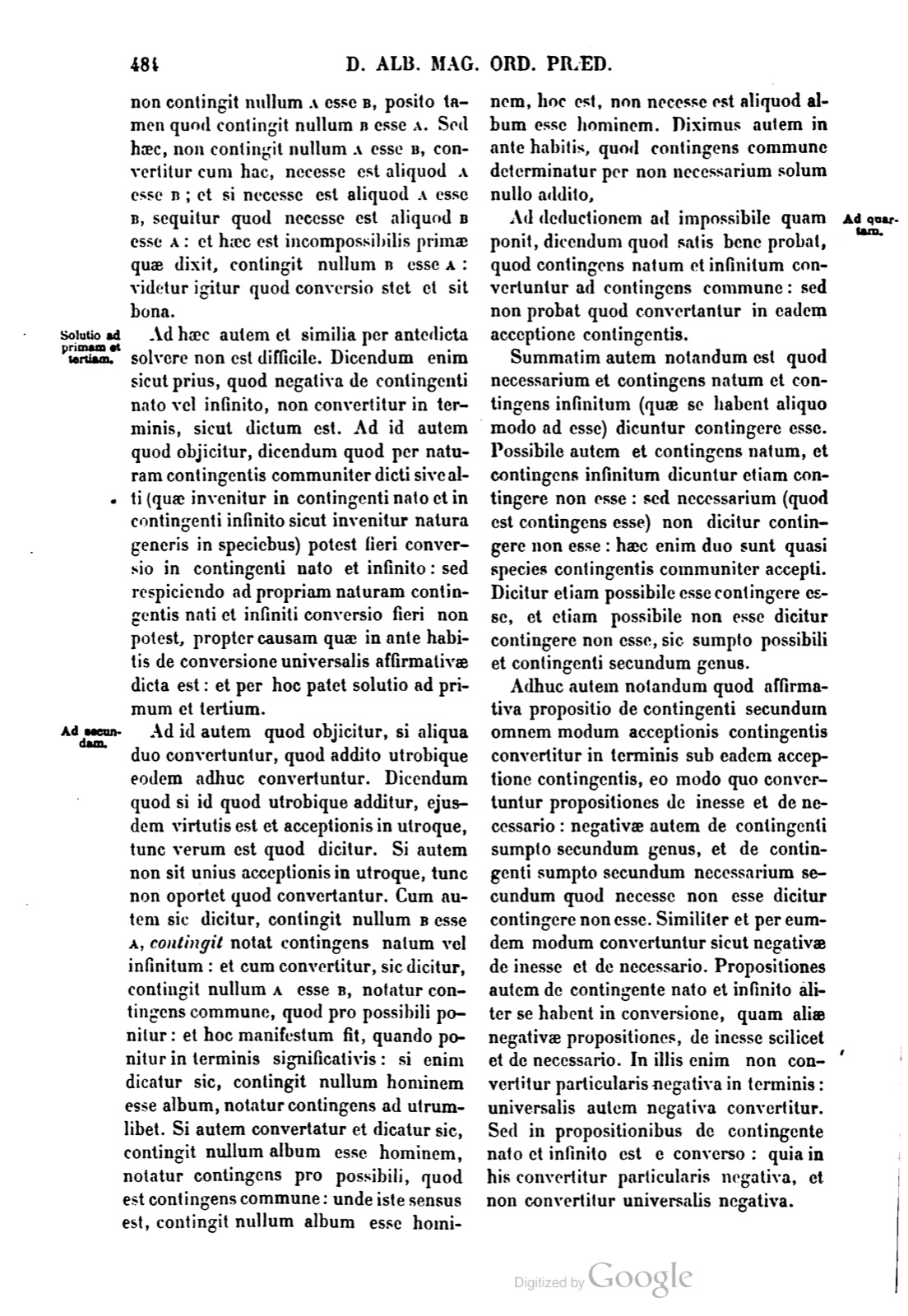
Ad deductionem ad impossibile quam ponit, dicendum quod satis bene probat, quod contingens natum et infinitum convertuntur ad contingens commune: sed non probat quod convertantur in eadem acceptione contingentis.
Summatim autem notandum est quod necessarium et contingens natum et contingens infinitum (quae se habent aliquo modo ad esse) dicuntur contingere esse. Possibile autem et contingens natum, et contingens infinitum dicuntur etiam contingere non esse: sed necessarium (quod est contingens esse) non dicitur contingere non esse: haec enim duo sunt quasi species contingentis communiter accepti. Dicitur etiam possibile esse contingere esse, et etiam possibile non esse dicitur contingere non esse, sic sumpto possibili et contingenti secundum genus.
Adhuc autem notandum quod affirmativa propositio de contingenti secundum omnem modum acceptionis contingentis convertitur in terminis sub eadem acceptione contingentis, eo modo quo convertuntur propositiones de inesse et de necessario: negativae autem de contingenti sumpto secundum genus, et de contingenti sumpto secundum necessarium secundum quod necesse non esse dicitur contingere non esse. Similiter et per eumdem modum convertuntur sicut negativae de inesse et de necessario. Propositiones autem de contingente nato et infinito aliter se habent in conversione, quam aliae negativae propositiones, de inesse scilicet et de necessario. In illis enim non convertitur particularis negativa in terminis: universalis autem negativa convertitur. Sed in propositionibus de contingente nato et infinito est e converso: quia in his convertitur particularis negativa, et non convertitur universalis negativa.
Est autem adhuc his adjiciendum, quod contingenti nato et infinito opponitur tam necessarium quam impossibile: quia tale contingens se habet ad esse et non esse: necessarium autem tantum se habet ad esse, et impossibile tantum ad non esse: contingenti autem sumpto secundum genus, et sumpto pro necessario secundum quod necessarium esse dicitur contingere esse, opponitur tantum impossibile.
To the reduction to impossibility which he posits, one must say that it proves well enough that the contingent by nature and the indefinite contingent are converted to the common contingent; but it does not prove that they are converted in the same acceptance of contingency.
But in summary it must be noted that the necessary, the contingent by nature, and the indefinite contingent (which in some way have themselves toward being) are said to happen to be. But the possible, the contingent by nature, and the indefinite contingent are also said to happen not to be; but the necessary (which is contingent being) is not said to happen not to be; for these two are as it were species of the commonly accepted contingent. It is also said that the possible to be happens to be, and also the possible not to be is said to happen not to be, with possible and contingent thus taken according to genus.
Again it must be noted that an affirmative proposition about the contingent according to every manner of acceptance of contingency is converted in terms under the same acceptance of contingency, in the way in which propositions about inherence and about the necessary are converted. But negatives about the contingent taken according to genus, and about the contingent taken according to the necessary insofar as necessary-not-being is said to happen-not-to-be, are converted similarly and by the same manner as negatives about inherence and about the necessary. But propositions about the contingent by nature and the indefinite contingent stand otherwise in conversion than the other negative propositions, namely those about inherence and about the necessary. For in those, the particular negative is not converted in terms, but the universal negative is converted. But in propositions about the contingent by nature and the indefinite contingent it is the converse, because in these the particular negative is converted and the universal negative is not converted.
But this must still be added to these points: that both the necessary and the impossible are opposed to the contingent by nature and to the indefinite contingent, because such a contingent has itself toward being and non-being; but the necessary has itself only toward being, and the impossible only toward non-being. But to the contingent taken according to genus, and taken for the necessary insofar as necessary being is said to happen to be, only the impossible is opposed.
If a page does not appear, its photograph has not been uploaded yet.