Works › On Interpretation, Books I–II
Volume 1 · p. 457
Chapter VII, Conclusion of Perihermenias
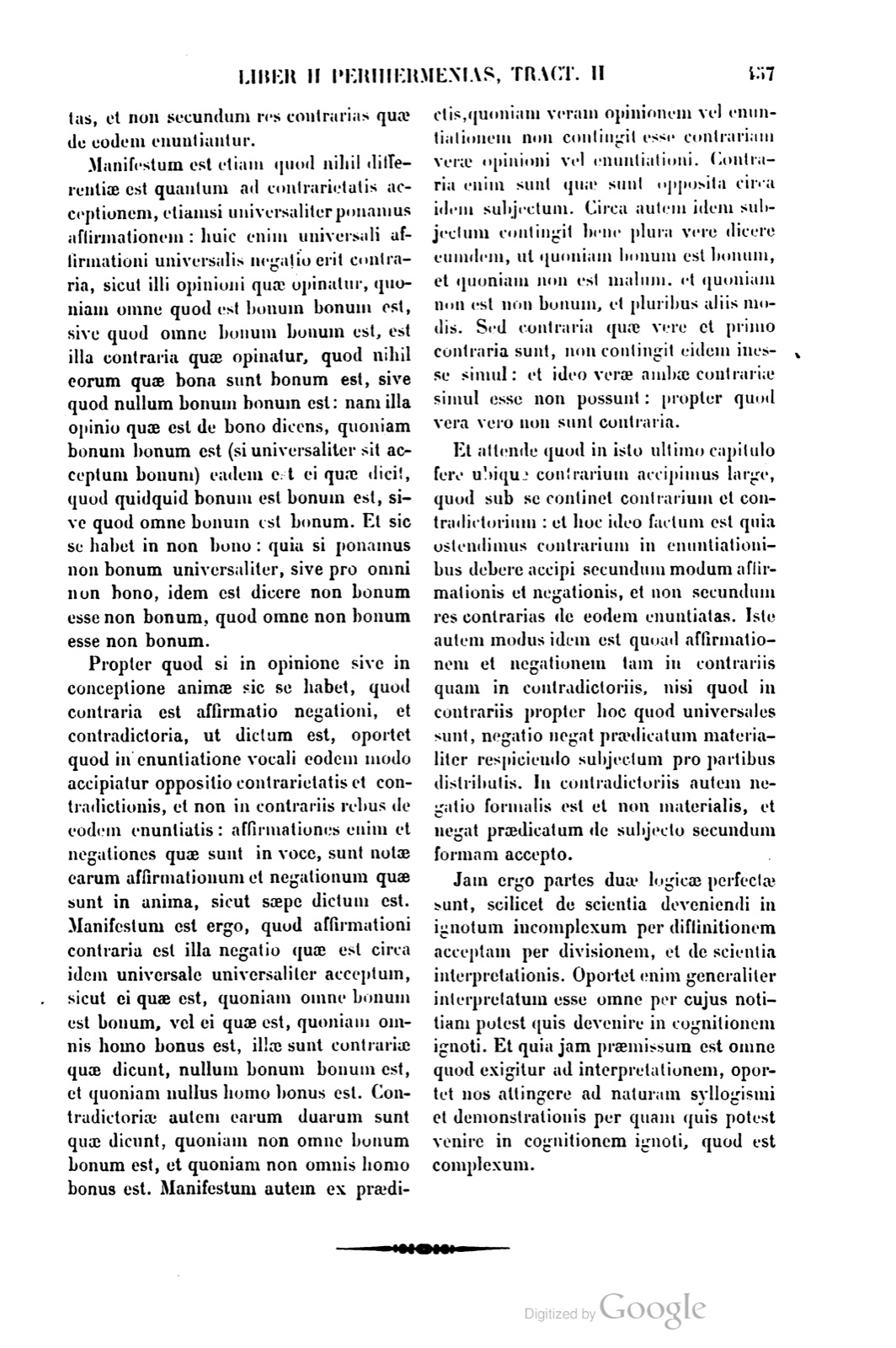
et non secundum res contrarias quae de eodem enuntiantur.
Manifestum est etiam quod nihil differentiae est quantum ad contrarietatis acceptionem, etiamsi universaliter ponamus affirmationem: huic enim universali affirmationi universalis negatio erit contraria, sicut illi opinioni quae opinatur, quoniam omne quod est bonum bonum est, sive quod omne bonum bonum est, est illa contraria quae opinatur, quod nihil eorum quae bona sunt bonum est, sive quod nullum bonum bonum est: nam illa opinio quae est de bono dicens, quoniam bonum bonum est (si universaliter sit acceptum bonum) eadem est ei quae dicit, quod quidquid bonum est bonum est, sive quod omne bonum est bonum. Et sic se habet in non bono: quia si ponamus non bonum universaliter, sive pro omni non bono, idem est dicere non bonum esse non bonum, quod omne non bonum esse non bonum.
Propter quod si in opinione sive in conceptione animae sic se habet, quod contraria est affirmatio negationi, et contradictoria, ut dictum est, oportet quod in enuntiatione vocali eodem modo accipiatur oppositio contrarietatis et contradictionis, et non in contrariis rebus de eodem enuntiatis: affirmationes enim et negationes quae sunt in voce, sunt notae earum affirmationum et negationum quae sunt in anima, sicut saepe dictum est. Manifestum est ergo, quod affirmationi contraria est illa negatio quae est circa idem universale universaliter acceptum, sicut ei quae est, quoniam omne bonum est bonum, vel ei quae est, quoniam omnis homo bonus est, illae sunt contrariae quae dicunt, nullum bonum bonum est, et quoniam nullus homo bonus est. Contradictoriae autem earum duarum sunt quae dicunt, quoniam non omne bonum bonum est, et quoniam non omnis homo bonus est. Manifestum autem ex praedictis, quoniam veram opinionem vel enuntiationem non contingit esse contrariam verae opinioni vel enuntiationi. Contraria enim sunt quae sunt opposita circa idem subjectum. Circa autem idem subjectum contingit bene plura vere dicere eumdem, ut quoniam bonum est bonum, et quoniam non est malum, et quoniam non est non bonum, et pluribus aliis modis. Sed contraria quae vere et primo contraria sunt, non contingit eidem inesse simul: et ideo verae ambae contrariae simul esse non possunt: propter quod vera vero non sunt contraria.
Et attende quod in isto ultimo capitulo fere ubique contrarium accipimus large, quod sub se continet contrarium et contradictorium: et hoc ideo factum est quia ostendimus contrarium in enuntiationibus debere accipi secundum modum affirmationis et negationis, et non secundum res contrarias de eodem enuntiatas. Iste autem modus idem est quoad affirmationem et negationem tam in contrariis quam in contradictoriis, nisi quod in contrariis propter hoc quod universales sunt, negatio negat praedicatum materialiter respiciendo subjectum pro partibus distributis. In contradictoriis autem negatio formalis est et non materialis, et negat praedicatum de subjecto secundum formam accepto.
Jam ergo partes duae logicae perfectae sunt, scilicet de scientia deveniendi in ignotum incomplexum per diffinitionem acceptam per divisionem, et de scientia interpretationis. Oportet enim generaliter interpretatum esse omne per cujus notitiam potest quis devenire in cognitionem ignoti. Et quia jam praemissum est omne quod exigitur ad interpretationem, oportet nos attingere ad naturam syllogismi et demonstrationis per quam quis potest venire in cognitionem ignoti, quod est complexum.
and not according to contrary things which are enunciated about the same thing.
It is also manifest that there is no difference with respect to the taking of contrariety, even if we posit affirmation universally: for to this universal affirmation a universal negation will be contrary, just as to that opinion which opines that every thing which is good is good, or that every good is good, that opinion is contrary which opines that nothing of those things which are good is good, or that no good is good; for that opinion which is about good, saying that good is good (if good is taken universally), is the same as that which says that whatever is good is good, or that every good is good. And so it holds in the non-good: because if we posit non-good universally, or for every non-good, it is the same to say that non-good is non-good as to say that every non-good is non-good.
On account of this, if in opinion or in conception of the soul it holds in such a way that affirmation is contrary to negation, and contradictory, as has been said, then in vocal enunciation the opposition of contrariety and contradiction must be taken in the same way, and not in contrary things enunciated about the same thing: for affirmations and negations which are in voice are signs of those affirmations and negations which are in the soul, as has often been said. Therefore it is manifest that contrary to an affirmation is that negation which is about the same universal taken universally, as to that one which is, that every good is good, or to that one which is, that every man is good, those are contrary which say that no good is good, and that no man is good. But the contradictories of these two are those which say that not every good is good, and that not every man is good. Moreover, it is manifest from the things said before that a true opinion or enunciation cannot be contrary to a true opinion or enunciation. For contraries are those things which are opposites concerning the same subject. But concerning the same subject it is indeed possible to say truly several things about the same thing, as that good is good, and that it is not evil, and that it is not non-good, and in several other ways. But contraries which are truly and primarily contraries cannot belong at the same time to the same thing; and therefore both true contrary things cannot be at the same time: on account of which true things are not contrary to true.
And attend that in this last chapter almost everywhere we take contrary broadly, which contains under itself contrary and contradictory; and this was done for this reason, because we showed that contrary in enunciations must be taken according to the mode of affirmation and negation, and not according to contrary things enunciated about the same thing. But that mode is the same with respect to affirmation and negation both in contraries and in contradictories, except that in contraries, because they are universal, negation negates the predicate materially by regarding the subject for the distributed parts. But in contradictories the negation is formal and not material, and it negates the predicate of the subject taken according to form.
Now therefore two parts of logic have been completed, namely concerning the science of coming to an unknown incomplex thing through definition received through division, and concerning the science of interpretation. For in general everything through whose knowledge someone can come into cognition of the unknown must be interpreted. And because everything which is required for interpretation has now been set down beforehand, we must reach toward the nature of syllogism and demonstration through which someone can come into cognition of the unknown which is complex.
If a page does not appear, its photograph has not been uploaded yet.