Volume 1
Preface of the Lyons Editors
A marker with ≈ is an approximate page boundary, placed by measure of the text; the page photographs remain the authority. In the paired views, clicking a page marker brings that page into view.
PRAEFATIO EDITORUM LUGDUNENSIUM.
BENEVOLO LECTORI.
Non Medeis poculis, benevole Lector, sed studio, labore impensisque maximis senescentem Albertum ad florescentem aetatem reduximus. Siluerat vetusta nimium tam resonans Ecclesiae tuba, caligaverat prae antiquitate tantus splendor: vixque Albertus in Alberto conspicuus erat. Terrebat quotquot ante nos extitere tantum laboris pondus; dum privato et publico bono consulendi necessitas urgeret. Erexit tandem animum secura benevolentiae tuae confidentia, tibique Albertum redivivum offerimus, de cujus scriptis nihil est quod hic veterum et recentiorum Auctorum laudes texamus: cum res ipsa fidem, si aliunde non foret, abunde tibi faceret. Hoc unum addemus beatum virum non scriptis solum, sed et pietate sanctimoniaque ita magnum, ut dubium reliquerit, plus litteris an pietate processerit: utrum plus scriptori praestantissimo laudis, an viro sanctissimo venerationis debeatur. Sanctum Ecclesia judicat, doctissimum scripta praedicant: ita ut neminem plura ex universis et in singulis attigisse audacter possimus dicere. Unde non obscure quilibet colligat memoriam Alberto pene immensam, lectionem infinitam, ingenium ad percipiendum, judicium ad seligendum paria fuisse. Quibus si addas indefessum laborem, aetatem longissimam secunda valetudine ad octoginta circiter annos perductam, rationem quodammodo ineas, qua tandem mortalis unus, tam multa tamque accurate scripserit, quorum singula multos homines eosque eruditissimos aetatesque plurimas requirerent.
Universam Philosophiam non quidem obiter et captiose, ut solet, sed acutissime pertractavit: ita ut nec brevitatem, nec quid redundans liceat animadvertere: de quo justius quam de Pericle veteri comoedo possemus dicere, in labiis ejus sedisse veluti quamdam philosophandi deam. Sed quod adhuc mirum tibi videbitur, ita Aristotelicae philosophiae non defensor modo, sed et usque ad minutissima verba acutissimasque sententias aemulator fuit, ut cujus philosophiam sectaretur, dicendi quoque exprimeret modum: facileque discernere nescias, interpresne Aristotelis an ipse sit Aristoteles: possesque, quod de Philone viro eruditissimo apud Graecos usurpatum est, dum inquiebant, aut Plato Philonem sequitur, aut Platonem Philo, Alberto ad principem Peripateticae disciplinae relato, jure merito aptare. Unde interpretando Aristotelem tantam ipsius verbis fidem adhibuit, ut corruptissimam translationem commentatus non mutaverit, imo incorruptissimam ipsam corruptionem multis in locis servaverit. Nec minus insuper Platonis, Epicuri, Pythagorae, aliorumque Philosophorum dogmata calluit quam Aristotelica. Primus enim Latinorum quidquid in Latinis, Graecis, Arabibus, Hebraeis, Aegyptiis Philosophis accuratissimum et praestantissimum fuit, perscrutatus est. In quibus omnibus mens libera semper fuit, nullis implicata ambagibus (sponte enim fluunt acutae sententiae) omnia perlustravit naturae mysteria, et ea quidem ex primis et proximis rerum causis: scire enim est res per causas cognoscere ex mente Aristotelis, quam ita assecutus est, ut posteri omnes qui in eum scripserunt, aut parum admodum, aut nihil adjecerint.
In libris quos in Bibliam scripsit, illud praecipuum obtinet inter omnes elogium, neminem Scripturae sacrae mentem altius aut eruditius ex sanctis Patribus collegisse. Unum tamen est dolendum, maximam ferme partem eorum quae in universam Bibliam scripsit, excidisse.
PREFACE OF THE LYONS EDITORS.
TO THE KINDLY READER.
Not by Medean cups, kindly Reader, but by study, labor, and very great expenses, we have brought aging Albert back to a flourishing age. That too-ancient trumpet of the Church, so resounding, had fallen silent; so great a splendor had grown dim through antiquity, and scarcely was Albert conspicuous in Albert. The weight of so great a labor frightened however many existed before us, while the necessity of consulting the private and public good pressed on. At last sure confidence in your goodwill raised our spirit, and to you we offer Albert brought back to life, concerning whose writings there is no reason here that we should weave the praises of ancient and recent authors, since the matter itself, if there were no trust from elsewhere, would abundantly make trust for you. This one thing we shall add: that the blessed man was so great not only in writings, but also in piety and holiness, that he left it doubtful whether he advanced more in letters or in piety; whether more praise is owed to the most excellent writer, or more veneration to the most holy man. The Church judges him holy; his writings proclaim him most learned; so that we can boldly say that no one touched more things from all fields and in individual fields. Hence anyone may gather, not obscurely, that in Albert memory almost immense, reading without limit, talent for perceiving, and judgment for selecting were equal. If to these you add indefatigable labor and a very long life led in good health to about eighty years, you in some way enter upon the reasoning by which at last one mortal wrote so many things and so accurately, each of which would require many men, and those most learned, and many ages.
He treated the whole of Philosophy not indeed cursorily and captiously, as is customary, but most keenly, so that it is permitted to notice neither brevity nor anything redundant; concerning him we could say more justly than concerning Pericles, the old comic poet, that a certain goddess of philosophizing had sat, as it were, on his lips. But what will seem still wonderful to you, he was not only a defender of Aristotelian philosophy, but even an emulator down to the smallest words and keenest opinions, so that, whose philosophy he followed, he also expressed that man's manner of speaking; and you would not easily know how to discern whether he is an interpreter of Aristotle or Aristotle himself. And what was customarily said of Philo, a most learned man among the Greeks, when they said either Plato follows Philo, or Philo follows Plato, you could rightly and deservedly fit to Albert in relation to the prince of the Peripatetic discipline. Hence in interpreting Aristotle he applied such trust to Aristotle's words that, having commented on a most corrupt translation, he did not change it; indeed in many places he preserved that most uncorrupted corruption itself. Moreover he was no less skilled in the dogmas of Plato, Epicurus, Pythagoras, and other philosophers than in the Aristotelian. For he was the first of the Latins to examine whatever was most accurate and most excellent among Latin, Greek, Arab, Hebrew, and Egyptian philosophers. In all these things his mind was always free, entangled in no windings (for keen judgments flow of themselves); he surveyed all the mysteries of nature, and indeed from the first and nearest causes of things; for to know is to know things through causes, according to the mind of Aristotle, which he attained so that all later men who wrote on him added either very little indeed or nothing.
In the books which he wrote on the Bible, this chief praise among all obtains: that no one gathered the mind of Sacred Scripture more deeply or more learnedly from the holy Fathers. Yet one thing must be grieved over: that nearly the greatest part of those things which he wrote on the whole Bible has fallen away.
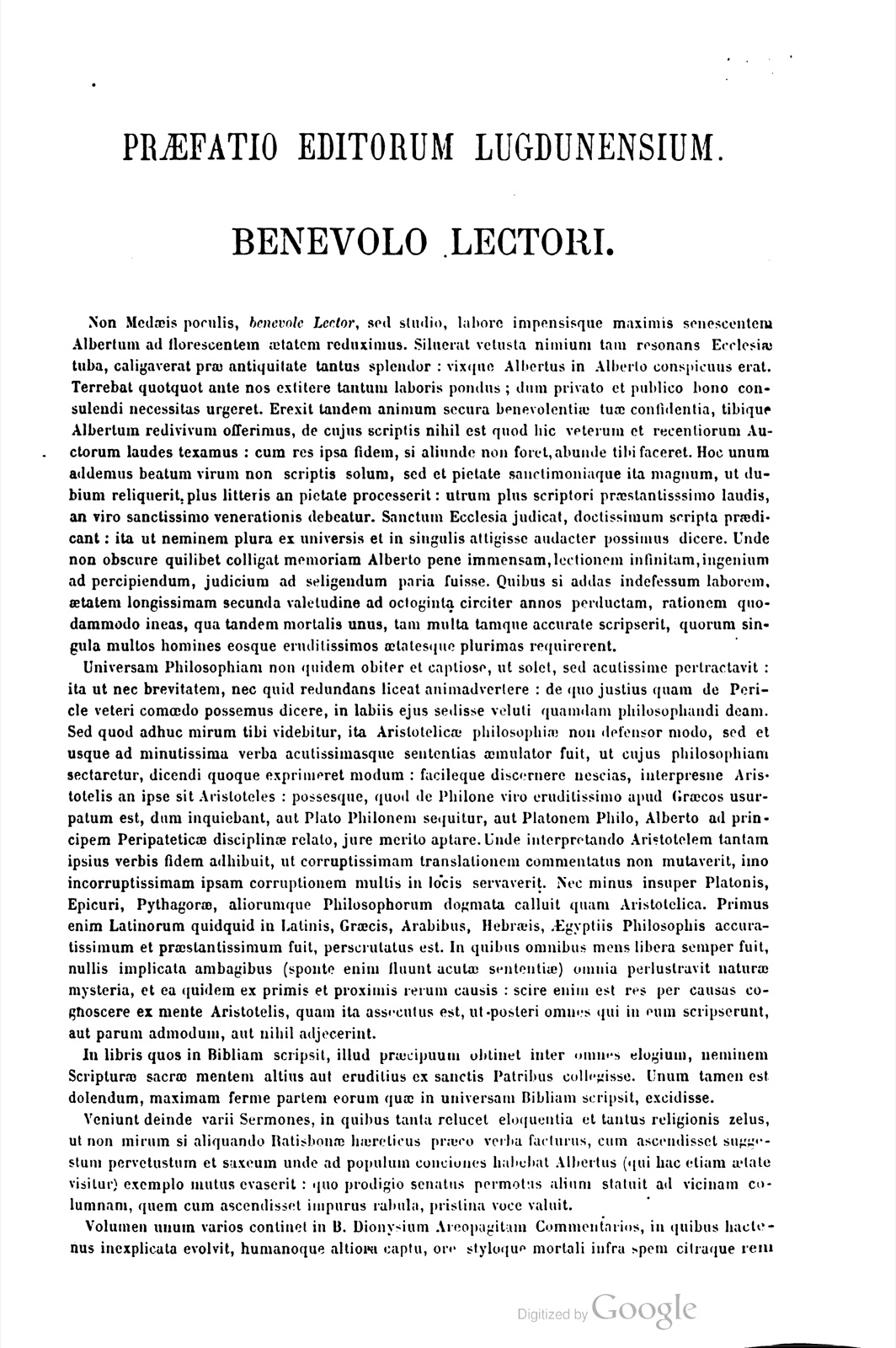
Veniunt deinde varii Sermones, in quibus tanta relucet eloquentia et tantus religionis zelus, ut non mirum si aliquando Ratisbonae haereticus praeco verba facturus, cum ascendisset suggestum pervetustum et saxeum unde ad populum conciones habebat Albertus (qui hac etiam aetate visitur) exemplo mutus evaserit: quo prodigio senatus permotus alium statuit ad vicinam columnam, quem cum ascendisset impurus rabula, pristina voce valuit.
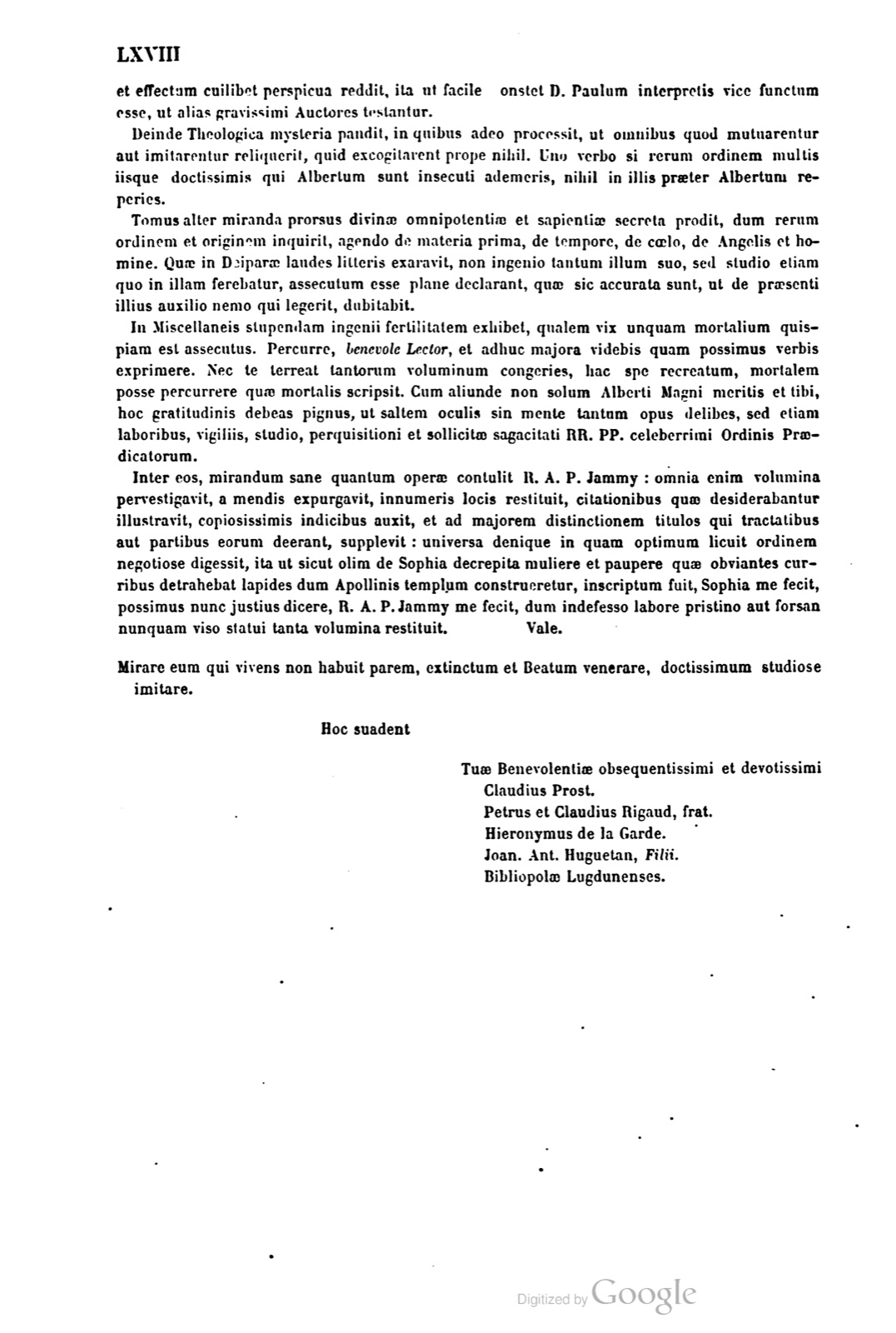
Volumen unum varios continet in B. Dionysium Areopagitam Commentarios, in quibus hactenus inexplicata evolvit, humanoque altiora captu, ore styloque mortali infra spem citraque rem et effectum cuilibet perspicua reddit, ita ut facile constet D. Paulum interpretis vice functum esse, ut alias gravissimi Auctores testantur.
Deinde Theologica mysteria pandit, in quibus adeo processit, ut omnibus quod mutuarentur aut imitarentur reliquerit, quid excogitarent prope nihil. Uno verbo si rerum ordinem multis iisque doctissimis qui Albertum sunt insecuti ademeris, nihil in illis praeter Albertum reperies.
Tomus alter miranda prorsus divinae omnipotentiae et sapientiae secreta prodit, dum rerum ordinem et originem inquirit, agendo de materia prima, de tempore, de caelo, de Angelis et homine. Quae in Deiparae laudes litteris exaravit, non ingenio tantum illum suo, sed studio etiam quo in illam ferebatur, assecutum esse plane declarant, quae sic accurata sunt, ut de praesenti illius auxilio nemo qui legerit, dubitabit.
In Miscellaneis stupendam ingenii fertilitatem exhibet, qualem vix unquam mortalium quispiam est assecutus. Percurre, benevole Lector, et adhuc majora videbis quam possimus verbis exprimere. Nec te terreat tantorum voluminum congeries, hac spe recreatum, mortalem posse percurrere quae mortalis scripsit. Cum aliunde non solum Alberti Magni meritis et tibi, hoc gratitudinis debeas pignus, ut saltem oculis sin mente tantum opus delibes, sed etiam laboribus, vigiliis, studio, perquisitioni et sollicitae sagacitati RR. PP. celeberrimi Ordinis Praedicatorum.
Inter eos, mirandum sane quantum operae contulit R. A. P. Jammy: omnia enim volumina pervestigavit, a mendis expurgavit, innumeris locis restituit, citationibus quae desiderabantur illustravit, copiosissimis indicibus auxit, et ad majorem distinctionem titulos qui tractatibus aut partibus eorum deerant, supplevit: universa denique in quam optimum licuit ordinem negotiose digessit, ita ut sicut olim de Sophia decrepita muliere et paupere quae obviantes curribus detrahebat lapides dum Apollinis templum construeretur, inscriptum fuit, Sophia me fecit, possimus nunc justius dicere, R. A. P. Jammy me fecit, dum indefesso labore pristino aut forsan nunquam viso statui tanta volumina restituit. Vale.
Mirare eum qui vivens non habuit parem, extinctum et Beatum venerare, doctissimum studiose imitare.
Hoc suadent
Tuae Benevolentiae obsequentissimi et devotissimi Claudius Prost. Petrus et Claudius Rigaud, frat. Hieronymus de la Garde. Joan. Ant. Huguetan, Filii. Bibliopolae Lugdunenses.
Then come the various Sermons, in which so great an eloquence and so great a zeal of religion shine forth that it is not wonderful if, once at Regensburg, a heretical herald, about to make a speech, when he had climbed the very ancient and stone pulpit from which Albert used to have sermons to the people (which is seen even in this age), became mute by the example; moved by this prodigy, the senate set up another pulpit at the neighboring column, and when the impure ranter had climbed it, he was strong with his former voice.
One volume contains various Commentaries on Blessed Dionysius the Areopagite, in which he unfolds things thus far unexplained and renders things higher than human grasp clear to anyone, by mortal mouth and style, below expectation and short of the reality and effect, so that it is easily clear that Saint Paul served in the role of interpreter, as elsewhere very weighty authors testify.
Then he opens theological mysteries, in which he advanced so far that he left to all men what they might borrow or imitate, almost nothing that they might devise. In one word, if you take away from the many, and those most learned, who followed Albert the order of things, you will find nothing in them except Albert.
Another volume brings forth secrets altogether wonderful of divine omnipotence and wisdom, while he inquires into the order and origin of things by treating of prime matter, of time, of heaven, of angels, and of man. The things which he set forth in letters in praise of the Mother of God plainly declare that he attained them not only by his own talent, but also by the zeal with which he was borne toward her; and they are so accurate that no one who reads will doubt her present help.
In the Miscellanies he displays a stunning fertility of talent, such as scarcely anyone of mortals has ever attained. Run through them, kindly Reader, and you will see still greater things than we can express in words. Let not the heap of so many volumes frighten you, recreated by this hope, that a mortal can run through the things which a mortal wrote. Since from elsewhere you owe this pledge of gratitude not only to the merits of Albert the Great and to yourself, so that at least with your eyes, if not with your mind, you may taste so great a work, but also to the labors, vigils, study, searching, and solicitous sagacity of the reverend fathers of the most celebrated Order of Preachers.
Among them, it is indeed wonderful how much work Reverend Father Jammy contributed: for he thoroughly searched all the volumes, purged them of errors, restored them in innumerable places, illustrated them with citations which were lacking, increased them with very full indexes, and, for greater distinction, supplied titles which were lacking to the treatises or to their parts. Finally he laboriously arranged the whole into the best order he could, so that, just as once concerning Sophia, a decrepit and poor woman who was removing stones from carts passing by while the temple of Apollo was being built, it was inscribed, Sophia made me, we can now say more justly, Reverend Father Jammy made me, while by indefatigable labor he restored so many volumes to their former, or perhaps never seen, state. Farewell.
Admire him who while living had no equal; venerate him, now dead and Blessed; studiously imitate him, most learned.
These things recommend this:
The most compliant and most devoted to Your Goodwill: Claudius Prost; Peter and Claudius Rigaud, brothers; Hieronymus de la Garde; the sons of Jean Antoine Huguetan; Lyons booksellers.
If a page does not appear, its photograph has not been uploaded yet.