Volume 1
Critical Bibliography, Lyons Index 48-56 and Conclusion
A marker with ≈ is an approximate page boundary, placed by measure of the text; the page photographs remain the authority. In the paired views, clicking a page marker brings that page into view.
48. De secretis naturae. Certo non est Alberti. Philippo Ulstadio medico et patritio Noriburgensi anno MCCXXV claro quidam adscripserunt, et sub ejus nomine prodiit Argentinae, 1528, teste Simlero: at longius a vero aberrarunt illi, verus enim auctor est Michael Scotus mathematicus et astronomus Friderico II imperante clarus, quem valde senem ad MCCXC pervenisse ait Baleus de eo legendus. Prodiit autem ille libellus de secretis naturae seu de Physionomia, nam idem est, sub ejus nomine, Venetiis, Jo. Bapt. Sessa, 1503: et postea Amstelodami, Janssonii, 1662 in-12 cum supra relatis de secretis mulierum, de virtutibus quarumdam herbarum et de mirabilibus mundi a p. 219 ad 358. Praefixa est ad Fridericum imperatorem ejusdem Scoti epistola nuncupatoria, in qua illum ad physionomiae studium amplectendum pluribus hortatur, et hujus artis laudes amplius prosequitur. Sic vero opella incipit: Prima pars secretorum naturalium. Utilitas physionomiae, cap. 1. Hic auctor plura alia opera scripsit, quorum catalogum videsis apud Simlerum. In Sorbona duo sunt codices ms fol. memb. cujusque titulus: Libri de caelo et mundo Aristotelis ex translatione Michaelis Scoti. Pr. Tibi Stephane de Pruvinis hoc opus quod ego Michael Scotus dedi Latinitati ex dictis Aristotelis et c. In gratiam lectorum placuit annotare, nam hujus translationis non nominit Simlerus¹.
Catal. Angl. T. II, P. I, cod. 3060 sic legitur: Albertus Magnus de occultis naturae. Sed si idem opus, ne dubites, supposititium est.
Paris. in Regia cod. 4963 fol. mag. memb. a fol. 79 ad 85: Incipit Physionomia F. Alberti Teutonici. Pr. De capite et capillis. Videmus animum masculum in pluribus, etc. Quisquis sit ille Albertus, Magnum esse nemo mihi suadebit. Caeterum opus aliud est a mox relato De secretis naturae.
49. De natura seu naturis rerum. Aiunt esse in Victor. sed falso adscribunt Alberto nostro, cum sit ejus olim discipuli F. Thomae Cantimpratani.
50. Variae quaestiones theologiae, et de universalibus principiis. Servari aiunt in Barber.
51. De fato. Haberi dicunt in Victor. In ea vero Bibl. cod. 56 quod sub nomine Alberti Magni servatur opusculum de fato, illud idem est quod inter S. Thomae de Aquino opuscula est ordine XXVIII. Alberto Magno etiam asserit codex Sangenovesianus circa MCCC scriptus.
48. On Secrets of Nature. It certainly is not Albert's. Certain men have ascribed it to Philip Ulstad, a physician and patrician of Nuremberg, famous in the year 1225, and under his name it came forth at Strasbourg, 1528, according to Simler; but those men wandered farther from the truth, for the true author is Michael Scot, a mathematician and astronomer famous while Frederick II was emperor, whom Bale, to be read concerning him, says reached the year 1290 as a very old man. That little book On Secrets of Nature, or On Physiognomy, for it is the same, came forth under his name at Venice, Giovanni Battista Sessa, 1503, and afterward at Amsterdam, Janssonius, 1662, duodecimo, with the things reported above On the Secrets of Women, On the Powers of Certain Herbs, and On the Wonders of the World, from page 219 to 358. A dedicatory letter of the same Scot to Emperor Frederick is prefixed, in which he urges him at length to embrace the study of physiognomy, and pursues more fully the praises of this art. But the little work begins thus: First part of natural secrets. The usefulness of physiognomy, chapter 1. This author wrote several other works, whose catalogue you may see in Simler. In the Sorbonne there are two manuscript parchment folio codices, and the title of each is: Books On Heaven and the World of Aristotle from the translation of Michael Scot. Beginning: To you, Stephen of Provins, this work which I, Michael Scot, gave to Latinity from the sayings of Aristotle, etc. It pleased me to note this for the favor of readers, for Simler does not name this translation.¹
English Catalogue, volume II, part I, codex 3060, reads thus: Albert the Great On the Occult Things of Nature. But if it is the same work, do not doubt, it is supposititious.
Paris, in the Royal Library, codex 4963, large folio parchment, from folio 79 to 85: Here begins the Physiognomy of Brother Albert the Teuton. Beginning: On the head and hair. We see a masculine spirit in many, etc. Whoever that Albert may be, no one will persuade me that he is the Great. Moreover it is another work than the one just reported, On Secrets of Nature.
49. On nature, or on the natures of things. They say it is in Victor, but falsely ascribe it to our Albert, since it belongs to his former disciple, Brother Thomas of Cantimpre.
50. Various questions of theology, and on universal principles. They say it is preserved in the Barberini.
51. On Fate. They say it is held in Victor. But in that library, codex 56, the little work On Fate which is preserved under the name of Albert the Great is that same one which, among the opuscula of Saint Thomas Aquinas, is number 28 in order. The codex of Saint-Genevieve, written about 1300, also assigns it to Albert the Great.
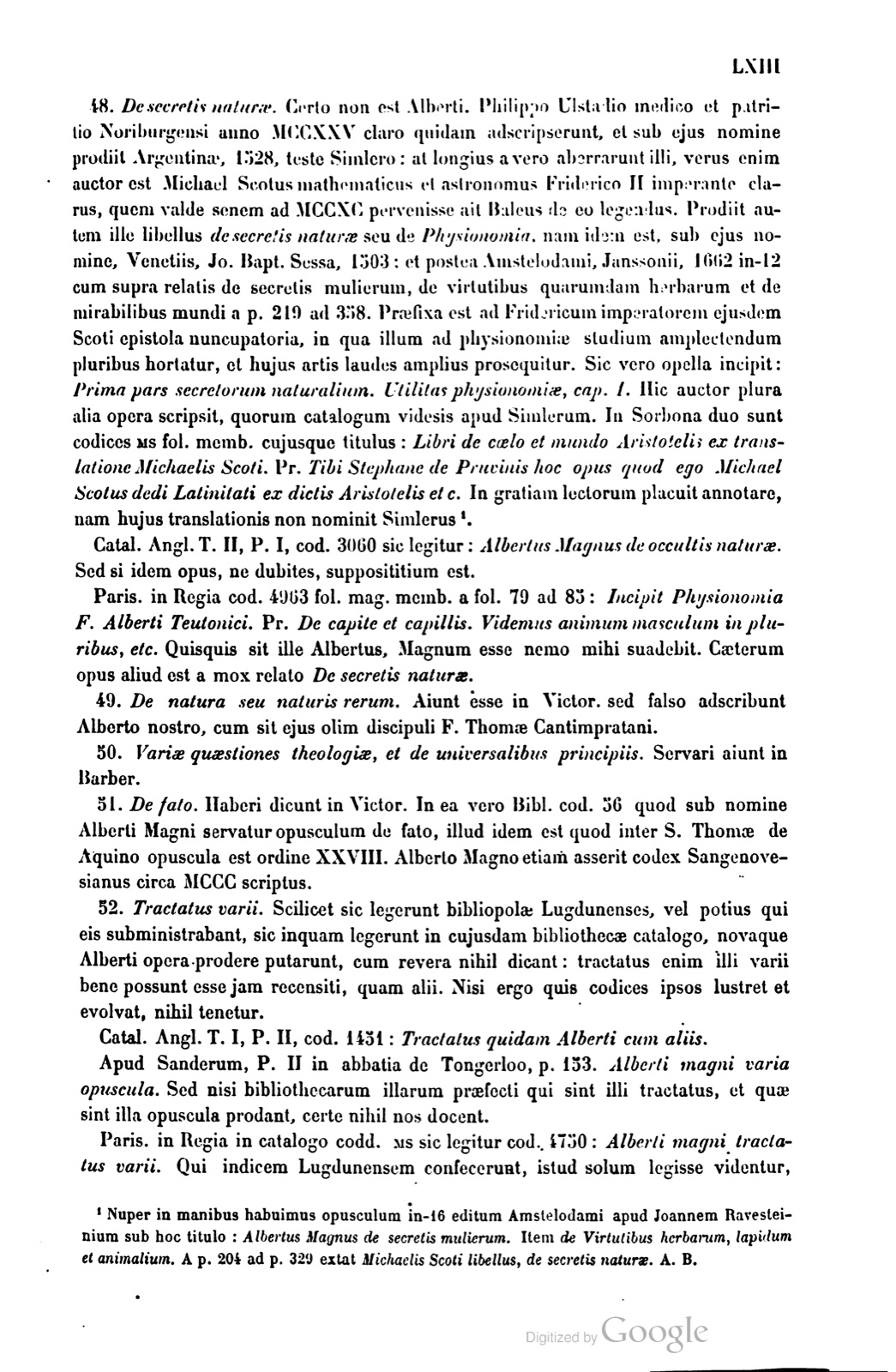
52. Tractatus varii. Scilicet sic legerunt bibliopolae Lugdunenses, vel potius qui eis subministrabant, sic inquam legerunt in cujusdam bibliothecae catalogo, novaque Alberti opera prodere putarunt, cum revera nihil dicant: tractatus enim illi varii bene possunt esse jam recensiti, quam alii. Nisi ergo quis codices ipsos lustret et evolvat, nihil tenetur. Catal. Angl. T. I, P. II, cod. 1451: Tractatus quidam Alberti cum aliis. Apud Sanderum, P. II in abbatia de Tongerloo, p. 153. Alberti magni varia opuscula. Sed nisi bibliothecarum illarum praefecti qui sint illi tractatus, et quae sint illa opuscula prodant, certe nihil nos docent. Paris. in Regia in catalogo codd. ms sic legitur cod. 4750: Alberti magni tractatus varii. Qui indicem Lugdunensem confecerunt, istud solum legisse videntur, nec ultra quaesivisse. Porro in codice illo fol. mag. memb. haec habentur omnia jam supra recensita. Commentaria in meteora. De generatione et corruptione et pleraque parva naturalia. De morte et vita. De somno et vigilia. De immortalitate animae. De spiritu et respiratione. De causis et proprietatibus elementorum. De nutrimento et nutrito. De natura et origine animae. De sensu et sensato. De memoria et reminiscentia. De motu et processu animalium. De perfectione animae. Itaque numerus hic non nova opera, sed codices tantum alios indicat, quibus opera jam laudata continentur.
53. De mirabilibus mundi. Laudant in Regia. Vide supra n. 32 ubi supposititium esse dictum est, cujus praeterea nullus antiquus inter Alberti opera meminit.
54. Eulogium ecclesiasticum. Laudant in Bibl. Carnot. sed qua non addunt. Certo non est in Bibl. Ecclesiae Carnoten. cujus indicem accuratum praestante clar. D. Gucau canonico consecutus sum. Si nostrae ibidem domus intelligant, novi non exiguum in ea codicum mss numerum servari, sed quorum indicem hactenus obtinere non potui. Sed quid sibi vult Eulogium? An Euchologium? Apud Sanderum, P. II in valle S. Martini p. 209, inter opera Alberti Magni recensentur Canones paenitentiales. Utinam quis indigena curiosius evolvat et recognoscat, ac quid de iis sentiendum hic addat.
52. Various treatises. Clearly the Lyons booksellers read thus, or rather those who supplied them read thus, thus, I say, they read in the catalogue of a certain library, and they thought they were bringing forward new works of Albert, when in truth they say nothing; for those various treatises can well be those already reviewed, as others are. Therefore unless someone inspects the codices themselves and turns them over, nothing is held. English Catalogue, volume I, part II, codex 1451: Certain treatises of Albert with others. In Sanderus, part II, in the abbey of Tongerloo, page 153: various opuscula of Albert the Great. But unless the prefects of those libraries disclose what those treatises are and what those opuscula are, they certainly teach us nothing. Paris, in the Royal Library, in the catalogue of manuscript codices, codex 4750 is read thus: various treatises of Albert the Great. Those who made the Lyons index seem to have read this only, and to have inquired no further. Further, in that codex, large folio parchment, all these things already reviewed above are held: commentaries on the Meteors; On Generation and Corruption and most of the Little Natural Works; On Death and Life; On Sleep and Waking; On the Immortality of the Soul; On Spirit and Respiration; On the Causes and Properties of the Elements; On Nourishment and the Nourished; On the Nature and Origin of the Soul; On Sense and the Sensible; On Memory and Reminiscence; On the Motion and Progression of Animals; On the Perfection of the Soul. And so this number indicates not new works, but only other codices in which works already praised are contained.
53. On the Wonders of the World. They praise it in the Royal Library. See above number 32, where it was said to be supposititious; moreover no ancient author mentions it among Albert's works.
54. Ecclesiastical Eulogium. They praise it in the Library of Chartres, but they do not add in what library. It certainly is not in the Library of the Church of Chartres, whose accurate index I obtained through the kindness of the distinguished canon Dom Gucau. If they mean the house of our order in the same place, I know that a considerable number of manuscript codices is preserved in it, but I have not thus far been able to obtain their index. But what does Eulogium mean for itself? Is it Euchologium? In Sanderus, part II, in the valley of St. Martin, page 209, Penitential Canons are reviewed among the works of Albert the Great. Would that some native might turn them over and examine them more curiously, and add here what must be thought about them.
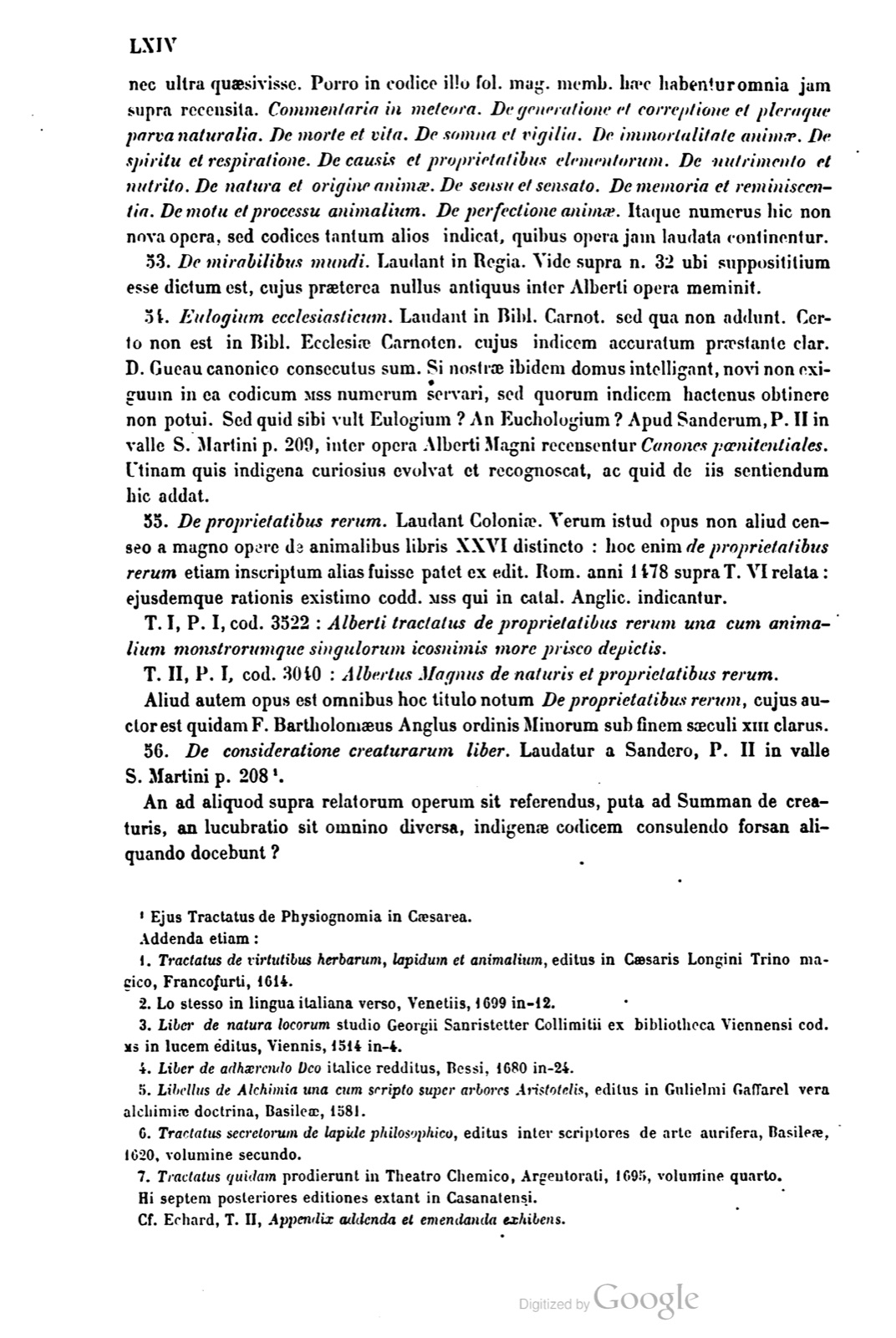
55. De proprietatibus rerum. Laudant Coloniae. Verum istud opus non aliud censeo a magno opere de animalibus libris XXVI distincto: hoc enim de proprietatibus rerum etiam inscriptum alias fuisse patet ex edit. Rom. anni 1478 supra T. VI relata: ejusdemque rationis existimo codd. mss qui in catal. Anglic. indicantur. T. I, P. I, cod. 3522: Alberti tractatus de proprietatibus rerum una cum animalium monstrorumque singulorum iconismis more prisco depictis. T. II, P. I, cod. 3040: Albertus Magnus de naturis et proprietatibus rerum. Aliud autem opus est omnibus hoc titulo notum De proprietatibus rerum, cujus auctor est quidam F. Bartholomaeus Anglus ordinis Minorum sub finem saeculi XIII clarus.
56. De consideratione creaturarum liber. Laudatur a Sandero, P. II in valle S. Martini p. 208². An ad aliquod supra relatorum operum sit referendus, puta ad Summam de creaturis, an lucubratio sit omnino diversa, indigenae codicem consulendo forsan aliquando docebunt?
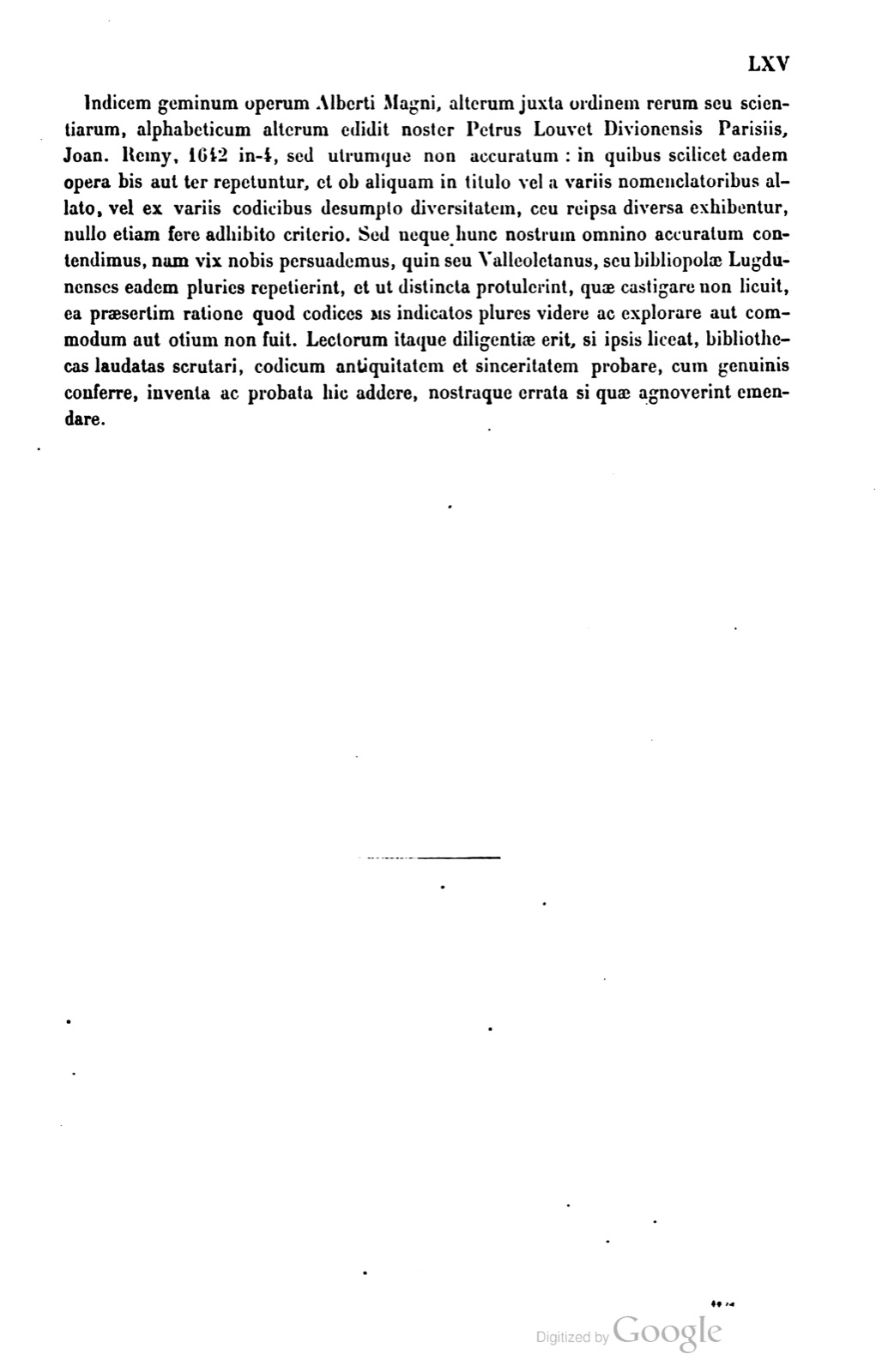
Indicem geminum operum Alberti Magni, alterum juxta ordinem rerum seu scientiarum, alphabeticum alterum edidit noster Petrus Louvet Divionensis Parisiis, Joan. Remy, 1642 in-4, sed utrumque non accuratum: in quibus scilicet eadem opera bis aut ter repetuntur, et ob aliquam in titulo vel a variis nomenclatoribus allato, vel ex variis codicibus desumpto diversitatem, ceu reipsa diversa exhibentur, nullo etiam fere adhibito criterio. Sed neque hunc nostrum omnino accuratum contendimus, nam vix nobis persuademus, quin seu Valleoletanus, seu bibliopolae Lugdunenses eadem pluries repetierint, et ut distincta protulerint, quae castigare non licuit, ea praesertim ratione quod codices ms indicatos plures videre ac explorare aut commodum aut otium non fuit. Lectorum itaque diligentiae erit, si ipsis liceat, bibliothecas laudatas scrutari, codicum antiquitatem et sinceritatem probare, cum genuinis conferre, inventa ac probata hic addere, nostraque errata si quae agnoverint emendare.
55. On the Properties of Things. They praise it at Cologne. But I judge that this work is not different from the great work On Animals, divided into 26 books; for that this work was also at another time inscribed On the Properties of Things is clear from the Roman edition of the year 1478 reported above in volume VI; and I judge that the manuscript codices which are indicated in the English Catalogue are of the same character. Volume I, part I, codex 3522: Albert's treatise On the Properties of Things together with portrayals, in the ancient manner, of animals and individual monsters. Volume II, part I, codex 3040: Albert the Great On the Natures and Properties of Things. But another work is known to all under this title On the Properties of Things, whose author is a certain Brother Bartholomew the Englishman of the Order of Minors, famous toward the end of the thirteenth century.
56. A book On the Consideration of Creatures. It is praised by Sanderus, part II, in the valley of St. Martin, page 208.² Whether it should be referred to some work among those reported above, for instance to the Summa on Creatures, or whether it is an entirely different study, native men perhaps will teach someday by consulting the codex.
Our Peter Louvet of Dijon published at Paris, Jean Remy, 1642, quarto, a double index of the works of Albert the Great, one according to the order of things or sciences, the other alphabetical, but each not accurate: in them, namely, the same works are repeated twice or three times, and because of some diversity in the title either supplied by various cataloguers or taken from various codices, they are presented as though different in reality, with almost no criterion applied. But neither do we contend that this one of ours is altogether accurate, for we scarcely persuade ourselves that either Valladolid or the Lyons booksellers did not repeat the same works several times and bring them forward as distinct, which it was not permitted to correct, especially for this reason, that there was not the convenience or leisure to see and explore the several manuscript codices indicated. Therefore it will belong to the diligence of readers, if they are permitted, to search the praised libraries, to test the antiquity and genuineness of the codices, to compare them with genuine works, to add here things found and approved, and to correct our errors if they recognize any.
If a page does not appear, its photograph has not been uploaded yet.