Volume 1
Critical Bibliography, Practical Arts and Lyons Index 1-47
A marker with ≈ is an approximate page boundary, placed by measure of the text; the page photographs remain the authority. In the paired views, clicking a page marker brings that page into view.
ARTES PRACTICAE.
55. Liber de medicina. Catal. Anglic. T. I, P. III, n. 952 inter auctores Latinos medicos Alberti Magni opera in 19 libris, quos tamen non de medicina omnes agere putarim, sed plures esse ex supra relatis praesertim physicis. Tom. II, P. I, cod. 3141. Alberti Magni experimenta medica. Et cod. 3634. Alberti experimenta. Et cod. 3681. Alberti experimenta rursus et inter medicos. An opus distinctum, an ex ejus variis operibus excerpta?
56. Libri de lanificio, de armatura (sic etiam in cod. Victor. Valleoletani, quamvis alii inter quos Petrus de Prussia legant de aratura) item de agricultura, de venatione, de navigatione, de theatrica. Hos omnes credere est vidisse Valleoletanum, sed ubi jam extent nemo refert. De agricultura quaedam habet T. V, Op. 15, de vegetabilibus et plantis (lib. 7, tract. 1). Tormenta bellica aenea ignivoma majora et minora adinvenisse quidam putarunt, sed horum inventionem longe recentiorem esse certo asserunt eruditi, cujus evidens argumentum est quod Vincentius Bellovacensis aequalis, qui et plura ab eo mutuatus est, horum in suo Speculo doctrinali non meminerit, sed tantum armorum antiquorum.
Hactenus index operum Alberti Magni a Valleoletano concinnatus.
SEQUITUR ALIORUM EJUSDEM OPERUM index ex catalogo a bibliographis Lugdunensibus anno MDCXLVI edito excerptus, adjectis etiam passim notis nostris illustratus.
1. De Scriptura sacra. Haberi dicunt Romae in Barber.
2. Notulae super Evangelium Matthaei de Epiphania Domini. Haberi dicunt cum sequenti apud nostros Coloniae. Prodiit in-fol. in Incun. Typ. absque loco, anno et nomine typothetae.
3. Passio magistralis D. N. Jesu Christi.
4. Annotationes in S. Augustini libros: Confessionum. De Trinitate. De quantitate et immortalitate animarum. Super Genesim. De disciplina ecclesiastica. LXXXI quaestionum. De haeresibus. Retractationes. De vera religione. De ecclesiasticis dogmatibus. De beata vita. De libero arbitrio. Epistolas. De bono. De sancta virginitate. De perseverantia. De correptione et gratia. De natura boni. De videndo Deo. In libellum S. Joannis Chrysostomi, quod nemo laeditur nisi a seipso. In sententias S. Prosperi. Has dicunt servari in Barber. Utinam quis eruditus evolvat et diligentius recognoscat.
5. Tabula super quatuor libros Sententiarum. In catalogo Bibl. Barber. edito sic lego: Index ms omnium operum scilicet Alberti.
6. De bono et natura bonorum. Laudat Pignon citatus. Addunt vero haberi in Victorina. Petrus de Prussia testatur hoc opus apud nostros servari Coloniae, et in eo de virtutibus singulis, de legibus et aliis multis auctorem agere. Apud Sanderum, P. II, in valle S. Martini p. 209: Alberti Magni summa de bono.
7. De gratia Dei.
8. De origine et immortalitate animae. Dicunt ms servari in Victorina. Beughemius asserit typis prodiisse Noribergae, 1493. Quae editio teste Reisero, p. 114, servatur in Bibl. Augustana. Paris. in Regia cod. 4750 de quo postea fusius n. 52 inter alia Alberti Magni habetur opusculum de immortalitate animae. Hunc librum auctor ipse citat in libello de unitate intellectus contra Averroem, cap. 1. Vide T. V, n. 10.
PRACTICAL ARTS.
55. A book On Medicine. English Catalogue, volume I, part III, number 952, among the Latin medical authors: works of Albert the Great in 19 books, which nevertheless I would think not all treat of medicine, but that several are from the things reported above, especially the physical works. Volume II, part I, codex 3141: Albert the Great's medical experiments. And codex 3634: Albert's experiments. And codex 3681: Albert's experiments again, and among the physicians. Is it a distinct work, or excerpts from his various works?
56. Books On Wool-Working, On Armor (thus also in Valladolid's Victor codex, although others, among whom Peter of Prussia, read On Plowing), likewise On Agriculture, On Hunting, On Navigation, On Theatrical Art. One is to believe that Valladolid saw all these, but no one reports where they now exist. Volume V, work 15, On Vegetables and Plants (book 7, treatise 1), has certain things on agriculture. Certain men have thought that he invented greater and lesser bronze, fire-vomiting engines of war, but learned men affirm as certain that their invention is far more recent; the evident argument for this is that Vincent of Beauvais, his contemporary, who also borrowed many things from him, did not mention these in his Doctrinal Mirror, but only ancient arms.
Thus far the index of the works of Albert the Great composed by Valladolid.
THERE FOLLOWS AN INDEX OF OTHER WORKS OF THE SAME MAN, excerpted from the catalogue published by the Lyons bibliographers in the year 1646, with our notes also everywhere added and illustrated.
1. On Sacred Scripture. They say it is held at Rome in the Barberini.
2. Little Notes on the Gospel of Matthew concerning the Epiphany of the Lord. They say it is held with the following among our men at Cologne. It came forth in folio among the incunabula, without place, year, and name of printer.
3. The Masterly Passion of Our Lord Jesus Christ.
4. Annotations on the books of Saint Augustine: of the Confessions; On the Trinity; On the Quantity and Immortality of Souls; On Genesis; On Ecclesiastical Discipline; of the Eighty-One Questions; On Heresies; Retractions; On True Religion; On Ecclesiastical Dogmas; On the Blessed Life; On Free Choice; Epistles; On the Good; On Holy Virginity; On Perseverance; On Correction and Grace; On the Nature of the Good; On Seeing God; on the little book of Saint John Chrysostom, That no one is harmed except by himself; on the Sentences of Saint Prosper. They say these are preserved in the Barberini. Would that some learned man might turn them over and examine them more diligently.
5. A table on the four books of the Sentences. In the published catalogue of the Barberini Library I read thus: a manuscript index of all the works, namely of Albert.
6. On the good and the nature of good things. The cited Pignon praises it. But they add that it is held in Victor. Peter of Prussia testifies that this work is preserved among our men at Cologne, and that in it the author treats of the several virtues, of laws, and of many other things. In Sanderus, part II, in the valley of St. Martin, page 209: Albert the Great's Summa on the Good.
7. On the Grace of God.
8. On the origin and immortality of the soul. They say a manuscript is preserved in Victor. Beughem asserts that it came forth in print at Nuremberg, 1493. This edition, according to Reiser, page 114, is preserved in the Augsburg Library. Paris, in the Royal Library, codex 4750, concerning which more fully later at number 52, among other things by Albert the Great, has a little work On the Immortality of the Soul. The author himself cites this book in the little book On the Unity of the Intellect against Averroes, chapter 1. See volume V, number 10.
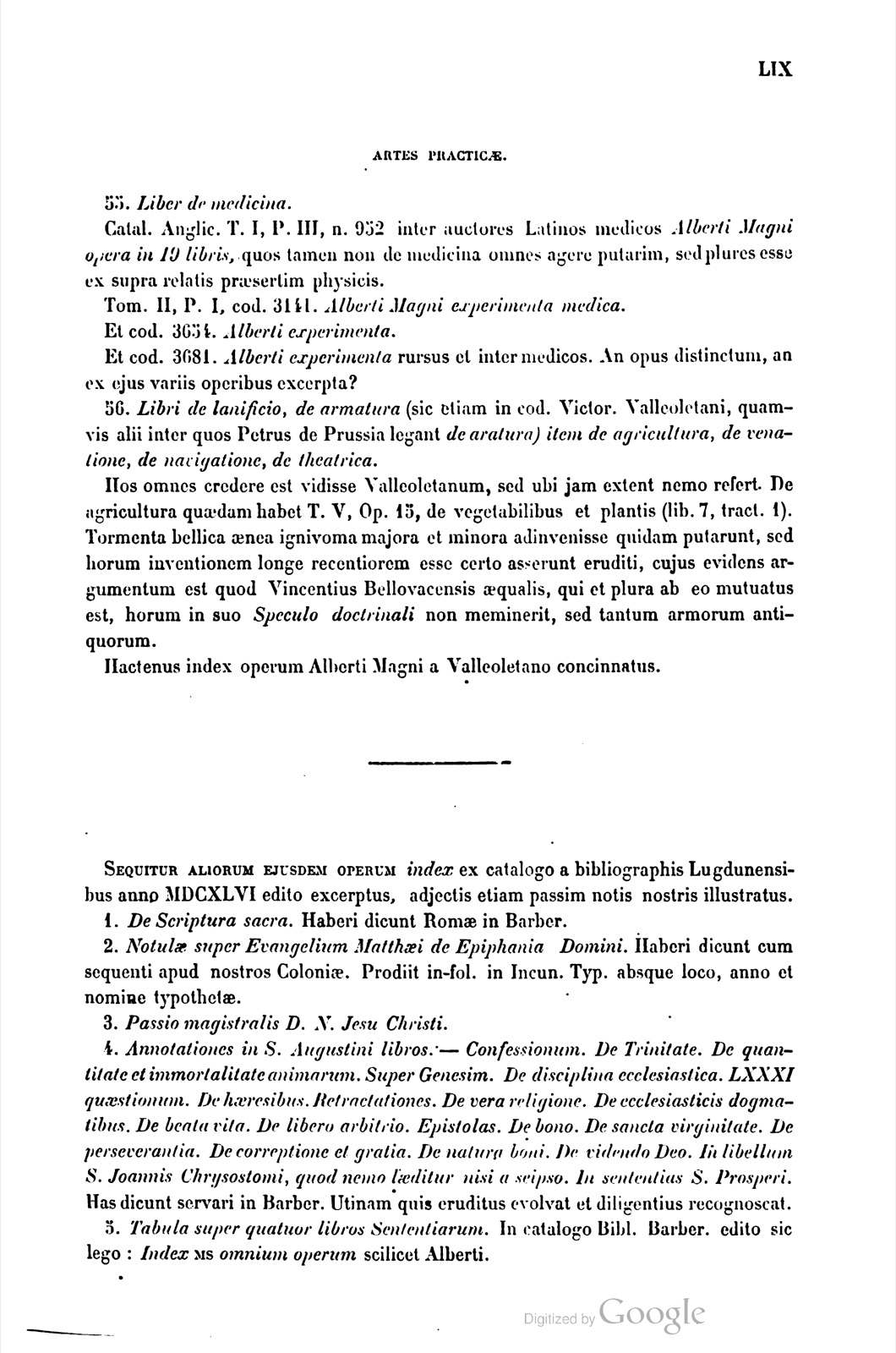
9. De sacra theologia. Addunt servari in Barber.
10. Theologia positiva, moralis, scholastica, mystica, symbolica et concionatoria. Quid hoc titulo intelligant nescio, nisi forte operum Alberti de theologia corpus universum.
11. De timore multiplici.
12. Enchiridion de veris et perfectis virtutibus. Catal. Angl. T. I, P. I, cod. 2149: Albertus Magnus de virtutibus animae veris et perfectis, quas gratuitas vocat, etc. est liber impressus. An diversum ab eo quod typis prodiit T. XXI cui titulus Paradisus animae?
13. Orationes super sententias. Extant Coloniae a Petro de Prussia visae.
14. An expediat homini vovere ingressum in religionem? Dicunt extare in Victor.
15. De quatuor virtutibus cardinalibus. Recensetur cum aliis Alberti catal. Anglic. T. I, P. II, cod. 750.
16. De arte bene moriendi. Laudant in Thuana, nunc Regia. In Colbert. cod. ms 6104: Alberti Magni ars bene moriendi.
17. Parvi tractatus, scilicet De libro vitae. De evacuatione charitatis. De ordine charitatis in patria. De virtutibus cardinalibus. De donis. De combinatione donorum. De timore. De scientia. De sapientia. De vitiis in communi et specialiter de usura. De mendacio. Quomodo differant mansuetudo et misericordia? Dicunt haberi sic collecta in Claromontana Parisiensi s. j. Catal. Angl. T. I, P. I; cod. 1672: Alberti dona.
18. Volumen unum de sacramentis. In laudata Clarom.
19. Conciones diversae. In ead. Clarom. Catal. Angl. T. I, P. I, cod. 820 recensetur. F. Alberti sermo de praeparatione cordis. An Magni, an alterius?
20. De doctrina dicendi et tacendi. Verus titulus: Tractatus Venerabilis Domini Alberti Magni de arte vivendi, loquendi et tacendi. Princ. Si fore vis sapiens, etc. Ad calcem: Finit tractatulus impressus Parisiis, Aedib. sorbonicis aurei solis, 1491, April. 7 in-8; pp. 7, typis romanis nitidis et elegantibus Udalr. Gering et Berth. Rembolt. Ejusdem fere tituli, sed longe alterius rationis prodiit opus hoc titulo: Incipit liber moralissimi Albertani causidici Brixiensis de ora S. Agathae super modo loquendi et tacendi. Pr. Quoniam in dicendo multi errant, etc. Prodiit pluries ex Beughemio Lovanii et Antverpiae, 1483. Daventriae, 1490. Lipsiae, 1491: ubique in-4. Aliam editionem vidi absque anno et loco sed cum privilegio ducis Sabaudiae et cum aliis ejusdem Albertani qui florebat anno MCCXXXVI operibus in-fol. ubi opus illud de modo loquendi pp. 30 implet: haecque editio ut et alterius Alberti Magni extant in Sorbon. Quae monenda fuere, ne quis hos tractatus confundat. Catal. Anglic. T. II, P. I: Doctrina dicendi et tacendi per Albertum. Vide n. 9312.
21. De officio missae. Vix tamen aliud crediderim ab edito T. XXI sub titulo De sacrificio Missae, nam in edit. Mogunt. 1477 fol. supra laudata hoc eodem titulo prodiit De officio missae.
9. On Sacred Theology. They add that it is preserved in the Barberini.
10. Positive, moral, scholastic, mystical, symbolic, and preaching theology. What they understand by this title I do not know, unless perhaps the whole body of Albert's works on theology.
11. On manifold fear.
12. Enchiridion on true and perfect virtues. English Catalogue, volume I, part I, codex 2149: Albert the Great on the virtues of the soul, true and perfect, which he calls gratuitous, etc.; it is a printed book. Is it different from that which came forth in print in volume XXI, whose title is Paradise of the Soul?
13. Prayers on the Sentences. They exist at Cologne, seen by Peter of Prussia.
14. Whether it is advantageous for a man to vow entrance into religion? They say it exists in Victor.
15. On the four cardinal virtues. It is reviewed with other works of Albert in the English Catalogue, volume I, part II, codex 750.
16. On the art of dying well. They praise it in the Thuanus Library, now the Royal. In Colbert, manuscript codex 6104: Albert the Great's art of dying well.
17. Small treatises, namely On the Book of Life; On the Emptying of Charity; On the Order of Charity in the Homeland; On the Cardinal Virtues; On the Gifts; On the Combination of the Gifts; On Fear; On Knowledge; On Wisdom; On Vices in common and especially on usury; On Lying; How do meekness and mercy differ? They say these are held thus collected in the Parisian Clermont Jesuit library. English Catalogue, volume I, part I; codex 1672: Albert's Gifts.
18. One volume On the Sacraments. In the praised Clermont.
19. Various sermons. In the same Clermont. English Catalogue, volume I, part I, codex 820 reviews: Brother Albert's sermon On the Preparation of the Heart. Is it by the Great, or by another?
20. On the doctrine of speaking and keeping silent. The true title: Treatise of the Venerable Lord Albert the Great On the Art of Living, Speaking, and Keeping Silent. Beginning: If you wish to be wise, etc. At the foot: The little treatise printed at Paris, in the Sorbonne buildings of the Golden Sun, 1491, April 7, octavo, seven pages, in the neat and elegant Roman type of Ulrich Gering and Berthold Rembolt, ends. A work of almost the same title, but of a far different character, came forth under this title: Here begins the book of the very moral Albertanus, advocate of Brescia from the district of St. Agatha, on the manner of speaking and keeping silent. Beginning: Since many err in speaking, etc. It came forth several times according to Beughem, at Louvain and Antwerp, 1483; Deventer, 1490; Leipzig, 1491, everywhere in quarto. I saw another edition without year and place, but with the privilege of the duke of Savoy, and with other works of the same Albertanus, who flourished in the year 1236, in folio, where that work on the manner of speaking fills thirty pages; and this edition, as also that of the other Albert the Great, exists in the Sorbonne. These things had to be warned, lest anyone confuse these treatises. English Catalogue, volume II, part I: Doctrine of speaking and keeping silent by Albert. See number 9312.
21. On the Office of the Mass. I would scarcely believe it to be anything other than the work published in volume XXI under the title On the Sacrifice of the Mass, for in the Mainz edition of 1477 folio, praised above, it came forth under this same title, On the Office of the Mass.
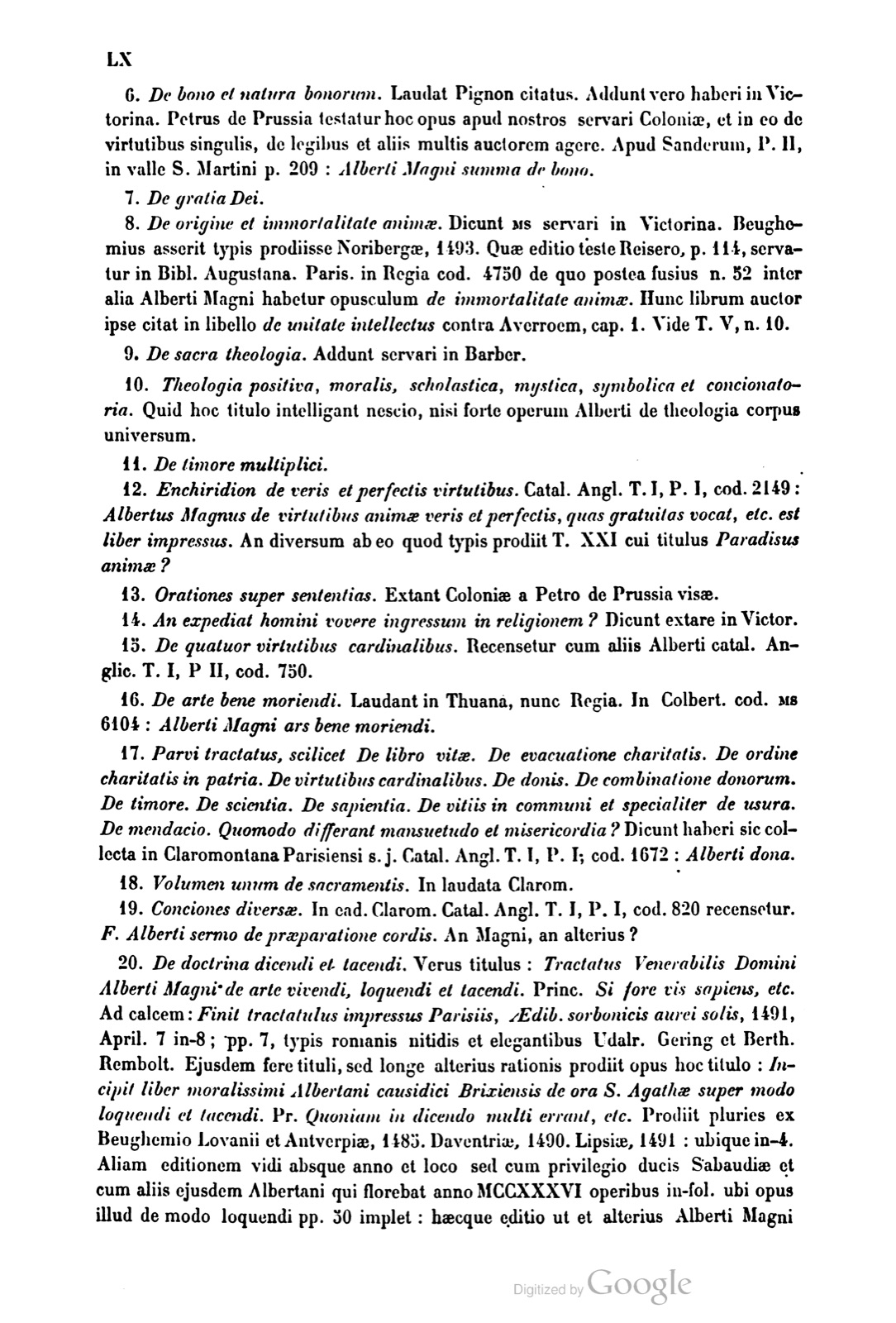
22. De oratione Dominica. Petrus de Prussia a quodam viro docto se didicisse testatur hunc tractatum specialem in Italia reperiri.
23. Litaniae de tempore et de Sanctis. Extant in Victor. cod. ms 1129 fol. chart. a fol. 99 ad 105. Titulus: Letania F. Alberti episcopi de Ord. Praedic. Pr. Candor lucis et speculum sine macula. Ad finem: Explicit Letania F. Alberti episcopi de Ord. Praedic. Teutonici. Coloniae apud nostros haberi a se visas testatur Petrus de Prussia, addens singulis quos invocat sanctis singularem ab eo dirigi orationem. Sic etiam in cod. Victor. Apud Sanderum, P. II in valle S. Martini p. 209 etiam recensentur.
24. Oratiunculae de Passione Domini.
25. De mysteriis missae. Idem censuerim cum edito T. XXI de sacrificio missae.
26. De capillitiis B. V. et in illa verba Regina Angelorum. Quindecim gaudia Virginis. Quaestio de speculo Mariae. Conciones de B. V. In Claravalle dicuntur extare Alberti Magni sermones Mariales.
27. Commentarius in canticum Magnificat. An aliud, an excerptum ex commentario in Lucam?
28. Summa B. V. et tractatus de martyriis Sanctorum. Laudant in Bibl. D. Coemans. Catal. Angl. T. II, P. I, cod. 961: Albertus magnus de B. V. Maria et ejus miraculis. An aliquod tribus his numeris ultimis laudatorum?
29. De antepraedicamentis. De contingenti et possibili. De postpraedicamentis. De definitionibus. Laudant Coloniae. An sint lucubrationes ab editis T. I logicalibus, docebunt forsan sodales?
30. Isagoge in Physicam. Repetitionem censeo et idem cum edita T. XXI philosophia pauperum, quae et Isagoge dicitur. Idem existimes de his quae ceu distincta opera numerant his titulis: Compendium philosophiae naturalis; et parva summa philosophica: et summa philosophiae.
31. De corpore mobili secundum locum. Dicunt haberi in Bibl. Cornelierensi.
32. De gemmis. De lapidum quorumdam virtutibus. De quorumdam animalium virtutibus. De virtutibus quorumdam herbarum. Prodiit sub hoc titulo: Liber aggregationum sive secretorum de virtutibus herbarum, lapidum et animalium. Neapoli, 1493-4. Sic Beughemius. Tum cum opusculo de mirabilibus mundi eidem Alberto supposito, Francofurti, 1614 in-12. Rursus hic subjecto libello de Secretis mulierum, Lugduni, 1615 in-16, quae duae editiones extant in Barber. Postea illis praemisso eodem libello de secret. mul. Amstelodami, 1643 et ibidem Janssonii, 1662 in-12 pp. 218. Catal. Anglic. T. I, P. I, cod. 1638 sic legitur: Alberti secreta de naturis quorumdam herborum, lapidum et animalium. Et cod. 1748 sequenti: Fratris Alberti de Saxonia secreta de herbis, lapidibus et animalibus. Haec probant incerto in editionibus relatis haec omnia opuscula Alberto Magno fuisse tributa, cum codd. ms varient, et alii Alberto cuidam, alii Alberto de Saxonia vindicent: noster enim non Saxo sed Suevus fuit. Praeterea qui Alberti Magni stylo paululum assuetus fuerit, et ingenium norit ab istis vanis et futilibus alienissimum, ei non sine injuria tribui judicabit. Quaenam vero indicentur ibidem cod. 1754: Experimenta sive secreta Alberti, docebunt periti indigenae, ut et quae cod. 1791: Alberti magni de lapidibus pretiosis; quamvis hoc ultimum esse ex libro de mineralibus conjectu sit pronum?
22. On the Lord's Prayer. Peter of Prussia testifies that he learned from a certain learned man that this special treatise is found in Italy.
23. Litanies for the season and for the saints. They exist in Victor, manuscript codex 1129, folio paper, from folio 99 to 105. Title: Litany of Brother Albert, bishop, of the Order of Preachers. Beginning: Brightness of light and spotless mirror. At the end: Here ends the Litany of Brother Albert, bishop, of the Order of Preachers, the Teuton. Peter of Prussia testifies that they are held at Cologne among our men, seen by himself, adding that a particular prayer is directed by him to each of the saints whom he invokes. Thus also in the Victor codex. In Sanderus, part II, in the valley of St. Martin, page 209, they also are reviewed.
24. Little prayers on the Passion of the Lord.
25. On the Mysteries of the Mass. I would judge it to be the same as the published volume XXI On the Sacrifice of the Mass.
26. On the hair of the Blessed Virgin and on those words Queen of Angels. Fifteen joys of the Virgin. A question on the mirror of Mary. Sermons on the Blessed Virgin. At Clairvaux sermons of Albert the Great on Mary are said to exist.
27. Commentary on the canticle Magnificat. Is it another work, or an excerpt from the commentary on Luke?
28. Summa of the Blessed Virgin and treatise on the martyrdoms of the saints. They praise it in the Library of Dom Coemans. English Catalogue, volume II, part I, codex 961: Albert the Great on the Blessed Virgin Mary and her miracles. Is it some one of the works praised under these last three numbers?
29. On the Antepredicaments. On the Contingent and the Possible. On the Postpredicaments. On Definitions. They praise them at Cologne. Whether they are studies from the logical works published in volume I, the brethren will perhaps teach.
30. Isagoge into Physics. I judge it to be a repetition and the same as the Philosophy of the Poor published in volume XXI, which is also called Isagoge. Think the same concerning the things which they number as distinct works under these titles: Compendium of Natural Philosophy; and Little Philosophical Summa; and Summa of Philosophy.
31. On body movable according to place. They say it is held in the Cornelier Library.
32. On gems. On the powers of certain stones. On the powers of certain animals. On the powers of certain herbs. It came forth under this title: Book of Aggregations or Secrets concerning the Powers of Herbs, Stones, and Animals. Naples, 1493 quarto. Thus Beughem. Then with the little work On the Wonders of the World, likewise attributed to Albert, Frankfurt, 1614, duodecimo. Again, with this little book On the Secrets of Women appended, Lyons, 1615, sextodecimo; these two editions exist in the Barberini. Later, with the same little book On the Secrets of Women placed before them, Amsterdam, 1643, and in the same place Janssonius, 1662, duodecimo, 218 pages. English Catalogue, volume I, part I, codex 1638, reads thus: Albert's secrets concerning the natures of certain herbs, stones, and animals. And in the following codex 1748: Brother Albert of Saxony's secrets concerning herbs, stones, and animals. These things prove that, in the editions reported, all these little works were uncertainly attributed to Albert the Great, since the manuscript codices vary, and some claim them for a certain Albert, others for Albert of Saxony: for our man was not a Saxon but a Swabian. Moreover, whoever has become even a little accustomed to Albert the Great's style, and knows his talent to be utterly alien from those vain and trivial things, will judge that it is attributed to him not without injury. What things are indicated there in codex 1754, Experiments or Secrets of Albert, native experts will teach, as also what things are in codex 1791, Albert the Great On Precious Stones; although it is easy to conjecture that this last is from the book On Minerals.
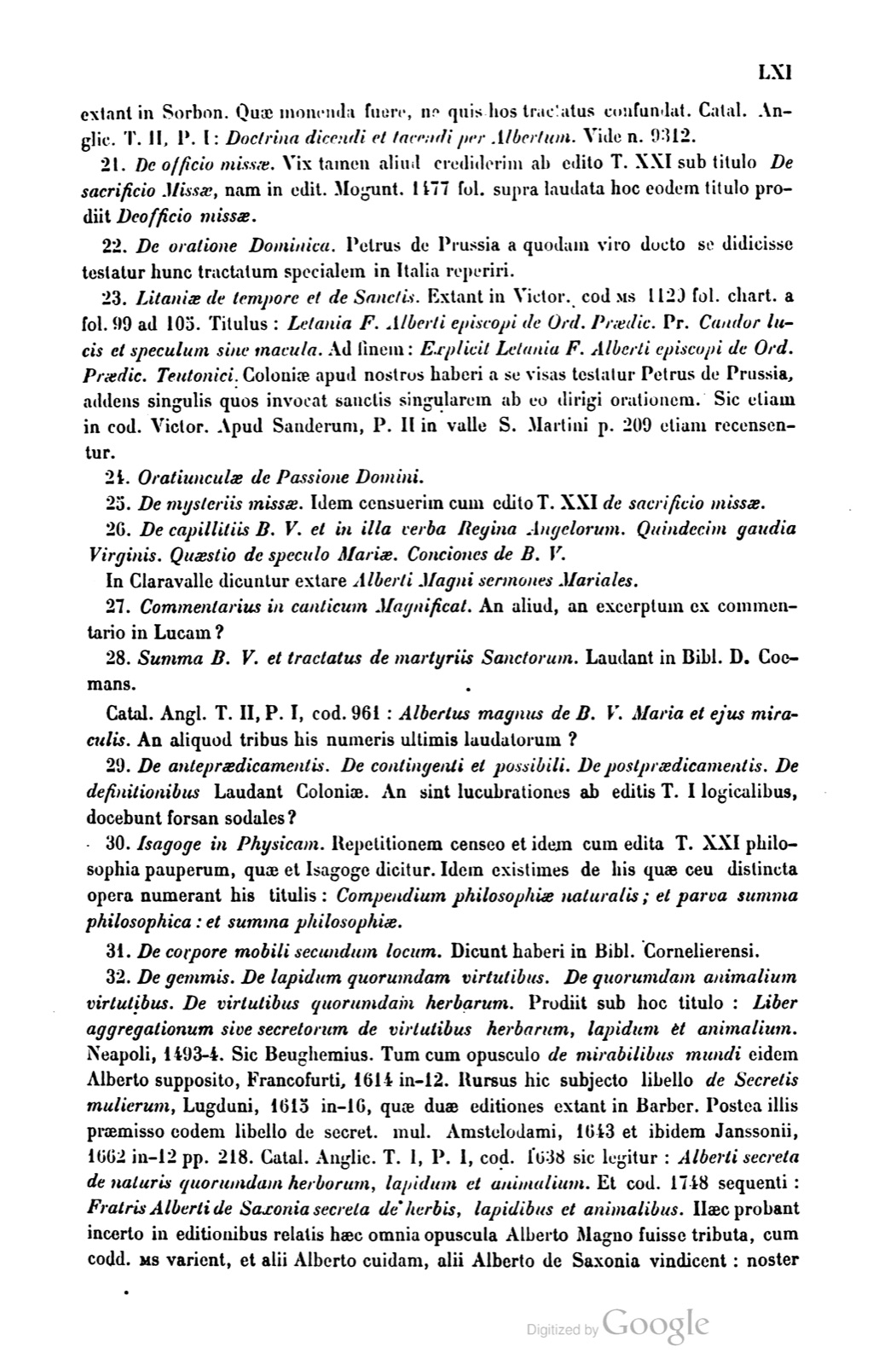
33. De scientia meteororum. De somniis. De natura animalium. De naturali perfectione intellectus. Et haec vix crediderim aliud esse quam bis repetita aut excerpta ex aliis supra jam relatis. Primum ex commentario in Meteora T. II edito; alterum ex libro de somno et vigilia T. V, op. 3, lib. 2 ubi plura de somniis, vel etiam ex Summa de homine, quaest. 44 et seqq. Tertium ex ingenti opere de animalibus lib. I. Quartum tandem ex op. 15, T. V, De intellectu et intelligibili, ubi lib. 2 agit de naturali perfectione intellectus, ut ibidem notatum.
34. De secretis super Henricum de Saxonia de formato foetu. At tantum abest ut Albertus scripserit super Henricum, quin ipse Henricus a Simlero proditur fuisse Alberti Magni discipulus, et verus auctor libri insulsi de secretis mulierum. Vide supra indice n. 42 annotata.
35. De sensu communi et aliis potentiis animae. Dicunt extare in Victor. Catal. Angl. T. I, P. II, cod. 880: Albertus Magnus de sensu communi. De eodem agit qq. 33 et 34 Summae de homine. T. XIX. Et P. I, cod. 1911: Alberti Magni de potentiis inter alia plura ejusdem. P. III, cod. 1705: De potentiis animae. Codex mutilus. Colbert. cod. 2411 fol. par. memb. Liber de viribus animae a F. Alberto Teutonico. Pr. Sicut dicit Damascenus impossibile est substantiam esse expertem aliqua naturali operatione, etc. foliolis quatuor tantum. Finis: Facultas voluntatis et rationis.
36. De avium natura et de quadrupedibus. Laudant utrumque in Regia. Revera extant cod. 5783 fol. med. chart. at non novum opus, sed duo libri sunt ex magno Alberti opere de animalibus seorsim scripti.
37. De homine et diversis ejus definitionibus. Laudant etiam in Regia. Revera extat cod. 4842 fol. mag. chart. Sed est idem opus cum edito T. XIX, et est pars secunda Summae de creaturis.
38. Parvorum naturalium textus cum commentario ex Alberti doctrina collecto per Joannem de Mechlinia anno MCCCCLX clarum. Coloniae, Quentell. 1498. Iste Joannes acerrimus fuit doctrinae Alberti sectator.
39. De perfectione animae. Laudant in Regia. Revera ultimum est opusculum cod. 4750 de quo postea fusius n. 52. Hujus libri meminit ipse Albertus, et citat ut distinctum in libello de unitate intellectus contra Averroem sub finem cap. 1.
40. Philosophia moralis.
41. De directione astronomiae et de astris. Laudant in Regia.
42. An licitum sit uti judiciis astrorum? Laudant in Regia.
43. In speculum astrolabicum.
44. Ephemerides.
45. De causis. An aliud ab opusculo 17, T. V, edito de causis et processu universitatis a causa prima?
46. De ente et essentia.
47. De diversis quaestionibus.
33. On the science of meteors. On dreams. On the nature of animals. On the natural perfection of the intellect. And I would scarcely believe these things to be anything other than repeated twice or excerpted from other works already reported above: the first from the commentary on the Meteors published in volume II; the second from the book On Sleep and Waking, volume V, work 3, book 2, where he treats many things on dreams, or also from the Summa on Man, questions 44 and following; the third from the enormous work On Animals, book I; finally the fourth from work 15, volume V, On Intellect and the Intelligible, where in book 2 he treats of the natural perfection of the intellect, as noted there.
34. On secrets, upon Henry of Saxony On the Formed Fetus. But so far is it from being the case that Albert wrote upon Henry, that Henry himself is reported by Simler to have been a disciple of Albert the Great and the true author of the tasteless book On the Secrets of Women. See the notes above in the index, number 42.
35. On common sense and the other powers of the soul. They say it exists in Victor. English Catalogue, volume I, part II, codex 880: Albert the Great on common sense. He treats of the same in questions 33 and 34 of the Summa on Man, volume XIX. And part I, codex 1911: Albert the Great on the powers, among several other works of the same man. Part III, codex 1705: On the powers of the soul. A mutilated codex. Colbert, codex 2411, small folio parchment: Book on the Powers of the Soul by Brother Albert the Teuton. Beginning: As Damascene says, it is impossible for a substance to be without some natural operation, etc., only four small leaves. End: the faculty of will and reason.
36. On the nature of birds and on quadrupeds. They praise both in the Royal Library. In reality they exist in codex 5783, medium folio paper, but it is not a new work; rather, the two books are from Albert's great work On Animals, written separately.
37. On man and his various definitions. They also praise it in the Royal Library. In reality it exists, codex 4842, large folio paper. But it is the same work as that published in volume XIX, and it is the second part of the Summa on Creatures.
38. The text of the Little Natural Works with commentary collected from Albert's teaching by John of Mechelen, famous in the year 1460. Cologne, Quentell, 1498. This John was a very keen follower of Albert's teaching.
39. On the perfection of the soul. They praise it in the Royal Library. In reality it is the last little work of codex 4750, concerning which more fully later at number 52. Albert himself mentions this book, and cites it as distinct in the little book On the Unity of the Intellect against Averroes toward the end of chapter 1.
40. Moral Philosophy.
41. On the direction of astronomy and on the stars. They praise it in the Royal Library.
42. Whether it is permitted to use the judgments of the stars? They praise it in the Royal Library.
43. Into the astrolabic mirror.
44. Ephemerides.
45. On Causes. Is it another work than little work 17, published in volume V, On the Causes and Process of the Universe from the First Cause?
46. On being and essence.
47. On various questions.
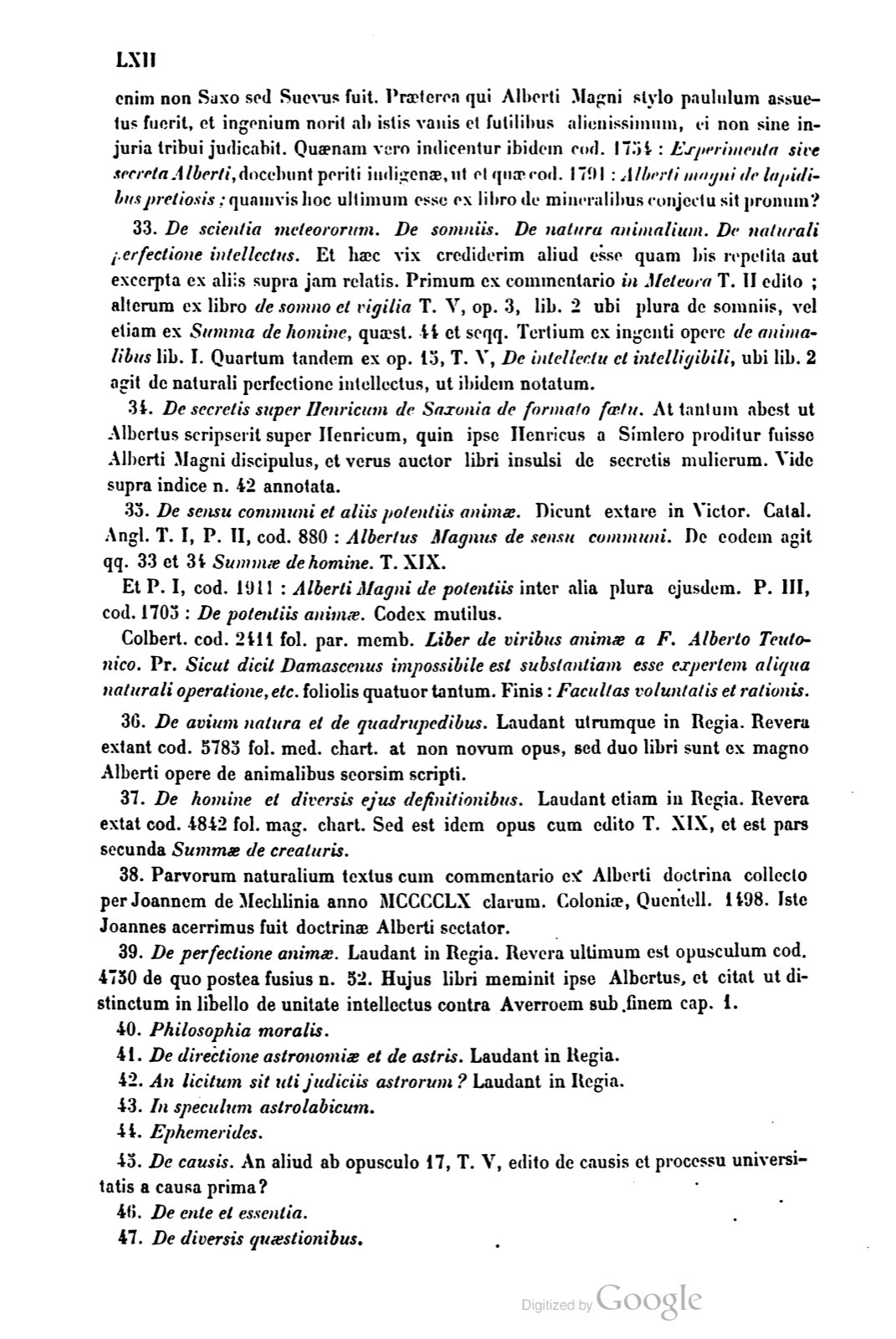
If a page does not appear, its photograph has not been uploaded yet.