Volume 1
Critical Bibliography, Volumes V-VI
A marker with ≈ is an approximate page boundary, placed by measure of the text; the page photographs remain the authority. In the paired views, clicking a page marker brings that page into view.
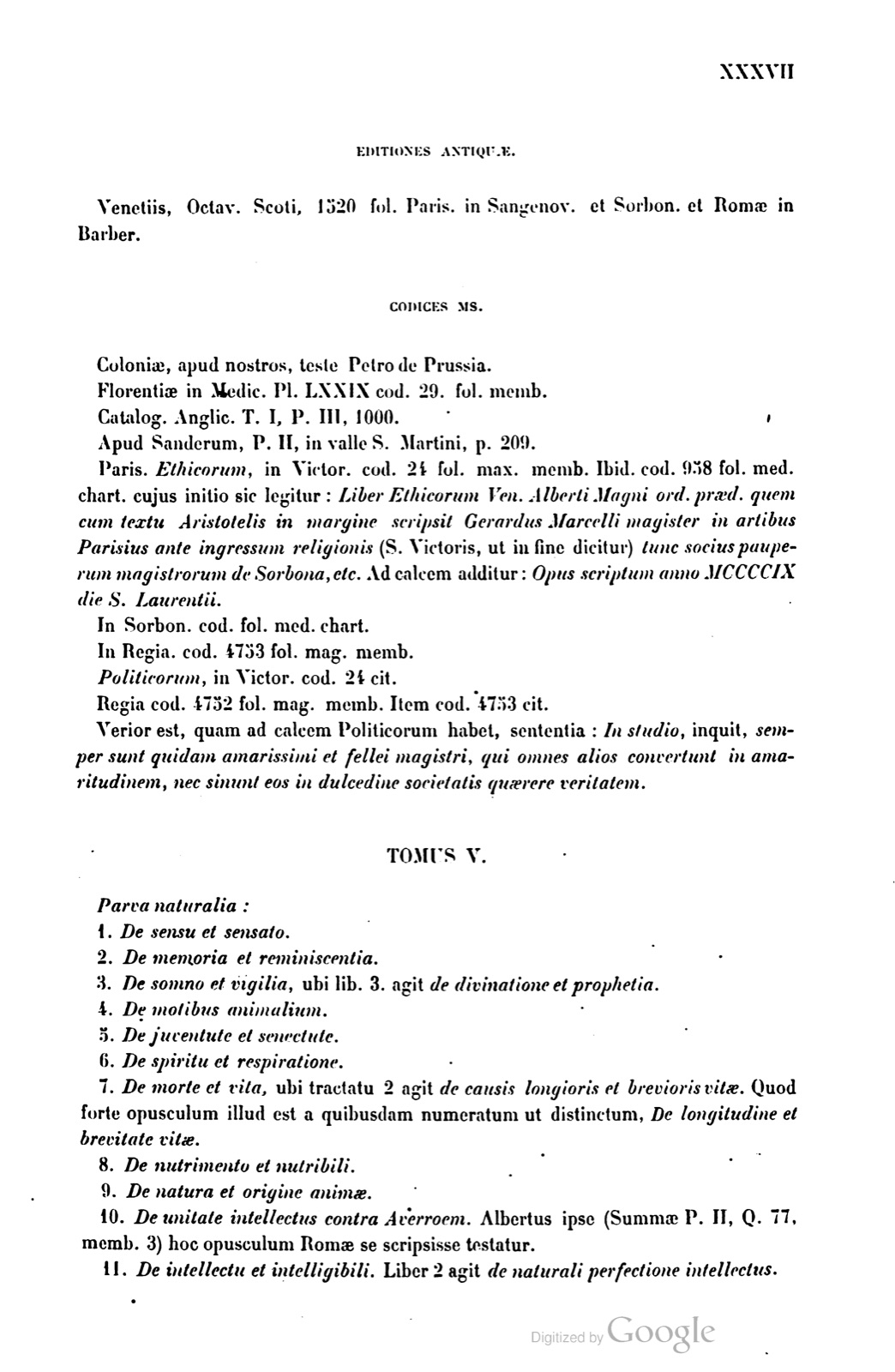
TOMUS V.
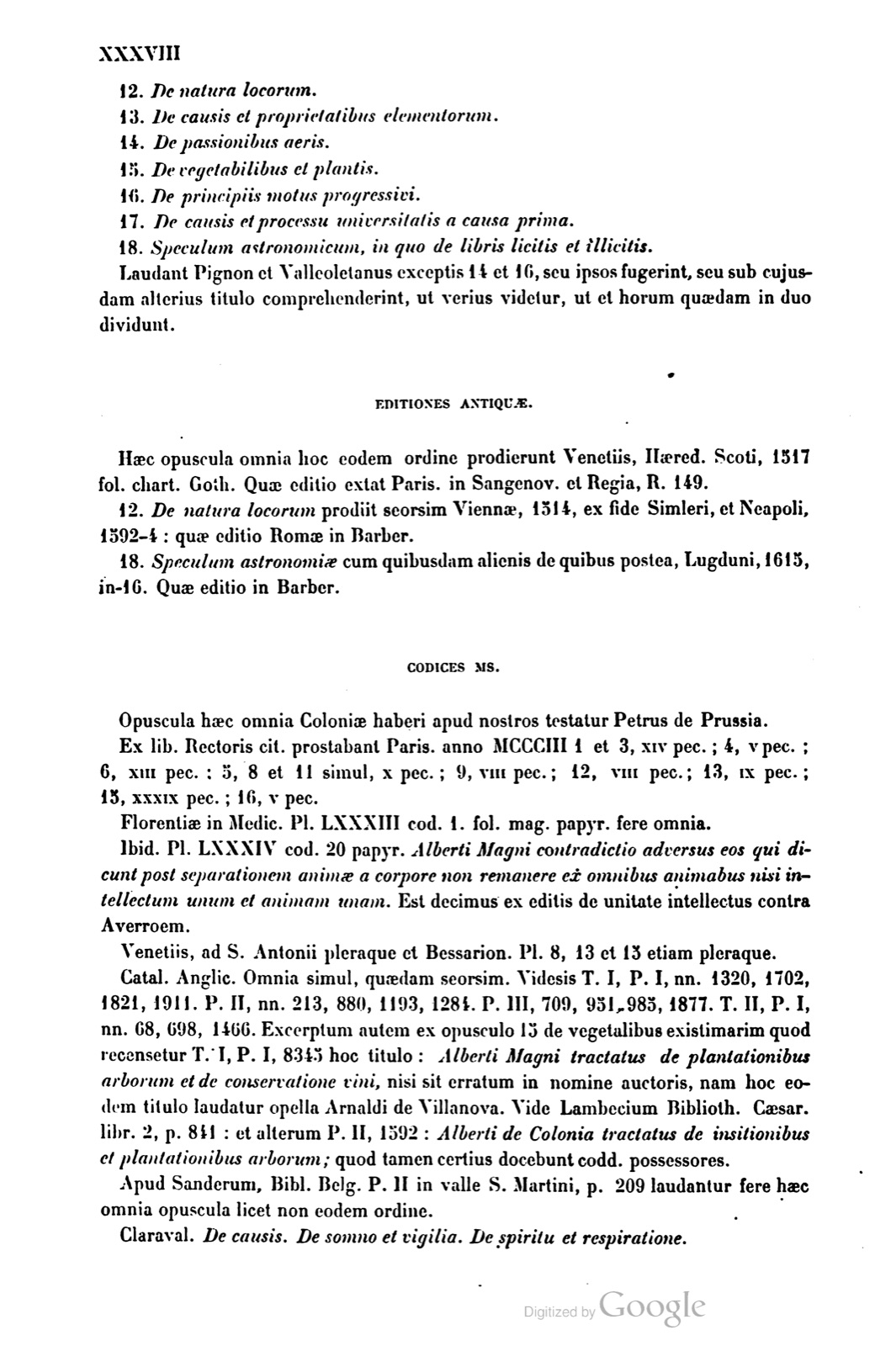
Parva naturalia: 1. De sensu et sensato. 2. De memoria et reminiscentia. 3. De somno et vigilia, ubi lib. 3. agit de divinatione et prophetia. 4. De motibus animalium. 5. De juventute et senectute. 6. De spiritu et respiratione. 7. De morte et vita, ubi tractatu 2 agit de causis longioris et brevioris vitae. Quod forte opusculum illud est a quibusdam numeratum ut distinctum, De longitudine et brevitate vitae. 8. De nutrimento et nutribili. 9. De natura et origine animae. 10. De unitate intellectus contra Averroem. Albertus ipse (Summae P. II, Q. 77, memb. 3) hoc opusculum Romae se scripsisse testatur. 11. De intellectu et intelligibili. Liber 2 agit de naturali perfectione intellectus. 12. De natura locorum. 13. De causis et proprietatibus elementorum. 14. De passionibus aeris. 15. De vegetabilibus et plantis. 16. De principiis motus progressivi. 17. De causis et processu universitatis a causa prima. 18. Speculum astronomicum, in quo de libris licitis et illicitis. Laudant Pignon et Valleoletanus exceptis 14 et 16, seu ipsos fugerint, seu sub cujusdam alterius titulo comprehenderint, ut verius videtur, ut et horum quaedam in duo dividunt.
EDITIONES ANTIQUAE.
Haec opuscula omnia hoc eodem ordine prodierunt Venetiis, Haered. Scoti, 1517 fol. chart. Goth. Quae editio extat Paris. in Sangenov. et Regia, R. 149. 12. De natura locorum prodiit seorsim Viennae, 1514, ex fide Simleri, et Neapoli, 1592-4: quae editio Romae in Barber. 18. Speculum astronomiae cum quibusdam alienis de quibus postea, Lugduni, 1615, in-16. Quae editio in Barber.
CODICES MS.
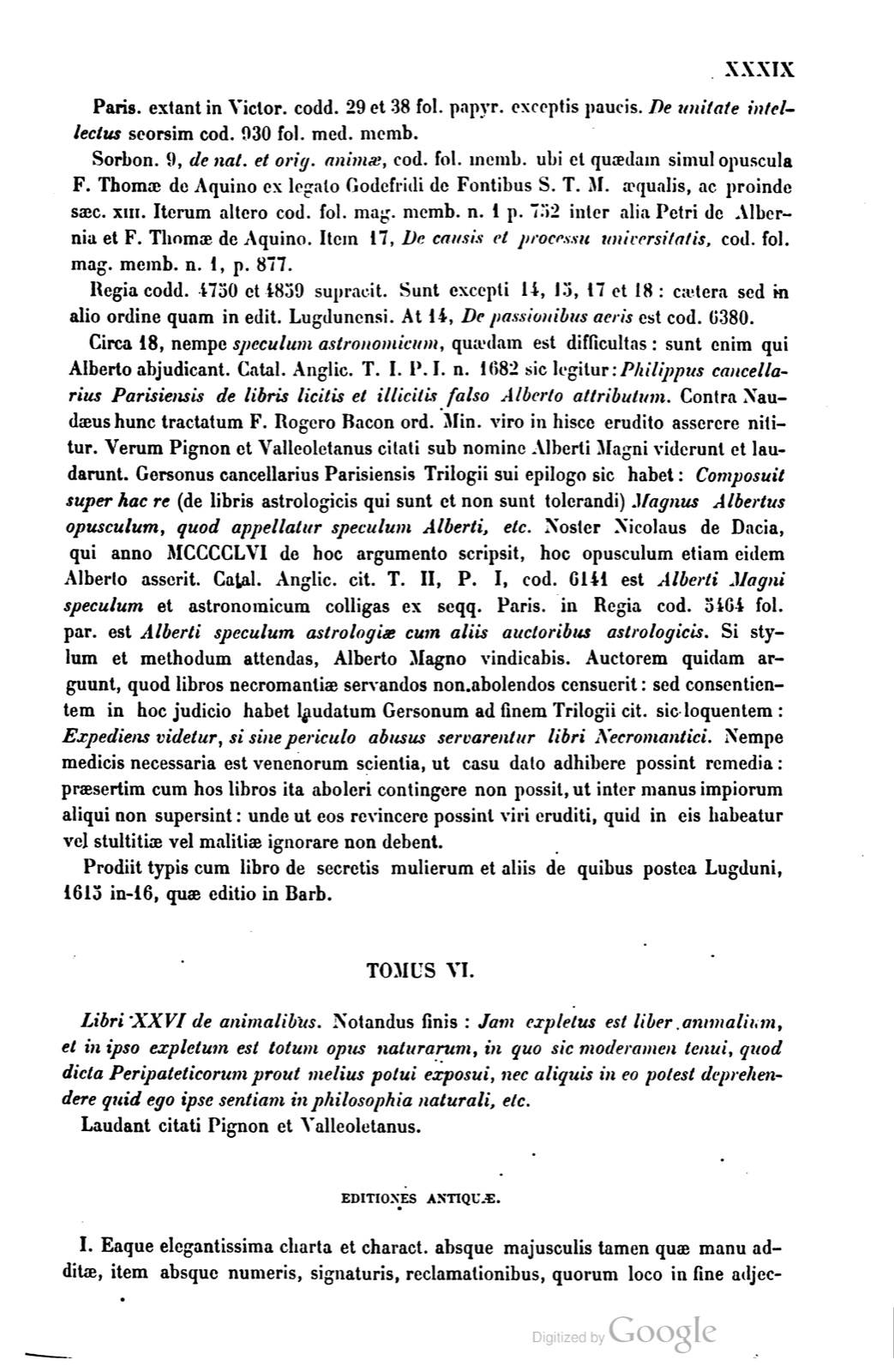
Opuscula haec omnia Coloniae haberi apud nostros testatur Petrus de Prussia. Ex lib. Rectoris cit. prostabant Paris. anno MCCCIII 1 et 3, XIV pec.; 4, V pec.; 6, XIII pec.; 5, 8 et 11 simul, X pec.; 9, VIII pec.; 12, VIII pec.; 13, IX pec.; 15, XXXIX pec.; 16, V pec. Florentiae in Medic. Pl. LXXXIII cod. 1. fol. mag. papyr. fere omnia. Ibid. Pl. LXXXIV cod. 20 papyr. Alberti Magni contradictio adversus eos qui dicunt post separationem animae a corpore non remanere ex omnibus animabus nisi intellectum unum et animam unam. Est decimus ex editis de unitate intellectus contra Averroem. Venetiis, ad S. Antonii pleraque et Bessarion. Pl. 8, 13 et 15 etiam pleraque. Catal. Anglic. Omnia simul, quaedam seorsim. Videsis T. I, P. I, nn. 1320, 1702, 1821, 1911. P. II, nn. 213, 880, 1193, 1284. P. III, 709, 951, 985, 1877. T. II, P. I, nn. 68, 698, 1466. Excerptum autem ex opusculo 15 de vegetalibus existimarim quod recensetur T. I, P. I, 8345 hoc titulo: Alberti Magni tractatus de plantationibus arborum et de conservatione vini, nisi sit erratum in nomine auctoris, nam hoc eodem titulo laudatur opella Arnaldi de Villanova. Vide Lambecium Biblioth. Caesar. libr. 2, p. 841: et alterum P. II, 1592: Alberti de Colonia tractatus de insitionibus et plantationibus arborum; quod tamen certius docebunt codd. possessores. Apud Sanderum, Bibl. Belg. P. II in valle S. Martini, p. 209 laudantur fere haec omnia opuscula licet non eodem ordine. Claraval. De causis. De somno et vigilia. De spiritu et respiratione. Paris. extant in Victor. codd. 29 et 38 fol. papyr. exceptis paucis. De unitate intellectus seorsim cod. 930 fol. med. memb. Sorbon. 9, de nat. et orig. animae, cod. fol. memb. ubi et quaedam simul opuscula F. Thomae de Aquino ex legato Godefridi de Fontibus S. T. M. aequalis, ac proinde saec. XIII. Iterum altero cod. fol. mag. memb. n. 1 p. 752 inter alia Petri de Albernia et F. Thomae de Aquino. Item 17, De causis et processu universitatis, cod. fol. mag. memb. n. 1, p. 877. Regia codd. 4750 et 4859 supracit. Sunt excepti 14, 15, 17 et 18: caetera sed in alio ordine quam in edit. Lugdunensi. At 14, De passionibus aeris est cod. 6380. Circa 18, nempe speculum astronomicum, quaedam est difficultas: sunt enim qui Alberto abjudicant. Catal. Anglic. T. I. P. I. n. 1682 sic legitur: Philippus cancellarius Parisiensis de libris licitis et illicitis falso Alberto attributum. Contra Naudaeus hunc tractatum F. Rogero Bacon ord. Min. viro in hisce erudito asserere nititur. Verum Pignon et Valleoletanus citati sub nomine Alberti Magni viderunt et laudarunt. Gersonus cancellarius Parisiensis Trilogii sui epilogo sic habet: Composuit super hac re (de libris astrologicis qui sunt et non sunt tolerandi) Magnus Albertus opusculum, quod appellatur speculum Alberti, etc. Noster Nicolaus de Dacia, qui anno MCCCCLVI de hoc argumento scripsit, hoc opusculum etiam eidem Alberto asserit. Catal. Anglic. cit. T. II, P. I, cod. 6141 est Alberti Magni speculum et astronomicum colligas ex seqq. Paris. in Regia cod. 5464 fol. par. est Alberti speculum astrologiae cum aliis auctoribus astrologicis. Si stylum et methodum attendas, Alberto Magno vindicabis. Auctorem quidam arguunt, quod libros necromantiae servandos non abolendos censuerit: sed consentientem in hoc judicio habet laudatum Gersonum ad finem Trilogii cit. sic loquentem: Expediens videtur, si sine periculo abusus servarentur libri Necromantici. Nempe medicis necessaria est venenorum scientia, ut casu dato adhibere possint remedia: praesertim cum hos libros ita aboleri contingere non possit, ut inter manus impiorum aliqui non supersint: unde ut eos revincere possint viri eruditi, quid in eis habeatur vel stultitiae vel malitiae ignorare non debent. Prodiit typis cum libro de secretis mulierum et aliis de quibus postea Lugduni, 1615 in-16, quae editio in Barb.
VOLUME V.
The Little Natural Works: 1. On Sense and the Sensible. 2. On Memory and Recollection. 3. On Sleep and Waking, where in book 3 he treats of divination and prophecy. 4. On the Motions of Animals. 5. On Youth and Old Age. 6. On Spirit and Respiration. 7. On Death and Life, where in treatise 2 he treats of the causes of longer and shorter life. Perhaps that is the little work counted by certain men as distinct, On Length and Shortness of Life. 8. On Nourishment and the Nourishable. 9. On the Nature and Origin of the Soul. 10. On the Unity of the Intellect against Averroes. Albert himself (Summa, Part II, Question 77, member 3) testifies that he wrote this little work at Rome. 11. On Intellect and the Intelligible. Book 2 treats of the natural perfection of the intellect. 12. On the Nature of Places. 13. On the Causes and Properties of the Elements. 14. On the Passions of the Air. 15. On Vegetables and Plants. 16. On the Principles of Progressive Motion. 17. On the Causes and Process of the Universe from the First Cause. 18. The Astronomical Mirror, in which he treats of licit and illicit books. Pignon and Valladolid praise them, except 14 and 16, whether these escaped them or they included them under the title of someone else, as seems more true, as also they divide certain of these into two.
ANCIENT EDITIONS.
All these little works came forth in this same order at Venice, heirs of Scotus, 1517, folio, Gothic paper. This edition exists at Paris in Saint-Genevieve and in the Royal Library, R. 149. 12. On the Nature of Places came forth separately at Vienna, 1514, on the authority of Simler, and at Naples, 1592 quarto; this edition is at Rome in the Barberini. 18. The Mirror of Astronomy, with certain alien works about which later, Lyons, 1615, sextodecimo. This edition is in the Barberini.
MANUSCRIPT CODICES.
Peter of Prussia testifies that all these little works are held at Cologne among our men. From the cited book of the Rector, they were offered for sale at Paris in the year 1303: 1 and 3, fourteen pieces; 4, five pieces; 6, thirteen pieces; 5, 8, and 11 together, ten pieces; 9, eight pieces; 12, eight pieces; 13, nine pieces; 15, thirty-nine pieces; 16, five pieces. Florence in the Medicean, Pluteus LXXXIII, codex 1, large folio paper, almost all. In the same place, Pluteus LXXXIV, codex 20, paper: Albert the Great's contradiction against those who say that after the separation of the soul from the body there does not remain from all souls except one intellect and one soul. It is the tenth of the edited works, On the Unity of the Intellect against Averroes. Venice, at St. Anthony, most of them, and Bessarion, Pluteus 8, and 13 and 15 also mostly. English catalogue: all together, certain separately. See volume I, part I, numbers 1320, 1702, 1821, 1911; part II, numbers 213, 880, 1193, 1284; part III, 709, 951, 985, 1877; volume II, part I, numbers 68, 698, 1466. But I would think the excerpt from little work 15 on plants is what is reviewed in volume I, part I, 8345 under this title: Albert the Great's treatise on the planting of trees and on the preservation of wine, unless there is an error in the name of the author, for under this same title a little work of Arnold of Villanova is praised. See Lambecius, Imperial Library, book 2, page 841; and another, part II, 1592: Albert of Cologne's treatise on graftings and plantings of trees; yet the possessors of the codices will teach this more certainly. In Sanderus, Belgian Library, part II, in the valley of St. Martin, page 209, almost all these little works are praised, though not in the same order. Clairvaux: On Causes; On Sleep and Waking; On Spirit and Respiration. Paris: they exist in Victor, codices 29 and 38, folio paper, except a few. On the Unity of the Intellect separately, codex 930, medium folio parchment. Sorbonne: 9, On the Nature and Origin of the Soul, folio parchment codex, where also certain little works of Brother Thomas of Aquino are together from the legacy of Godfrey of Fontaines, Master of Sacred Theology and contemporary, and therefore thirteenth century. Again, in another large folio parchment codex, number 1, page 752, among other things of Peter of Auvergne and Brother Thomas of Aquino. Likewise 17, On the Causes and Process of the Universe, large folio parchment codex, number 1, page 877. Royal codices 4750 and 4859 cited above. 14, 15, 17, and 18 are excepted; the rest are there, but in another order than in the Lyons edition. But 14, On the Passions of the Air, is codex 6380. Concerning 18, namely the Astronomical Mirror, there is a certain difficulty: for there are men who adjudge it away from Albert. In the English catalogue, volume I, part I, number 1682, it is read thus: Philip the chancellor of Paris, On Licit and Illicit Books, falsely attributed to Albert. On the contrary, Naudé strives to assert this treatise for Brother Roger Bacon of the Order of Minors, a man learned in these matters. But the cited Pignon and Valladolid saw and praised it under the name of Albert the Great. Gerson, chancellor of Paris, has thus in the epilogue of his Trilogy: On this matter (concerning astrological books which are and are not to be tolerated) Albert the Great composed a little work which is called the Mirror of Albert, etc. Our Nicholas of Dacia, who wrote on this subject in the year 1456, also asserts this little work for the same Albert. In the cited English catalogue, volume II, part I, codex 6141, it is The Mirror of Albert the Great, and you may gather that it is astronomical from the following things. At Paris in the Royal Library, codex 5464, small folio, is Albert's Mirror of Astrology with other astrological authors. If you attend to style and method, you will vindicate it for Albert the Great. Certain men accuse the author because he judged that books of necromancy should be preserved, not abolished; but he has the praised Gerson agreeing in this judgment at the end of the cited Trilogy, speaking thus: It seems expedient, if they might be preserved without danger of abuse, that necromantic books be preserved. For knowledge of poisons is necessary for physicians, so that in a given case they may be able to apply remedies; especially since it cannot happen that these books be so abolished that some do not survive in the hands of impious men. Therefore, so that learned men may be able to refute them, they ought not to be ignorant of what folly or wickedness is contained in them. It came forth in print with the book On the Secrets of Women and other works about which later, Lyons, 1615, sextodecimo; this edition is in the Barberini.
TOMUS VI.
VOLUME VI.
Libri XXVI de animalibus. Notandus finis: Jam expletus est liber animalium, et in ipso expletum est totum opus naturarum, in quo sic moderamen tenui, quod dicta Peripateticorum prout melius potui exposui, nec aliquis in eo potest deprehendere quid ego ipse sentiam in philosophia naturali, etc. Laudant citati Pignon et Valleoletanus.
Twenty-six books On Animals. The end is to be noted: Now the book of animals has been completed, and in it the whole work of natures has been completed; in this I maintained such moderation that I expounded the sayings of the Peripatetics as well as I could, nor can anyone detect in it what I myself think in natural philosophy, etc. The cited Pignon and Valladolid praise it.
EDITIONES ANTIQUAE.
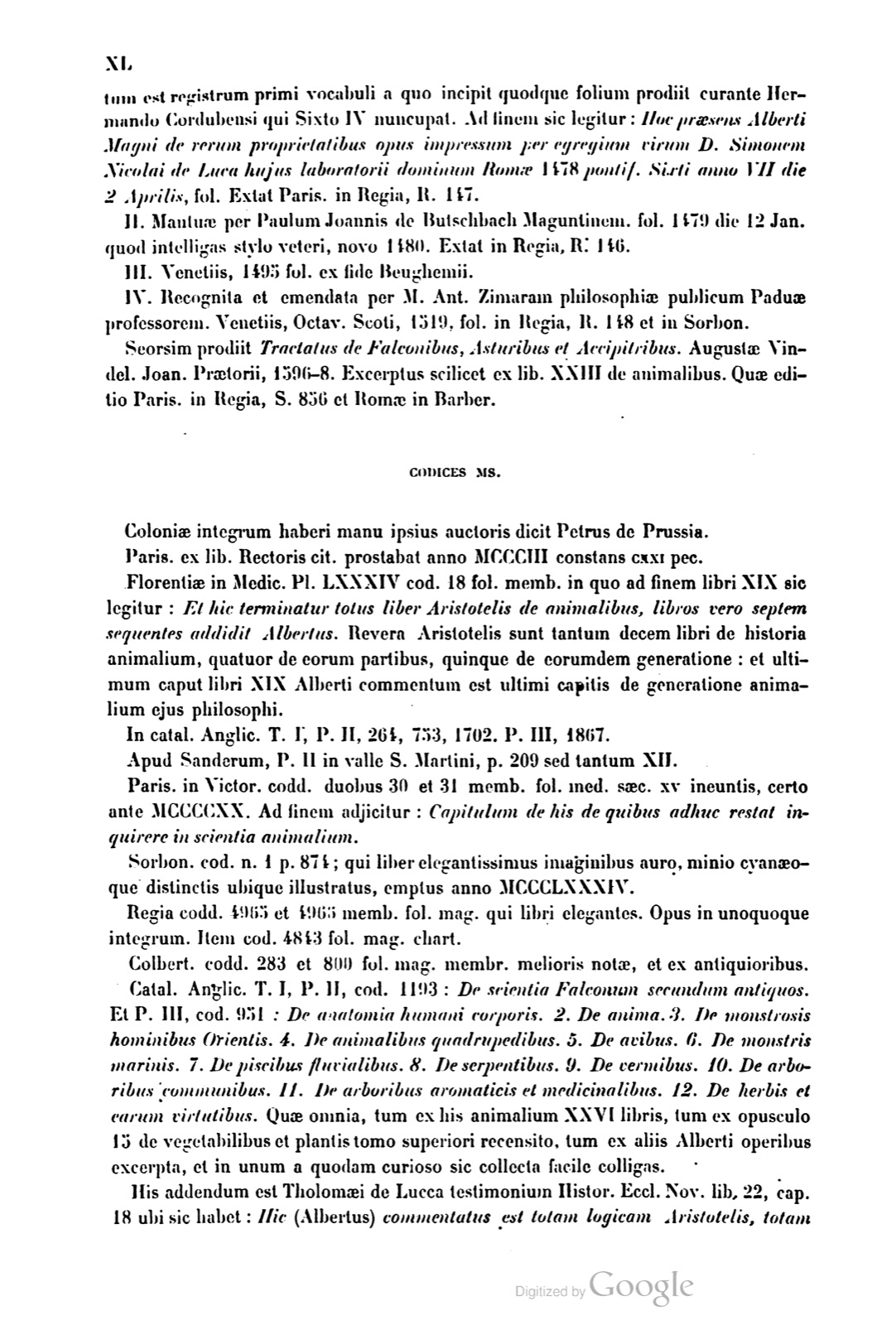
I. Eaque elegantissima charta et charact. absque majusculis tamen quae manu additae, item absque numeris, signaturis, reclamationibus, quorum loco in fine adjectum est registrum primi vocabuli a quo incipit quodque folium prodiit curante Hermando Cordubensi qui Sixto IV nuncupat. Ad finem sic legitur: Hoc praesens Alberti Magni de rerum proprietatibus opus impressum per egregium virum D. Simonem Nicolai de Luca hujus laboratorii dominum Romae 1478 pontif. Sixti anno VII die 2 Aprilis, fol. Extat Paris. in Regia, R. 147. II. Mantuae per Paulum Joannis de Butschbach Maguntinem. fol. 1479 die 12 Jan. quod intelligas stylo veteri, novo 1480. Extat in Regia, R. 146. III. Venetiis, 1495 fol. ex fide Beughemii. IV. Recognita et emendata per M. Ant. Zimaram philosophiae publicum Paduae professorem. Venetiis, Octav. Scoti, 1519, fol. in Regia, R. 148 et in Sorbon. Seorsim prodiit Tractatus de Falconibus, Asturibus et Accipitribus. Augustae Vindel. Joan. Praetorii, 1596-8. Excerptus scilicet ex lib. XXIII de animalibus. Quae editio Paris. in Regia, S. 856 et Romae in Barber.
CODICES MS.
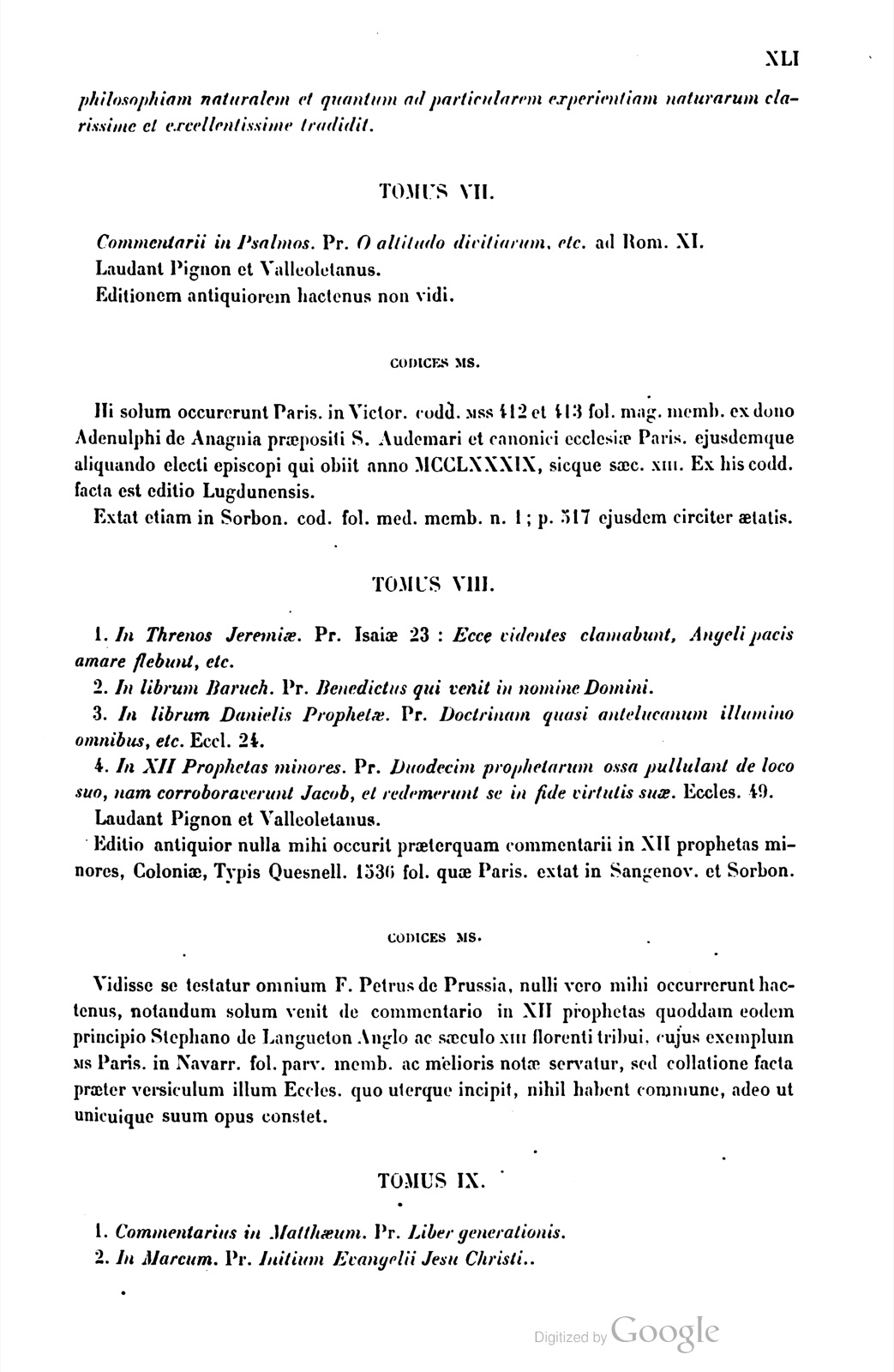
Coloniae integrum haberi manu ipsius auctoris dicit Petrus de Prussia. Paris. ex lib. Rectoris cit. prostabat anno MCCCIII constans CXXI pec. Florentiae in Medic. Pl. LXXXIV cod. 18 fol. memb. in quo ad finem libri XIX sic legitur: Et hic terminatur totus liber Aristotelis de animalibus, libros vero septem sequentes addidit Albertus. Revera Aristotelis sunt tantum decem libri de historia animalium, quatuor de eorum partibus, quinque de eorumdem generatione: et ultimum caput libri XIX Alberti commentum est ultimi capitis de generatione animalium ejus philosophi. In catal. Anglic. T. I, P. II, 264, 733, 1702. P. III, 1867. Apud Sanderum, P. II in valle S. Martini, p. 209 sed tantum XII. Paris. in Victor. codd. duobus 30 et 31 memb. fol. med. saec. XV ineuntis, certo ante MCCCCXX. Ad finem adjicitur: Capitulum de his de quibus adhuc restat inquirere in scientia animalium. Sorbon. cod. n. 1 p. 874; qui liber elegantissimus imaginibus auro, minio cyaneoque distinctis ubique illustratus, emptus anno MCCCLXXXIV. Regia codd. 4965 et 1965 memb. fol. mag. qui libri elegantes. Opus in unoquoque integrum. Item cod. 4843 fol. mag. chart. Colbert. codd. 283 et 800 fol. mag. membr. melioris notae, et ex antiquioribus. Catal. Anglic. T. I, P. II, cod. 1193: De scientia Falconum secundum antiquos. Et P. III, cod. 951: De anatomia humani corporis. 2. De anima. 3. De monstrosis hominibus Orientis. 4. De animalibus quadrupedibus. 5. De avibus. 6. De monstris marinis. 7. De piscibus fluvialibus. 8. De serpentibus. 9. De vermibus. 10. De arboribus communibus. 11. De arboribus aromaticis et medicinalibus. 12. De herbis et earum virtutibus. Quae omnia, tum ex his animalium XXVI libris, tum ex opusculo 15 de vegetabilibus et plantis tomo superiori recensito, tum ex aliis Alberti operibus excerpta, et in unum a quodam curioso sic collecta facile colligas. His addendum est Tholomaei de Lucca testimonium Histor. Eccl. Nov. lib. 22, cap. 18 ubi sic habet: Hic (Albertus) commentatus est totam logicam Aristotelis, totam philosophiam naturalem et quantum ad particularem experientiam naturarum clarissime et excellentissime tradidit.
ANCIENT EDITIONS.
I. And it came forth on most elegant paper and type, without capitals, however, which were added by hand; likewise without numbers, signatures, and catchwords, in place of which at the end was added a register of the first word from which each folio begins, under the care of Hermandus Cordubensis, who dedicates it to Sixtus IV. At the end it is read thus: This present work of Albert the Great On the Properties of Things was printed by the distinguished man Lord Simon Nicolai of Lucca, lord of this workshop, at Rome, 1478, in the seventh year of the pontificate of Sixtus, on the second day of April, folio. It exists at Paris in the Royal Library, R. 147. II. Mantua, by Paul, son of John of Butschbach, a Mainz man, folio, 1479, on 12 January, which you should understand according to the old style, by the new 1480. It exists in the Royal Library, R. 146. III. Venice, 1495, folio, on the authority of Beughem. IV. Reviewed and corrected by Master Anthony Zimara, public professor of philosophy at Padua. Venice, Octavianus Scotus, 1519, folio, in the Royal Library, R. 148, and in the Sorbonne. Separately there came forth the Treatise on Falcons, Hawks, and Goshawks. Augsburg of the Vindelici, John Praetorius, 1596 octavo. Namely excerpted from book 23 On Animals. This edition is at Paris in the Royal Library, S. 856, and at Rome in the Barberini.
MANUSCRIPT CODICES.
Peter of Prussia says that the complete work is held at Cologne in the hand of the author himself. Paris: from the cited book of the Rector it was offered for sale in the year 1303, consisting of 121 pieces. Florence in the Medicean, Pluteus LXXXIV, codex 18, folio parchment, in which at the end of book 19 it is read thus: And here the whole book of Aristotle On Animals is ended, but the seven following books Albert added. In truth, Aristotle's are only ten books On the History of Animals, four on their parts, and five on the generation of the same; and the last chapter of book 19 of Albert is a commentary on the last chapter On the Generation of Animals of that philosopher. In the English catalogue, volume I, part II, 264, 733, 1702; part III, 1867. In Sanderus, part II in the valley of St. Martin, page 209, but only twelve. Paris, in Victor, in two codices, 30 and 31, parchment, medium folio, of the beginning of the fifteenth century, certainly before 1420. At the end is added: A chapter on those things concerning which it still remains to inquire in the science of animals. Sorbonne, codex number 1, page 874; this most elegant book, illustrated everywhere with images distinguished by gold, red, and blue, was bought in the year 1384. Royal codices 4965 and 1965, parchment, large folio, which books are elegant. The work is complete in each. Likewise codex 4843, large folio paper. Colbert codices 283 and 800, large folio parchment, of better note and among the more ancient. English catalogue, volume I, part II, codex 1193: On the Science of Falcons according to the ancients. And part III, codex 951: On the Anatomy of the Human Body. 2. On the Soul. 3. On the Monstrous Humans of the East. 4. On Quadruped Animals. 5. On Birds. 6. On Sea Monsters. 7. On River Fish. 8. On Serpents. 9. On Worms. 10. On Common Trees. 11. On Aromatic and Medicinal Trees. 12. On Herbs and their Powers. All these things you may easily gather were excerpted partly from these twenty-six books On Animals, partly from little work 15 On Vegetables and Plants reviewed in the preceding volume, and partly from other works of Albert, and thus collected into one by a certain curious person. To these must be added the testimony of Ptolemy of Lucca, New Ecclesiastical History, book 22, chapter 18, where he has thus: This man (Albert) commented on the whole logic of Aristotle and the whole natural philosophy, and as regards the particular experience of natures he handed it down most clearly and most excellently.
If a page does not appear, its photograph has not been uploaded yet.