Volume 1
Annotations on the Life, Notes 11-16
A marker with ≈ is an approximate page boundary, placed by measure of the text; the page photographs remain the authority. In the paired views, clicking a page marker brings that page into view.
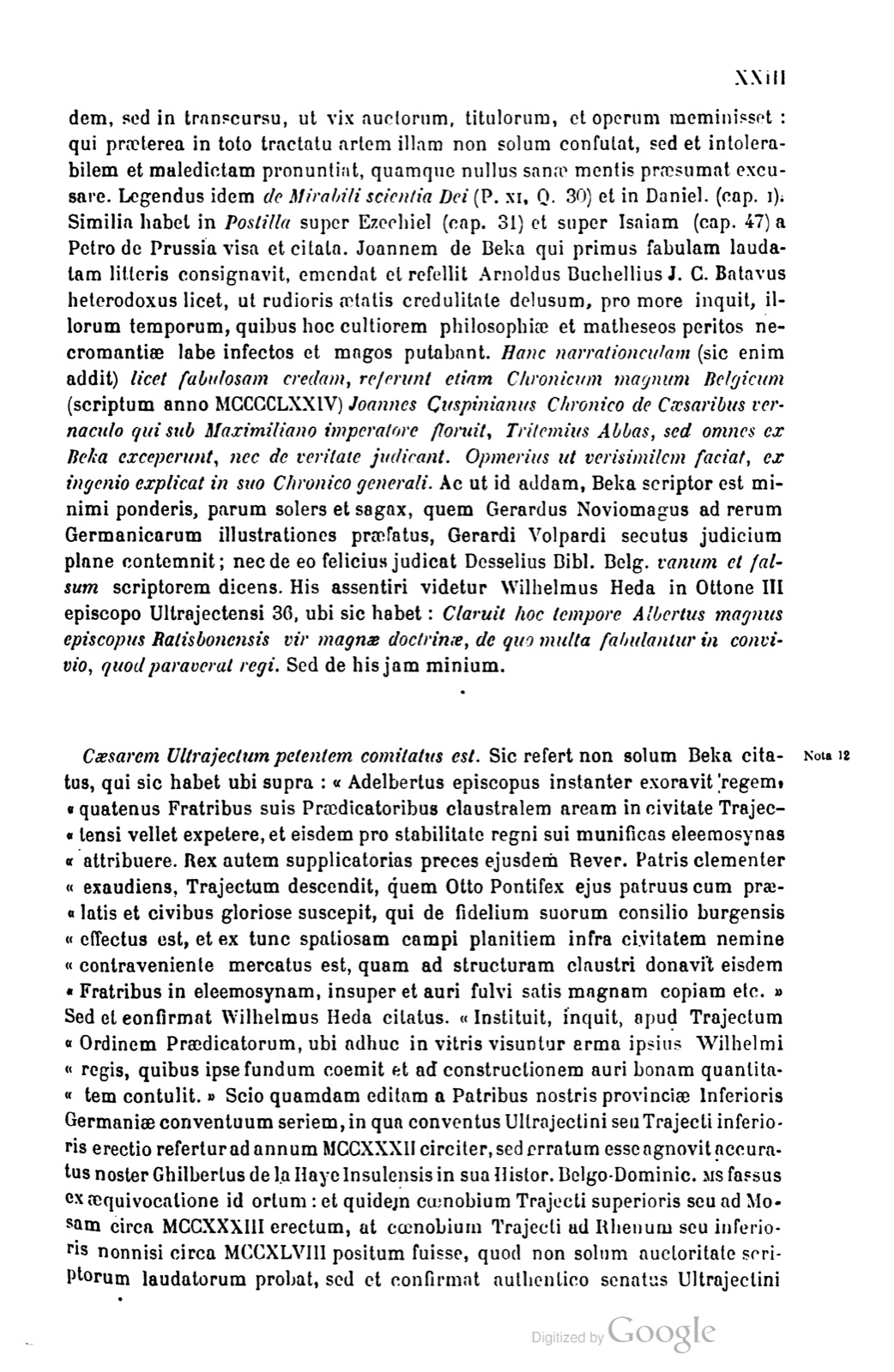
sed in transcursu, ut vix auctorum, titulorum, et operum meminisset: qui praeterea in toto tractatu artem illam non solum confutat, sed et intolerabilem et maledictam pronuntiat, quamque nullus sanae mentis praesumat excusare. Legendus idem de Mirabili scientia Dei (P. XI, Q. 30) et in Daniel. (cap. 1). Similia habet in Postilla super Ezechiel (cap. 31) et super Isaiam (cap. 47) a Petro de Prussia visa et citata. Joannem de Beka qui primus fabulam laudatam litteris consignavit, emendat et refellit Arnoldus Buchellius J. C. Batavus heterodoxus licet, ut rudioris aetatis credulitate delusum, pro more inquit, illorum temporum, quibus hoc cultiorem philosophiae et matheseos peritos necromantiae labe infectos et magos putabant. Hanc narrationculam (sic enim addit) licet fabulosam credam, referunt etiam Chronicum magnum Belgicum (scriptum anno MCCCCLXXIV) Joannes Cuspinianus Chronico de Caesaribus vernaculo qui sub Maximiliano imperatore floruit, Tritemius Abbas, sed omnes ex Beka exceperunt, nec de veritate judicant. Opmerius ut verisimilem faciat, ex ingenio explicat in suo Chronico generali. Ac ut id addam, Beka scriptor est minimi ponderis, parum solers et sagax, quem Gerardus Noviomagus ad rerum Germanicarum illustrationes praefatus, Gerardi Volpardi secutus judicium plane contemnit; nec de eo felicius judicat Desselius Bibl. Belg. vanum et falsum scriptorem dicens. His assentiri videtur Wilhelmus Heda in Ottone III episcopo Ultrajectensi 36, ubi sic habet: Claruit hoc tempore Albertus magnus episcopus Ratisbonensis vir magnae doctrinae, de quo multa fabulantur in convivio, quod paraverat regi. Sed de his jam minimum.
Nota 12. Caesarem Ultrajectum petentem comitatus est. Sic refert non solum Beka citatus, qui sic habet ubi supra: « Adelbertus episcopus instanter exoravit regem, quatenus Fratribus suis Praedicatoribus claustralem aream in civitate Trajectensi vellet expetere, et eisdem pro stabilitate regni sui munificas eleemosynas attribuere. Rex autem supplicatorias preces ejusdem Rever. Patris clementer exaudiens, Trajectum descendit, quem Otto Pontifex ejus patruus cum praelatis et civibus gloriose suscepit, qui de fidelium suorum consilio burgensis effectus est, et ex tunc spatiosam campi planitiem infra civitatem nemine contraveniente mercatus est, quam ad structuram claustri donavit eisdem Fratribus in eleemosynam, insuper et auri fulvi satis magnam copiam etc. » Sed et confirmat Wilhelmus Heda citatus. « Instituit, inquit, apud Trajectum Ordinem Praedicatorum, ubi adhuc in vitris visuntur arma ipsius Wilhelmi regis, quibus ipse fundum coemit, et ad constructionem auri bonam quantitatem contulit. » Scio quamdam editam a Patribus nostris provinciae Inferioris Germaniae conventuum seriem, in qua conventus Ultrajectini seu Trajecti inferioris erectio refertur ad annum MCCXXXII circiter, sed erratum esse agnovit accuratus noster Ghilbertus de la Haye Insulensis in sua Histor. Belgo-Dominic. MS fassus ex aequivocatione id ortum: et quidem coenobium Trajecti superioris seu ad Mosam circa MCCXXXIII erectum, at coenobium Trajecti ad Rhenum seu inferioris nonnisi circa MCCXLVIII positum fuisse, quod non solum auctoritate scriptorum laudatorum probat, sed et confirmat authentico senatus Ultrajectini instrumento ad concilium Mechliniense dato anno MCCCCLXXVII in quadam causa Patrum Ultrajectinorum nostrorum, quo disertis verbis sui conventus originem solummodo ad annum MCCXLVIII referunt, stylo nempe veteri, et ad auctores Albertum magnum et Wilhelmum Hollandum imperatorem, cujus arma gentilitia non solum in ecclesia, sed et passim per officinas domus olim cernebantur.
but in passing, so that he scarcely remembered the authors, titles, and works; he who, moreover, in the whole treatise not only refutes that art, but also pronounces it intolerable and accursed, and such that no one of sound mind should presume to excuse it. The same man should be read in On the Wonderful Knowledge of God (Part XI, Question 30) and on Daniel (chapter 1). He has similar things in the Postilla on Ezekiel (chapter 31) and on Isaiah (chapter 47), seen and cited by Peter of Prussia. John of Beka, who first committed the praised fable to writing, Arnold Buchellius, a Batavian jurisconsult, though heterodox, corrects and refutes as having been deceived by the credulity of a ruder age, according, he says, to the custom of those times, in which they thought men the more cultivated for this reason, skilled in philosophy and mathematics, to be infected with the stain of necromancy and to be magicians. This little narrative, for so he adds, although I believe it fabulous, the Great Belgian Chronicle also relates (written in the year 1474), as does John Cuspinian in the vernacular Chronicle on the Caesars, who flourished under the emperor Maximilian, and Trithemius the abbot; but all took it from Beka, and do not judge concerning the truth. Opmerius, so that he may make it plausible, explains it from his own invention in his General Chronicle. And, to add this, Beka is a writer of very little weight, not very skillful or discerning; Gerardus Noviomagus, prefacing Illustrations of German Affairs and following the judgment of Gerard Volpard, plainly despises him; nor does Desselius in the Belgian Library judge more happily about him, calling him a vain and false writer. William Heda seems to agree with these men in Otto III, bishop of Utrecht, 36, where he has thus: Albert the Great, bishop of Ratisbon, a man of great learning, flourished at this time; about him many things are fabled concerning the banquet which he had prepared for the king. But about these things now too much has been said.
Marginal label: Note 12. He accompanied Caesar as he sought Utrecht. Thus not only does the cited Beka report, who has thus in the place above: « Bishop Adelbert earnestly begged the king that he would be willing to seek out for his Friars Preachers a cloistered area in the city of Utrecht, and to bestow upon them munificent alms for the stability of his kingdom. But the king, kindly hearing the supplicatory prayers of the same Reverend Father, descended to Utrecht; Otto the Pontiff, his paternal uncle, received him gloriously with the prelates and citizens; and he, by the counsel of his faithful men, was made a burgess, and from that time bought a spacious level field within the city with no one opposing, which he gave to the same Friars as alms for the building of a cloister, and in addition a sufficiently great abundance of yellow gold, etc. » But the cited William Heda also confirms it. « He established, he says, the Order of Preachers at Utrecht, where even now in the windows are seen the arms of that King William, with which he himself purchased the ground and contributed a good quantity of gold for the construction. » I know of a certain series of convents published by our Fathers of the Province of Lower Germany, in which the erection of the convent of Utrecht, or Lower Utrecht, is referred to about the year 1232; but our accurate Ghilbert de la Haye of Lille recognized in his manuscript Belgo-Dominican History that this was an error, confessing that it arose from equivocation: and indeed that the monastery of Upper Trajectum, or on the Meuse, was erected about 1233, but that the monastery of Trajectum on the Rhine, or the lower one, was founded only about 1248. He proves this not only by the authority of the praised writers, but also confirms it by an authentic instrument of the senate of Utrecht given to the council of Mechelen in the year 1477 in a certain cause of our Utrecht Fathers, by which in plain words they refer the origin of their convent only to the year 1248, namely according to the old style, and to the founders Albert the Great and William of Holland, the emperor, whose family arms formerly were seen not only in the church, but also everywhere throughout the workshops of the house.
Nota 13. Anno MCCLIV priorem provincialem electum ferunt. Sic Petrus de Prussia, qui ex actis comitiorum provinciae eo anno Wormatii et sequenti Augustae Vindelicorum habitorum quaedam refert, imo et litteras encyclicas ejusdem Alberti magni provincialis ad omnes priores et conventus Teutoniae.
Nota 14. Anno sequenti Romam a Summo Pontifice vocatus. Hic erat Alexander IV creatus xxIII Decemb. MCCLIV. Sic refert Cantimpratanus (lib. 2, cap. 10, § 26): « Accidit ergo ut facta dissensione inter universitatem cleri Parisiis et Fratres ordinis Praedicatorum atque Minorum citatisque partibus coram papa, ipse apostolicus magistrum mandaret Albertum, antequam ipse iter vellet arripere. » Dissidium hoc Parisiense jam exortum fuerat ab anno MCCLIII, sed cum de eo actum non fuerit Romae nisi sub Alexandro IV, ideo hoc iter Alberti in annum MCCLV visum est rejiciendum post habita Augustae Teutoniae comitia provincialia forte circa septembrem de more.
Marginal label: Note 13. They report that in the year 1254 he was elected provincial prior. Thus Peter of Prussia, who reports certain things from the acts of the provincial assemblies held at Worms in that year and in the following year at Augsburg of the Vindelici, and indeed also the encyclical letters of the same Albert the Great, provincial, to all the priors and convents of Teutonia.
Marginal label: Note 14. In the following year he was called to Rome by the Supreme Pontiff. This was Alexander IV, created on 23 December 1254. Thus Cantimpratanus reports (book 2, chapter 10, section 26): « It happened therefore that, when a dissension had arisen between the university of the clergy at Paris and the Brothers of the Order of Preachers and of the Minors, and the parties had been cited before the pope, the apostolic man sent for master Albert before he himself wished to undertake the journey. » This Parisian dispute had already arisen from the year 1253, but since it was not treated at Rome except under Alexander IV, therefore this journey of Albert has seemed to have to be assigned to the year 1255, after the provincial assemblies of Germany had been held at Augsburg, perhaps around September according to custom.
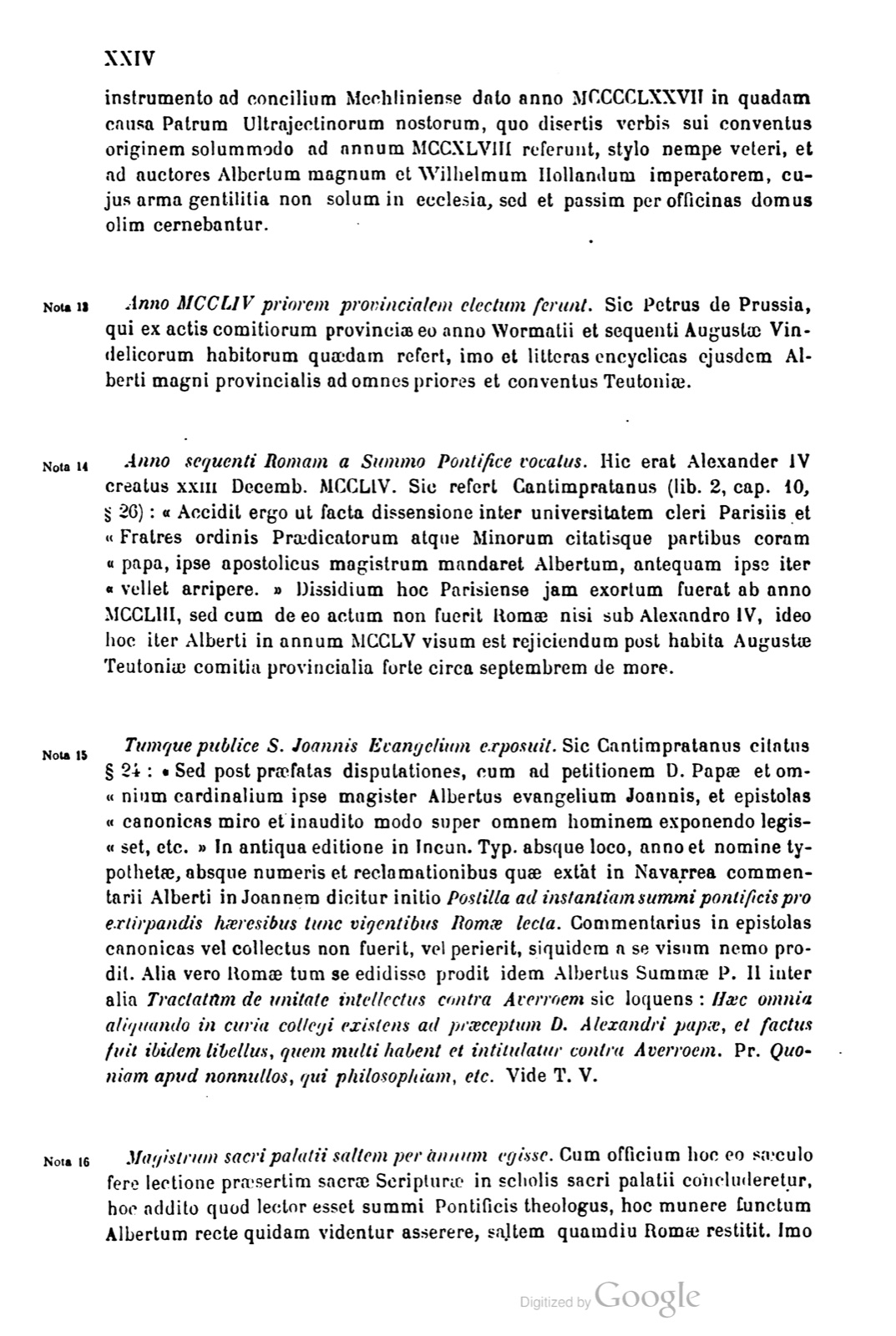
Nota 15. Tumque publice S. Joannis Evangelium exposuit. Sic Cantimpratanus citatus § 24: « Sed post praefatas disputationes, cum ad petitionem D. Papae et omnium cardinalium ipse magister Albertus evangelium Joannis, et epistolas canonicas miro et inaudito modo super omnem hominem exponendo legisset, etc. » In antiqua editione in Incun. Typ. absque loco, anno et nomine typothetae, absque numeris et reclamationibus quae extat in Navarrea commentarii Alberti in Joannem dicitur initio Postilla ad instantiam summi pontificis pro extirpandis haeresibus tunc vigentibus Romae lecta. Commentarius in epistolas canonicas vel collectus non fuerit, vel perierit, siquidem a se visum nemo prodit. Alia vero Romae tum se edidisse prodit idem Albertus Summae P. II inter alia Tractatum de unitate intellectus contra Averroem sic loquens: Haec omnia aliquando in curia collegi existens ad praeceptum D. Alexandri papae, et factus fuit ibidem libellus, quem multi habent et intitulatur contra Averroem. Pr. Quoniam apud nonnullos, qui philosophiam, etc. Vide T. V.
Nota 16. Magistrum sacri palatii saltem per annum egisse. Cum officium hoc eo saeculo fere lectione praesertim sacrae Scripturae in scholis sacri palatii concluderetur, hoc addito quod lector esset summi Pontificis theologus, hoc munere functum Albertum recte quidam videntur asserere, saltem quamdiu Romae restitit. Imo putat Petrus de Prussia (cap. 32) primum fuisse lectorem sacri palatii, et ejus occasione evenisse, quod hoc munus in Ordine habeatur. Sed ista laus S. P. Dominico non auferenda.
Marginal label: Note 15. And then he publicly expounded the Gospel of St. John. Thus the cited Cantimpratanus, section 24: « But after the aforesaid disputations, when at the request of the Lord Pope and of all the cardinals master Albert himself had read, by expounding in a marvelous and unheard-of way beyond every man, the Gospel of John and the canonical epistles, etc. » In an old incunable edition, without place, year, and name of printer, without numbers and catchwords, which exists in Navarre, at the beginning of Albert's commentary on John it is called A Postilla read at Rome at the instance of the supreme pontiff for rooting out the heresies then flourishing. The commentary on the canonical epistles either was not collected, or perished, since no one reports that it was seen by him. But that he then published other things at Rome the same Albert reveals in Summa Part II, among other things the Treatise on the Unity of the Intellect against Averroes, speaking thus: I once collected all these things in the curia, being there at the command of Lord Pope Alexander, and a little book was made there, which many have and which is entitled Against Averroes. Beginning: Since among some who philosophy, etc. See volume V.
Marginal label: Note 16. That he acted as master of the sacred palace for at least a year. Since this office in that century was almost confined to lecturing, especially on sacred Scripture, in the schools of the sacred palace, with this added, that the lector was the theologian of the Supreme Pontiff, certain men seem rightly to assert that Albert performed this office, at least as long as he stayed at Rome. Indeed Peter of Prussia (chapter 32) thinks that he was the first lector of the sacred palace, and that, on his occasion, this office came to be held in the Order. But that praise must not be taken away from our holy father Dominic.
If a page does not appear, its photograph has not been uploaded yet.