Volume 1
Annotations on the Life, Notes 1-11
A marker with ≈ is an approximate page boundary, placed by measure of the text; the page photographs remain the authority. In the paired views, clicking a page marker brings that page into view.
Nota 1. Natus est Albertus anno MCXCIII. Id constat ex anno ætatis quo mortuus est, Christi MCCLXXX, quo tum annorum LXXXVII fuisse omnes asserunt, Tritemius, Malvenda ad annum 1222, cap. 15, p. 413; Joannes Henricus Heister in suffraganeorum Coloniensium syntagmate edito Coloniæ 1641 in-8, ubi Alberti nostri ætatem et acta varios in annos digesta melioribus conjecturis ad legitimam satis chronologiam revocat; Petrus noster de Prussia, qui circa annum 1487 vitam Alberti scripsit, anno etsi 1621 tantum editam in-8, legendus cap. 45, p. 330; et ante hos omnes Ludovicus a Valleoleti in sua auctorum nostrorum Tabula, quam anno 1413 Parisiis scribebat. Hinc tum ipse Valleoletanus, tum Petrus de Prussia et alii emendandi, cum visionem B. Virginis Alberto sextum decimum tantum annum agenti factam referunt, qua sic eum monebat: Alberte, mundum fuge, Prædicatorum Ordinem ingredere etc. Nam 23 ætatis jam attigerat, priusquam Ordo stabiliretur et confirmaretur: ad posteriores igitur annos prolatanda hæc si fuit visio.
Nota 2. Aptissimum disciplinis a natura sortitus ingenium. Id mox evincetur: hinc fabula est a nescio quo inventa, quam Joannes Antonius Flaminius, et ex eo Leander Albertus aliique referunt Albertum non acri admodum ingenio in adolescentia sua fuisse: quapropter primis illis mensibus post amplexum Ordinem, cum hebes ingenio esset, et sodalibus inferior haberetur, de deserendo cœnobio abjiciendaque veste cogitasse, sed cœlesti somnio a proposito deterritum, spondente ei Deipara egregium deinceps futurum philosophum: cujus visionis vel somnii nulla apud antiquos memoria.
Nota 3. Tum in Gallia Parisiis. Sic Heisterus citatus verisimili satis conjectura, cum ad eam urbem regiam undique confluerent non solum Galli, sed et extranei præsertim Teutones, qui litteras avidius sectabantur, et in illis excellere cupiebant. Sic Henrici duo Colonienses, sic Albertus comitis Falkembergensis filius, sic ipse Jordanus et alii qui Ordini postea nomen dederunt.
Nota 4. Tum in Italia Patavii. De Patavio sic ipse Albertus de Natura locorum, Tract. 3, cap. 2. « Patavium quæ nunc Padua vocatur, in qua multo tempore viguit studium litterarum. » In ea urbe fuisse et experimenta quædam fecisse probat quod refert Meteor. Lib. 3, Tract. 2, c. 12. « Ego autem vidi in Padua civitate Lombardiæ, quod puteus ab antiquo tempore clausus inventus fuit, qui cum aperiretur, et quidam intraret ad purgandum puteum, mortuus fuit ex vapore cavernæ illius, et similiter mortuus est secundus: et tertius qui voluit scire quare duo moras agerent, inclinatus ad puteum adeo debilitatus est, quod spatio duorum dierum vix rediit ad seipsum: cum autem expirasset vapor putrefactus in puteo, factus est bonus et potabilis. » Quæ juvenem non solum Patavii commorantem, sed et experimenta annotantem, ac proinde jam alicujus ætatis supra adolescentiam ostendunt. Clarius adhuc est quod habet de Mineralibus, lib. 2, t. 3, c. 1. « Volo autem narrare primo quæ vidi et expertus sum ego ipse, et postea ostendere causam et modum per quem a natura efficitur imago, etc. Dico igitur quod me essente Venetiis, cum essem juvenis, incidebantur marmora per serras ad parietes templi ornandos: contigit autem in uno marmore jam inciso tabulis incisis sibi invicem applicatis apparere depictum caput pulcherrimum regis cum corona et longa barba: neque in aliquo peccare videbatur pictura, nisi in hoc solo, quod frontem videbatur in medio habere nimis altam ascendentem versus verticem capitis. Scivimus autem omnes qui aderamus, hoc a natura fuisse pictum in lapide. Et cum a me quæreretur causa inordinationis frontis, dixi lapidem illum ex vapore fuisse coagulatum, et in medio per calorem fortiorem vaporem inordinate ascendisse ultra modum. Fuit autem pictura ejusdem coloris cum lapide. » Quod antequam Ordini nomen daret evenisse verisimilius, cum ut mox dicetur tum jam esset 29 annorum, ex quo evincitur juvenem et adhuc in sæculo detentum in rebus physicis fuisse eruditum, iisque scrutandis maxime deditum: quibus evertitur illa fabula de ingenio hebeti Alberti cum Ordini nomen dedit, et de consilio vestis propterea abjiciendæ ab eo suscepto. Nota etiam hic insignis basilicæ Venetæ anno MCLXX a duce Zeno inchoatæ parietibus marmore ornandis juvene Alberto fuisse laboratum.
Marginal label: Note 1. Albert was born in the year 1193. This is established from the year of his age in which he died, the year of Christ 1280, in which all assert that he was then eighty-seven years old: Trithemius; Malvenda at the year 1222, chapter 15, page 413; John Henry Heister in the syntagma of the suffragans of Cologne, published at Cologne in 1641 in octavo, where he recalls the age and deeds of our Albert, arranged over various years, to a sufficiently legitimate chronology by better conjectures; our Peter of Prussia, who wrote the life of Albert around the year 1487, although it was published only in the year 1621 in octavo, to be read chapter 45, page 330; and before all these Louis of Valladolid in his Table of our authors, which he was writing at Paris in the year 1413. Hence both the Vallisoletan himself and Peter of Prussia and others must be corrected, when they report that a vision of the Blessed Virgin was made to Albert when he was only in his sixteenth year, by which she thus warned him: Albert, flee the world, enter the Order of Preachers, etc. For he had already reached twenty-three years of age before the Order was established and confirmed; therefore this vision, if there was one, must be brought forward to later years.
Marginal label: Note 2. He obtained from nature an intellect most apt for the disciplines. This will soon be proved; hence it is a fable invented by I know not whom, which John Antony Flaminius, and from him Leander Albertus and others, report: that Albert in his adolescence was not of very sharp intellect; wherefore, in those first months after embracing the Order, since he was dull in intellect and was considered inferior to his companions, he thought about deserting the monastery and throwing away the habit, but was deterred from the plan by a heavenly dream, the Mother of God promising him that thereafter he would be an outstanding philosopher; of this vision or dream there is no memory among the ancients.
Marginal label: Note 3. Then in Gaul at Paris. So the cited Heister by a sufficiently probable conjecture, since to that royal city there flowed together from every side not only Gauls but also foreigners, especially Teutons, who pursued letters rather eagerly and desired to excel in them. So the two Henries of Cologne, so Albert the son of the count of Falkemberg, so Jordan himself and others who afterward gave their name to the Order.
Marginal label: Note 4. Then in Italy at Padua. Concerning Padua Albert himself speaks thus in On the Nature of Places, tractate 3, chapter 2: "Padua, which is now called Padova, in which the study of letters flourished for a long time." That he was in that city and made certain experiments is proved by what he relates in Meteorology, book 3, tractate 2, chapter 12: "But I saw in Padua, a city of Lombardy, that a well closed from ancient time was found; when it was opened, and someone entered to clean the well, he died from the vapor of that cavern, and likewise a second died; and a third, who wished to know why the two were delaying, bent toward the well and was so weakened that over the space of two days he scarcely returned to himself; but when the vapor putrefied in the well had breathed out, it became good and drinkable." These things show him to have been a young man not only staying at Padua, but also noting experiments, and consequently already of some age beyond adolescence. Still clearer is what he has in On Minerals, book 2, treatise 3, chapter 1: "I wish first to narrate the things which I myself saw and experienced, and afterward to show the cause and the mode through which an image is produced by nature, etc. I say, therefore, that when I was at Venice, when I was young, marbles were being cut by saws for adorning the walls of a temple; and it happened in one marble already cut, with the cut slabs applied to one another, that the most beautiful head of a king appeared depicted, with a crown and a long beard; nor did the picture seem to be defective in anything except in this alone, that the forehead seemed in the middle to have too great a height rising toward the crown of the head. But all of us who were present knew that this had been painted in the stone by nature. And when the cause of the disordering of the forehead was asked from me, I said that that stone had been coagulated from vapor, and that in the middle, through stronger heat, the vapor had ascended inordinately beyond measure. The picture, moreover, was of the same color as the stone." It is more probable that this happened before he gave his name to the Order, since, as will soon be said, he was then already twenty-nine years old; from this it is proved that as a young man and still detained in the world he was learned in physical matters and was especially given to examining them; by these things that fable is overthrown concerning Albert's dull intellect when he gave his name to the Order, and concerning the plan therefore undertaken by him of throwing away the habit. Note also here that work was being done, while Albert was young, on adorning with marble the walls of the distinguished Venetian basilica begun by Duke Zeno in the year 1170.
Nota 5. Cum eo advenit Jordanus magister Ordinis. Certum e manibus Jordani vestem accepisse. Jordanus autem anno tantum MCCXX die cinerum Ordini cooptatus affuit quidem primo capitulo S. Dominici Bononiæ, sed tum non prædicavit. Anno sequenti MCCXXI capitulo secundo ibidem a S. Dominico coacto non aderat, in eo tamen absens et agens Parisiis provinciæ Lombardiæ institutus est prior provincialis, et cum muneris adimplendi causa Italiam ingressus est, jam mortuus erat Dominicus VIII idus aug. Fateor Jordanum inter Augustum MCCXXI et Pentecosten sequentem Albertum ad Ordinem adducere potuisse: verum cum vulgo id Jordano jam Ordinis magistro ascribatur, et ad eam præfecturam tantum assumptus fuerit in comitiis Ordinis Parisiis ad Pentecostem MCCXXII celebratis, vel anno illo solum, modo ante finem anni Italiam repetierit, nec diutius ordinandis Galliæ rebus in ea hæserit, vel anno MCCXXIII, quo Bononiam ad capitulum generale accedere tenebatur id præstiterit. Ex quibus constat Albertum anno MCXCIII natum nonnisi ætatis XXIX, vel ad summum XXVIII completo, Ordini nomen dedisse, qua certe ætate homines sunt quidquid erunt. In vitis Fratrum locus est, quem vulgo de Alberto interpretantur, qui sic habet (P. IV, cap. 10): « Frater quidam famæ eximiæ et excellentis status et scientiæ magnus in philosophia, cum adhuc juvenculus Paduæ studeret, ex admonitionibus Fratrum et maxime ex prædicationibus magistri Jordani habebat voluntatem intrandi Ordinem Prædicatorum, sed non plenam: avunculus enim ejus contradicebat illi, unde et jurare ipsum compulit ne infra tantum tempus iret ad domum FF. Prædicatorum. Post quod transactum veniebat frequenter ad Fratres eosdem, firmabatque propositum, sed timor ne exiret faciebat eum vacillare multoties. Quadam autem nocte vidit in somnis quod intrasset Ordinem, postmodumque exivisset: evigilans ergo mirabiliter gavisus est, eo quod non intraverat, in animo suo dicens: Nunc video quia id quod timebam inde eveniret si unquam intrarem. Contigit autem eodem die eum interesse sermoni magistri Jordani, qui inter cætera loquens de tentationibus diaboli, dixit quam subtiliter decipiat aliquos. Sunt enim, ait, aliqui qui relinquere mundum proponunt et ordinem intrare, sed diabolus eis impressiones facit in somnis quod intrant et postea exeunt equitantes in rubeis vestibus, vel se solos relictos inveniant, ut sic scilicet eis incutiat timorem intrandi, quasi perseverare non possent. Tunc juvenis miratus vehementer post sermonem magistrum accessit et ait: Magister, quis revelavit cor meum vobis, exposuitque ei omnes suas cogitationes et somnium. Magister autem firma de Deo percepta fiducia, multis modis confortavit eum contra hujusmodi tentationes. Ille autem ad verba ejus ex toto conversus, et omnem moram rescindens Ordinem intravit. Hæc autem omnia ipse Frater enarravit. » Ex ea narratione infert Petrus de Prussia Albertum juvenculum Ordini cooptatum, quod et confirmat ex ejusdem oratione in evangelium Septuagesimæ, in qua sic loquitur: Dne Jesu Christe, summe paterfamilias, qui me primo mane in vineam tuam vocasti, dum me a juventute mea ad laborandum in religione pro denario vitæ æternæ conduxisti, etc. Verum ut sit, ipse Petrus de Prussia qui ponit Albertum mortuum ætatis LXXXVII, et a Jordano ad Ordinem ascitum, cogitur ut et nos agnoscere ætatis XXIX veste indutum. Nec vero mirum præsertim in gymnasiis in quibus sunt venerandi senes, sodales qui nondum trigesimum compleverunt, juvenes imo et juvenculos appellari.
Marginal label: Note 5. Jordan, master of the Order, came to him. It is certain that he received the habit from the hands of Jordan. But Jordan was enrolled in the Order only in the year 1220 on Ash Wednesday; he was indeed present at the first chapter of St. Dominic at Bologna, but did not then preach. In the following year, 1221, he was not present at the second chapter convened there by St. Dominic; nevertheless in that chapter, though absent and acting at Paris, he was appointed provincial prior of the province of Lombardy, and when he entered Italy for the sake of fulfilling his office, Dominic had already died on the eighth day before the Ides of August. I admit that Jordan could have brought Albert to the Order between August 1221 and the following Pentecost; but since this is commonly ascribed to Jordan already as master of the Order, and he was assumed to that prefecture only in the assemblies of the Order celebrated at Paris at Pentecost 1222, either he accomplished it in that year alone, provided that he returned to Italy before the end of the year and did not remain in Gaul longer for arranging its affairs, or in the year 1223, in which he was bound to come to Bologna for the general chapter. From these things it is established that Albert, born in the year 1193, gave his name to the Order only when he had completed his twenty-ninth year, or at most his twenty-eighth; at which age, surely, human beings are whatever they are going to be. In the Lives of the Brethren there is a place which is commonly interpreted of Albert, which reads thus (Part IV, chapter 10): "A certain brother of exceptional fame and of excellent state, and great in the science of philosophy, while still a young man studying at Padua, from the admonitions of the Brethren and especially from the preachings of Master Jordan, had the will of entering the Order of Preachers, but not a full one; for his uncle contradicted him, whence he also compelled him to swear that for such a time he would not go to the house of the Friars Preachers. After that time had passed, he often came to the same Friars, and confirmed his purpose; but fear lest he should leave made him waver many times. But one night he saw in dreams that he had entered the Order and afterward had left it; waking, therefore, he rejoiced wonderfully because he had not entered, saying in his mind: Now I see that the thing which I feared would happen from it if I ever entered. But it happened on the same day that he attended a sermon of Master Jordan, who, speaking among other things about the temptations of the devil, said how subtly he deceives some. For there are, he says, some who propose to leave the world and enter an order, but the devil makes impressions on them in dreams that they enter and afterward leave, riding in red garments, or that they find themselves left alone, so that in this way, namely, he may strike into them fear of entering, as though they could not persevere. Then the young man, vehemently astonished after the sermon, approached the master and said: Master, who revealed my heart to you? And he set forth to him all his thoughts and the dream. But the master, with firm confidence received from God, comforted him in many ways against temptations of this kind. He, however, wholly converted by his words and cutting off every delay, entered the Order. And all these things that brother himself narrated." From that narration Peter of Prussia infers that Albert was enrolled in the Order as a young man; and he also confirms this from his oration on the Gospel of Septuagesima, in which he speaks thus: Lord Jesus Christ, highest householder, who called me into your vineyard in the first morning, when from my youth you hired me to labor in religion for the denarius of eternal life, etc. But however that may be, Peter of Prussia himself, who sets Albert as dead at the age of eighty-seven and as admitted to the Order by Jordan, is compelled, as we also are, to acknowledge that he was clothed with the habit at the age of twenty-nine. Nor indeed is it strange, especially in schools in which there are venerable old men, that companions who have not yet completed the thirtieth year are called young men, indeed very young men.
Nota 6. Patavii vel Bononiæ quibusdam annis theologiæ operam dedit. Conjectura nostra est ex more Ordinis sumpta. Cum enim jam esset in philosophia excellens Albertus, ut theologiæ incumberet ipsi supererat. Quod si quis velit Coloniæ potius eam audiisse, facilis non contendam.
Nota 7. Thomam Cantimpratanum inter discipulos. Ipse Thomas de Apibus, lib. 2, cap. 57, § 550, se multo tempore Alberti auditorem fuisse gloriatur. Cum autem Thomas Ordinem intraverit circa MCCXXXII, annis sequentibus id accidisse verius, certe priusquam juvenis Thomas de Aquino Coloniam deduceretur.
Nota 8. Inter hos etiam annos Parisios. Præter rationem allatam id mihi persuadet, quod idem Cantimpratanus refert eodem cap. § 34, his verbis: « Simili prope modo magister Albertus Theologus Frater ordinis Prædicatorum narravit mihi, quod Parisiis illi demum in specie cujusdam fratris apparuit, ut eum a studio revocaret, sed mox crucis virtute discessit. » Cum enim hæc difficillime intelligas de annis quibus Magisterium capessebat, jam enim tum erat emeritus, annos 52 natus, nec tam studebat quam studiorum uberrimos fructus depromebat, facilius referes ad priores annos MCCXXX puta vel MCCXXXII, quibus totus studiis incumbebat. Mirabitur forsan quis quod non meminerim vicariatus Ordinis, quem dicunt gessisse MCCXXXVI in Terram sanctam transeunte Jordano, et ab hujus morte ad comitia Ordinis anno MCCXXXVIII Bononiæ habita, in quibus etiam volunt vocales inter ipsum et Hugonem de Sancto Charo divisos fuisse. An Albertus a Jordano vicarius institutus fuerit ut affirmare sic negare non ausim, cum in monumentis antiquis nihil de eo repererim. A morte Jordani vicarium egisse certus nego, cum hoc jus esset provincialis Lombardiæ juxta constitutiones: divisionem denique illam vocalium Albertum inter et Hugonem veluti meram fabulam expunximus supra ubi de S. Raymondo. Si Albertus capitulo huic Bononiensi affuit, quod mihi non certum, ut diffinitor vel lector pro Teutonia affuit, non alio titulo.
Marginal label: Note 6. At Padua or Bologna he devoted himself for some years to theology. Our conjecture is taken from the custom of the Order. For since Albert was already excellent in philosophy, it remained for him to apply himself to theology. But if someone wishes that he rather heard it at Cologne, I will not readily contend.
Marginal label: Note 7. Thomas of Cantimpré among his disciples. Thomas himself, in On Bees, book 2, chapter 57, section 550, glories that he was a hearer of Albert for a long time. But since Thomas entered the Order around 1232, it is truer that this happened in the following years, certainly before the young Thomas of Aquino was led to Cologne.
Marginal label: Note 8. Among these years also to Paris. Besides the reason brought forward, what the same Cantimpratanus reports in the same chapter, section 34, persuades me of this, in these words: "In almost a similar way Master Albert the Theologian, a Brother of the Order of Preachers, narrated to me that at Paris he at last appeared to him in the form of a certain brother, in order to call him back from study, but soon departed by the virtue of the cross." For since you would understand these things with very great difficulty of the years in which he was taking up the mastership, for by then he was already emeritus, fifty-two years old, and was not so much studying as drawing forth the richest fruits of studies, you will more easily refer them to the earlier years, say 1230 or 1232, in which he was wholly applying himself to studies. Perhaps someone will wonder that I have not remembered the vicariate of the Order, which they say he exercised in 1236, when Jordan was crossing over into the Holy Land, and from Jordan's death to the assemblies of the Order held at Bologna in the year 1238, in which they also wish that the voters were divided between him and Hugh of Saint-Cher. Whether Albert was appointed vicar by Jordan, I dare neither affirm nor deny, since I have found nothing about it in ancient monuments. That he acted as vicar after the death of Jordan I certainly deny, since this right belonged to the provincial of Lombardy according to the constitutions; finally, that division of the voters between Albert and Hugh we have struck out above, where we dealt with St. Raymond, as a mere fable. If Albert was present at this Bolognese chapter, which is not certain to me, he was present as a definitor or lector for Teutonia, not by any other title.
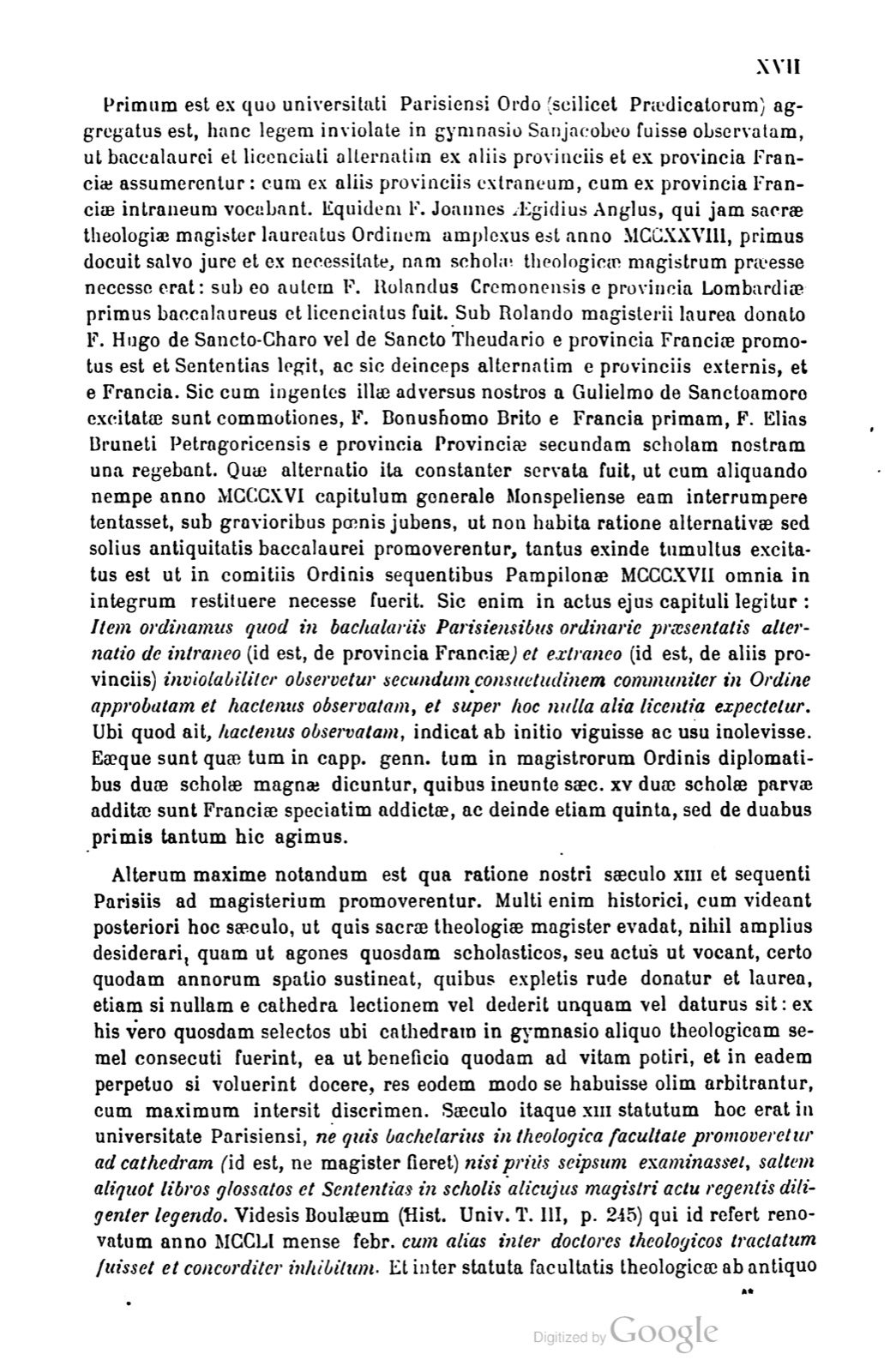
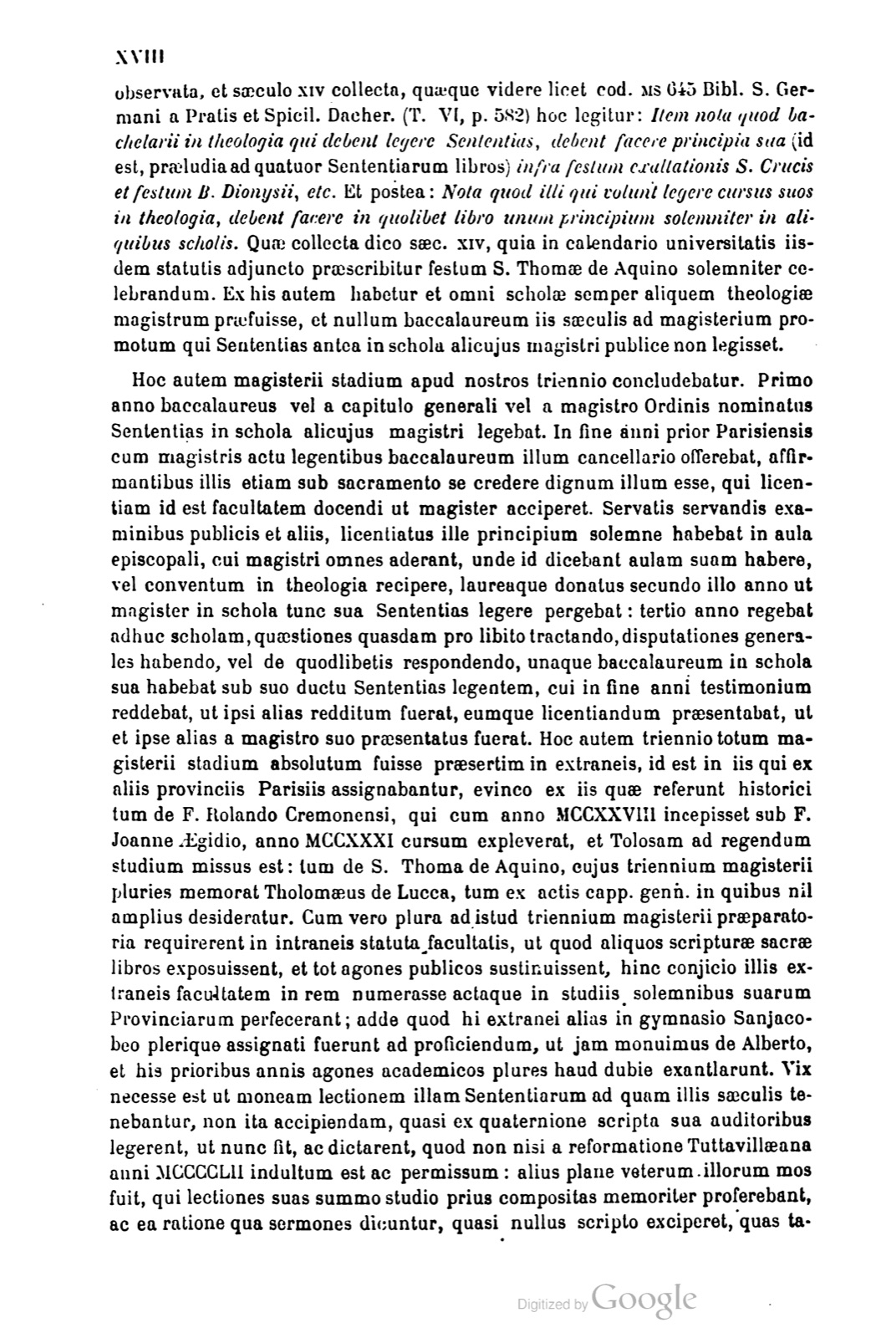
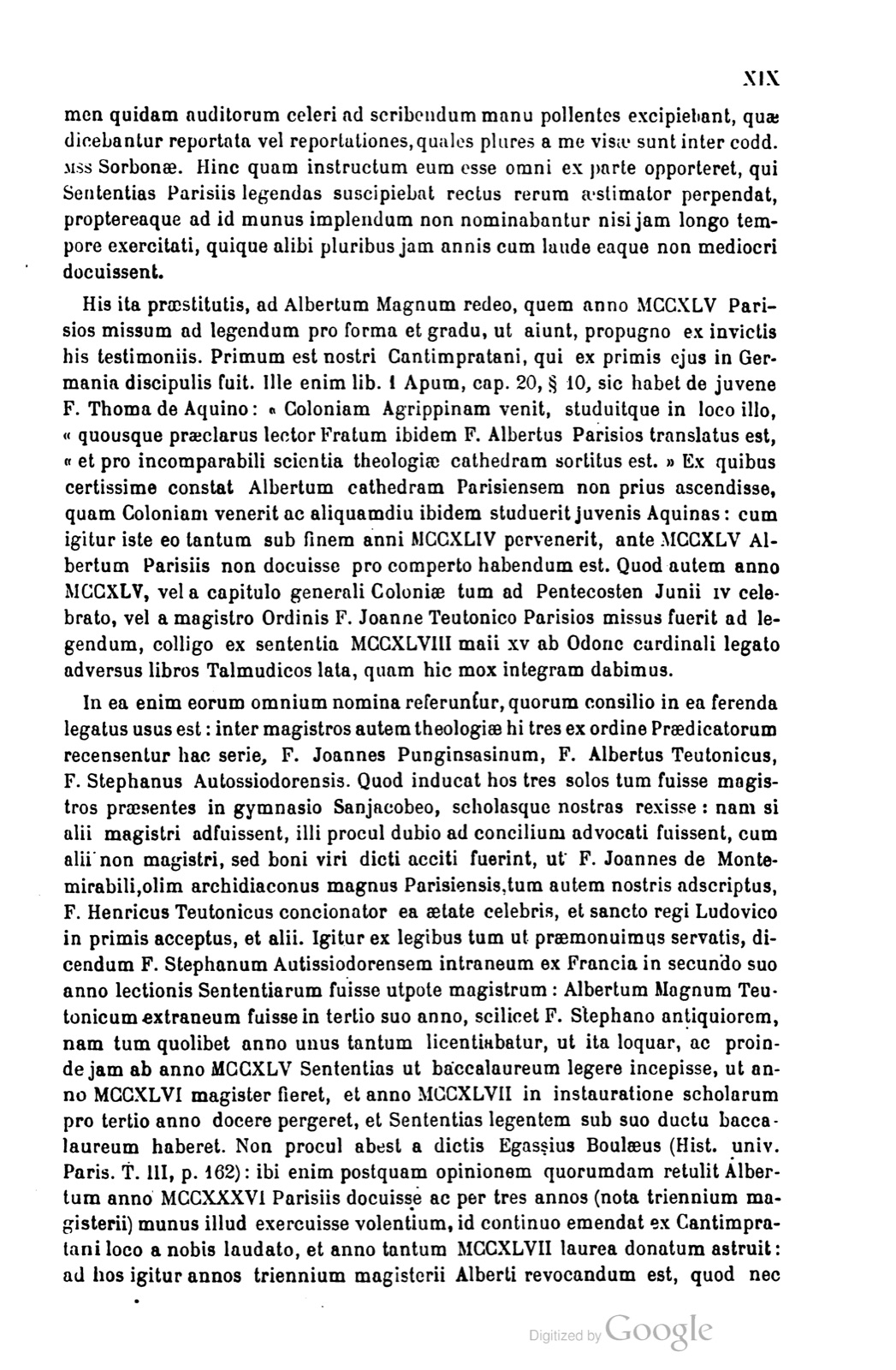
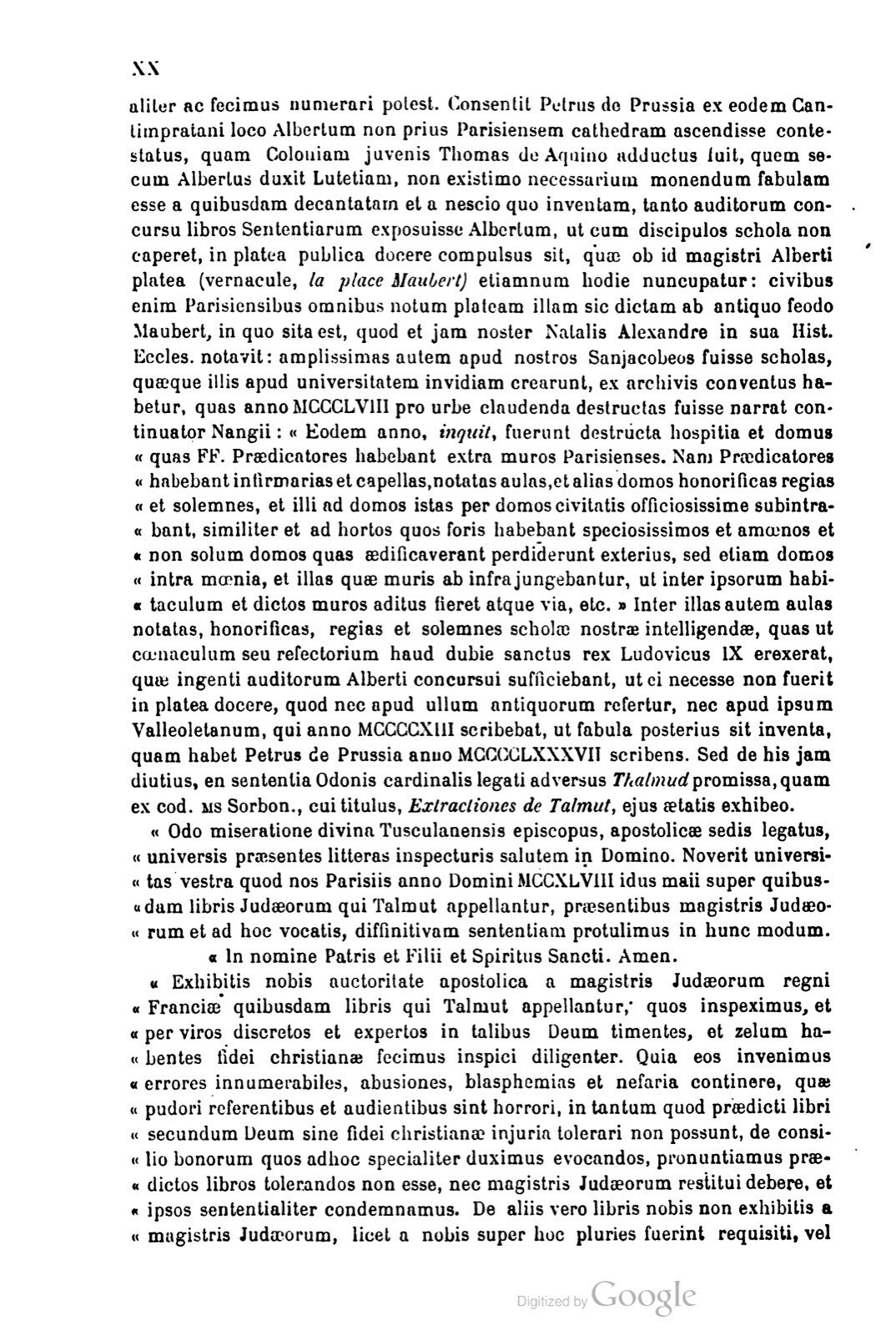
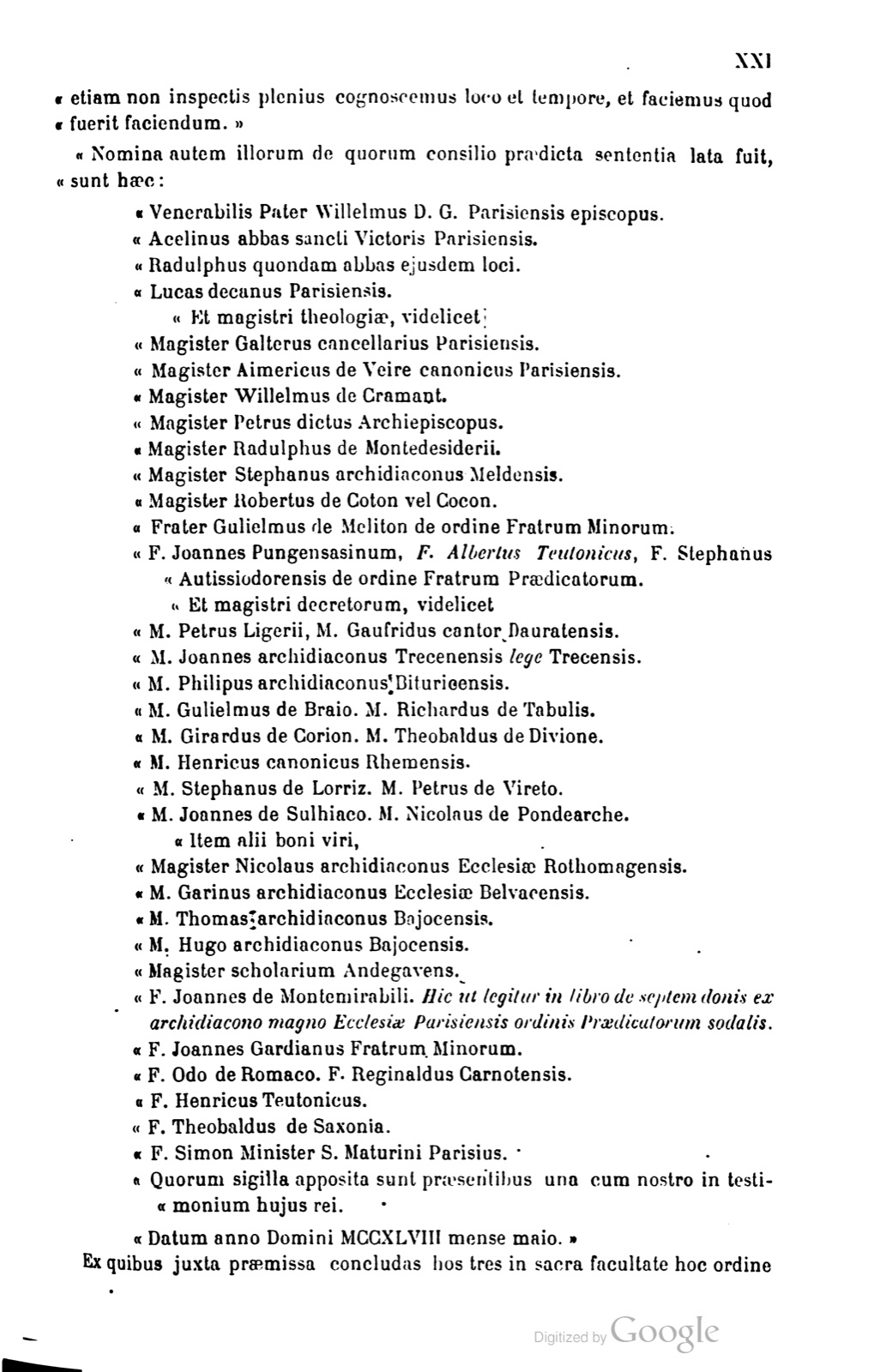
Nota 9. Anno MCCXLV Parisios missus est ad gradus promovendus. Quin Albertus inter magistros Parisienses cooptatus fuerit, dubitari nequit, cum de se ipse sic testetur (Mineral. lib. 2, tract. 3, cap. 1) post locum supra citatum: « Post hoc autem longo tempore cum essem Parisiis de numero doctorum et grege, contingit advenire ad studium filium regis Castellæ, cujus coqui cum pisces emerent prænominati nobilis famuli piscem emerunt, qui Latine Peccet, vulgariter Pleis vocabatur, et erat maximæ quantitatis in illo genere piscis: cum autem exentaretur piscis, in ventre ejus apparuit concha ostrei maximi, quam ad me memoratus nobilis fecit causa dilectionis adaptari: concha ergo illa in concavo sui, quod est planum et politum, habebat figuram trium serpentum ore elevato optime factorum, ita quod nec figura defuit oculorum, cum tamen essent valde parvi: exterius autem in convexo quod erat asperum, habebat multorum, decem videlicet et amplius serpentum simili modo per omnia opere factorum, nisi quod omnes exteriores nodo quodam in collo videbantur colligati, capitibus tamen et corporibus separatis: neque fuit ulla istarum imaginum, quæ non esset perforata foramine ab ore serpentis incipiente, et inferius ad caudam serpentis exeunte: et erat foramen ita parvum quod videbatur filo factum fuisse. Hanc autem concham ego multo tempore habui, et multis ostendi, et postea eam misi pro munere in Teutoniam cuidam. » Is princeps haud dubie ex filiis fuit Ferdinandi III regis Castellæ et Legionis, qui ab anno MCCXVII ad MCCLII regnavit. Si annus quo princeps ille Parisios advenit sciretur, et tempus certo sciretur quo Albertus magisterium sacræ facultatis Parisiensis capessivit. Jacobus seu Diegus de Castejon y Fonseca in sua Primatia Toletana (T. II, p. 557) narrat Joannem IV, aliis II, archiepiscopum Toletanum anno MCCXLV Lugdunum ad Synodum I generalem ab Innocentio IV celebratam venisse, ac ea finita Parisios usque excurrisse, ut regis Ferdinandi infantes duos Philippum et Sancium Ecclesiæ dictæ Toletanæ ambos canonicos in universitate Parisiensi studentes inviseret. Hæc autem omnino conveniunt tum cum narratione Alberti, tum cum iis quæ scimus de annis quibus magisterii tempus Parisiis Albertus perficiebat. Verum illud etiam aliunde expiscari licet, nempe ex sententia jam indicata Odonis cardinalis de Castro Radulphi adversus libros Talmudicos XV maii MCCXLVIII lata: sed duo prius statuenda paucis cognita et tamen scitu necessaria. Primum est ex quo universitati Parisiensi Ordo (scilicet Prædicatorum) aggregatus est, hanc legem inviolate in gymnasio Sanjacobeo fuisse observatam, ut baccalaurei et licenciati alternatim ex aliis provinciis et ex provincia Franciæ assumerentur: cum ex aliis provinciis extraneum, cum ex provincia Franciæ intraneum vocabant. Equidem F. Joannes Ægidius Anglus, qui jam sacræ theologiæ magister laureatus Ordinem amplexus est anno MCCXXVIII, primus docuit salvo jure et ex necessitate, nam scholæ theologicæ magistrum præesse necesse erat: sub eo autem F. Rolandus Cremonensis e provincia Lombardiæ primus baccalaureus et licenciatus fuit. Sub Rolando magisterii laurea donato F. Hugo de Sancto-Charo vel de Sancto Theudario e provincia Franciæ promotus est et Sententias legit, ac sic deinceps alternatim e provinciis externis, et e Francia. Sic cum ingentes illæ adversus nostros a Gulielmo de Sanctoamore excitatæ sunt commotiones, F. Bonushomo Brito e Francia primam, F. Elias Bruneti Petragoricensis e provincia Provinciæ secundam scholam nostram una regebant. Quæ alternatio ita constanter servata fuit, ut cum aliquando nempe anno MCCCXVI capitulum generale Monspeliense eam interrumpere tentasset, sub gravioribus pœnis jubens, ut non habita ratione alternativæ sed solius antiquitatis baccalaurei promoverentur, tantus exinde tumultus excitatus est ut in comitiis Ordinis sequentibus Pampilonæ MCCCXVII omnia in integrum restituere necesse fuerit. Sic enim in actus ejus capituli legitur: Item ordinamus quod in bachalariis Parisiensibus ordinarie præsentatis alternatio de intraneo (id est, de provincia Franciæ) et extraneo (id est, de aliis provinciis) inviolabiliter observetur secundum consuetudinem communiter in Ordine approbatam et hactenus observatam, et super hoc nulla alia licentia expectetur. Ubi quod ait, hactenus observatam, indicat ab initio viguisse ac usu inolevisse. Eæque sunt quæ tum in capp. genn. tum in magistrorum Ordinis diplomatibus duæ scholæ magnæ dicuntur, quibus ineunte sæc. XV duæ scholæ parvæ additæ sunt Franciæ speciatim addictæ, ac deinde etiam quinta, sed de duabus primis tantum hic agimus. Alterum maxime notandum est qua ratione nostri sæculo XIII et sequenti Parisiis ad magisterium promoverentur. Multi enim historici, cum videant posteriori hoc sæculo, ut quis sacræ theologiæ magister evadat, nihil amplius desiderari, quam ut agones quosdam scholasticos, seu actus ut vocant, certo quodam annorum spatio sustineat, quibus expletis rude donatur et laurea, etiam si nullam e cathedra lectionem vel dederit unquam vel daturus sit: ex his vero quosdam selectos ubi cathedram in gymnasio aliquo theologicam semel consecuti fuerint, ea ut beneficio quodam ad vitam potiri, et in eadem perpetuo si voluerint docere, res eodem modo se habuisse olim arbitrantur, cum maximum intersit discrimen. Sæculo itaque XIII statutum hoc erat in universitate Parisiensi, ne quis bachelarius in theologica facultate promoveretur ad cathedram (id est, ne magister fieret) nisi prius seipsum examinasset, saltem aliquot libros glossatos et Sententias in scholis alicujus magistri actu regentis diligenter legendo. Videsis Boulæum (Hist. Univ. T. III, p. 245) qui id refert renovatum anno MCCLI mense febr. cum alias inter doctores theologicos tractatum fuisset et concorditer inhibitum. Et inter statuta facultatis theologicæ ab antiquo observata, et sæculo XIV collecta, quæque videre licet cod. ms 645 Bibl. S. Germani a Pratis et Spicil. Dacher. (T. VI, p. 582) hoc legitur: Item nota quod bachelarü in theologia qui debent legere Sententias, debent facere principia sua (id est, præludia ad quatuor Sententiarum libros) infra festum exaltationis S. Crucis et festum B. Dionysii, etc. Et postea: Nota quod illi qui volunt legere cursus suos in theologia, debent facere in quolibet libro unum principium solemniter in aliquibus scholis. Quæ collecta dico sæc. XIV, quia in calendario universitatis iisdem statutis adjuncto præscribitur festum S. Thomæ de Aquino solemniter celebrandum. Ex his autem habetur et omni scholæ semper aliquem theologiæ magistrum præfuisse, et nullum baccalaureum iis sæculis ad magisterium promotum qui Sententias antea in schola alicujus magistri publice non legisset. Hoc autem magisterii stadium apud nostros triennio concludebatur. Primo anno baccalaureus vel a capitulo generali vel a magistro Ordinis nominatus Sententias in schola alicujus magistri legebat. In fine anni prior Parisiensis cum magistris actu legentibus baccalaureum illum cancellario offerebat, affirmantibus illis etiam sub sacramento se credere dignum illum esse, qui licentiam id est facultatem docendi ut magister acciperet. Servatis servandis examinibus publicis et aliis, licentiatus ille principium solemne habebat in aula episcopali, cui magistri omnes aderant, unde id dicebant aulam suam habere, vel conventum in theologia recipere, laureaque donatus secundo illo anno ut magister in schola tunc sua Sententias legere pergebat: tertio anno regebat adhuc scholam, quæstiones quasdam pro libito tractando, disputationes generales habendo, vel de quodlibetis respondendo, unaque baccalaureum in schola sua habebat sub suo ductu Sententias legentem, cui in fine anni testimonium reddebat, ut ipsi alias redditum fuerat, eumque licentiandum præsentabat, ut et ipse alias a magistro suo præsentatus fuerat. Hoc autem triennio totum magisterii stadium absolutum fuisse præsertim in extraneis, id est in iis qui ex aliis provinciis Parisiis assignabantur, evinco ex iis quæ referunt historici tum de F. Rolando Cremonensi, qui cum anno MCCXXVIII incepisset sub F. Joanne Ægidio, anno MCCXXXI cursum expleverat, et Tolosam ad regendum studium missus est: tum de S. Thoma de Aquino, cujus triennium magisterii pluries memorat Tholomæus de Lucca, tum ex actis capp. genn. in quibus nil amplius desideratur. Cum vero plura ad istud triennium magisterii præparatoria requirerent in intraneis statuta facultatis, ut quod aliquos scripturæ sacræ libros exposuissent, et tot agones publicos sustinuissent, hinc conjicio illis extraneis facultatem in rem numerasse actaque in studiis solemnibus suarum Provinciarum perfecerant; adde quod hi extranei alias in gymnasio Sanjacobeo plerique assignati fuerunt ad proficiendum, ut jam monuimus de Alberto, et his prioribus annis agones academicos plures haud dubie exantlarunt. Vix necesse est ut moneam lectionem illam Sententiarum ad quam illis sæculis tenebantur, non ita accipiendam, quasi ex quaternione scripta sua auditoribus legerent, ut nunc fit, ac dictarent, quod non nisi a reformatione Tuttavillæana anni MCCCCLII indultum est ac permissum: alius plane veterum illorum mos fuit, qui lectiones suas summo studio prius compositas memoriter proferebant, ac ea ratione qua sermones dicuntur, quasi nullus scripto exciperet, quas tamen quidam auditorum celeri ad scribendum manu pollentes excipiebant, quæ dicebantur reportata vel reportationes, quales plures a me visæ sunt inter codd. MSS Sorbonæ. Hinc quam instructum eum esse omni ex parte opporteret, qui Sententias Parisiis legendas suscipiebat rectus rerum æstimator perpendat, proptereaque ad id munus implendum non nominabantur nisi jam longo tempore exercitati, quique alibi pluribus jam annis cum laude eaque non mediocri docuissent. His ita præstitutis, ad Albertum Magnum redeo, quem anno MCCXLV Parisios missum ad legendum pro forma et gradu, ut aiunt, propugno ex invictis his testimoniis. Primum est nostri Cantimpratani, qui ex primis ejus in Germania discipulis fuit. Ille enim lib. 1 Apum, cap. 20, § 10, sic habet de juvene F. Thoma de Aquino: « Coloniam Agrippinam venit, studuitque in loco illo, quousque præclarus lector Fratum ibidem F. Albertus Parisios translatus est, et pro incomparabili scientia theologiæ cathedram sortitus est. » Ex quibus certissime constat Albertum cathedram Parisiensem non prius ascendisse, quam Coloniam venerit ac aliquamdiu ibidem studuerit juvenis Aquinas: cum igitur iste eo tantum sub finem anni MCCXLIV pervenerit, ante MCCXLV Albertum Parisiis non docuisse pro comperto habendum est. Quod autem anno MCCXLV, vel a capitulo generali Coloniæ tum ad Pentecosten Junii iv celebrato, vel a magistro Ordinis F. Joanne Teutonico Parisios missus fuerit ad legendum, colligo ex sententia MCCXLVIII maii xv ab Odone cardinali legato adversus libros Talmudicos lata, quam hic mox integram dabimus. In ea enim eorum omnium nomina referuntur, quorum consilio in ea ferenda legatus usus est: inter magistros autem theologiæ hi tres ex ordine Prædicatorum recensentur hac serie, F. Joannes Punginsasinum, F. Albertus Teutonicus, F. Stephanus Autossiodorensis. Quod inducat hos tres solos tum fuisse magistros præsentes in gymnasio Sanjacobeo, scholasque nostras rexisse: nam si alii magistri adfuissent, illi procul dubio ad concilium advocati fuissent, cum alii non magistri, sed boni viri dicti acciti fuerint, ut F. Joannes de Montemirabili, olim archidiaconus magnus Parisiensis, tum autem nostris adscriptus, F. Henricus Teutonicus concionator ea ætate celebris, et sancto regi Ludovico in primis acceptus, et alii. Igitur ex legibus tum ut præmonuimus servatis, dicendum F. Stephanum Autissiodorensem intraneum ex Francia in secundo suo anno lectionis Sententiarum fuisse utpote magistrum: Albertum Magnum Teutonicum extraneum fuisse in tertio suo anno, scilicet F. Stephano antiquiorem, nam tum quolibet anno unus tantum licentiabatur, ut ita loquar, ac proinde jam ab anno MCCXLV Sententias ut baccalaureum legere incepisse, ut anno MCCXLVI magister fieret, et anno MCCXLVII in instauratione scholarum pro tertio anno docere pergeret, et Sententias legentem sub suo ductu baccalaureum haberet. Non procul abest a dictis Egassius Boulæus (Hist. univ. Paris. T. III, p. 162): ibi enim postquam opinionem quorumdam retulit Albertum anno MCCXXXVI Parisiis docuisse ac per tres annos (nota triennium magisterii) munus illud exercuisse volentium, id continuo emendat ex Cantimpratani loco a nobis laudato, et anno tantum MCCXLVII laurea donatum astruit: ad hos igitur annos triennium magisterii Alberti revocandum est, quod nec aliter ac fecimus numerari potest. Consentit Petrus de Prussia ex eodem Cantimpratani loco Albertum non prius Parisiensem cathedram ascendisse contestatus, quam Coloniam juvenis Thomas de Aquino adductus fuit, quem secum Albertus duxit Lutetiam, non existimo necessarium monendum fabulam esse a quibusdam decantatam et a nescio quo inventam, tanto auditorum concursu libros Sententiarum exposuisse Albertum, ut cum discipulos schola non caperet, in platea publica docere compulsus sit, quæ ob id magistri Alberti platea (vernacule, la place Maubert) etiamnum hodie nuncupatur: civibus enim Parisiensibus omnibus notum plateam illam sic dictam ab antiquo feodo Maubert, in quo sita est, quod et jam noster Natalis Alexandre in sua Hist. Eccles. notavit: amplissimas autem apud nostros Sanjacobeos fuisse scholas, quæque illis apud universitatem invidiam crearunt, ex archivis conventus habetur, quas anno MCCCLVIII pro urbe claudenda destructas fuisse narrat continuator Nangii: « Eodem anno, inquit, fuerunt destructa hospitia et domus quas FF. Prædicatores habebant extra muros Parisienses. Nam Prædicatores habebant infirmarias et capellas, notatas aulas, et alias domos honorificas regias et solemnes, et illi ad domos istas per domos civitatis officiosissime subintrabant, similiter et ad hortos quos foris habebant speciosissimos et amœnos et non solum domos quas ædificaverant perdiderunt exterius, sed etiam domos intra mœnia, et illas quæ muris ab infra jungebantur, ut inter ipsorum habitaculum et dictos muros aditus fieret atque via, etc. » Inter illas autem aulas notatas, honorificas, regias et solemnes scholæ nostræ intelligendæ, quas ut cœnaculum seu refectorium haud dubie sanctus rex Ludovicus IX erexerat, quæ ingenti auditorum Alberti concursui sufficiebant, ut ei necesse non fuerit in platea docere, quod nec apud ullum antiquorum refertur, nec apud ipsum Valleoletanum, qui anno MCCCCXIII scribebat, ut fabula posterius sit inventa, quam habet Petrus de Prussia anno MCCCCLXXXVII scribens. Sed de his jam diutius, en sententia Odonis cardinalis legati adversus Thalmud promissa, quam ex cod. ms Sorbon., cui titulus, Extractiones de Talmut, ejus ætatis exhibeo. « Odo miseratione divina Tusculanensis episcopus, apostolicæ sedis legatus, universis præsentes litteras inspecturis salutem in Domino. Noverit universitas vestra quod nos Parisiis anno Domini MCCXLVIII idus maii super quibusdam libris Judæorum qui Talmut appellantur, præsentibus magistris Judæorum et ad hoc vocatis, diffinitivam sententiam protulimus in hunc modum. In nomine Patris et Filii et Spiritus Sancti. Amen. Exhibitis nobis auctoritate apostolica a magistris Judæorum regni Franciæ quibusdam libris qui Talmut appellantur, quos inspeximus, et per viros discretos et expertos in talibus Deum timentes, et zelum habentes fidei christianæ fecimus inspici diligenter. Quia eos invenimus errores innumerabiles, abusiones, blasphemias et nefaria continere, quæ pudori referentibus et audientibus sint horrori, in tantum quod prædicti libri secundum Deum sine fidei christianæ injuria tolerari non possunt, de consilio bonorum quos ad hoc specialiter duximus evocandos, pronuntiamus prædictos libros tolerandos non esse, nec magistris Judæorum restitui debere, et ipsos sententialiter condemnamus. De aliis vero libris nobis non exhibitis a magistris Judæorum, licet a nobis super hoc pluries fuerint requisiti, vel etiam non inspectis plenius cognoscemus loco et tempore, et faciemus quod fuerit faciendum. » « Nomina autem illorum de quorum consilio prædicta sententia lata fuit, sunt hæc: Venerabilis Pater Willelmus D. G. Parisiensis episcopus. Acelinus abbas sancti Victoris Parisiensis. Radulphus quondam abbas ejusdem loci. Lucas decanus Parisiensis. Et magistri theologiæ, videlicet: Magister Galterus cancellarius Parisiensis. Magister Aimericus de Veire canonicus Parisiensis. Magister Willelmus de Cramant. Magister Petrus dictus Archiepiscopus. Magister Radulphus de Montedesiderii. Magister Stephanus archidiaconus Meldensis. Magister Robertus de Coton vel Cocon. Frater Gulielmus de Meliton de ordine Fratrum Minorum. F. Joannes Pungensasinum, F. Albertus Teutonicus, F. Stephanus Autissiodorensis de ordine Fratrum Prædicatorum. Et magistri decretorum, videlicet: M. Petrus Ligerii, M. Gaufridus cantor Dauratensis. M. Joannes archidiaconus Trecenensis lege Trecensis. M. Philipus archidiaconus Bituricensis. M. Gulielmus de Braio. M. Richardus de Tabulis. M. Girardus de Corion. M. Theobaldus de Divione. M. Henricus canonicus Rhemensis. M. Stephanus de Lorriz. M. Petrus de Vireto. M. Joannes de Sulhiaco. M. Nicolaus de Pondearche. Item alii boni viri, Magister Nicolaus archidiaconus Ecclesiæ Rothomagensis. M. Garinus archidiaconus Ecclesiæ Belvacensis. M. Thomas archidiaconus Bajocensis. M. Hugo archidiaconus Bajocensis. Magister scholarium Andegavens. F. Joannes de Montemirabili. Hic ut legitur in libro de septem donis ex archidiacono magno Ecclesiæ Parisiensis ordinis Prædicatorum sodalis. F. Joannes Gardianus Fratrum Minorum. F. Odo de Romaco. F. Reginaldus Carnotensis. F. Henricus Teutonicus. F. Theobaldus de Saxonia. F. Simon Minister S. Maturini Parisius. Quorum sigilla apposita sunt præsentibus una cum nostro in testimonium hujus rei. Datum anno Domini MCCXLVIII mense maio. » Ex quibus juxta præmissa concludas hos tres in sacra facultate hoc ordine incepisse, F. Joannem Pungensasinum Parisinum anno MCCXLIV, F. Albertum Teutonicum MCCXLV et F. Stephanum Autissiodorensem MCCXLVI; sic enim omnia constant et conveniunt.
Marginal label: Note 9. In the year 1245 he was sent to Paris to be advanced to degrees. That Albert was enrolled among the Parisian masters cannot be doubted, since he himself bears witness concerning himself thus (On Minerals, book 2, tractate 3, chapter 1) after the place cited above: "But after this, a long time later, when I was at Paris from the number and company of the doctors, it happened that the son of the king of Castile came to the study. When the cooks of the aforementioned noble's servant were buying fish, they bought a fish which in Latin was called Peccet, in the vernacular Pleis, and it was of very great quantity in that kind of fish. But when the fish was gutted, in its belly there appeared the shell of a very large oyster, which the remembered noble, because of affection, caused to be adapted to me. Therefore that shell, in its hollow, which is flat and polished, had the figure of three serpents with lifted mouth, very well made, so that not even the figure of the eyes was lacking, although they were very small. But exteriorly, in the convex part which was rough, it had the figures of many, namely ten and more, serpents made in all things by similar workmanship, except that all the exterior ones seemed to be tied by a certain knot at the neck, while their heads and bodies were nevertheless separated; nor was there any one of those images which was not perforated by a hole beginning from the mouth of the serpent and going out below at the tail of the serpent; and the hole was so small that it seemed to have been made by a thread. This shell I had for a long time, and showed it to many, and afterward I sent it as a gift to someone in Teutonia." That prince without doubt was one of the sons of Ferdinand III, king of Castile and León, who reigned from the year 1217 to 1252. If the year in which that prince came to Paris were known, the time would also be known certainly in which Albert took up the mastership of the Parisian sacred faculty. James or Diego de Castejon y Fonseca, in his Primacy of Toledo (volume II, page 557), narrates that John IV, according to others II, Archbishop of Toledo, came in the year 1245 to Lyons for the First General Synod celebrated by Innocent IV, and, when it was finished, hastened as far as Paris in order to visit the two infantes of King Ferdinand, Philip and Sancho, both canons of the said Church of Toledo, studying in the University of Paris. These things, moreover, agree entirely both with Albert's narration and with those things which we know about the years in which Albert was completing the time of mastership at Paris. But that matter can also be fished out from elsewhere, namely from the sentence already indicated of Odo, cardinal of Châteauroux, against the Talmudic books, rendered on 15 May 1248; but two things first must be established, known to few and yet necessary to know. The first is that, from the time when the Order, that is, of Preachers, was joined to the University of Paris, this law was observed inviolate in the gymnasium of Saint-Jacques, that bachelors and licentiates should be assumed alternately from other provinces and from the province of France; when from other provinces, they called him external, when from the province of France, internal. Indeed Brother John Ægidius the Englishman, who had already embraced the Order as a laureled master of sacred theology in the year 1228, first taught with his right preserved and from necessity, for it was necessary that a master preside over the theological school; but under him Brother Roland of Cremona from the province of Lombardy was the first bachelor and licentiate. Under Roland, after he had been given the laurel of mastership, Brother Hugh of Saint-Cher or of Saint-Theudary from the province of France was promoted and read the Sentences, and so thereafter alternately from the external provinces and from France. Thus when those great disturbances were stirred up against our men by William of Saint-Amour, Brother Bonhomme the Breton from France ruled the first of our schools, and Brother Elias Bruneti of Périgord from the province of Provence ruled the second, together. This alternation was so constantly preserved that when at some time, namely in the year 1316, the general chapter of Montpellier tried to interrupt it, commanding under the graver penalties that bachelors should be promoted without regard for the alternation but only for antiquity, so great a tumult was stirred up from this that in the following assemblies of the Order at Pamplona in 1317 it was necessary to restore all things to their original state. For thus it is read in the acts of that chapter: Likewise we ordain that, in the Parisian bachelors ordinarily presented, the alternation of internal, that is, from the province of France, and external, that is, from the other provinces, be inviolably observed according to the custom commonly approved in the Order and observed up to this point, and that no other license be awaited concerning this. Where what it says, observed up to this point, indicates that it had flourished from the beginning and had grown established by use. And these are the things which, both in the general chapters and in the diplomas of the masters of the Order, are called the two great schools; to these, at the beginning of the fifteenth century, two small schools were added, specially assigned to France, and afterward also a fifth, but here we are dealing only with the first two. The other thing especially to be noted is by what method our men in the thirteenth century and the following century were promoted at Paris to the mastership. For many historians, since they see in this later century that, for someone to become a master of sacred theology, nothing more is desired than that he sustain certain scholastic contests, or acts as they call them, over a certain space of years, and when these have been completed he is presented with the rod and the laurel, even if he has never given and is never going to give any lecture from the chair; and since they see that certain selected men from these, once they have obtained a theological chair in some school, possess it as a certain benefice for life and teach in it perpetually if they wish, think that matters once had themselves in the same way, although there is the greatest difference. Therefore in the thirteenth century this was established in the University of Paris: that no bachelor in the theological faculty should be promoted to a chair, that is, should become a master, unless first he had examined himself, at least by diligently reading some glossed books and the Sentences in the schools of some master actually regent. See Boulæus (History of the University, volume III, page 245), who reports that this was renewed in the month of February 1251, when it had at another time been treated among the theological doctors and harmoniously prohibited. And among the statutes of the theological faculty observed from antiquity and collected in the fourteenth century, which may be seen in manuscript codex 645 of the Library of Saint-Germain-des-Prés and in D'Achery's Spicilegium (volume VI, page 582), this is read: Likewise note that bachelors in theology who must read the Sentences ought to make their beginnings, that is, preludes to the four books of the Sentences, between the feast of the Exaltation of the Holy Cross and the feast of Blessed Dionysius, etc. And afterward: Note that those who wish to read their courses in theology ought to make in each book one beginning solemnly in some schools. I say that these were collected in the fourteenth century, because in the calendar of the university joined to the same statutes the feast of St. Thomas of Aquino is prescribed to be solemnly celebrated. But from these things it is held both that some master of theology always presided over every school, and that no bachelor in those centuries was promoted to the mastership who had not earlier read the Sentences publicly in the school of some master. Among our men, however, this course of mastership was concluded in three years. In the first year the bachelor, named either by the general chapter or by the master of the Order, read the Sentences in the school of some master. At the end of the year the Parisian prior with the masters actually reading offered that bachelor to the chancellor, those masters affirming, even under oath, that they believed him worthy to receive the license, that is, the faculty of teaching as master. When the public examinations and the other things that were to be observed had been observed, that licentiate held a solemn beginning in the episcopal hall, at which all the masters were present; whence they said that he had his hall, or received the assembly in theology, and, after being given the laurel, in that second year as master he continued reading the Sentences in what was then his school. In the third year he still ruled the school, treating certain questions as he pleased, holding general disputations, or responding on quodlibets, and at the same time he had in his school under his guidance a bachelor reading the Sentences, to whom at the end of the year he gave testimony, as it had formerly been given to him, and presented him to be licensed, just as he himself had formerly been presented by his own master. That the whole course of mastership was completed in this three-year period, especially among the externals, that is, in those who were assigned at Paris from other provinces, I prove from the things which historians report, both concerning Brother Roland of Cremona, who, when he had begun under Brother John Ægidius in the year 1228, had completed the course in the year 1231 and was sent to Toulouse to rule the study; and concerning St. Thomas of Aquino, whose three-year mastership Ptolemy of Lucca mentions several times; and from the acts of the general chapters, in which nothing more is required. But since the statutes of the faculty required more preparatory things for that three-year mastership in the internal men, such as that they had expounded some books of sacred Scripture and had sustained so many public contests, hence I conjecture that for those externals the faculty counted toward the matter the acts which they had completed in the solemn studies of their Provinces. Add that those externals had generally been assigned at another time in the gymnasium of Saint-Jacques for advancement, as we have already mentioned concerning Albert, and in these earlier years they without doubt endured many academic contests. It is scarcely necessary that I warn that that reading of the Sentences to which they were bound in those centuries is not to be taken as though they read to their hearers their own writings from a quire, as is now done, and dictated them, which was granted and permitted only from the Tuttavillæan reform of the year 1452. The custom of those ancients was plainly another: they delivered from memory their lectures, first composed with the greatest study, and in that manner in which sermons are said, as though no one took them down in writing; yet certain hearers, strong with a hand swift for writing, took down the things that were said, which were called reportata or reportationes, several of which I have seen among the manuscript codices of the Sorbonne. Hence let the upright appraiser of matters weigh how instructed in every part he had to be who undertook to read the Sentences at Paris; and for that reason no men were nominated to fulfill that office unless they had already been exercised for a long time and had elsewhere taught for several years already with praise, and that not mediocre. Having set these things down beforehand, I return to Albert the Great, whom I maintain, from these unconquered testimonies, to have been sent to Paris in the year 1245 to read for form and degree, as they say. The first testimony is that of our Cantimpratanus, who was among his first disciples in Germany. For he, in book 1 of Bees, chapter 20, section 10, speaks thus about the young Brother Thomas of Aquino: "He came to Cologne Agrippina and studied in that place until the illustrious lector of the Friars there, Brother Albert, was transferred to Paris and, on account of his incomparable knowledge of theology, obtained the chair." From these things it is most certainly established that Albert did not ascend the Parisian chair before the young Aquinas came to Cologne and studied there for some time; therefore, since he reached that place only toward the end of the year 1244, it must be held as known that Albert did not teach at Paris before 1245. But that in the year 1245 he was sent to Paris to read, either by the general chapter then celebrated at Cologne on the fourth of June at Pentecost, or by the master of the Order, Brother John the Teuton, I gather from the sentence rendered on 15 May 1248 by Odo the cardinal legate against the Talmudic books, which we shall soon give here entire. For in that sentence the names of all those are reported whose counsel the legate used in rendering it; and among the masters of theology these three from the Order of Preachers are reviewed in this sequence: Brother John Punginsasinum, Brother Albert the Teuton, Brother Stephen of Auxerre. This indicates that these three alone were then masters present in the gymnasium of Saint-Jacques and ruled our schools; for if other masters had been present, they without doubt would have been summoned to the council, since others were summoned who were not masters but were called good men, such as Brother John of Montmirail, formerly the great archdeacon of Paris and then enrolled among our men, Brother Henry the Teuton, a preacher celebrated at that age and especially pleasing to the holy king Louis, and others. Therefore, from the laws then observed as we have warned beforehand, it must be said that Brother Stephen of Auxerre, an internal from France, was in his second year of reading the Sentences, as being a master; that Albert the Great, the Teuton, an external, was in his third year, namely older than Brother Stephen, for then only one was licensed each year, so to speak; and consequently that already from the year 1245 he had begun to read the Sentences as a bachelor, so that in the year 1246 he became master, and in the year 1247 he continued to teach in the restoration of the schools for the third year, and had under his guidance a bachelor reading the Sentences. Egasse Boulæus is not far from the things said (History of the University of Paris, volume III, page 162); for there, after he reported the opinion of certain men who wished that Albert had taught at Paris in the year 1236 and had exercised that office for three years, note the three-year mastership, he immediately corrects it from the place of Cantimpratanus praised by us, and asserts that he was given the laurel only in the year 1247. Therefore the three-year mastership of Albert must be recalled to these years, and it cannot be numbered otherwise than as we have done. Peter of Prussia agrees, having testified from the same place of Cantimpratanus that Albert did not ascend the Parisian chair before the young Thomas of Aquino was brought to Cologne, whom Albert led with himself to Paris. I do not think it necessary to warn that it is a fable chanted by certain men and invented by I know not whom that Albert expounded the books of the Sentences with so great a gathering of hearers that, since the school did not hold the disciples, he was compelled to teach in the public square, which for this reason is even now today called the square of Master Albert, in the vernacular, la place Maubert. For it is known to all Parisian citizens that that square is so named from the ancient fief Maubert in which it is situated, which also our Natalis Alexandre already noted in his Church History. Moreover, that there were very spacious schools among our Saint-Jacques brethren, and schools which created envy toward them at the university, is held from the archives of the convent; the continuator of Nangis narrates that these were destroyed in the year 1358 for closing the city: "In the same year," he says, "there were destroyed the lodgings and houses which the Friars Preachers had outside the walls of Paris. For the Preachers had infirmaries and chapels, noted halls, and other honorable, royal, and solemn houses; and they very dutifully entered those houses through the houses of the city, and likewise to the gardens which they had outside, most beautiful and pleasant; and they lost not only the houses which they had built outside, but also houses within the walls, and those which were joined from within to the walls, so that between their dwelling and the said walls there might be an approach and a road, etc." Among those noted, honorable, royal, and solemn halls our schools must be understood, which without doubt the holy king Louis IX had erected as a dining room or refectory, and which sufficed for the huge crowd of Albert's hearers, so that it was not necessary for him to teach in the square; this is reported neither by any of the ancients nor by the Vallisoletan himself, who was writing in the year 1413, so that the fable was invented later than he, and Peter of Prussia has it when writing in the year 1487. But enough now about these things; behold the promised sentence of Odo the cardinal legate against the Talmud, which I present from the manuscript codex of the Sorbonne, whose title is Extractions from the Talmud, of that age. "Odo, by divine mercy bishop of Tusculum, legate of the Apostolic See, to all who shall inspect the present letters, greeting in the Lord. Let your whole body know that we at Paris, in the year of the Lord 1248, on the Ides of May, concerning certain books of the Jews which are called Talmud, with the masters of the Jews present and called for this, brought forth a definitive sentence in this manner. In the name of the Father and of the Son and of the Holy Spirit. Amen. Certain books which are called Talmud having been exhibited to us by apostolic authority by the masters of the Jews of the kingdom of France, which we inspected, and which we caused to be diligently inspected by discreet men experienced in such matters, fearing God and having zeal for the Christian faith: because we found them to contain innumerable errors, abuses, blasphemies, and wicked things, which should be a shame to those reporting them and a horror to those hearing them, to such an extent that the aforesaid books cannot, according to God, be tolerated without injury to the Christian faith, by the counsel of good men whom we judged should be specially summoned for this, we pronounce that the aforesaid books are not to be tolerated, nor ought they to be restored to the masters of the Jews, and we condemn them by sentence. But concerning the other books not exhibited to us by the masters of the Jews, although they were requested by us several times concerning this, or also not inspected, we shall know more fully in place and time, and we shall do what will have to be done." "The names of those by whose counsel the aforesaid sentence was rendered are these: The venerable father William, by the grace of God bishop of Paris. Acelinus, abbot of Saint-Victor of Paris. Radulphus, former abbot of the same place. Lucas, dean of Paris. And the masters of theology, namely: Master Walter, chancellor of Paris. Master Aimeric of Veire, canon of Paris. Master William of Cramant. Master Peter called Archbishop. Master Radulphus of Montdésir. Master Stephen, archdeacon of Meaux. Master Robert of Coton or Cocon. Brother William of Meliton, of the Order of Friars Minor. Brother John Pungensasinum, Brother Albert the Teuton, Brother Stephen of Auxerre, of the Order of Friars Preachers. And the masters of decrees, namely: Master Peter Ligerii, Master Geoffrey, cantor of Daurat. Master John, archdeacon of Trecenensis, read Trecensis. Master Philip, archdeacon of Bourges. Master William of Bray. Master Richard of Tabulis. Master Girard of Corion. Master Theobald of Dijon. Master Henry, canon of Reims. Master Stephen of Lorris. Master Peter of Viret. Master John of Sulhiac. Master Nicholas of Pondearche. Likewise other good men: Master Nicholas, archdeacon of the Church of Rouen. Master Garin, archdeacon of the Church of Beauvais. Master Thomas, archdeacon of Bayeux. Master Hugh, archdeacon of Bayeux. Master of the schools of Angers. Brother John of Montmirail. This man, as is read in the book On the Seven Gifts, from being great archdeacon of the Church of Paris became a companion of the Order of Preachers. Brother John, guardian of the Friars Minor. Brother Odo of Romaco. Brother Reginald of Chartres. Brother Henry the Teuton. Brother Theobald of Saxony. Brother Simon, minister of Saint-Mathurin at Paris. Their seals are attached to the presents together with ours in testimony of this matter. Given in the year of the Lord 1248 in the month of May." From these things, according to what has been premised, you may conclude that these three began in the sacred faculty in this order: Brother John Pungensasinum the Parisian in the year 1244, Brother Albert the Teuton in 1245, and Brother Stephen of Auxerre in 1246; for thus all things are established and agree.
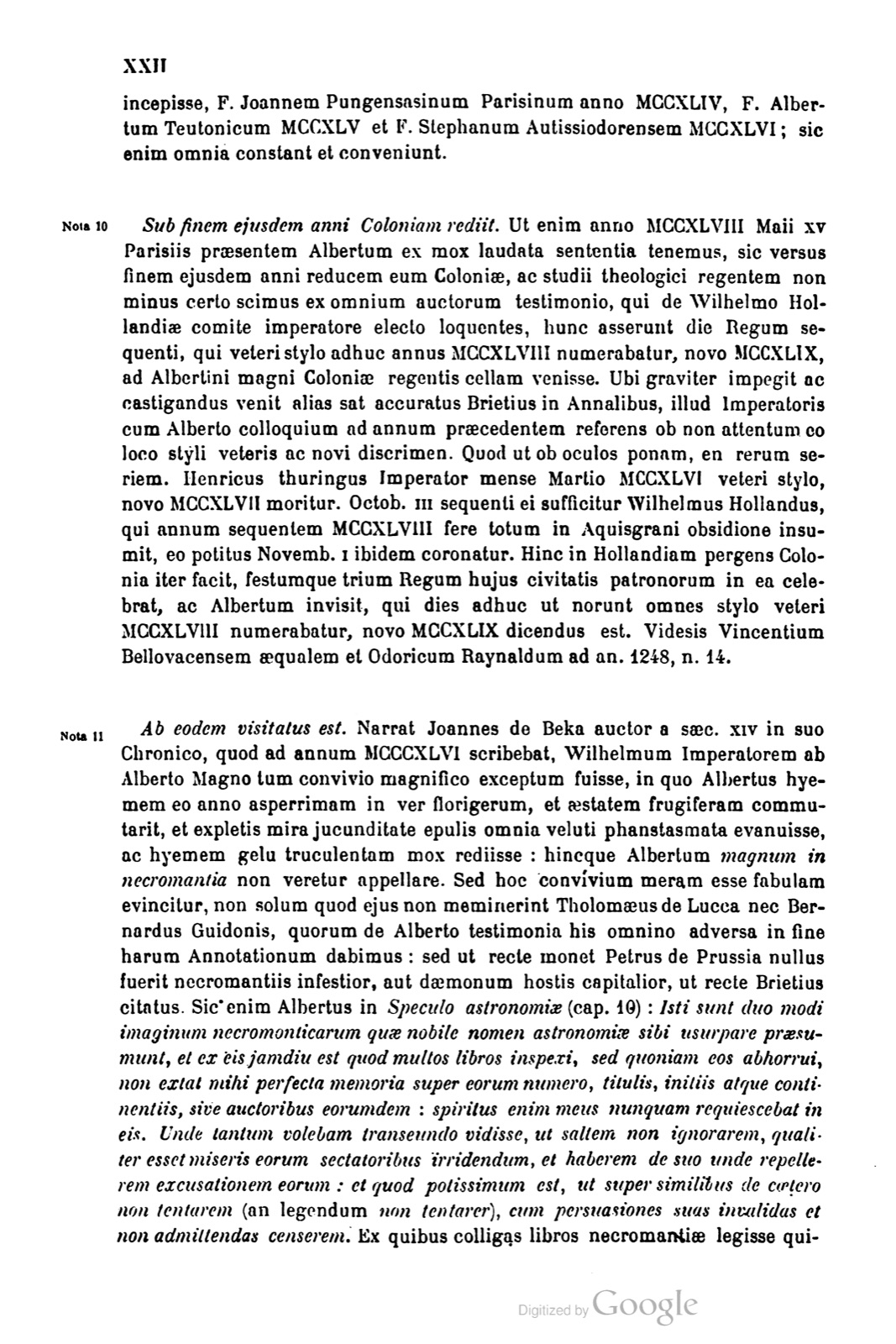
Nota 10. Sub finem ejusdem anni Coloniam rediit. Ut enim anno MCCXLVIII Maii xv Parisiis præsentem Albertum ex mox laudata sententia tenemus, sic versus finem ejusdem anni reducem eum Coloniæ, ac studii theologici regentem non minus certo scimus ex omnium auctorum testimonio, qui de Wilhelmo Hollandiæ comite imperatore electo loquentes, hunc asserunt die Regum sequenti, qui veteri stylo adhuc annus MCCXLVIII numerabatur, novo MCCXLIX, ad Albertini magni Coloniæ regentis cellam venisse. Ubi graviter impegit ac castigandus venit alias sat accuratus Brietius in Annalibus, illud Imperatoris cum Alberto colloquium ad annum præcedentem referens ob non attentum eo loco styli veteris ac novi discrimen. Quod ut ob oculos ponam, en rerum seriem. Henricus Thuringus Imperator mense Martio MCCXLVI veteri stylo, novo MCCXLVII moritur. Octob. III sequenti ei sufficitur Wilhelmus Hollandus, qui annum sequentem MCCXLVIII fere totum in Aquisgrani obsidione insumit, eo potitus Novemb. I ibidem coronatur. Hinc in Hollandiam pergens Colonia iter facit, festumque trium Regum hujus civitatis patronorum in ea celebrat, ac Albertum invisit, qui dies adhuc ut norunt omnes stylo veteri MCCXLVIII numerabatur, novo MCCXLIX dicendus est. Videsis Vincentium Bellovacensem æqualem et Odoricum Raynaldum ad an. 1248, n. 14.
Marginal label: Note 10. Toward the end of the same year he returned to Cologne. For as, from the sentence just praised, we hold Albert present at Paris on 15 May 1248, so toward the end of the same year we know no less certainly, from the testimony of all authors who speak of William, count of Holland, emperor-elect, that he had returned to Cologne and was regent of the theological study. They assert that this William, on the following Day of the Kings, which by the old style was still numbered as the year 1248, by the new as 1249, came to the cell of Albert the Great, regent at Cologne. Here Brietius, otherwise sufficiently accurate in the Annals, gravely stumbled and comes to be corrected, referring that conversation of the Emperor with Albert to the preceding year because he did not attend in that place to the distinction of the old and new style. To set this before the eyes, behold the sequence of events. Henry the Thuringian Emperor dies in the month of March 1246 by the old style, 1247 by the new. On the following third of October, William of Holland is substituted for him; he spends almost the whole following year, 1248, in the siege of Aachen, and, having obtained it, is crowned there on 1 November. Hence, going into Holland, he makes his journey through Cologne, celebrates there the feast of the Three Kings, patrons of this city, and visits Albert. That day, as all know, was still numbered 1248 by the old style; by the new it must be called 1249. See Vincent of Beauvais, a contemporary, and Odoricus Raynaldus at the year 1248, number 14.
Nota 11. Ab eodem visitatus est. Narrat Joannes de Beka auctor a sec. XIV in suo Chronico, quod ad annum MCCCXLVI scribebat, Wilhelmum Imperatorem ab Alberto Magno tum convivio magnifico exceptum fuisse, in quo Albertus hyemem eo anno asperrimam in ver florigerum, et æstatem frugiferam commutarit, et expletis mira jucunditate epulis omnia veluti phantasmata evanuisse, ac hyemem gelu truculentam mox rediisse: hincque Albertum magnum in necromantia non veretur appellare. Sed hoc convivium meram esse fabulam evincitur, non solum quod ejus non meminerint Tholomæus de Lucca nec Bernardus Guidonis, quorum de Alberto testimonia his omnino adversa in fine harum Annotationum dabimus: sed ut recte monet Petrus de Prussia nullus fuerit necromantiis infestior, aut dæmonum hostis capitalior, ut recte Brietius citatus. Sic enim Albertus in Speculo astronomiæ (cap. 10): Isti sunt duo modi imaginum necromanticarum quæ nobile nomen astronomiæ sibi usurpare præsumunt, et ex eis jamdiu est quod multos libros inspexi, sed quoniam eos abhorrui, non extat mihi perfecta memoria super eorum numero, titulis, initiis atque continentiis, sive auctoribus eorumdem: spiritus enim meus nunquam requiescebat in eis. Unde tantum volebam transeundo vidisse, ut saltem non ignorarem, qualiter esset miseris eorum sectatoribus irridendum, et haberem de suo unde repellerem excusationem eorum: et quod potissimum est, ut super similibus de cætero non tentarem (an legendum non tentarer), cum persuasiones suas invalidas et non admittendas censerem. Ex quibus colligas libros necromantiæ legisse quidem
Marginal label: Note 11. He was visited by the same man. John of Beka, an author from the fourteenth century, narrates in his Chronicle, which he was writing up to the year 1346, that the Emperor William was then received by Albert the Great with a magnificent banquet, in which Albert changed the very harsh winter in that year into a flowery spring and fruitful summer, and that, when the dishes had been completed with wonderful delight, all things vanished as if phantasms, and the winter savage with frost soon returned; and hence he does not fear to call Albert great in necromancy. But that this banquet is a mere fable is proved, not only because Ptolemy of Lucca and Bernard Gui do not remember it, whose testimonies concerning Albert, entirely contrary to these, we shall give at the end of these Annotations, but also because, as Peter of Prussia rightly warns, no one was more hostile to necromancies or a more capital enemy of demons, as the cited Brietius rightly says. For thus Albert says in the Speculum of Astronomy, chapter 10: These are two modes of necromantic images which presume to usurp for themselves the noble name of astronomy, and concerning them it has long been the case that I inspected many books; but because I abhorred them, there does not exist for me a perfect memory concerning their number, titles, beginnings and contents, or their authors: for my spirit never rested in them. Hence I wished only to have seen them in passing, so that at least I would not be ignorant in what way their wretched followers were to be mocked, and so that I would have something from their own material by which I might repel their excuse; and, what is most important, so that concerning similar things hereafter I might not be tempted (or should it be read: might not be tested), since I judged their persuasions invalid and not to be admitted. From these things you may gather that he read books of necromancy indeed
If a page does not appear, its photograph has not been uploaded yet.